REVIEW 3 major objections 5 minor 59 references
Observation of metastable chiral domain walls in a topological magnet
T0 review · 3 major / 5 minor · reviewed 2026-08-10 · deepseek-v4-flash
Pith's one-line read Resonant pump-probe measurements in twisted MoTe2 reveal a long-lived spin-valley excitation in the quantum anomalous Hall state, which the authors identify as chiral domain walls stabilized by band quantum geometry.
desk verdict Solid new experimental result with an elegant but unverified chiral-domain-wall interpretation; send it out and referee the theory companion. read the letter →
The pith
A machine-rendered reading of the paper's core claim, the machinery that carries it, and where it could break.
The reading
What carries the argument
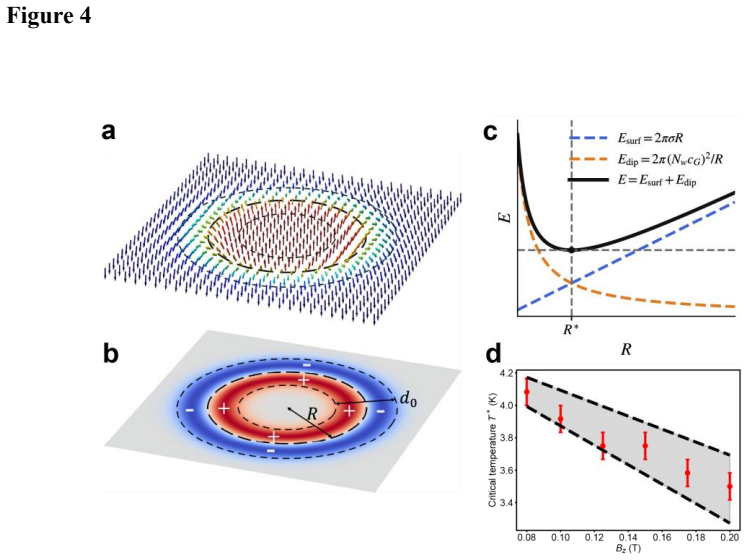
The central object is the chiral domain wall, a ring-shaped skyrmion-like texture of the spin-valley (pseudospin) order parameter with integer winding number $N_w$ along the wall. The mechanism that stabilizes it is the quantum-geometric charge dipole: in a band with spin-contrasting Chern numbers, the spatial winding of the order parameter produces a local charge redistribution described, to leading order, by a dipole density normal to the wall, proportional to the quantum-geometric coefficient $c_G$. Here $c_G$ is a weighted average of the second-Chern form over the four-dimensional manifold spanned by spin-polarization direction and momentum, encoding how the occupied Bloch subspace changes as the magnetic order parameter rotates. The energy of a wall of radius $R$ then has an electrostatic repulsion that grows as $c_G^2 / R$, a surface-tension term that grows as $R$, and a Zeeman term that grows as $B_z R^2$, giving a finite optimal radius $R^*$ and an activation barrier that explains metastability against collapse.
What would settle it
Measure the Chern number directly as a function of displacement field at $v = -1$, for example by Streda-slope transport at D = -60, 0, and 40 mV/nm and at temperatures across 3.5 K; if the state remains C = 1 without a topological transition in this window, or if an independent measurement of $c_G$ yields a predicted $-dT^*/dB_z$ far from 5 K/T, the chiral-domain-wall assignment fails. A second, more direct check is Lorentz transmission electron microscopy: the proposal predicts closed ring-shaped domain walls with radius $R^*$ and width $d_0$ in the -60 to 40 mV/nm window only, so imaging ordinary stripe domains there, or seeing these textures in the high-displacement-field region, would rule it out.
Extended reading notes
Core claim
The central claim is that a metastable spin-valley excitation observed in the QAH state of twisted MoTe2 at filling $v = -1$ is a chiral domain wall: a closed spin texture whose in-plane pseudospin winds by an integer $N_w$ along the wall, separating regions of opposite spin-valley polarization. The paper argues that in a topological magnet this texture carries a charge dipole density on the wall, with magnitude set by a quantum-geometric coefficient $c_G$ that measures how the occupied Bloch subspace responds as the spin-valley order parameter rotates. The dipole-dipole repulsion between wall segments grows as $N_w^2 c_G^2 / R$ and competes with surface tension and Zeeman energy, producing a stable optimal radius $R^*$ even when the external magnetic field is much stronger than the saturation field. The key experimental facts supporting this assignment are that the excitation appears only inside the QAH portion of the phase diagram, has a threshold in pump fluence, shows a lifetime of tens of microseconds, and disappears at about 3.5-3.8 K, far below the magnetic ordering temperature; the measured field dependence of its onset temperature gives $-dT^*/dB_z$ of about 5 K/T, matching the theory's predicted 4-6 K/T.
Load-bearing premise
The load-bearing premise is that the displacement-field window where the long-lived excitation appears (-60 to 40 mV/nm) is exactly the topologically nontrivial quantum anomalous Hall phase, while the surrounding spin-valley-polarized region is topologically trivial, and that the phase boundary and the quantum-geometry coefficient $c_G$ that fix the predicted 4-6 K/T slope come from unpublished Hartree-Fock calculations rather than from measurements in this experiment.
Editorial extensions
If this is right
- If the chiral-domain-wall picture is right, the efficiency of optical switching in twisted MoTe2 is governed by the spin-valley lifetime, so the long-lived walls explain why switching needs much lower pump intensity in the low-displacement-field QAH window than at higher fields where ordinary domains relax fast.
- The theory implies a tradeoff: the same long-lived walls that make switching efficient also slow down the switching speed, so device designs will have to balance efficiency against speed.
- Chiral domain walls should act as the weak link for topological protection, analogous to vortices limiting dissipationless current in type-II superconductors, which would explain why quantized anomalous Hall transport is often observed at temperatures well below the ordering temperature and single-particle gap.
- The same mechanism should operate in fractional quantum anomalous Hall states, and the observed failure of optical switching in the FQAH state between 1.8 and 2.2 K is consistent with chiral domain walls becoming unstable near 2 K, so lower-temperature experiments should see the same dynamics.
- Because the dipole strength is set by $c_G$, time-resolved spin-valley dynamics become a quantitative probe of a higher-order band quantum geometry quantity that static transport does not access.
Reading between the lines
- Editorial inference: the theory predicts a critical wall radius $R^*$ that shrinks as $B_z$ grows, so measuring the onset temperature $T^*$ over a wider field range or at slightly different twist angles would test the predicted scaling and pin down $c_G$ without relying on the unpublished Hartree-Fock value.
- Editorial inference: direct real-space imaging with Lorentz transmission electron microscopy or nitrogen-vacancy magnetometry at base temperature should resolve closed ring-like domain-wall textures on the scale of $R^*$; seeing ordinary stripe domains, or no textures, in the -60 to 40 mV/nm window would falsify the chiral-wall assignment.
- Editorial inference: the disorder-pinning argument predicts that in cleaner devices the spontaneous magnetization fluctuations between 3 and 4 K should be smaller, while in dirtier devices they should extend to higher temperatures, an ordering that can be checked with existing devices without new techniques.
- Editorial inference: the same $c_G$-mediated dipole mechanism should appear in other moiré Chern ferromagnets with spin-contrasting Chern numbers, so comparing several twist angles or materials would turn this from a single-device observation into a systematic test of the quantum-geometry route to long-lived spin textures.
Editorial analysis
A structured set of objections, weighed in public.
Referee Report
Summary. The paper reports resonant ultrafast pump-probe spectroscopy of twisted MoTe2 at one hole per moiré cell, and identifies a long-lived spin-valley excitation that appears only in a narrow displacement-field window (-60 to 40 mV/nm), below T≈3.7 K, with a threshold pump fluence and a lifetime of tens to hundreds of microseconds. The authors distinguish this excitation from ordinary domain dynamics and magnons through systematic control experiments: fluence dependence, temperature dependence, magnetic-field dependence, filling dependence, charge/spin separation, and reproducibility in three devices. They interpret the excitation as a chiral domain wall, i.e., a ring-shaped skyrmion with an in-plane winding of the pseudospin order parameter, stabilized by a quantum-geometric charge dipole. The quantitative support is a comparison between the measured field dependence of the onset temperature, -dT*/dBz ≈ 5 K/T, and a theoretical estimate of 4-6 K/T.
Significance. If the chiral-domain-wall interpretation is correct, the paper reports a qualitatively new class of spin-texture excitations unique to topological magnets, with broad implications for the stability of quantum anomalous Hall states, optical switching efficiency, and the dynamics of fractional Chern insulators. The empirical work is exceptionally careful: raw data are shown, charge and spin dynamics are cleanly separated, the long-lived excitation is reproduced in two additional devices with different disorder levels, and the fluence/temperature/field/filling systematics exclude the most obvious conventional explanations. The main weakness is that the mechanistic assignment to chiral domain walls depends on two elements that are not independently established in the manuscript: the D-field location of the topological phase boundary (only D=0 is measured via the Streda formula) and the value of the quantum-geometric coefficient c_G used in the predicted slope. Because these come from an unpublished companion paper, the quantitative agreement is not presently an auditable test of the theory. The observation itself is nevertheless significant and likely to stimulate further work.
major comments (3)
- [Methods: Quantitative comparison between experiment and theory; Extended Data Fig. 1; Fig. 1g] The assignment of the metastable-excitation window (-60 to 40 mV/nm) to the topologically nontrivial QAH phase is load-bearing but is not established by measurements in this paper. The only Chern-number determination is the Streda fit at D=0 (C=0.973±0.028, Extended Data Fig. 1), while the phase boundary as a function of D is taken from unpublished Hartree-Fock calculations (ref. 58). If the actual topological transition occurs at a different D, the correspondence between the observed excitation window and the QAH phase—and hence the chiral-domain-wall mechanism—is unsupported. Please provide a direct measurement of the Chern number or quantized Hall transport across the D-window, or otherwise empirically anchor the phase boundary.
- [Fig. 4d; Methods: Quantitative comparison between experiment and theory] The quantitative agreement between the measured slope -dT*/dBz ≈ 5 K/T and the predicted 4-6 K/T is not an independent test of the chiral-domain-wall model, because the prediction uses c_G from the same unpublished ref. 58 and the derivation/parameter list is relegated to a Supplementary Information that is not included in the manuscript. The O(1) prefactors in the energy functional are not specified. Please include the full derivation and all parameter values in the main text or an accessible supplement, and report c_G as a function of D; without this, the comparison cannot be audited.
- [Fig. 4a; Discussion (last paragraph)] The chiral-domain-wall assignment remains indirect: no imaging of the winding texture is provided, and the paper acknowledges that local probes such as Lorentz transmission electron microscopy would be needed. The title and abstract state 'Observation of ... chiral domain walls,' which overstates what is directly demonstrated. The data establish a distinct long-lived spin-valley excitation, but the specific identification with chiral domain walls is a proposal supported primarily by the theoretical arguments above. Please either soften the claim or provide additional evidence that the texture carries the proposed winding.
minor comments (5)
- [Discussion (third paragraph)] There is a typo in the sentence 'At higher temperature or large r D-field'—the stray 'r' should be removed.
- [Fig. 4d; Extended Data Fig. 10] The procedure for extracting T* from temperature-dependent dynamics is not described in the main text; please specify the criterion used (e.g., amplitude threshold or lifetime threshold) so that the reader can reproduce the values in Fig. 4d.
- [Reference list, ref. 58] Reference 58 is listed only as 'To appear.' If the companion paper is under review, please provide a preprint identifier or include the relevant results (phase boundary and c_G values) in the supplement so that the present manuscript is self-contained.
- [Methods: Quantitative comparison between experiment and theory] The statement that 'A complete list of parameters used in theoretical calculations and the full derivation are provided in the supplementary information' is not verifiable because the Supplementary Information is not included in the manuscript; this should be resolved before publication.
- [Extended Data Fig. 2 caption] The color scale and the meaning of the red/blue regions in panels a-b are not defined; please add a brief explanation to the caption.
Circularity Check
The chiral-domain-wall interpretation relies on c_G and the QAH phase boundary from an unpublished companion paper by overlapping authors, while the measured dynamics themselves are independent.
-
self citation load bearing
[Methods, 'Quantitative comparison between experiment and theory'; main text Fig. 4d]
"Using spin parameters from literature 16 and calculated 𝑐𝐺, theory predicts a slope of -dT*/dBz around 4~6 K/T. The quantitative consistency between the experiment and theory (Fig. 4d) further confirms the observed metastable spin-valley excitations from chiral domain walls."
The calculated c_G entering the predicted slope is attributed to ref. 58, an unpublished companion paper whose authors (N. Chadha, Q. Gao, E. Khalaf, Z. Han) overlap with the present paper. The measured -dT*/dBz ≈ 5 K/T is therefore compared not with an independent external calculation but with a value produced by the same group. Because ref. 58 is not available in the manuscript, the agreement cannot be audited as a first-principles test. There is no indication that c_G was fitted to the pump-probe data, so this is load-bearing self-citation rather than a fitted-input prediction, but it does weaken the independence of the claimed confirmation.
-
self citation load bearing
[Main text, 'Spin-valley texture stabilized by quantum geometry' and Methods, 'Quantitative comparison between experiment and theory']
"Indeed, recent microscopic Hartree-Fock calculations show that 3.7-degree-twisted MoTe2 transitions from a QAH state to a topologically trivial spin-valley polarized state upon increasing D-field. The quantum geometry quantity cG, which determines the stability of chiral domain walls, decreases abruptly at the first-order topological transition 58."
This step maps the experimentally observed D-window (-60 to 40 mV/nm) onto the topologically nontrivial QAH phase using the same unpublished Hartree-Fock calculation (ref. 58) that supplies c_G. The only measured Chern number in the paper is C = 0.973 ± 0.028 at D = 0 (Extended Data Fig. 1), not inside the metastable window. The claimed identification of the metastable region as QAH is therefore carried by a self-citation to an unavailable companion paper. If that phase boundary is wrong, the quantitative match in Fig. 4d becomes coincidental and the chiral-domain-wall assignment lacks independent support. This is a load-bearing import of the authors' own unpublished result, though the empirical dynamics themselves are not affected.
full rationale
The empirical part of the paper is self-contained and not circular: the long-lived spin-valley excitation, its threshold pump fluence, its temperature cutoff near 3.7 K, its survival at reverse fields up to 200 mT, and its narrow density window are measured directly and reproduced in three devices. These observations are not fitted by the chiral-domain-wall theory. The circularity concern is concentrated in the mechanistic attribution. The theory's predicted slope -dT*/dBz ≈ 4-6 K/T uses c_G from ref. 58, an unpublished companion paper by four of the present authors, and the same ref. 58 is used to assert that the metastable D-window is the topologically nontrivial QAH phase while neighboring SVP regions are trivial. The Methods section states that 'A complete list of parameters used in theoretical calculations and the full derivation are provided in the supplementary information,' but this supplementary information is not included in the provided text, so the derivation chain cannot be independently audited. Because no measured quantity is renamed as a prediction and c_G is not shown to be fitted to the pump-probe data, this is load-bearing self-citation rather than equivalence-by-construction, justifying a score of 4 rather than a higher circularity score.
Assumptions & free parameters
free parameters (2)
- c_G (quantum geometric dipole coefficient) =
not shown; from ref. 58 (to appear)
- O(1) prefactors in E(R) and T*-barrier conversion =
not specified
assumptions (5)
- domain assumption The pump-probe signal after ~100 ns is pure spin-valley polarization, decoupled from charge population.
- domain assumption The D-field window -60 to 40 mV/nm corresponds to the topologically nontrivial QAH phase, and the surrounding SVP region is topologically trivial.
- ad hoc to paper The energy of a ring-shaped chiral domain wall is governed by E ~ N_w^2 c_G^2 / R + sigma R + B_z R^2 at leading order.
- domain assumption In the smooth-wall limit, 1D chiral edge modes do not affect the transverse charge redistribution that stabilizes the wall.
- domain assumption Quenched disorder does not qualitatively alter the pump-probe dynamics of the spin-valley excitations.
invented entities (3)
-
Chiral domain wall (ring-shaped skyrmion with winding number N_w)
-
Charge dipole density p on the domain wall
-
c_G (second-Chern-form quantum geometry quantity)
Cite this review
Pith. "Pith review of Observation of metastable chiral domain walls in a topological magnet." pith.science (2026). https://pith.science/paper/BXNQCSG7
@misc{pith2026260806569,
  author       = {Pith},
  title        = {Pith review of: Observation of metastable chiral domain walls in a topological magnet},
  year         = {2026},
  howpublished = {\url{https://pith.science/paper/BXNQCSG7}},
  note         = {Machine review of arXiv:2608.06569}
}
read the original abstract
The interplay between topology and correlation can give rise to exotic collective excitations. The integer and fractional quantum anomalous Hall (QAH) magnets recently discovered in two-dimensional (2D) flatband systems are predicted to host spin excitations distinct from those in conventional magnets. Experimentally, nevertheless, these new excitations remain largely unexplored. Here we investigate spin-valley excitations in a twisted MoTe2 moir\'e superlattice using resonant ultrafast pump-probe spectroscopy. We observe a metastable spin-valley excitation in the QAH magnet below T ~ 3.7 K that survives reverse magnetic field several times larger than the saturation field. The behavior of this excitation is sharply distinct from ordinary domain walls and magnons, indicating a new type of spin-valley textures unique to topological magnets. We propose that these textures are chiral domain walls with an in-plane winding of the pseudospin order parameter along the domain wall. Their metastability arises from the interplay between the topological winding in real space and the quantum geometry of the parent bands in momentum space through a universal mechanism. These chiral domain walls govern the nonequilibrium dynamics of QAH magnets and may play a central role in their stability. Our study highlights intrinsic quantum geometry effects on spin excitations in topological magnets; and provides key insights into the fundamental mechanism limiting stability of topological protection.
Figures

Reference graph
Works this paper leans on
-
[1]
Stormer, H. L., Tsui, D. C. & Gossard, A. C. The fractional quantum Hall effect. Rev. Mod. Phys. 71, S298–S305 (1999)
work page 1999
-
[2]
Savary, L. & Balents, L. Quantum spin liquids: a review. Reports on Progress in Physics 80, 016502 (2017)
work page 2017
-
[3]
Keimer, B. & Moore, J. E. The physics of quantum materials. Nat. Phys. 13, 1045–1055 (2017)
work page 2017
-
[4]
Cai, J. et al. Signatures of fractional quantum anomalous Hall states in twisted MoTe2. Nature 622, 63–68 (2023)
2023
-
[5]
Park, H. et al. Observation of fractionally quantized anomalous Hall effect. Nature 622, 74–79 (2023)
2023
-
[6]
Zeng, Y . et al. Thermodynamic evidence of fractional Chern insulator in moiré MoTe2. Nature 622, 69–73 (2023)
2023
-
[7]
Xu, F. et al. Observation of Integer and Fractional Quantum Anomalous Hall Effects in Twisted Bilayer MoTe2. Phys. Rev. X 13, 031037 (2023)
2023
-
[8]
Lu, Z. et al. Fractional quantum anomalous Hall effect in multilayer graphene. Nature 626, 759–764 (2024)
2024
Show all 59 references
-
[9]
Li, W. et al. Signatures of fractional charges via anyon–trions in twisted MoTe2. Nature 651, 48–53 (2026)
2026
-
[10]
& Mudry, C
Neupert, T., Santos, L., Chamon, C. & Mudry, C. Fractional quantum hall states at zero magnetic field. Phys. Rev. Lett. 106, (2011)
2011
-
[11]
Tang, E., Mei, J. W. & Wen, X. G. High-temperature fractional quantum hall states. Phys. Rev. Lett. 106, (2011)
2011
-
[12]
N., Gu, Z
Sheng, D. N., Gu, Z. C., Sun, K. & Sheng, L. Fractional quantum Hall effect in the absence of Landau levels. Nat. Commun. 2, (2011)
2011
-
[13]
P., Alsallom, F., Zhang, Y ., Devakul, T
Reddy, A. P., Alsallom, F., Zhang, Y ., Devakul, T. & Fu, L. Fractional quantum anomalous Hall states in twisted bilayer MoTe2 and WSe2. Phys. Rev. B 108, (2023)
2023
-
[14]
M., Morales-Durán, N., Wolf, T
Kousa, B. M., Morales-Durán, N., Wolf, T. M. R., Khalaf, E. & MacDonald, A. H. Theory of Magnetoroton Bands in Moiré Materials. Phys. Rev. Lett. 135, (2025)
2025
-
[15]
Shen, X. et al. Magnetorotons in moiré fractional Chern insulators. Phys. Rev. B 113, L081403 (2026)
2026
-
[16]
Qiu, W. X. & Wu, F. Topological magnons and domain walls in twisted bilayer MoTe2. Phys. Rev. B 112, (2025)
2025
-
[17]
& Sarma, S
Xie, M. & Sarma, S. Das. Collective Spin Excitations in Correlated Moiré Chern Ferromagnets. http://arxiv.org/abs/2603.20370 (2026)
2026
-
[18]
H., Stern, A., Freedman, M
Nayak, C., Simon, S. H., Stern, A., Freedman, M. & Das Sarma, S. Non- Abelian anyons and topological quantum computation. Rev. Mod. Phys. 80, 1083–1159 (2008)
2008
-
[19]
Mak, K. F. & Shan, J. Semiconductor moiré materials. Nat. Nanotechnol. 17, 686–695 (2022)
2022
-
[20]
Cao, T., Fu, L., Ju, L., Xiao, D. & Xu, X. Fractional Quantum Anomalous Hall Effect. The Annual Review of Condensed Matter Physics 30, 233–56 (2026)
2026
-
[21]
& Millis, A
Zang, J., Wang, J., Cano, J., Georges, A. & Millis, A. J. Dynamical Mean-Field Theory of Moiré Bilayer Transition Metal Dichalcogenides: Phase Diagram, Resistivity, and Quantum Criticality. Phys. Rev. X 12, (2022)
2022
-
[22]
Guo, Y . et al. Superconductivity in 5.0° twisted bilayer WSe2. Nature 637, 839–845 (2025)
2025
-
[23]
Xia, Y . et al. Superconductivity in twisted bilayer WSe2. Nature 637, 833–838 (2025)
2025
-
[24]
Xu, F. et al. Signatures of unconventional superconductivity near reentrant and fractional quantum anomalous Hall insulators. arXiv: 2504.06972 (2025)
2025 arXiv
-
[25]
Xiong, R. et al. Observation of propagating collective spin–valley modes in twisted WSe2. Nat. Phys. 22, 877–883 (2026)
2026
-
[26]
Holtzmann, W. et al. Optical control of integer and fractional Chern insulators. Nature 649, 1147–1152 (2026)
2026
-
[27]
Huber, O. et al. Optical control over topological Chern number in moiré materials. Nature 649, 1153–1158 (2026)
2026
-
[28]
Cai, X. et al. Optical switching of a moiré Chern ferromagnet. Nature 650, 580–584 (2026)
2026
-
[29]
D., Möller, G., Cooper, N
Caio, M. D., Möller, G., Cooper, N. R. & Bhaseen, M. J. Topological marker currents in Chern insulators. Nat. Phys. 15, 257–261 (2019)
2019
-
[30]
Yu, J. et al. Quantum geometry in quantum materials. NPJ Quantum Mater. 10, 101 (2025)
2025
-
[31]
& Heinz, T
Xu, X., Yao, W., Xiao, D. & Heinz, T. F. Spin and pseudospins in layered transition metal dichalcogenides. Nat. Phys. 10, 343–350 (2014)
2014
-
[32]
Jin, C. et al. Ultrafast dynamics in van der Waals heterostructures. Nat. Nanotechnol. 13, 994–1003 (2018)
2018
-
[33]
& Siegmann, H
Stöhr, J. & Siegmann, H. C. Magnetism. (Springer Berlin Heidelberg, Berlin, Heidelberg, 2006). doi:10.1007/978-3-540-30283-4
2006 doi
-
[34]
V ., Serga, A
Chumak, A. V ., Serga, A. A. & Hillebrands, B. Magnon transistor for all- magnon data processing. Nat. Commun. 5, 4700 (2014)
2014
-
[35]
V ., Vasyuchka, V
Chumak, A. V ., Vasyuchka, V . I., Serga, A. A. & Hillebrands, B. Magnon spintronics. Nat. Phys. 11, 453–461 (2015)
2015
-
[36]
Mohseni, S. M. et al. Spin Torque–Generated Magnetic Droplet Solitons. Science. 339, 1295–1298 (2013)
2013
-
[37]
Jin, C. et al. Imaging and control of critical fluctuations in two-dimensional magnets. Nat. Mater. 19, 1290–1294 (2020)
2020
-
[38]
& Tokura, Y
Nagaosa, N. & Tokura, Y . Topological properties and dynamics of magnetic skyrmions. Nat. Nanotechnol. 8, 899–911 (2013)
2013
-
[39]
& Xiao, J
Tserkovnyak, Y . & Xiao, J. Energy Storage via Topological Spin Textures. Phys. Rev. Lett. 121, (2018)
2018
-
[40]
& Beach, G
Büttner, F., Lemesh, I. & Beach, G. S. D. Theory of isolated magnetic skyrmions: From fundamentals to room temperature applications. Sci. Rep. 8, 4464 (2018)
2018
-
[41]
& Das Sarma, S
Wu, F. & Das Sarma, S. Quantum geometry and stability of moiré flatband ferromagnetism. Phys. Rev. B 102, (2020)
2020
-
[42]
& Vishwanath, A
Khalaf, E. & Vishwanath, A. Baby skyrmions in Chern ferromagnets and topological mechanism for spin-polaron formation in twisted bilayer graphene. Nat. Commun. 13, (2022)
2022
-
[43]
L., Hughes, T
Qi, X. L., Hughes, T. L. & Zhang, S. C. Topological field theory of time- reversal invariant insulators. Phys. Rev. B Condens. Matter Mater. Phys. 78, (2008)
2008
-
[44]
Xiao, D., Shi, J., Clougherty, D. P. & Niu, Q. Polarization and adiabatic pumping in inhomogeneous crystals. Phys. Rev. Lett. 102, (2009)
2009
-
[45]
& Xiao, D
Zhao, Y ., Gao, Y . & Xiao, D. Electric polarization in inhomogeneous crystals. Phys. Rev. B 104, (2021)
2021
-
[46]
Zhang, X.-W. et al. Polarization-driven band topology evolution in twisted MoTe2 and WSe2. Nat. Commun. 15, 4223 (2024)
2024
-
[47]
Li, B., Qiu, W. X. & Wu, F. Electrically tuned topology and magnetism in twisted bilayer MoTe2 at νh = 1. Phys. Rev. B 109, (2024)
2024
-
[48]
Jia, Y . et al. Moiré fractional Chern insulators. I. First-principles calculations and continuum models of twisted bilayer MoTe2. Phys. Rev. B 109, 205121 (2024)
2024
-
[49]
Wang, T., Devakul, T., Zaletel, M. P. & Fu, L. Diverse magnetic orders and quantum anomalous Hall effect in twisted bilayer MoTe2 and WSe2. arXiv:2306.02501 (2023)
2023 arXiv
-
[50]
Park, H. et al. Observation of dissipationless fractional Chern insulator. Nat. Phys. 22, 389–395 (2026)
2026
-
[51]
Wang, L. et al. One-dimensional electrical contact to a two-dimensional material. Science. 342, 614–617 (2013)
2013
-
[52]
Jin, C. et al. Stripe phases in WSe2/WS2 moiré superlattices. Nat. Mater. 20, 940–944 (2021)
2021
-
[53]
Jin, C. et al. Imaging of pure spin-valley diffusion current in WS2 -WSe2 heterostructures. Science. 360, 893–896 (2018)
2018
-
[54]
Srivastava, A. et al. Optically active quantum dots in monolayer WSe 2. Nat. Nanotechnol. 10, 491–496 (2015)
2015
-
[55]
Tongay, S. et al. Defects activated photoluminescence in two-dimensional semiconductors: Interplay between bound, charged, and free excitons. Sci. Rep. 3, (2013)
2013
-
[56]
Li, W. et al. Universal Magnetic Phases in Twisted Bilayer MoTe2. Nano Lett. 25, 18044–18050 (2025)
2025
-
[57]
Redekop, E. et al. Direct magnetic imaging of fractional Chern insulators in twisted MoTe2. Nature 635, 584–589 (2024)
2024
-
[58]
Chadha, Q
N. Chadha, Q. Gao, E. Khalaf, and Z. Han, To appear. Figure 1 Fig. 1: Emergent spin-valley excitations in the QAH state. a,b, Polarization-resolved reflection contrast (RC) spectra of the twisted MoTe2 device D1 as a function of moiré filling v under LCP (a) and RCP (b) illumi...
-
[59]
on” and “off
= 𝐸𝑟0 2 (1 𝑖 ) + 𝐸𝑟0 2 ( 1 −𝑖) (1) A finite spin-valley polarization Sz in the system induces MCD, i.e., imbalance between LCP and RCP reflection. This leads to an electric field component perpendicular to the incident light, which can be sensitively picked up when the polariz...
Reviewed August 10, 2026 · model on record in the stance chip above.
Discussion (0). Continue with ORCID to comment.