Reversible Privacy Preservation using Multi-level Encryption and Compressive Sensing
Pith reviewed 2026-05-25 19:40 UTC · model grok-4.3
The pith
Combining multi-level encryption with compressive sensing yields a reversible privacy method supporting multiple de-identification levels.
A machine-rendered reading of the paper's core claim, the machinery that carries it, and where it could break.
Core claim
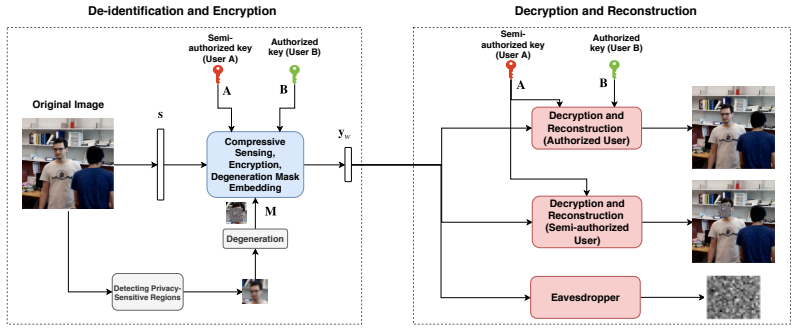
The central discovery is a novel method that combines multi-level encryption with compressive sensing to perform reversible privacy preservation, supporting multiple privacy levels while efficiently acquiring, encrypting, and hiding data in video monitoring applications.
What carries the argument
Multi-level encryption integrated with compressive sensing, enabling simultaneous data acquisition, encryption, and data hiding at adjustable privacy levels.
If this is right
- Supports de-identification at multiple privacy levels for flexible access control.
- Allows efficient performance of data acquisition, encryption, and hiding in one process.
- Provides reversibility so original data can be recovered by authorized parties.
- Achieves strong anonymization of faces while maintaining good reconstruction quality.
Where Pith is reading between the lines
- The method may be adaptable to other types of sensitive visual data beyond faces.
- It could facilitate selective data sharing under regulations by allowing different decryption keys for various parties.
- Further testing on real-time video streams would verify computational efficiency in practical deployments.
Load-bearing premise
That the integration of multi-level encryption and compressive sensing will deliver reversibility, multiple decryption levels, efficiency, and strong anonymization simultaneously without creating vulnerabilities or poor reconstructions.
What would settle it
An experiment showing that faces remain identifiable after the process or that reconstruction from the encrypted data fails to match the original with high fidelity.
Figures

read the original abstract
Security monitoring via ubiquitous cameras and their more extended in intelligent buildings stand to gain from advances in signal processing and machine learning. While these innovative and ground-breaking applications can be considered as a boon, at the same time they raise significant privacy concerns. In fact, recent GDPR (General Data Protection Regulation) legislation has highlighted and become an incentive for privacy-preserving solutions. Typical privacy-preserving video monitoring schemes address these concerns by either anonymizing the sensitive data. However, these approaches suffer from some limitations, since they are usually non-reversible, do not provide multiple levels of decryption and computationally costly. In this paper, we provide a novel privacy-preserving method, which is reversible, supports de-identification at multiple privacy levels, and can efficiently perform data acquisition, encryption and data hiding by combining multi-level encryption with compressive sensing. The effectiveness of the proposed approach in protecting the identity of the users has been validated using the goodness of reconstruction quality and strong anonymization of the faces.
Editorial analysis
A structured set of objections, weighed in public.
Referee Report
Summary. The manuscript proposes a novel privacy-preserving method for security monitoring that combines multi-level encryption with compressive sensing. The approach is claimed to be reversible, support de-identification at multiple privacy levels, and efficiently handle data acquisition, encryption, and hiding. Effectiveness is validated via reconstruction quality metrics and visual assessment of face anonymization in the context of GDPR-compliant surveillance.
Significance. If the joint properties of reversibility, graded decryption, efficiency, and anonymization hold under the stated conditions, the work addresses a practical gap in existing non-reversible or single-level privacy schemes for video monitoring. The constructive use of compressive sensing for simultaneous acquisition and hiding is a notable technical strength, and the experimental validation with standard reconstruction metrics provides initial support for the claims.
minor comments (2)
- The abstract and introduction would benefit from explicit citation of the specific compressive sensing formulation (e.g., measurement matrix or recovery algorithm) used in the multi-level encryption pipeline to allow readers to assess the efficiency claims directly.
- Figure captions and experimental section should include the exact dataset sizes, number of test faces, and quantitative privacy metrics (beyond visual inspection) to strengthen the 'strong anonymization' assertion.
Simulated Author's Rebuttal
We thank the referee for their constructive summary and positive assessment of the manuscript's contributions to reversible, multi-level privacy preservation in video surveillance. The recommendation for minor revision is noted. However, the report lists no specific major comments under the MAJOR COMMENTS section, so there are no individual points requiring point-by-point response or manuscript changes at this stage.
Circularity Check
No significant circularity detected
full rationale
The paper describes a constructive privacy-preserving technique that combines multi-level encryption with compressive sensing to achieve reversibility, graded decryption levels, efficiency, and face anonymization. No equations, parameter-fitting procedures, or derivation chains appear in the abstract or described claims that reduce a prediction or result to its own inputs by construction. The central claim is the joint achievement of these properties via the proposed combination, validated with standard reconstruction metrics and visual checks rather than any self-referential fitting or self-citation load-bearing step. No uniqueness theorems, ansatzes smuggled via citation, or renamings of known results are indicated. The derivation is therefore self-contained as an engineering construction.
Axiom & Free-Parameter Ledger
Reference graph
Works this paper leans on
-
[1]
From buildings to smart buildings-sensing and actuation to improve energy efficiency,
T. Weng and Y . Agarwal, “From buildings to smart buildings-sensing and actuation to improve energy efficiency,” IEEE Design & Test of Computers, vol. 29, no. 4, pp. 36–44, 2012
work page 2012
-
[2]
Energy intelligent buildings based on user activity: A survey,
T. A. Nguyen and M. Aiello, “Energy intelligent buildings based on user activity: A survey,” Energy and Buildings , vol. 56, pp. 244–257, 2013
work page 2013
-
[3]
The EU General Data Protection Regulation (GDPR),
P. V oigt and A. V on dem Bussche, “The EU General Data Protection Regulation (GDPR),” A Practical Guide, 1st Ed., Cham: Springer International Publishing, 2017
work page 2017
-
[4]
Person de-identification in videos,
P. Agrawal and P. Narayanan, “Person de-identification in videos,” IEEE Transactions on Circuits and Systems for Video Technology , vol. 21, no. 3, pp. 299–310, 2011
work page 2011
-
[5]
Garp-face: Balancing privacy protection and utility preservation in face de-identification,
L. Du, M. Yi, E. Blasch, and H. Ling, “Garp-face: Balancing privacy protection and utility preservation in face de-identification,” in Proceed- ings of the IEEE International Joint Conference on Biometrics , 2014, pp. 1–8
work page 2014
-
[6]
Deep learning with differential privacy,
M. Abadi, A. Chu, I. Goodfellow, H. B. McMahan, I. Mironov, K. Tal- war, and L. Zhang, “Deep learning with differential privacy,” in Pro- ceedings of the SIGSAC Conference on Computer and Communications Security, 2016, pp. 308–318
work page 2016
-
[7]
R. L. Lagendijk, Z. Erkin, and M. Barni, “Encrypted signal processing for privacy protection: Conveying the utility of homomorphic encryption and multiparty computation,” IEEE Signal Processing Magazine, vol. 30, no. 1, pp. 82–105, 2013
work page 2013
-
[8]
E. J. Cand `es et al. , “Compressive sampling,” in Proceedings of the International Congress of Mathematicians, vol. 3, 2006, pp. 1433–1452
work page 2006
-
[9]
Sparse MRI: The application of compressed sensing for rapid MR imaging,
M. Lustig, D. Donoho, and J. M. Pauly, “Sparse MRI: The application of compressed sensing for rapid MR imaging,” Magnetic Resonance in Medicine: An Official Journal of the International Society for Magnetic Resonance in Medicine , vol. 58, no. 6, pp. 1182–1195, 2007
work page 2007
-
[10]
A compressive sensing data acquisition and imaging method for stepped frequency GPRs,
A. C. Gurbuz, J. H. McClellan, and W. R. Scott, “A compressive sensing data acquisition and imaging method for stepped frequency GPRs,”IEEE Transactions on Signal Processing, vol. 57, no. 7, pp. 2640–2650, 2009
work page 2009
-
[11]
M. Yamac ¸, M. Orhan, B. Sankur, A. S. Turk, and M. Gabbouj, “Through the wall target detection/monitoring from compressively sensed signals via structural sparsity,” in 5th International Workshop on Compressed Sensing applied to Radar, Multimodal Sensing,and Imaging , 2018
work page 2018
-
[12]
Secure wireless communications based on compressive sensing: A survey,
Y . Zhang, Y . Xiang, L. Y . Zhang, Y . Rong, and S. Guo, “Secure wireless communications based on compressive sensing: A survey,” IEEE Communications Surveys & Tutorials , 2018
work page 2018
-
[13]
A review of compressive sensing in information security field,
Y . Zhang, L. Y . Zhang, J. Zhou, L. Liu, F. Chen, and X. He, “A review of compressive sensing in information security field,” IEEE Access, vol. 4, pp. 2507–2519, 2016
work page 2016
-
[14]
Compressed sensing and best -term approximation,
A. Cohen, W. Dahmen, and R. DeV ore, “Compressed sensing and best -term approximation,” Journal of the American Mathematical Society , vol. 22, no. 1, pp. 211–231, 2009
work page 2009
-
[15]
The restricted isometry property and its implications for compressed sensing,
E. J. Candes, “The restricted isometry property and its implications for compressed sensing,” Comptes rendus mathematique, vol. 346, no. 9-10, pp. 589–592, 2008
work page 2008
-
[16]
The secrecy of compressed sensing mea- surements,
Y . Rachlin and D. Baron, “The secrecy of compressed sensing mea- surements,” in Proceedings of the Annual Allerton Conference on Communication, Control, and Computing , 2008, pp. 813–817
work page 2008
-
[17]
Communication theory of secrecy systems*,
C. E. Shannon, “Communication theory of secrecy systems*,” Bell System Technical Journal, vol. 28, no. 4, pp. 656–715, 1949
work page 1949
-
[18]
Analysis of one-time random projections for privacy preserving compressed sensing,
T. Bianchi, V . Bioglio, and E. Magli, “Analysis of one-time random projections for privacy preserving compressed sensing,” IEEE Transac- tions on Information Forensics and Security, vol. 11, no. 2, pp. 313–327, 2016
work page 2016
-
[19]
On the security and robustness of encryption via compressed sensing,
A. Orsdemir, H. O. Altun, G. Sharma, and M. F. Bocko, “On the security and robustness of encryption via compressed sensing,” in Proceedings of the IEEE Military Communications Conference , 2008, pp. 1–7
work page 2008
-
[20]
Low- complexity multiclass encryption by compressed sensing,
V . Cambareri, M. Mangia, F. Pareschi, R. Rovatti, and G. Setti, “Low- complexity multiclass encryption by compressed sensing,” IEEE Trans- actions on Signal Processing , vol. 63, no. 9, pp. 2183–2195, 2015
work page 2015
-
[21]
M. Yamac, C ¸ . Dikici, and B. Sankur, “Hiding data in compressive sensed measurements: A conditionally reversible data hiding scheme for compressively sensed measurements,”Digital Signal Processing, vol. 48, pp. 188–200, 2016
work page 2016
-
[22]
Robust data hiding scheme for compressively sensed signals,
M. Yamac ¸, B. Sankur, and M. Gabbouj, “Robust data hiding scheme for compressively sensed signals,” in Proceedings of the European Signal Processing Conference, 2018, pp. 1760–1764
work page 2018
-
[23]
Robust watermarking of com- pressive sensed measurements under impulsive and gaussian attacks,
M. Yamac ¸, C ¸ . Dikici, and B. Sankur, “Robust watermarking of com- pressive sensed measurements under impulsive and gaussian attacks,” in Proceedings of the European Signal Processing Conference , 2013, pp. 1–5
work page 2013
-
[24]
Optical image encryption based on compressive sensing and chaos in the fractional fourier domain,
X. Liu, W. Mei, and H. Du, “Optical image encryption based on compressive sensing and chaos in the fractional fourier domain,” Journal of Modern Optics , vol. 61, no. 19, pp. 1570–1577, 2014
work page 2014
-
[25]
N. Zhou, H. Li, D. Wang, S. Pan, and Z. Zhou, “Image compression and encryption scheme based on 2d compressive sensing and fractional mellin transform,” Optics Communications, vol. 343, pp. 10–21, 2015
work page 2015
-
[26]
Dlib-ml: A machine learning toolkit,
D. E. King, “Dlib-ml: A machine learning toolkit,” Journal of Machine Learning Research, vol. 10, no. Jul, pp. 1755–1758, 2009
work page 2009
discussion (0)
Sign in with ORCID, Apple, or X to comment. Anyone can read and Pith papers without signing in.