Observation of a Majorana zero mode in a topologically protected edge channel
Pith reviewed 2026-05-25 17:06 UTC · model grok-4.3
The pith
Scanning tunneling microscopy reveals a localized Majorana zero mode at the interface between a superconducting helical edge channel and magnetic clusters in Bi(111) films.
A machine-rendered reading of the paper's core claim, the machinery that carries it, and where it could break.
Core claim
Our measurements reveal the emergence of a localized MZM at the interface between the superconducting helical edge channel and the Fe clusters with strong magnetization component along the edge. Our experiments also resolve the MZM spin signature that distinguishes it from trivial in-gap states that may accidently occur at zero energy in a superconductor.
What carries the argument
Proximity-induced superconductivity from the Nb substrate combined with local magnetism from Fe clusters acting on the helical hinge states of Bi(111), localizing a zero-energy mode whose spin texture confirms its Majorana character.
If this is right
- The Majorana zero mode appears only at the specific interface where the helical edge meets a region of strong edge-aligned magnetization.
- The resolved spin signature provides a direct experimental handle to separate the Majorana mode from accidental zero-energy states.
- Consistency between the data and model calculations supports the interpretation that topological protection of the edge channel is essential to the observed localization.
- This hybrid platform combines induced pairing, magnetism, and helical topology without requiring electrostatic gating to stabilize the zero mode.
Where Pith is reading between the lines
- Engineering arrays of such Fe clusters along the edge could create multiple addressable Majorana modes whose interactions might be tuned by cluster spacing.
- The spin-resolved STM technique demonstrated here could be applied to other helical-edge systems to test for Majorana signatures under different material combinations.
- If the interface remains stable under further processing, the approach might allow networks of Majorana modes to be fabricated for interference or braiding experiments.
Load-bearing premise
The zero-bias feature and its spin texture are produced by proximity-induced superconductivity and magnetism acting on the helical hinge states rather than by unrelated disorder or trivial Andreev bound states.
What would settle it
A measurement showing that the zero-bias peak and spin polarization remain unchanged when the direction of the Fe cluster magnetization is rotated away from alignment with the edge would indicate the feature is not the predicted Majorana mode.
Figures




read the original abstract
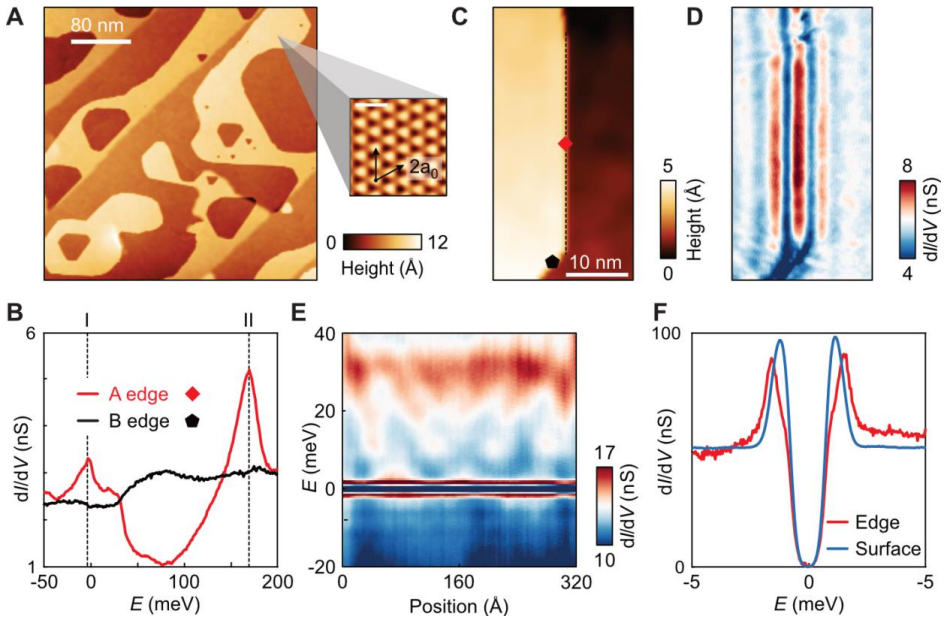
Superconducting proximity pairing in helical edge modes, such as those of topological insulators (TI), is predicted to provide a unique platform for realizing Majorana zero modes (MZMs). We use scanning tunneling microscopy measurements to probe the influence of proximity induced superconductivity and magnetism on the helical hinge states of Bi(111) films, grown on a superconducting Nb substrate and decorated with magnetic Fe clusters. Consistent with model calculations, our measurements reveal the emergence of a localized MZM at the interface between the superconducting helical edge channel and the Fe clusters with strong magnetization component along the edge. Our experiments also resolve the MZM spin signature that distinguishes it from trivial in-gap states that may accidently occur at zero energy in a superconductor.
Editorial analysis
A structured set of objections, weighed in public.
Referee Report
Summary. The manuscript reports STM measurements on Bi(111) films grown on superconducting Nb and decorated with Fe clusters. It claims that proximity-induced superconductivity and magnetism on the helical hinge states produce a localized Majorana zero mode (MZM) at the Fe-cluster interface, with the observed zero-bias feature and its spin texture matching model calculations and distinguishable from trivial in-gap states.
Significance. If the central interpretation is robust, the result would constitute direct experimental evidence for an MZM hosted in a topologically protected helical edge channel, strengthening the case for engineered topological superconductivity in TI systems. The work explicitly invokes consistency with model calculations and a spin-signature diagnostic, both of which are positive features when fully documented.
major comments (2)
- [Abstract] Abstract: the claim that the measured spin signature 'distinguishes it from trivial in-gap states' is load-bearing for the central interpretation, yet the abstract supplies neither the quantitative spin-texture data, error bars, nor the explicit model predictions (including disorder and ABS realizations) used to establish uniqueness. Without these, the distinction cannot be verified from the given text.
- [Abstract] Abstract: the statement 'consistent with model calculations' is invoked to support the MZM assignment, but no parameter ranges, disorder ensembles, or coverage of plausible trivial Andreev-bound-state configurations are reported. If the models omit configurations that can reproduce both the zero-bias peak and the observed spin texture, the interpretation does not follow.
Simulated Author's Rebuttal
We thank the referee for the detailed review and constructive comments. We address the two major comments on the abstract below, noting that abstracts are concise summaries while supporting quantitative details appear in the main text and supplementary information.
read point-by-point responses
-
Referee: [Abstract] Abstract: the claim that the measured spin signature 'distinguishes it from trivial in-gap states' is load-bearing for the central interpretation, yet the abstract supplies neither the quantitative spin-texture data, error bars, nor the explicit model predictions (including disorder and ABS realizations) used to establish uniqueness. Without these, the distinction cannot be verified from the given text.
Authors: We agree the abstract itself does not contain the quantitative spin-texture values, error bars or full model comparisons; those reside in the main text (spin-resolved dI/dV maps, extracted polarization angles, and direct overlays with MZM versus trivial ABS simulations) and supplementary material. The abstract summarizes the central result. If the editor prefers, we will add a short clause such as 'supported by spin-texture analysis that excludes trivial zero-energy states' while respecting length limits. revision: partial
-
Referee: [Abstract] Abstract: the statement 'consistent with model calculations' is invoked to support the MZM assignment, but no parameter ranges, disorder ensembles, or coverage of plausible trivial Andreev-bound-state configurations are reported. If the models omit configurations that can reproduce both the zero-bias peak and the observed spin texture, the interpretation does not follow.
Authors: The abstract invokes consistency without enumerating ranges or ensembles; those are documented in the body and SI, where we scan chemical potential, pairing strength, magnetization orientation and include disorder realizations plus multiple trivial ABS geometries. None of the trivial cases simultaneously reproduce both the zero-bias localization and the measured spin texture. We can revise the abstract to read 'robustly consistent with MZM calculations that exclude trivial Andreev states' if space permits. revision: partial
Circularity Check
Experimental observation paper with no derivation chain that reduces to inputs by construction
full rationale
This is an experimental STM paper reporting zero-bias peaks and spin textures interpreted as MZMs on helical hinge states. The abstract and provided text contain no equations, fitted parameters renamed as predictions, or self-citation chains that bear the central claim. Model calculations are invoked only for consistency checks, not as the origin of the result. No load-bearing step matches any of the enumerated circularity patterns; the result is data-driven rather than derived from a closed mathematical loop.
Axiom & Free-Parameter Ledger
axioms (2)
- domain assumption Helical hinge states of Bi(111) films survive proximity to superconducting Nb and local Fe magnetism
- domain assumption Spin signature of the zero-bias state uniquely identifies it as an MZM rather than a trivial in-gap state
invented entities (1)
-
Majorana zero mode
independent evidence
Reference graph
Works this paper leans on
-
[1]
A. Y. Kitaev, Ann. Phys. 303, 2–30 (2003)
work page 2003
- [2]
-
[3]
Mourik et al., Science 336, 1003–1007 (2012)
V. Mourik et al., Science 336, 1003–1007 (2012)
work page 2012
-
[4]
Nadj-Perge et al., Science 346, 602-607 (2014)
S. Nadj-Perge et al., Science 346, 602-607 (2014)
work page 2014
-
[5]
M. T. Deng et al., Science 354, 1557-1562 (2016)
work page 2016
- [6]
- [7]
- [8]
-
[9]
A. Y. Kitaev, Physics-Uspekhi 44, 131–136 (2001)
work page 2001
-
[10]
R. M. Lutchyn et al., Phys. Rev. Lett. 105, 077001 (2010)
work page 2010
- [11]
- [12]
- [13]
- [14]
- [15]
- [16]
- [17]
-
[18]
Benalcazar et al., Science 357, 61-66 (2017)
W.A. Benalcazar et al., Science 357, 61-66 (2017)
work page 2017
- [19]
- [20]
- [21]
-
[22]
Schindler et al., Science Advances 4, eaat0346 (2018)
F. Schindler et al., Science Advances 4, eaat0346 (2018)
work page 2018
- [23]
-
[24]
I. K. Drozdov et al., Nature Phys. 10, 664–669 (2014)
work page 2014
- [25]
- [26]
- [27]
-
[28]
Splitting the hinge mode of higher-order topological insulators
R. Queiroz et al., arXiv:1807.04141 (2018)
work page internal anchor Pith review Pith/arXiv arXiv 2018
- [29]
-
[30]
Supplementary Material
-
[31]
Yazdani et al., Science 275, 1767–1770 (1997)
A. Yazdani et al., Science 275, 1767–1770 (1997)
work page 1997
-
[32]
A. V. Balatsky et al., Rev. Mod. Phys. 78, 373-433 (2006)
work page 2006
-
[33]
Wang et al., Science 362, 333 – 335 (2018)
D. Wang et al., Science 362, 333 – 335 (2018)
work page 2018
-
[34]
Zero-energy vortex bound state in the superconducting topological surface state of Fe(Se,Te)
T. Machida et al., arXiv:1812.08995 [cond-mat.supr-con] (2018)
work page internal anchor Pith review Pith/arXiv arXiv 2018
- [35]
-
[36]
5. Ferromagnetism and Exchange
J.M.D. Coey, “5. Ferromagnetism and Exchange” in Magnetism and Magnetic Materials (Cambridge University Press, New York, 2009), pp. 141-143
work page 2009
- [37]
- [38]
- [39]
- [40]
- [41]
-
[42]
Fatemi et al., Science 362, 926-929 (2018)
V. Fatemi et al., Science 362, 926-929 (2018)
work page 2018
- [43]
-
[44]
B. Jäck et al., Replication data and theory code for: Observation of a Majorana zero mode in a topologically protected edge channel, http://dx.doi.org/10.5281/zenodo.2779382 (2019)
-
[45]
Y. Liu & R. E. Allen, Phys. Rev. B 52, 1566 (1995)
work page 1995
- [46]
-
[47]
D. Sticlet et al., Phys. Rev. Lett. 108, 096802 (2012). Acknowledgments: It is our pleasure to acknowledge initial theoretical support by Annika Johansson. Funding: This work has been primarily supported by Gordon and Betty Moore Foundation as part of EPiQS initiative (GBMF4530), ONR-N00014-17-1-2784, ONR-N00014- 14-1-0330, NSF-MRSEC programs through the ...
work page 2012
discussion (0)
Sign in with ORCID, Apple, or X to comment. Anyone can read and Pith papers without signing in.