The full evolution of supernova remnants in low and high density ambient media
Pith reviewed 2026-05-25 16:49 UTC · model grok-4.3
The pith
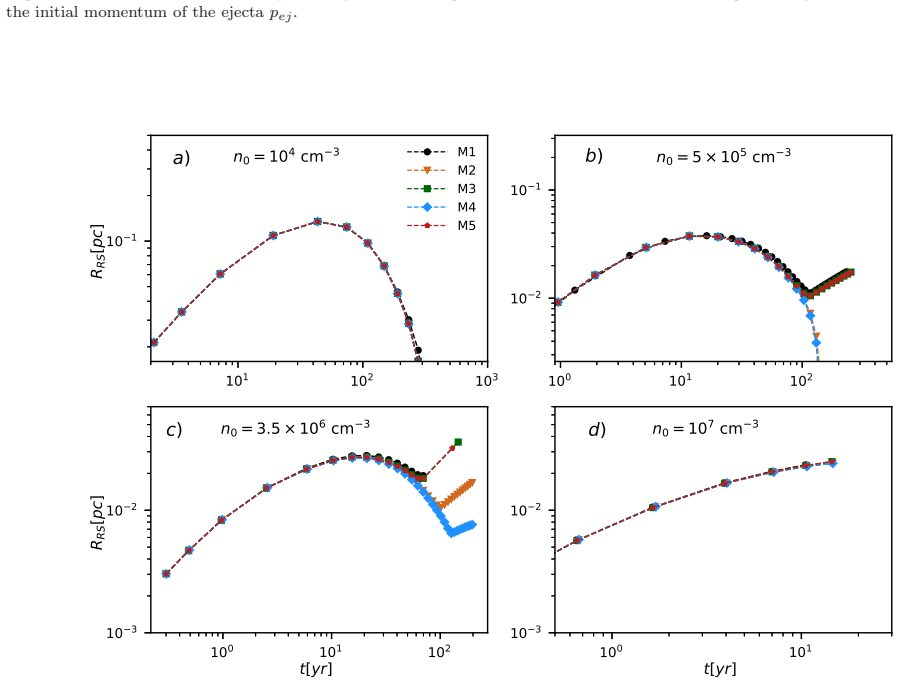
In dense media above 5 times 10 to the fifth particles per cubic centimeter, radiative cooling stops the reverse shock before it reaches the explosion center.
A machine-rendered reading of the paper's core claim, the machinery that carries it, and where it could break.
Core claim
For ambient densities n0 greater than 5 times 10 to the 5 per cubic centimeter, strong radiative cooling causes the thermal pressure in the shocked gas to fall rapidly enough that the reverse shock never reaches the center of the explosion, thereby inhibiting the Sedov-Taylor stage and limiting the overall feedback that the remnant can provide.
What carries the argument
The thin-shell approximation that incorporates the ejected-gas configuration and radiative cooling to evolve the remnant from ejecta-dominated to momentum-dominated stages across a wide density range.
If this is right
- Supernova remnants supply significantly less feedback to high-density interstellar environments than they do at lower densities.
- The Sedov-Taylor expansion phase is skipped entirely once radiative cooling becomes dominant.
- The remnant reaches the momentum-dominated stage with a reduced total energy and momentum budget.
- The internal structure of the remnant is altered because the reverse shock fails to cross the center.
Where Pith is reading between the lines
- This density threshold may mark a transition where supernova feedback becomes inefficient at dispersing dense molecular clouds.
- Galactic evolution models that assume a universal Sedov-Taylor phase may overestimate energy injection in the densest star-forming regions.
- Comparisons between observed supernova remnant sizes and velocities in varying density environments could directly test the predicted cutoff.
Load-bearing premise
The thin-shell approximation remains valid and accurately captures the dynamics when strong radiative cooling is present in high-density homogeneous media.
What would settle it
A high-resolution hydrodynamic simulation or direct observation of a young supernova remnant in an ambient medium denser than 5 times 10 to the 5 cm^{-3} that shows whether the reverse shock reaches the geometric center at late times.
Figures



read the original abstract
Supernova explosions and their remnants (SNRs) drive important feedback mechanisms that impact considerably the galaxies that host them. Then, the knowledge of the SNRs evolution is of paramount importance in the understanding of the structure of the interstellar medium (ISM) and the formation and evolution of galaxies. Here we study the evolution of SNRs in homogeneous ambient media from the initial, ejecta-dominated phase, to the final, momentum-dominated stage. The numerical model is based on the Thin-Shell approximation and takes into account the configuration of the ejected gas and radiative cooling. It accurately reproduces well known analytic and numerical results and allows one to study the SNR evolution in ambient media with a wide range of densities $n_{0}$. It is shown that in the high density cases, strong radiative cooling alters noticeably the shock dynamics and inhibits the Sedov-Taylor stage, thus limiting significantly the feedback that SNRs provide to such environments. For $n_{0}>5 \times 10^{5}$ cm$^{-3}$, the reverse shock does not reach the center of the explosion due to the rapid fall of the thermal pressure in the shocked gas caused by strong radiative cooling.
Editorial analysis
A structured set of objections, weighed in public.
Referee Report
Summary. The manuscript develops a thin-shell numerical model for supernova remnant evolution from the ejecta-dominated phase through the momentum-dominated stage in homogeneous media. The model incorporates ejecta configuration and radiative cooling, reproduces standard analytic and numerical benchmarks at moderate densities, and concludes that for n0 > 5×10^5 cm^{-3} strong cooling causes rapid thermal-pressure collapse, inhibiting the Sedov-Taylor phase and preventing the reverse shock from reaching the explosion center.
Significance. If the thin-shell closure holds under strong radiative losses, the work supplies an efficient tool for mapping SNR feedback across the full density range encountered in star-forming regions. The approach correctly identifies that cooling can truncate the energy-conserving stage and thereby reduce momentum injection, a result with direct implications for ISM structure and galactic evolution models.
major comments (2)
- [Model description] Model description (thin-shell equations): the headline result that the reverse shock fails to reach the center for n0>5×10^5 cm^{-3} follows directly from integrating the thin-shell momentum and energy equations once radiative losses are inserted; however, no test is presented showing that the thin-shell geometry and contact-discontinuity tracking remain accurate once the cooling length becomes comparable to the shell thickness.
- [Validation section] Validation section: the statement that the code 'accurately reproduces well known analytic and numerical results' is supported only for lower-density regimes; no 1D or 2D hydrodynamical comparison is reported at n0>10^5 cm^{-3}, the regime in which the new dynamical claim is made.
minor comments (1)
- [Methods] Notation for the cooling function and the precise definition of the thin-shell thickness should be stated explicitly in the methods to allow independent reproduction.
Simulated Author's Rebuttal
We thank the referee for the constructive report and the opportunity to address the points raised. We respond to each major comment below and indicate where revisions will be made to the manuscript.
read point-by-point responses
-
Referee: [Model description] Model description (thin-shell equations): the headline result that the reverse shock fails to reach the center for n0>5×10^5 cm^{-3} follows directly from integrating the thin-shell momentum and energy equations once radiative losses are inserted; however, no test is presented showing that the thin-shell geometry and contact-discontinuity tracking remain accurate once the cooling length becomes comparable to the shell thickness.
Authors: We agree that the headline result follows directly from the thin-shell equations with radiative losses included. The thin-shell approximation is a standard and widely used closure for SNR evolution studies; our implementation tracks the contact discontinuity and incorporates cooling self-consistently. However, we acknowledge that an explicit test of geometric fidelity when the cooling length approaches the shell thickness is not provided. Such a test would require full 1D/2D hydrodynamical runs at the relevant densities, which lies outside the scope of the present thin-shell study. We will revise the model-description section to include an explicit discussion of this assumption and its potential limitations in the high-cooling regime. revision: partial
-
Referee: [Validation section] Validation section: the statement that the code 'accurately reproduces well known analytic and numerical results' is supported only for lower-density regimes; no 1D or 2D hydrodynamical comparison is reported at n0>10^5 cm^{-3}, the regime in which the new dynamical claim is made.
Authors: The analytic benchmarks we reproduce (Sedov-Taylor, ejecta-dominated phase) are density-independent in their scaling relations, and our code matches them at the moderate densities where those solutions apply. The new dynamical claim at n0 > 5×10^5 cm^{-3} arises precisely from the inclusion of strong radiative losses, which are absent from the standard benchmarks. We will revise the validation section to (i) state the density range of the comparisons explicitly and (ii) clarify that the high-density behavior constitutes a model prediction under the thin-shell closure rather than a direct numerical validation. revision: partial
Circularity Check
No significant circularity; standard thin-shell model with independent validation claims
full rationale
The paper builds its results on the established Thin-Shell approximation plus radiative cooling, explicitly stating that the model reproduces known analytic and numerical results. No load-bearing steps reduce by construction to fitted parameters, self-definitions, or self-citation chains. The central claim about reverse-shock behavior at high n0 follows from the model's integrated equations without the derivation being equivalent to its inputs. This is a normal non-finding for a numerical implementation of a standard framework.
Axiom & Free-Parameter Ledger
axioms (1)
- domain assumption The thin-shell approximation accurately models SNR evolution including radiative cooling effects across the density range studied.
Lean theorems connected to this paper
-
IndisputableMonolith/Cost/FunctionalEquation.leanwashburn_uniqueness_aczel unclear?
unclearRelation between the paper passage and the cited Recognition theorem.
The numerical model is based on the Thin-Shell approximation and takes into account the configuration of the ejected gas and radiative cooling.
-
IndisputableMonolith/Foundation/RealityFromDistinction.leanreality_from_one_distinction unclear?
unclearRelation between the paper passage and the cited Recognition theorem.
For n0>5×10^5 cm−3, the reverse shock does not reach the center of the explosion due to the rapid fall of the thermal pressure in the shocked gas caused by strong radiative cooling.
What do these tags mean?
- matches
- The paper's claim is directly supported by a theorem in the formal canon.
- supports
- The theorem supports part of the paper's argument, but the paper may add assumptions or extra steps.
- extends
- The paper goes beyond the formal theorem; the theorem is a base layer rather than the whole result.
- uses
- The paper appears to rely on the theorem as machinery.
- contradicts
- The paper's claim conflicts with a theorem or certificate in the canon.
- unclear
- Pith found a possible connection, but the passage is too broad, indirect, or ambiguous to say the theorem truly supports the claim.
Reference graph
Works this paper leans on
-
[1]
" write newline "" before.all 'output.state := FUNCTION fin.entry write newline FUNCTION new.block output.state before.all = 'skip after.block 'output.state := if FUNCTION new.sentence output.state after.block = 'skip output.state before.all = 'skip after.sentence 'output.state := if if FUNCTION not #0 #1 if FUNCTION and 'skip pop #0 if FUNCTION or pop #1...
-
[2]
Agertz O., Kravtsov A. V., Leitner S. N., Gnedin N. Y., 2013, @doi [ ] 10.1088/0004-637X/770/1/25 , http://cdsads.u-strasbg.fr/abs/2013ApJ...770...25A 770, 25
-
[3]
Bianchi S., Schneider R., 2007, @doi [ ] 10.1111/j.1365-2966.2007.11829.x , http://adsabs.harvard.edu/abs/2007MNRAS.378..973B 378, 973
-
[4]
Bisnovatyi-Kogan G. S., Silich S. A., 1995, @doi [Reviews of Modern Physics] 10.1103/RevModPhys.67.661 , http://adsabs.harvard.edu/abs/1995RvMP...67..661B 67, 661
-
[5]
Blondin J. M., Wright E. B., Borkowski K. J., Reynolds S. P., 1998, @doi [ ] 10.1086/305708 , http://adsabs.harvard.edu/abs/1998ApJ...500..342B 500, 342
-
[6]
Borkowski K. J., Lyerly W. J., Reynolds S. P., 2001, @doi [ ] 10.1086/319011 , http://adsabs.harvard.edu/abs/2001ApJ...548..820B 548, 820
-
[7]
Chevalier R. A., 1977, @doi [ ] 10.1146/annurev.aa.15.090177.001135 , http://adsabs.harvard.edu/abs/1977ARA
-
[8]
A., 1982a, @doi [ ] 10.1086/160126 , http://adsabs.harvard.edu/abs/1982ApJ...258..790C 258, 790
Chevalier R. A., 1982a, @doi [ ] 10.1086/160126 , http://adsabs.harvard.edu/abs/1982ApJ...258..790C 258, 790
-
[9]
A., 1982b, @doi [ ] 10.1086/160167 , http://adsabs.harvard.edu/abs/1982ApJ...259..302C 259, 302
Chevalier R. A., 1982b, @doi [ ] 10.1086/160167 , http://adsabs.harvard.edu/abs/1982ApJ...259..302C 259, 302
-
[10]
Cioffi D. F., McKee C. F., Bertschinger E., 1988, @doi [ ] 10.1086/166834 , http://adsabs.harvard.edu/abs/1988ApJ...334..252C 334, 252
-
[11]
Draine B. T., McKee C. F., 1993, @doi [ ] 10.1146/annurev.aa.31.090193.002105 , http://adsabs.harvard.edu/abs/1993ARA
-
[12]
Draine B. T., Salpeter E. E., 1979, @doi [ ] 10.1086/157165 , http://cdsads.u-strasbg.fr/abs/1979ApJ...231...77D 231, 77
-
[13]
Elmegreen B. G., 2017, @doi [ ] 10.3847/1538-4357/836/1/80 , http://adsabs.harvard.edu/abs/2017ApJ...836...80E 836, 80
-
[14]
Fabian A. C., Stewart G. C., Brinkmann W., 1983, in Danziger J., Gorenstein P., eds, IAU Symposium Vol. 101, Supernova Remnants and their X-ray Emission. pp 119--124
work page 1983
-
[15]
Falle S. A. E. G., 1975, @doi [ ] 10.1093/mnras/172.1.55 , http://cdsads.u-strasbg.fr/abs/1975MNRAS.172...55F 172, 55
-
[16]
Ferreira S. E. S., de Jager O. C., 2008, @doi [ ] 10.1051/0004-6361:20077824 , http://cdsads.u-strasbg.fr/abs/2008A
-
[17]
Franco J., Tenorio-Tagle G., Bodenheimer P., Rozyczka M., 1991, @doi [ ] 10.1086/132884 , http://adsabs.harvard.edu/abs/1991PASP..103..803F 103, 803
-
[18]
Gaffet B., 1978, @doi [ ] 10.1086/156506 , http://adsabs.harvard.edu/abs/1978ApJ...225..442G 225, 442
-
[19]
Gull S. F., 1973, @doi [ ] 10.1093/mnras/161.1.47 , http://adsabs.harvard.edu/abs/1973MNRAS.161...47G 161, 47
-
[20]
Gull S. F., 1975, @doi [ ] 10.1093/mnras/171.2.263 , http://adsabs.harvard.edu/abs/1975MNRAS.171..263G 171, 263
-
[21]
Haid S., Walch S., Naab T., Seifried D., Mackey J., Gatto A., 2016, @doi [ ] 10.1093/mnras/stw1082 , http://adsabs.harvard.edu/abs/2016MNRAS.460.2962H 460, 2962
-
[22]
Hamilton A. J. S., Sarazin C. L., 1984, @doi [ ] 10.1086/162145 , http://adsabs.harvard.edu/abs/1984ApJ...281..682H 281, 682
-
[23]
Hines D. C., Krause O., Rieke G. H., Fan X., Blaylock M., Neugebauer G., 2006, @doi [ ] 10.1086/504109 , http://adsabs.harvard.edu/abs/2006ApJ...641L..85H 641, L85
-
[24]
Hughes J. P., Rakowski C. E., Burrows D. N., Slane P. O., 2000, @doi [ ] 10.1086/312438 , http://cdsads.u-strasbg.fr/abs/2000ApJ...528L.109H 528, L109
-
[25]
Hwang U., Laming J. M., 2012, @doi [ ] 10.1088/0004-637X/746/2/130 , http://adsabs.harvard.edu/abs/2012ApJ...746..130H 746, 130
-
[26]
Kim C.-G., Ostriker E. C., 2015, @doi [ ] 10.1088/0004-637X/802/2/99 , http://adsabs.harvard.edu/abs/2015ApJ...802...99K 802, 99
-
[27]
Laming J. M., Hwang U., 2003, @doi [ ] 10.1086/378268 , http://adsabs.harvard.edu/abs/2003ApJ...597..347L 597, 347
-
[28]
Lecture Notes 1997 Swiss Society for Astrophysics and Astronomy
LeVeque R., Steiner O., Gautschy A., Mihalas D., Dorfi E., M \"u ller E., 2006, Computational Methods for Astrophysical Fluid Flow: Saas-Fee Advanced Course 27. Lecture Notes 1997 Swiss Society for Astrophysics and Astronomy. Saas-Fee Advanced Course, Springer Berlin Heidelberg, https://books.google.com.mx/books?id=xOYFCAAAQBAJ
work page 2006
-
[29]
Li M., Ostriker J. P., Cen R., Bryan G. L., Naab T., 2015, @doi [ ] 10.1088/0004-637X/814/1/4 , http://adsabs.harvard.edu/abs/2015ApJ...814....4L 814, 4
-
[30]
Dust Production in the High-Redshift Universe
Marchenko S. V., 2006, in Lamers H. J. G. L. M., Langer N., Nugis T., Annuk K., eds, Astronomical Society of the Pacific Conference Series Vol. 353, Stellar Evolution at Low Metallicity: Mass Loss, Explosions, Cosmology. p. 299 ( @eprint astro-ph/0511147 )
work page internal anchor Pith review Pith/arXiv arXiv 2006
-
[31]
Mart \' nez-Gonz \'a lez S., Tenorio-Tagle G., Silich S., 2016, @doi [ ] 10.3847/0004-637X/816/1/39 , http://cdsads.u-strasbg.fr/abs/2016ApJ...816...39M 816, 39
-
[32]
Martizzi D., Faucher-Gigu \`e re C.-A., Quataert E., 2015, @doi [ ] 10.1093/mnras/stv562 , http://cdsads.u-strasbg.fr/abs/2015MNRAS.450..504M 450, 504
-
[33]
McKee C. F., Ostriker J. P., 1977, @doi [ ] 10.1086/155667 , http://adsabs.harvard.edu/abs/1977ApJ...218..148M 218, 148
-
[34]
McKee C. F., Truelove J. K., 1995, @doi [ ] 10.1016/0370-1573(94)00106-D , http://cdsads.u-strasbg.fr/abs/1995PhR...256..157M 256, 157
-
[35]
McKinnon R., Torrey P., Vogelsberger M., Hayward C. C., Marinacci F., 2017, @doi [ ] 10.1093/mnras/stx467 , http://cdsads.u-strasbg.fr/abs/2017MNRAS.468.1505M 468, 1505
-
[36]
Micelotta E. R., Dwek E., Slavin J. D., 2016, @doi [ ] 10.1051/0004-6361/201527350 , http://adsabs.harvard.edu/abs/2016A
-
[37]
J., 2015, @doi [ ] 10.1051/0004-6361/201525644 , http://cdsads.u-strasbg.fr/abs/2015A
Micha owski M. J., 2015, @doi [ ] 10.1051/0004-6361/201525644 , http://cdsads.u-strasbg.fr/abs/2015A
-
[38]
Dover Books on Physics, Dover Publications, https://books.google.com.mx/books?id=GVK8AQAAQBAJ
Mihalas D., Mihalas B., 2013, Foundations of Radiation Hydrodynamics. Dover Books on Physics, Dover Publications, https://books.google.com.mx/books?id=GVK8AQAAQBAJ
work page 2013
-
[39]
Morgan H. L., Dunne L., Eales S. A., Ivison R. J., Edmunds M. G., 2003, @doi [ ] 10.1086/379639 , http://adsabs.harvard.edu/abs/2003ApJ...597L..33M 597, L33
-
[40]
Nozawa T., Kozasa T., Tominaga N., Maeda K., Umeda H., Nomoto K., Krause O., 2010, @doi [ ] 10.1088/0004-637X/713/1/356 , http://adsabs.harvard.edu/abs/2010ApJ...713..356N 713, 356
-
[41]
Ostriker J. P., McKee C. F., 1988, @doi [Reviews of Modern Physics] 10.1103/RevModPhys.60.1 , http://adsabs.harvard.edu/abs/1988RvMP...60....1O 60, 1
-
[42]
Petruk O., 2006, ArXiv Astrophysics e-prints, http://adsabs.harvard.edu/abs/2006astro.ph..4057P
work page 2006
-
[43]
Cambridge University Press, https://books.google.com.mx/books?id=1aAOdzK3FegC
Press W., 2007, Numerical Recipes 3rd Edition: The Art of Scientific Computing. Cambridge University Press, https://books.google.com.mx/books?id=1aAOdzK3FegC
work page 2007
-
[44]
Raymond J. C., Cox D. P., Smith B. W., 1976, @doi [ ] 10.1086/154170 , http://adsabs.harvard.edu/abs/1976ApJ...204..290R 204, 290
-
[45]
Rowlands K., Gomez H. L., Dunne L., Arag \'o n-Salamanca A., Dye S., Maddox S., da Cunha E., van der Werf P., 2014, @doi [ ] 10.1093/mnras/stu605 , http://cdsads.u-strasbg.fr/abs/2014MNRAS.441.1040R 441, 1040
-
[46]
Schure K. M., Kosenko D., Kaastra J. S., Keppens R., Vink J., 2009, @doi [ ] 10.1051/0004-6361/200912495 , http://adsabs.harvard.edu/abs/2009A
-
[47]
Sedov L. I., 1946, Dokl. Akad. Nauk SSSR, http://adsabs.harvard.edu/abs/1999A
work page 1946
-
[48]
A., 1992, @doi [ ] 10.1007/BF00646764 , http://adsabs.harvard.edu/abs/1992Ap
Silich S. A., 1992, @doi [ ] 10.1007/BF00646764 , http://adsabs.harvard.edu/abs/1992Ap
-
[49]
Silich S., Tenorio-Tagle G., 2018, @doi [ ] 10.1093/mnras/sty1383 , http://adsabs.harvard.edu/abs/2018MNRAS.478.5112S 478, 5112
-
[50]
Slane P., Chen Y., Schulz N. S., Seward F. D., Hughes J. P., Gaensler B. M., 2000, @doi [ ] 10.1086/312589 , http://adsabs.harvard.edu/abs/2000ApJ...533L..29S 533, L29
-
[51]
Tang X., Chevalier R. A., 2017, @doi [ ] 10.1093/mnras/stw2978 , http://adsabs.harvard.edu/abs/2017MNRAS.465.3793T 465, 3793
-
[52]
Tang S., Wang Q. D., 2009, @doi [ ] 10.1111/j.1365-2966.2009.15099.x , http://cdsads.u-strasbg.fr/abs/2009MNRAS.397.2106T 397, 2106
-
[53]
Tenorio-Tagle G., Bodenheimer P., Franco J., Rozyczka M., 1990, , http://adsabs.harvard.edu/abs/1990MNRAS.244..563T 244, 563
work page 1990
-
[54]
Tenorio-Tagle G., Rozyczka M., Franco J., Bodenheimer P., 1991, @doi [ ] 10.1093/mnras/251.2.318 , http://adsabs.harvard.edu/abs/1991MNRAS.251..318T 251, 318
-
[55]
Tenorio-Tagle G., Silich S., Mart \' nez-Gonz \'a lez S., Mu \ n oz-Tu \ n \'o n C., Palou s J., W \"u nsch R., 2013, @doi [ ] 10.1088/0004-637X/778/2/159 , http://cdsads.u-strasbg.fr/abs/2013ApJ...778..159T 778, 159
-
[56]
Tenorio-Tagle G., Mu \ n oz-Tu \ n \'o n C., Silich S., Cassisi S., 2015, @doi [ ] 10.1088/2041-8205/814/1/L8 , http://adsabs.harvard.edu/abs/2015ApJ...814L...8T 814, L8
-
[57]
Terlevich R., Tenorio-Tagle G., Franco J., Melnick J., 1992, @doi [ ] 10.1093/mnras/255.4.713 , http://adsabs.harvard.edu/abs/1992MNRAS.255..713T 255, 713
-
[58]
Thornton K., Gaudlitz M., Janka H.-T., Steinmetz M., 1998, @doi [ ] 10.1086/305704 , http://adsabs.harvard.edu/abs/1998ApJ...500...95T 500, 95
-
[59]
Todini P., Ferrara A., 2001, @doi [ ] 10.1046/j.1365-8711.2001.04486.x , http://adsabs.harvard.edu/abs/2001MNRAS.325..726T 325, 726
-
[60]
Truelove J. K., McKee C. F., 1999, @doi [ ] 10.1086/313176 , http://adsabs.harvard.edu/abs/1999ApJS..120..299T 120, 299
-
[61]
Walch S., Naab T., 2015, @doi [ ] 10.1093/mnras/stv1155 , http://cdsads.u-strasbg.fr/abs/2015MNRAS.451.2757W 451, 2757
-
[62]
Wiersma R. P. C., Schaye J., Smith B. D., 2009, @doi [ ] 10.1111/j.1365-2966.2008.14191.x , http://adsabs.harvard.edu/abs/2009MNRAS.393...99W 393, 99
discussion (0)
Sign in with ORCID, Apple, or X to comment. Anyone can read and Pith papers without signing in.