Are the observed gaps in protoplanetary discs caused by growing planets?
Pith reviewed 2026-05-25 14:28 UTC · model grok-4.3
The pith
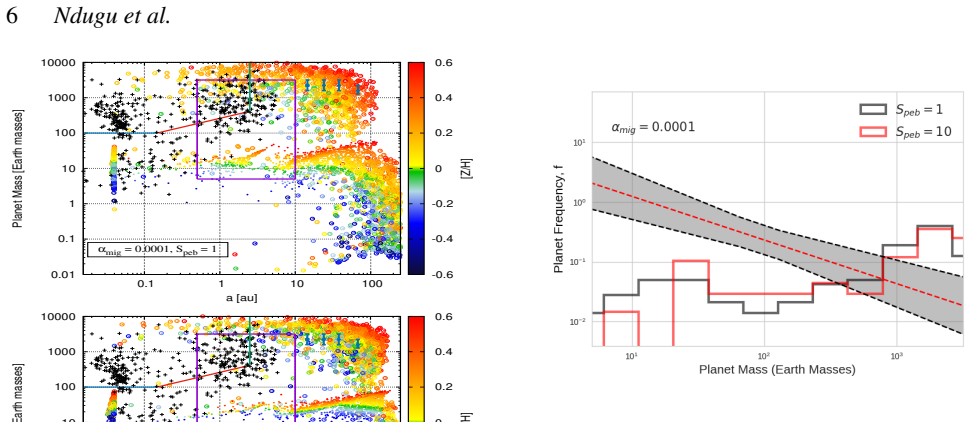
Explaining observed protoplanetary disc gaps with planets requires 2000 Earth masses of pebbles and produces mostly gas giants instead of super-Earths.
A machine-rendered reading of the paper's core claim, the machinery that carries it, and where it could break.
Core claim
In order to match the gap structures 2000 M_E in pebbles is needed, which would be only available for the most metal rich stars. Planet formation in discs with these large amounts of pebbles result in mostly forming gas giants and only very little super-Earths, contradicting observations. This leads to the conclusions that either (i) the observed discs are exceptions, (ii) not all gaps in observed discs are caused by planets or (iii) that we miss some important ingredients in planet formation related to gas accretion and/or planet migration.
What carries the argument
The pebble isolation mass, the planetary mass at which pebble accretion halts, a small gap opens, and a pressure bump forms exterior to the orbit that traps the largest dust particles.
If this is right
- Reproducing the gaps requires pebble reservoirs present only around the most metal-rich stars.
- Formation from such large pebble supplies produces a planet population dominated by gas giants.
- The resulting scarcity of super-Earths contradicts the observed exoplanet population.
- The mismatch implies that either the observed discs are atypical, that not every gap is opened by a planet, or that models miss key physics in gas accretion or migration.
Where Pith is reading between the lines
- If gaps are not produced by planets, alternative mechanisms such as disc instabilities or zonal flows may explain the ring structures.
- Revised treatments of type-I migration or gas accretion could permit more super-Earths even at high pebble masses.
- Correlating gap presence with host-star metallicity in large disc surveys would test the metal-rich requirement directly.
Load-bearing premise
That the planetary masses creating the observed small gaps and pressure bumps are exactly the pebble isolation mass and that the total pebble content of the disc can be adjusted as a free parameter to 2000 Earth masses.
What would settle it
A measurement of the actual pebble mass reservoir in a disc that shows the observed gap pattern, or a statistical comparison of the super-Earth to gas-giant ratio in systems whose discs exhibit similar gaps.
Figures




read the original abstract
Recent detailed observations of protoplanetary discs revealed a lot of sub-structures which are mostly ring-like. One interpretation is that these rings are caused by growing planets. These potential planets are not yet opening very deep gaps in their discs. These planets instead form small gaps in the discs to generate small pressure bumps exterior to their orbits that stop the inflow of the largest dust particles. In the pebble accretion paradigm, this planetary mass corresponds to the pebble isolation mass, where pebble accretion stops and efficient gas accretion starts. We perform planet population synthesis via pebble and gas accretion including type-I and type-II migration. In the first stage of our simulations, we investigate the conditions necessary for planets to reach the pebble isolation mass and compare their position to the observed gaps. We find that in order to match the gap structures 2000 M E in pebbles is needed, which would be only available for the most metal rich stars. We then follow the evolution of these planets for a few My to compare the resulting population with the observed exoplanet populations. Planet formation in discs with these large amounts of pebbles result in mostly forming gas giants and only very little super-Earths, contradicting observations. This leads to the conclusions that either (i) the observed discs are exceptions, (ii) not all gaps in observed discs are caused by planets or (iii) that we miss some important ingredients in planet formation related to gas accretion and/or planet migration.
Editorial analysis
A structured set of objections, weighed in public.
Referee Report
Summary. The paper uses planet population synthesis incorporating pebble accretion, gas accretion, and type-I/II migration to test whether observed ring-like gaps in protoplanetary discs can be produced by planets reaching the pebble isolation mass. In the first stage, the authors determine the pebble reservoir needed for planets to reach isolation mass at observed gap locations; they report that 2000 Earth masses of pebbles are required, available only for the most metal-rich stars. In the second stage, evolving these systems for a few Myr yields a population dominated by gas giants with very few super-Earths, in tension with exoplanet demographics. The authors conclude that the observed discs may be atypical, not all gaps are planetary, or important physics (gas accretion or migration) is missing from the model.
Significance. If the central tension holds after addressing the pebble-budget calibration, the work quantifies a potential inconsistency between disc substructure observations and exoplanet occurrence rates under the pebble-accretion paradigm. The explicit inclusion of both migration regimes and the two-stage approach (gap matching followed by long-term evolution) are strengths that allow a direct link between disc features and final demographics.
major comments (2)
- [first-stage simulations] First-stage gap-matching simulations: the total pebble mass is adjusted to 2000 M_E specifically so that planets reach pebble isolation mass at the radial locations of observed gaps. Because this value is not derived from an independent observational constraint on disc pebble content, metallicity distribution, or dust-to-gas ratio, the subsequent prediction of a giant-dominated population is a direct consequence of the fitted input rather than an independent test of the model.
- [second-stage evolution] Population synthesis results (second stage): the statement that the model forms 'mostly gas giants and only very little super-Earths' is presented qualitatively. Quantitative outputs (e.g., occurrence rate histograms or fractions as a function of pebble budget) are needed to substantiate the claimed contradiction with observed exoplanet populations.
minor comments (2)
- The abstract writes '2000 M E'; consistent notation '2000 M_E' should be used throughout.
- Clarify the assumed disc lifetime, stellar mass range, and how the 'few Myr' integration is terminated in the second stage.
Simulated Author's Rebuttal
We thank the referee for their thoughtful report and constructive suggestions. We address the two major comments point by point below.
read point-by-point responses
-
Referee: [first-stage simulations] First-stage gap-matching simulations: the total pebble mass is adjusted to 2000 M_E specifically so that planets reach pebble isolation mass at the radial locations of observed gaps. Because this value is not derived from an independent observational constraint on disc pebble content, metallicity distribution, or dust-to-gas ratio, the subsequent prediction of a giant-dominated population is a direct consequence of the fitted input rather than an independent test of the model.
Authors: We agree that the 2000 M_E value is chosen specifically to enable planets to reach pebble isolation mass at the observed gap radii; it is not taken from an independent disc-mass or metallicity constraint. The manuscript's logic is therefore conditional: if the gaps are produced by planets at isolation mass, then a pebble reservoir of this size is required (available only around the most metal-rich stars), and the subsequent population synthesis then shows the resulting demographic tension. We will revise the text to state this conditional framing explicitly and to remove any suggestion that the demographic result constitutes an independent test of the model. revision: partial
-
Referee: [second-stage evolution] Population synthesis results (second stage): the statement that the model forms 'mostly gas giants and only very little super-Earths' is presented qualitatively. Quantitative outputs (e.g., occurrence rate histograms or fractions as a function of pebble budget) are needed to substantiate the claimed contradiction with observed exoplanet populations.
Authors: We accept that the current description is qualitative. In the revised manuscript we will add quantitative diagnostics, including the fraction of planets that become gas giants versus super-Earths (and their occurrence-rate comparison to observations) for the adopted 2000 M_E pebble budget. These will be presented as additional figures or tables showing the final mass distribution after several Myr of evolution. revision: yes
Circularity Check
Pebble reservoir tuned to 2000 M_E to match gaps, then fed into population synthesis yielding demographic mismatch by construction
specific steps
-
fitted input called prediction
[Abstract]
"We find that in order to match the gap structures 2000 M E in pebbles is needed, which would be only available for the most metal rich stars. We then follow the evolution of these planets for a few My to compare the resulting population with the observed exoplanet populations. Planet formation in discs with these large amounts of pebbles result in mostly forming gas giants and only very little super-Earths, contradicting observations."
The pebble mass is varied until the isolation-mass planets appear at the observed gap locations; the same numerical value is inserted into the population-synthesis calculation, rendering the 'mostly gas giants' outcome a direct consequence of the fitted input rather than an independent prediction.
full rationale
The paper adjusts the total pebble reservoir as a free parameter until planets reach pebble isolation mass at observed gap radii. The identical tuned value (2000 M_E) is then used for the full evolutionary runs, so the reported excess of gas giants is a direct numerical outcome of that fit rather than an independent test. This is a single instance of the 'fitted input called prediction' pattern; the central claim therefore contains partial circularity but is not wholly self-referential.
Axiom & Free-Parameter Ledger
free parameters (1)
- total pebble mass
axioms (2)
- domain assumption Pebble isolation mass marks the transition where pebble accretion stops and efficient gas accretion begins, directly producing the observed small gaps.
- domain assumption Type-I and type-II migration prescriptions from prior literature accurately describe planet movement during growth.
Reference graph
Works this paper leans on
-
[1]
ALMA Partnership et al., 2015, @doi [ ] 10.1088/2041-8205/808/1/L3 , http://adsabs.harvard.edu/abs/2015ApJ...808L...3A 808, L3
work page internal anchor Pith review doi:10.1088/2041-8205/808/1/l3 2015
-
[3]
Andrews S. M., et al., 2016, @doi [ ] 10.3847/2041-8205/820/2/L40 , http://adsabs.harvard.edu/abs/2016ApJ...820L..40A 820, L40
-
[4]
Andrews S. M., et al., 2018, @doi [ ] 10.3847/2041-8213/aaf741 , http://adsabs.harvard.edu/abs/2018ApJ...869L..41A 869, L41
work page internal anchor Pith review doi:10.3847/2041-8213/aaf741 2018
-
[5]
Bai X.-N., 2013, @doi [ ] 10.1088/0004-637X/772/2/96 , http://adsabs.harvard.edu/abs/2013ApJ...772...96B 772, 96
-
[6]
Bai X.-N., 2014, @doi [ ] 10.1088/0004-637X/791/1/73 , http://adsabs.harvard.edu/abs/2014ApJ...791...73B 791, 73
-
[7]
Bai X.-N., Ye J., Goodman J., Yuan F., 2016, @doi [ ] 10.3847/0004-637X/818/2/152 , http://adsabs.harvard.edu/abs/2016ApJ...818..152B 818, 152
-
[9]
Baruteau C., et al., 2014, @doi [Protostars and Planets VI] 10.2458/azu_uapress_9780816531240-ch029 , http://adsabs.harvard.edu/abs/2014prpl.conf..667B pp 667--689
-
[11]
Bitsch B., Johansen A., 2016, @doi [ ] 10.1051/0004-6361/201527676 , http://adsabs.harvard.edu/abs/2016A
-
[12]
445, Astrophysics and Space Science Library
Bitsch B., Johansen A., 2017, in Pessah M., Gressel O., eds, Astrophysics and Space Science Library Vol. 445, Astrophysics and Space Science Library. p. 339, @doi 10.1007/978-3-319-60609-5_12
-
[14]
Bitsch B., Johansen A., Lambrechts M., Morbidelli A., 2015a, @doi [ ] 10.1051/0004-6361/201424964 , http://adsabs.harvard.edu/abs/2015A
-
[15]
Bitsch B., Lambrechts M., Johansen A., 2015b, @doi [ ] 10.1051/0004-6361/201526463 , http://adsabs.harvard.edu/abs/2015A
-
[16]
Bitsch B., Lambrechts M., Johansen A., 2018a, @doi [ ] 10.1051/0004-6361/201526463e , http://adsabs.harvard.edu/abs/2018A
-
[17]
Bitsch B., Morbidelli A., Johansen A., Lega E., Lambrechts M., Crida A., 2018b, @doi [ ] 10.1051/0004-6361/201731931 , http://adsabs.harvard.edu/abs/2018A
-
[18]
N., Izidoro A., 2019a, arXiv e-prints, http://adsabs.harvard.edu/abs/2019arXiv190302488B
Bitsch B., Raymond S. N., Izidoro A., 2019a, arXiv e-prints, http://adsabs.harvard.edu/abs/2019arXiv190302488B
-
[19]
N., Morbidelli A., Lambrechts M., Jacobson S
Bitsch B., Izidoro A., Johansen A., Raymond S. N., Morbidelli A., Lambrechts M., Jacobson S. A., 2019b, @doi [ ] 10.1051/0004-6361/201834489 , http://adsabs.harvard.edu/abs/2019A
-
[20]
Br \"u gger N., Alibert Y., Ataiee S., Benz W., 2018, @doi [ ] 10.1051/0004-6361/201833347 , http://adsabs.harvard.edu/abs/2018A
-
[21]
Cassan A., et al., 2012, @doi [ ] 10.1038/nature10684 , http://adsabs.harvard.edu/abs/2012Natur.481..167C 481, 167
-
[22]
Chambers J. E., 2016, @doi [ ] 10.3847/0004-637X/825/1/63 , http://adsabs.harvard.edu/abs/2016ApJ...825...63C 825, 63
-
[23]
Chambers J., 2018, @doi [ ] 10.3847/1538-4357/aada09 , http://adsabs.harvard.edu/abs/2018ApJ...865...30C 865, 30
-
[24]
I., Goldreich P., 1997, , http://adsabs.harvard.edu/abs/1997ApJ...490..368C 490, 368
Chiang E. I., Goldreich P., 1997, , http://adsabs.harvard.edu/abs/1997ApJ...490..368C 490, 368
work page 1997
-
[25]
Cieza L. A., et al., 2019, @doi [ ] 10.1093/mnras/sty2653 , https://ui.adsabs.harvard.edu/abs/2019MNRAS.482..698C 482, 698
-
[26]
Coleman G. A. L., Nelson R. P., 2016, @doi [ ] 10.1093/mnras/stw1177 , http://adsabs.harvard.edu/abs/2016MNRAS.460.2779C 460, 2779
-
[27]
N., Pierens A., 2013, @doi [ ] 10.1051/0004-6361/201220853 , http://adsabs.harvard.edu/abs/2013A
Cossou C., Raymond S. N., Pierens A., 2013, @doi [ ] 10.1051/0004-6361/201220853 , http://adsabs.harvard.edu/abs/2013A
-
[28]
Crida A., Morbidelli A., Masset F., 2006, @doi [ ] 10.1016/j.icarus.2005.10.007 , http://adsabs.harvard.edu/abs/2006Icar..181..587C 181, 587
-
[29]
Dullemond C. P., et al., 2018, @doi [ ] 10.3847/2041-8213/aaf742 , http://adsabs.harvard.edu/abs/2018ApJ...869L..46D 869, L46
-
[30]
Fedele D., et al., 2017, @doi [ ] 10.1051/0004-6361/201629860 , http://adsabs.harvard.edu/abs/2017A
-
[31]
Flock M., Ruge J. P., Dzyurkevich N., Henning T., Klahr H., Wolf S., 2015, @doi [ ] 10.1051/0004-6361/201424693 , http://adsabs.harvard.edu/abs/2015A
-
[32]
Gonzalez J.-F., Laibe G., Maddison S. T., 2017, @doi [ ] 10.1093/mnras/stx016 , http://adsabs.harvard.edu/abs/2017MNRAS.467.1984G 467, 1984
-
[33]
Gressel O., Turner N. J., Nelson R. P., McNally C. P., 2015, @doi [ ] 10.1088/0004-637X/801/2/84 , http://adsabs.harvard.edu/abs/2015ApJ...801...84G 801, 84
-
[34]
Hartmann L., Calvet N., Gullbring E., D'Alessio P., 1998, @doi [ ] 10.1086/305277 , http://adsabs.harvard.edu/abs/1998ApJ...495..385H 495, 385
-
[35]
Huang J., et al., 2018, @doi [ ] 10.3847/2041-8213/aaf740 , http://adsabs.harvard.edu/abs/2018ApJ...869L..42H 869, L42
-
[36]
Ida S., Lin D. N. C., 2004, @doi [ ] 10.1086/381724 , http://adsabs.harvard.edu/abs/2004ApJ...604..388I 604, 388
-
[37]
Ida S., Tanaka H., Johansen A., Kanagawa K. D., Tanigawa T., 2018, @doi [ ] 10.3847/1538-4357/aad69c , http://adsabs.harvard.edu/abs/2018ApJ...864...77I 864, 77
-
[38]
Isella A., et al., 2016, @doi [Physical Review Letters] 10.1103/PhysRevLett.117.251101 , http://adsabs.harvard.edu/abs/2016PhRvL.117y1101I 117, 251101
-
[39]
Izidoro A., Ogihara M., Raymond S. N., Morbidelli A., Pierens A., Bitsch B., Cossou C., Hersant F., 2017, @doi [ ] 10.1093/mnras/stx1232 , http://adsabs.harvard.edu/abs/2017MNRAS.470.1750I 470, 1750
-
[40]
N., Johansen A., Morbidelli A., Lambrechts M., Jacobson S
Izidoro A., Bitsch B., Raymond S. N., Johansen A., Morbidelli A., Lambrechts M., Jacobson S. A., 2019, arXiv e-prints, http://adsabs.harvard.edu/abs/2019arXiv190208772I
work page 2019
-
[41]
Johansen A., Lacerda P., 2010, @doi [ ] 10.1111/j.1365-2966.2010.16309.x , http://adsabs.harvard.edu/abs/2010MNRAS.404..475J 404, 475
-
[43]
Johansen A., Mac Low M.-M., Lacerda P., Bizzarro M., 2015b, @doi [Science Advances] 10.1126/sciadv.1500109 , http://adsabs.harvard.edu/abs/2015SciA....115109J 1, 1500109
-
[44]
Johansen A., Ida S., Brasser R., 2019, @doi [ ] 10.1051/0004-6361/201834071 , http://adsabs.harvard.edu/abs/2019A
-
[45]
Johnson J. A., Aller K. M., Howard A. W., Crepp J. R., 2010, @doi [ ] 10.1086/655775 , http://adsabs.harvard.edu/abs/2010PASP..122..905J 122, 905
-
[46]
Juri \'c M., Tremaine S., 2008, @doi [ ] 10.1086/590047 , http://adsabs.harvard.edu/abs/2008ApJ...686..603J 686, 603
-
[50]
A., Johansen A., Bitsch B., Izidoro A., Raymond S
Lambrechts M., Morbidelli A., Jacobson S. A., Johansen A., Bitsch B., Izidoro A., Raymond S. N., 2019, arXiv e-prints, http://adsabs.harvard.edu/abs/2019arXiv190208694L
work page 2019
-
[51]
Levison H. F., Thommes E., Duncan M. J., 2010, @doi [ ] 10.1088/0004-6256 , http://adsabs.harvard.edu/abs/2010AJ....139.1297L 139, 1297
-
[52]
Levison H. F., Kretke K. A., Duncan M. J., 2015, @doi [ ] 10.1038/nature14675 , http://adsabs.harvard.edu/abs/2015Natur.524..322L 524, 322
-
[53]
W., 2018, @doi [ ] 10.1051/0004-6361/201732307 , http://adsabs.harvard.edu/abs/2018A
Liu B., Ormel C. W., 2018, @doi [ ] 10.1051/0004-6361/201732307 , http://adsabs.harvard.edu/abs/2018A
-
[54]
Long F., et al., 2018, @doi [ ] 10.3847/1538-4357/aae8e1 , https://ui.adsabs.harvard.edu/abs/2018ApJ...869...17L 869, 17
-
[55]
Lor \'e n-Aguilar P., Bate M. R., 2016, @doi [ ] 10.1093/mnrasl/slv206 , http://adsabs.harvard.edu/abs/2016MNRAS.457L..54L 457, L54
-
[56]
Machida M. N., Kokubo E., Inutsuka S.-I., Matsumoto T., 2010, @doi [ ] 10.1111/j.1365-2966.2010.16527.x , http://adsabs.harvard.edu/abs/2010MNRAS.405.1227M 405, 1227
-
[57]
Initial Conditions of Planet Formation: Lifetimes of Primordial Disks
Mamajek E. E., 2009, in Usuda T., Tamura M., Ishii M., eds, American Institute of Physics Conference Series Vol. 1158, American Institute of Physics Conference Series. pp 3--10 ( @eprint arXiv 0906.5011 ), @doi 10.1063/1.3215910
work page internal anchor Pith review Pith/arXiv arXiv doi:10.1063/1.3215910 2009
-
[58]
Mayor M., et al., 2011, preprint, http://adsabs.harvard.edu/abs/2011arXiv1109.2497M ( @eprint arXiv 1109.2497 )
work page internal anchor Pith review Pith/arXiv arXiv 2011
-
[59]
Monsch K., Ercolano B., Picogna G., Preibisch T., Rau M. M., 2019, @doi [ ] 10.1093/mnras/sty3346 , https://ui.adsabs.harvard.edu/abs/2019MNRAS.483.3448M 483, 3448
-
[60]
Morbidelli A., Nesvorny D., 2012, @doi [ ] 10.1051/0004-6361/201219824 , http://adsabs.harvard.edu/abs/2012A
-
[61]
Morbidelli A., Lambrechts M., Jacobson S., Bitsch B., 2015, @doi [ ] 10.1016/j.icarus.2015.06.003 , http://adsabs.harvard.edu/abs/2015Icar..258..418M 258, 418
-
[63]
Movshovitz N., Podolak M., 2008, @doi [ ] 10.1016/j.icarus.2007.09.018 , http://adsabs.harvard.edu/abs/2008Icar..194..368M 194, 368
-
[64]
D., Pascucci I., Apai D., Ciesla F
Mulders G. D., Pascucci I., Apai D., Ciesla F. J., 2018, @doi [ ] 10.3847/1538-3881/aac5ea , http://adsabs.harvard.edu/abs/2018AJ....156...24M 156, 24
-
[65]
Nayakshin S., Dipierro G., Szulagyi J., 2019, arXiv e-prints, https://ui.adsabs.harvard.edu/abs/2019arXiv190513104N
work page 2019
-
[66]
Ndugu N., Bitsch B., Jurua E., 2018, @doi [ ] 10.1093/mnras/stx2815 , http://adsabs.harvard.edu/abs/2018MNRAS.474..886N 474, 886
-
[67]
Okuzumi S., Momose M., Sirono S.-i., Kobayashi H., Tanaka H., 2016, @doi [ ] 10.3847/0004-637X/821/2/82 , http://adsabs.harvard.edu/abs/2016ApJ...821...82O 821, 82
-
[68]
Ormel C. W., Klahr H. H., 2010, @doi [ ] 10.1051/0004-6361/201014903 , http://adsabs.harvard.edu/abs/2010A
-
[69]
W., Liu B., 2018, @doi [ ] 10.1051/0004-6361/201732562 , http://adsabs.harvard.edu/abs/2018A
Ormel C. W., Liu B., 2018, @doi [ ] 10.1051/0004-6361/201732562 , http://adsabs.harvard.edu/abs/2018A
-
[70]
Paardekooper S.-J., Mellema G., 2006, @doi [ ] 10.1051/0004-6361:20054449 , http://adsabs.harvard.edu/abs/2006A
-
[71]
Paardekooper S.-J., Baruteau C., Kley W., 2011, @doi [ ] 10.1111/j.1365-2966.2010.17442.x , http://adsabs.harvard.edu/abs/2011MNRAS.410..293P 410, 293
-
[72]
Pinilla P., Birnstiel T., Ricci L., Dullemond C. P., Uribe A. L., Testi L., Natta A., 2012a, @doi [ ] 10.1051/0004-6361/201118204 , http://adsabs.harvard.edu/abs/2012A
-
[73]
Pinilla P., Benisty M., Birnstiel T., 2012b, @doi [ ] 10.1051/0004-6361/201219315 , http://adsabs.harvard.edu/abs/2012A
-
[74]
Pinilla P., et al., 2015, @doi [ ] 10.1051/0004-6361/201526655 , http://adsabs.harvard.edu/abs/2015A
-
[75]
Piso A.-M. A., Youdin A. N., 2014, @doi [ ] 10.1088/0004-637X , http://adsabs.harvard.edu/abs/2014ApJ...786...21P 786, 21
-
[76]
Semenov D., Henning T., Helling C., Ilgner M., Sedlmayr E., 2003, @doi [ ] 10.1051/0004-6361:20031279 , https://ui.adsabs.harvard.edu/abs/2003A
-
[77]
Sotiriadis S., Libert A.-S., Bitsch B., Crida A., 2017, @doi [ ] 10.1051/0004-6361 , http://adsabs.harvard.edu/abs/2017A\
-
[78]
Suzuki T. K., Ogihara M., Morbidelli A., Crida A., Guillot T., 2016, @doi [ ] 10.1051/0004-6361/201628955 , http://adsabs.harvard.edu/abs/2016A
-
[79]
Suzuki D., et al., 2018, @doi [ ] 10.3847/2041-8213/aaf577 , http://adsabs.harvard.edu/abs/2018ApJ...869L..34S 869, L34
-
[80]
Takahashi S. Z., Inutsuka S.-i., 2016, @doi [ ] 10.3847/0004-6256/152/6/184 , http://adsabs.harvard.edu/abs/2016AJ....152..184T 152, 184
-
[81]
Tanaka H., Ida S., 1999, @doi [ ] 10.1006/icar.1999.6107 , http://adsabs.harvard.edu/abs/1999Icar..139..350T 139, 350
-
[82]
Turner N. J., Fromang S., Gammie C., Klahr H., Lesur G., Wardle M., Bai X.-N., 2014, @doi [Protostars and Planets VI] 10.2458/azu_uapress_9780816531240-ch018 , http://adsabs.harvard.edu/abs/2014prpl.conf..411T pp 411--432
-
[83]
Walsh C., et al., 2014, @doi [ ] 10.1088/2041-8205/791/1/L6 , http://adsabs.harvard.edu/abs/2014ApJ...791L...6W 791, L6
-
[84]
J., 2006, , http://adsabs.harvard.edu/abs/2006Icar..181..572W 181, 572
Weidenschilling S. J., 2006, , http://adsabs.harvard.edu/abs/2006Icar..181..572W 181, 572
work page 2006
-
[85]
L., 1972, in Elvius A., ed., From Plasma to Planet
Whipple F. L., 1972, in Elvius A., ed., From Plasma to Planet. p. 211
work page 1972
-
[86]
Zhang K., Blake G. A., Bergin E. A., 2015, @doi [ ] 10.1088/2041-8205/806/1/L7 , http://adsabs.harvard.edu/abs/2015ApJ...806L...7Z 806, L7
-
[87]
van der Marel N., Pinilla P., Tobin J., van Kempen T., Andrews S., Ricci L., Birnstiel T., 2015, @doi [ ] 10.1088/2041-8205/810/1/L7 , http://adsabs.harvard.edu/abs/2015ApJ...810L...7V 810, L7
-
[88]
van der Marel N., Dong R., di Francesco J., Williams J. P., Tobin J., 2019, @doi [ ] 10.3847/1538-4357/aafd31 , http://adsabs.harvard.edu/abs/2019ApJ...872..112V 872, 112
-
[89]
" write newline "" before.all 'output.state := FUNCTION fin.entry write newline FUNCTION new.block output.state before.all = 'skip after.block 'output.state := if FUNCTION new.sentence output.state after.block = 'skip output.state before.all = 'skip after.sentence 'output.state := if if FUNCTION not #0 #1 if FUNCTION and 'skip pop #0 if FUNCTION or pop #1...
discussion (0)
Sign in with ORCID, Apple, or X to comment. Anyone can read and Pith papers without signing in.