Estimation of nucleon D-term in QCD
Pith reviewed 2026-05-25 14:47 UTC · model grok-4.3
The pith
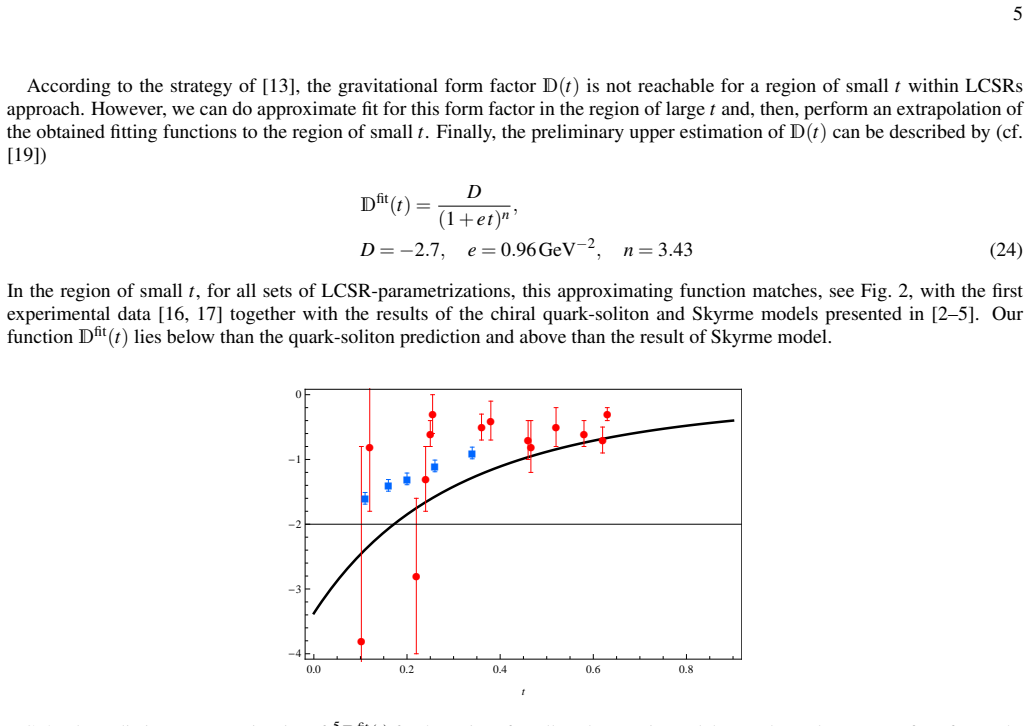
Light-cone sum rules at leading order yield a preliminary upper estimate for the nucleon gravitational form factor D(t).
A machine-rendered reading of the paper's core claim, the machinery that carries it, and where it could break.
Core claim
Using the light-cone sum rules at leading order, the authors present an approach to perform the preliminary upper estimation for the nucleon gravitational form factor D(t) (D-term contribution). Comparison with the experimental data and with the results of different models is discussed.
What carries the argument
Leading-order light-cone sum rules applied to the nucleon matrix elements of the energy-momentum tensor to bound the D-term form factor D(t).
If this is right
- The D-term receives a concrete QCD-derived upper limit that can be tested against data from deeply virtual Compton scattering.
- The bound supplies a benchmark against which model calculations of nucleon mechanical properties can be checked.
- The same sum-rule framework can in principle be applied to other gravitational form factors of the nucleon.
- If the upper limit holds, it restricts the allowable range of pressure distributions inside the nucleon.
Where Pith is reading between the lines
- Inclusion of higher-order perturbative corrections would be needed to convert the present upper estimate into a more precise central value.
- The method could be extended to strange or heavy baryons to compare D-term behavior across the baryon octet.
- Direct comparison with lattice QCD evaluations of the same matrix elements would provide an independent cross-check of the bound.
Load-bearing premise
The leading-order light-cone sum rule approximation is sufficient to produce a meaningful upper bound on D(t) without higher-order corrections or additional systematic uncertainties that would invalidate the bound.
What would settle it
A next-to-leading-order light-cone sum rule calculation or a direct experimental measurement that places D(t) above the reported upper bound at any accessible momentum transfer would falsify the claim.
Figures
read the original abstract
Using the light-cone sum rules at leading order, we present an approach to perform the preliminary upper estimation for the nucleon gravitational form factor $D(t)$ ($D$-term contribution). Comparison with the experimental data and with the results of different models is discussed.
Editorial analysis
A structured set of objections, weighed in public.
Referee Report
Summary. The paper proposes using leading-order light-cone sum rules to obtain a preliminary upper estimate for the nucleon gravitational form factor D(t) (the D-term contribution) and compares the result to experimental data and other models.
Significance. If the upper bound is robust against higher-order effects, it would supply a useful QCD-derived constraint on D(t) at low momentum transfer, which encodes information on the nucleon's mechanical properties. The approach is presented as preliminary, which appropriately tempers expectations given the LO truncation.
major comments (1)
- [Abstract] Abstract and introduction: the central claim that leading-order LCSR produces a meaningful preliminary upper bound on D(t) is load-bearing for the paper's result, yet the manuscript provides no estimate or bound on the size of omitted NLO perturbative corrections, higher-twist contributions, or variations in Borel window/continuum threshold. In analogous LCSR applications to nucleon form factors these corrections are typically O(30-100)%, which could shift or invalidate the reported upper limit.
minor comments (1)
- The abstract states that comparisons with data and models are discussed, but the manuscript should clarify the kinematic range of t over which the bound is claimed to apply.
Simulated Author's Rebuttal
We thank the referee for the careful reading of our manuscript and the constructive comment. We address the major point below.
read point-by-point responses
-
Referee: [Abstract] Abstract and introduction: the central claim that leading-order LCSR produces a meaningful preliminary upper bound on D(t) is load-bearing for the paper's result, yet the manuscript provides no estimate or bound on the size of omitted NLO perturbative corrections, higher-twist contributions, or variations in Borel window/continuum threshold. In analogous LCSR applications to nucleon form factors these corrections are typically O(30-100)%, which could shift or invalidate the reported upper limit.
Authors: We agree that the manuscript does not provide quantitative estimates of NLO perturbative corrections, higher-twist contributions, or parameter variations. The work is presented as a leading-order preliminary estimate, and the upper bound should be interpreted in that restricted context. In the revised version we will expand the abstract and introduction to explicitly reference the typical magnitude of such corrections in related nucleon LCSR studies and to state more clearly that the reported bound is subject to these uncertainties. A full NLO calculation remains outside the scope of this preliminary study. revision: partial
Circularity Check
No circularity: standard LCSR estimation with independent inputs
full rationale
The paper applies leading-order light-cone sum rules to obtain a preliminary upper bound on the nucleon D-term form factor. The derivation relies on standard QCD sum-rule machinery (correlation functions, Borel transform, continuum subtraction) whose parameters are chosen from external stability criteria rather than being fitted directly to D(t) itself. No equation reduces the claimed bound to a self-definition, a renamed fit, or a load-bearing self-citation chain; the result is presented as an estimate whose validity rests on the usual LCSR assumptions, not on tautological re-expression of its inputs.
Axiom & Free-Parameter Ledger
Reference graph
Works this paper leans on
-
[1]
Estimation of nucleon D-term in QCD
which can be called as the last unknown fundamental hadron characteristic determining the spatial deformations as well as defining the mechanical properties of hadrons [1, 2, 6]. The analogy of D-term with the vacuum cosmological constant has been studed in [10]. The D-term has also been calculated in the framework of the dispersion relation approach where...
work page internal anchor Pith review Pith/arXiv arXiv 1906
-
[2]
Generalized parton distributions and strong forces inside nucleons and nuclei.Phys
Polyakov M.V . Generalized parton distributions and strong forces inside nucleons and nuclei.Phys. Lett. B 2003, 555, 57
work page 2003
-
[3]
Forces inside hadrons: pressure, surface tension, mechanical radius, and all that.Int
Polyakov M.V .; Schweitzer P. Forces inside hadrons: pressure, surface tension, mechanical radius, and all that.Int. J. Mod. Phys. A 2018, 33, 1830025
work page 2018
-
[4]
Nucleon form-factors of the energy momentum tensor in the chiral quark-soliton model
Goeke K.; Grabis J.; Ossmann J.; Polyakov M.V .; Schweitzer P.; Silva A.; Urbano D. Nucleon form-factors of the energy momentum tensor in the chiral quark-soliton model. Phys. Rev. D 2007 75, 094021
work page 2007
-
[5]
Goeke K.; Grabis J.; Ossmann J.; Schweitzer P.; Silva A.; Urbano D. The pion mass dependence of the nucleon form-factors of the energy momentum tensor in the chiral quark-soliton model. Phys. Rev. C 2007 75, 055207
work page 2007
-
[6]
The Nucleon form-factors of the energy momentum tensor in the Skyrme model
Cebulla C.; Goeke K.; Ossmann J.; Schweitzer P. The Nucleon form-factors of the energy momentum tensor in the Skyrme model. Nucl. Phys. A 2007 794, 87
work page 2007
-
[7]
Nucleon gravitational form factors from instantons: forces between quark and gluon subsystems
Polyakov M.V .; Son H.D. Nucleon gravitational form factors from instantons: forces between quark and gluon subsystems. arXiv:1808.00155 [hep-ph]
work page internal anchor Pith review Pith/arXiv arXiv
-
[8]
Unraveling hadron structure with generalized parton distributions.Phys
Belitsky A.V .; Radyushkin A.V . Unraveling hadron structure with generalized parton distributions.Phys. Rept. 2005, 418, 1
work page 2005
-
[9]
Generalized parton distributions
Diehl M. Generalized parton distributions. Phys. Rept. 2003, 388, 41
work page 2003
-
[10]
DVCS on the nucleon: Study of the twist - three effects.Phys
Kivel N.; Polyakov M.V .; Vanderhaeghen M. DVCS on the nucleon: Study of the twist - three effects.Phys. Rev. D 2001, 63, 114014
work page 2001
-
[11]
Teryaev O. Analyticity and higher twists. Nucl. Phys. Proc. Suppl. 2013, 245, 195
work page 2013
-
[12]
Dispersive evaluation of the D-term form factor in deeply virtual Compton scattering
Pasquini B.; Polyakov M.V .; Vanderhaeghen M. Dispersive evaluation of the D-term form factor in deeply virtual Compton scattering. Phys. Lett. B 2014, 739, 133
work page 2014
-
[13]
Revisiting the mechanical properties of the nucleon
Lorcé C.; Moutarde H.; Trawinski A.P. Revisiting the mechanical properties of the nucleon. Eur. Phys. J. C 2019, 79, 89
work page 2019
-
[14]
Nucleon Form Factors and Distribution Amplitudes in QCD.Phys
Anikin I.V .; Braun V .M.; Offen N. Nucleon Form Factors and Distribution Amplitudes in QCD.Phys. Rev. D 2013, 88, 114021
work page 2013
-
[15]
Electroproduction of theN∗(1535) nucleon resonance in QCD
Anikin I.V .; Braun V .M.; Offen N. Electroproduction of theN∗(1535) nucleon resonance in QCD. Phys. Rev. D 2015, 92, 014018
work page 2015
-
[16]
Axial form factor of the nucleon at large momentum transfers.Phys
Anikin I.V .; Braun V .M.; Offen N. Axial form factor of the nucleon at large momentum transfers.Phys. Rev. D 2016, 94, 034011
work page 2016
-
[17]
Hagler P. [LHPC Collaboration]. Nucleon Generalized Parton Distributions from Full Lattice QCD. Phys. Rev. D 2008, 77, 094502
work page 2008
-
[18]
The pressure distribution inside the proton.Nature 2018, 557, 396
Burkert V .D.; Elouadrhiri L.; Girod F.X. The pressure distribution inside the proton.Nature 2018, 557, 396
work page 2018
-
[19]
Evolution Equations for QCD String Operators.Nucl
Balitsky I.I.; Braun V .M. Evolution Equations for QCD String Operators.Nucl. Phys. B 1989, 311, 541
work page 1989
-
[20]
Operator relations for gravitational form factors of a spin-0 hadron
Tanaka K. Operator relations for gravitational form factors of a spin-0 hadron. Phys. Rev. D 2018, 98, 034009
work page 2018
-
[21]
Balitsky I.I.; Braun V .M.; Kolesnichenko A.V .Σ+→ Pγ Decay in QCD. Sov. J. Nucl. Phys. 1986, 44, 1028
work page 1986
-
[22]
Radiative Decay Sigma+ —> p gamma in Quantum Chromodynamics
Balitsky I.I.; Braun V .M.; Kolesnichenko A.V . Radiative Decay Sigma+ —> p gamma in Quantum Chromodynamics. Nucl. Phys. B 1989, 312, 509
work page 1989
-
[23]
Nucleon Form Factors in QCD.Phys
Braun V .M.; Lenz A.; Wittmann M. Nucleon Form Factors in QCD.Phys. Rev. D 2006, 73, 094019
work page 2006
-
[24]
Light cone sum rules for the nucleon form-factors.Phys
Braun V .M.; Lenz A.; Mahnke N.; Stein E. Light cone sum rules for the nucleon form-factors.Phys. Rev. D 2002, 65, 074011. 7
work page 2002
discussion (0)
Sign in with ORCID, Apple, or X to comment. Anyone can read and Pith papers without signing in.