Transformation Properties under the Operations of the Molecular Symmetry Groups G₃₆ and G₃₆(EM) of Ethane H₃CCH₃
Pith reviewed 2026-05-25 13:49 UTC · model grok-4.3
The pith
Ethane's symmetry groups G36 and G36(EM) have explicit irreducible transformation matrices derived from four or five generators.
A machine-rendered reading of the paper's core claim, the machinery that carries it, and where it could break.
Core claim
We present the derivation of irreducible transformation matrices for all 36 (72) operations of G36 (G36(EM)) and also describe algorithms for a numerical construction of these matrices based on a set of four (five) generators. The derived transformation matrices associated with G36(EM) have been implemented in the variational nuclear motion program TROVE. The methodology is illustrated on the construction of the symmetry-adapted representations both of the potential energy function of ethane and of the rotation, torsion and vibration basis set functions.
What carries the argument
The set of four (five) generators that produce the full set of irreducible transformation matrices for the 36 (72) group operations acting on the ro-vibrational basis.
If this is right
- The Hamiltonian matrix for ethane factors into independent blocks labeled by the irreducible representations of G36(EM).
- Symmetry-adapted basis functions for rotation, torsion and vibration can be generated automatically for any size of basis.
- The same generator procedure yields symmetry-adapted expansions of the potential energy surface.
- The matrices are already coded inside TROVE, so the method is immediately available for numerical work on ethane and similar species.
Where Pith is reading between the lines
- The generator technique could be reused for other molecules that possess internal rotation and the same extended symmetry structure.
- Numerical generation from generators removes the need to tabulate hundreds of matrices by hand and may reduce transcription errors.
- Once the matrices exist, it becomes straightforward to project any operator or basis onto individual symmetry species without re-deriving the action each time.
Load-bearing premise
The selected generators produce every group operation on the chosen basis without extra phase or sign conventions that would have to be adjusted by hand when the basis grows or the molecule changes.
What would settle it
A direct multiplication check in which the matrix for the product of two generators differs from the product of their individual matrices when both are applied to the same basis function.
Figures




read the original abstract
In the present work, we report a detailed description of the symmetry properties of the eight-atomic molecule ethane, with the aim of facilitating the variational calculations of rotation-vibration spectra of ethane and related molecules. Ethane consists of two methyl groups $\text{CH}_3$ where the internal rotation (torsion) of one $\text{CH}_3$ group relative to the other is of large amplitude and involves tunneling between multiple minima of the potential energy function. The molecular symmetry group of ethane is the 36-element group $G_{36}$ but the construction of symmetrized basis functions is most conveniently done in terms of the 72-element extended molecular symmetry group $G_{36}\text{(EM)}$. This group can subsequently be used in the construction of block-diagonal matrix representations of the ro-vibrational Hamiltonian for ethane. The derived transformation matrices associated with $G_{36}\text{(EM)}$ have been implemented in the variational nuclear motion program TROVE (Theoretical ROVibrational Energies). TROVE variational calculations will be used as a practical example of a $G_{36}\text{(EM)}$ symmetry adaptation for large systems with a non-rigid, torsional degree of freedom. We present the derivation of irreducible transformation matrices for all 36 (72) operations of $G_{36}\text{(M)}$ ($G_{36}\text{(EM)}$) and also describe algorithms for a numerical construction of these matrices based on a set of four (five) generators. The methodology presented is illustrated on the construction of the symmetry-adapted representations both of the potential energy function of ethane and of the rotation, torsion and vibration basis set functions.
Editorial analysis
A structured set of objections, weighed in public.
Referee Report
Summary. The paper derives irreducible transformation matrices for all 36 operations of the molecular symmetry group G36 and all 72 operations of the extended group G36(EM) for ethane, presents algorithms for their numerical construction from a fixed set of four (five) generators, and describes their implementation in the TROVE variational program for symmetry-adapted ro-vibrational basis functions and potential energy surfaces.
Significance. If the matrices and generator-driven algorithm are correct and close under the group, the work supplies a practical, reproducible route to block-diagonal Hamiltonian matrices for molecules with large-amplitude torsion; this directly supports high-accuracy variational spectra calculations for ethane and related systems. The explicit implementation in TROVE and the generator-based numerical method are concrete strengths that lower the barrier for symmetry adaptation in large non-rigid molecules.
major comments (1)
- [Abstract / numerical construction section] Abstract and the section on numerical construction: the claim that the chosen set of four (five) generators produces all irreducible matrices without additional phase or sign conventions for the torsional factors e^{i m τ} is load-bearing for the 'automatic' algorithm. No explicit verification is shown that the generated matrices satisfy the full G36(EM) multiplication table (including operations such as (123)(456) and extended inversion) for an enlarged vibrational basis; a single counter-example would require case-by-case adjustments and undermine the generator-only procedure.
minor comments (2)
- The notation for the basis functions (rotation, torsion, vibration) should be defined once with explicit phase conventions before the generator action is applied.
- A short table listing the four (five) generators and their explicit action on each coordinate would improve readability of the algorithm description.
Simulated Author's Rebuttal
We thank the referee for their careful review and for highlighting a key aspect of the numerical construction. We respond to the major comment below and will revise the manuscript to incorporate the requested verification.
read point-by-point responses
-
Referee: [Abstract / numerical construction section] Abstract and the section on numerical construction: the claim that the chosen set of four (five) generators produces all irreducible matrices without additional phase or sign conventions for the torsional factors e^{i m τ} is load-bearing for the 'automatic' algorithm. No explicit verification is shown that the generated matrices satisfy the full G36(EM) multiplication table (including operations such as (123)(456) and extended inversion) for an enlarged vibrational basis; a single counter-example would require case-by-case adjustments and undermine the generator-only procedure.
Authors: We agree that an explicit verification of closure under the full multiplication table would strengthen the presentation. The four (five) generators were selected to obey the defining relations of G_{36}(EM), so that the generated matrices form a faithful representation by construction and require no additional phase or sign conventions for the torsional factors. During implementation we confirmed that composite operations, including (123)(456) and the extended inversion, are reproduced correctly by products of the generated matrices for the vibrational basis employed in TROVE. To make this transparent we will add a short verification subsection (or appendix) in the revised manuscript that tabulates selected products for both the original and an enlarged vibrational basis, confirming that the generator-only procedure holds without case-by-case adjustments. revision: yes
Circularity Check
No circularity: derivation rests on standard group-theory generators and definitions
full rationale
The paper derives irreducible transformation matrices for G36 and G36(EM) via explicit construction from a fixed set of four (five) generators, then implements them in TROVE. No equations reduce a claimed prediction or matrix element to a fitted parameter or self-citation chain inside the paper; the construction follows ordinary group-theory multiplication rules applied to the chosen basis (rotation, torsion, vibration functions). The central claim is therefore self-contained against external group-theory benchmarks and does not collapse by definition to its inputs.
Axiom & Free-Parameter Ledger
axioms (2)
- domain assumption The 36-element group G36 is the correct molecular symmetry group for ethane with feasible internal rotation.
- domain assumption The 72-element extension G36(EM) is the appropriate group for constructing symmetrized basis functions before projection onto G36.
Lean theorems connected to this paper
-
IndisputableMonolith/Foundation/AbsoluteFloorClosure.leanreality_from_one_distinction unclear?
unclearRelation between the paper passage and the cited Recognition theorem.
We present the derivation of irreducible transformation matrices for all 36 (72) operations of G36 (G36(EM)) and also describe algorithms for a numerical construction of these matrices based on a set of four (five) generators.
-
IndisputableMonolith/Foundation/ArithmeticFromLogic.leanLogicNat recovery unclear?
unclearRelation between the paper passage and the cited Recognition theorem.
The MS group G36 has been the subject of a number of studies... G36 = C(−)3v × C(+)3v
What do these tags mean?
- matches
- The paper's claim is directly supported by a theorem in the formal canon.
- supports
- The theorem supports part of the paper's argument, but the paper may add assumptions or extra steps.
- extends
- The paper goes beyond the formal theorem; the theorem is a base layer rather than the whole result.
- uses
- The paper appears to rely on the theorem as machinery.
- contradicts
- The paper's claim conflicts with a theorem or certificate in the canon.
- unclear
- Pith found a possible connection, but the passage is too broad, indirect, or ambiguous to say the theorem truly supports the claim.
Reference graph
Works this paper leans on
-
[1]
Representation Matrices for the G Irreducible Representation of G36 We now aim at determining a set of 4× 4 matrices constituting the irrep G of G36. In principle, we could continue as outlined in the preceding section by utilizing that G = ( Γ(−), Γ(+) ) = ( E, E). However, this would imply that we use the 2× 2 E-representation matrices for C(−) 3v and C...
work page 2018
-
[2]
Generation of a Symmetry Adapted Basis Set for Ethane As mentioned in Section 1, the analysis in the present paper is analogous to previous work [2] on the point groupD∞h of acetylene and other centrosymmetric linear molecules. Also in the present work, we use the variational nuclear-motion program TROVE in the generation of a symmetry-adapted ro-vibratio...
work page 2018
-
[3]
the C – C bond length R,
-
[4]
six C – H bond lengths rk, k = 1, 2, . . . , 6,
-
[5]
six bond angles ∠(Hk-C-C) = αk, k = 1, 2, . . . , 6,
-
[6]
four dihedral-angle coordinates γ1, γ2, δ1, and δ2,
-
[7]
the torsional angle τ, and
-
[8]
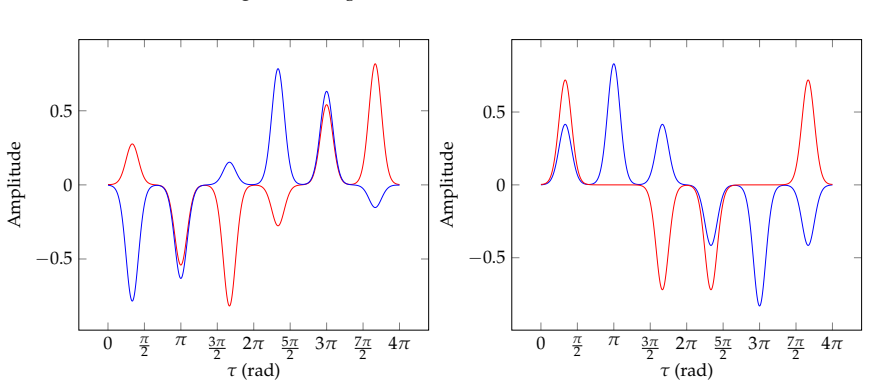
the three rotational angles (θ, φ, χ). Symmetry 2018, xx, x 11 of 37 The primitive basis functions for subsets 1, 2, 3, and 5 are obtained using the Numerov-Cooley approach [3,42,43], while we use harmonic-oscillator eigenfunctions [1] for subset 4. The primitive basis set 5 is obtained by solving the 1D torsional Schrödinger equation [ − 1 2 ∂ ∂τ g1D τ,τ...
work page 2018
-
[9]
in terms of (γ1, γ2). The transformation matrix for (γ1, γ2) for (123)(456), and the ones for the other generating operations, obtained in a similar manner, are ( γ′ 1 γ′ 2 ) = ( − 1 2 − √ 3 2√ 3 2 − 1 2 ) ( γ1 γ2 ) for (123)(456), ( γ′ 1 γ′ 2 ) = ( 1 0 0 −1 ) ( δ1 δ2 ) for (14)(26)(35)(ab)∗, ( γ′ 1 γ′ 2 ) = ( − 1 2 √ 3 2 − √ 3 2 − 1 2 ) ( γ1 γ2 ) for (13...
work page 2018
-
[10]
Potential Energy Function of Ethane in a Symmetry Adapted Representation To represent the PES analytically, an on-the-fly symmetrization procedure has been implemented (see, e.g., [22]). We first introduce the stretching coordinates ξ1 = 1− exp (−a(R− Re)) (32) ξj = 1− exp (−b(ri− re)) ; j = 2, 3, 4, 5, 6, 7 , i = j− 1, (33) (a is used for the C–C internal ...
work page 2018
-
[11]
Numerical Example In this section we will apply the symmetrisation procedure on a small test basis set for the ethane molecule. We will demonstrate how the method works for subsets 2 (six C−Hi stretching modes), 4 (four dihedral-angle modes γ1, γ2, δ1, δ2), and 5 (the torsional mode τ). In subset 1 (C−C stretch), the symmetrised wavefunctions are of A1s s...
work page 2018
-
[12]
Conclusion We have presented a detailed description of the G36 and G36(EM) molecular symmetry groups. A full set of irreducible representation matrices have been derived and tested for constructing symmetry-adapted potential energy functions and basis functions of ethane C 2H6. Both the construction of the transformation matrices and the symmetry adaption...
-
[13]
ST/M001334/1 and ST/R000476/1, and by the COST action MOLIM (CM1405)
Acknowledgements This work was supported by the STFC Projects No. ST/M001334/1 and ST/R000476/1, and by the COST action MOLIM (CM1405). The authors acknowledge the use of the UCL Legion High Performance Computing Facility (Legion@UCL) and associated support services in the completion of this work, along with the Cambridge Service for Data Driven Discovery...
work page 2018
-
[14]
C(±) 3v has three classes,C (±) 1 ={E} ={R(±) 1 },C (±) 2 ={R(±) 2 , R(±) 3 }, andC (±) 3 ={R(±) 4 , R(±) 5 , R(±) 6 }. Appendix B. The G36 T ransformation Matrices In Sections B.1 and B.2, we have abbreviated some of the operations R∈ G36 as R = R(−) j R(+) k = R(+) k R(−) j , where R(−) j ∈ C(−) 3v and R(+) k ∈ C(+) 3v (since, if we used the complete la...
work page 2018
-
[15]
The dihedral angle between the two planes is the angle between the x and x′ axes
The unit vector ex′ = ez×⟨ ez× r1a⟩ defines an x′ axis in the 1–a–b plane; this axis is analogous to the x axis in the 4–a–b plane. The dihedral angle between the two planes is the angle between the x and x′ axes. The x and y components of ex′ are ex· ex′ and ey· ex′, respectively. In order to obtain the dihedral angle in the range [−π, π] with the correct...
work page 2018
-
[16]
Molecular Symmetry and Spectroscopy, 2 ed.; NRC Research Press: Ottawa, 1998
Bunker, P .R.; Jensen, P . Molecular Symmetry and Spectroscopy, 2 ed.; NRC Research Press: Ottawa, 1998
work page 1998
-
[17]
Symmetry Adaptation of the Rotation-Vibration Theory for Linear Molecules
Chubb, K.L.; Jensen, P .; Yurchenko, S.N. Symmetry Adaptation of the Rotation-Vibration Theory for Linear Molecules. Symmetry 2018, 10. doi:10.3390/sym10050137
-
[18]
Yurchenko, S.N.; Thiel, W.; Jensen, P . Theoretical ROVibrational Energies (TROVE): A robust numerical approach to the calculation of rovibrational energies for polyatomic molecules. J. Mol. Spectrosc. 2007, 245, 126–140. doi:10.1016/j.jms.2007.07.009
-
[19]
Internal dynamics of nonrigid molecules
Smeyers, Y.G.; Bellido, M.N. Internal dynamics of nonrigid molecules. I. Application to acetone. Intern. J. Quantum Chem. 1981, 19, 553–565
work page 1981
-
[20]
Carvajal, M.; Álvarez-Bajo, O.; Senent, M.L.; Domínguez-Gómez, R.; Villa, M. Raman and infrared spectra of dimethyl ether 13C-isotopologue (CH3O13CH3) from a CCSD (T) potential energy surface. J. Mol. Spectrosc. 2012, 279, 3–11
work page 2012
-
[21]
On the Physical Reasons for the Extension of Symmetry Groups in Molecular Spectroscopy
Lattanzi, F.; Di Lauro, C. On the Physical Reasons for the Extension of Symmetry Groups in Molecular Spectroscopy. Symmetry 2010, 2, 213–229
work page 2010
-
[22]
Lattanzi, F.; Di Lauro, C. Vibrational symmetry classification and torsional tunneling splitting patterns in G6(EM), G12, and G36(EM) molecules. Mol. Phys. 2005, 103, 697–708
work page 2005
-
[23]
Hougen, J.T. Perturbations in the vibration-rotation-torsion energy levels of an ethane molecule exhibiting internal rotation splittings. J. Mol. Spectrosc. 1980, 82, 92 – 116. doi:https://doi.org/10.1016/0022-2852(80)90102-2
-
[24]
Rotation–Torsion Analysis of the High-Resolution ν6 and ν8 Fundamentals of 70Ge2H6
Lattanzi, F.; di Lauro, C. Rotation–Torsion Analysis of the High-Resolution ν6 and ν8 Fundamentals of 70Ge2H6. J. Mol. Spectrosc. 1999, 198, 315–328
work page 1999
-
[25]
Lauro, C.D.; Lattanzi, F.; Valentin, A. Rotational analysis of the ν6, ν8, ν3 + ν4 interacting infrared system of C 2D6 between 960 cm −1 and 1180 cm −1. Mol. Phys. 1996, 89, 663–676, [https://doi.org/10.1080/002689796173624]. doi:10.1080/002689796173624
-
[26]
Lattanzi, F.; Lauro, C.D.; Horneman, V .M. The high-resolution infrared spectrum of Si 2H6: rotation-torsion analysis of the ν5 and ν7 fundamentals, and torsional splittings in the degenerate vibrational states. Mol. Phys. 2004, 102, 757–764, [https://doi.org/10.1080/00268970410001719771]. doi:10.1080/00268970410001719771
-
[27]
Lattanzi, F.; Lauro, C.D.; Horneman, V .M. Torsional splittings in the v12 = 1 vibrational state of Si 2H6: analysis of the ν6 + ν12 and ν9 + ν12(E) combination bands in the high resolution infrared spectrum. Mol. Phys. 2006, 104, 1795–1817, [https://doi.org/10.1080/00268970600557624]. doi:10.1080/00268970600557624
-
[28]
Yachmenev, A.; Yurchenko, S.N. Automatic differentiation method for numerical construction of the rotational-vibrational Hamiltonian as a power series in the curvilinear internal coordinates using the Eckart frame. J. Chem. Phys. 2015, 143, 014105. doi:10.1063/1.4923039
-
[29]
A Variationally Computed T=300 K Line List for NH3
Yurchenko, S.N.; Barber, R.J.; Yachmenev, A.; Thiel, W.; Jensen, P .; Tennyson, J. A Variationally Computed T=300 K Line List for NH3. J. Phys. Chem. A 2009, 113, 11845–11855. doi:10.1021/jp9029425
-
[30]
Yachmenev, A.; Yurchenko, S.N.; Jensen, P .; Thiel, W. A new “spectroscopic” potential energy surface for formaldehyde in its ground electronic state. J. Chem. Phys. 2011, 134, 244307. doi:10.1063/1.3599927
-
[31]
High temperature partition functions and thermodynamic data for ammonia and phosphine
Sousa-Silva, C.; Hesketh, N.; Yurchenko, S.N.; Hill, C.; Tennyson, J. High temperature partition functions and thermodynamic data for ammonia and phosphine. J. Quant. Spectrosc. Radiat. Transf. 2014, 142, 66–74. doi:10.1016/j.jqsrt.2014.03.012. Symmetry 2018, xx, x 36 of 37
-
[32]
Sousa-Silva, C.; Al-Refaie, A.F.; Tennyson, J.; Yurchenko, S.N. ExoMol line lists - VII. The rotation-vibration spectrum of phosphine up to 1500 K. Mon. Not. R. Astron. Soc. 2015, 446, 2337–2347. doi:10.1093/mnras/stu2246
-
[33]
Underwood, D.S.; Yurchenko, S.N.; Tennyson, J.; Jensen, P . Rotational spectrum of SO3 and theoretical evidence for the formation of sixfold rotational energy-level clusters in its vibrational ground state. J. Chem. Phys. 2014, 140. doi:10.1063/1.4882865
-
[34]
ExoMol line lists IX: A variationally computed line-list for hot formaldehyde
Al-Refaie, A.F.; Yurchenko, S.N.; Yachmenev, A.; Tennyson, J. ExoMol line lists IX: A variationally computed line-list for hot formaldehyde. Mon. Not. R. Astron. Soc. 2015
work page 2015
-
[35]
Yurchenko, S.N.; Tennyson, J. ExoMol line lists - IV. The rotation-vibration spectrum of methane up to 1500 K. Mon. Not. R. Astron. Soc. 2014, 440, 1649–1661. doi:10.1093/mnras/stu326
-
[36]
A variationally calculated room temperature line-list for H2O2
Al-Refaie, A.F.; Ovsyannikov, R.I.; Polyansky, O.L.; Yurchenko, S.N.; Tennyson, J. A variationally calculated room temperature line-list for H2O2. J. Mol. Spectrosc. 2015, 318, 84–90. doi:10.1016/j.jms.2015.10.004
-
[37]
Accurate ab initio vibrational energies of methyl chloride
Owens, A.; Yurchenko, S.N.; Yachmenev, A.; Tennyson, J.; Thiel, W. Accurate ab initio vibrational energies of methyl chloride. J. Chem. Phys. 2015, 142. doi:10.1063/1.4922890
-
[39]
Ro-vibrational averaging of the isotropic hyperfine coupling constant for the methyl radical
Adam, A.Y.; Yachmenev, A.; Yurchenko, S.N.; Jensen, P . Ro-vibrational averaging of the isotropic hyperfine coupling constant for the methyl radical. J. Chem. Phys. 2015, 143, 244306. doi:http://dx.doi.org/10.1063/1.4938253
-
[40]
Accurate prediction of the ammonia probes of a variable proton-to-electron mass ratio
Owens, A.; Yurchenko, S.N.; Thiel, W.; Spirko, V . Accurate prediction of the ammonia probes of a variable proton-to-electron mass ratio. Mon. Not. R. Astron. Soc. 2015, 450, 3191–3200. doi:10.1093/mnras/stv869
-
[41]
Al-Refaie, A.F.; Polyansky, O.L.; Ovsyannikov, R.I.; Tennyson, J.; Yurchenko, S.N. ExoMol line lists - XV . A new hot line list for hydrogen peroxide. Mon. Not. R. Astron. Soc. 2016, 461, 1012–1022, [http://mnras.oxfordjournals.org/content/461/1/1012.full.pdf+html]. doi:10.1093/mnras/stw1295
-
[42]
ExoMol molecular line lists - XIV
Underwood, D.S.; Tennyson, J.; Yurchenko, S.N.; Huang, X.; Schwenke, D.W.; Lee, T.J.; Clausen, S.; Fateev, A. ExoMol molecular line lists - XIV . The rotation-vibration spectrum of hot SO2. Mon. Not. R. Astron. Soc. 2016, 459, 3890–3899, [http://mnras.oxfordjournals.org/content/459/4/3890.full.pdf+html]. doi:10.1093/mnras/stw849
-
[43]
A global ab initio dipole moment surface for methyl chloride
Owens, A.; Yurchenko, S.N.; Yachmenev, A.; Tennyson, J.; Thiel, W. A global ab initio dipole moment surface for methyl chloride. J. Quant. Spectrosc. Radiat. Transf. 2016, 184, 100–110. doi:10.1016/j.jqsrt.2016.06.037
-
[44]
A highly accurate ab initio potential energy surface for methane
Owens, A.; Yurchenko, S.N.; Yachmenev, A.; Tennyson, J.; Thiel, W. A highly accurate ab initio potential energy surface for methane. J. Chem. Phys. 2016, 145. doi:http://dx.doi.org/10.1063/1.4962261
-
[45]
Owens, A.; Yachmenev, A.; Thiel, W.; Fateev, A.; Tennyson, J.; Yurchenko, S.N. ExoMol line lists - XXIX. The rotation-vibration spectrum of methyl chloride up to 1200 K. Mon. Not. R. Astron. Soc. 2018, 479, 3002–3010. doi:10.1093/mnras/sty1542
-
[46]
ExoMol molecular line lists - XXVII
Mant, B.P .; Yachmenev, A.; Tennyson, J.; Yurchenko, S.N. ExoMol molecular line lists - XXVII. Spectra of C2H4. Mon. Not. R. Astron. Soc. 2018, 478, 3220–3232. doi:10.1093/mnras/sty1239
-
[47]
A global potential energy surface and dipole moment surface for silane
Owens, A.; Yurchenko, S.N.; Yachmenev, A.; Thiel, W. A global potential energy surface and dipole moment surface for silane. J. Chem. Phys. 2015, 143. doi:10.1063/1.4938563
-
[48]
A variationally computed room temperature line list for AsH3
Coles, P .A.; Yurchenko, S.N.; Kovacich, R.P .; Hobby, J.; Tennyson, J. A variationally computed room temperature line list for AsH3. Phys. Chem. Chem. Phys. 2019, 21, 3264–3277. doi:10.1039/C8CP07110A
-
[49]
The infrared spectrum of PF 3 and analysis of rotational energy clustering effect
Mant, B.P .; Chubb, K.L.; Yachmenev, A.; Tennyson, J.; Yurchenko, S.N. The infrared spectrum of PF 3 and analysis of rotational energy clustering effect. Mol. Phys. 2019, 0, 1–14, [https://doi.org/10.1080/00268976.2019.1581951]. doi:10.1080/00268976.2019.1581951
-
[50]
Tennyson, J.; Yurchenko, S.N. ExoMol: molecular line lists for exoplanet and other atmospheres. Mon. Not. R. Astron. Soc. 2012, 425, 21–33. doi:10.1111/j.1365-2966.2012.21440.x
-
[51]
The ExoMol project: Software for computing large molecular line lists.Intern
Tennyson, J.; Yurchenko, S.N. The ExoMol project: Software for computing large molecular line lists.Intern. J. Quantum Chem. 2017, 117, 92–103. doi:10.1002/qua.25190
-
[52]
GPU Accelerated INtensities MPI (GAIN-MPI): A new method of computing Einstein-A coefficients
Al-Refaie, A.F.; Yurchenko, S.N.; Tennyson, J. GPU Accelerated INtensities MPI (GAIN-MPI): A new method of computing Einstein-A coefficients. Comput. Phys. Commun. 2017, 214, 216–224. doi:10.1016/j.cpc.2017.01.013. Symmetry 2018, xx, x 37 of 37
-
[53]
The symmetry groups of non-rigid molecules
Longuet-Higgins, H. The symmetry groups of non-rigid molecules. Molecular Physics 1963, 6, 445–460. doi:10.1080/00268976300100501
-
[54]
http://maxima.sourceforge.net/documentation.html, downloaded on September 20th, 2018
work page 2018
-
[56]
Treating linear molecule HCCH in calculations of rotation-vibration spectra
Chubb, K.L.; Yachmenev, A.; Tennyson, J.; Yurchenko, S.N. Treating linear molecule HCCH in calculations of rotation-vibration spectra. J. Chem. Phys. 2018, 149, 014101. doi:10.1063/1.5031844
-
[57]
A method of extrapolation of perturbations.Mon
Noumerov, B.V . A method of extrapolation of perturbations.Mon. Not. R. Astron. Soc. 1924, 84, 592–602. doi:10.1093/mnras/84.8.592
-
[58]
An Improved eigenvalue corrector formula for solving the Schrödinger equation for central fields
Cooley, J.W. An Improved eigenvalue corrector formula for solving the Schrödinger equation for central fields. Math. Comp. 1961, 15, 363–374. doi:10.1090/S0025-5718-1961-0129566-X
-
[59]
Hougen, J.T. A Group-Theoretical Treatment of Electronic, Vibrational, Torsional, and Rotational Motions in the Dimethylacetylene Molecule. Canadian Journal of Physics 1964, 42, 1920–1937, [https://doi.org/10.1139/p64-182]. doi:10.1139/p64-182
-
[60]
Internal rotation tunnelling in HSOH
Yamada, K.M.; Winnewisser, G.; Jensen, P . Internal rotation tunnelling in HSOH. Journal of Molecular Structure 2004, 695-696, 323 – 337. Winnewisser Special Issue, doi:https://doi.org/10.1016/j.molstruc.2003.12.042
-
[61]
The torsional and asymmetry splittings in HSOH
Yamada, K.M.; Jensen, P .; Ross, S.C.; Baum, O.; Giesen, T.F.; Schlemmer, S. The torsional and asymmetry splittings in HSOH. Journal of Molecular Structure 2009, 927, 96 – 100. doi:https://doi.org/10.1016/j.molstruc.2009.02.022
-
[62]
Szalay, V .; Viglaska, D.; Rey, M. Internal- and rho-axis systems of molecules with one large amplitude internal motion: The geometry of rho. J. Chem. Phys. 2018, 149, 244118. doi:10.1063/1.5056217
-
[63]
Yurchenko, S.N.; Yachmenev, A.; Ovsyannikov, R.I. Symmetry-Adapted Ro-vibrational Basis Functions for Variational Nuclear Motion Calculations: TROVE Approach. J. Chem. Theory Comput. 2017, 13, 4368–4381. doi:10.1021/acs.jctc.7b00506. c⃝ 2018 by the authors. Licensee MDPI, Basel, Switzerland. This article is an open access article distributed under the ter...
discussion (0)
Sign in with ORCID, Apple, or X to comment. Anyone can read and Pith papers without signing in.