Studying the Impact of Mood on Identifying Smartphone Users
Pith reviewed 2026-05-25 14:24 UTC · model grok-4.3
The pith
Mood does not negatively affect smartphone user identification performance
A machine-rendered reading of the paper's core claim, the machinery that carries it, and where it could break.
Core claim
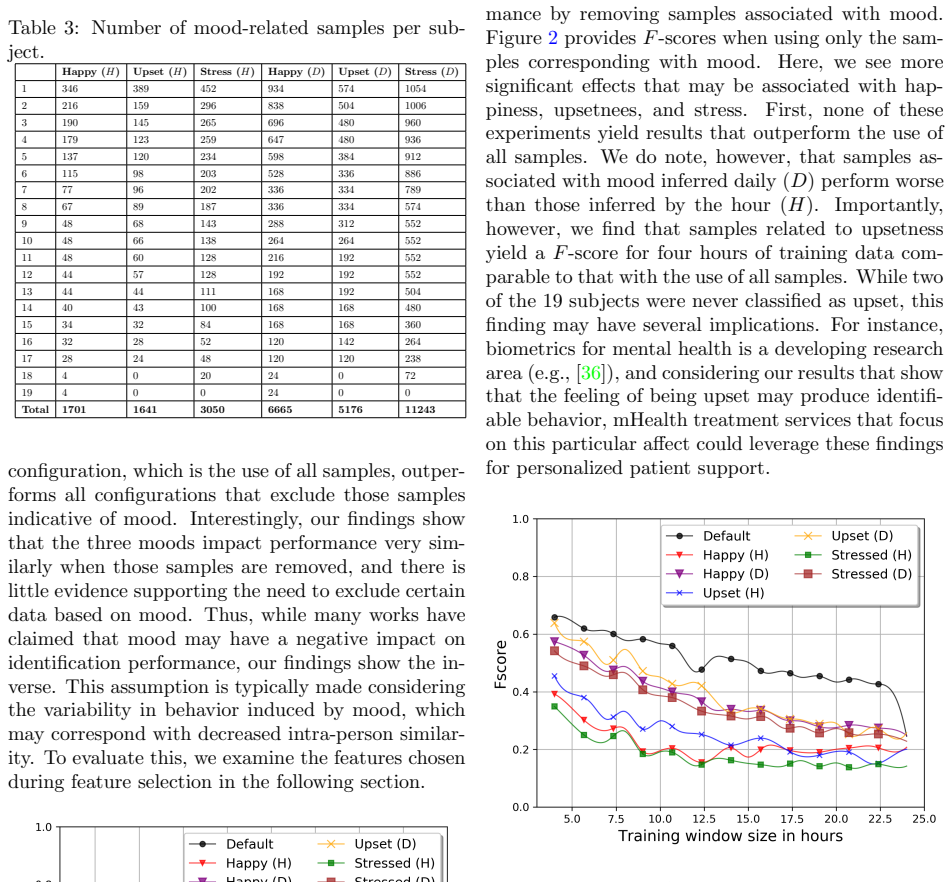
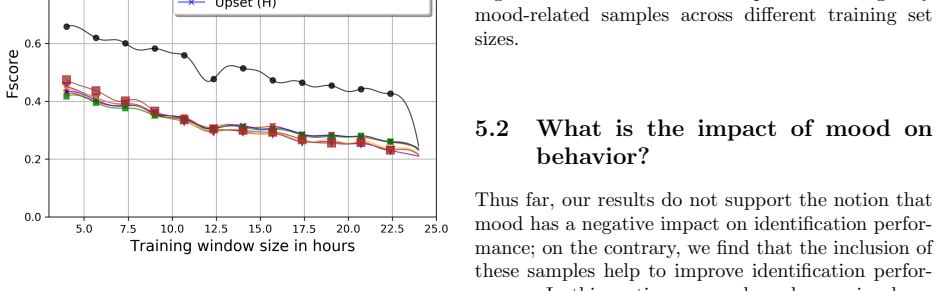
Performance worsens when removing samples generated when subjects may be happy, upset, or stressed. Thus, there is no indication that mood negatively impacts performance, although changes in smartphone usage patterns may correlate with mood, including changes in locking, audio, location, calling, homescreen, and e-mail habits.
What carries the argument
Comparison of identification performance on the full dataset versus the dataset with mood-labeled samples removed.
If this is right
- Identification accuracy decreases without the mood-associated samples.
- Mood correlates with variations in locking, audio, location, calling, homescreen, and e-mail habits.
- Biometric systems may not need to treat mood as a negative source of variation.
- Mood is a source of intra-person variation but one that does not reduce identification performance.
Where Pith is reading between the lines
- Training models on mood-diverse data could improve robustness if the performance benefit holds.
- The same removal test could be applied to other candidate sources of behavioral variation such as time of day.
- Systems might treat mood shifts as an additional usable signal rather than noise to be filtered.
Load-bearing premise
The mood states are reliably and accurately labeled for the samples in the dataset.
What would settle it
Repeating the removal experiment on a new dataset where mood is measured and labeled independently to check whether performance still declines without those samples.
Figures
read the original abstract
This paper explores the identification of smartphone users when certain samples collected while the subject felt happy, upset or stressed were absent or present. We employ data from 19 subjects using the StudentLife dataset, a dataset collected by researchers at Dartmouth College that was originally collected to correlate behaviors characterized by smartphone usage patterns with changes in stress and academic performance. Although many previous works on behavioral biometrics have implied that mood is a source of intra-person variation which may impact biometric performance, our results contradict this assumption. Our findings show that performance worsens when removing samples that were generated when subjects may be happy, upset, or stressed. Thus, there is no indication that mood negatively impacts performance. However, we do find that changes existing in smartphone usage patterns may correlate with mood, including changes in locking, audio, location, calling, homescreen, and e-mail habits. Thus, we show that while mood is a source of intra-person variation, it may be an inaccurate assumption that biometric systems (particularly, mobile biometrics) are likely influenced by mood.
Editorial analysis
A structured set of objections, weighed in public.
Referee Report
Summary. The paper examines the effect of mood on smartphone user identification performance using the StudentLife dataset (19 subjects). It reports that removing samples labeled as collected during happy, upset, or stressed states degrades identification accuracy, from which it concludes there is no indication that mood negatively impacts performance. It additionally observes correlations between mood and changes in usage patterns (locking, audio, location, calling, homescreen, email).
Significance. If the central empirical claim holds after proper controls, the result would challenge the common assumption in behavioral biometrics that mood-induced intra-person variation harms identification accuracy and could simplify requirements for mobile biometric systems. The use of a named public dataset is a positive attribute.
major comments (2)
- [Results] Results section: the headline comparison (performance with vs. without mood-labeled samples) lacks a control ablation that removes an equal number of randomly chosen samples (or time-of-day/user-matched samples). This control is load-bearing for the claim that the observed degradation is attributable to mood rather than reduced data volume; without it the interpretation that 'mood does not negatively impact performance' cannot be supported.
- [Methodology] Methodology: the identification algorithm, feature set, classifier, cross-validation scheme, per-mood sample counts, and statistical tests are not described in sufficient detail to assess whether the reported performance differences are reliable or replicable.
minor comments (1)
- [Abstract] Abstract and introduction: the phrasing 'our findings show that performance worsens when removing samples...' should be qualified to note that the comparison is uncontrolled for sample size.
Simulated Author's Rebuttal
We thank the referee for the constructive comments. We address each major point below and will revise the manuscript accordingly to strengthen the empirical claims and improve replicability.
read point-by-point responses
-
Referee: [Results] Results section: the headline comparison (performance with vs. without mood-labeled samples) lacks a control ablation that removes an equal number of randomly chosen samples (or time-of-day/user-matched samples). This control is load-bearing for the claim that the observed degradation is attributable to mood rather than reduced data volume; without it the interpretation that 'mood does not negatively impact performance' cannot be supported.
Authors: We agree that the current comparison does not isolate the effect of mood from the effect of reduced sample volume. We will add a control ablation that removes an equal number of randomly chosen samples (and, where feasible, time-of-day or user-matched samples) and report the resulting identification accuracies alongside the mood-removal results. This will allow readers to assess whether the observed degradation is specifically attributable to mood-labeled samples. revision: yes
-
Referee: [Methodology] Methodology: the identification algorithm, feature set, classifier, cross-validation scheme, per-mood sample counts, and statistical tests are not described in sufficient detail to assess whether the reported performance differences are reliable or replicable.
Authors: We acknowledge the need for greater methodological transparency. In the revised manuscript we will expand the Methodology section to specify the exact identification algorithm and feature extraction pipeline, the classifier and its hyperparameters, the cross-validation scheme (including how train/test splits respect subject identity), the per-mood and per-subject sample counts, and the statistical tests used to evaluate performance differences. revision: yes
Circularity Check
No circularity: straightforward empirical ablation on public dataset
full rationale
The paper conducts a direct empirical comparison of smartphone user identification performance on the StudentLife dataset, with and without samples labeled as happy/upset/stressed. No equations, fitted parameters, derivations, or self-citations appear in the load-bearing steps; the central claim follows from counting and classifying existing data points rather than reducing to any input by construction. The analysis is self-contained against the external benchmark of the named public dataset.
Axiom & Free-Parameter Ledger
Reference graph
Works this paper leans on
-
[1]
J. Asselbergs, J. Ruwaard, M. Ejdys, N. Schrader, M. Sijbrandij, and H. Riper. Mobile phone-based un- obtrusive ecological momentary assessment of day- to-day mood: an explorative study. Journal of med- ical Internet research, 18(3), 2016
work page 2016
-
[2]
Bardram, Mads Frost, K´ aroly Sz´ ant´ o, and Gabriela Marcu
Jakob E. Bardram, Mads Frost, K´ aroly Sz´ ant´ o, and Gabriela Marcu. The monarca self-assessment sys- tem: A persuasive personal monitoring system for bipolar patients. In Proceedings of the 2Nd ACM SIGHIT International Health Informatics Sympo- sium, IHI ’12, pages 21–30, New York, NY, USA,
-
[3]
Biometric authentication on iphone and android: Usability, perceptions, and influences on adoption
Rasekhar Bhagavatula, Blase Ur, Kevin Iacovino, Su Mon Kywe, Lorrie Faith Cranor, and Marios Savvides. Biometric authentication on iphone and android: Usability, perceptions, and influences on adoption. In In Proc. USEC, 2015
work page 2015
-
[4]
Au- tomatic usability and stress analysis in mobile bio- metrics
Ramon Blanco-Gonzalo, Raul Sanchez-Reillo, Os- car Miguel-Hurtado, and Eric Bella-Pulgarin. Au- tomatic usability and stress analysis in mobile bio- metrics. Image and Vision Computing , 32(12):1173 – 1180, 2014
work page 2014
-
[5]
Mei-Yen Chen, Edward K. Wang, and Yi-Jong Jeng. Adequate sleep among adolescents is positively asso- ciated with health status and health-related behav- iors. BMC Public Health , 6(1):59, Mar 2006
work page 2006
-
[6]
Alexander De Luca, Alina Hang, Emanuel von Zezschwitz, and Heinrich Hussmann. I feel like i’m taking selfies all day!: Towards understanding bio- metric authentication on smartphones. In Proceed- ings of the 33rd Annual ACM Conference on Human Factors in Computing Systems, CHI ’15, pages 1411– 1414, New York, NY, USA, 2015. ACM
work page 2015
-
[7]
Craig DeLancey. Basic moods. Philosophical Psy- chology, 19(4):527–538, 2006
work page 2006
-
[8]
Kadir Demirci, Mehmet Akgnl, and Abdullah Akpinar. Relationship of smartphone use severity with sleep quality, depression, and anxiety in uni- versity students. Journal of Behavioral Addictions , 4(2):85–92, 2015
work page 2015
-
[9]
The effects of weather on daily mood: A multilevel approach
Jaap JA Denissen, Ligaya Butalid, Lars Penke, and Marcel AG Van Aken. The effects of weather on daily mood: A multilevel approach. Emotion, 8(5):662, 2008
work page 2008
- [10]
-
[11]
Panteleimon Ekkekakis. Affect, mood, and emotion. Measurement in sport and exercise psychology , 321, 2012
work page 2012
-
[12]
Martin Ester, Hans-Peter Kriegel, J¨ org Sander, and Xiaowei Xu. A density-based algorithm for discover- ing clusters a density-based algorithm for discover- ing clusters in large spatial databases with noise. In Proceedings of the Second International Conference on Knowledge Discovery and Data Mining , KDD’96, pages 226–231. AAAI Press, 1996. 7
work page 1996
-
[13]
Huan Feng, Kassem Fawaz, and Kang G. Shin. Con- tinuous authentication for voice assistants. In Pro- ceedings of the 23rd Annual International Confer- ence on Mobile Computing and Networking , Mobi- Com ’17, pages 343–355, New York, NY, USA, 2017. ACM
work page 2017
-
[14]
Joseph P. Forgas. Mood effects on decision mak- ing strategies. Australian Journal of Psychology , 41(2):197–214, 1989
work page 1989
- [15]
-
[16]
Sleep and the affective response to stress and pain
Nancy A Hamilton, Delwyn Catley, and Cynthia Karlson. Sleep and the affective response to stress and pain. Health Psychology, 26(3):288, 2007
work page 2007
-
[17]
It’s a hard lock life: A field study of smart- phone (un)locking behavior and risk perception
Marian Harbach, Emanuel von Zezschwitz, An- dreas Fichtner, Alexander De Luca, and Matthew Smith. It’s a hard lock life: A field study of smart- phone (un)locking behavior and risk perception. In 10th Symposium On Usable Privacy and Security (SOUPS 2014) , pages 213–230, Menlo Park, CA,
work page 2014
-
[18]
A. K. Jain, A. Ross, and S. Prabhakar. An introduc- tion to biometric recognition. IEEE Transactions on Circuits and Systems for Video Technology, 14(1):4– 20, Jan 2004
work page 2004
-
[19]
Anil K. Jain, Arun A. Ross, and Karthik Nandaku- mar. Introduction, pages 1–49. Springer US, Boston, MA, 2011
work page 2011
-
[20]
Predicting students’ happiness from physi- ology, phone, mobility, and behavioral data
Natasha Jaques, Sara Taylor, Asaph Azaria, Asma Ghandeharioun, Akane Sano, and Rosalind Pi- card. Predicting students’ happiness from physi- ology, phone, mobility, and behavioral data. In 2015 International Conference on Affective Comput- ing and Intelligent Interaction (ACII) , pages 222–
work page 2015
-
[21]
Investigating user comprehension and risk perception of apple’s touch id technology
Yousra Javed, Mohamed Shehab, and Emmanuel Bello-Ogunu. Investigating user comprehension and risk perception of apple’s touch id technology. In Proceedings of the 12th International Conference on Availability, Reliability and Security , ARES ’17, pages 35:1–35:6, New York, NY, USA, 2017. ACM
work page 2017
-
[22]
Robert LiKamWa, Yunxin Liu, Nicholas D. Lane, and Lin Zhong. Moodscope: Building a mood sensor from smartphone usage patterns. In Proceeding of the 11th Annual International Conference on Mobile Systems, Applications, and Services , MobiSys ’13, pages 389–402, New York, NY, USA, 2013. ACM
work page 2013
-
[23]
Y. Ma, B. Xu, Y. Bai, G. Sun, and R. Zhu. Daily mood assessment based on mobile phone sensing. In International conference on wearable and im- plantable body sensor networks, pages 142–147, 2012
work page 2012
-
[24]
Wong, Sheng Wen, and Yang Xiang
Weizhi Meng, Yu Wang, Duncan S. Wong, Sheng Wen, and Yang Xiang. Touchwb: Touch behavioral user authentication based on web browsing on smart- phones. Journal of Network and Computer Applica- tions, 117:1 – 9, 2018
work page 2018
-
[25]
William N. Morris. Mood: The Frame of Mind . Springer, New York, NY, 1989
work page 1989
-
[26]
Tibor P. Palfai and Peter Salovey. The influence of depressed and elated mood on deductive and induc- tive reasoning. Imagination, Cognition and Person- ality, 13(1):57–71, 1993
work page 1993
-
[27]
V. M. Patel, R. Chellappa, D. Chandra, and B. Bar- bello. Continuous user authentication on mobile devices: Recent progress and remaining challenges. IEEE Signal Processing Magazine, 33(4):49–61, July 2016
work page 2016
-
[28]
Detecting change points in the large-scale structure of evolving net- works
Leto Peel and Aaron Clauset. Detecting change points in the large-scale structure of evolving net- works. In Twenty-Ninth AAAI Conference on Arti- ficial Intelligence, 2015
work page 2015
- [29]
-
[30]
James A Russell. A circumplex model of affect. Jour- nal of personality and social psychology , 39(6):1161, 1980
work page 1980
-
[31]
Akane Sano, Sara Taylor, Andrew W McHill, An- drew JK Phillips, Laura K Barger, Elizabeth Kler- man, and Rosalind Picard. Identifying objective physiological markers and modifiable behaviors for self-reported stress and mental health status using wearable sensors and mobile phones: observational study. Journal of medical Internet research , 20(6), 2018
work page 2018
-
[32]
Saul Shiffman, Arthur A. Stone, and Michael R. Huf- ford. Ecological momentary assessment. Annual Re- view of Clinical Psychology , 4(1):1–32, 2008. PMID: 18509902
work page 2008
-
[33]
Arthur A. Stone, Joshua M. Smyth, Thomas Pick- ering, and Joseph Schwartz. Daily mood variability: Form of diurnal patterns and determinants of diur- nal patterns. Journal of Applied Social Psychology , 26(14):1286–1305, 1996
work page 1996
-
[34]
Activity-aware mental stress detection using physiological sensors
Feng-Tso Sun, Cynthia Kuo, Heng-Tze Cheng, Senaka Buthpitiya, Patricia Collins, and Martin Griss. Activity-aware mental stress detection using physiological sensors. In International conference on Mobile computing, applications, and services , pages 282–301. Springer, 2010
work page 2010
-
[35]
Realizing the potential of mobile mental health: New methods for new data in psychiatry
John Torous, Patrick Staples, and Jukka-Pekka On- nela. Realizing the potential of mobile mental health: New methods for new data in psychiatry. Current Psychiatry Reports, 17(8):61, Jun 2015
work page 2015
-
[36]
Mobile sensing and support for people with depression: A pilot trial 8 in the wild
Fabian Wahle, Tobias Kowatsch, Elgar Fleisch, Michael Rufer, and Steffi Weidt. Mobile sensing and support for people with depression: A pilot trial 8 in the wild. JMIR Mhealth Uhealth , 4(3):e111, Sep 2016
work page 2016
-
[37]
Rui Wang, Fanglin Chen, Zhenyu Chen, Tianxing Li, Gabriella Harari, Stefanie Tignor, Xia Zhou, Dror Ben-Zeev, and Andrew T Campbell. Studentlife: assessing mental health, academic performance and behavioral trends of college students using smart- phones. In Proceedings of the 2014 ACM interna- tional joint conference on pervasive and ubiquitous computing,...
work page 2014
-
[38]
Hui Xu, Yangfan Zhou, and Michael R. Lyu. To- wards continuous and passive authentication via touch biometrics: An experimental study on smart- phones. In 10th Symposium On Usable Privacy and Security (SOUPS 2014), pages 187–198, Menlo Park, CA, 2014. USENIX Association. 9
work page 2014
discussion (0)
Sign in with ORCID, Apple, or X to comment. Anyone can read and Pith papers without signing in.