Skyrmion relaxation dynamics in the presence of quenched disorder
Pith reviewed 2026-05-25 13:45 UTC · model grok-4.3
The pith
Clean skyrmion systems always display dynamical scaling using the typical diffusion length as the scale.
A machine-rendered reading of the paper's core claim, the machinery that carries it, and where it could break.
Core claim
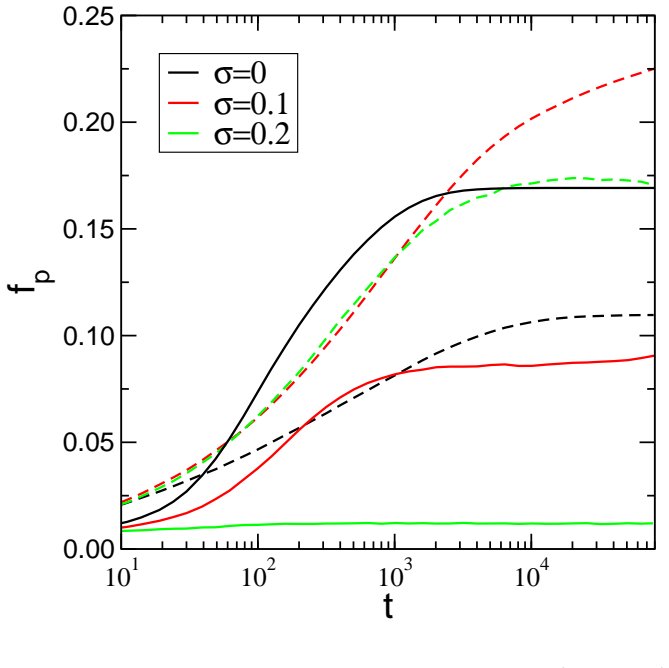
Clean skyrmion systems always display dynamical scaling when the typical diffusion length is used to characterize the relaxation process. This scaling persists even in cases where the length is not a simple power law of time. In the presence of the Magnus force two different regimes emerge as a function of the noise strength. Attractive pinning sites capture a substantial fraction of skyrmions which results in a complex behavior of the two-time auto-correlation function that is not reproduced by a simple aging scaling ansatz, except in the limit of large noise where dynamical scaling persists.
What carries the argument
The typical diffusion length as the time-dependent length that characterizes the relaxation process and tests for dynamical scaling.
If this is right
- Clean systems display dynamical scaling regardless of whether the typical length follows a power law in time.
- The Magnus force creates two regimes in the relaxation as noise strength varies.
- The Magnus force allows skyrmions to bend around defects and reduces caging effects.
- Simple aging scaling fails to describe the auto-correlation function when attractive pinning sites are present, except at large noise.
Where Pith is reading between the lines
- Models of skyrmion dynamics in real materials must include the velocity-dependent Magnus force to capture how disorder affects relaxation.
- Experiments could tune temperature or noise strength to locate the boundary between the two Magnus-force regimes.
- Applications that rely on predictable skyrmion motion would benefit from minimizing attractive pinning to preserve scaling behavior.
Load-bearing premise
The typical diffusion length is the correct time-dependent length to characterize the relaxation process and the chosen simulation parameters and pinning model faithfully represent the essential physics of real skyrmion systems with quenched disorder.
What would settle it
A clean skyrmion system that fails to display dynamical scaling when relaxation data are plotted against the typical diffusion length, or a pinned system at moderate noise whose two-time auto-correlation follows a simple aging scaling ansatz.
Figures
read the original abstract
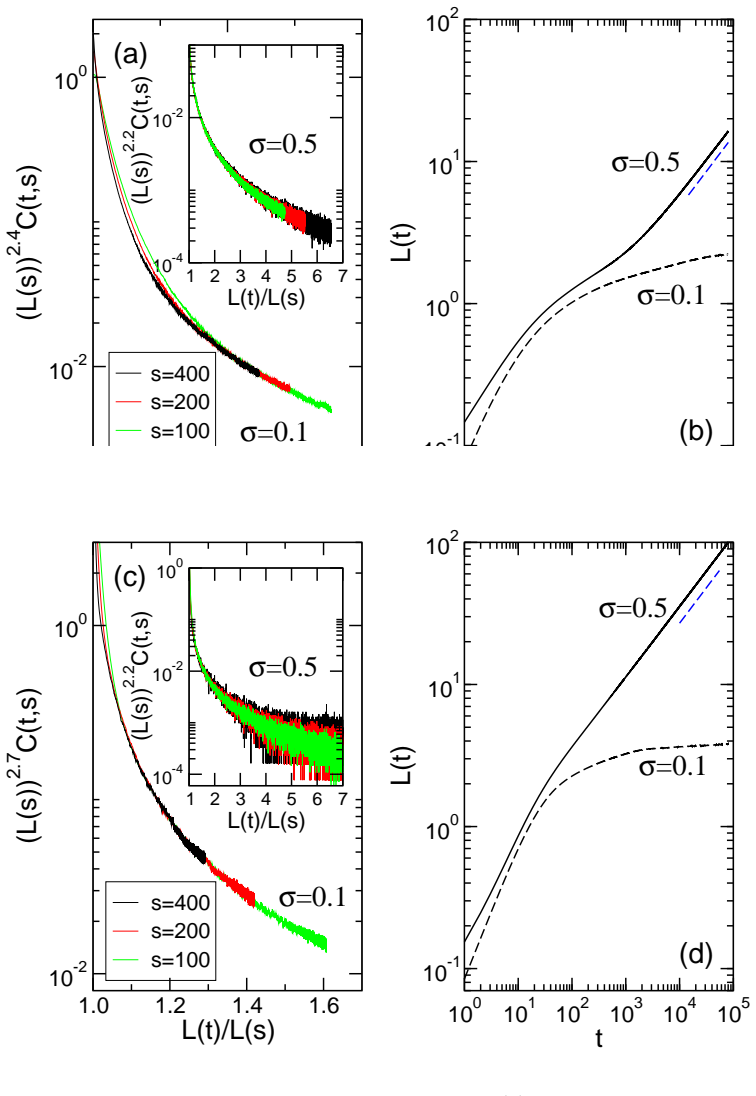
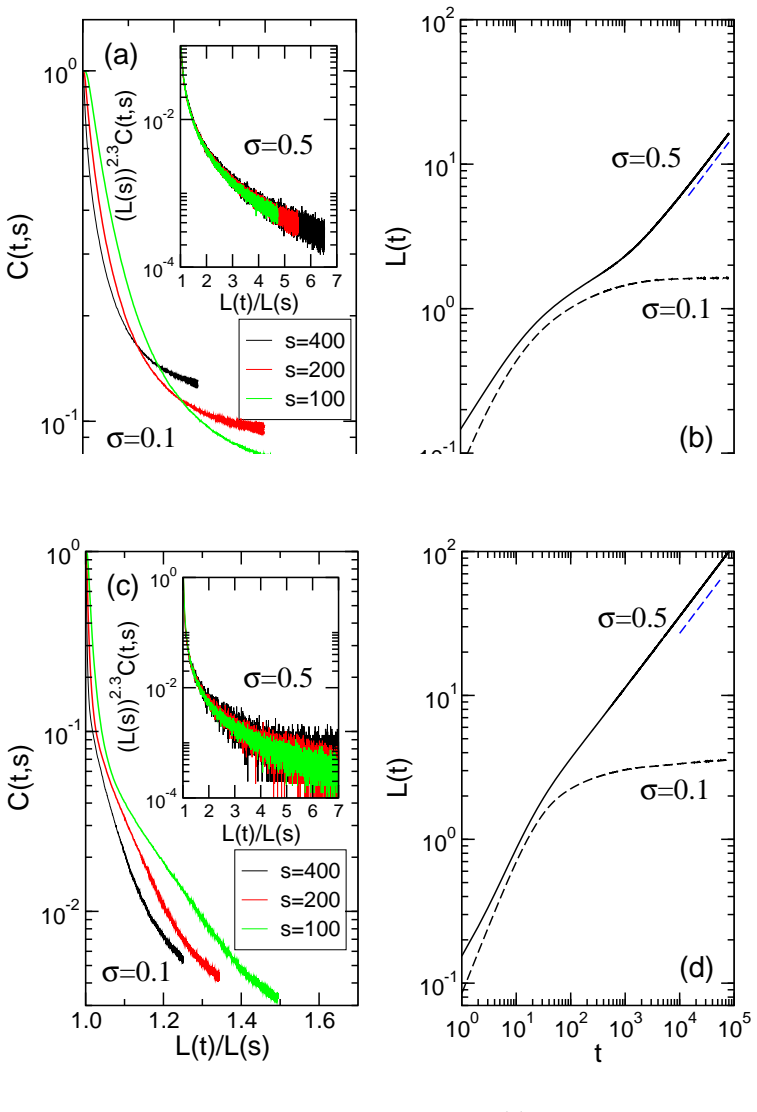
Using Langevin molecular dynamics simulations we study relaxation processes of interacting skyrmion systems with and without quenched disorder. Using the typical diffusion length as the time-dependent length characterizing the relaxation process, we find that clean systems always display dynamical scaling, and this even in cases where the typical length is not a simple power law of time. In the presence of the Magnus force, two different regimes are identified as a function of the noise strength. The Magnus force has also a major impact when attractive pinning sites are present, as this velocity-dependent force helps skyrmions to bend around defects and avoid caging effects. With the exception of the limit of large noise, for which dynamical scaling persists even in the presence of quenched disorder, attractive pinning sites capture a substantial fraction of skyrmions which results in a complex behavior of the two-time auto-correlation function that is not reproduced by a simple aging scaling ansatz.
Editorial analysis
A structured set of objections, weighed in public.
Referee Report
Summary. The manuscript reports Langevin molecular dynamics simulations of interacting skyrmion relaxation in clean and quenched-disordered systems. Using the typical diffusion length extracted from mean-squared displacement as the time-dependent scale, the authors claim that clean systems exhibit dynamical scaling of two-time correlation functions even when this length is not a simple power law of time. They identify two noise-strength regimes in the presence of the Magnus force and report that attractive pinning produces complex aging behavior not captured by simple scaling, except at large noise where scaling persists.
Significance. If the numerical observations hold under scrutiny, the work provides concrete evidence that Magnus-force-induced transverse motion and pinning alter relaxation scaling in skyrmion systems, which is relevant for understanding topological spin textures in disordered materials. The explicit demonstration that scaling can survive without power-law growth of the characteristic length is a useful numerical result for the field.
major comments (2)
- [Abstract / results on Magnus regimes] Abstract and results sections: the central claim that dynamical scaling is observed when the typical diffusion length is used as the scaling variable rests on the assumption that this length (derived from isotropic mean-squared displacement) remains the dynamically relevant scale even when the Magnus term produces Hall-like transverse trajectories. No test is reported with an alternative length scale (e.g., gyration radius or velocity autocorrelation length) to confirm that the reported collapse and the two noise-strength regimes survive this choice.
- [Methods / figure captions] Methods and results: quantitative support for the scaling statements and regime distinctions is difficult to assess because the manuscript does not supply full parameter tables, pinning densities, noise strengths, system sizes, or error bars on the correlation functions. Without these, it is impossible to verify reproducibility or the statistical significance of the claimed departures from simple aging scaling.
minor comments (1)
- Notation for the two-time auto-correlation function and the definition of the typical diffusion length should be stated explicitly with equations in the main text rather than only in supplementary material.
Simulated Author's Rebuttal
We thank the referee for the careful reading of our manuscript and the constructive comments. We address each major comment below.
read point-by-point responses
-
Referee: [Abstract / results on Magnus regimes] Abstract and results sections: the central claim that dynamical scaling is observed when the typical diffusion length is used as the scaling variable rests on the assumption that this length (derived from isotropic mean-squared displacement) remains the dynamically relevant scale even when the Magnus term produces Hall-like transverse trajectories. No test is reported with an alternative length scale (e.g., gyration radius or velocity autocorrelation length) to confirm that the reported collapse and the two noise-strength regimes survive this choice.
Authors: The mean-squared displacement provides the characteristic diffusion length, which is the standard and physically motivated scale for characterizing relaxation in particle systems. Although the Magnus force induces transverse motion, the isotropic MSD remains the relevant measure for the overall relaxation process, as demonstrated by the data collapse we observe. We did not test alternative scales such as gyration radius. To address the concern we will add a brief justification for this choice in the revised manuscript, while maintaining the original claim. revision: partial
-
Referee: [Methods / figure captions] Methods and results: quantitative support for the scaling statements and regime distinctions is difficult to assess because the manuscript does not supply full parameter tables, pinning densities, noise strengths, system sizes, or error bars on the correlation functions. Without these, it is impossible to verify reproducibility or the statistical significance of the claimed departures from simple aging scaling.
Authors: We agree that the manuscript is missing these details. In the revised version we will supply full parameter tables (including pinning densities, noise strengths and system sizes) together with error bars on the correlation functions. revision: yes
Circularity Check
No circularity: direct numerical outputs from parameter-varied simulations
full rationale
The paper reports results exclusively from Langevin molecular dynamics simulations of skyrmion systems. The abstract and reader's summary confirm there are no analytical derivations, no parameters fitted to data then relabeled as predictions, and no self-citation chains invoked to justify uniqueness or ansatzes. Dynamical scaling observations and regime distinctions are stated as direct simulation outputs. The choice of typical diffusion length is an explicit modeling assumption, not a result that reduces to itself by construction. This is the normal case of a self-contained numerical study with no load-bearing circular steps.
Axiom & Free-Parameter Ledger
free parameters (2)
- noise strength
- pinning strength and density
axioms (2)
- domain assumption Skyrmion motion obeys overdamped Langevin dynamics with additive noise
- domain assumption Quenched disorder is represented by fixed attractive pinning sites
Lean theorems connected to this paper
-
IndisputableMonolith/Cost/FunctionalEquation.leanwashburn_uniqueness_aczel unclear?
unclearRelation between the paper passage and the cited Recognition theorem.
Using the typical diffusion length as the time-dependent length characterizing the relaxation process, we find that clean systems always display dynamical scaling... C(t,s) = (L(s))^{-b} f_C (L(t)/L(s))
-
IndisputableMonolith/Foundation/RealityFromDistinction.leanreality_from_one_distinction unclear?
unclearRelation between the paper passage and the cited Recognition theorem.
L(t) = sqrt(r²(t)) with r²(t) = <1/Ns sum |Ri(t) - Ri(0)|²>
What do these tags mean?
- matches
- The paper's claim is directly supported by a theorem in the formal canon.
- supports
- The theorem supports part of the paper's argument, but the paper may add assumptions or extra steps.
- extends
- The paper goes beyond the formal theorem; the theorem is a base layer rather than the whole result.
- uses
- The paper appears to rely on the theorem as machinery.
- contradicts
- The paper's claim conflicts with a theorem or certificate in the canon.
- unclear
- Pith found a possible connection, but the passage is too broad, indirect, or ambiguous to say the theorem truly supports the claim.
Reference graph
Works this paper leans on
- [1]
-
[2]
u hlbauer, B. Binz, F. Jonietz, C. Pfleiderer, A. Rosch, A. Neubauer, R. Georgii, and P. B \
S. M \" u hlbauer, B. Binz, F. Jonietz, C. Pfleiderer, A. Rosch, A. Neubauer, R. Georgii, and P. B \" o ni, Science 323 , 915 (2009)
work page 2009
-
[3]
X. Z. Yu, Y. Onose, N. Kanazawa, J. H. Park, J. H. Han, Y. Matsui, N. Nagaosa, and Y. Tokura, Nature (London) 465 , 901 (2010)
work page 2010
-
[4]
A. Fert, V. Cros, and J. Sampaio, Nat. Nanotechnol. 8 152 (2013)
work page 2013
- [5]
- [6]
-
[7]
u hlbauer, C. Pfleiderer, A. Neubauer, W. M\
F. Jonietz, S. M\" u hlbauer, C. Pfleiderer, A. Neubauer, W. M\" u nzer, A. Bauer, T. Adams, R. Georgii, P. B\" o ni, R. A. Duine, K. Everschor, M. Garst, and A. Rosch, Science 330, 1648 (2010)
work page 2010
-
[8]
X.Z. Yu, N. Kanazawa, W.Z. Zhang, T. Nagai, T. Hara, K. Kimoto, Y. Matsui, Y. Onose, and Y. Tokura, Nat. Commun. 3 , 988 (2012)
work page 2012
-
[9]
S.-Z. Lin, C. Reichhardt, C.D. Batista, and A. Saxena, Phys. Rev. B 87 , 214419 (2013)
work page 2013
- [10]
-
[11]
G. Blatter, M.V. Feigel'man, V.B. Geshkenbein, A.I. Larkin, and V.M. Vinokur, Rev. Mod. Phys. 66 , 1125 (1994)
work page 1994
-
[12]
B. L. Brown, U. C. T \" a uber, and M. Pleimling, Phys. Rev. B 97 , 020405 (2018)
work page 2018
-
[13]
C. Hanneken, A. Kubetzka, K. von Bergmann, and R. Wiedendanger, New. J. Phys. 18 , 055009 (2016)
work page 2016
- [14]
- [15]
-
[16]
J. Sampaio, V. Cros, S. Rohart, A. Thiaville, and A. Fert, Nat. Nanotechn. 8 , 939 (2013)
work page 2013
- [17]
-
[18]
W. Legrand, D. Maccariello, N. Reyren, K. Garcia, C. Moutafis, C. Moreau-Luchaire, S. Collin, K. Bouzehouane, V. Cros, and A. Fert, Nano Lett. 17 , 2703 (2017)
work page 2017
-
[19]
D. Stosic, T.B. Ludermir, and M.V. Milo s evi\' c , Phys. Rev. B 96 , 214403 (2017)
work page 2017
-
[20]
A. Soumyanarayanan, M. Raju, A. L. Gonzalez Oyarce, A. K. C. Tan, M.-Y. Im, A. P. Petrovi\' c , P. Ho, K. H. Khoo, M. Tran, C. K. Gan, F. Ernult, and C. Panagopoulos, Nat. Mat. 16 , 898 (2017)
work page 2017
- [21]
-
[22]
S. Woo, K. Litzius, B. Kr\" u ger, M.-Y. Im, L. Caretta, K. Richter, M. Mann, A. Krone, R.M. Reeve, M. Weigand, P. Agrawal, I. Lemesh, M.-A. Mawass, P. Fischer, M. Kl\" a ui, and G.S.D. Beach, Nat. Mater. 15 , 501 (2016)
work page 2016
-
[23]
N.S. Kiselev, R. Sch \"a fer, and U.K. R \"o ler, J. Physics D 44 , 39 (2011)
work page 2011
- [24]
-
[25]
I. Purnama, W.L. Gan, D.W. Wong, and W.S. Lew, Sci. Rep. 5 , 10620 (2015)
work page 2015
- [26]
- [27]
-
[28]
u ger, P. Bassirian, L. caretta, K. Richter, F. B\
K. Litzius, I. Lemesh, B. Kr\" u ger, P. Bassirian, L. caretta, K. Richter, F. B\" u ttner, K. Sato, O.A. Tretiakov, J. F\" o rster, R.M. Reeve, M. Weigand, I. Bykova, H. Stoll, G. Sch\" u tz, G.S.D. Beach, and M. Kl\" a ui, Nat. Phys. 13 , 170 (2017)
work page 2017
-
[29]
C. Reichhardt, D. Ray, and C. J. Olson Reichhardt, Phys. Rev. Lett. 114 , 217202 (2015)
work page 2015
-
[30]
C. Reichhardt and C. J. O. Reichhardt, New J. Phys. 18 , 095005 (2016)
work page 2016
-
[31]
S. A. D\' i az, C. Reichhardt, D. P. Arovas, A. Saxena, and C. J. O. Reichhardt, Phys. Rev. B 96 , 085106 (2017)
work page 2017
-
[32]
S. P \"o llath, J. WriIld, L. Heinen, T. N. G. Meier, M. Kronseder, L. Tutsch, A. Bauer, H. Berger, C. Pfleiderer, J. Zweck, A. Rosch, and C. H. Back, Phys. Rev. Lett. 118 , 207205 (2017)
work page 2017
-
[33]
S. A. D\' i az, C. Reichhardt, D. P. Arovas, A. Saxena, and C. J. O. Reichhardt, Phys. Rev. Lett. 120 , 117203 (2018)
work page 2018
-
[34]
C. Reichhardt, D. Ray, and C. J. O. Reichhardt, Phys. Rev. B 98 , 134418 (2018)
work page 2018
-
[35]
B. L. Brown, C. Reichhardt, and C. J. O. Reichhardt, New J. Phys. 21 , 013001 (2019)
work page 2019
- [36]
- [37]
- [38]
-
[39]
M. Henkel and M. Pleimling, Non-Equilibrium Phase Transitions, Volume 2: Ageing and Dynamical Scaling Far From Equilibrium (Springer, Heidelberg, 2010)
work page 2010
-
[40]
A. A. Thiele, Phys. Rev. Lett. 30 , 230 (1973)
work page 1973
- [41]
discussion (0)
Sign in with ORCID, Apple, or X to comment. Anyone can read and Pith papers without signing in.