E-Sports Talent Scouting Based on Multimodal Twitch Stream Data
Pith reviewed 2026-05-25 10:50 UTC · model grok-4.3
The pith
Multimodal Twitch stream data can predict intrinsic skill and ranks of CS:GO gamers.
A machine-rendered reading of the paper's core claim, the machinery that carries it, and where it could break.
Core claim
We propose a novel task of finding e-sports talent by predicting ranks of CS:GO gamers from multimodal Twitch data. Neural features are extracted from video, audio, and text chat collected January-April 2019 for 425 ranked and 9,928 unranked gamers; modality-specific probabilities of being top-ranked are estimated and then pooled by a hierarchical Bayesian model to yield intrinsic skill scores. The approach is validated by correlating the resulting scores with the May 2019 ranks of the publicly profiled gamers.
What carries the argument
A hierarchical Bayesian model that pools modality-specific probabilities, each derived from neural features extracted from video, audio, and chat streams, to estimate each gamer's intrinsic skill.
If this is right
- Intrinsic skill estimates can be produced for the 9,928 unranked gamers solely from their public streams.
- Talent scouting for CS:GO becomes possible using only broadcast data without official competition records.
- Evidence from video, audio, and chat modalities can be combined to strengthen skill predictions.
- The correlation with later ranks supports using the model for predictive validation of gamer ability.
Where Pith is reading between the lines
- The same stream-based pipeline could be tested on other competitive games that have active Twitch communities.
- Public chat and video data used for skill profiling raises questions about consent and long-term player privacy.
- If the method works, it could be combined with in-game telemetry to create more robust talent identification systems.
- The approach might surface systematic differences between how skill appears in streams versus how it appears in ranked matches.
Load-bearing premise
The modality-specific probabilities estimated from the streams reflect stable intrinsic skill rather than transient factors such as streaming schedule or audience size.
What would settle it
The intrinsic skill estimates show no positive correlation with the May 2019 ranks of the 425 publicly profiled gamers, or the correlation disappears once transient streaming factors are controlled for.
Figures
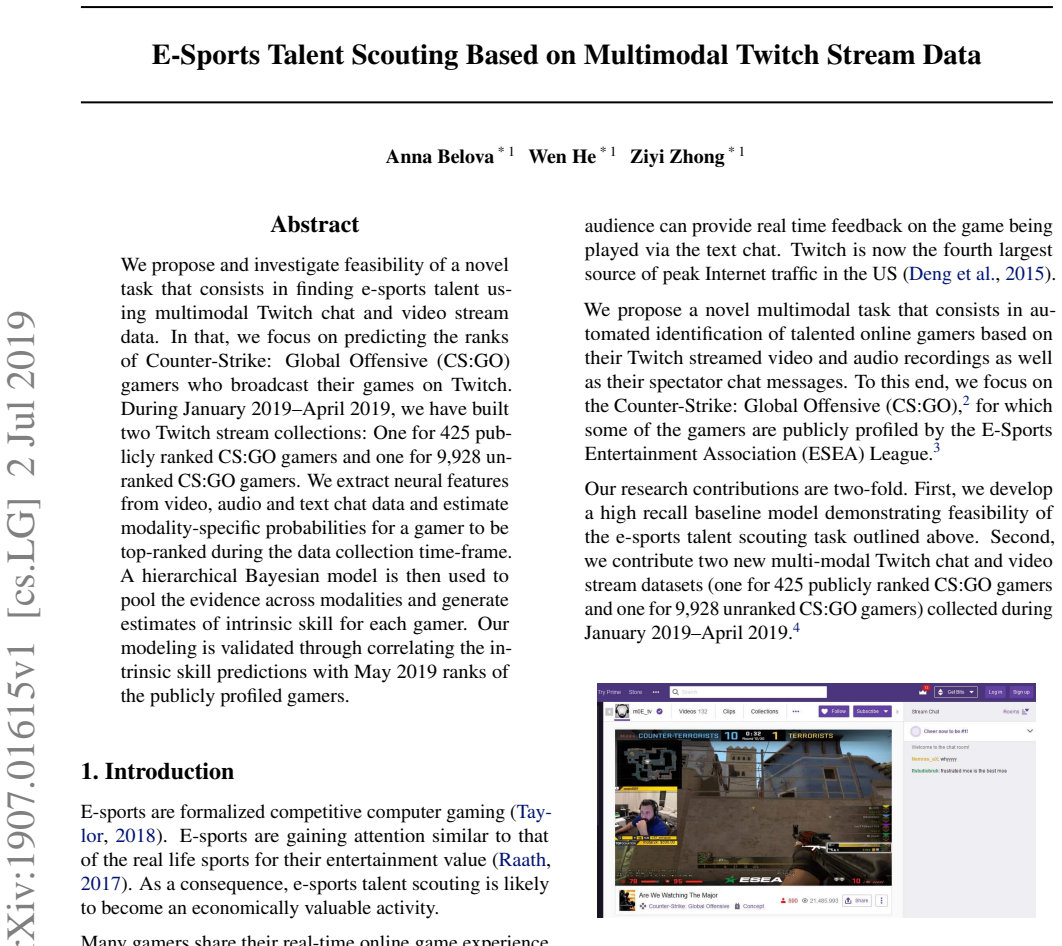


read the original abstract
We propose and investigate feasibility of a novel task that consists in finding e-sports talent using multimodal Twitch chat and video stream data. In that, we focus on predicting the ranks of Counter-Strike: Global Offensive (CS:GO) gamers who broadcast their games on Twitch. During January 2019-April 2019, we have built two Twitch stream collections: One for 425 publicly ranked CS:GO gamers and one for 9,928 unranked CS:GO gamers. We extract neural features from video, audio and text chat data and estimate modality-specific probabilities for a gamer to be top-ranked during the data collection time-frame. A hierarchical Bayesian model is then used to pool the evidence across modalities and generate estimates of intrinsic skill for each gamer. Our modeling is validated through correlating the intrinsic skill predictions with May 2019 ranks of the publicly profiled gamers.
Editorial analysis
A structured set of objections, weighed in public.
Referee Report
Summary. The paper proposes a feasibility study for e-sports talent scouting by processing multimodal Twitch streams (video, audio, chat) of CS:GO gamers. Neural features are extracted to produce modality-specific probabilities of being top-ranked during the Jan-Apr 2019 collection window; these are pooled via a hierarchical Bayesian model to yield per-gamer intrinsic-skill estimates. The central claim is that these estimates correlate with the independent May 2019 ranks of the 425 publicly ranked gamers in the collection.
Significance. If the reported correlation survives controls for streaming volume, audience size, and schedule stability, the work would demonstrate a practical, non-circular route from public streaming data to skill proxies. The absence of any quantitative validation metrics, baselines, or implementation details currently prevents assessment of whether that threshold is met.
major comments (2)
- [Abstract] Abstract (validation paragraph): the claim that the hierarchical-Bayesian intrinsic-skill estimates are validated by correlation with May 2019 ranks is unsupported by any reported coefficient, p-value, sample-size detail, baseline comparison, or error analysis. This omission is load-bearing for the central claim.
- [Abstract] Validation description (abstract and methods): modality-specific probabilities are estimated from the same Jan-Apr 2019 streams used to derive the skill scores, yet no controls or ablation for transient factors (stream count, concurrent viewers, chat volume) are described. Without these, the May-rank correlation cannot be interpreted as evidence for stable intrinsic skill rather than popularity or scheduling effects.
minor comments (1)
- [Abstract] The abstract states two collections (425 ranked, 9,928 unranked) but supplies no overlap statistics or selection criteria for the unranked set; this detail belongs in the data section.
Simulated Author's Rebuttal
We thank the referee for the constructive feedback highlighting the need for stronger quantitative support in the abstract and explicit controls in the validation. We address each major comment below and will revise the manuscript accordingly to improve clarity and rigor.
read point-by-point responses
-
Referee: [Abstract] Abstract (validation paragraph): the claim that the hierarchical-Bayesian intrinsic-skill estimates are validated by correlation with May 2019 ranks is unsupported by any reported coefficient, p-value, sample-size detail, baseline comparison, or error analysis. This omission is load-bearing for the central claim.
Authors: We agree that the abstract does not include the specific numerical validation results. The full manuscript reports a Pearson correlation of the intrinsic skill estimates with May 2019 ranks (n=425), along with p-value, baseline comparisons, and error analysis in the results section. We will revise the abstract to explicitly include these quantitative details, the sample size, and reference to the baselines and error metrics so that the validation claim is fully supported. revision: yes
-
Referee: [Abstract] Validation description (abstract and methods): modality-specific probabilities are estimated from the same Jan-Apr 2019 streams used to derive the skill scores, yet no controls or ablation for transient factors (stream count, concurrent viewers, chat volume) are described. Without these, the May-rank correlation cannot be interpreted as evidence for stable intrinsic skill rather than popularity or scheduling effects.
Authors: The referee is correct that the current manuscript does not describe explicit controls or ablations for transient factors such as stream count, concurrent viewers, or chat volume. Although the hierarchical Bayesian model pools modality-specific evidence to estimate intrinsic skill, we acknowledge that this does not substitute for direct controls. We will add an ablation study and controls (e.g., regressing out these factors or sensitivity analyses) in the revised methods and results sections. revision: yes
Circularity Check
No significant circularity in the modeling and validation chain
full rationale
The paper extracts features from Jan-Apr 2019 streams, estimates modality-specific probabilities of being top-ranked in that collection period, pools them via hierarchical Bayesian model into intrinsic skill estimates, and validates solely by correlating those estimates against independent May 2019 ranks of the 425 gamers. This uses temporally separated external rank data for validation rather than re-using the fitted collection-period targets, so the claimed prediction does not reduce to its inputs by construction. No self-citations, uniqueness theorems, or ansatzes are invoked in the abstract or description, and the derivation remains self-contained against the future-rank benchmark.
Axiom & Free-Parameter Ledger
Reference graph
Works this paper leans on
-
[1]
Bilal, K. and Erbad, A. Impact of multiple video repre- sentations in live streaming: A cost, bandwidth, and qoe analysis. In 2017 IEEE International Conference on Cloud Engineering (IC2E), pp. 88–94. IEEE,
work page 2017
-
[2]
Spectral regression: A unified approach for sparse subspace learning
Cai, D., He, X., and Han, J. Spectral regression: A unified approach for sparse subspace learning. In Seventh IEEE international conference on data mining (ICDM 2007), pp. 73–82. IEEE,
work page 2007
-
[3]
Behind the game: Exploring the twitch streaming platform
Deng, J., Cuadrado, F., Tyson, G., and Uhlig, S. Behind the game: Exploring the twitch streaming platform. In 2015 International Workshop on Network and Systems Support for Games (NetGames), pp. 1–6. IEEE,
work page 2015
-
[4]
URL http://www.ffmpeg. org. Ford, C., Gardner, D., Horgan, L. E., Liu, C., Nardi, B., Rickman, J., et al. Chat speed op pogchamp: Practices of coherence in massive twitch chat. In Proceedings of the 2017 CHI Conference Extended Abstracts on Human Factors in Computing Systems, pp. 858–871. ACM,
work page 2017
-
[5]
Fu, C.-Y ., Lee, J., Bansal, M., and Berg, A. C. Video highlight prediction using audience chat reactions. arXiv preprint arXiv:1707.08559,
work page internal anchor Pith review Pith/arXiv arXiv
-
[6]
Design challenges for livestreamed audience participation games
Glickman, S., McKenzie, N., Seering, J., Moeller, R., and Hammer, J. Design challenges for livestreamed audience participation games. In Proceedings of the 2018 Annual Symposium on Computer-Human Interaction in Play, pp. 187–199. ACM,
work page 2018
-
[7]
Haque, A. Twitch plays pokemon, machine learns twitch: unsupervised context-aware anomaly detection for identifying trolls in streaming data. arXiv preprint arXiv:1902.06208,
work page internal anchor Pith review Pith/arXiv arXiv 1902
-
[8]
In Defense of the Triplet Loss for Person Re-Identification
Hermans, A., Beyer, L., and Leibe, B. In defense of the triplet loss for person re-identification. arXiv preprint arXiv:1703.07737,
work page internal anchor Pith review Pith/arXiv arXiv
-
[9]
A campus- level view of netflix and twitch: Characterization and performance implications
Laterman, M., Arlitt, M., and Williamson, C. A campus- level view of netflix and twitch: Characterization and performance implications. In 2017 International Sym- posium on Performance Evaluation of Computer and Telecommunication Systems (SPECTS), pp. 1–8. IEEE,
work page 2017
-
[10]
Live streaming channel recommendation using hits algorithm
Liu, Y .-W., Lin, C.-Y ., and Huang, J.-L. Live streaming channel recommendation using hits algorithm. In 2015 IEEE International Conference on Consumer Electronics- Taiwan, pp. 118–119. IEEE,
work page 2015
-
[11]
ACM. ISBN 978-1-60558-933-6. doi: 10.1145/1873951. 1874254. URL http://doi.acm.org/10.1145/ 1873951.1874254. Miech, A., Laptev, I., and Sivic, J. Learning a text-video em- bedding from incomplete and heterogeneous data. arXiv preprint arXiv:1804.02516,
-
[12]
A cloud-assisted tree-based p2p system for low latency streaming
Provensi, L., Eliassen, F., and Vitenberg, R. A cloud-assisted tree-based p2p system for low latency streaming. In 2017 International Conference on Cloud and Autonomic Computing (ICCAC), pp. 172–183. IEEE,
work page 2017
-
[13]
Understanding the gift- sending interaction on live-streaming video websites
Zhu, Z., Yang, Z., and Dai, Y . Understanding the gift- sending interaction on live-streaming video websites. In International Conference on Social Computing and Social Media, pp. 274–285. Springer, 2017
work page 2017
discussion (0)
Sign in with ORCID, Apple, or X to comment. Anyone can read and Pith papers without signing in.