A Nonequilibrium Variational Polaron Theory to Study Quantum Heat Transport
Pith reviewed 2026-05-25 09:14 UTC · model grok-4.3
The pith
A nonequilibrium variational polaron transformation with effective temperature accurately calculates heat currents in Ohmic baths by treating infrared divergence and cross-bath correlations.
A machine-rendered reading of the paper's core claim, the machinery that carries it, and where it could break.
Core claim
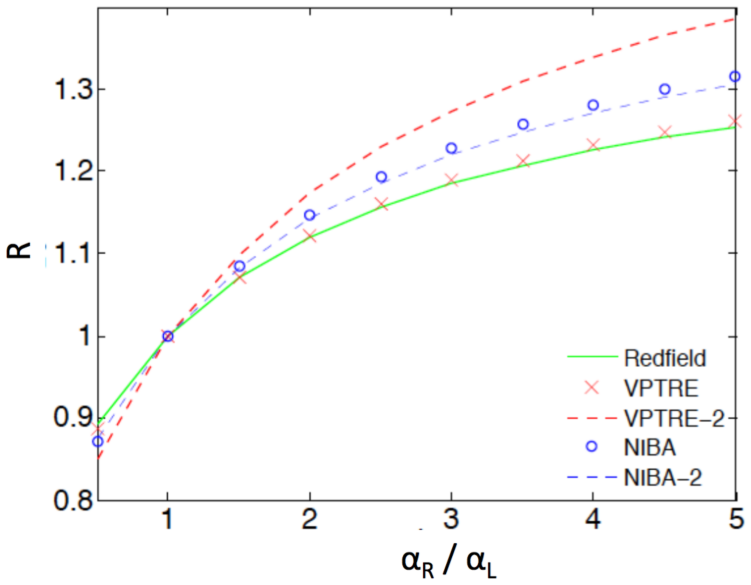
We propose a nonequilibrium variational polaron transformation, based on an ansatz for nonequilibrium steady state (NESS) with an effective temperature, to study quantum heat transport at the nanoscale. By combining the variational polaron transformed master equation with the full counting statistics, the method extends the polaron framework beyond super-Ohmic baths. It treats the infrared divergence in low-frequency bath modes and includes cross-bath correlation effects, providing more accurate heat current calculations than the NIBA formalism for Ohmic bath models in the spin-boson model.
What carries the argument
nonequilibrium variational polaron transformation parameterized by a single effective temperature for the nonequilibrium steady state
Load-bearing premise
The nonequilibrium steady state can be described by a variational polaron transformation parameterized by a single effective temperature.
What would settle it
Direct comparison of predicted heat currents against numerically exact solvers such as hierarchical equations of motion for an Ohmic spin-boson model at low temperature where infrared effects matter.
Figures

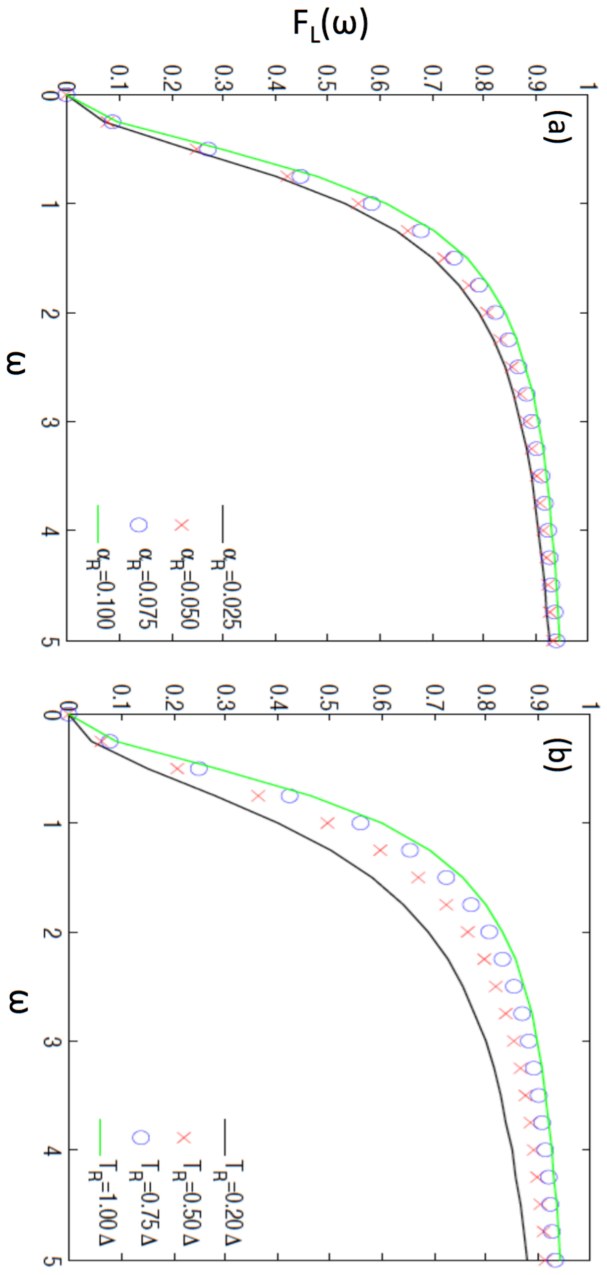
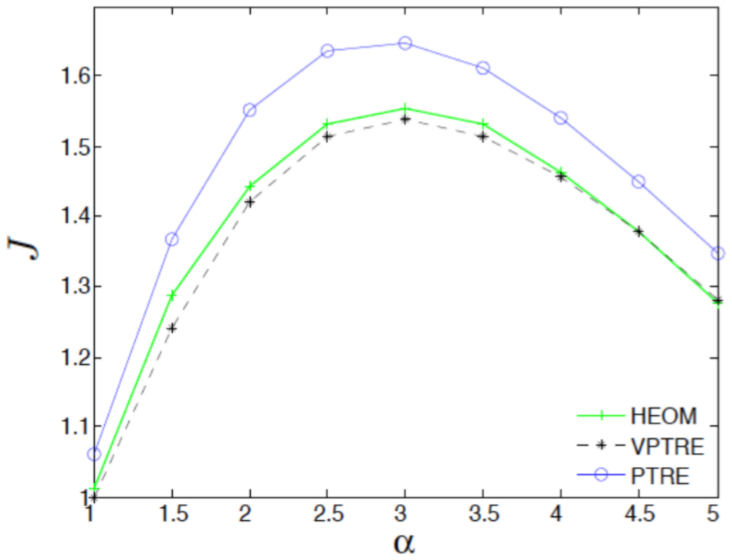
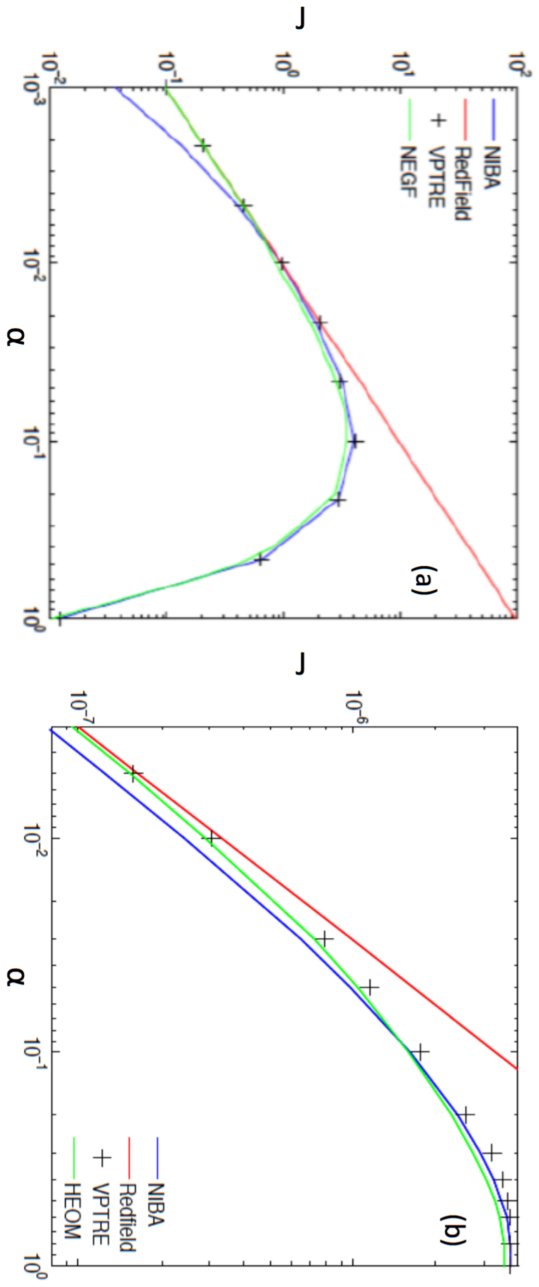
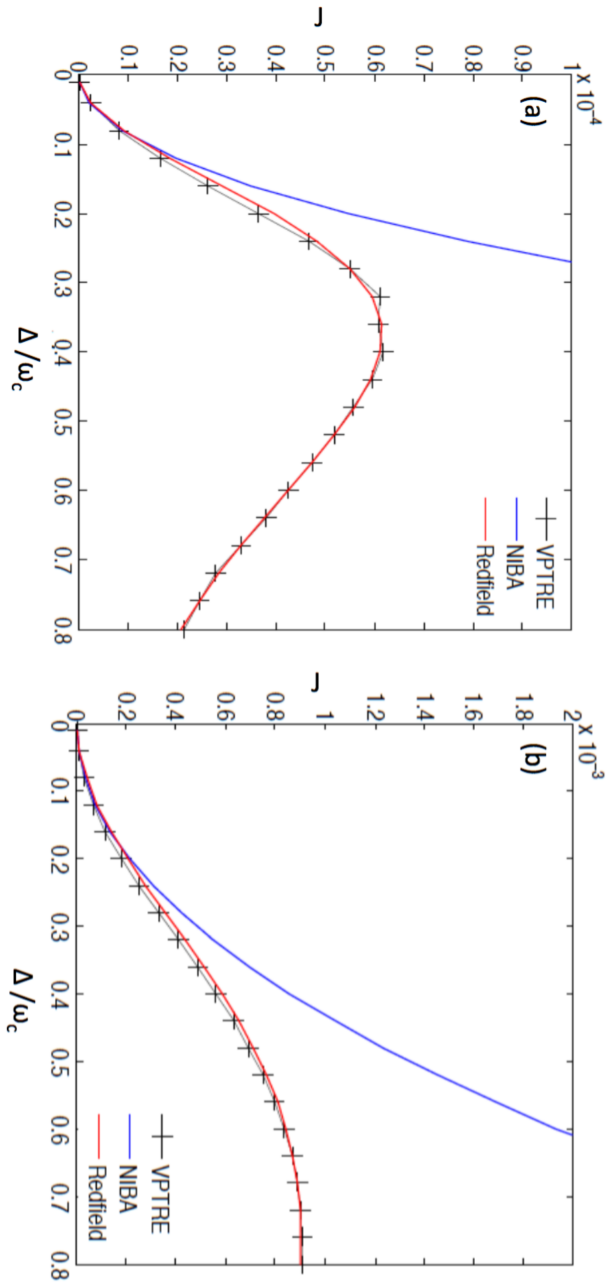
read the original abstract
We propose a nonequilibrium variational polaron transformation, based on an ansatz for nonequilibrium steady state (NESS) with an effective temperature, to study quantum heat transport at the nanoscale. By combining the variational polaron transformed master equation with the full counting statistics, we have extended the applicability of the polaron-based framework to study nonequilibrium process beyond the super-Ohmic bath models. Previously, the polaron-based framework for quantum heat transport reduces exactly to the non-interacting blip approximation (NIBA) formalism for Ohmic bath models due to the issue of the infrared divergence associated with the full polaron transformation. The nonequilibrium variational method allows us to appropriately treat the infrared divergence in the low-frequency bath modes and explicitly include cross-bath correlation effects. These improvements provide more accurate calculation of heat current than the NIBA formalism for Ohmic bath models. We illustrate the aforementioned improvements with the nonequilibrium spin-boson model in this work and quantitatively demonstrate the cross-bath correlation, current turnover, and rectification effects in quantum heat transfer.
Editorial analysis
A structured set of objections, weighed in public.
Referee Report
Summary. The manuscript proposes a nonequilibrium variational polaron transformation based on an effective-temperature ansatz for the nonequilibrium steady state (NESS). Combined with the variational polaron master equation and full counting statistics, the method is claimed to extend polaron-based treatments of quantum heat transport to Ohmic baths by regularizing infrared divergences in low-frequency modes and incorporating cross-bath correlations, yielding heat currents more accurate than those from the non-interacting blip approximation (NIBA). The improvements are illustrated for the nonequilibrium spin-boson model, including current turnover and rectification.
Significance. If the single-effective-temperature ansatz is shown to be sufficient, the approach would provide a practical extension of polaron methods to nonequilibrium Ohmic regimes, enabling quantitative study of correlation effects and transport phenomena not accessible to NIBA.
major comments (2)
- [Abstract] Abstract (paragraph describing the proposal): The central ansatz that the NESS can be captured by a variational polaron transformation parameterized by a single effective temperature is load-bearing for the accuracy claim. No derivation, error bound, or independent test is supplied showing that this one-parameter family reproduces the multi-bath correlations required for systematic improvement over NIBA when T_L ≠ T_R.
- [Abstract] Abstract: The statement that the method 'provides more accurate calculation of heat current than the NIBA formalism for Ohmic bath models' is presented without any numerical comparison, error bars, or benchmark against exact results; the abstract supplies only the formal claim.
Simulated Author's Rebuttal
We thank the referee for the careful review and constructive comments. We address each major comment below.
read point-by-point responses
-
Referee: [Abstract] Abstract (paragraph describing the proposal): The central ansatz that the NESS can be captured by a variational polaron transformation parameterized by a single effective temperature is load-bearing for the accuracy claim. No derivation, error bound, or independent test is supplied showing that this one-parameter family reproduces the multi-bath correlations required for systematic improvement over NIBA when T_L ≠ T_R.
Authors: The single-effective-temperature ansatz is obtained by applying the variational principle to minimize a suitable nonequilibrium functional that incorporates the bath spectral densities and the system-bath coupling; the resulting transformation explicitly retains cross-bath correlation terms that are absent in the standard polaron mapping. While a rigorous a-priori error bound is not derived, the manuscript presents numerical benchmarks for the nonequilibrium spin-boson model at T_L ≠ T_R that quantify the improvement in heat current relative to NIBA and demonstrate the role of the retained cross correlations. We will add a concise paragraph in the revised introduction and methods section that spells out the variational condition and the numerical evidence for multi-bath effects. revision: partial
-
Referee: [Abstract] Abstract: The statement that the method 'provides more accurate calculation of heat current than the NIBA formalism for Ohmic bath models' is presented without any numerical comparison, error bars, or benchmark against exact results; the abstract supplies only the formal claim.
Authors: We agree that the abstract should not assert improved accuracy without qualification. In the revised manuscript we will rephrase the relevant sentence to read that the method 'yields heat currents that are more accurate than NIBA, as shown by direct numerical comparison for the nonequilibrium spin-boson model with Ohmic baths.' revision: yes
Circularity Check
No circularity: derivation rests on explicit new variational ansatz for NESS, independent of fitted inputs or self-citation chains
full rationale
The paper introduces a nonequilibrium variational polaron transformation parameterized by a single effective temperature as its central proposal. This ansatz is stated directly rather than derived from prior equations or data fits within the work. No load-bearing step reduces by construction to a fitted parameter renamed as prediction, nor does any uniqueness theorem or ansatz originate from self-citation. The claimed improvements over NIBA for Ohmic baths follow from applying the new transformation to the master equation and FCS, without the derivation collapsing to its own inputs. The method is therefore self-contained against external benchmarks.
Axiom & Free-Parameter Ledger
free parameters (1)
- effective temperature
axioms (1)
- domain assumption A nonequilibrium steady state can be represented by a variational polaron transformation parameterized by an effective temperature
Lean theorems connected to this paper
-
IndisputableMonolith/Cost/FunctionalEquation.leanwashburn_uniqueness_aczel unclear?
unclearRelation between the paper passage and the cited Recognition theorem.
ansatz that the NESS can be approximated by ... rho_NESS = exp(-beta_L H_L^B - beta_R H_R^B - beta_bar H_s) ... Teff = (alpha_L T_L + alpha_R T_R)/(alpha_L + alpha_R)
-
IndisputableMonolith/Foundation/AlphaCoordinateFixation.leanalpha_pin_under_high_calibration unclear?
unclearRelation between the paper passage and the cited Recognition theorem.
displacement parameters {f_k,v} ... minimizing the effective free energy upper bound A_B ... F_v(omega) = [1 + tanh(beta_bar Lambda/2) coth(beta_v omega/2) (Delta_R)^2 / (Lambda omega)]^{-1}
What do these tags mean?
- matches
- The paper's claim is directly supported by a theorem in the formal canon.
- supports
- The theorem supports part of the paper's argument, but the paper may add assumptions or extra steps.
- extends
- The paper goes beyond the formal theorem; the theorem is a base layer rather than the whole result.
- uses
- The paper appears to rely on the theorem as machinery.
- contradicts
- The paper's claim conflicts with a theorem or certificate in the canon.
- unclear
- Pith found a possible connection, but the passage is too broad, indirect, or ambiguous to say the theorem truly supports the claim.
Reference graph
Works this paper leans on
-
[1]
Nitzan, A, Chemical Dynamics in Condensed Phases (Oxford University Press, New York), 2006
work page 2006
-
[2]
Nitzan, A.; Ratner, M. A. Electron Transport in Molecular Wire Junctions, Science, 2003, 300, 1384-1389
work page 2003
-
[3]
Lee, W.; Kim, K.; Jeong, W.; Zotti, L. A.; Pauly, F.; Cuevas, J. C.; Reddy, P. Heat Dissipation in Atomic-scale Junctions, Nature 2013, 498, 209–212
work page 2013
-
[4]
Colloquium : Phononics: Manipulating Heat Flow with Electronic Analogs and Beyond, Rev
Li, N.; Ren, J.; Wang, L.; Zhang, G, H¨anggi, P.; Li, B. Colloquium : Phononics: Manipulating Heat Flow with Electronic Analogs and Beyond, Rev. Mod. Phys. 2012, 84, 1045–1066
work page 2012
-
[5]
Quantum Heat Engines and Refrigerators: Continuous Devices,Annu
Kosloff, R.; Levy, A. Quantum Heat Engines and Refrigerators: Continuous Devices,Annu. Rev. Phys. Chem. 2014, 65, 365–393
work page 2014
-
[6]
Xu, D.; Wang, C.; Zhao, Y .; Cao, J. Polaron Effects on the Performance of Light-harvesting Systems: A Quantum Heat Engine Perspective, New J. Phys. 2016, 18, 023003/1–14
work page 2016
-
[7]
Efficiency at Maximum Power of a Laser Quantum Heat Engine Enhanced by Noise-induced Coherence.’ Phys
Dorfman, K.E.; Xu, D.; Cao, J. Efficiency at Maximum Power of a Laser Quantum Heat Engine Enhanced by Noise-induced Coherence.’ Phys. Rev. E 2018, 97, 042120/1–8
work page 2018
-
[8]
Leitner, D. M. Quantum ergodicity and energy flow in molecules Advances in Physics (Taylor Francis), 2015
work page 2015
-
[9]
Heat Flux Manipulation with Engineered Thermal Materials,Phys
Narayana, S.; Sato, Y . Heat Flux Manipulation with Engineered Thermal Materials,Phys. Rev. Lett. 2012, 108, 214303/1–5
work page 2012
-
[10]
Tuning the Aharonov-Bohm Effect with Dephasing in Nonequilibrium Transport, Phys
Engelhardt, G.; Cao, J. Tuning the Aharonov-Bohm Effect with Dephasing in Nonequilibrium Transport, Phys. Rev. B 2019, 99, 075436/1–1
work page 2019
-
[11]
Nonequilibrium Fluctuations, Fluctuation Theorems, and Counting Statistics in Quantum Systems, Rev
Esposito, M.; Harbola, U.; Mukamel, S. Nonequilibrium Fluctuations, Fluctuation Theorems, and Counting Statistics in Quantum Systems, Rev. Mod. Phys. 2009, 81, 1665–1702
work page 2009
-
[12]
Colloquium: Quantum Fluctuation Relations: Foundations and Applications, Rev
Campisi, M.; H¨anggi, P.; Talkner, P. Colloquium: Quantum Fluctuation Relations: Foundations and Applications, Rev. Mod. Phys. 2011, 83, 771–791
work page 2011
-
[13]
Frequency-dependent Current Noise in Quantum Heat Transfer with Full Counting Statistics
Liu, J.; Hsieh, C.-Y .; Cao, J. Frequency-dependent Current Noise in Quantum Heat Transfer with Full Counting Statistics. J. Chem. Phys. 2018, 148, 234104/1–11. 14
work page 2018
-
[14]
Bidirectional Counting of Single Electrons
Fujisawa, T.; Hayashi, T.; Tomita, R.; Hirayama, Y . Bidirectional Counting of Single Electrons. Science 2006, 312, 1634–1636
work page 2006
-
[15]
S.; Utsumi, Y .; Ihn, T.; Ensslin, K
K¨ung, B.; Kung, B.; Rossler, C.; Beck, M.; Marthaler, M.; Golubev, D. S.; Utsumi, Y .; Ihn, T.; Ensslin, K. Irreversibility on the Level of Single-electron Tunneling, Phys. Rev. X 2012, 2, 011001/1–6
work page 2012
-
[16]
Gustavsson, S.; Leturcq, R.; Simovic, B.; Schleser, R.; Ihn, T.; Studerus, P.; Ensslin, K.; Driscoll, D. C.; Gossard, A. C. Counting Statistics of Single Electron Transport in a Quantum Dot, Phys. Rev. Lett. 2006, 96, 076605/1–4
work page 2006
-
[17]
Nonequilibrium Energy Transfer at Nanoscale: A Unified Theory from Weak to Strong Coupling, Sci
Wang, C.; Ren, J.; Cao, J. Nonequilibrium Energy Transfer at Nanoscale: A Unified Theory from Weak to Strong Coupling, Sci. Rep. 2015, 5, 11787
work page 2015
-
[18]
Wang, C.; Ren, J.; Cao, J. Unifying Quantum Heat Transfer in a Nonequilibrium Spin-Boson Model with Full Counting Statistics, Phys. Rev. A 2017, 95, 023610/1–1
work page 2017
-
[19]
Lee, C. K.; Moix, J.; Cao, J. Accuracy of Second Order Perturbation Theory in the Polaron and Variational Polaron Frames, J. Chem. Phys. 2012, 136 204120/1–7
work page 2012
-
[20]
Lee, C. K.; Moix, J.; Cao, J. Coherent Quantum Transport in Disordered Systems: A Unified Polaron Treatment of Hopping and Band-like Transport,” J. Chem. Phys. 2015, 142 164103/1–7
work page 2015
-
[21]
Xu, D.; Cao, J. Non-canonical Distribution and Non-equilibrium Transport Beyond Weak System-bath Coupling Regime: A Polaron Transformation Approach, Front. Phys. 2016, 11, 111308/1–17
work page 2016
-
[22]
Non-equilibrium Spin-Boson Model: Counting Statistics and the Heat Exchange Fluctuation Theorem, J
Nicolin, L.; Segal, D. Non-equilibrium Spin-Boson Model: Counting Statistics and the Heat Exchange Fluctuation Theorem, J. Chem. Phys. 2011, 135, 164106/1–14
work page 2011
-
[23]
Silbey, R.; Harris, R. A. Variational Calculation of the Dynamics of a Two Level System Interacting with a Bath,J. Chem. Phys. 1984, 80, 2615–17
work page 1984
-
[24]
Harris, R. A.; Silbey, R. Variational Calculation of the Tunneling System Interacting with a Heat Bath. II. Dynamics of an Asymmetric Tunneling System, J. Chem. Phys. 1985, 83, 1069–1074
work page 1985
-
[25]
Reformulation of Steady State Nonequilibrium Quantum Statistical Mechanics,Phys
Hershfield, S. Reformulation of Steady State Nonequilibrium Quantum Statistical Mechanics,Phys. Rev. Lett. 1993, 70, 2134–2137
work page 1993
-
[26]
Ness, H. Nonequilibrium Density Matrix in Quantum Open Systems: Generalization for Simultaneous Heat and Charge Steady-state Transport, Phys. Rev. E 2014, 90, 062119/1–10
work page 2014
-
[27]
Thingna, J.; Zhou, H.; Wang, J.-S. Improved Dyson Series Expansion for Steady-state Quantum Transport Beyond the Weak Coupling Limit: Divergences and Resolution, J. Chem. Phys. 2014, 141, 194101/1–13
work page 2014
-
[28]
Nonequilibrium Density-matrix Description of Steady-state Quantum Transport, Phys
Dhar, A.; Saito, K.; H¨anggi, P. Nonequilibrium Density-matrix Description of Steady-state Quantum Transport, Phys. Rev. E 2012, 85, 011126/1–11
work page 2012
-
[29]
J.; Chakravarty, S.; Dorsey, A
Leggett, A. J.; Chakravarty, S.; Dorsey, A. T.; Fisher, M. P. A.; Garg, A.; Zwerger, W. Dynamics of the Dissipative Two-state System, Rev. Mod. Phys. 1987, 59, 1–85
work page 1987
-
[30]
Quantum Dissipative Systems (World Scientific, Singapore), 2012
Weiss, U. Quantum Dissipative Systems (World Scientific, Singapore), 2012
work page 2012
-
[31]
Velizhanin, K. A.; Wang, H.; Thoss, M. Heat Transport Through Model Molecular Junctions: A Multilayer Multiconfigura- tion Time–dependent Hartree Approach, Chem. Phys. Letts. 2014, 460, 325–330
work page 2014
-
[32]
Kilgour, M.; Agarwalla, B. K.; Segal, D. Path-integral methodology and simulations of quantum thermal transport: Full counting statistics approach J. Chem. Phys. 2019, 150, 084111/1–16
work page 2019
-
[33]
Manzano, D; Chuang, C; Cao, J ”Quantum transport in d-dimensional lattices, New Journal of Physics 2016, 18, 043044/1– 10
work page 2016
-
[34]
S.; Effects of Bath Relaxation on Dissipative Two-state Dynamics,J
Cao, J. S.; Effects of Bath Relaxation on Dissipative Two-state Dynamics,J. Chem. Phys. 2000, 112, 6719–6724
work page 2000
-
[35]
Cravena, G. T.; Nitzan, A. Electron Transfer Across a Thermal Gradient, Proc. Natl. Acad. Sci. U.S.A. 2016, 113, 9421–9429
work page 2016
-
[36]
Breuer, H.-P.; Petruccione, F.The Theory of Open Quantum Systems (Oxford University Press, Oxford), 2007
work page 2007
-
[37]
McCutcheon, D. P. S.; Dattani, N. S.; Gauger, E. M.; Lovett, B. W.; Nazir, A. A General Approach to Quantum Dynamics using a Variational Master Equation: Application to Phonon-damped Rabi Rotations in Quantum Dots, Phys. Rev. B 2011, 84, 081305/1–4
work page 2011
-
[38]
McCutcheon, D. P. S.; Nazir, A. Consistent treatment of coherent and incoherent energy transfer dynamics using a variational master equation J. Chem. Phys. 2011, 135, 114501/1-114501/12. 15
work page 2011
-
[39]
Optimal Tunneling Enhances the Quantum Photovoltaic Effect in Double Quantum Dots,New J
Wang, C.; Ren, J.; Cao, J. Optimal Tunneling Enhances the Quantum Photovoltaic Effect in Double Quantum Dots,New J. Phys. 2014, 16, 045019/1–16
work page 2014
-
[40]
Tanimura, Y . Stochastic Liouville, Langevin, Fokker-Planck, and Master Equation Approaches to Quantum Dissipative Systems, J. Phys. Soc. Jpn. 2006, 75, 082001/1–39
work page 2006
-
[41]
Kato, A.; Tanimura, Y . Quantum heat current under non-perturbative and non-Markovian conditions: Applications to heat machines J. Chem. Phys. 2016, 145, 224105/1–9
work page 2016
-
[42]
A Unified Stochastic Formulation of Dissipative Quantum Dynamics
Hsieh, C-Y .; Cao, J. A Unified Stochastic Formulation of Dissipative Quantum Dynamics. I. Generalized Hierarchical Equations, J. Chem. Phys. 2018, 148, 014103/1–14
work page 2018
-
[43]
Duan, C.; Tang, Z.; Cao, J.; Wu, J. Zero-temperature Localization in a Sub-Ohmic Spin-Boson Model Investigated by an Extended Hierarchy Equation of Motion, Phys. Rev. B 2017, 95, 214308/1–8
work page 2017
-
[44]
Spin-Boson Thermal Rectifier,Phys
Segal, D.; Nitzan, A. Spin-Boson Thermal Rectifier,Phys. Rev. Lett. 2005, 94, 034301/1–4
work page 2005
-
[45]
Segal, D.; Agarwalla, B. K. Vibrational heat transport in molecular junctions Ann. Rev. Phys. Chem. 2016, 67, 185–209 16
work page 2016
discussion (0)
Sign in with ORCID, Apple, or X to comment. Anyone can read and Pith papers without signing in.