Neutron rich matter in heaven and on Earth
Pith reviewed 2026-05-25 08:28 UTC · model grok-4.3
The pith
Neutron star interiors and nuclear neutron distributions are profoundly connected across 18 orders of magnitude.
A machine-rendered reading of the paper's core claim, the machinery that carries it, and where it could break.
Core claim
Despite a length-scale difference of 18 orders of magnitude, the internal structure of neutron stars and the spatial distribution of neutrons in atomic nuclei are profoundly connected.
What carries the argument
The equation of state of neutron-rich matter, which sets both the neutron distribution inside nuclei and the density profile inside neutron stars.
Load-bearing premise
The equation of state and other properties of neutron-rich matter remain consistent and transferable between the nuclear and stellar regimes without scale-dependent corrections that break the connection.
What would settle it
An observed neutron star mass-radius relation that lies outside the range allowed by nuclear models constrained by measurements of neutron skins in heavy nuclei.
Figures



read the original abstract
Despite a length-scale difference of 18 orders of magnitude, the internal structure of neutron stars and the spatial distribution of neutrons in atomic nuclei are profoundly connected.
Editorial analysis
A structured set of objections, weighed in public.
Referee Report
Summary. The manuscript is a review article asserting that the internal structure of neutron stars and the spatial distribution of neutrons in atomic nuclei are profoundly connected despite an 18-order-of-magnitude difference in length scales, primarily through shared properties of neutron-rich matter and the equation of state.
Significance. If the claimed connections hold, the review synthesizes laboratory nuclear data with astrophysical observations to constrain the dense-matter equation of state, offering a useful interdisciplinary overview that could guide future combined analyses in nuclear astrophysics.
major comments (2)
- [Abstract] Abstract: the central claim of a 'profound connection' is asserted without any supporting derivation, data, or outline of the linking mechanism, leaving the thesis unevaluable from the provided summary alone.
- [Review body] Throughout the review: the transferability of the symmetry energy and EOS from saturation density in nuclei to 2–5 times saturation density in neutron-star cores is load-bearing for the claimed link, yet the manuscript surveys connections without deriving or falsifying the absence of intervening degrees of freedom (hyperons, condensates, or deconfined quarks).
minor comments (2)
- A dedicated subsection on limitations of the EOS universality assumption would improve clarity for readers.
- Recent experimental constraints on neutron skins or heavy-ion collision data could be cross-referenced more explicitly if not already covered.
Simulated Author's Rebuttal
We thank the referee for the constructive report on our review manuscript. The comments correctly identify areas where the presentation of the central thesis can be strengthened. We address each major comment below and indicate the revisions planned for the next version.
read point-by-point responses
-
Referee: [Abstract] Abstract: the central claim of a 'profound connection' is asserted without any supporting derivation, data, or outline of the linking mechanism, leaving the thesis unevaluable from the provided summary alone.
Authors: We agree that the abstract is too terse to convey the linking mechanism. The manuscript body develops the connection through the density dependence of the nuclear symmetry energy, which governs both neutron skins in nuclei and the pressure in neutron-star cores. We will revise the abstract to include one sentence outlining this mechanism via the equation of state of neutron-rich matter. revision: yes
-
Referee: [Review body] Throughout the review: the transferability of the symmetry energy and EOS from saturation density in nuclei to 2–5 times saturation density in neutron-star cores is load-bearing for the claimed link, yet the manuscript surveys connections without deriving or falsifying the absence of intervening degrees of freedom (hyperons, condensates, or deconfined quarks).
Authors: The referee correctly notes that the review relies on the assumption that the same EOS framework applies across this density range without new degrees of freedom intervening. The manuscript surveys empirical constraints and theoretical models under this assumption but does not derive or falsify the absence of exotic phases, as that lies beyond the scope of a review. We will add an explicit caveat paragraph in the conclusions section acknowledging this limitation and its implications for the claimed connection. revision: partial
Circularity Check
No circularity: review surveys established links without self-referential derivation
full rationale
The paper is a review article whose central claim is the existence of a profound connection between neutron-star structure and nuclear neutron distributions across scales. No derivation chain is presented that reduces a prediction to a fitted input by construction, nor does any load-bearing step rely on self-citation of an unverified uniqueness theorem or ansatz. The abstract and available text state an empirical and theoretical linkage without introducing new equations whose outputs are forced by their own inputs. External literature on the equation of state is invoked as independent support rather than as a self-referential loop. This is the expected non-finding for a survey paper whose arguments remain falsifiable against laboratory and astrophysical data outside the present manuscript.
Axiom & Free-Parameter Ledger
Lean theorems connected to this paper
-
IndisputableMonolith/Cost/FunctionalEquation.leanwashburn_uniqueness_aczel unclear?
unclearRelation between the paper passage and the cited Recognition theorem.
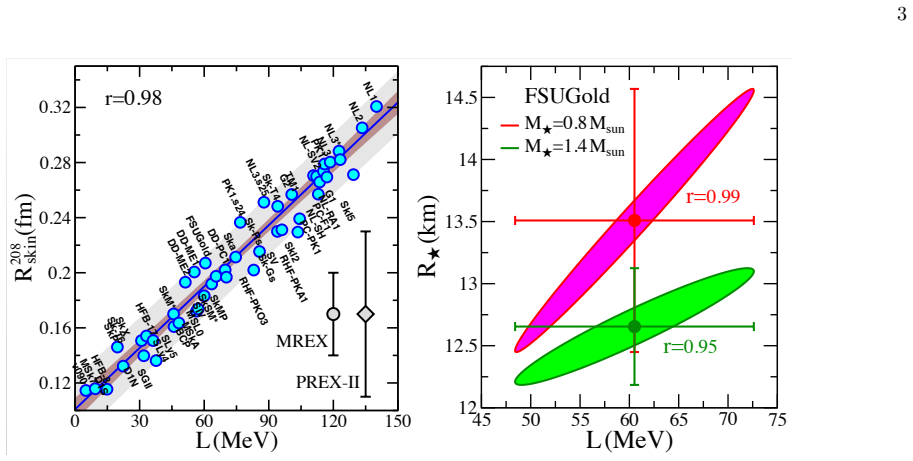
the symmetry pressure L ... controls both the thickness of the neutron skin of 208Pb and the radius of a neutron star
-
IndisputableMonolith/Foundation/RealityFromDistinction.leanreality_from_one_distinction unclear?
unclearRelation between the paper passage and the cited Recognition theorem.
Despite a length-scale difference of 18 orders of magnitude, the internal structure of neutron stars and the spatial distribution of neutrons in atomic nuclei are profoundly connected.
What do these tags mean?
- matches
- The paper's claim is directly supported by a theorem in the formal canon.
- supports
- The theorem supports part of the paper's argument, but the paper may add assumptions or extra steps.
- extends
- The paper goes beyond the formal theorem; the theorem is a base layer rather than the whole result.
- uses
- The paper appears to rely on the theorem as machinery.
- contradicts
- The paper's claim conflicts with a theorem or certificate in the canon.
- unclear
- Pith found a possible connection, but the passage is too broad, indirect, or ambiguous to say the theorem truly supports the claim.
Reference graph
Works this paper leans on
-
[1]
Moreover, GW170817 has provided fundamental new insights into the nature of dense matter. Criti- cal properties of the equation of state are encoded in the tidal polarizability, a neutron-star property that de- scribes its tendency to deform in response to the tidal field induced by its companion. As the two neutron stars approach each other, the phase of ...
work page 2019
- [2]
- [3]
-
[4]
C. J. Horowitz and J. Piekarewicz, Phys. Rev. Lett. 86, 5647 (2001)
work page 2001
-
[5]
C. J. Horowitz et al., J. Phys. G41, 093001 (2014)
work page 2014
- [6]
-
[7]
B. G. Todd-Rutel and J. Piekarewicz, Phys. Rev. Lett 95, 122501 (2005)
work page 2005
- [8]
- [9]
-
[10]
Antoniadis et al., Science 340, 6131 (2013)
J. Antoniadis et al., Science 340, 6131 (2013)
work page 2013
- [11]
-
[12]
B. P. Abbott et al. (Virgo, LIGO Scientific), Phys. Rev. Lett. 119, 161101 (2017)
work page 2017
-
[13]
F. J. Fattoyev, J. Piekarewicz, and C. J. Horowitz, Phys. Rev. Lett. 120, 172702 (2018)
work page 2018
- [14]
- [15]
-
[16]
A. Bauswein, O. Just, H.-T. Janka, and N. Stergioulas, Astrophys. J. 850, L34 (2017)
work page 2017
-
[17]
Connecting Quarks with the Cosmos: Eleven Science Questions for the New Century (The National Academies Press, Washington, 2003). 7 A neutron star is a gold mine for the study of physical phenomena that cut across a variety of disciplines, from particle physics to general relativity . With masses comparable to that of our Sun but radii of only 10-15 km, n...
work page 2003
discussion (0)
Sign in with ORCID, Apple, or X to comment. Anyone can read and Pith papers without signing in.