High-throughput Onboard Hyperspectral Image Compression with Ground-based CNN Reconstruction
Pith reviewed 2026-05-25 01:46 UTC · model grok-4.3
The pith
Convolutional neural networks can reconstruct hyperspectral images from onboard prequantized compression and recover the full SNR loss at 2 bits per pixel.
A machine-rendered reading of the paper's core claim, the machinery that carries it, and where it could break.
Core claim
The paper claims that convolutional neural networks can reconstruct hyperspectral images compressed via prequantization and lossless prediction, fully recovering the SNR drop at 2 bits per pixel without needing extra side information.
What carries the argument
Ground-based convolutional neural network reconstruction that models the signal to invert quantization effects from the onboard compression pipeline.
If this is right
- High-throughput compression becomes feasible onboard spacecraft without the data dependencies of in-loop reconstruction.
- The rate-distortion performance approaches that of more complex near-lossless methods at low bitrates.
- Reconstruction requires only the compressed stream, fitting existing downlink protocols.
- Performance holds when the CNN is trained on representative hyperspectral datasets.
Where Pith is reading between the lines
- Similar reconstruction networks could apply to other remote sensing modalities like multispectral or radar data.
- Training the CNN on data from the specific instrument might further improve recovery.
- Deployment could allow lower onboard bitrates while maintaining ground image quality.
Load-bearing premise
A CNN trained on representative hyperspectral data can recover the quantization-induced SNR loss without introducing new artifacts.
What would settle it
Measuring the SNR of CNN-reconstructed images at 2 bpp and finding it lower than the uncompressed reference by more than the paper's reported margin, or observing artifacts not present in the original.
Figures




read the original abstract
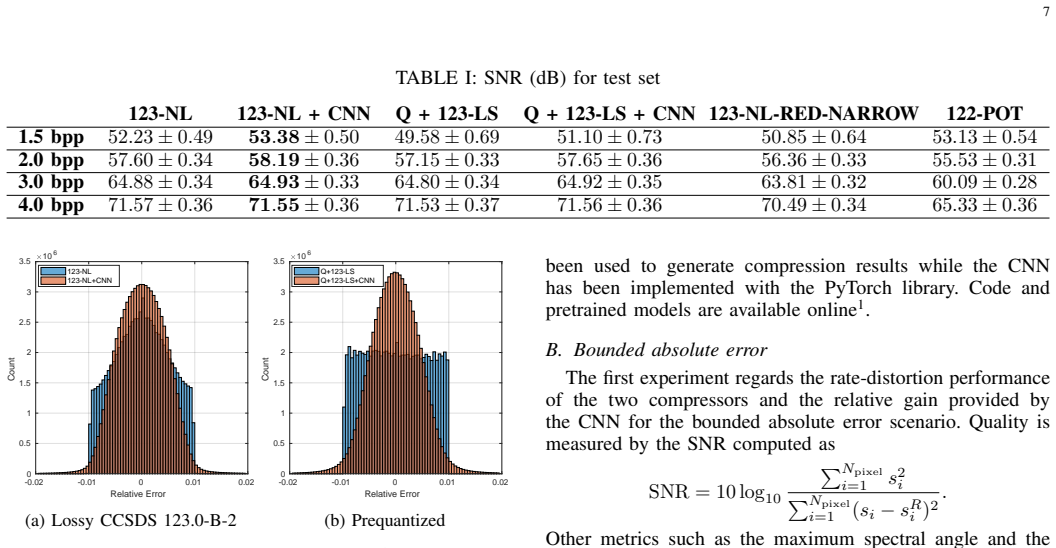
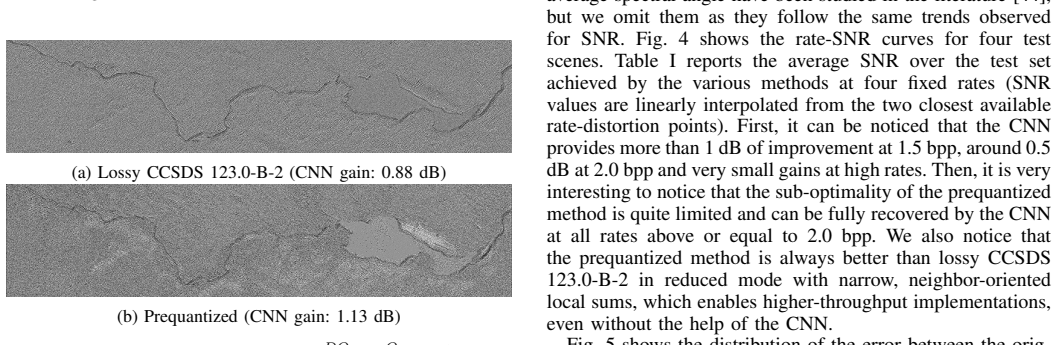
Compression of hyperspectral images onboard of spacecrafts is a tradeoff between the limited computational resources and the ever-growing spatial and spectral resolution of the optical instruments. As such, it requires low-complexity algorithms with good rate-distortion performance and high throughput. In recent years, the Consultative Committee for Space Data Systems (CCSDS) has focused on lossless and near-lossless compression approaches based on predictive coding, resulting in the recently published CCSDS 123.0-B-2 recommended standard. While the in-loop reconstruction of quantized prediction residuals provides excellent rate-distortion performance for the near-lossless operating mode, it significantly constrains the achievable throughput due to data dependencies. In this paper, we study the performance of a faster method based on prequantization of the image followed by a lossless predictive compressor. While this is well known to be suboptimal, one can exploit powerful signal models to reconstruct the image at the ground segment, recovering part of the suboptimality. In particular, we show that convolutional neural networks can be used for this task and that they can recover the whole SNR drop incurred at a bitrate of 2 bits per pixel.
Editorial analysis
A structured set of objections, weighed in public.
Referee Report
Summary. The paper proposes prequantization of hyperspectral images followed by lossless predictive compression (CCSDS 123.0-B-2) for high onboard throughput, with a ground-based CNN used to reconstruct the image and recover the rate-distortion loss relative to near-lossless in-loop quantization. The central empirical claim is that the CNN recovers the entire SNR drop at a bitrate of 2 bits per pixel.
Significance. If the reconstruction result holds under realistic domain-shift conditions, the approach would allow substantially higher onboard throughput than current CCSDS near-lossless standards while preserving end-to-end SNR, which is directly relevant to resource-constrained space missions with growing sensor resolutions.
major comments (2)
- [Abstract] Abstract (reconstruction paragraph): the claim that the CNN 'recovers the whole SNR drop' at 2 bpp is presented as an empirical outcome, yet no description is given of how the training cubes were quantized with the exact onboard prequantizer step size and noise statistics; without this, it is impossible to assess whether the reported recovery is an artifact of matched training/test conditions.
- [Abstract] The weakest assumption (training data exactly matches onboard quantization noise statistics and test scenes) is load-bearing for the central claim; any mismatch in sensor response, scene statistics, or quantization granularity would leave residual structured error not captured by aggregate SNR, but the manuscript provides no cross-sensor or cross-scene ablation to quantify this risk.
Simulated Author's Rebuttal
We thank the referee for the constructive comments on the abstract and the assumptions underlying our central claim. We respond to each point below and will incorporate clarifications in the revised manuscript.
read point-by-point responses
-
Referee: [Abstract] Abstract (reconstruction paragraph): the claim that the CNN 'recovers the whole SNR drop' at 2 bpp is presented as an empirical outcome, yet no description is given of how the training cubes were quantized with the exact onboard prequantizer step size and noise statistics; without this, it is impossible to assess whether the reported recovery is an artifact of matched training/test conditions.
Authors: We confirm that the training cubes were quantized using the exact same prequantizer step size and noise statistics as the onboard process to simulate realistic conditions. This ensures the CNN is trained to reconstruct under the specific quantization noise present in the compressed data. The abstract omitted this detail for brevity. We will revise the abstract to explicitly state that training was performed with matched quantization parameters. revision: yes
-
Referee: [Abstract] The weakest assumption (training data exactly matches onboard quantization noise statistics and test scenes) is load-bearing for the central claim; any mismatch in sensor response, scene statistics, or quantization granularity would leave residual structured error not captured by aggregate SNR, but the manuscript provides no cross-sensor or cross-scene ablation to quantify this risk.
Authors: The reported results are based on training and testing with data from the same sensor and scene statistics to demonstrate the reconstruction capability under matched conditions. We agree that this is a key assumption and that aggregate SNR may not capture all structured errors under mismatch. The manuscript does not include cross-sensor ablations due to the limited availability of multi-sensor hyperspectral datasets in the study. We will add text to the revised paper discussing this limitation and recommending sensor-specific model training for operational use. revision: partial
Circularity Check
No circularity: empirical CNN reconstruction result
full rationale
The paper's central claim is an empirical demonstration that a ground-based CNN recovers the full SNR loss from onboard prequantization at 2 bpp. No equations, derivations, or 'predictions' are presented that reduce the outcome to fitted parameters or self-citations by construction. The result is framed as an experimental outcome of training on representative data, with no load-bearing self-referential steps or uniqueness theorems invoked. This is a standard non-circular empirical finding.
Axiom & Free-Parameter Ledger
axioms (1)
- domain assumption Powerful signal models exist that can recover suboptimality of prequantization via learned reconstruction
Reference graph
Works this paper leans on
-
[1]
Consultative Committee for Space Data Systems (CCSDS), “Image Data Compression,” Blue Book , November 2005. [Online]. Available: https://public.ccsds.org/Pubs/122x0b1c3s.pdf
work page 2005
-
[2]
Pairwise orthogonal transform for spectral image coding,
I. Blanes and J. Serra-Sagrist `a, “Pairwise orthogonal transform for spectral image coding,” IEEE Transactions on Geosciece and Remote Sensing, vol. 49, no. 3, pp. 961–972, 2011
work page 2011
-
[3]
A. Abrardo, M. Barni, E. Magli, and F. Nencini, “Error-resilient and low-complexity onboard lossless compression of hyperspectral images by means of distributed source coding,” IEEE Transactions on Geo- sciece and Remote Sensing , vol. 48, no. 4, pp. 1892–1904, 2010
work page 1904
-
[4]
Universal encoding of multispectral images,
D. Valsesia and P. T. Boufounos, “Universal encoding of multispectral images,” in 2016 IEEE International Conference on Acoustics, Speech and Signal Processing , March 2016, pp. 4453–4457
work page 2016
-
[5]
Multispectral image compression using universal vector quanti- zation,
——, “Multispectral image compression using universal vector quanti- zation,” in 2016 IEEE Information Theory Workshop (ITW) , Sep. 2016, pp. 151–155
work page 2016
-
[6]
Compressive sensing for hyperspectral Earth observation from space,
A. Barducci, D. Guzzi, C. Lastri, V . Nardino, I. Pippi, and V . Raimondi, “Compressive sensing for hyperspectral Earth observation from space,” International Conference on Space Optics , vol. 7, p. 10, 2014
work page 2014
-
[7]
Lossless compression of multi/hyper-spectral imagery based on a 3-d fuzzy prediction,
B. Aiazzi, P. Alba, L. Alparone, and S. Baronti, “Lossless compression of multi/hyper-spectral imagery based on a 3-d fuzzy prediction,” IEEE Transactions on Geosciece and Remote Sensing , vol. 37, no. 5, pp. 2287–2294, 1999
work page 1999
-
[8]
Optimized onboard lossless and near-lossless compression of hyperspectral data using CALIC,
E. Magli, G. Olmo, and E. Quacchio, “Optimized onboard lossless and near-lossless compression of hyperspectral data using CALIC,” IEEE Geoscience and Remote Sensing Letters , vol. 1, no. 1, pp. 21–25, Jan 2004
work page 2004
-
[9]
Exploiting calibration-induced arti- facts in lossless compression of hyperspectral imagery,
A. B. Kiely and M. A. Klimesh, “Exploiting calibration-induced arti- facts in lossless compression of hyperspectral imagery,” IEEE Transac- tions on Geoscience and Remote Sensing , vol. 47, no. 8, pp. 2672–2678, 2009
work page 2009
-
[10]
Lossless Multispectral and Hyperspectral Image Compression,
Consultative Committee for Space Data Systems (CCSDS), “Lossless Multispectral and Hyperspectral Image Compression,” Silver Book , no. 1, May 2012. [Online]. Available: https://public.ccsds.org/Pubs/ 123x0b1ec1s.pdf
work page 2012
-
[11]
D. Valsesia and E. Magli, “A novel rate control algorithm for onboard predictive coding of multispectral and hyperspectral images,” IEEE Transactions on Geoscience and Remote Sensing , vol. 52, no. 10, pp. 6341–6355, Oct 2014
work page 2014
-
[12]
——, “A hardware-friendly architecture for onboard rate-controlled predictive coding of hyperspectral and multispectral images,” in 2014 IEEE International Conference on Image Processing , Oct 2014, pp. 5142–5146
work page 2014
-
[13]
Fast and lightweight rate control for onboard predictive coding of hyperspectral images,
——, “Fast and lightweight rate control for onboard predictive coding of hyperspectral images,” IEEE Geoscience and Remote Sensing Letters , vol. 14, no. 3, pp. 394–398, March 2017
work page 2017
-
[14]
M. Conoscenti, R. Coppola, and E. Magli, “Constant snr, rate control, and entropy coding for predictive lossy hyperspectral image compres- sion,” IEEE Transactions on Geoscience and Remote Sensing , vol. 54, no. 12, pp. 7431–7441, Dec 2016
work page 2016
-
[15]
Low- Complexity Lossless and Near-Lossless Multispectral and Hyperspectral Image Compression,
Consultative Committee for Space Data Systems (CCSDS), “Low- Complexity Lossless and Near-Lossless Multispectral and Hyperspectral Image Compression,” Blue Book , no. 1, February 2019. [Online]. Available: https://public.ccsds.org/Pubs/123x0b2.pdf
work page 2019
-
[16]
Digital coding of waveforms: principles and applications to speech and video,
N. S. Jayant and P. Noll, “Digital coding of waveforms: principles and applications to speech and video,” Englewood Cliffs, NJ , pp. 115–251, 1984. 10 TABLE III: Transfer learning on AIRS sensor Q 123-NL 123-NL + CNN Q + 123-LS Q + 123-LS + CNN 3 SNR (dB) 68.73 68.83 68.73 68.82 Rate (bpp) 2.81 2.87 7 SNR (dB) 60.96 61.25 60.95 61.45 Rate (bpp) 1.87 1.99 ...
work page 1984
-
[17]
Squeeze-and-excitation networks,
J. Hu, L. Shen, and G. Sun, “Squeeze-and-excitation networks,” in 2018 IEEE/CVF Conference on Computer Vision and Pattern Recognition , June 2018, pp. 7132–7141
work page 2018
-
[18]
Learning aerial image segmentation from online maps,
P. Kaiser, J. D. Wegner, A. Lucchi, M. Jaggi, T. Hofmann, and K. Schindler, “Learning aerial image segmentation from online maps,” IEEE Transactions on Geoscience and Remote Sensing , vol. 55, no. 11, pp. 6054–6068, Nov 2017
work page 2017
-
[19]
You only look once: Unified, real-time object detection,
J. Redmon, S. Divvala, R. Girshick, and A. Farhadi, “You only look once: Unified, real-time object detection,” in 2016 IEEE Conference on Computer Vision and Pattern Recognition (CVPR) , June 2016, pp. 779–788
work page 2016
-
[20]
Beyond a Gaussian denoiser: residual learning of deep CNN for image denoising,
K. Zhang, W. Zuo, Y . Chen, D. Meng, and L. Zhang, “Beyond a Gaussian denoiser: residual learning of deep CNN for image denoising,” IEEE Transactions on Image Processing , vol. 26, no. 7, pp. 3142–3155, 2017
work page 2017
-
[21]
Image super-resolution using deep convolutional networks,
C. Dong, C. C. Loy, K. He, and X. Tang, “Image super-resolution using deep convolutional networks,” IEEE Transactions on Pattern Analysis and Machine Intelligence , vol. 38, no. 2, pp. 295–307, Feb 2016
work page 2016
-
[22]
Super-resolution for remote sensing images via localglobal combined network,
S. Lei, Z. Shi, and Z. Zou, “Super-resolution for remote sensing images via localglobal combined network,” IEEE Geoscience and Remote Sensing Letters , vol. 14, no. 8, pp. 1243–1247, Aug 2017
work page 2017
-
[23]
Deep learning for super-resolution of unregistered multi-temporal satellite images,
A. Bordone Molini, D. Valsesia, G. Fracastoro, and E. Magli, “Deep learning for super-resolution of unregistered multi-temporal satellite images,” in 2019 10th Workshop on Hyperspectral Image and Signal Processing: Evolution in Remote Sensing (WHISPERS) , 2019
work page 2019
-
[24]
L. Santos, L. Berrojo, J. Moreno, J. F. Lopez, and R. Sarmiento, “Multispectral and Hyperspectral Lossless Compressor for Space Ap- plications (HyLoC): A Low-Complexity FPGA Implementation of the CCSDS 123 Standard,” IEEE Journal of Selected Topics in Applied Earth Observations and Remote Sensing , vol. 9, no. 2, pp. 757–770, Feb 2016
work page 2016
- [25]
-
[26]
[Online]. Available: http://www.esa.int/Our Activities\/Space Engineering Technology/Microelectronics/SHyLoC IP Core
-
[27]
Lossy multi/hyperspectral compression hw implementation at high data rate,
M. D. Nino, M. Romano, G. Capuano, and E. Magli, “Lossy multi/hyperspectral compression hw implementation at high data rate,” in Proceedings of International Astronautical Congress , 2014
work page 2014
-
[28]
Image dequantization for hyperspectral lossy compression with convolutional neural networks,
D. Valsesia and E. Magli, “Image dequantization for hyperspectral lossy compression with convolutional neural networks,” in European Workshop on On-Board Data Processing (OBDP2019) , 2019
work page 2019
-
[29]
Low-complexity lossless compression of hyperspectral imagery via adaptive filtering,
M. A. Klimesh, “Low-complexity lossless compression of hyperspectral imagery via adaptive filtering,” 2005
work page 2005
-
[30]
S. Golomb, “Run-length encodings,” IEEE Transactions on Information Theory, vol. 12, no. 3, pp. 399–401, July 1966
work page 1966
-
[31]
Tracking analysis of the sign algorithm in nonstationary environments,
S. H. Cho and V . J. Mathews, “Tracking analysis of the sign algorithm in nonstationary environments,” IEEE Trans. Acoust., Speech, Signal Process., vol. 38, no. 12, pp. 2046–2057, 1990
work page 2046
-
[32]
Noise2Noise: learning image restoration without clean data,
J. Lehtinen, J. Munkberg, J. Hasselgren, S. Laine, T. Karras, M. Aittala, and T. Aila, “Noise2Noise: learning image restoration without clean data,” in International Conference on Machine Learning (ICML) , 2018
work page 2018
-
[33]
Image denoising via CNNs: an adversarial approach,
N. Divakar and R. V . Babu, “Image denoising via CNNs: an adversarial approach,” in New Trends in Image Restoration and Enhancement, CVPR, 2017
work page 2017
-
[34]
Image blind denoising with generative adversarial network based noise modeling,
J. Chen, J. Chen, H. Chao, and M. Yang, “Image blind denoising with generative adversarial network based noise modeling,” in Proceedings of the IEEE Conference on Computer Vision and Pattern Recognition , 2018, pp. 3155–3164
work page 2018
-
[35]
Photo-realistic single image super-resolution using a generative adversarial network,
C. Ledig, L. Theis, F. Huszr, J. Caballero, A. Cunningham, A. Acosta, A. Aitken, A. Tejani, J. Totz, Z. Wang, and W. Shi, “Photo-realistic single image super-resolution using a generative adversarial network,” in 2017 IEEE Conference on Computer Vision and Pattern Recognition (CVPR), July 2017, pp. 105–114
work page 2017
-
[36]
Empirical Evaluation of Rectified Activations in Convolutional Network
B. Xu, N. Wang, T. Chen, and M. Li, “Empirical evaluation of rectified activations in convolutional network,”arXiv preprint arXiv:1505.00853, 2015
work page internal anchor Pith review Pith/arXiv arXiv 2015
-
[37]
Deep residual learning for image recognition,
K. He, X. Zhang, S. Ren, and J. Sun, “Deep residual learning for image recognition,” in 2016 IEEE Conference on Computer Vision and Pattern Recognition (CVPR) , June 2016, pp. 770–778
work page 2016
-
[38]
Instance Normalization: The Missing Ingredient for Fast Stylization
D. Ulyanov, A. Vedaldi, and V . Lempitsky, “Instance normaliza- tion: The missing ingredient for fast stylization,” arXiv preprint arXiv:1607.08022, 2016
work page internal anchor Pith review Pith/arXiv arXiv 2016
-
[39]
Batch normalization: Accelerating deep network training by reducing internal covariate shift,
S. Ioffe and C. Szegedy, “Batch normalization: Accelerating deep network training by reducing internal covariate shift,” in Proceedings of the 32Nd International Conference on International Conference on Machine Learning - V olume 37 , ser. ICML’15. JMLR.org, 2015, 11 pp. 448–456. [Online]. Available: http://dl.acm.org/citation.cfm?id= 3045118.3045167
-
[40]
Neural nearest neighbors networks,
T. Pl ¨otz and S. Roth, “Neural nearest neighbors networks,” in Advances in Neural Information Processing Systems 31 , S. Bengio, H. Wallach, H. Larochelle, K. Grauman, N. Cesa-Bianchi, and R. Garnett, Eds. Curran Associates, Inc., 2018, pp. 1087–1098. [Online]. Available: http://papers.nips.cc/paper/7386-neural-nearest-neighbors-networks.pdf
work page 2018
-
[41]
Image denoising with graph-convolutional neural networks,
D. Valsesia, G. Fracastoro, and E. Magli, “Image denoising with graph-convolutional neural networks,” in 2019 26th IEEE International Conference on Image Processing (ICIP) , 2019
work page 2019
-
[42]
J. Fjeldtvedt, M. Orlandic, and T. Arne Johansen, “An Efficient Real- Time FPGA Implementation of the CCSDS-123 Compression Standard for Hyperspectral Images,” IEEE Journal of Selected Topics in Applied Earth Observations and Remote Sensing , vol. PP, pp. 1–12, 09 2018
work page 2018
-
[43]
Compression to Achieve a Relative Error Bound,
A. Kiely, “Compression to Achieve a Relative Error Bound,” CCSDS MHDC WG meeting , April 2017
work page 2017
-
[44]
Adam: A Method for Stochastic Optimization
D. P. Kingma and J. Ba, “Adam: A method for stochastic optimization,” arXiv preprint arXiv:1412.6980 , 2014
work page internal anchor Pith review Pith/arXiv arXiv 2014
-
[45]
Quality criteria benchmark for hyperspectral imagery,
E. Christophe, D. Leger, and C. Mailhes, “Quality criteria benchmark for hyperspectral imagery,” IEEE Transactions on Geoscience and Remote Sensing , vol. 43, no. 9, pp. 2103–2114, Sep. 2005
work page 2005
discussion (0)
Sign in with ORCID, Apple, or X to comment. Anyone can read and Pith papers without signing in.