Lattice methods for students at a formal TASI
Pith reviewed 2026-05-25 02:02 UTC · model grok-4.3
The pith
Lattice field theory lectures supply physical motivation rather than full technical details for formal quantum field theory students.
A machine-rendered reading of the paper's core claim, the machinery that carries it, and where it could break.
Core claim
The lectures claim that the physical motivation behind lattice regularization of quantum field theories, including the appearance of confinement and the procedure for recovering continuum physics, can be conveyed directly to formal-theory students, together with an overview of calculation components, the special treatment required for chiral fermions, and concrete examples drawn from the three-dimensional Ising model and QCD.
What carries the argument
The lattice as a discrete spacetime regulator that enables non-perturbative computations while allowing a controlled approach to the continuum limit.
If this is right
- Lattice methods make the phenomenon of confinement accessible to direct computation in gauge theories.
- Chiral fermions can be placed on the lattice through formulations that respect their properties in the continuum limit.
- The three-dimensional Ising model serves as a controlled test case for lattice techniques before application to four-dimensional QCD.
- An overview of the parts of a lattice calculation reveals the sequence from action formulation to measurement of physical observables.
Where Pith is reading between the lines
- The motivational framing could allow formal theorists to incorporate lattice results into analytic work more quickly.
- The same structure of presentation might be adapted to other non-perturbative regulators such as functional methods or tensor networks.
- Case studies limited to the Ising model and QCD leave open whether similar motivation applies equally to lattice studies of supersymmetric or conformal theories.
Load-bearing premise
That an overview centered on physical motivation supplies enough background for the intended audience without complete technical derivations.
What would settle it
A follow-up check whether students who attended the lectures could outline the steps of a basic lattice QCD calculation or identify the role of the continuum limit without consulting additional technical references.
Figures


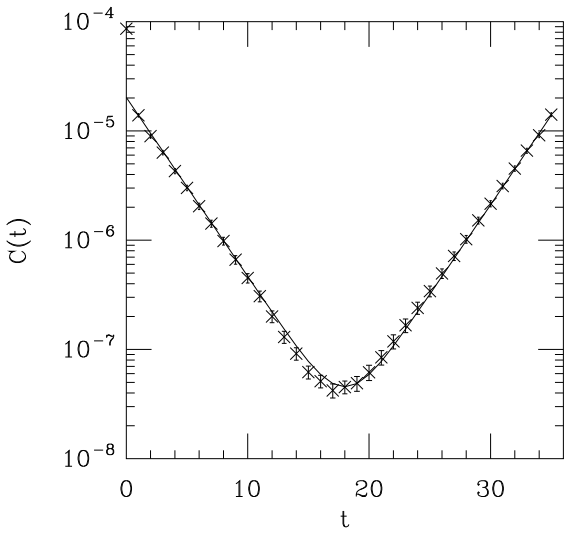


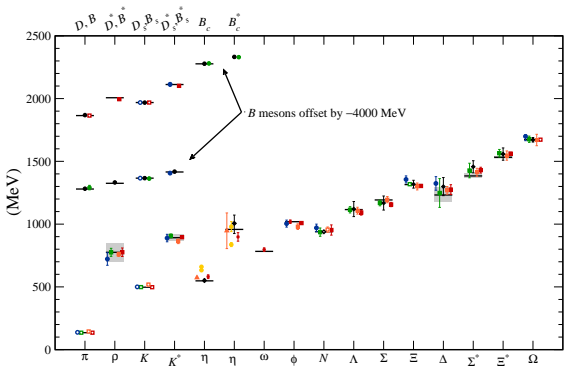


read the original abstract
These lectures about lattice field theory were written for, and given at, TASI 2019, ``The many dimensions of quantum field theory.'' The students at this TASI were mostly interested in formal things, and so these are slightly unusual lattice lectures: I wanted to give the physical motivation behind lattice calculations rather than describe all the technical details. A quick outline: (1) The really big picture: lattice basics, lattice confinement, getting rid of the lattice. (2) A walk through the parts of a lattice calculation -- an overview, to show what's involved. (3) Chiral fermions on the lattice. (This part might be interesting to lattice people.) (4) Case studies: the three dimensional Ising model, and QCD.
Editorial analysis
A structured set of objections, weighed in public.
Referee Report
Summary. These lecture notes, prepared for TASI 2019 on the many dimensions of quantum field theory, supply physical motivation for lattice field theory methods to an audience primarily interested in formal aspects of QFT. The notes outline lattice basics and confinement, the process of removing the lattice, an overview of the components of a lattice calculation, chiral fermions on the lattice, and case studies of the three-dimensional Ising model and QCD, deliberately emphasizing motivation over exhaustive technical implementation details.
Significance. If the motivations are conveyed accurately, the notes provide a useful bridge for formal theorists to lattice techniques by focusing on physical intuition rather than derivations, which aligns with the stated goal for the TASI audience. The pedagogical framing and selection of topics (including the dedicated section on chiral fermions) represent a strength for this context.
minor comments (2)
- [Abstract] The parenthetical remark in the abstract that the chiral fermions section 'might be interesting to lattice people' is informal and could be removed or rephrased for consistency with the rest of the manuscript.
- A short list of suggested references for readers seeking the technical details omitted from the overview sections would improve utility without altering the motivational focus.
Simulated Author's Rebuttal
We thank the referee for the positive report and the recommendation to accept the manuscript. The notes were prepared specifically for the TASI audience of formal theorists, and we are glad the pedagogical approach and topic selection were viewed as appropriate.
Circularity Check
No circularity: pedagogical lecture notes with no derivations or claims
full rationale
The paper consists of TASI lecture notes whose explicit purpose is to supply physical motivation for lattice methods rather than technical derivations or novel results. No equations, fitted parameters, predictions, or load-bearing claims are present that could reduce to inputs by construction, self-citation, or renaming. The central content is an overview of motivation and case studies, which is self-contained and independent of any circular reduction.
Axiom & Free-Parameter Ledger
Reference graph
Works this paper leans on
-
[1]
Fermionic Monte Carlo Lattice fermions are really annoying. First of all, it is tricky to write do wn a lattice fermion action with the right number of degrees of freedom. (This is called the “doubling problem.”) Second, computers can’t deal with Grassmann variables and so you have to integrate them out exactly before the simulation starts. This is har d ...
work page 2008
-
[2]
A peak at L1/ν (T − Tc) = v0 (or T =Tpeak, so Tpeak =Tc +v0L− 1/ν )
-
[3]
A width of ∆ T =v1L− 1/ν
-
[4]
A height scaling like Lγ/ν Item (1) implies that the apparent Tc is shifted; items (2) and (3) that the peak in χ rises and narrows with L. There is an example of this, mentioned in a paper about duality transf ormations in three dimensional topological insulators by Metlitski and Vishwanath [55]. They refer to a lattice study of the three-dimensional Gin...
-
[5]
[62]), but how to get confinement was u nknown before Wilson
and Gross and Wilczek [61] came the realization that QCD was the t heory of the strong interactions (compare Ref. [62]), but how to get confinement was u nknown before Wilson. The name “QCD” is Gell-Mann’s. Wilson and Kogut and Susskind and othe rs did strong coupling calculations in the 70’s. Monte Carlo for pure gauge theories began with Creutz in 1979 a...
work page 1979
-
[6]
chiral symmetry breaking, when the constituents are light We use bits of asymptotic freedom in our simulations (taking the bare coupling to zero takes the lattice spacing to zero), and some of us measure lattice q uantities which give a running coupling as an output, but we tend not to think in terms of Λ p arameters (say, to set the overall scale). They ...
work page 1974
-
[7]
Lattice methods for quantum c hromodynamics,
T. DeGrand and C. E. Detar, “Lattice methods for quantum c hromodynamics,” New Jersey, USA: World Scientific (2006) 345 p
work page 2006
-
[8]
Quantum chromodynamics on the lattice,
C. Gattringer and C. B. Lang, “Quantum chromodynamics on the lattice,” Lect. Notes Phys. 788, 1 (2010). doi:10.1007/978-3-642-01850-3
-
[9]
Lattice Quantu m Chromodynamics: Practical Essentials,
F. Knechtli, M. G¨ unther and M. Peardon, “Lattice Quantu m Chromodynamics: Practical Essentials,” doi:10.1007/978-94-024-0999-4
-
[10]
Markov Chain Monte Carlo for Dummies
M. Hanada, “Markov Chain Monte Carlo for Dummies,” arXiv :1808.08490 [hep-th]
work page internal anchor Pith review Pith/arXiv arXiv
-
[11]
K. G. Wilson, Phys. Rev. D 10, 2445 (1974). doi:10.1103/PhysRevD.10.2445
-
[12]
J. M. Drouffe and C. Itzykson, Phys. Rept. 38, 133 (1978). doi:10.1016/0370-1573(78)90154-0
-
[13]
J. B. Kogut and L. Susskind, Phys. Rev. D 11, 395 (1975). doi:10.1103/PhysRevD.11.395
-
[14]
A. Krasnitz and R. Venugopalan, Nucl. Phys. B 557, 237 (1999) doi:10.1016/S0550- 3213(99)00366-1 [hep-ph/9809433]
work page internal anchor Pith review Pith/arXiv arXiv doi:10.1016/s0550- 1999
-
[15]
K. G. Wilson and J. B. Kogut, Phys. Rept. 12, 75 (1974). doi:10.1016/0370-1573(74)90023-4
-
[16]
M. Creutz, Phys. Rev. D 21, 2308 (1980). doi:10.1103/PhysRevD.21.2308
-
[17]
N. Metropolis, A. W. Rosenbluth, M. N. Rosenbluth, A. H. Teller and E. Teller, J. Chem. Phys. 21, 1087 (1953). doi:10.1063/1.1699114
-
[18]
Actions for dynamical fermion simulations: are we ready to go?
K. Jansen, Nucl. Phys. Proc. Suppl. 129, 3 (2004) doi:10.1016/S0920-5632(03)02502-7 [hep-lat/0311039]
work page internal anchor Pith review Pith/arXiv arXiv doi:10.1016/s0920-5632(03)02502-7 2004
-
[19]
Lattice tests of beyond Standard Model dynamics
T. DeGrand, Rev. Mod. Phys. 88, 015001 (2016) doi:10.1103/RevModPhys.88.015001 [arXiv:1510.05018 [hep-ph]]
work page internal anchor Pith review Pith/arXiv arXiv doi:10.1103/revmodphys.88.015001 2016
-
[20]
S. Catterall, D. B. Kaplan and M. Unsal, Phys. Rept. 484, 71 (2009) doi:10.1016/j.physrep.2009.09.001 [arXiv:0903.4881 [h ep-lat]]
work page internal anchor Pith review Pith/arXiv arXiv doi:10.1016/j.physrep.2009.09.001 2009
-
[21]
G. T. Fleming, J. B. Kogut and P. M. Vranas, Phys. Rev. D 64, 034510 (2001) doi:10.1103/PhysRevD.64.034510 [hep-lat/0008009]
work page internal anchor Pith review Pith/arXiv arXiv doi:10.1103/physrevd.64.034510 2001
-
[22]
J. Giedt, R. Brower, S. Catterall, G. T. Fleming and P. Vr anas, Phys. Rev. D 79, 025015 (2009) doi:10.1103/PhysRevD.79.025015 [arXiv:0810.574 6 [hep-lat]]
-
[23]
M. G. Endres, Phys. Rev. D 79, 094503 (2009) doi:10.1103/PhysRevD.79.094503 [arXiv:0902.4267 [hep-lat]]
work page internal anchor Pith review Pith/arXiv arXiv doi:10.1103/physrevd.79.094503 2009
-
[24]
S. W. Kim et al. [JLQCD Collaboration], PoS LATTICE 2011, 069 (2011) doi:10.22323/1.139.0069 [arXiv:1111.2180 [hep-lat]]. 45
work page internal anchor Pith review Pith/arXiv arXiv doi:10.22323/1.139.0069 2011
-
[25]
Towards the spectrum of low-lying particles in supersymmetric Yang-Mills theory
G. Bergner, I. Montvay, G. M¨ unster, U. D. ¨Ozugurel and D. Sandbrink, JHEP 1311, 061 (2013) doi:10.1007/JHEP11(2013)061 [arXiv:1304.2168 [h ep-lat]]
work page internal anchor Pith review Pith/arXiv arXiv doi:10.1007/jhep11(2013)061 2013
-
[26]
S. Ali, G. Bergner, H. Gerber, I. Montvay, G. M¨ unster, S . Piemonte and P. Scior, arXiv:1902.11127 [hep-lat]
work page internal anchor Pith review Pith/arXiv arXiv 1902
-
[27]
N=4 Supersymmetry on a Space-Time Lattice
S. Catterall, D. Schaich, P. H. Damgaard, T. DeGrand and J. Giedt, Phys. Rev. D 90, no. 6, 065013 (2014) doi:10.1103/PhysRevD.90.065013 [arXiv: 1405.0644 [hep-lat]]
work page internal anchor Pith review Pith/arXiv arXiv doi:10.1103/physrevd.90.065013 2014
-
[28]
Phase Structure of Lattice N=4 Super Yang-Mills
S. Catterall, P. H. Damgaard, T. Degrand, R. Galvez and D . Mehta, JHEP 1211, 072 (2012) doi:10.1007/JHEP11(2012)072 [arXiv:1209.5285 [hep-lat ]]
work page internal anchor Pith review Pith/arXiv arXiv doi:10.1007/jhep11(2012)072 2012
- [29]
-
[30]
Direct test of the AdS/CFT correspondence by Monte Carlo studies of N=4 super Yang-Mills theory
M. Honda, G. Ishiki, S. W. Kim, J. Nishimura and A. Tsuchi ya, JHEP 1311, 200 (2013) doi:10.1007/JHEP11(2013)200 [arXiv:1308.3525 [hep-th] ]
work page internal anchor Pith review Pith/arXiv arXiv doi:10.1007/jhep11(2013)200 2013
-
[31]
Holographic description of quantum black hole on a computer
M. Hanada, Y. Hyakutake, G. Ishiki and J. Nishimura, Sci ence 344, 882 (2014) doi:10.1126/science.1250122 [arXiv:1311.5607 [hep-th] ]
work page internal anchor Pith review Pith/arXiv arXiv doi:10.1126/science.1250122 2014
-
[32]
M. Honda, G. Ishiki, J. Nishimura and A. Tsuchiya, PoS LA TTICE 2011, 244 (2011) doi:10.22323/1.139.0244 [arXiv:1112.4274 [hep-lat]]
work page internal anchor Pith review Pith/arXiv arXiv doi:10.22323/1.139.0244 2011
-
[33]
Testing a novel large-N reduction for N=4 super Yang-Mills theory on RxS^3
G. Ishiki, S. W. Kim, J. Nishimura and A. Tsuchiya, JHEP 0909, 029 (2009) doi:10.1088/1126-6708/2009/09/029 [arXiv:0907.1488 [h ep-th]]
work page internal anchor Pith review Pith/arXiv arXiv doi:10.1088/1126-6708/2009/09/029 2009
-
[34]
N=4 Super Yang-Mills from the Plane Wave Matrix Model
T. Ishii, G. Ishiki, S. Shimasaki and A. Tsuchiya, Phys. Rev. D 78, 106001 (2008) doi:10.1103/PhysRevD.78.106001 [arXiv:0807.2352 [hep- th]]
work page internal anchor Pith review Pith/arXiv arXiv doi:10.1103/physrevd.78.106001 2008
-
[35]
G. Ishiki, S. W. Kim, J. Nishimura and A. Tsuchiya, Phys. Rev. Lett. 102, 111601 (2009) doi:10.1103/PhysRevLett.102.111601 [arXiv:0810.2884 [ hep-th]]
work page internal anchor Pith review Pith/arXiv arXiv doi:10.1103/physrevlett.102.111601 2009
-
[36]
Topological Insulators -- A review
R. Shankar, “Topological insulators – a review,” arXiv :1804.06471
work page internal anchor Pith review Pith/arXiv arXiv
-
[37]
Lectures on the Quantum Hall Effect,
D. Tong, “Lectures on the Quantum Hall Effect,” arXiv:160 6.06687 [hep-th]
-
[38]
H. B. Nielsen and M. Ninomiya, Nucl. Phys. B 185, 20 (1981) Erratum: [Nucl. Phys. B 195, 541 (1982)]. doi:10.1016/0550-3213(81)90361-8, 10.1016 /0550-3213(82)90011-6
-
[40]
R. Jackiw and C. Rebbi, Phys. Rev. D 13, 3398 (1976). doi:10.1103/PhysRevD.13.3398
-
[41]
D. B. Kaplan, Phys. Lett. B 288, 342 (1992) doi:10.1016/0370-2693(92)91112-M [hep-lat/9206013]
work page internal anchor Pith review Pith/arXiv arXiv doi:10.1016/0370-2693(92)91112-m 1992
-
[42]
Chiral Fermions from Lattice Boundaries
Y. Shamir, Nucl. Phys. B 406, 90 (1993) doi:10.1016/0550-3213(93)90162-I [hep-lat/9303005]
work page internal anchor Pith review Pith/arXiv arXiv doi:10.1016/0550-3213(93)90162-i 1993
-
[44]
M. F. L. Golterman, K. Jansen and D. B. Kaplan, Phys. Lett . B 301, 219 (1993) doi:10.1016/0370-2693(93)90692-B [hep-lat/9209003]
work page internal anchor Pith review Pith/arXiv arXiv doi:10.1016/0370-2693(93)90692-b 1993
-
[46]
P. H. Ginsparg and K. G. Wilson, Phys. Rev. D 25, 2649 (1982). doi:10.1103/PhysRevD.25.2649
-
[47]
Exactly massless quarks on the lattice
H. Neuberger, Phys. Lett. B 417, 141 (1998) doi:10.1016/S0370-2693(97)01368-3 [hep-lat/9707022]
work page internal anchor Pith review Pith/arXiv arXiv doi:10.1016/s0370-2693(97)01368-3 1998
-
[48]
Chiral gauge theories revisited
M. Luscher, Subnucl. Ser. 38, 41 (2002) doi:10.1142/9789812778253 0002 [hep-th/0102028]
work page internal anchor Pith review Pith/arXiv arXiv doi:10.1142/9789812778253 2002
-
[49]
R. C. Brower, H. Neff and K. Orginos, Comput. Phys. Commun . 220, 1 (2017) doi:10.1016/j.cpc.2017.01.024 [arXiv:1206.5214 [hep-l at]]
work page internal anchor Pith review Pith/arXiv arXiv doi:10.1016/j.cpc.2017.01.024 2017
-
[50]
M. Golterman, Nucl. Phys. Proc. Suppl. 94, 189 (2001) doi:10.1016/S0920-5632(01)00953-7 46 [hep-lat/0011027]
work page internal anchor Pith review Pith/arXiv arXiv doi:10.1016/s0920-5632(01)00953-7 2001
-
[51]
SU(N) chiral gauge theories on the lattice
M. Golterman and Y. Shamir, Phys. Rev. D 70, 094506 (2004) doi:10.1103/PhysRevD.70.094506 [hep-lat/0404011]
work page internal anchor Pith review Pith/arXiv arXiv doi:10.1103/physrevd.70.094506 2004
-
[52]
E. Eichten and J. Preskill, Nucl. Phys. B 268, 179 (1986). doi:10.1016/0550-3213(86)90207-5
-
[53]
M. F. L. Golterman, D. N. Petcher and E. Rivas, Nucl. Phys . B 395, 596 (1993) doi:10.1016/0550-3213(93)90049-U [hep-lat/9206010]
work page internal anchor Pith review Pith/arXiv arXiv doi:10.1016/0550-3213(93)90049-u 1993
-
[54]
Luscher, JHEP 0006, 028 (2000) doi:10.1088/1126-6708/2000/06/028 [hep-lat /0006014]
M. Luscher, JHEP 0006, 028 (2000) doi:10.1088/1126-6708/2000/06/028 [hep-lat /0006014]
-
[55]
D. M. Grabowska and D. B. Kaplan, Phys. Rev. D 94, no. 11, 114504 (2016) doi:10.1103/PhysRevD.94.114504 [arXiv:1610.02151 [hep -lat]]
work page internal anchor Pith review Pith/arXiv arXiv doi:10.1103/physrevd.94.114504 2016
-
[56]
D. M. Grabowska and D. B. Kaplan, Phys. Rev. Lett. 116, no. 21, 211602 (2016) doi:10.1103/PhysRevLett.116.211602 [arXiv:1511.03649 [hep-lat]]
work page internal anchor Pith review Pith/arXiv arXiv doi:10.1103/physrevlett.116.211602 2016
-
[57]
TASI Lectures on the Conformal Bootstrap
D. Simmons-Duffin, “The Conformal Bootstrap,” in the Pro ceedings of TASI - 2015, New Jer- sey, USA: World Scientific (2016); doi:10.1142/9789813149 441 0001 [arXiv:1602.07982 [hep- th]]
work page internal anchor Pith review Pith/arXiv arXiv doi:10.1142/9789813149 2015
-
[58]
A Semidefinite Program Solver for the Conformal Bootstrap
D. Simmons-Duffin, JHEP 1506, 174 (2015) doi:10.1007/JHEP06(2015)174 [arXiv:1502.02033 [hep-th]]
work page internal anchor Pith review Pith/arXiv arXiv doi:10.1007/jhep06(2015)174 2015
-
[59]
A Finite Size Scaling Study of Lattice Models in the three-dimensional Ising Universality Class
M. Hasenbusch, Phys. Rev. B 82, 174433 (2010) doi:10.1103/PhysRevB.82.174433 [arXiv:1004.4486 [cond-mat.stat-mech]]
work page internal anchor Pith review Pith/arXiv arXiv doi:10.1103/physrevb.82.174433 2010
-
[60]
Scaling And Renormalization In Statistic al Physics,
J. L. Cardy, “Scaling And Renormalization In Statistic al Physics,” Cambridge, UK: Univ. Pr. (1996). (Cambridge lecture notes in physics: 3)
work page 1996
-
[61]
M. A. Metlitski and A. Vishwanath, Phys. Rev. B 93, no. 24, 245151 (2016) doi:10.1103/PhysRevB.93.245151 [arXiv:1505.05142 [con d-mat.str-el]]
work page internal anchor Pith review Pith/arXiv arXiv doi:10.1103/physrevb.93.245151 2016
-
[62]
Masses and Phase Structure in the Ginzburg-Landau Model
K. Kajantie, M. Karjalainen, M. Laine and J. Peisa, Phys . Rev. B 57, 3011 (1998) doi:10.1103/PhysRevB.57.3011 [cond-mat/9704056]
work page internal anchor Pith review Pith/arXiv arXiv doi:10.1103/physrevb.57.3011 1998
-
[63]
M. E. Fisher and A. N. Berker, Phys. Rev. B 26, 2507 (1982). doi:10.1103/PhysRevB.26.2507
-
[64]
A. Cheng, A. Hasenfratz, Y. Liu, G. Petropoulos and D. Sc haich, Phys. Rev. D 90, no. 1, 014509 (2014) doi:10.1103/PhysRevD.90.014509 [arXiv:14 01.0195 [hep-lat]]
-
[65]
Finite-size scaling tests for SU(3) lattice gauge theory with color sextet fermions
T. DeGrand, Phys. Rev. D 80, no. 11, 114507 (2009) doi:10.1103/PhysRevD.80.114507 [arXiv:0910.3072 [hep-lat]]
work page internal anchor Pith review Pith/arXiv arXiv doi:10.1103/physrevd.80.114507 2009
-
[66]
H. D. Politzer, Phys. Rev. Lett. 30, 1346 (1973). doi:10.1103/PhysRevLett.30.1346
-
[67]
D. J. Gross and F. Wilczek, Phys. Rev. Lett. 30, 1343 (1973). doi:10.1103/PhysRevLett.30.1343
-
[68]
H. Fritzsch, M. Gell-Mann and H. Leutwyler, Phys. Lett. 47B, 365 (1973). doi:10.1016/0370- 2693(73)90625-4
-
[69]
TASI Lectures on Remnants from the String Landscape
J. Halverson and P. Langacker, PoS TASI 2017, 019 (2018) doi:10.22323/1.305.0019 [arXiv:1801.03503 [hep-th]]
work page internal anchor Pith review Pith/arXiv arXiv doi:10.22323/1.305.0019 2017
-
[70]
Meson spectra of asymptotically free gauge theories from holography
J. Erdmenger, N. Evans and M. Scott, Phys. Rev. D 91, no. 8, 085004 (2015) doi:10.1103/PhysRevD.91.085004 [arXiv:1412.3165 [hep- ph]]
work page internal anchor Pith review Pith/arXiv arXiv doi:10.1103/physrevd.91.085004 2015
-
[71]
A. M. Polyakov, Nucl. Phys. B 120, 429 (1977). doi:10.1016/0550-3213(77)90086-4
-
[72]
A. M. Polyakov, “GAUGE FIELDS AND STRINGS,” CHUR, SWITZERLAND: HAR- WOOD (1987) 301 P. (CONTEMPORARY CONCEPTS IN PHYSICS, 3)
work page 1987
-
[73]
M. E. Peskin, Nucl. Phys. B 175, 197 (1980). doi:10.1016/0550-3213(80)90051-6
-
[74]
J. Preskill, Nucl. Phys. B 177, 21 (1981). doi:10.1016/0550-3213(81)90265-0
-
[75]
D. A. Kosower, Phys. Lett. 144B, 215 (1984). doi:10.1016/0370-2693(84)91806-9
-
[76]
M. Tanabashi et al. [Particle Data Group], Phys. Rev. D 98, no. 3, 030001 (2018). doi:10.1103/PhysRevD.98.030001 47
-
[77]
Light hadrons with improved staggered quarks: approaching the continuum limit
C. Aubin et al. , Phys. Rev. D 70, 094505 (2004) doi:10.1103/PhysRevD.70.094505 [hep-lat/0402030]
work page internal anchor Pith review Pith/arXiv arXiv doi:10.1103/physrevd.70.094505 2004
-
[78]
Full nonperturbative QCD simulations with 2+1 flavors of improved staggered quarks
A. Bazavov et al. [MILC Collaboration], Rev. Mod. Phys. 82, 1349 (2010) doi:10.1103/RevModPhys.82.1349 [arXiv:0903.3598 [hep- lat]]
work page internal anchor Pith review Pith/arXiv arXiv doi:10.1103/revmodphys.82.1349 2010
-
[79]
2+1 Flavor Lattice QCD toward the Physical Point
S. Aoki et al. [PACS-CS Collaboration], Phys. Rev. D 79, 034503 (2009) doi:10.1103/PhysRevD.79.034503 [arXiv:0807.1661 [hep- lat]]
work page internal anchor Pith review Pith/arXiv arXiv doi:10.1103/physrevd.79.034503 2009
-
[80]
S. Durr et al. , Science 322, 1224 (2008) doi:10.1126/science.1163233 [arXiv:0906.3 599 [hep- lat]]
-
[81]
W. Bietenholz et al. , Phys. Rev. D 84, 054509 (2011) doi:10.1103/PhysRevD.84.054509 [arXiv:1102.5300 [hep-lat]]
work page internal anchor Pith review Pith/arXiv arXiv doi:10.1103/physrevd.84.054509 2011
-
[82]
Baryon spectrum with $N_f=2+1+1$ twisted mass fermions
C. Alexandrou, V. Drach, K. Jansen, C. Kallidonis and G. Koutsou, Phys. Rev. D 90, no. 7, 074501 (2014) doi:10.1103/PhysRevD.90.074501 [arXiv: 1406.4310 [hep-lat]]
work page internal anchor Pith review Pith/arXiv arXiv doi:10.1103/physrevd.90.074501 2014
-
[83]
N. H. Christ et al., Phys. Rev. Lett. 105, 241601 (2010) doi:10.1103/PhysRevLett.105.241601 [arXiv:1002.2999 [hep-lat]]
work page internal anchor Pith review Pith/arXiv arXiv doi:10.1103/physrevlett.105.241601 2010
discussion (0)
Sign in with ORCID, Apple, or X to comment. Anyone can read and Pith papers without signing in.