CTRL-ALT-LED: Leaking Data from Air-Gapped Computers via Keyboard LEDs
Pith reviewed 2026-05-24 23:31 UTC · model grok-4.3
The pith
Malware can exfiltrate data from air-gapped computers by blinking keyboard LEDs at up to 3000 bits per second.
A machine-rendered reading of the paper's core claim, the machinery that carries it, and where it could break.
Core claim
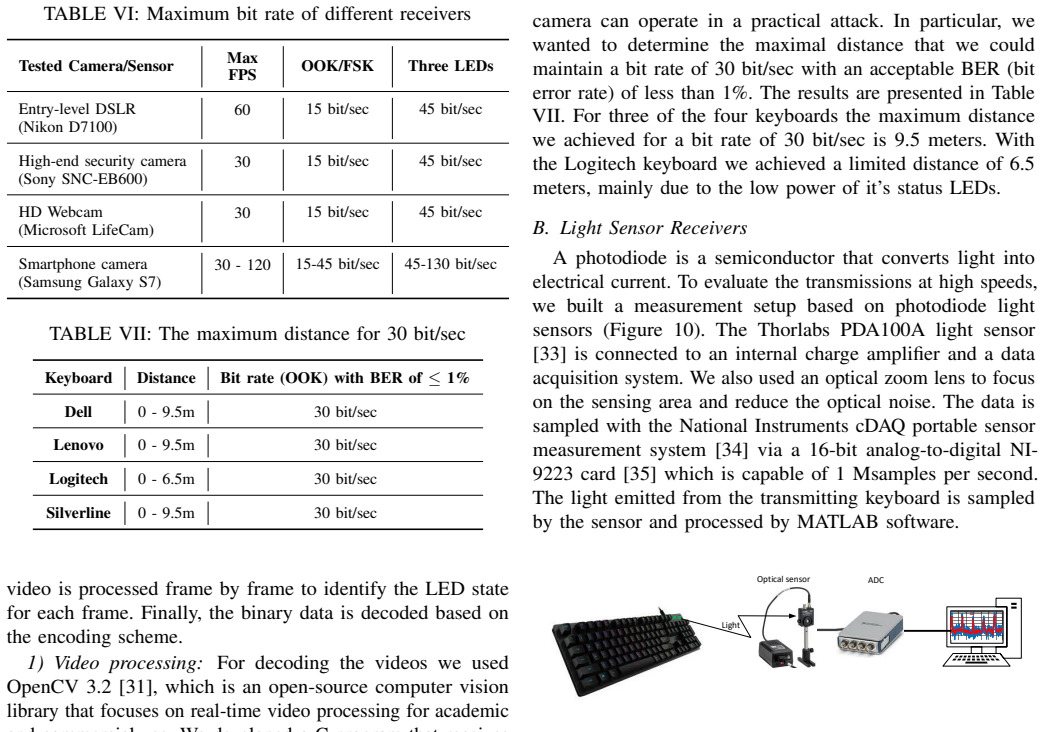
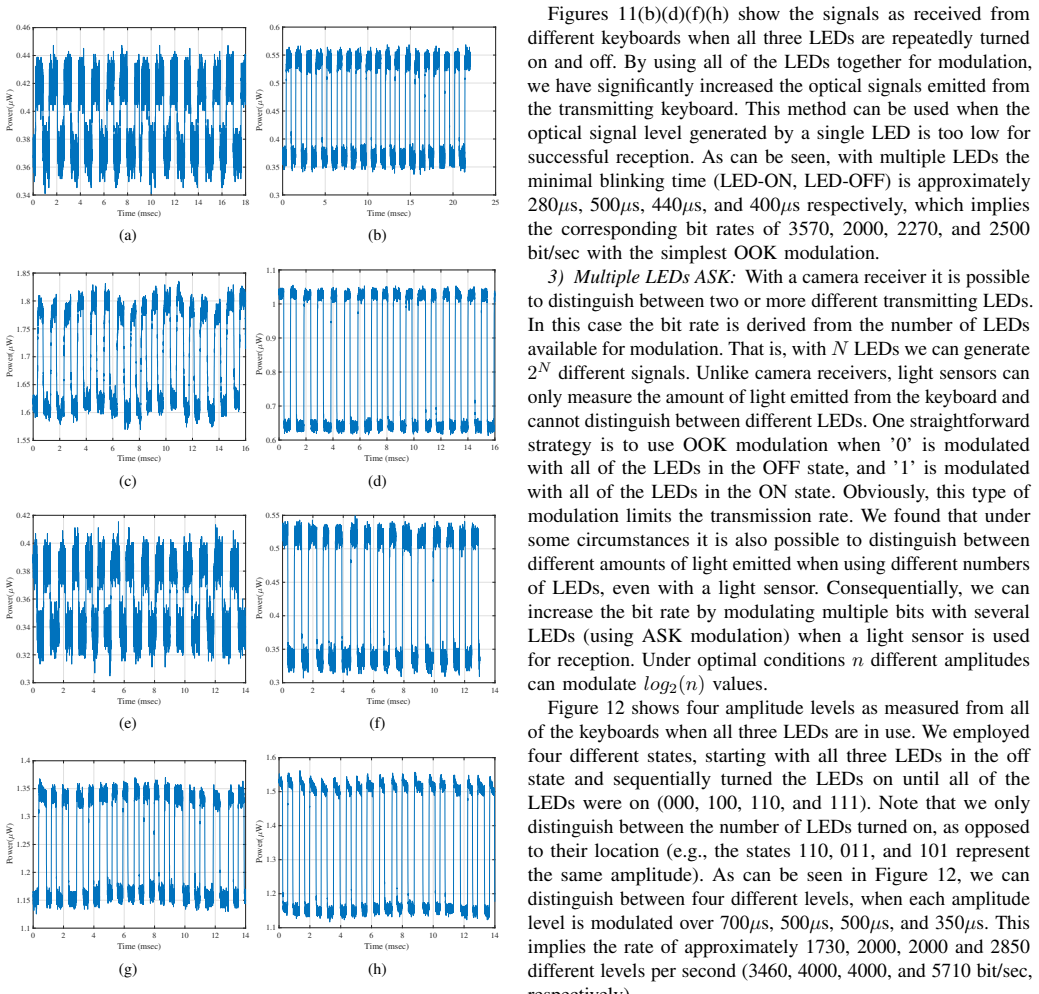
An advanced persistent threat can use the keyboard LEDs to encode and transmit information optically from air-gapped computers. The attack involves malware modulating the LED states to represent data bits, which are captured by optical receivers like light sensors or cameras. Experiments show maximum rates of 3000 bit/sec per LED with dedicated sensors and over 120 bit/sec with smartphones, without requiring keyboard modifications.
What carries the argument
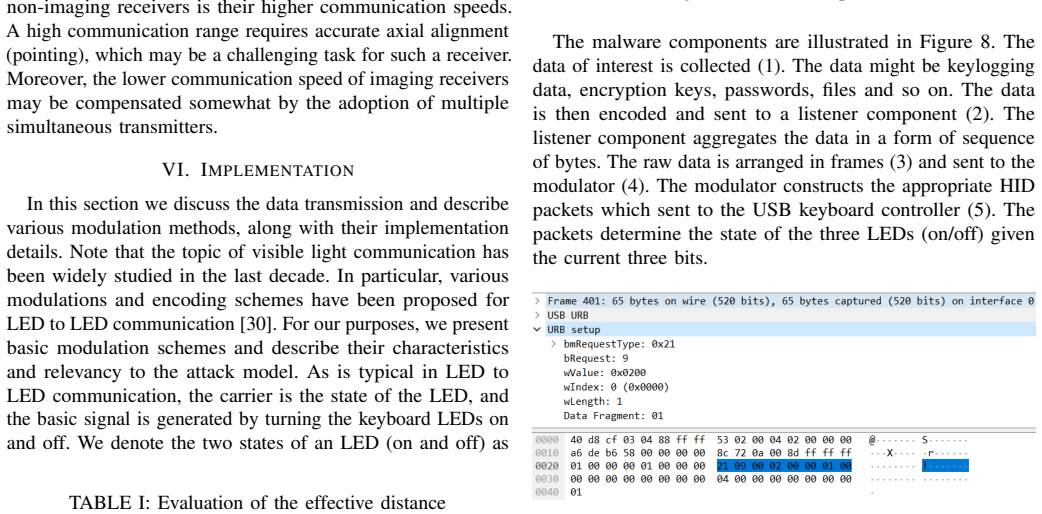
Modulation of the three keyboard LED states (Caps-Lock, Num-Lock, Scroll-Lock) via software USB HID control to form an optical covert channel for data encoding and transmission.
Load-bearing premise
The attacker must be able to run code on the air-gapped machine to control the LED states via software, and the receiver must have line-of-sight to the keyboard.
What would settle it
A controlled test in which malware attempts LED modulation but no corresponding data is recovered by the described light sensors or smartphone cameras at the claimed distances and rates.
Figures




read the original abstract
Using the keyboard LEDs to send data optically was proposed in 2002 by Loughry and Umphress [1] (Appendix A). In this paper we extensively explore this threat in the context of a modern cyber-attack with current hardware and optical equipment. In this type of attack, an advanced persistent threat (APT) uses the keyboard LEDs (Caps-Lock, Num-Lock and Scroll-Lock) to encode information and exfiltrate data from airgapped computers optically. Notably, this exfiltration channel is not monitored by existing data leakage prevention (DLP) systems. We examine this attack and its boundaries for today's keyboards with USB controllers and sensitive optical sensors. We also introduce smartphone and smartwatch cameras as components of malicious insider and 'evil maid' attacks. We provide the necessary scientific background on optical communication and the characteristics of modern USB keyboards at the hardware and software level, and present a transmission protocol and modulation schemes. We implement the exfiltration malware, discuss its design and implementation issues, and evaluate it with different types of keyboards. We also test various receivers, including light sensors, remote cameras, 'extreme' cameras, security cameras, and smartphone cameras. Our experiment shows that data can be leaked from air-gapped computers via the keyboard LEDs at a maximum bit rate of 3000 bit/sec per LED given a light sensor as a receiver, and more than 120 bit/sec if smartphones are used. The attack doesn't require any modification of the keyboard at hardware or firmware levels.
Editorial analysis
A structured set of objections, weighed in public.
Referee Report
Summary. The manuscript demonstrates an optical exfiltration attack from air-gapped computers that modulates the states of the Caps-Lock, Num-Lock, and Scroll-Lock LEDs on USB keyboards to encode and transmit data. It provides hardware/software background on modern keyboards, defines a transmission protocol and modulation schemes, implements the malware, and evaluates performance across multiple keyboards and receivers (light sensors, remote cameras, security cameras, smartphone cameras). Reported rates reach 3000 bit/sec per LED with a light sensor and >120 bit/sec with smartphones; no keyboard hardware or firmware modification is required.
Significance. If the results hold, the work supplies a concrete, reproducible demonstration of a covert optical channel that bypasses conventional DLP monitoring. The empirical scope (multiple keyboards, diverse receivers, explicit protocol design) and the explicit scoping to standard APT/evil-maid assumptions (code execution on target + line-of-sight) make the contribution measurable and falsifiable. The absence of invented parameters or circular derivations further supports the reliability of the reported bit rates.
minor comments (3)
- [§4] §4 (protocol description): the modulation scheme and error-correction details are referenced but a compact pseudocode or state diagram would improve reproducibility for readers implementing the transmitter.
- [Table 2] Table 2 (receiver comparison): the reported bit rates for smartphone cameras would benefit from an explicit column listing the distance and ambient-light conditions under which the >120 bit/sec figure was measured.
- [References] The abstract cites Loughry and Umphress (2002) but the reference list entry should include the full conference name and page numbers for completeness.
Simulated Author's Rebuttal
We thank the referee for the detailed and accurate summary of the manuscript, the recognition of its significance as a concrete and reproducible demonstration of an optical covert channel, and the recommendation to accept. No major comments were raised that require addressing.
Circularity Check
No significant circularity; empirical measurement paper
full rationale
The paper reports an experimental implementation of an optical exfiltration channel via keyboard LEDs, including protocol design, malware implementation, and bit-rate measurements across multiple keyboards and receivers. No derivation chain, fitted parameters, equations, or self-referential predictions exist. The sole citation to prior work is to an external 2002 paper by Loughry and Umphress; all performance claims rest on direct hardware tests rather than any reduction to inputs by construction. The work is self-contained against external benchmarks.
Axiom & Free-Parameter Ledger
Reference graph
Works this paper leans on
-
[1]
Information leakage from optical emanations,
J. Loughry and D. A. Umphress, “Information leakage from optical emanations,” ACM Transactions on Information and System Security (TISSEC), vol. 5, no. 3, pp. 262–289, 2002
work page 2002
-
[2]
R. Grant, “The cyber menace,” Air Force Magazine, vol. 92, no. 3, 2009
work page 2009
-
[3]
Fansmitter: Acoustic Data Exfiltration from (Speakerless) Air-Gapped Computers
M. Guri, Y . Solewicz, A. Daidakulov, and Y . Elovici, “Fansmitter: Acoustic data exfiltration from (speakerless) air-gapped computers,”arXiv preprint arXiv:1606.05915, 2016
work page internal anchor Pith review Pith/arXiv arXiv 2016
-
[4]
Airhopper: Bridging the air-gap between isolated networks and mobile phones using radio frequencies,
M. Guri, G. Kedma, A. Kachlon, and Y . Elovici, “Airhopper: Bridging the air-gap between isolated networks and mobile phones using radio frequencies,” in 9th International Conference on Malicious and Unwanted Software: The Americas (MALWARE) . IEEE, 2014, pp. 58–67
work page 2014
-
[5]
Bridgeware: The air-gap malware,
M. Guri and Y . Elovici, “Bridgeware: The air-gap malware,” Commun. ACM, vol. 61, no. 4, pp. 74–82, Mar. 2018. [Online]. Available: http://doi.acm.org/10.1145/3177230
-
[6]
Lcd tempest air-gap attack reloaded,
M. Guri and M. Monitz, “Lcd tempest air-gap attack reloaded,” in 2018 IEEE International Conference on the Science of Electrical Engineering in Israel (ICSEE) . IEEE, 2018, pp. 1–5
work page 2018
-
[7]
Bridging the air gap between isolated networks and mobile phones in a practical cyber-attack,
M. Guri, M. Monitz, and Y . Elovici, “Bridging the air gap between isolated networks and mobile phones in a practical cyber-attack,” ACM Transactions on Intelligent Systems and Technology (TIST) , vol. 8, no. 4, p. 50, 2017
work page 2017
-
[8]
Gsmem: Data exfiltration from air-gapped computers over gsm frequen- cies
M. Guri, A. Kachlon, O. Hasson, G. Kedma, Y . Mirsky, and Y . Elovici, “Gsmem: Data exfiltration from air-gapped computers over gsm frequen- cies.” in USENIX Security Symposium , 2015, pp. 849–864
work page 2015
-
[9]
USBee: Air-gap covert-channel via electromagnetic emission from USB,
M. Guri, M. Monitz, and Y . Elovici, “USBee: Air-gap covert-channel via electromagnetic emission from USB,” in 14th Annual Conference on Privacy, Security and Trust (PST) . IEEE, 2016, pp. 264–268
work page 2016
-
[10]
Odini : Escaping sensitive data from faraday-caged, air-gapped computers via magnetic fields,
M. Guri, B. Zadov, A. Daidakulov, and Y . Elovici, “Odini : Escaping sensitive data from faraday-caged, air-gapped computers via magnetic fields,” 2018
work page 2018
-
[11]
M. Guri, A. Daidakulov, and Y . Elovici, “Magneto: Covert channel between air-gapped systems and nearby smartphones via cpu-generated magnetic fields,” arXiv preprint arXiv:1802.02317 , 2018
work page internal anchor Pith review Pith/arXiv arXiv 2018
-
[12]
PowerHammer: Exfiltrating Data from Air-Gapped Computers through Power Lines,
M. Guri, B. Zadov, D. Bykhovsky, and Y . Elovici, “PowerHammer: Exfiltrating Data from Air-Gapped Computers through Power Lines,” ArXiv e-prints, Apr. 2018
work page 2018
-
[13]
On Covert Acoustical Mesh Networks in Air
M. Hanspach and M. Goetz, “On covert acoustical mesh networks in air,” arXiv preprint arXiv:1406.1213 , 2014
work page internal anchor Pith review Pith/arXiv arXiv 2014
-
[14]
M. Guri, Y . Solewicz, A. Daidakulov, and Y . Elovici, “Acoustic data exfiltration from speakerless air-gapped computers via covert hard-drive noise (diskfiltration),” in European Symposium on Research in Computer Security. Springer, 2017, pp. 98–115
work page 2017
-
[15]
M. Guri, Y . Solewicz, and Y . Elovici, “Mosquito: Covert ultrasonic transmissions between two air-gapped computers using speaker-to-speaker communication,” in 2018 IEEE Conference on Dependable and Secure Computing (DSC). IEEE, 2018, pp. 1–8
work page 2018
-
[16]
Bitwhisper: Covert signaling channel between air-gapped computers using thermal manipu- lations,
M. Guri, M. Monitz, Y . Mirski, and Y . Elovici, “Bitwhisper: Covert signaling channel between air-gapped computers using thermal manipu- lations,” in 28th IEEE Computer Security Foundations Symposium (CSF) . IEEE, 2015, pp. 276–289
work page 2015
-
[17]
M. Guri, B. Zadov, and Y . Elovici, LED-it-GO: Leaking (A Lot of) Data from Air-Gapped Computers via the (Small) Hard Drive LED . Cham: Springer International Publishing, 2017, pp. 161–184. [Online]. Available: https://doi.org/10.1007/978-3-319-60876-1 8
-
[18]
xLED: Covert data exfiltration from air-gapped networks via switch and router LEDs,
M. Gur, B. Zadov, A. Daidakulov, and Y . Elovici, “xLED: Covert data exfiltration from air-gapped networks via switch and router LEDs,” in 2018 16th Annual Conference on Privacy, Security and Trust (PST) . IEEE, 2018, pp. 1–12
work page 2018
-
[19]
air-jumper: Covert air-gap exfiltra- tion/infiltration via security cameras & infrared (ir),
M. Guri and D. Bykhovsky, “air-jumper: Covert air-gap exfiltra- tion/infiltration via security cameras & infrared (ir),” Computers & Security, vol. 82, pp. 15–29, 2019
work page 2019
-
[20]
An optical covert- channel to leak data through an air-gap,
M. Guri, O. Hasson, G. Kedma, and Y . Elovici, “An optical covert- channel to leak data through an air-gap,” in 14th Annual Conference on Privacy, Security and Trust (PST) . IEEE, 2016, pp. 642–649
work page 2016
-
[21]
Optical air-gap exfiltration attack via invisible images,
M. Guri, “Optical air-gap exfiltration attack via invisible images,” Journal of Information Security and Applications , vol. 46, pp. 222–230, 2019
work page 2019
-
[22]
Evil maid goes after truecrypt,
J. Rutkowska and A. Tereshkin, “Evil maid goes after truecrypt,” The Invisible Things Lab , 2009
work page 2009
-
[23]
Device class definition for human interface devices (hid),
U. I. F. Inc., “Device class definition for human interface devices (hid),” http://www.usb.org/developers/hidpage/HID1 11.pdf, (Accessed on 08/11/2018)
work page 2018
-
[24]
Demonstrating the set report request with a PS/2 to USB keyboard translator example,
Microchip, “Demonstrating the set report request with a PS/2 to USB keyboard translator example,” http://ww1.microchip.com/downloads/cn /AppNotes/cn 91056C.pdf, (Accessed on 08/11/2018)
work page 2018
-
[25]
“Flashing keyboard leds,” https://linux.die.net/lkmpg/x1194.html, (Accessed on 08/11/2018)
work page 2018
-
[26]
USB HID keyboard - - sending output report for LED control fails,
NXP, “USB HID keyboard - - sending output report for LED control fails,” https://community.nxp.com/thread/382242, (Accessed on 08/11/2018)
work page 2018
- [27]
-
[28]
Image sensor based visible light com- munication,
S. Haruyama and T. Yamazato, “Image sensor based visible light com- munication,” in Visible Light Communication, S. Arnon, Ed. Cambridge University Press, 2015, ch. 9, pp. 181–205
work page 2015
-
[29]
V . Mackowiak, J. Peupelmann, Y . Ma, and A. Gorges, “NEP – noise equivalent power,” Thorlabs Inc., 56 Sparta Avenue, Newton, NJ 07860, USA, Tech. Rep. [Online]. Available: https://www.thorlabs.com/images/ TabImages/Noise Equivalent Power White Paper.pdf
-
[30]
Fundamental analysis for visible- light communication system using LED lights,
T. Komine and M. Nakagawa, “Fundamental analysis for visible- light communication system using LED lights,” IEEE transactions on Consumer Electronics, vol. 50, no. 1, pp. 100–107, 2004
work page 2004
-
[31]
O. Foundation, “Opencv library,” https://opencv.org/, (Accessed on 08/12/2018)
work page 2018
-
[32]
513 mbit/s visible light communications link based on dmt-modulation of a white led,
J. Vu ˇci´c, C. Kottke, S. Nerreter, K.-D. Langer, and J. W. Walewski, “513 mbit/s visible light communications link based on dmt-modulation of a white led,” Journal of lightwave technology , vol. 28, no. 24, pp. 3512–3518, 2010
work page 2010
-
[33]
Thorlabs. Thorlabs Inc. 56 Sparta Avenue, Newton, NJ 07860, USA. (Accessed on 08/12/2018). [Online]. Available: https://www.thorlabs.c om/thorproduct.cfm?partnumber=PDA100A
work page 2018
-
[34]
N. Instruments. National Instruments. (Accessed on 08/12/2018). [Online]. Available: http://www.ni.com/en-us/shop/compactdaq.html
work page 2018
-
[35]
——. National Instruments. (Accessed on 08/12/2018). [Online]. Available: https://www.ni.com/pdf/manuals/373784f.pdf
work page 2018
-
[36]
Making USB great again with USBFILTER,
D. J. Tian, N. Scaife, A. Bates, K. Butler, and P. Traynor, “Making USB great again with USBFILTER,” in USENIX Security Symposium , 2016
work page 2016
discussion (0)
Sign in with ORCID, Apple, or X to comment. Anyone can read and Pith papers without signing in.