A Electric Network Reconfiguration Strategy with Case-Based Reasoning for the Smart Grid
Pith reviewed 2026-05-24 22:50 UTC · model grok-4.3
The pith
CBR with HATSGA reduces the number of full recomputations needed for smart grid reconfiguration.
A machine-rendered reading of the paper's core claim, the machinery that carries it, and where it could break.
Core claim
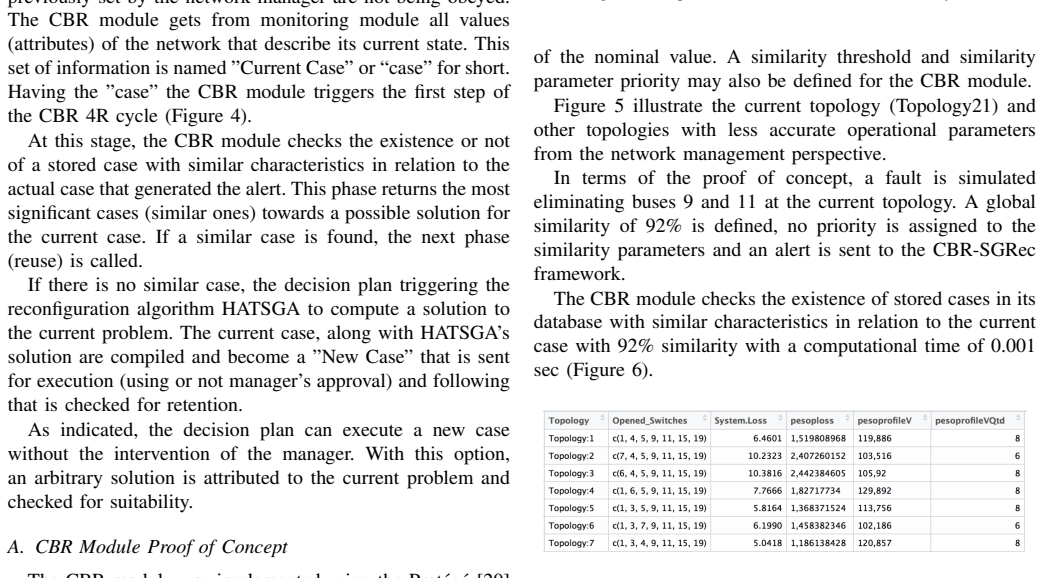
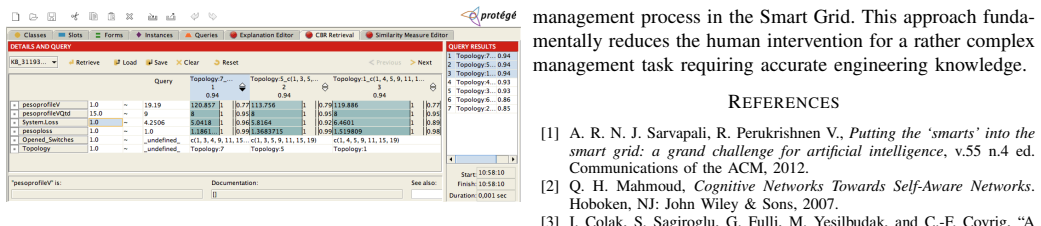
The CBR strategy looks for managerial acceptable reconfiguration solutions at the CBR database and, as such, contributes to reduce the required number of reconfiguration computation using HATSGA. The evaluation indicates that the adopted HATSGA algorithm computes new reconfiguration topologies with a feasible computational time for large networks. This suggests CBR can be applied with a fast reconfiguration algorithm resulting in more efficient, dynamic and cognitive grid recovery strategy.
What carries the argument
Case-Based Reasoning database paired with the HATSGA algorithm, which stores past reconfiguration cases and retrieves similar acceptable solutions to avoid repeated full computations.
Load-bearing premise
A pre-populated CBR database will contain sufficiently similar and managerially acceptable cases for the majority of new fault scenarios encountered in large networks.
What would settle it
Simulation of many new fault scenarios on a large network in which the CBR database returns no sufficiently similar case for most scenarios, forcing HATSGA to run from scratch each time.
Figures


read the original abstract
The complexity, heterogeneity and scale of electrical networks have grown far beyond the limits of exclusively human-based management at the Smart Grid (SG). Likewise, researchers cogitate the use of artificial intelligence and heuristics techniques to create cognitive and autonomic management tools that aim better assist and enhance SG management processes like in the grid reconfiguration. The development of self-healing management approaches towards a cognitive and autonomic distribution power network reconfiguration is a scenario in which the scalability and on-the-fly computation are issues. This paper proposes the use of Case-Based Reasoning (CBR) coupled with the HATSGA algorithm for the fast reconfiguration of large distribution power networks. The suitability and the scalability of the CBR-based reconfiguration strategy using HATSGA algorithm are evaluated. The evaluation indicates that the adopted HATSGA algorithm computes new reconfiguration topologies with a feasible computational time for large networks. The CBR strategy looks for managerial acceptable reconfiguration solutions at the CBR database and, as such, contributes to reduce the required number of reconfiguration computation using HATSGA. This suggests CBR can be applied with a fast reconfiguration algorithm resulting in more efficient, dynamic and cognitive grid recovery strategy.
Editorial analysis
A structured set of objections, weighed in public.
Referee Report
Summary. The paper proposes coupling Case-Based Reasoning (CBR) with the HATSGA algorithm for fast reconfiguration of large distribution power networks in smart grids. It claims that HATSGA computes new topologies in feasible time for large networks and that the CBR component retrieves managerially acceptable solutions from a pre-populated database, thereby reducing the number of required HATSGA runs and enabling more efficient, dynamic self-healing.
Significance. If the asserted reduction in HATSGA invocations were quantitatively validated, the hybrid approach could improve scalability of cognitive reconfiguration strategies in smart grids by avoiding repeated heuristic searches for recurring fault patterns.
major comments (2)
- [Abstract] Abstract: the central claim that the CBR strategy 'contributes to reduce the required number of reconfiguration computation using HATSGA' is presented as an evaluation outcome, yet the text supplies no quantitative results on retrieval success rate, case-base size, similarity metric, retrieval threshold, or fraction of scenarios that avoid a fresh HATSGA call.
- [Abstract] Abstract (evaluation paragraph): the statement that 'the evaluation indicates that the adopted HATSGA algorithm computes new reconfiguration topologies with a feasible computational time' is unsupported by any reported runtimes, network sizes, dataset descriptions, baseline comparisons, or error analysis.
minor comments (2)
- [Title] Title: 'A Electric Network...' is grammatically incorrect and should read 'An Electric Network...'.
- [Abstract] Abstract: repeated use of 'reconfiguration computation' without clarifying whether this refers to full HATSGA runs or total wall-clock time reduces precision.
Simulated Author's Rebuttal
We thank the referee for the careful reading and the specific observations on the abstract. We agree that the abstract must be revised so that all claims are either supported by reported results or appropriately qualified. Below we respond to each major comment.
read point-by-point responses
-
Referee: [Abstract] Abstract: the central claim that the CBR strategy 'contributes to reduce the required number of reconfiguration computation using HATSGA' is presented as an evaluation outcome, yet the text supplies no quantitative results on retrieval success rate, case-base size, similarity metric, retrieval threshold, or fraction of scenarios that avoid a fresh HATSGA call.
Authors: We agree that the abstract currently presents the reduction in HATSGA invocations as an evaluation outcome without supplying the requested quantitative details. The manuscript body describes the CBR retrieval mechanism and similarity metric, but does not report the specific metrics listed. In the revised version we will change the abstract wording to describe the CBR component as a strategy intended to reduce the number of HATSGA calls, rather than as a quantitatively validated outcome, unless the evaluation section can be expanded with the missing figures. revision: yes
-
Referee: [Abstract] Abstract (evaluation paragraph): the statement that 'the evaluation indicates that the adopted HATSGA algorithm computes new reconfiguration topologies with a feasible computational time' is unsupported by any reported runtimes, network sizes, dataset descriptions, baseline comparisons, or error analysis.
Authors: The referee is correct that the abstract asserts an evaluation result without providing any of the supporting data mentioned. The manuscript refers to feasibility for large networks but does not include the concrete runtimes, network sizes, or comparisons in the abstract itself. We will revise the abstract to remove the phrase 'the evaluation indicates' and instead state only what is directly supported by the experiments reported in the body, or qualify the claim accordingly. revision: yes
Circularity Check
No circularity: proposal relies on external HATSGA performance and unquantified case retrieval
full rationale
The paper advances a CBR+HATSGA strategy for network reconfiguration but presents no equations, fitted parameters, or derivation steps that reduce a claimed result to its own inputs by construction. The reduction benefit is asserted from the logical premise that stored cases avoid fresh HATSGA runs when retrieval succeeds; this premise is not self-referential or forced by any internal definition or self-citation chain. Evaluation statements concern only HATSGA runtime feasibility, leaving retrieval statistics external. No self-citation is load-bearing for the central claim, and no ansatz or uniqueness theorem is invoked. The derivation chain is therefore self-contained against external benchmarks.
Axiom & Free-Parameter Ledger
axioms (2)
- domain assumption A pre-existing CBR database will contain sufficiently similar cases for typical new fault scenarios.
- domain assumption HATSGA algorithm scales to large networks with feasible run times.
Reference graph
Works this paper leans on
-
[1]
A. R. N. J. Sarvapali, R. Perukrishnen V ., Putting the ‘smarts’ into the smart grid: a grand challenge for artificial intelligence , v.55 n.4 ed. Communications of the ACM, 2012
work page 2012
-
[2]
Q. H. Mahmoud, Cognitive Networks Towards Self-Aware Networks . Hoboken, NJ: John Wiley & Sons, 2007
work page 2007
-
[3]
A Survey on the Critical Issues in Smart Grid Technologies,
I. Colak, S. Sagiroglu, G. Fulli, M. Yesilbudak, and C.-F. Covrig, “A Survey on the Critical Issues in Smart Grid Technologies,” Renewable and Sustainable Energy Reviews , vol. 54, pp. 396–405, Feb. 2016
work page 2016
-
[4]
F. G. Calhau, J. Martins, and R. M. Bezerra, “Hybrid algorithm based on genetic algorithm and tabu search for reconfiguration problem in smart grid networks using “r”,” 4th International Workshop on ICT Infrastructures and Services – ADVANCE, 2015
work page 2015
-
[5]
V . C. V . Thomas, M.; Arora, Distribution Automation Leading to a Smarter Grid, in proc. pp. 211-216. ed. IEEE Innovative Smart Grid Technologies, 2008
work page 2008
-
[6]
G. Haughton, D.; Heydt, Smart distribution system design: Automatic reconfiguration for improved reliability , in proc. pp. 1-8. ed. IEEE Power and Energy Society General Meeting, 2010
work page 2010
-
[7]
W. S. V . A. F. Merdan, M.; Lepuschitz, Multi-Agent system for self- optimizing power distribution grids, pp. 312-317 ed. IEEE International Conference on Automation, Robotics and Applications, 2011
work page 2011
-
[8]
A. G. A. Cherkaoui, R.; Bart, Optimal configuration of electrical distribution networks using heuristic methods , (pscc) avignon france ed. Proc. 11th power system computation Conf., 1993
work page 1993
-
[9]
T. Thakur, T.; Jaswanti, Application of Tabu-Search Algorithm for Network Reconfiguration in Radial Distribution System , new delhi ed. Power Electronics, Drives and Energy Systems, 2006
work page 2006
-
[10]
Distribution system reconfiguration using a modified tabu search algorithm,
A. Y . Abdelaziz, F. Mohamed, S. Mekhamer, and M. Badr, “Distribution system reconfiguration using a modified tabu search algorithm,”Electric Power Systems Research, vol. 80, no. 8, pp. 943–953, 2010
work page 2010
-
[11]
Distribution network reconfiguration using hybrid heuristic — genetic algorithm,
D. Jakus, R. Cadenovic, M. Bogdanovic, P. Sarajcev, and J. Vasilj, “Distribution network reconfiguration using hybrid heuristic — genetic algorithm,” in 2017 2nd International Multidisciplinary Conference on Computer and Energy Science (SpliTech) , Jul 2017, p. 1–6
work page 2017
-
[12]
Computac ¸˜ao evolutiva: Uma abordagem pragm´atica,
F. V on Zuben, “Computac ¸˜ao evolutiva: Uma abordagem pragm´atica,” 01 2000
work page 2000
-
[13]
U. W. E. Engineering. (2017, mar) Power systems test case archive. [Online]. Available: https://www2.ee.washington.edu/research/pstca/
work page 2017
-
[14]
On evaluating power loss with hatsga algorithm for power network reconfiguration in the smart grid,
F. G. Calhau and J. Martins, “On evaluating power loss with hatsga algorithm for power network reconfiguration in the smart grid,” 5th In- ternational Workshop on ICT Infrastructures and Services – ADVANCE, 2017
work page 2017
-
[15]
R. Nachimuthu, D.; Basha, Reactive Power Loss Optimization For An IEEE 14-Bus Power System Using Various Algorithms. , 1737th ed. IU - Journal of Electrical & Electronics Engineering, 2014
work page 2014
-
[16]
Case-Based Reasoning: Foundational Issues, Methodological Variations, and System Approaches,
A. Aamodt and E. Plaza, “Case-Based Reasoning: Foundational Issues, Methodological Variations, and System Approaches,” Artificial Intelli- gence Communications, vol. 7, no. 1, pp. 39–59, 1994
work page 1994
-
[17]
A. v. Wangenheim, C. G. von; W ANGENHEIM, Racioc´ınio Baseado em Casos . Manole, 2003. [Online]. Available: http://www.inf.ufsc.br/ ∼aldo.vw/rbcmanole.html
work page 2003
-
[18]
Evaluating CBR Similarity Functions for BAM Switching in Networks with Dynamic Traffic Profile,
E. M Oliveira, R. F. Reale, and J. S. B. Martins, “Evaluating CBR Similarity Functions for BAM Switching in Networks with Dynamic Traffic Profile,” in Proceedings of the 5th International Workshop on ADVANCEs in ICT Infrastructure and Services , Paris, Jan. 2017, pp. 1–7
work page 2017
-
[19]
S. Shiu and S. K. Pal, Foundations of Soft Case-Based Reasoning. John Wiley Sons, Inc., 2004
work page 2004
-
[20]
A framework for building intelligent systems,
R. D’Ippolito, “A framework for building intelligent systems,” accessed July 1, 2018. [Online]. Available: https://protege.stanford.edu
work page 2018
-
[21]
An open-source similarity-based retrieval tool,
C. C. at DFKI, the School of Computing, and T. at UWL, “An open-source similarity-based retrieval tool,” accessed June 9, 2018. [Online]. Available: http://www.mycbr-project.net/
work page 2018
discussion (0)
Sign in with ORCID, Apple, or X to comment. Anyone can read and Pith papers without signing in.