Electronic and optical properties of stacking-configuration-modulated bilayer graphene in electric and magnetic fields
Pith reviewed 2026-05-24 18:57 UTC · model grok-4.3
The pith
Modulating stacking via domain walls in bilayer graphene induces zone folding that alters energy subbands, wave functions, density of states and optical absorption spectra under electric and magnetic fields.
A machine-rendered reading of the paper's core claim, the machinery that carries it, and where it could break.
Core claim
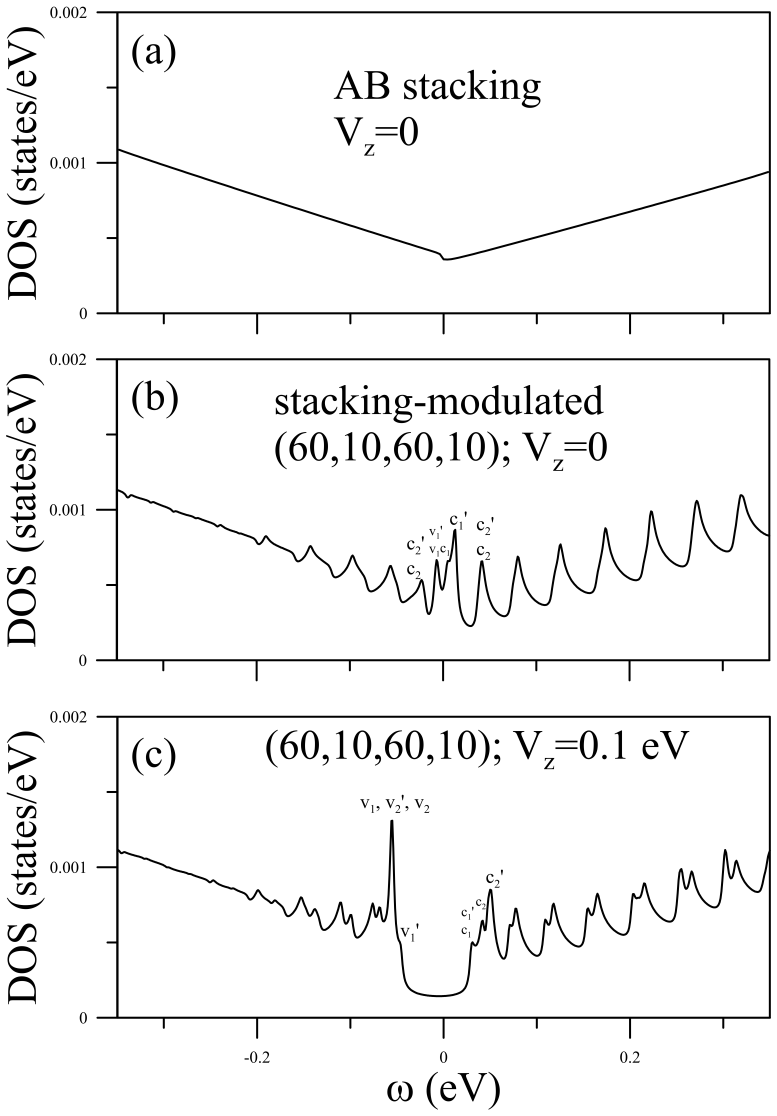
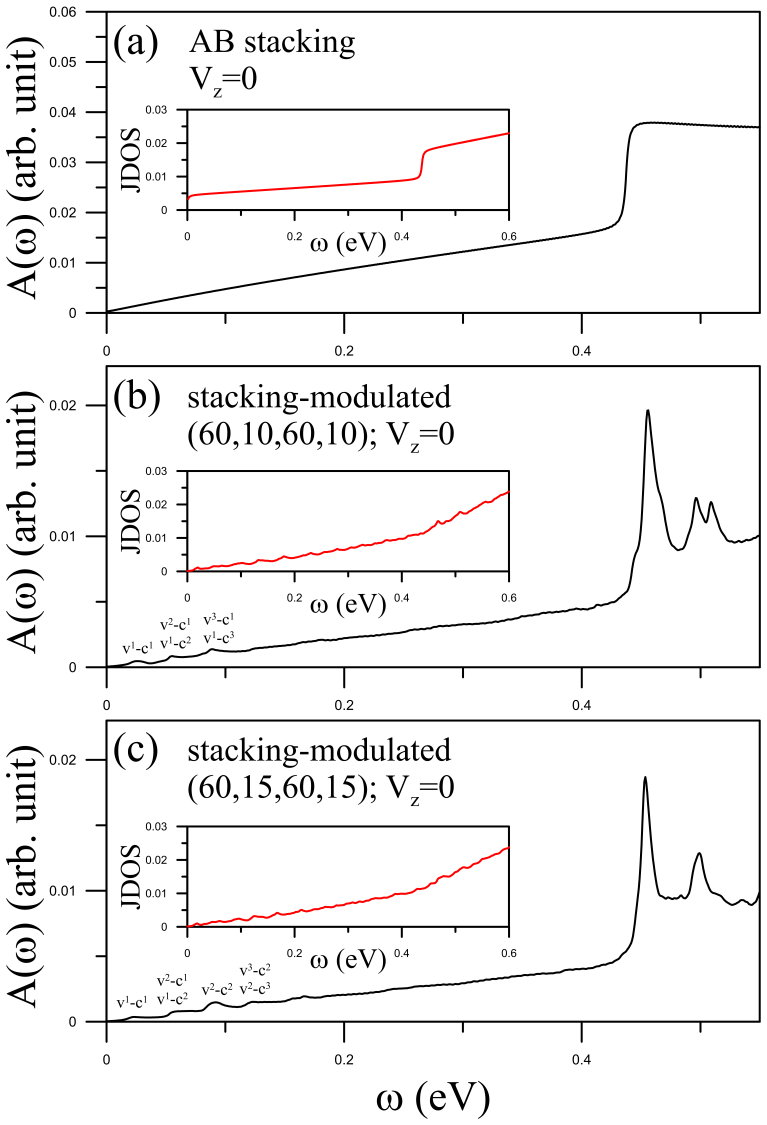
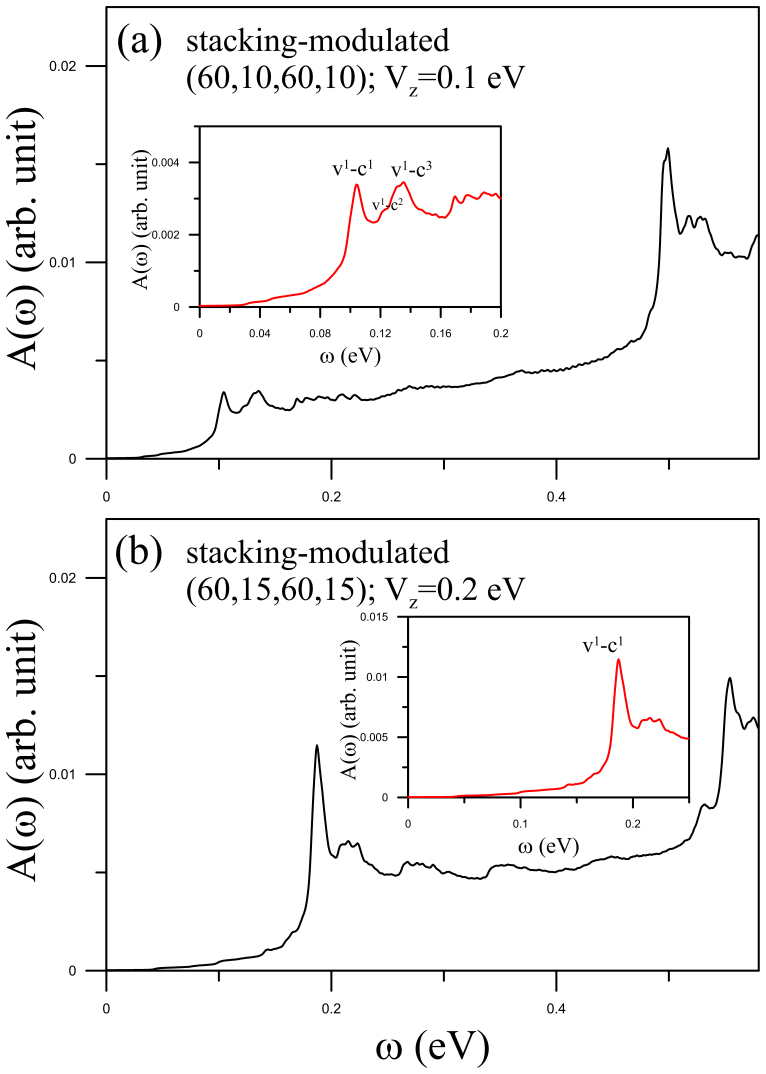
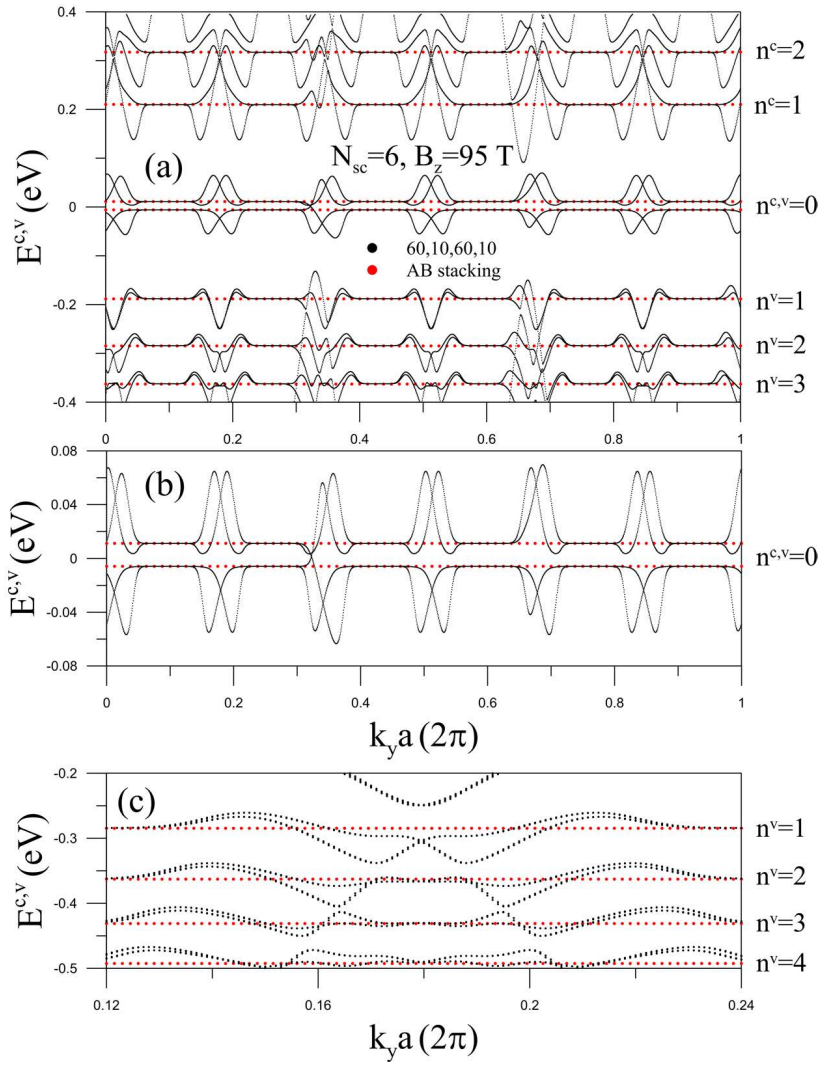
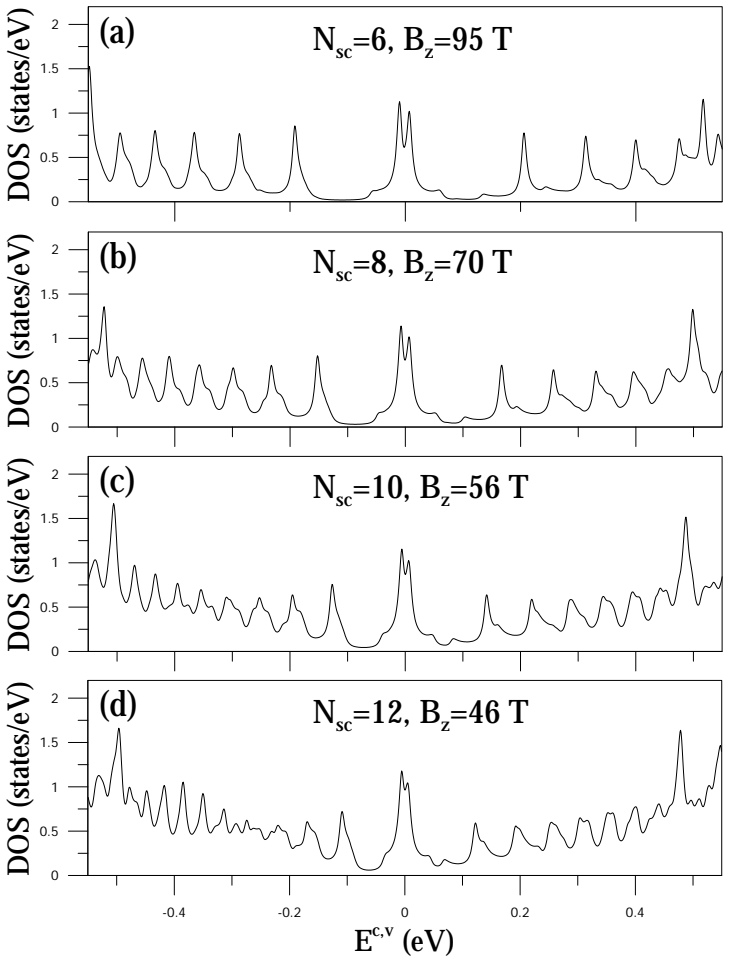
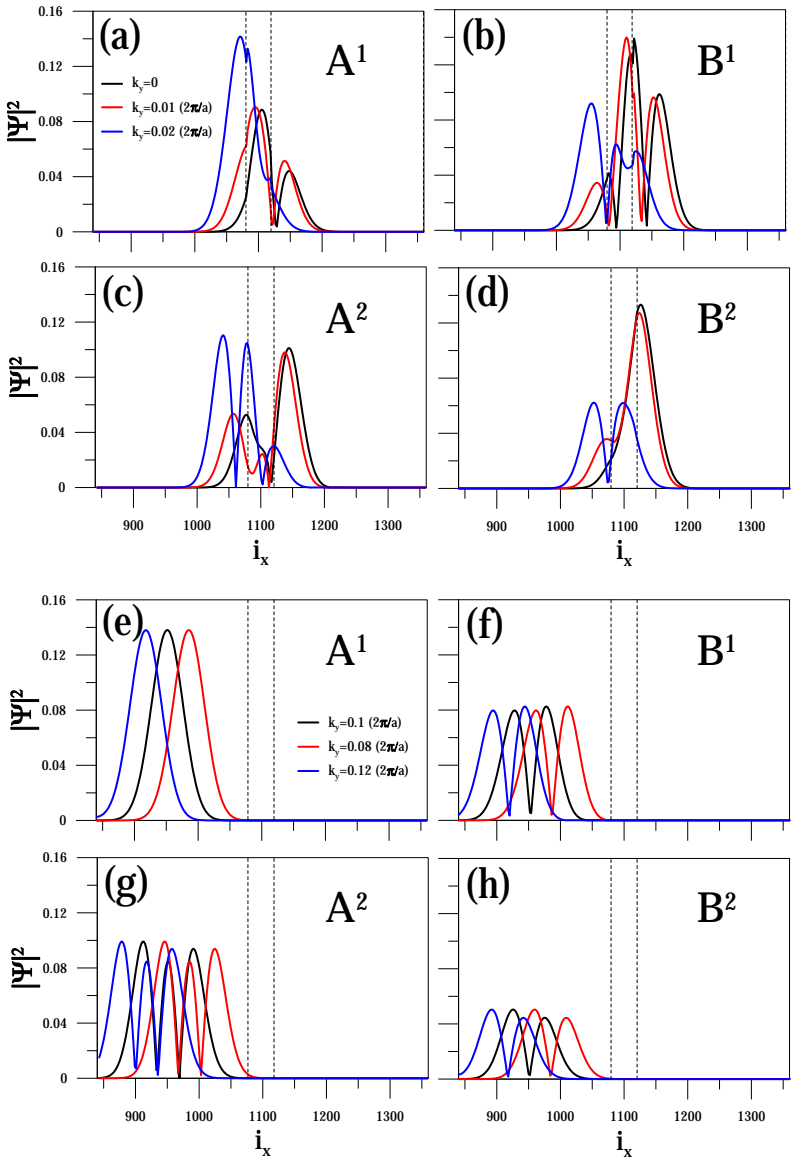
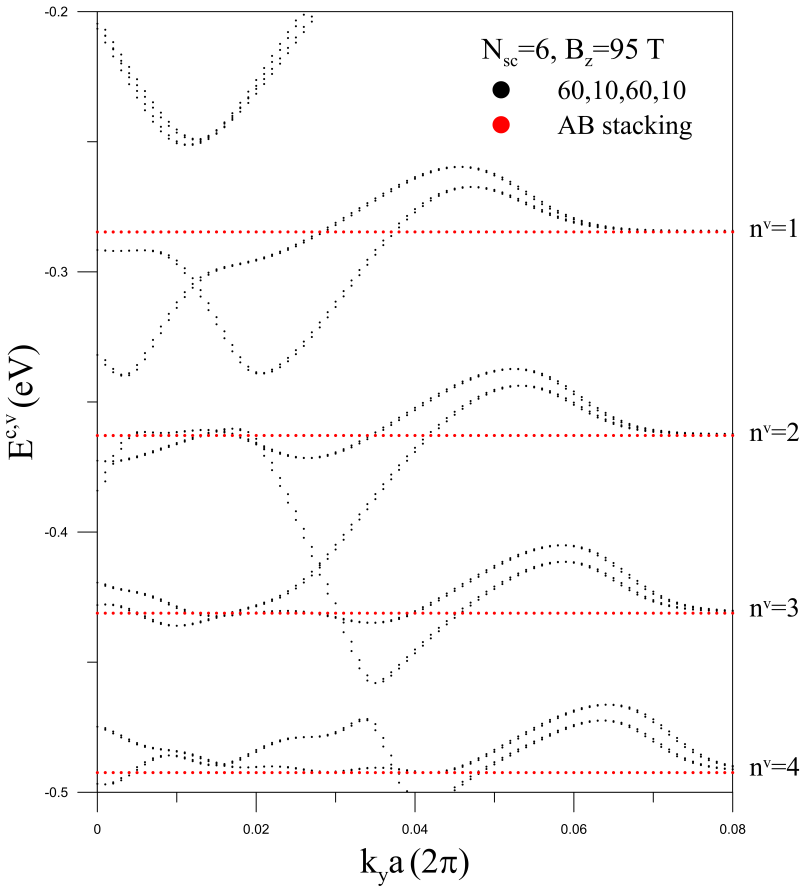
The modulation of stacking configuration gives rise to significant effects of zone folding on energy subbands, subenvelope wave functions, density of states, and optical absorption spectra. This is investigated in geometry- and field-modulated bilayer graphene systems by using the tight-binding model and Kubo formula, with all layer-dependent atomic interactions taken into consideration under external fields. The study illustrates the diverse 1D phenomena in the energy band structure and absorption spectra and explores the DW- and Vz-created dramatic variations.
What carries the argument
Domain wall (DW) that varies the width and position to modulate stacking symmetry between normally stacked graphene layers, treated within the tight-binding model that includes all layer-dependent interactions under external fields.
If this is right
- Zone folding from the domain wall modifies the energy subbands.
- Subenvelope wave functions are reshaped by the stacking changes.
- Density of states exhibits the consequences of the zone folding.
- Optical absorption spectra display dramatic variations driven by the domain walls and the perpendicular electric field Vz.
- Diverse quasi-1D phenomena appear in both the band structure and the absorption spectra.
Where Pith is reading between the lines
- The position and width of the domain wall act as additional tunable parameters that can be varied independently of the applied fields.
- The inclusion of both electric and magnetic fields in the same framework implies that Landau-level formation occurs inside the zone-folded bands.
- The quasi-1D character of the resulting states may connect to transport or confinement studies in other graphene-based one-dimensional structures.
Load-bearing premise
The tight-binding model that takes all layer-dependent atomic interactions into consideration under external fields is sufficient to capture the zone-folding effects created by domain walls.
What would settle it
A direct calculation or measurement that finds no detectable changes in the density of states or optical absorption spectra when domain walls of different widths and positions are introduced would show that zone folding is not occurring at the claimed strength.
Figures
read the original abstract
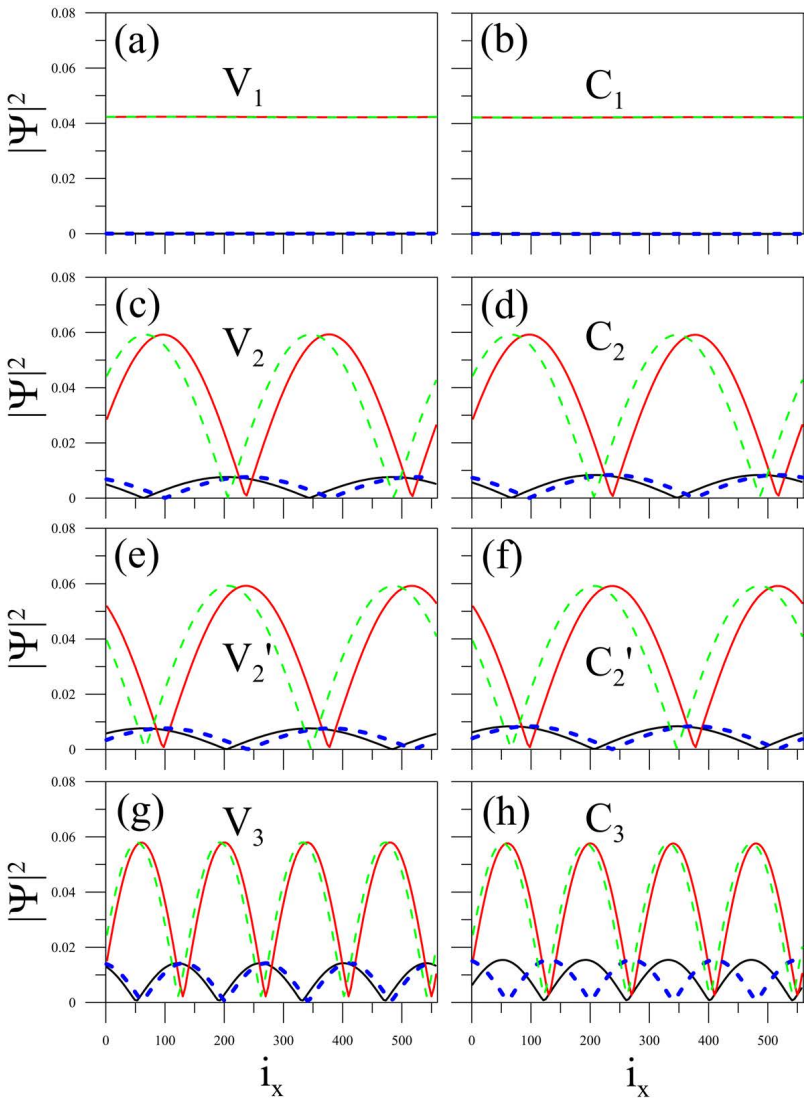
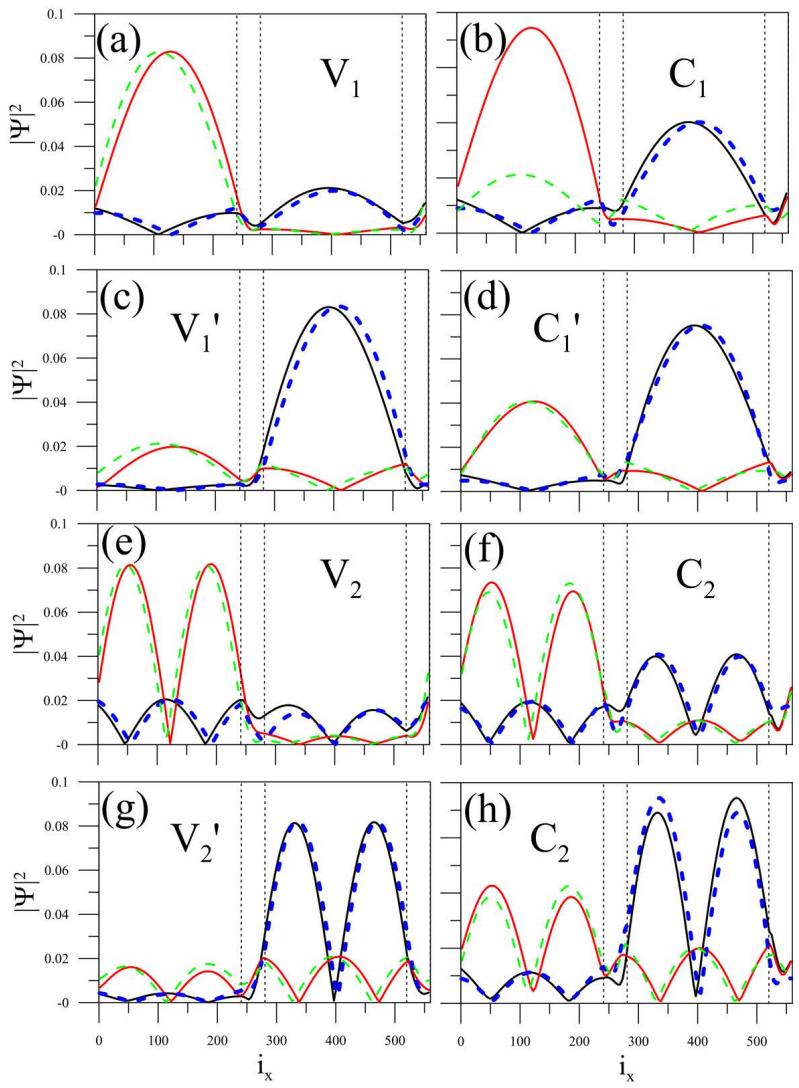
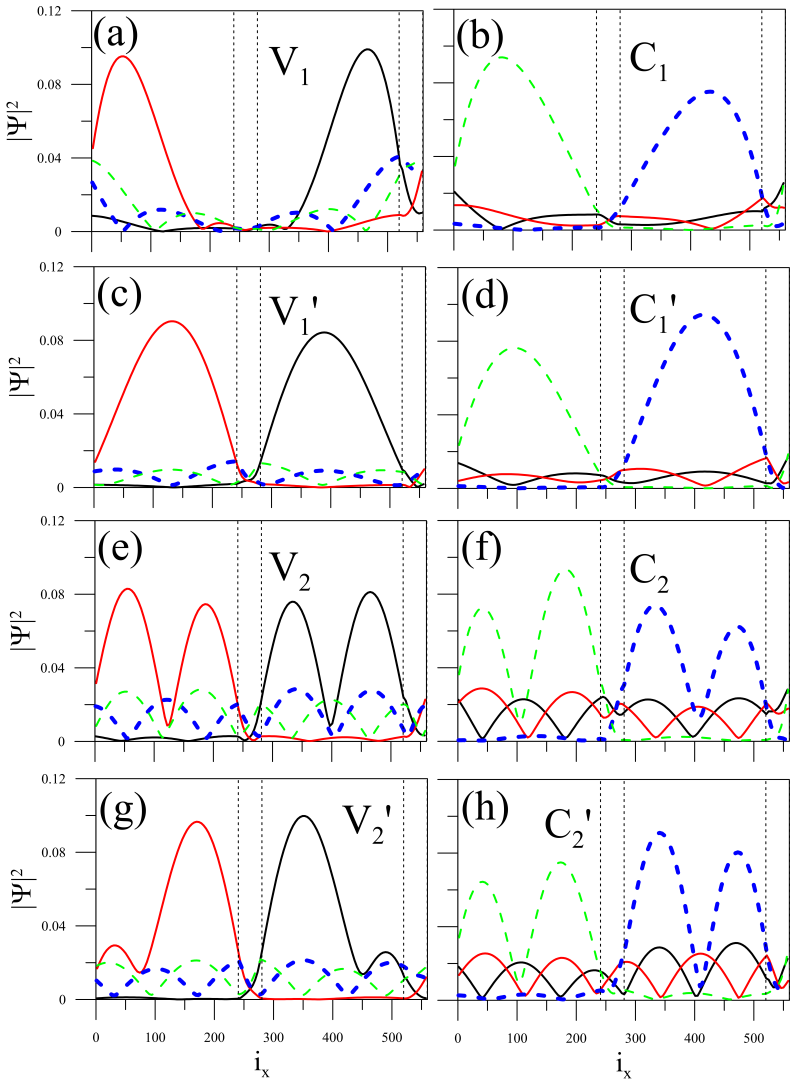
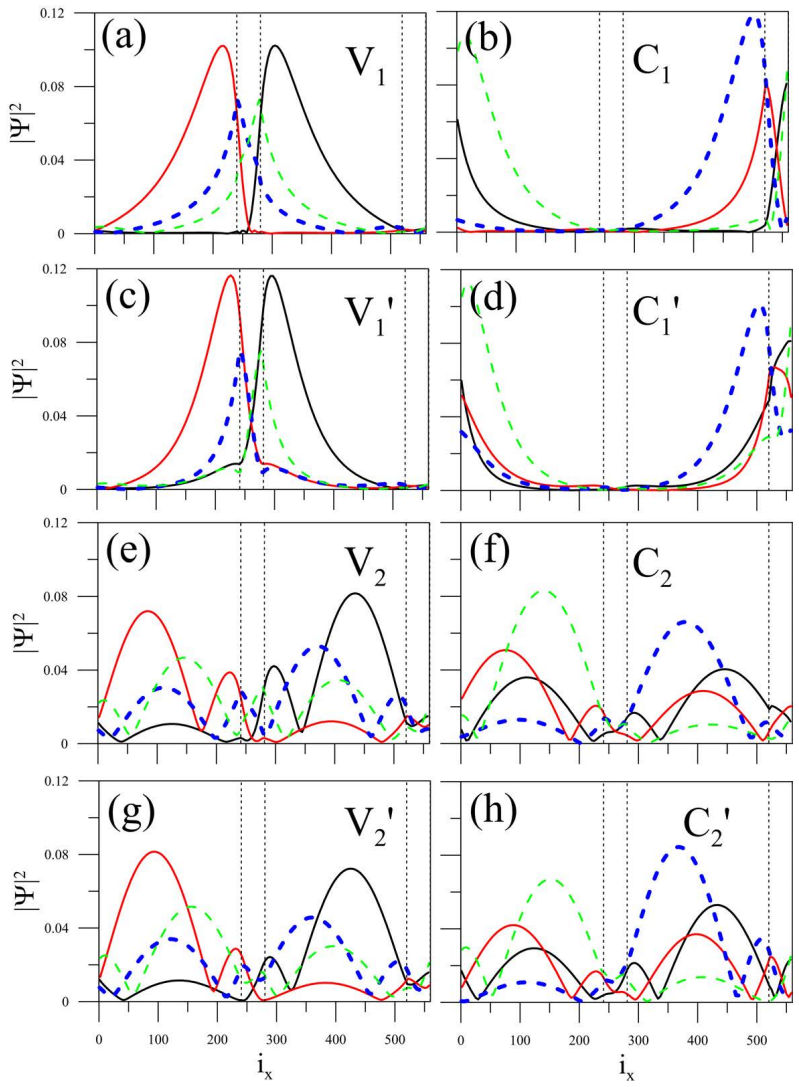
The electronic properties and optical excitations are investigated in the geometry- and field-modulated bilayer graphene systems, respectively, by using the tight-binding model and Kubo formula. The stacking symmetry of bilayer graphene can be manipulated by varying the width and position of domain wall (DW) within two normally stacked graphene. All the layer-dependent atomic interactions are taken into consideration under external fields. The modulation of stacking configuration gives rise to significant effects of zone folding on energy subbands, subenvelope wave functions, density of states, and optical absorption spectra. This study clearly illustrates the diverse 1D phenomena in the energy band structure and absorption spectra; the DW- and $V_z$-created dramatic variations are comprehensively explored under accurate calculations and delicate analysis. Concise physical pictures are proposed to give further insight into the quasi-1D behaviors.
Editorial analysis
A structured set of objections, weighed in public.
Referee Report
Summary. The manuscript employs a tight-binding model that incorporates all layer-dependent atomic interactions, together with the Kubo formula, to examine the electronic structure and optical excitations of bilayer graphene whose stacking configuration is modulated by domain walls of tunable width and position. External perpendicular electric (V_z) and magnetic fields are included. The central claim is that the resulting geometry modulation produces pronounced zone-folding signatures in the energy subbands, subenvelope wave functions, density of states, and optical absorption spectra, giving rise to diverse quasi-1D phenomena that are explored through explicit calculations.
Significance. If the numerical results are reliable, the work supplies a systematic parameter-space exploration of how domain-wall geometry and external fields reshape the spectra of bilayer graphene. The explicit inclusion of all interlayer hoppings under both electric and magnetic fields is a methodological strength; the production of concrete subband and absorption spectra for varying DW widths and positions offers testable predictions for quasi-1D features that could be checked by transport or optical experiments on engineered bilayer samples.
minor comments (3)
- [Section 2] The abstract states that 'all the layer-dependent atomic interactions are taken into consideration,' yet the main text should explicitly list the numerical values of the interlayer hoppings (e.g., γ1, γ3, γ4) and confirm whether they are held fixed or allowed to vary across the domain wall.
- [Figures 4–7] Figure captions and axis labels for the density-of-states and absorption spectra should include the precise DW width and V_z values used in each panel to allow direct reproduction of the reported zone-folding features.
- [Section 3.3] The discussion of magnetic-field effects would benefit from a brief statement of the Landau-level filling or the magnetic length relative to the DW period, clarifying how the vector potential is incorporated into the tight-binding Hamiltonian.
Simulated Author's Rebuttal
We thank the referee for the positive summary and significance assessment of our manuscript on stacking-configuration-modulated bilayer graphene. The recommendation for minor revision is noted. No specific major comments were provided in the report, so we have no points to address point-by-point at this time. We remain available to incorporate any additional feedback if supplied.
Circularity Check
No significant circularity in derivation chain
full rationale
The paper applies the standard tight-binding model (incorporating all layer-dependent atomic interactions) plus the Kubo formula to a geometry-modulated bilayer system under external fields. The zone-folding effects on subbands, wave functions, DOS, and absorption spectra arise directly from the explicit incorporation of domain-wall width/position into the Hamiltonian; no parameter is fitted to a target observable and then relabeled as a prediction, no self-citation chain supplies a uniqueness theorem or ansatz, and no result is shown to be definitionally equivalent to its inputs. The calculation is therefore a direct numerical exploration of the modulated geometry rather than a tautological restatement of prior inputs.
Axiom & Free-Parameter Ledger
axioms (1)
- domain assumption The tight-binding model with all layer-dependent atomic interactions accurately describes bilayer graphene under electric and magnetic fields when domain walls are present.
Reference graph
Works this paper leans on
-
[1]
Ju L, Shi Z, Nair N, Lv Y, Jin C, Velasco Jr J, Ojeda-Aristizabal C, Bechtel H A, Martin M C, Zettl A, Analytis J, and Wang F 2015 Topological valley transport at bilayer graphene domain walls Nature 520 650
work page 2015
-
[2]
Butz B, Dolle C, Niekiel F, Weber K, Waldmann D, Weber H B, Meyer B, and Spiecker E 2014 Dislocations in bilayer graphene Nature 505 533
work page 2014
-
[3]
Yin L J, Jiang H, Qiao J B, and He L 2016 Direct imaging of topological edge states at a bilayer graphene domain wall Nat. Commun. 7 11760
work page 2016
- [4]
-
[5]
Vaezi A, Liang Y, Ngai D H, Yang L, and Kim E A 2013 Topological Edge States at a Tilt Boundary in Gated Multilayer Graphene Phys. Rev. X 3 021018
work page 2013
-
[6]
Huang B L, Chuu C P, and Lin M F 2019 Asymmetry-enriched electronic and optical properties of bilayer graphene Sci. Rep. 9 859
work page 2019
-
[7]
San Raefel, CA, USA: Morgan & Claypool Publishers
Lin C Y, Do T N, Huang Y K, and Lin M F 2017 Electronic and optical properties of graphene in magnetic and electric fields IOP Concise Physics. San Raefel, CA, USA: Morgan & Claypool Publishers
work page 2017
-
[8]
Zhang Y, Tang T T, Girit C, Hao Z, Martin M C, Zettl A, Crommie M F, Shen Y R, and Wang F 2009 Direct observation of a widely tunable bandgap in bilayer graphene Nature 459 820. 32
work page 2009
-
[9]
Huang Y K, Chen S C, Ho Y H, Lin C Y, and Lin M F 2014 Feature-Rich Magnetic Quantization in Sliding Bilayer Graphenes Sci. Rep. 4 7509
work page 2014
-
[10]
Wang Z F, Liu F, and Chou M Y 2012 Fractal Landau-Level Spectra in Twisted Bilayer Graphene Nano Lett. 12 3833
work page 2012
-
[11]
Chung H C, Chang C P, Lin C Y, and Lin M F 2016 Electronic and Optical Properties of Graphene Nanoribbons in External Fields, Phys. Chem. Chem. Phys. 18 7573
work page 2016
-
[12]
Lin C Y, Chen R B, Ho Y H, and Lin M F 2018 Electronic and optical properties of graphite-related systems, CRC Press Boca Raton, Florida
work page 2018
-
[13]
Lin C Y, Chen S C, Wu J Y, and Lin M F 2012 Curvature Effects on Magnetoelectronic Properties of Nanographene Ribbons J. Phys. Soc. Jpn. 81 064719
work page 2012
-
[14]
Oostinga J B, Heersche H B, Liu X, Morpurgo A F, Vandersypen L M 2008 Gate- induced insulating state in bilayer graphene devices. Nature materials 7 151
work page 2008
-
[15]
Moon P, and Koshino M 2013 Optical absorption in twisted bilayer graphene Phys. Rev. B 87 205404
work page 2013
-
[16]
Ruffieux P, Cai J, Plumb N C, Patthey L, Prezzi D, Ferretti A, and Fasel R 2012 Electronic structure of atomically precise graphene nanoribbons ACS Nano 6 6930
work page 2012
-
[17]
Bao C, Yao W, Wang E, Chen C, Avila J, Asensio M C, and Zhou S 2017 Stacking- dependent electronic structure of trilayer graphene resolved by nanospot angle-resolved photoemission spectroscopy Nano Lett. 17 1564. 33
work page 2017
-
[18]
Knox K R, Wang S, Morgante A, Cvetko D, Locatelli A, Mentes T O, Nino M A, Kim P, and Osgood J R M 2008 Spectromicroscopy of single and multilayer graphene supported by a weakly interacting substrate Phys. Rev. B 78 201408
work page 2008
-
[19]
Chang C P 2011 Exact solution of the spectrum and magneto-optics of multilayer hexagonal graphene J. Appl. Phys. 110 013725
work page 2011
-
[20]
Kim K S, Walter A L, Moreschini L, Seyller T, Horn K, Rotenberg E, and Bostwick A 2013 Coexisting massive and massless Dirac fermions in symmetry-broken bilayer graphene Nat. Mater. 12 887
work page 2013
-
[21]
Sugawara K, Sato T, Souma S, Takahashi T, and Suematsu H 2006 Fermi surface and edge-localized states in graphite studied by high-resolution angle-resolved photoemis- sion spectroscopy Phys. Rev. B 73 045124
work page 2006
-
[22]
2008 Approaching the Dirac point in high-mobility multilayer epitaxial graphene.Phys
Orlita M, Faugeras C, Plochocka P, Neugebauer P, Martinez G, Maude DK, et al. 2008 Approaching the Dirac point in high-mobility multilayer epitaxial graphene.Phys. Rev. Lett. 101 267601
work page 2008
-
[23]
Lui C H, Li Z, Mak K F, Cappelluti E, and Heinz T F 2011 Observation of an electri- cally tunable band gap in trilayer graphene Nat. Phys. 7 944
work page 2011
-
[24]
Ho Y H, Wang J, Chiu Y H, Lin M F, and Su W P 2011 Characterization of Landau subbands in graphite: A tight-binding study Phys. Rev. B 83 121201
work page 2011
-
[25]
Ho C H, Chang C P, and Lin M F 2015 Optical magnetoplasmons in rhombohedral graphite with a three-dimensional Dirac cone structure J. Phys.: Condens. Matter 27 125602. 34
work page 2015
-
[26]
Ou Y C, Chiu Y H, Yang P H, and Lin M F 2014 The selection rule of graphene in a composite magnetic field Optics Express 22 7473
work page 2014
-
[27]
Ou Y C, Sheu J K, Chiu Y H, Chen R B, and Lin M F 2011 Influence of modulated fields on the Landau level properties of graphene Phys. Rev. B 83 195405
work page 2011
-
[28]
Ou Y C, Chiu Y H, Lu J M, Su W P, and Lin M F 2013 Electric modulation effect on magneto-optical spectrum of monolayer graphene Comput. Phys. Commun. 184 1821
work page 2013
-
[29]
Neumann J, and Wigner E 1929 Phys. Z. 30 467
work page 1929
-
[30]
San Raefel, CA, USA: Morgan & Claypool Publishers
Chen S C, Wu J Y, Lin C Y, and Lin M F 2017 Theory of Magnetoelectric Proper- ties of 2D Systems IOP Concise Physics. San Raefel, CA, USA: Morgan & Claypool Publishers
work page 2017
-
[31]
Do T N, Lin C Y, Lin Y P, Shih P H, and Lin M F 2015 Configuration-enriched magnetoelectronic spectra of AAB-stacked trilayer graphene Carbon 94 619
work page 2015
-
[32]
Venema L C, Wildoer J W G, Janssen J W, Tans S J, Tuinstra H L J T, Kouwenhoven L P, and Dekker C 1999 Imaging Electron Wave Functions of Quantized Energy Levels in Carbon Nanotubes Science 283 52
work page 1999
-
[33]
Matsui T, Kambara H, Niimi Y, Tagami K, Tsukada M, and Fukuyama H 2005 STS Observations of Landau Levels at Graphite Surfaces Phys. Rev. Lett. 94 226403
work page 2005
-
[34]
Lin C Y, Wu J Y, Chiu Y H, and Lin M F 2014 Stacking-dependent magneto-electronic properties in multilayer graphenes Phys. Rev. B 90 205434
work page 2014
-
[35]
Solid State Communications 142 123
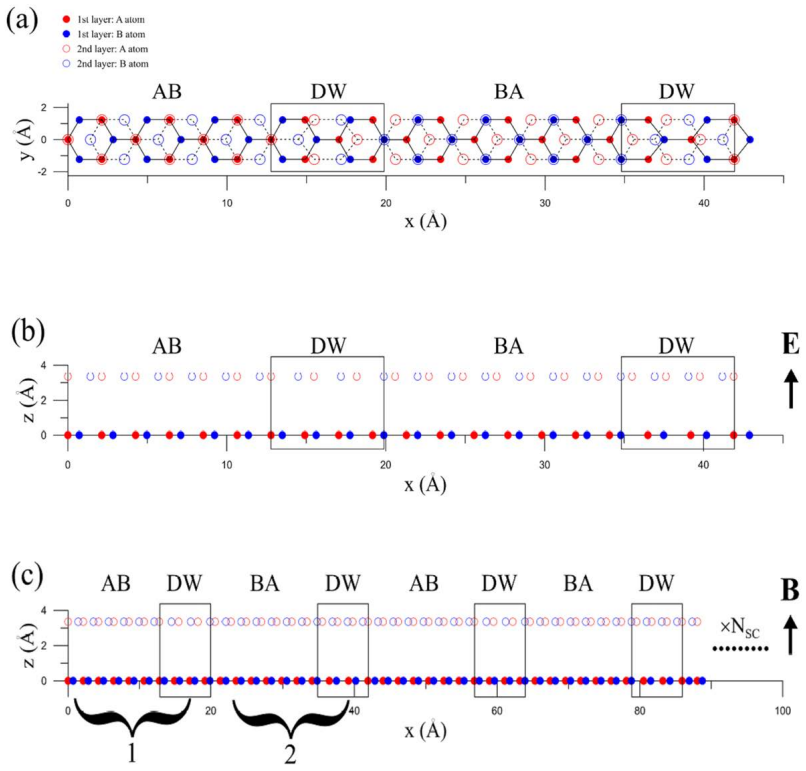
Aoki M, Amawashi H 2007 Dependence of band structures on stacking and field in layered graphene. Solid State Communications 142 123. 35 Figure 5.1: Geometric structures of the stacking-modulated bilayer graphenes associated with the AB configuration under the (a) top, (b) side views with a uniform perpendicular electric field, and (c) an enlarged unit cell i...
work page 2007
discussion (0)
Sign in with ORCID, Apple, or X to comment. Anyone can read and Pith papers without signing in.