Magneto-electronic properties of twisted bilayer graphene system
Pith reviewed 2026-05-24 18:38 UTC · model grok-4.3
The pith
Twisted bilayer graphene forms a zero-gap semiconductor with double-degenerate Dirac cones and saddle points at low energies for small twist angles, producing multiple Landau-level subgroups through Moire zone folding.
A machine-rendered reading of the paper's core claim, the machinery that carries it, and where it could break.
Core claim
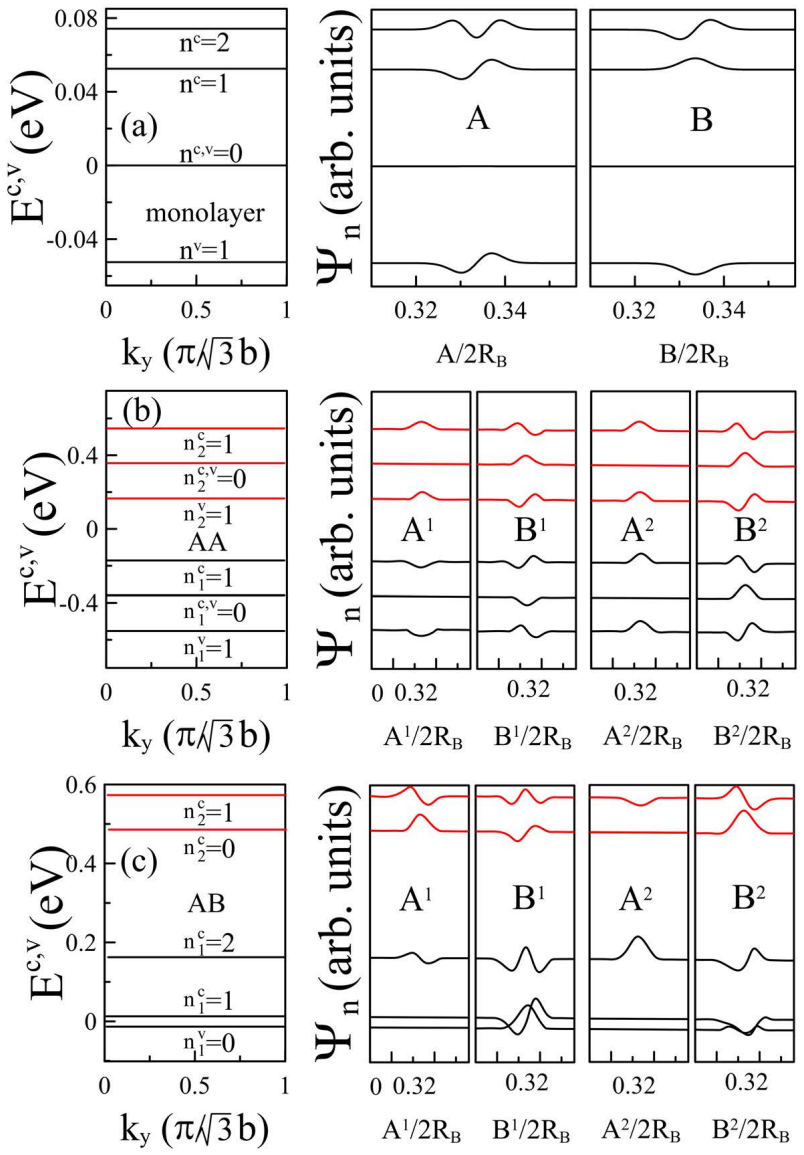
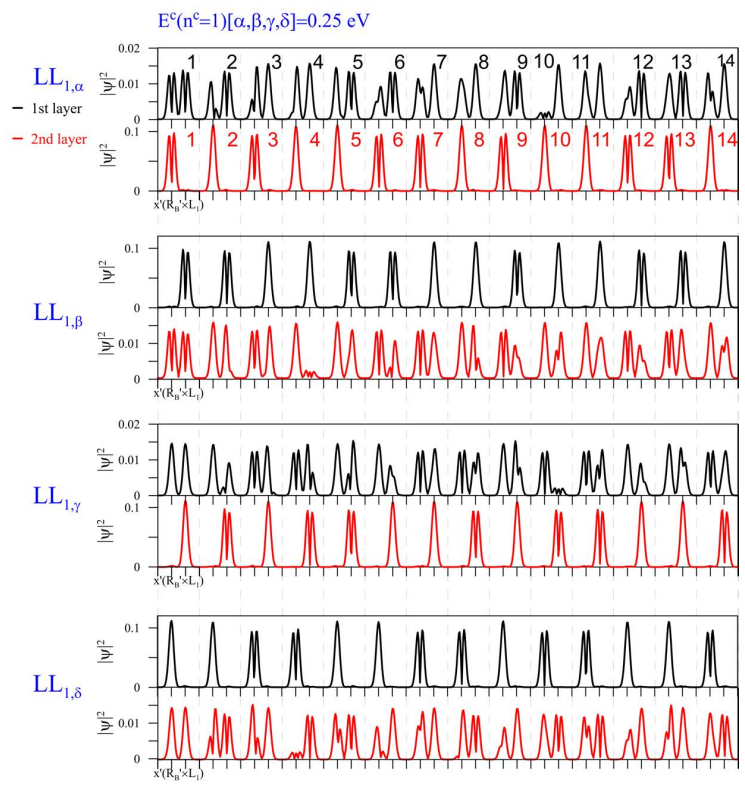
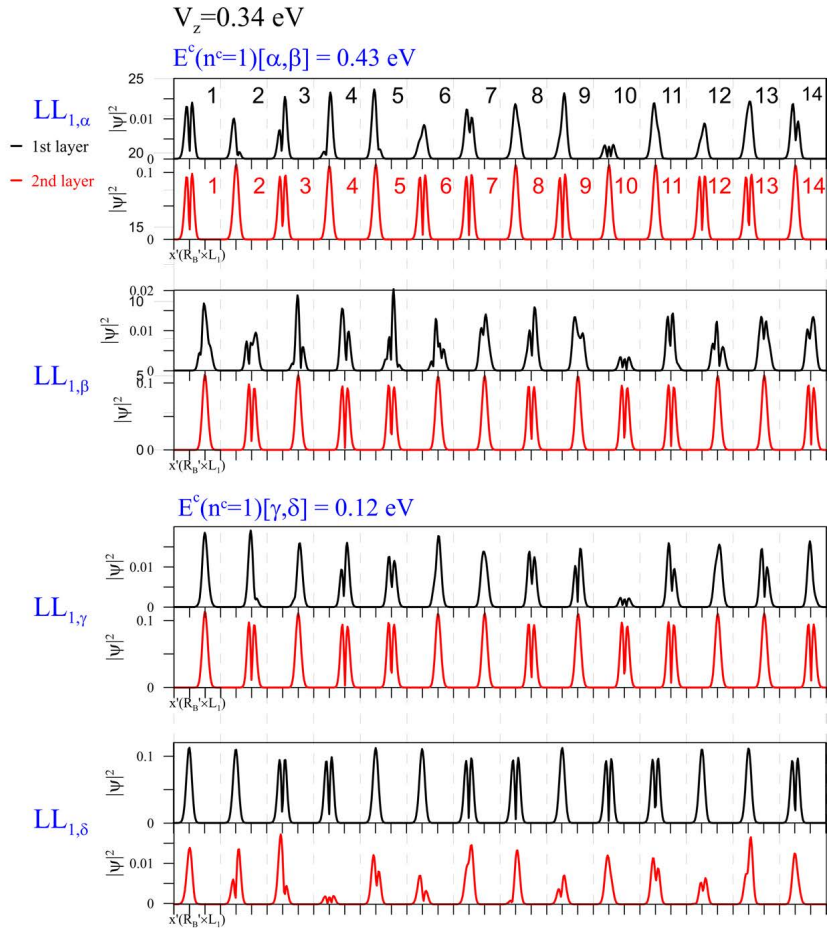
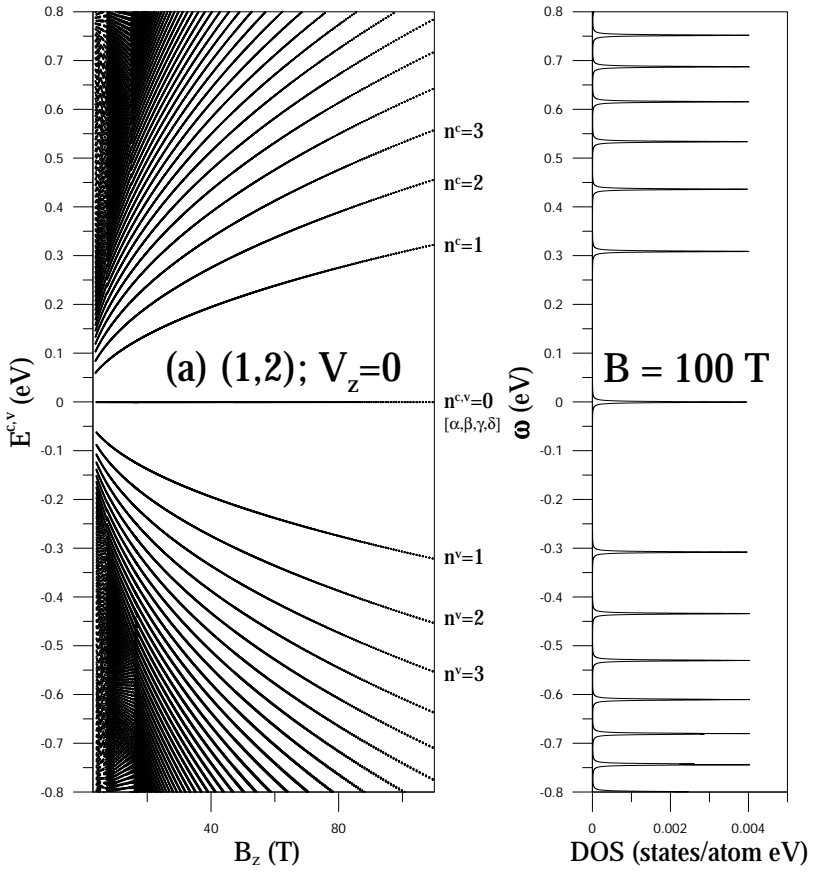
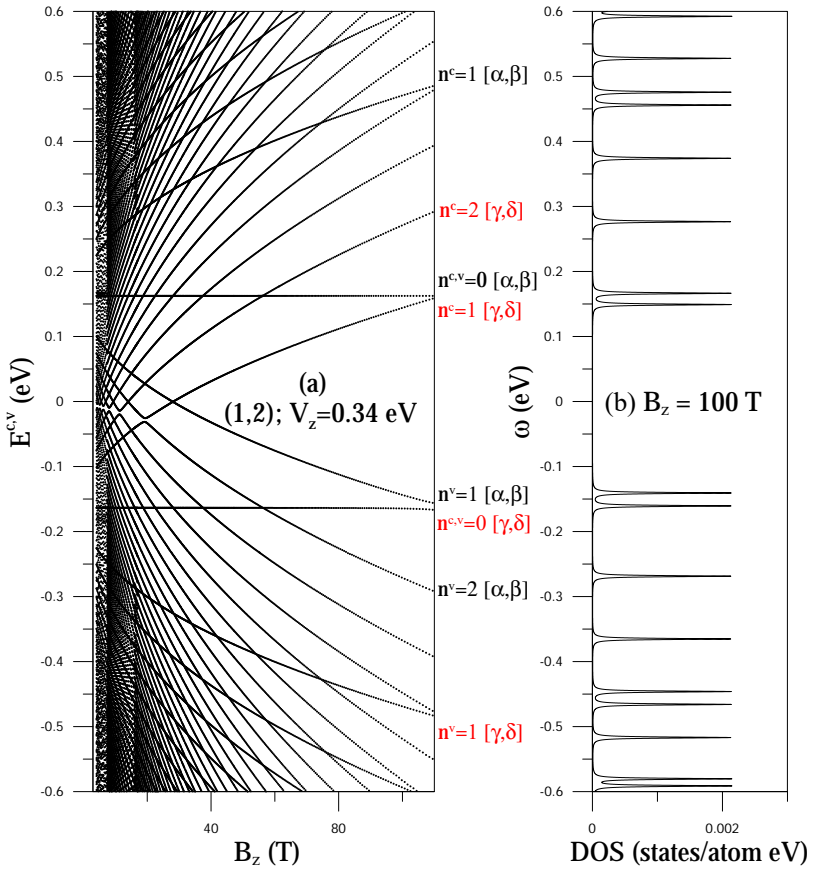
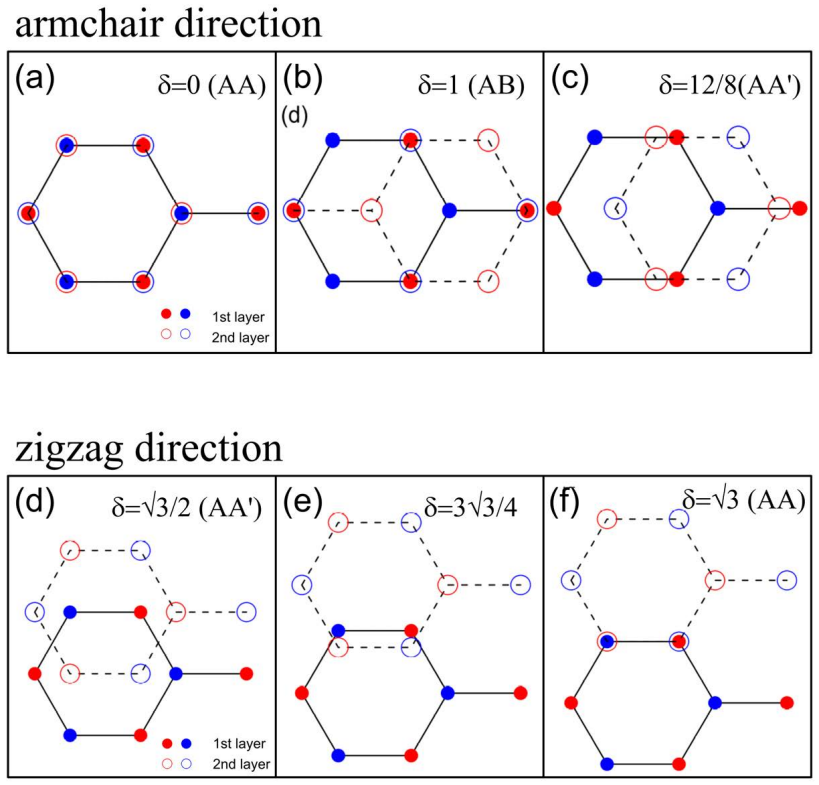
The twisted bilayer graphene system is a zero-gap semiconductor with double-degenerate Dirac-cone structures, and saddle-point energy dispersions appearing at low energies for cases of small twisting angles. There exist rich and unique magnetic quantization phenomena, in which many Landau-level subgroups are induced due to specific Moire zone folding through modulating the various stacking angles. The Landau-level spectrum shows hybridized characteristics associated with those in monolayer, and AA & AB stackings. The complex relations among the different sublattices on the same and different graphene layers are explored in detail.
What carries the argument
The generalized tight-binding model that includes all interlayer and intralayer atomic interactions in the Moire superlattice, which produces the magneto-electronic spectrum via angle-dependent zone folding.
If this is right
- Varying the twist angle produces tunable numbers of Landau-level subgroups through changes in Moire zone folding.
- The Landau-level spectrum combines features of isolated monolayer graphene with those of AA and AB stacked bilayers.
- Sublattice relations between layers determine the degeneracy and hybridization pattern of the quantized states.
- Magnetic quantization remains rich even at low energies where saddle points appear for small angles.
Where Pith is reading between the lines
- The angle dependence implies that transport or spectroscopy experiments could map twist angle directly onto the number of observable level subgroups.
- The same Moire-folding mechanism may apply to other twisted bilayer systems such as transition-metal dichalcogenides, yielding analogous subgroup structures.
- If many-body effects remain negligible, the model supplies a baseline spectrum against which interaction-driven renormalizations can be measured.
Load-bearing premise
The generalized tight-binding model that includes all interlayer and intralayer atomic interactions in the Moire superlattice is sufficient to capture the magneto-electronic spectrum without additional many-body corrections or higher-order terms.
What would settle it
Spectroscopic or transport measurements on twisted bilayer graphene at small twist angles that fail to resolve the predicted multiple Landau-level subgroups or that reveal large gaps inconsistent with the zero-gap Dirac cones would falsify the central claims.
Figures
read the original abstract
The generalized tight-binding model is developed to investigate the magneto-electronic properties in twisted bilayer graphene system. All the interlayer and intralayer atomic interactions are included in the Moire superlattice. The twisted bilayer graphene system is a zero-gap semiconductor with double-degenerate Dirac-cone structures, and saddle-point energy dispersions appearing at low energies for cases of small twisting angles. There exist rich and unique magnetic quantization phenomena, in which many Landau-level subgroups are induced due to specific Moire zone folding through modulating the various stacking angles. The Landau-level spectrum shows hybridized characteristics associated with the those in monolayer, and AA $\&$ AB stackings. The complex relations among the different sublattices on the same and different graphene layers are explored in detail.
Editorial analysis
A structured set of objections, weighed in public.
Referee Report
Summary. The manuscript develops a generalized tight-binding model that incorporates all interlayer and intralayer atomic interactions within the Moire superlattice of twisted bilayer graphene. It claims that the system is a zero-gap semiconductor featuring double-degenerate Dirac-cone structures, with saddle-point dispersions emerging at low energies for small twist angles. The work further asserts the existence of rich magnetic quantization phenomena, including multiple Landau-level subgroups induced by Moire zone folding upon varying the stacking angle, with the spectrum exhibiting hybridized characteristics associated with those of monolayer graphene and AA/AB stackings. The complex sublattice relations across layers are explored in detail.
Significance. If the single-particle calculations hold without significant many-body renormalizations, the results would offer a detailed account of how twist-angle-dependent Moire folding produces hybridized Landau-level subgroups, extending the understanding of magneto-electronic spectra in moire superlattices. The explicit inclusion of all hoppings is a positive feature of the approach.
major comments (2)
- [Model and results sections] The central claim that the generalized tight-binding model suffices to capture the low-energy spectrum and Landau-level hybridization rests on the unexamined assumption that many-body corrections can be neglected. This assumption is load-bearing for the reported saddle-point dispersions and subgroup structure at small twist angles, yet the manuscript provides no quantitative estimate or test of interaction effects in that regime.
- [Abstract and model description] No explicit Hamiltonian matrix elements, parameter values, or derivation of the Moire zone folding are supplied in a form that allows independent verification of whether the reported Landau-level subgroups are independent of input choices or reduce by construction to the model's definitions.
minor comments (2)
- [Abstract] Abstract: 'associated with the those in monolayer' contains a grammatical error and should read 'associated with those in monolayer'.
- [Introduction and discussion] The manuscript would benefit from a clear statement of the twist-angle range over which the saddle-point and subgroup claims are asserted, together with a comparison to existing literature on twisted bilayer graphene Landau levels.
Simulated Author's Rebuttal
We thank the referee for the careful reading and constructive comments on our manuscript. We address the two major comments point by point below, indicating the revisions we will implement.
read point-by-point responses
-
Referee: [Model and results sections] The central claim that the generalized tight-binding model suffices to capture the low-energy spectrum and Landau-level hybridization rests on the unexamined assumption that many-body corrections can be neglected. This assumption is load-bearing for the reported saddle-point dispersions and subgroup structure at small twist angles, yet the manuscript provides no quantitative estimate or test of interaction effects in that regime.
Authors: We agree that the calculations are performed strictly within the single-particle tight-binding approximation and that many-body effects are not quantified. The reported saddle points and hybridized Landau-level subgroups are obtained from the non-interacting model; the manuscript does not claim to include interaction renormalizations. A quantitative estimate of interaction strength would require additional many-body calculations outside the present scope. In the revised manuscript we will add an explicit statement in the introduction and a short paragraph in the discussion section clarifying that the results are single-particle only and noting the regime where interaction effects may become important. revision: partial
-
Referee: [Abstract and model description] No explicit Hamiltonian matrix elements, parameter values, or derivation of the Moire zone folding are supplied in a form that allows independent verification of whether the reported Landau-level subgroups are independent of input choices or reduce by construction to the model's definitions.
Authors: The Model section constructs the generalized tight-binding Hamiltonian by including all intralayer and interlayer hoppings on the Moire superlattice, with parameters taken from standard Slater-Koster values for carbon. The Moire zone folding follows directly from the commensurate supercell geometry for each twist angle. To enable independent verification we will add an appendix that lists the explicit Hamiltonian matrix elements (including the distance-dependent hopping functions) and provides a step-by-step derivation of the supercell construction and zone folding for representative angles. revision: yes
Circularity Check
No circularity: results are direct outputs of the stated tight-binding model
full rationale
The paper constructs a generalized tight-binding Hamiltonian that explicitly includes all interlayer and intralayer hoppings in the Moire superlattice, then diagonalizes it to obtain the zero-gap Dirac cones, saddle points, and Landau-level subgroups. These are computed quantities, not quantities defined in terms of themselves or obtained by fitting a subset and relabeling the fit as a prediction. No self-citation is invoked as a uniqueness theorem or to smuggle an ansatz; the derivation chain is self-contained within the model definition and its numerical solution. The single-particle approximation is an explicit modeling choice whose validity is external to the calculation itself.
Axiom & Free-Parameter Ledger
Reference graph
Works this paper leans on
-
[1]
Iijima S 1991 Helical microtubules of graphitic carbon Nature 354 56
work page 1991
-
[2]
Cao Y, Fatemi V, Fang S, Watanabe K, Taniguchi T 2018 Efthimios Kaxiras & Pablo Jarillo-Herrero Unconventional superconductivity in magic-angle graphene superlat- tices Nature 556 43
work page 2018
-
[3]
Fan Z, Yan J, Zhi L, Zhang Q, Wei T, Feng J, Zhang M, Qian W, and Wei F 2010 A three-dimensional carbon nanotube/graphene sandwich and its application as elec- trode in supercapacitors Adv. Mater. 22 3723
work page 2010
-
[4]
Wilder J W G, Venema L C, Rinzler A G, Smalley R E, and Dekker C 1998 Electronic structure of atomically resolved carbon nanotubes Nature 391 59
work page 1998
-
[5]
Shyu F L, and Lin M F 2002 Electronic and optical properties of narrow-gap carbon nanotubes J. Phys. Soc. Jpn. 71 1820
work page 2002
-
[6]
Saito R, Fujita M, Dresselhaus G, and Dresselhaus M S 1998 Electronic structure of chiral graphene tubules Appl. Phys. Lett. 60 2204
work page 1998
-
[7]
Liu H J, and Chan C T 2002 Properties of 4A carbon nanotubes from first-principles calculations Phys. Rev. B 66 115416
work page 2002
-
[8]
Choi H J, Ihm J, Louie S G, and Cohen M L 2000 Defects, Quasibound States, and Quantum Conductance in Metallic Carbon Nanotubes Phys. Rev. Lett. 84 2917
work page 2000
-
[9]
Novoselov K S, Geim A K, Morozov S V, Jiang D, Zhang Y, Dubonos S V, Grigorieva I V, Firsov A A 2004 Electric Field Effect in Atomically Thin Carbon Films Science 306 666
work page 2004
-
[10]
Chung H C, Chang C P, Lin C Y, and Lin M F 2016 Electronic and Optical Properties of Graphene Nanoribbons in External Fields, Phys. Chem. Chem. Phys. 18 7573. 26
work page 2016
-
[11]
Schmidt H, Ludtke T, Barthold P, McCann E, Falko V I, and Haug R J 2008 Tunable graphene system with two decoupled monolayers Appl. Phys. Lett. 93 172108
work page 2008
-
[12]
Berger C, Song Z, Li X, Wu X, Brown N, Naud C, Mayou D, Li T, Hass J, Marchenkov A N, Conrad E H, First P N, de Heer W A 2006 Electronic Confinement and Coherence in Patterned Epitaxial Graphene Science 312 1191
work page 2006
-
[13]
Hass J, Feng R, Millan-Otoya J E, Li X, Sprinkle M, First P N, de Heer W A, Con- rad E H, and Berger C 2007 Structural properties of the multilayer graphene/4H- SiC(000¯1)system as determined by surface x-ray diffraction Phys. Rev. B 75 214109
work page 2007
-
[14]
Yan Z, Peng Z, Sun Z, Yao J, Zhu Y, Liu Z, Ajayan P M, and Tour J M 2011 Growth of Bilayer Graphene on Insulating Substrates ACS Nano 5 8187
work page 2011
-
[15]
Hass J, Varchon F, Mill´an-Otoya J E, Sprinkle M, Sharma N, de Heer W A, Berger C, First P N, Magaud L, and Conrad E H 2008 Why Multilayer Graphene on 4H- SiC(000¯1) Behaves Like a Single Sheet of Graphene Phys. Rev. Lett. 100 125504
work page 2008
-
[16]
Li G, Luican A, Lopes dos Santos J M B, Castro Neto A H, Reina A, Kong J ,and Andrei E Y 2010 Observation of Van Hove singularities in twisted graphene layers Nature Physics 6 109
work page 2010
-
[17]
Brihuega I, Mallet P, Gonzalez-Herrero H, Trambly de Laissardiere G, Ugeda M M, Magaud L, Gomez-Rodriguez J M, Yndurain F, and Veuillen J-Y 2012 Unraveling the Intrinsic and Robust Nature of van Hove Singularities in Twisted Bilayer Graphene by Scanning Tunneling Microscopy and Theoretical AnalysisPhys. Rev. Lett. 109 196802
work page 2012
-
[18]
Kim K S, Walter A L, Moreschini L, Seyller T, Horn K, Rotenberg E, and Bostwick A 2013 Coexisting massive and massless Dirac fermions in symmetry-broken bilayer graphene Nat. Mater. 12 887. 27
work page 2013
-
[19]
Ohta T, Robinson J T, Feibelman P J, Bostwick A, Rotenberg E, and Beechem T E 2012 Evidence for Interlayer Coupling and Moire Periodic Potentials in Twisted Bilayer Graphene Phys. Rev. Lett. 109 186807
work page 2012
-
[20]
Fallahazad B, Hao Y, Lee K, Kim S, Ruoff R S, and Tutuc E 2012 Quantum Hall effect in Bernal stacked and twisted bilayer graphene grown on Cu by chemical vapor deposition Phys. Rev. B 85 201408
work page 2012
-
[21]
Morell E S, Pacheco M, Chico L, and Brey L 2013 Electronic properties of twisted trilayer graphene Phys. Rev. B 87 125414
work page 2013
-
[22]
Mele E J 2010 Commensuration and interlayer coherence in twisted bilayer graphene Phys. Rev. B 81 161405
work page 2010
-
[23]
Moon P, and Koshino M 2012 Energy spectrum and quantum Hall effect in twisted bilayer graphene Phys. Rev. B 85 195458
work page 2012
-
[24]
Moon P, and Koshino M 2013 Optical absorption in twisted bilayer graphene Phys. Rev. B 87 205404
work page 2013
-
[25]
Wang Z F, Liu F, and Chou M Y 2012 Fractal Landau-Level Spectra in Twisted Bilayer Graphene Nano Lett. 12 3833
work page 2012
-
[26]
San Raefel, CA, USA: Morgan & Claypool Publishers
Lin C Y, Do T N, Huang Y K, and Lin M F 2017 Electronic and optical properties of graphene in magnetic and electric fields IOP Concise Physics. San Raefel, CA, USA: Morgan & Claypool Publishers
work page 2017
-
[27]
Ruffieux P, Cai J, Plumb N C, Patthey L, Prezzi D, Ferretti A, and Fasel R 2012 Electronic structure of atomically precise graphene nanoribbons ACS Nano 6 6930
work page 2012
-
[28]
Sugawara K, Sato T, Souma S, Takahashi T, and Suematsu H 2006 Fermi surface and edge-localized states in graphite studied by high-resolution angle-resolved photoemis- sion spectroscopy Phys. Rev. B 73 045124. 28
work page 2006
-
[29]
Bao C, Yao W, Wang E, Chen C, Avila J, Asensio M C, and Zhou S 2017 Stacking- dependent electronic structure of trilayer graphene resolved by nanospot angle-resolved photoemission spectroscopy Nano Lett. 17 1564
work page 2017
-
[30]
Zhou S Y, Gweon G H, Fedorov A V, First P D, De Heer W A, Lee D H, Lanzara A 2007 Substrate-induced bandgap opening in epitaxial graphene Nature materials 6 770
work page 2007
-
[31]
Knox K R, Wang S, Morgante A, Cvetko D, Locatelli A, Mentes T O, Nino M A, Kim P, and Osgood J R M 2008 Spectromicroscopy of single and multilayer graphene supported by a weakly interacting substrate Phys. Rev. B 78 201408
work page 2008
-
[32]
Starodub E, Bostwick A, Moreschini L, Nie S, Gabaly F E, McCarty K F, and Roten- berg E 2011 In-plane orientation effects on the electronic structure, stability, and Raman scattering of monolayer graphene on Ir(111) Phys. Rev. B 83 125428
work page 2011
-
[33]
Chang C P 2011 Exact solution of the spectrum and magneto-optics of multilayer hexagonal graphene J. Appl. Phys. 110 013725
work page 2011
-
[34]
Li M Y, Chen C H, Shi Y, Li L J 2016 Heterostructures based on two-dimensional layered materials and their potential applications Materials Today 19 322
work page 2016
-
[35]
Nair R R, Blake P, Grigorenko A N, Novoselov K S, Booth T J, Stauber T, Peres N M R, Geim A K 2008 Fine Structure Constant Defines Visual Transparency of Graphene Science 320 1308
work page 2008
-
[36]
2008 Approaching the Dirac point in high-mobility multilayer epitaxial graphene.Phys
Orlita M, Faugeras C, Plochocka P, Neugebauer P, Martinez G, Maude DK, et al. 2008 Approaching the Dirac point in high-mobility multilayer epitaxial graphene.Phys. Rev. Lett. 101 267601
work page 2008
-
[37]
Wang F, Zhang Y, Tian C, Girit C, Zettl A, Crommie M, Shen Y R 2008 Gate-Variable Optical Transitions in Graphene Science 320 206. 29
work page 2008
-
[38]
Do T N, Chang C P, Shih P H, and Lin M 2017 Stacking-enriched magneto-transport properties of few-layer graphenes Phys. Chem. Chem. Phys. 19 29525
work page 2017
-
[39]
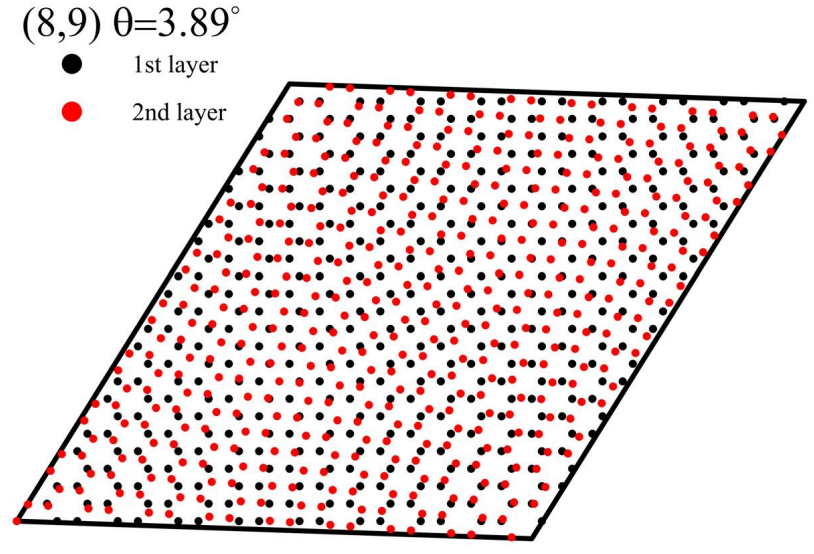
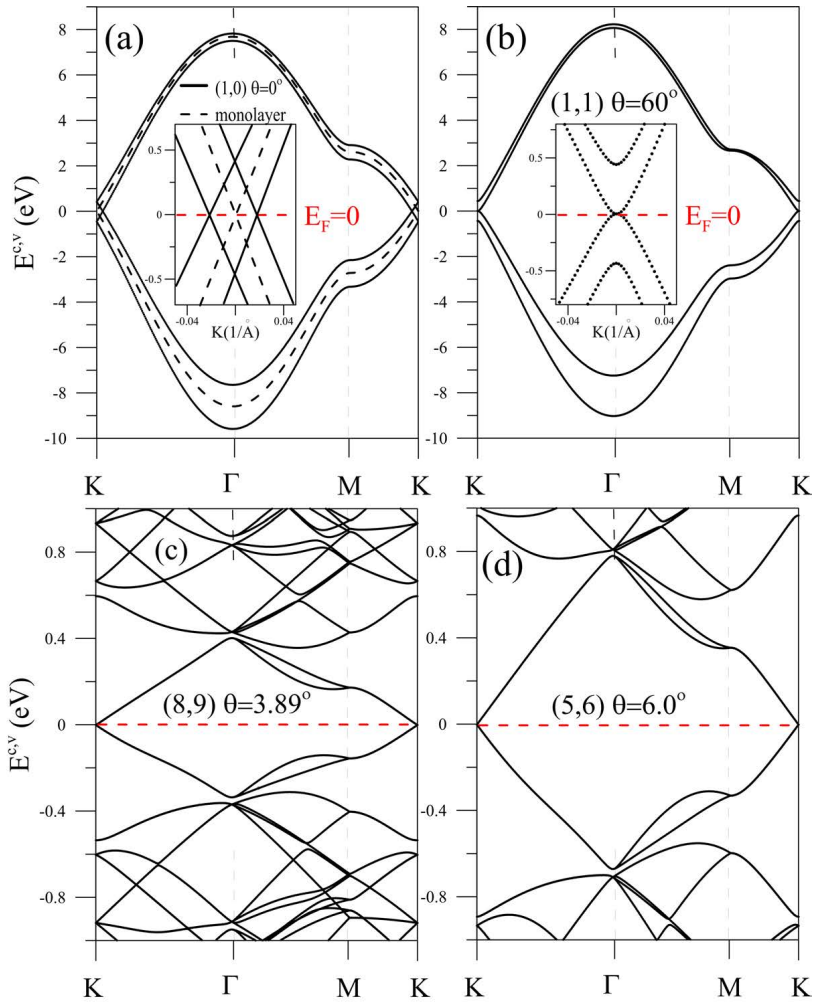
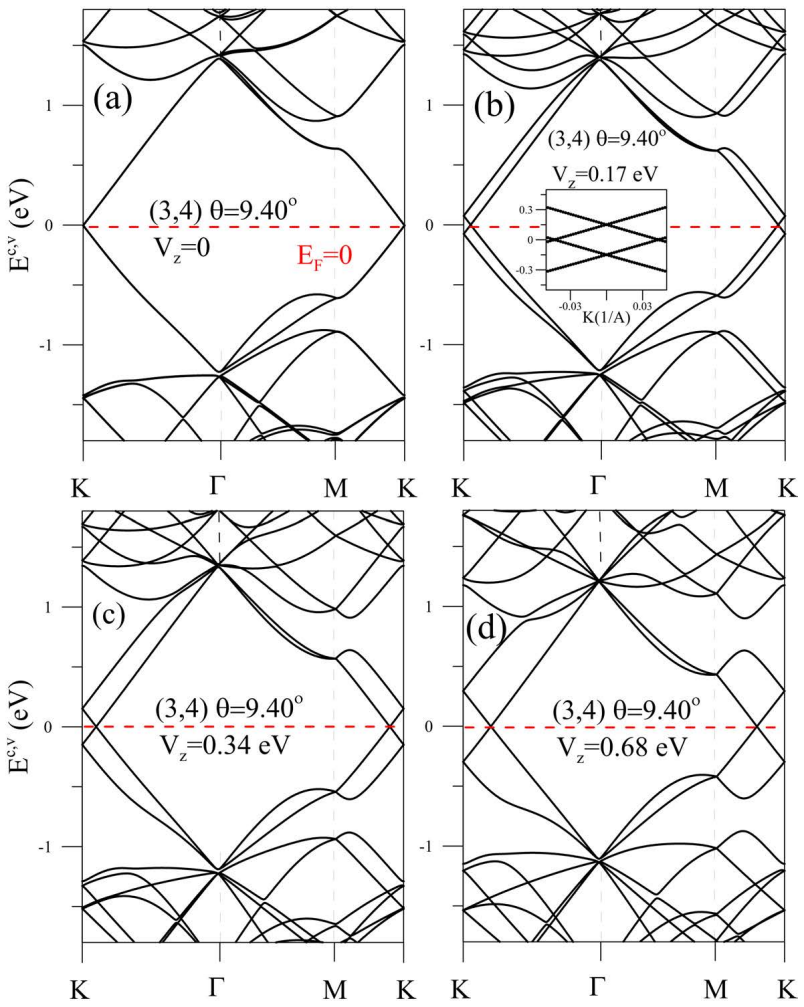
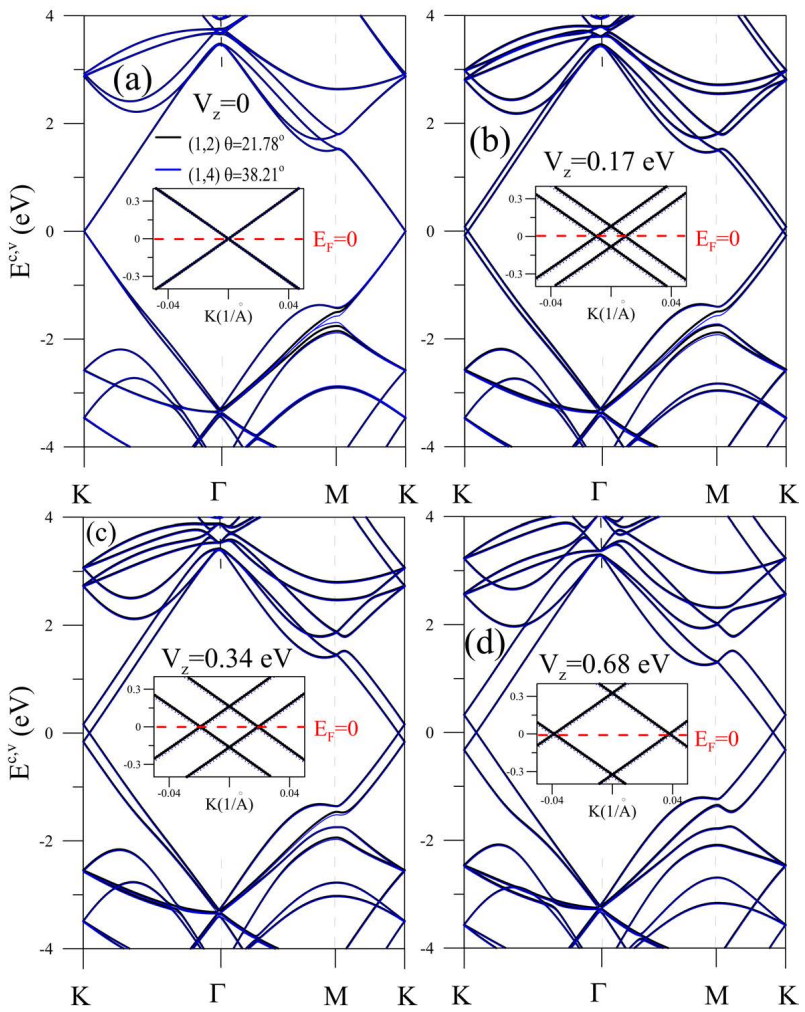
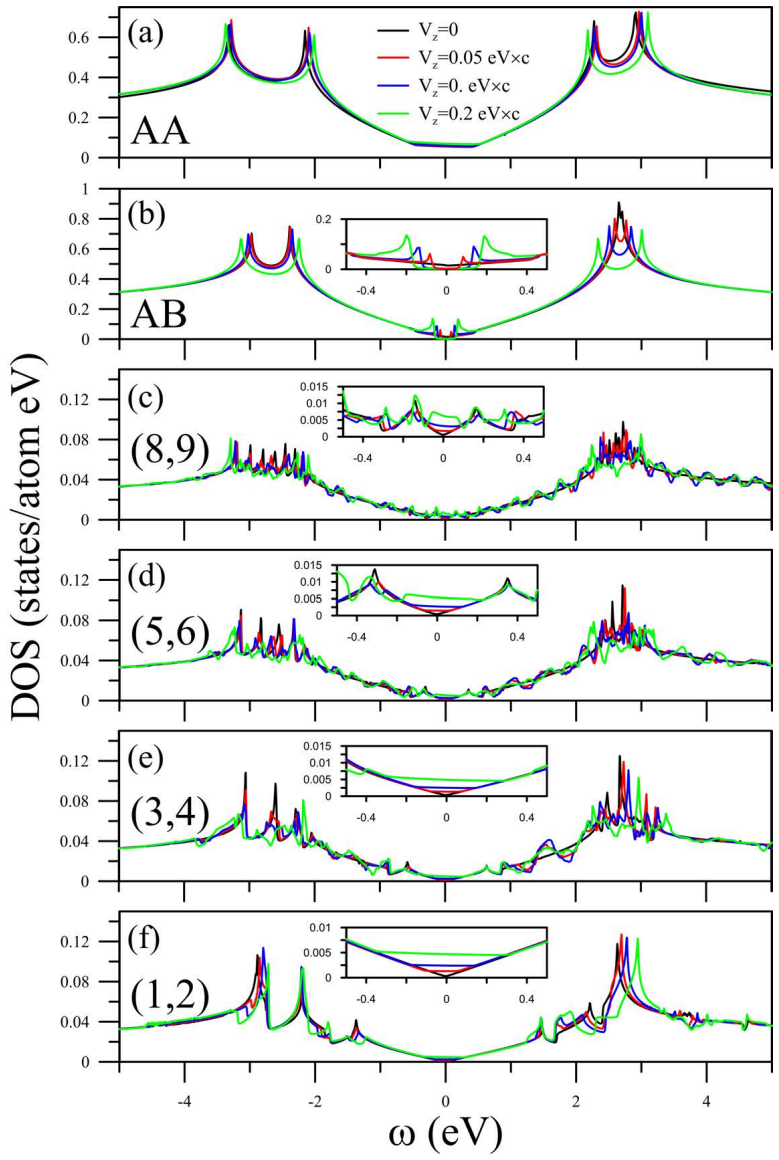
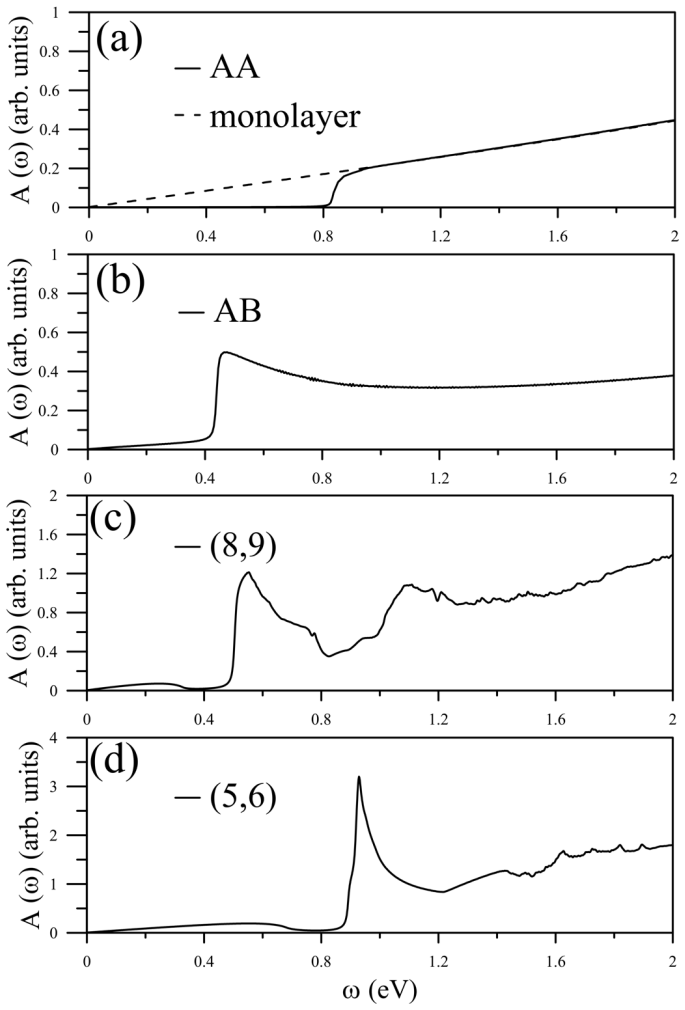
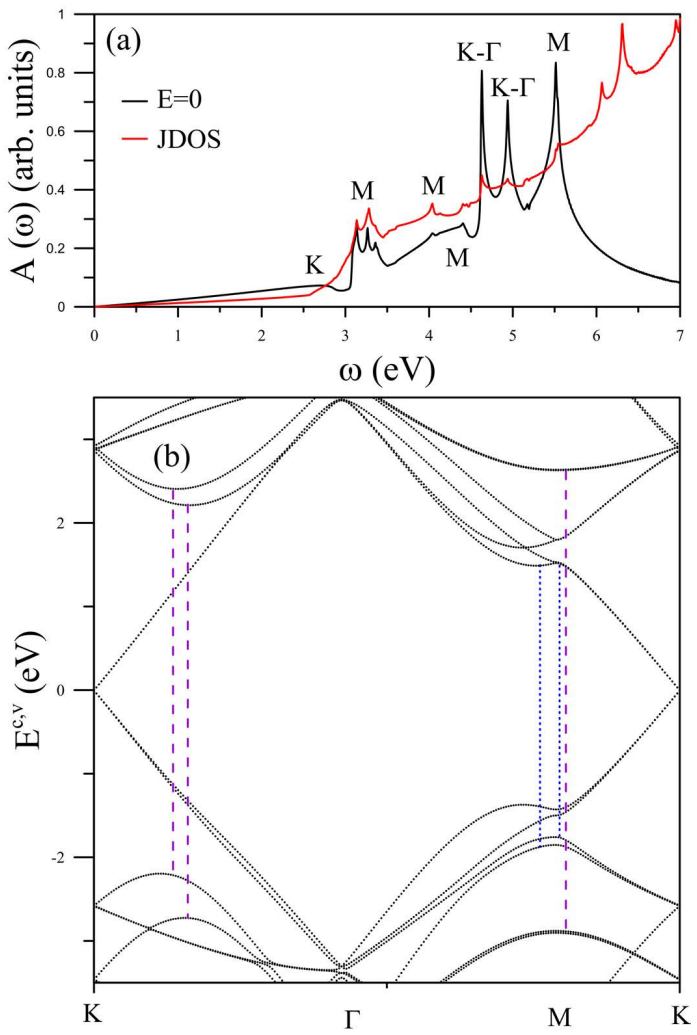
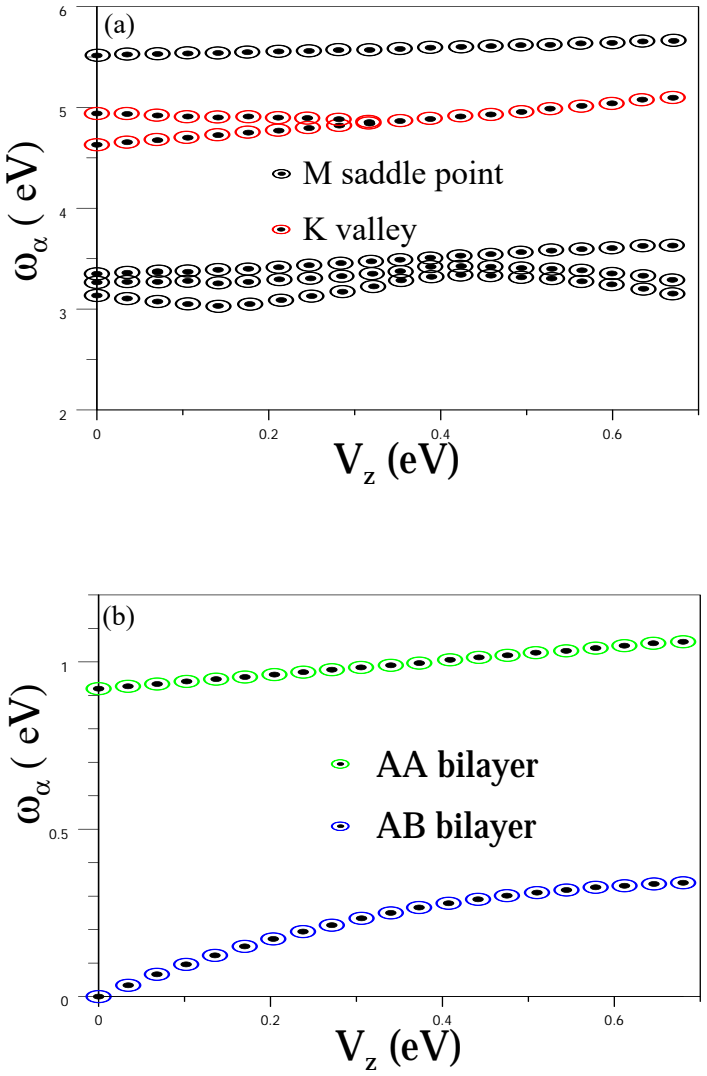
Huang Y K, Chen S C, Ho Y H, Lin C Y, and Lin M F 2014 Feature-Rich Magnetic Quantization in Sliding Bilayer Graphenes Sci. Rep. 4 7509. 30 Figure 1: The geometric structure of a twisted bilayer graphene, such as for a (1,2) system with fourteen carbon atoms in a unit cell for each layer. 31 Figure 2: The band structures due to the C-2 pz orbitals for bil...
work page 2014
discussion (0)
Sign in with ORCID, Apple, or X to comment. Anyone can read and Pith papers without signing in.