Properties of LiMnBO3 glasses and nanostructured glass-ceramics
Pith reviewed 2026-05-24 18:07 UTC · model grok-4.3
The pith
Thermal nanocrystallization of LiMnBO3 glass creates nanostructured glass-ceramics whose conductivity rises six orders of magnitude at room temperature.
A machine-rendered reading of the paper's core claim, the machinery that carries it, and where it could break.
Core claim
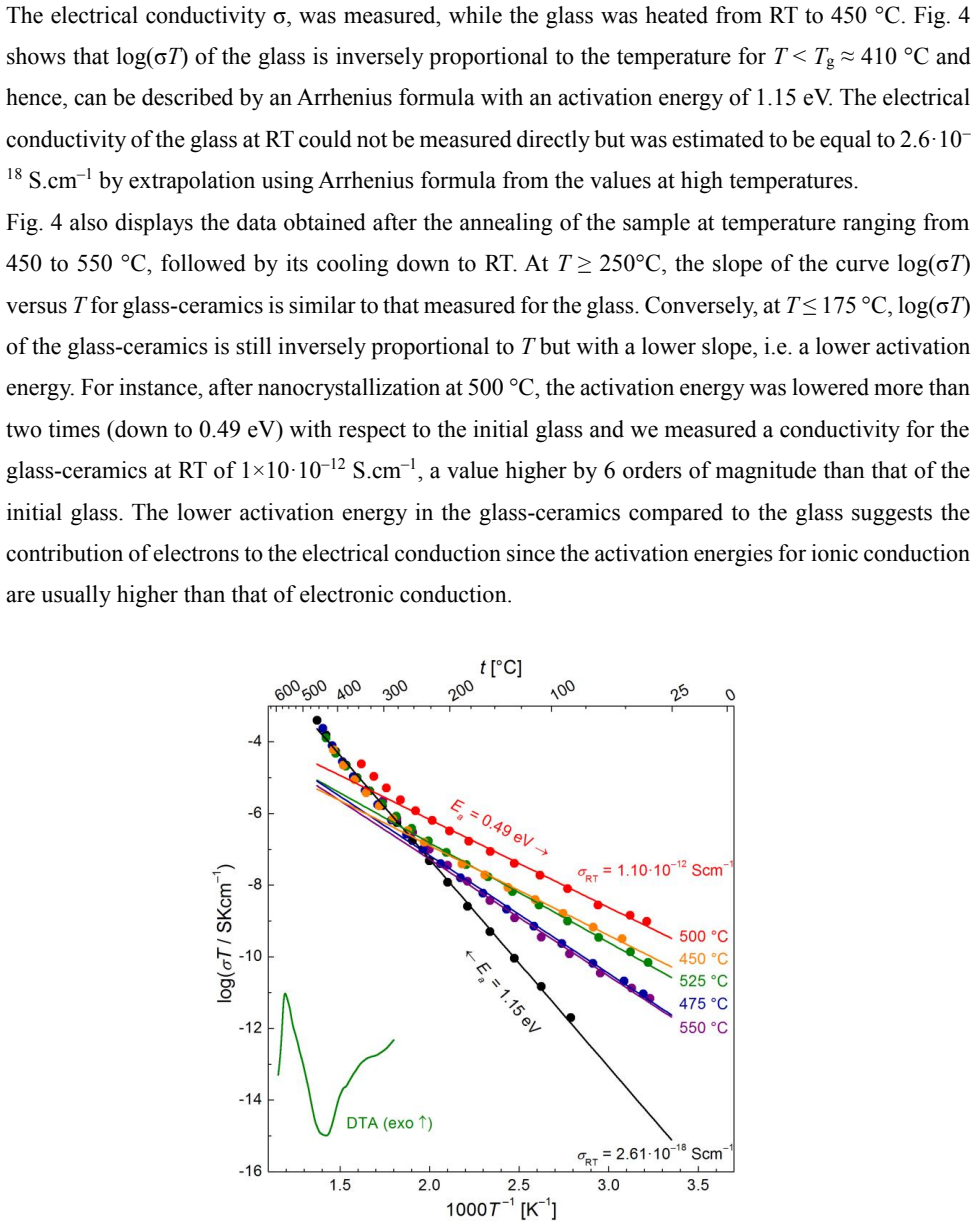
The thermal nanocrystallization of the glass produces a nanostructured glass-ceramics containing MnBO3 and LiMnBO3 phases. The electric conductivity of this glass-ceramics is increased by 6 orders of magnitude, compared to the starting material at room temperature. Such improved conductivity stems from the facilitated electronic transport along the grain boundaries.
What carries the argument
Nanostructured glass-ceramics containing MnBO3 and LiMnBO3 phases, whose grain boundaries enable electronic transport
If this is right
- The conductivity of the nanostructured glass-ceramics exceeds values reported for other manganese- and borate-containing glasses in the literature.
- The initial glass conductivity is dominated by ionic rather than electronic contributions.
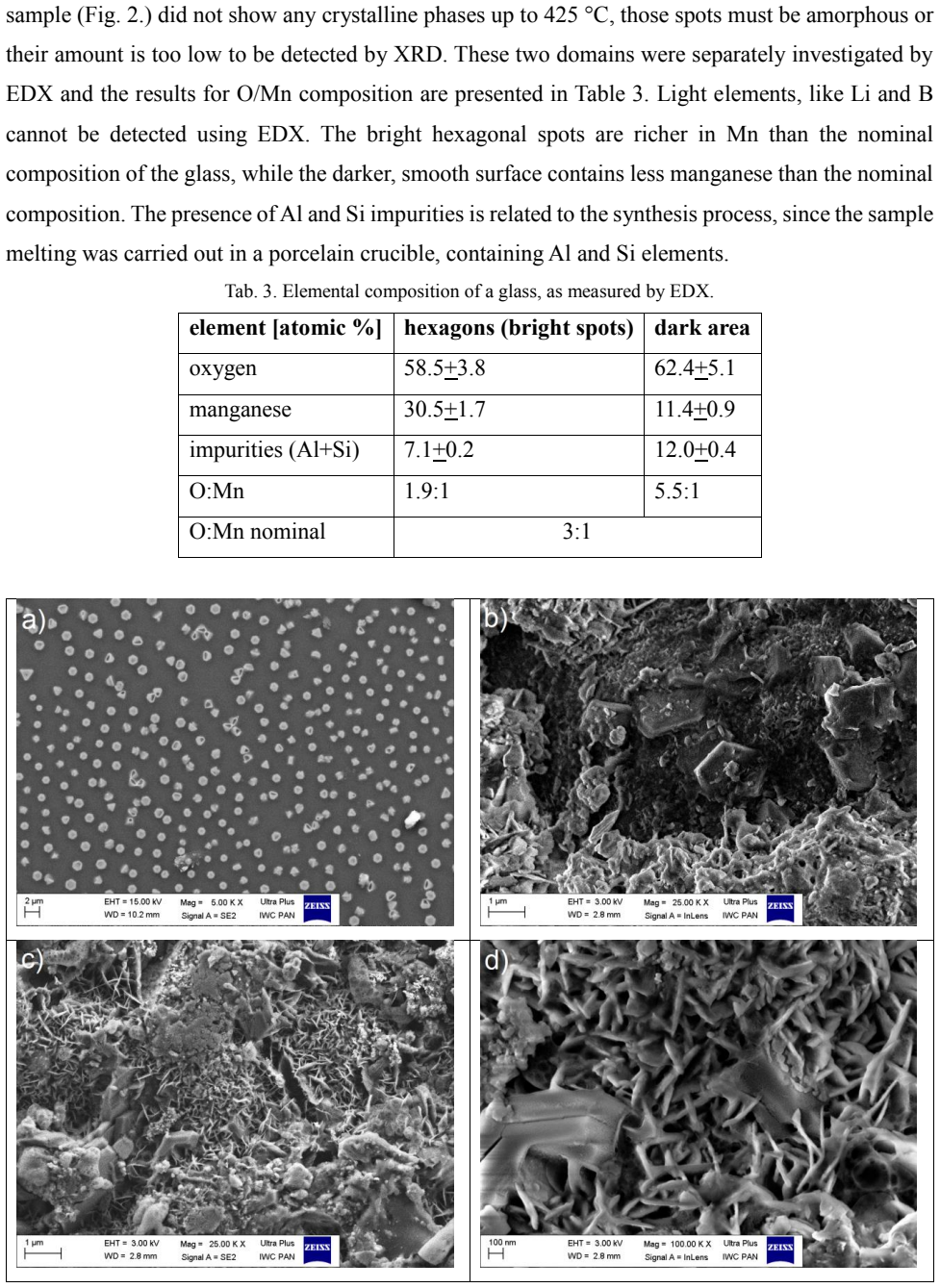
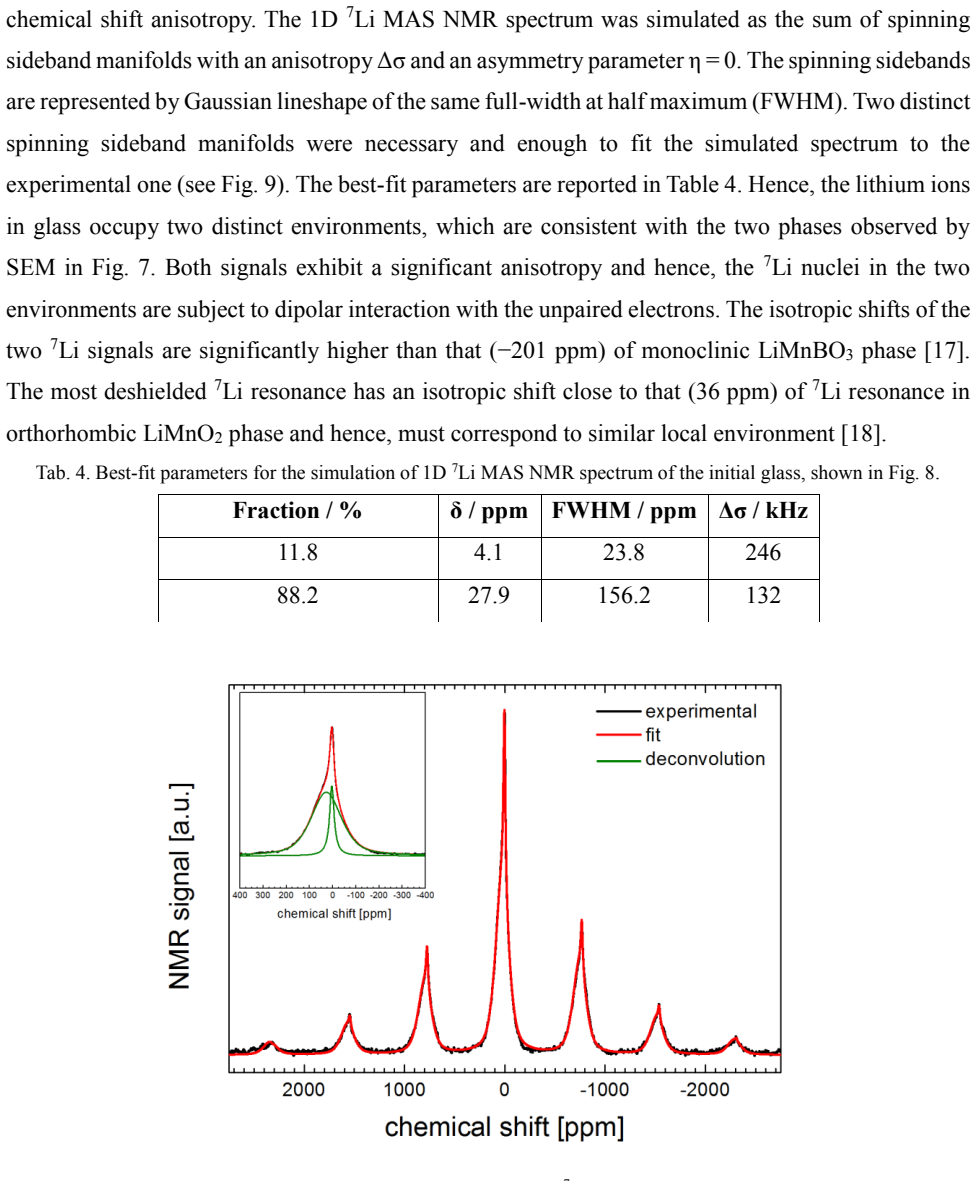
- SEM and 7Li solid-state NMR establish that the parent glass consists of two distinct glassy phases.
- Nanocrystallization converts the low-conductivity glass into a higher-conductivity composite while preserving overall chemical composition.
Where Pith is reading between the lines
- Testing the same nanocrystallization route on other borate compositions would show whether grain-boundary electronic transport is a general route to conductivity gains.
- Varying the density of grain boundaries while holding phase fractions fixed would isolate their contribution from any effect of the new crystalline phases themselves.
- If grain boundaries remain the dominant path, similar nanostructuring could be applied to related cathode or electrolyte compositions to improve room-temperature performance.
- The two-phase glassy structure identified by NMR may itself influence how crystallization proceeds and where boundaries form.
Load-bearing premise
The six-order conductivity increase is caused by electronic transport along grain boundaries rather than by changes in phase composition, measurement geometry, or contact resistance.
What would settle it
A measurement that isolates electronic from ionic conductivity contributions in the glass-ceramics and shows that electronic transport does not account for the observed increase.
Figures

read the original abstract
Polycrystalline LiMnBO3 is a promising cathode material for Li-ion batteries. In this work, we investigated the thermal, structural and electrical properties of glassy and nanocrystallized materials having the same chemical composition. The original glass was obtained via a standard meltquenching method. SEM and 7Li solid-state NMR indicate that it contains a mixture of two distinct glassy phases. The results suggest that the electrical conductivity of the glass is dominated by the ionic one. The dc conductivity of initial glass was estimated to be in the order of 10-18 S.cm-1 at room temperature. The thermal nanocrystallization of the glass produces a nanostructured glass-ceramics containing MnBO3 and LiMnBO3 phases. The electric conductivity of this glass-ceramics is increased by 6 orders of magnitude, compared to the starting material at room temperature. Compared to other manganese and borate containing glasses reported in the literature, the conductivity of the nanostructured glass ceramics is higher than that of the previously reported glassy materials. Such improved conductivity stems from the facilitated electronic transport along the grain boundaries.
Editorial analysis
A structured set of objections, weighed in public.
Referee Report
Summary. The manuscript reports preparation of LiMnBO3 glass by melt-quenching, its characterization by SEM and 7Li solid-state NMR (indicating two glassy phases), and thermal nanocrystallization to produce a glass-ceramic containing MnBO3 and LiMnBO3 phases. The glass is stated to exhibit ionic-dominated dc conductivity of order 10^{-18} S cm^{-1} at room temperature; the glass-ceramic is reported to show a six-order-of-magnitude conductivity increase attributed to facilitated electronic transport along grain boundaries, exceeding values for previously reported Mn- and B-containing glasses.
Significance. If the conductivity enhancement and its mechanistic attribution are substantiated with appropriate controls, the result would be of interest for nanostructured cathode or electrolyte materials in Li-ion batteries, as it suggests a route to conductivity improvement via controlled nanocrystallization beyond typical glassy borates.
major comments (2)
- [Abstract] Abstract: the claim that the six-order conductivity increase 'stems from the facilitated electronic transport along the grain boundaries' is not supported by any reported data separating ionic and electronic contributions (e.g., transference numbers, Hebb-Wagner polarization, or impedance spectra showing distinct grain-boundary arcs). Without such evidence, the causal attribution cannot be distinguished from intrinsic conductivity of the new crystalline phases or changes in geometry/contact resistance.
- [Abstract] Abstract: the stated glass conductivity (~10^{-18} S cm^{-1}) and the magnitude of the increase are presented without error bars, raw impedance data, baseline measurements on the crystalline phases alone, or controls confirming that nanocrystallization did not alter electrode interfaces or effective sample dimensions.
minor comments (2)
- The abstract contains typographical inconsistencies ('meltquenching' instead of 'melt-quenching'; '10-18 S.cm-1' instead of standard scientific notation '10^{-18} S cm^{-1}').
- The statement that the glass-ceramic conductivity exceeds 'previously reported glassy materials' would be strengthened by explicit literature citations or a comparative table.
Simulated Author's Rebuttal
We thank the referee for the careful review and constructive comments on our manuscript. We address each major comment below.
read point-by-point responses
-
Referee: [Abstract] Abstract: the claim that the six-order conductivity increase 'stems from the facilitated electronic transport along the grain boundaries' is not supported by any reported data separating ionic and electronic contributions (e.g., transference numbers, Hebb-Wagner polarization, or impedance spectra showing distinct grain-boundary arcs). Without such evidence, the causal attribution cannot be distinguished from intrinsic conductivity of the new crystalline phases or changes in geometry/contact resistance.
Authors: We agree that direct measurements separating ionic and electronic contributions (transference numbers or Hebb-Wagner polarization) were not performed. Our attribution relies on the observed six-order increase coinciding with grain-boundary formation in the glass-ceramic, the ionic character of the parent glass, and literature on the crystalline phases. We acknowledge this leaves room for alternative explanations such as intrinsic crystalline conductivity. In revision we will rephrase the abstract to present the grain-boundary mechanism as a proposed interpretation rather than a firmly established conclusion and will add a short discussion of possible alternatives. revision: partial
-
Referee: [Abstract] Abstract: the stated glass conductivity (~10^{-18} S cm^{-1}) and the magnitude of the increase are presented without error bars, raw impedance data, baseline measurements on the crystalline phases alone, or controls confirming that nanocrystallization did not alter electrode interfaces or effective sample dimensions.
Authors: The reported values are order-of-magnitude estimates from impedance spectroscopy. We accept that error bars, representative raw spectra, and explicit controls would strengthen the presentation. In the revised manuscript we will add representative impedance data (with uncertainty estimates where possible), clarify that measurements on the glass and glass-ceramic were performed under identical electrode and geometric conditions, and note that separate baseline measurements on phase-pure crystals were outside the scope of the present study. We will also acknowledge the possibility of interface or dimensional changes as a contributing factor. revision: yes
Circularity Check
No circularity: experimental measurements with no derivation chain or self-referential fitting
full rationale
This is a purely experimental materials science paper reporting synthesis, structural characterization (SEM, NMR), thermal analysis, and direct dc conductivity measurements on glass and nanocrystallized samples. Conductivity values (~10^{-18} S cm^{-1} for glass, ~10^{-12} S cm^{-1} for glass-ceramic) are presented as measured results, not derived from equations or fitted parameters that are then relabeled as predictions. The interpretation linking the increase to grain-boundary electronic transport is an inference from the data, not a self-definitional or self-citation-dependent step. No mathematical models, uniqueness theorems, ansatzes, or renamings of known results appear. The paper is self-contained against external benchmarks via reported experimental protocols and literature comparisons.
Axiom & Free-Parameter Ledger
Reference graph
Works this paper leans on
- [1]
-
[2]
J.C. Kim, C.J. Moore, B. Kang, G. Hautier, A. Jain, G. Ceder, Synthesis and Electrochemical Properties of Monoclinic LiMnBO 3 as a Li Intercalation Material . Journal of the Electrochemical Society 158 (2011), A309–A315. DOI: https://doi.org/10.1016/j.jpowsour.2012.09.099
- [3]
-
[4]
DOI: https://doi.org/10.1016/j.cap.2013.04.027
-
[5]
Y .-S. Lee, H. Lee, Electrochemical properties of LiMnBO 3 as a potential cathode material for lithium batteries. Journal of Ceramic Processing Research 13-S2 (2012), 237–240
work page 2012
-
[6]
S. Afyon, D. Kundu, A. Darbandi, H. Hahn, F. Krumeich, R. Nesper, A low dimensional composite of hexagonal lithium manganese borate (LiMnBO3), a cathode material for Li-ion batteries. Journal of Materials Chemistry A 2 (2014), 18946–18951. DOI: https://doi.org/ 10.1039/C4TA04209C
-
[7]
T.K. Pietrzak, J.E. Garbarczyk, M. Wasiucionek, J.L. Nowiński, Nanocrystallization in vanadate- phosphate and lithium -iron-vanadate-phosphate glasses . Physics and Chemistry of Glasses: European Journal of Glass Science 57 (2016), 113 –124. DOI: https://doi.org/10.13036/17533562.57.3.038
-
[8]
T.K. Pietrzak, P.P. Michalski, M. Wasiucionek, J.E. Garbarczyk, Synthesis of nanostructured Li3Me2(PO4)2F3 glass-ceramics (Me = V , Fe, Ti) . Solid State Ionics 288 (2016), 193 –198. DOI: https://doi.org/10.1016/j.ssi.2015.11.021
-
[9]
T.K. Pietrzak, M. Wasiucionek, I. Gorzkowska, J.L. Nowiński, J.E. Garbarczyk, Novel vanadium- doped olivine-like nanomaterials with high electronic conductivity. Solid State Ionics 251 (2013) 40–
work page 2013
-
[10]
DOI: https://doi.org/10.1016/j.ssi.2013.02.012
-
[11]
P.P. Michalski, T.K. Pietrzak, J.L. Nowiński, M. Wasiucionek, J.E. Garbarczyk, Novel nanocrystalline mixed conductors based on LiFeBO 3 glass. Solid State Ionics 302 (2017), 40–44. DOI: https://doi.org/10.1016/j.ssi.2016.12.002
-
[12]
K. Hirose, T. Honma, Y . Benino, T. Komatsu, Glass–ceramics with LiFePO4 crystals and crystal line patterning in glass by YAG laser irradiation . Solid State Ionics 178 (2007), 801 –807. DOI: https://doi.org/10.1016/j.ssi.2007.03.003
-
[13]
D. Massiot, F. Fayon, M. Capron, I. Ki ng, S. Le Calv é, B. Alonso, J. -O. Durand, B. Bujoli, Z Gan, G. Hoatson, Modelling one - and two -dimensional solid -state NMR spectra . Magnetic Resonance in Chemistry 40 (2002), 70–76. DOI: https://doi.org/10.1002/mrc.984
-
[14]
KH. S. Shaaban, S.M. Abo-naf, A.M. Abd Elnaeim, M.E.M. Hassouna, Studying effect of MoO3 on elastic and crystallization behavior of lithium diborate glasses . Applied Physics A 123 (2017),
work page 2017
-
[15]
DOI: https://doi.org/10.1007/s00339-017-1052-9
-
[16]
M.C. Biesinger, B.P. Payne, A.P. Grosvenor, L.W.M. Lau, A.R. Gerson, R.St.C. Smart, Resolving surface chemical states in XPS analysis of first row transition metals, oxides and hydroxides: Cr, Mn, Fe, Co and Ni . Applied Surface Science 257 (2011), 2717 –2730. DOI: https://doi.org/10.1016/j.apsusc.2010.10.051
-
[17]
M.A. Stranick, MnO2 by XPS. Surface Science Spectra 6 (1999), 31 –48. DOI: https://doi.org/10.1116/1.1247888
-
[18]
M.A. Stranick, Mn2O3 by XPS. Surface Science Spectra 6 (1999), 39 –46. DOI: https://doi.org/10.1116/1.1247889
-
[19]
C.P. Grey, N. Dupré, NMR Studies of Cathode Materials for Lithium-Ion Rechargeable Batteries. Chemical Reviews 104 (2004), 4493–4512. DOI: https://doi.org/ 10.1021/cr020734p
-
[20]
J. C. Kim, X. Li, C.J. Moore, S.-H. Bo, P.G. Khalifah, C.P. Grey, G. Ceder, Analysis of Charged State Stability for Monoclinic LiMnBO 3 Cathode. Chemistry of Materials 26 (2014), 4200 –4206. DOI: http://doi.org/ 10.1021/cm5014174
-
[21]
C.P. Grey, Y . J. Lee, Lithium MAS NMR studies of cathode materials for lithium -ion batteries. Solid State Sciences 5 (2003), 883–894. DOI: https://doi.org/10.1016/S1293-2558(03)00113-4
-
[22]
I. G. Austin, N. F. Mott, Polarons in crystalline and non -crystalline materials . Advances in Physics 18 (1969) 41–102. DOI: https://doi.org/10.1080/00018736900101267
-
[23]
Mott, Electrons in disordered structures
N.F. Mott, Electrons in disordered structures . Advances in Physics 16 (1967), 49–144. DOI: https://doi.org/10.1080/00018736700101265
-
[24]
T.K. Pietrzak, Ł. Wewiór, J.E. Garbarczyk, M. Wasiucionek, I. Gorzkowska, J.L. Nowiński, S. Gierlotka, Electrical properties and thermal stability of FePO4 glasses and nanomaterials. Solid State Ionics 188 (2011), 99–103. DOI: https://doi.org/10.1016/j.ssi.2010.11.006
-
[25]
V .C. Veeranna Gowda, R.V . Anavekar, Transport properties of Li2O–MnO2–B2O3 glasses. Solid State Ionics 176 (2005), 1393–1401. DOI: https://doi.org/10.1016/j.ssi.2005.04.002
-
[26]
J. Min, L. Chen, J. Wang, R. Xue, W. Cui, Electronic conductivity of LiMn 2O4–B2O3 and LiMn2O4–B2O3–P2O5 glasses. physica status solidi (a) 146 (1994), 771–776. DOI: https://doi.org/10.1002/pssa.2211460222
-
[27]
P. Kupracz, J. Karczewski, M. Prześniak -Welenc, N.A. Szreder, M.J. Winiarski, T. Klimczuk, R.J. Barczyński, Microstructure and electrical properties of manganese borosilicate glasses. Journal of N on-Crystalline Solids 423–424 (2015), 68 –75. DOI: https://doi.org/10.1016/j.jnoncrysol.2015.05.014
-
[28]
P. Kupracz, A. Lenarciak, M. Łapiński, M. Prześniak -Welenc, N.A. Wójcik, R.J. Barczyński, Polaron hopping conduction in manganese borosilicate glass. Journal of Non-Crystalline Solids 458 (2017), 15–21. DOI: https://doi.org/10.1016/j.jnoncrysol.2016.12.008
-
[29]
V . Ragupathi, M. Safiq, P. Panigrahi, T. Hussain, S. Raman, R. Ahuja, G.S. Nagarajan, Enhanced electrochemical performance of LiMnBO 3 with conduct ive glassy phase: a prospective cathode material for lithium-ion battery. Ionics 23 (2017), 1645–1653. DOI: https://doi.org/10.1007/s11581- 017-2019-8 Table captions Tab. 1. Temperatures of characteristic the...
discussion (0)
Sign in with ORCID, Apple, or X to comment. Anyone can read and Pith papers without signing in.