REVIEW 32 references
Tetrahedrality dictates dynamics in hard spheres
T0 review · reviewed 2026-08-14 · deepseek-v4-flash
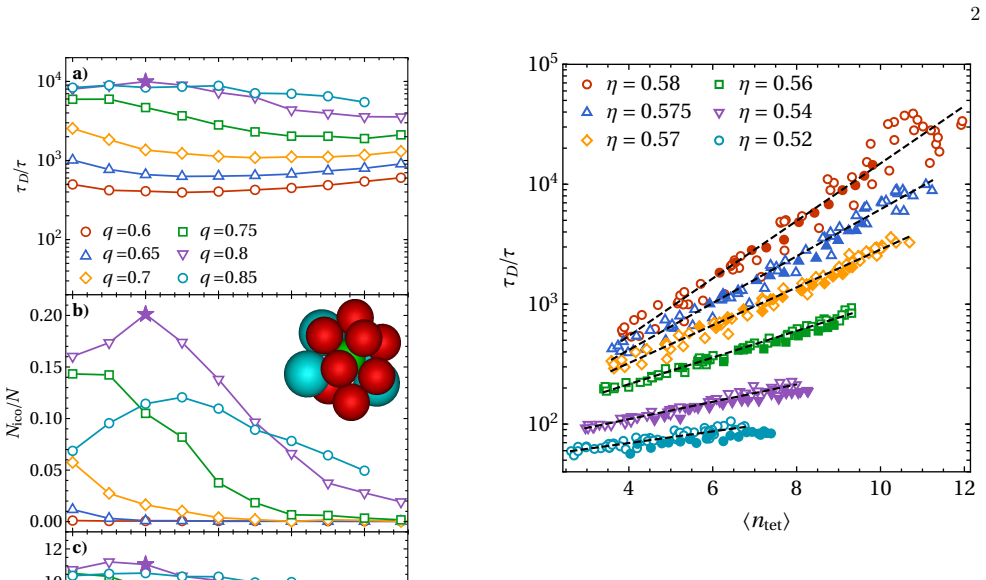
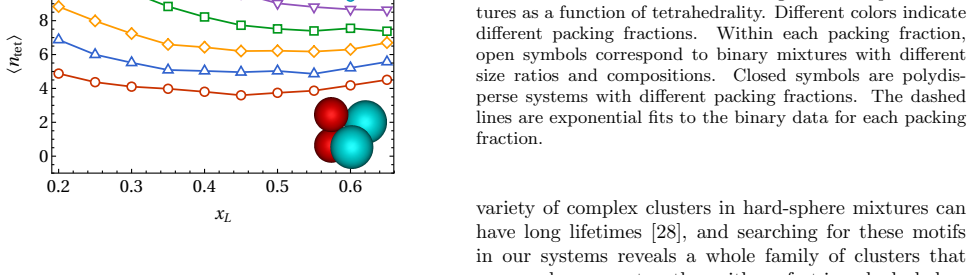
Pith's one-line read The average number of tetrahedra per particle predicts diffusion time across a wide range of hard-sphere mixtures, and local tetrahedrality predicts single-particle mobility.
The pith
A machine-rendered reading of the paper's core claim, the machinery that carries it, and where it could break.
The reading
Extended reading notes
Core claim
The paper's central assertion is that the average number of tetrahedra per particle, denoted <ntet>, quantitatively predicts the diffusion time tau_D of dense hard-sphere mixtures, with all binary and polydisperse systems collapsing onto the same exponential curve at a given packing fraction (Fig. 2). The abstract states: 'dynamics can be fully understood by simply counting the number of tetrahedra.'
Load-bearing premise
The load-bearing premise is that the number of tetrahedra identified by the modified Voronoi construction with cutoff fc=0.82 (Methods, after Ref. 27) is the causally relevant structural measure, rather than a proxy for other quantities such as local density or packing efficiency. In addition, the exponential law is fitted separately for each packing fraction, and systems that crystallized are excluded from the analysis without quantifying the fraction or properties of excluded systems. If the tetrahedrality metric were changed, or if crystallization exclusion biased the sampled configurations, the reported collapse might weaken substantially.
Signed reviews
Editorial analysis
A structured set of objections, weighed in public.
Assumptions & free parameters
free parameters (3)
- Exponential prefactor A(eta) =
not reported
- Exponential rate B(eta) =
not reported
- Voronoi cutoff fc =
0.82
assumptions (4)
- domain assumption Event-driven molecular dynamics correctly simulates hard-sphere trajectories in the microcanonical ensemble.
- domain assumption The TCC-modified Voronoi construction with fc=0.82 correctly identifies nearest-neighbor bonds and tetrahedral clusters.
- domain assumption Dynamic propensity averaged over approximately 200 runs with randomized velocities is a reliable measure of local mobility.
- ad hoc to paper Systems that crystallized can be excluded without biasing the structure-dynamics relationship.
Cite this review
Pith. "Pith review of Tetrahedrality dictates dynamics in hard spheres." pith.science (2026). https://pith.science/paper/JCLF642I
@misc{pith2026190800425,
  author       = {Pith},
  title        = {Pith review of: Tetrahedrality dictates dynamics in hard spheres},
  year         = {2026},
  howpublished = {\url{https://pith.science/paper/JCLF642I}},
  note         = {Machine review of arXiv:1908.00425}
}
read the original abstract
Glasses are ubiquitous amorphous solids that remain one of the big mysteries in condensed matter. Despite the vast body of literature on glasses, a unifying approach to link the structure and dynamics of glasses is still missing. A growing set of evidence, however, indicates the microscopic local geometry as a key ingredient. This originated from the seminal work of Frank, who conjectured that glasses may be the result of the local tendency of liquids to form icosahedral structures, which are not capable of globally filling space regularly. Here, we show that, for a fundamental glass model, dynamics can be fully understood by simply counting the number of tetrahedra. Both globally and locally, these local structures directly predict dynamical slowdown. After more than 60 years of Frank's Conjecture, it might not be the icosahedra that matter for glasses, but rather the tetrahedra inside them.
Figures

Reference graph
Works this paper leans on
-
[1]
Berthier, L. & Biroli, G. Theoretical perspective on the glass transition and amorphous materials. Rev. Mod. Phys. 83, 587 (2011)
work page 2011
-
[2]
Stillinger, F. H. & Debenedetti, P. G. Glass transi- tion thermodynamics and kinetics. Annu. Rev. Condens. Matter Phys. 4, 263–285 (2013)
work page 2013
-
[3]
Royall, C. P. & Williams, S. R. The role of local structure in dynamical arrest. Phys. Rep. 560, 1–75 (2015)
work page 2015
-
[4]
Tanaka, H., Tong, H., Shi, R. & Russo, J. Revealing key structural features hidden in liquids and glasses. Nat. Rev. Phys. 1, 333–348 (2019)
work page 2019
-
[5]
has been a great source of inspiration and different observables have been proposed to try to pin down the relation between local geometry and the extremely long timescales observed in glasses. In particular, several au- thors have looked at the role of locally favored clusters with perfect or modified icosahedral structures as well as, more recently, at th...
work page Pith review arXiv 1908
-
[6]
Frank, F. C. Supercooling of liquids. Proc. Royal Soc. A 215, 43–46 (1952)
work page 1952
-
[7]
Kirkpatrick, T. R., Thirumalai, D. & Wolynes, P. G. Scaling concepts for the dynamics of viscous liquids near an ideal glassy state. Phys. Rev. A 40, 1045 (1989)
work page 1989
-
[8]
Bouchaud, J.-P. & Biroli, G. On the adam-gibbs- kirkpatrick-thirumalai-wolynes scenario for the viscos- ity increase in glasses. J. Chem. Phys. 121, 7347–7354 (2004)
work page 2004
Show all 32 references
-
[9]
& Gibbs, J
Adam, G. & Gibbs, J. H. On the temperature de- pendence of cooperative relaxation properties in glass- forming liquids. J. Chem. Phys. 43, 139–146 (1965)
1965
-
[10]
& Sjolander, A
Bengtzelius, U., Gotze, W. & Sjolander, A. Dynamics of supercooled liquids and the glass transition. J. Phys. C 17, 5915 (1984)
1984
-
[11]
& Latz, A
Barrat, J., Gotze, W. & Latz, A. The liquid-glass transi- tion of the hard-sphere system. J. Phys. Condens. Matter 1, 7163 (1989)
1989
-
[12]
Pusey, P. et al. Hard spheres: crystallization and glass formation. Phil. Trans. R. Soc. A 367, 4993–5011 (2009)
2009
-
[13]
& Zamponi, F
Parisi, G. & Zamponi, F. Mean-field theory of hard sphere glasses and jamming. Rev. Mod. Phys. 82, 789 (2010)
2010
-
[14]
Sanz, E. et al. Avalanches mediate crystallization in a hard-sphere glass. Proc. Natl. Acad. Sci. USA 111, 75– 80 (2014)
2014
-
[15]
& Voigtmann, T
G¨ otze, W. & Voigtmann, T. Effect of composition changes on the structural relaxation of a binary mixture. Phys. Rev. E 67, 021502 (2003)
2003
-
[16]
& Voigt- mann, T
Foffi, G., G¨ otze, W., Sciortino, F., Tartaglia, P. & Voigt- mann, T. Mixing effects for the structural relaxation in binary hard-sphere liquids. Phys. Rev. Lett. 91, 085701 (2003)
2003
-
[17]
Pusey, P. N. & van Megen, W. Observation of a glass transition in suspensions of spherical colloidal particles. Phys. Rev. Lett. 59, 2083 (1987). 5
1987
-
[18]
& Underwood, S
Van Megen, W. & Underwood, S. Glass transition in colloidal hard spheres: Mode-coupling theory analysis. Phys. Rev. Lett. 70, 2766 (1993)
1993
-
[19]
R., Crocker, J
Weeks, E. R., Crocker, J. C., Levitt, A. C., Schofield, A. & Weitz, D. A. Three-dimensional direct imaging of structural relaxation near the colloidal glass transition. Science 287, 627–631 (2000)
2000
-
[20]
Berthier, L. et al. Direct experimental evidence of a grow- ing length scale accompanying the glass transition. Sci- ence 310, 1797–1800 (2005)
2005
-
[21]
Brambilla, G. et al. Probing the equilibrium dynamics of colloidal hard spheres above the mode-coupling glass transition. Phys. Rev. Lett. 102, 085703 (2009)
2009
-
[22]
Kegel, W. K. & van Blaaderen, A. Direct observation of dynamical heterogeneities in colloidal hard-sphere sus- pensions. Science 287, 290–293 (2000)
2000
-
[23]
& Tanaka, H
Tong, H. & Tanaka, H. Revealing hidden structural order controlling both fast and slow glassy dynamics in super- cooled liquids. Phys. Rev. X 8, 011041 (2018)
2018
-
[24]
Xia, C. et al. The structural origin of the hard-sphere glass transition in granular packing. Nat. Commun. 6, 8409 (2015)
2015
-
[25]
Anikeenko, A. V. & Medvedev, N. N. Polytetrahedral nature of the dense disordered packings of hard spheres. Phys. Rev. Lett. 98, 235504 (2007)
2007
-
[26]
& Tarjus, G
Charbonneau, B., Charbonneau, P. & Tarjus, G. Geo- metrical frustration and static correlations in a simple glass former. Phys. Rev. Lett. 108, 035701 (2012)
2012
-
[27]
H., Foffi, G
Mar´ ın-Aguilar, S., Wensink, H. H., Foffi, G. & Smallen- burg, F. Designing slower glasses by manipulating their local structure. arXiv preprint arXiv:1812.00764 (2018)
2018 arXiv
-
[28]
R., Eggers, J
Malins, A., Williams, S. R., Eggers, J. & Royall, C. P. Identification of structure in condensed matter with the topological cluster classification. J. Chem. Phys. 139, 234506 (2013)
2013
-
[29]
P., Williams, S
Malins, A., Eggers, J., Royall, C. P., Williams, S. R. & Tanaka, H. Identification of long-lived clusters and their link to slow dynamics in a model glass former. J. Chem. Phys. 138, 12A535 (2013)
2013
-
[30]
Anderson, V. J. & Lekkerkerker, H. N. Insights into phase transition kinetics from colloid science. Nature 416, 811 (2002)
2002
-
[31]
& Fynewever, H
Widmer-Cooper, A., Harrowell, P. & Fynewever, H. How reproducible are dynamic heterogeneities in a su- percooled liquid? Phys. Rev. Lett. 93, 135701 (2004)
2004
-
[32]
Rapaport, D. C. The art of molecular dynamics simula- tion (Cambridge university press, 2004). Acknowledgements The authors thank Robert Botet, Paddy Royall, and Laura Fil- ion for useful discussions. S.M.A. acknowledges CONACyT for funding
2004
Reviewed August 14, 2026 · model on record in the stance chip above.
Discussion (0). Continue with ORCID to comment.