REVIEW 3 major objections 4 minor 81 references
Superradiance of a Global Monopole in Reissner-Nordstr\"{o}m(-AdS) Space-time
T0 review · 3 major / 4 minor · reviewed 2026-08-14 · deepseek-v4-flash
Pith's one-line read A global monopole lowers the superradiance threshold frequency of Reissner-Nordström(-AdS) black holes and shrinks the charged-scalar-field instability window, with the paper's time-scale claims internally inconsistent.
desk verdict A clean threshold-frequency result is buried under a self-contradictory stability argument: the paper's own Eq. (69) shows the instability grows faster when the monopole is present, while the abstract claims it grows slower. read the letter →
The pith
A machine-rendered reading of the paper's core claim, the machinery that carries it, and where it could break.
The reading
This paper adds a global monopole, a topological defect from early-universe symmetry breaking, to a Reissner-Nordström (RN) or RN-AdS black hole. In the metric, the monopole only changes the factor b² = 1-8πη² in front of the r² term. A larger monopole charge η means smaller b², which moves the horizon outward. Because the superradiance threshold is eQ/r₊, a larger horizon means a lower threshold. The authors then apply the standard near-far asymptotic matching method to calculate the growth rate of the charged scalar field in two setups: RN-AdS, where the AdS boundary acts as the mirror, and RN with a reflecting sphere, the 'black hole bomb'. They conclude the monopole makes the instability harder to start in both cases.
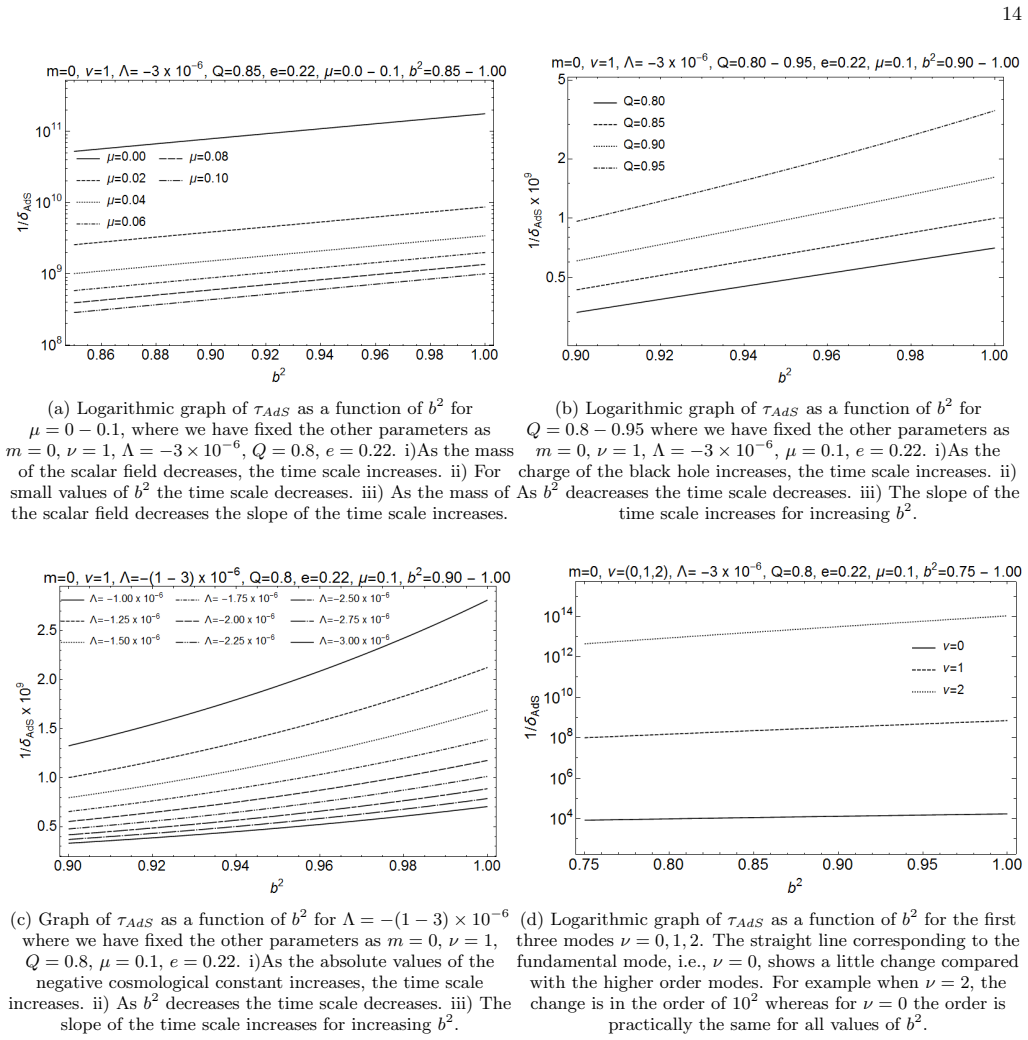
The qualitative threshold result is simple and robust. The quantitative instability analysis is not: the matching forces the angular eigenvalue to its monopole-free value (λ ≈ ν), dropping a correction of the same order as the kept effect. More seriously, Eq. (69) and the figures show the growth rate rises when b² shrinks (τ = 1/δ falls), while the conclusion says the instability 'will grow slower'. The paper itself concedes that a numerical analysis is needed.
Extended reading notes
Core claim
The load-bearing assertion is in the abstract and Sec. IV: 'The existence of global monopole makes these black holes more stable against superradiance instability.' Concretely, with b² = 1-8πη² < 1, the outer horizon r₊ = (M + √(M²-b²Q²))/b² is enlarged, so the electric potential eΦ_h = eQ/r₊ and the superradiance threshold frequency ω < eΦ_h are reduced (Sec. II.F, Eqs. 30-32). The derived instability windows are Re[ω_QM] = (2b/ℓ)(m+σ) < eQ/r₊ for RN-AdS (Eq. 74) and Re[ω_BQN] = (b²/r₀)j_{ν+1/2,s} < eQ/r₊ for the mirror case (Eq. 92). If correct, a swallowed monopole narrows the superradiant window and slows the onset of the charged-scalar instability.
Load-bearing premise
Two load-bearing premises, structurally separate from the claim. First, the near-far matching is made to work by expanding 1/b² = 1+O(η²) and 'neglecting the O(η²) term' to set the angular eigenvalue λ = ν (Sec. III.A, just after Eq. 64), while the same O(η²) monopole effect is kept in the radial sector to produce the b²-dependence of δ_AdS in Eqs. (67)-(69). This selective truncation is unquantified; if the angular correction is of the same order as the retained radial effect, the claimed time-scale scaling τ ∝ ℓ^{2(ν+1)}b^{2ν} is not established. Second, the QNM ansatz ω_QM = (2b/ℓ)(m+σ) + iδ_AdS assumes δ_AdS ≪ 1 (Eq. 60) without verifying it for the plotted parameters, and the case-2 rate δ in Eq. (89) is asserted after 'similar mechanical steps', so its correctness rests on an unshown computation.
Signed reviews
Editorial analysis
A structured set of objections, weighed in public.
Referee Report
Summary. The paper studies the superradiance of a massive charged scalar field on a Reissner-Nordström(-AdS) spacetime containing a global monopole, parameterized by b^2 = 1 - 8πη^2 < 1. After deriving the Klein-Gordon equation and its asymptotic solutions, the authors obtain the superradiance condition ω < eΦ_h (Sec. II.F) and show that the monopole enlarges the outer horizon r_+ (Eq. (32)), thereby lowering the threshold frequency. The main body (Sec. III) then uses matched asymptotic expansions in two confinement settings: RN-AdS, where the AdS boundary acts as a reflecting box, and the black-hole-bomb case, where a mirror is placed at radius r_0. For the AdS case, the authors derive a discrete spectrum (Eq. (59)), a QNM ansatz with a small imaginary part (Eq. (60)), and a growth rate δ_AdS (Eq. (69)); for the bomb case, they obtain a condition involving Bessel zeros (Eqs. (88)-(92)) and a growth rate δ (Eq. (89)). The paper's abstract and conclusion assert that the presence of a global monopole makes these black holes more stable against superradiance instability by lowering the threshold and slowing the instability growth.
Significance. If the central claim were fully established, the paper would provide a concrete physical example of a topological defect modifying black-hole superradiance: the threshold reduction follows cleanly from the horizon equation and is a robust, model-independent effect. The threshold part is indeed sound and correctly identifies the role of b^2 in enlarging r_+. However, the instability-growth results are not reliable in the current form. The paper's own Eq. (69) and Fig. 2 show the time scale τ_AdS decreasing as b^2 decreases, which indicates faster exponential growth, and this sits in direct tension with the stated conclusion that the instability 'grows slower.' In addition, the derivation retains a b^{-2ν} radial effect while dropping the same-order O(η^2) angular eigenvalue correction, and the mirror-case rate in Eq. (89) is asserted without showing the matching computation. The threshold narrowing is a useful result, but the more novel quantitative predictions about instability timescales require substantial revision before they can support the abstract's stability claim.
major comments (3)
- [Sec. III A (after Eq. (74)) and Sec. IV] Equation (69) gives δ_AdS proportional to b^{-2ν}, so as b^2 = 1 - 8πη^2 decreases (stronger monopole), δ_AdS increases; the text immediately after Eq. (74) acknowledges this and defines τ_AdS = 1/δ_AdS, and Fig. 2 plots τ_AdS decreasing with decreasing b^2. However, the Conclusion and Abstract state that the instability 'grows slower' in the presence of the global monopole. Since the field amplitude evolves as Φ ∝ e^{δ t} (Eq. (73)), a smaller τ means faster exponential growth. The central 'more stable' claim is thus contradicted by the paper's own formula and figures, and this inconsistency must be resolved before the main conclusion can be stated.
- [Sec. III A, Eqs. (64)-(66) and Eq. (69)] The matching procedure sets λ = ν by expanding 1/b^2 = 1 + O(η^2) and 'neglecting the O(η^2) term,' yet the radial sector then retains the O(η^2) monopole effect through the explicit factor b^{-2ν} in Eq. (69). Because b^{-2ν} - 1 is itself O(η^2) for small η, the retained radial scaling in Eq. (69) is of the same order as the angular correction that is dropped. Therefore the claimed τ_AdS ∝ b^{2ν} dependence and the mode-dependent curves in Figs. 2(a)-(d) are not established at leading order. The authors should either solve Eq. (64) exactly for λ in terms of ν and b, or demonstrate that the angular correction does not enter the growth rate at leading order.
- [Sec. III A Eq. (60) and Sec. III B Eqs. (88)-(89)] The QNM ansatz (60) assumes δ_AdS ≪ 1 without verifying this for the parameters used in the plots; from Eq. (69), small b^2 and larger ν can make b^{-2ν} large, so the smallness of δ_AdS needs explicit support. In the mirror case, the growth rate δ in Eq. (89) is introduced after 'similar mechanical steps' without presenting the matching computation. Since Eq. (89) is the quantitative input for Fig. 3 and the bomb-case conclusions, the derivation should be shown in full or the result should be clearly traced to a displayed calculation.
minor comments (4)
- [Eq. (5)] The Hawking temperature expression contains spurious factors of 1/(4π) inside the parentheses; the preceding derivative of Δ_r/r^2 gives T = (1/4π)(b^2/r_+ + 3r_+/ℓ^2 - Q^2/r_+^3), and the displayed formula should be corrected accordingly.
- [Eq. (20)] The near-horizon potential is written as V(r_*) → (ω - eΦ_h), but it should be (ω - eΦ_h)^2 to be consistent with the potential in Eq. (19) and with the plane-wave exponents in Eq. (22).
- [Throughout] There are numerous typographical errors, including 'wih' in Sec. I, 'deacreases' in the captions of Figs. 2 and 3, and repeated 'effects' in the abstract; a careful proofreading pass is needed.
- [Sec. III A, after Eq. (64)] The text says 'neglecting the O(η^2) term we have λ = ν,' but the exact relation λ(λ+1) = ν(ν+1)/b^2 implies a shift in λ of order η^2, and the notation would be clearer if the authors explicitly distinguish the exact λ from the approximated integer ν.
Circularity Check
No significant circularity: the derivation is self-contained; the main consistency defect is an internal contradiction between Eq. (69) and the conclusion, which is a correctness issue, not a circular reduction.
full rationale
The paper does not fit parameters and then relabel them as predictions, nor does it import a uniqueness theorem or load-bearing result from the authors' prior work. The superradiance threshold condition (30) is derived in Sec. II.F from a Wronskian calculation and is the input of the stability analysis; Eqs. (72), (74), and (92) apply that same condition to the computed quasinormal-mode real parts, which is an application of the input rather than a circular derivation. The growth-rate expressions (69) and (89) are obtained by asymptotic matching of near- and far-region solutions, not by assuming the answer; the sign relation δ ∝ −(Re[ω] − eΦ_h) is a derived consequence of that matching, even though it reproduces the superradiance condition. The λ=ν simplification after Eq. (64), where an O(η²) angular correction is dropped while O(η²) monopole effects are kept in the radial factor b^{−2ν}, is an unquantified approximation that threatens the reliability of the b-dependence of δ, but it is an approximation-consistency problem, not a self-referential reduction. The self-citations [30, 50, 76] are background references and are not load-bearing. The unshown 'similar mechanical steps' behind Eq. (89) and the conclusion's 'grows slower' statement, which conflicts with the displayed τ ∝ b^{2ν} decrease, are correctness/consistency concerns rather than circularity. No step in the paper's chain reduces by construction to its own inputs, so the circularity score is 0.
Assumptions & free parameters
free parameters (1)
- Angular eigenvalue truncation λ ≈ ν =
λ set to ν, O(η²) correction dropped
assumptions (6)
- domain assumption Line element (1)-(2) is the correct RN(-AdS) global monopole spacetime
- domain assumption Low-frequency near/far matching regime: r₊ ≪ ℓ, (r-r₊) ≪ 1/ω, μ²r₊² ≪ 1 in the near region, and M,Q → 0 in the far region
- ad hoc to paper QNM ansatz ω_QM = (2b/ℓ)(m+σ) + iδ_AdS with δ_AdS ≪ 1 (Eq. 60)
- standard math Standard hypergeometric transformation formulas and gamma function identities (Abramowitz-Stegun [77])
- domain assumption Superradiance condition ω < eΦ_h derived from the Wronskian (Eqs. 28-30)
- domain assumption Mirror condition Φ = 0 at r = r₀, quantized by Bessel zeros J_{ν+1/2}(r₀ω/b²) = 0 (Eqs. 80-83)
Cite this review
Pith. "Pith review of Superradiance of a Global Monopole in Reissner-Nordstr\"{o}m(-AdS) Space-time." pith.science (2026). https://pith.science/paper/KGWXXWCH
@misc{pith2026190800504,
  author       = {Pith},
  title        = {Pith review of: Superradiance of a Global Monopole in Reissner-Nordstr\"om(-AdS) Space-time},
  year         = {2026},
  howpublished = {\url{https://pith.science/paper/KGWXXWCH}},
  note         = {Machine review of arXiv:1908.00504}
}
read the original abstract
In this article, the behaviour of a charged and massive scalar field around a global monopole swallowed by a Reissner-Nordstr\"{o}m-Anti-de Sitter (RN-AdS) black hole is investigated by considering the Klein-Gordon equation in this geometry. The superradiance phenomenon and instability behaviour of the black hole against charged scalar perturbations are studied for both an RN-AdS case and also for an RN black hole surrounded by a reflective mirror, i.e., the black hole bomb case. The effects of the monopole on these cases are discussed analytically and also with the help of several graphs in detail. The monopole charge affects the superradiance threshold frequency and also effects the instability time scale for both cases. The existence of global monopole makes these black holes more stable against superradiance instability.
Figures


Reference graph
Works this paper leans on
-
[1]
Nonvanishing Cosmological constant case For nonvanishing cosmological constant, i.e., 𝓁⁄=∞, we have V (r∗)→∞, as r→∞ (for 𝓁⁄=∞) (23) which implies that the boundary condition for the scalar field in this case is the following, R→ 0 when r∗→∞, (24) due to the fact that AdS space behaves effectively as a reflecting mirror. 7
-
[2]
Vanishing Cosmological Constant case For the vanishing cosmological constant, however, the behaviour of the scalar field is very different, since V (r∗)→ω2−b2µ2, as r→∞ (for 𝓁 =∞). (25) Hence, for vanishing cosmological constant, and if the scalar field is massive ( µ⁄= 0), then bound states that are decaying at infinity are possible for the scalar field if ω2...
-
[3]
(47) 10 and the following ansatz, R =xβ1(1−x)β2F. (48) Substitution of (48) to (46) yields, (1−x)x∂ 2 rF + [γ′−x(α′ +β′ + 1) ]∂xF−α′β′F = 0, (49) where we have defined, α′ =β1 +β2 + 3 4 + 1 4 √ 9 + 4µ2𝓁2 = ˜ω𝓁 2 + λ 2 + 3 4 + 1 4 √ 9 + 4µ2𝓁2, (50) β′ =β1 +β2 + 3 4− 1 4 √ 9 + 4µ2𝓁2 = ˜ω𝓁 2 + λ 2 + 3 4− 1 4 √ 9 + 4µ2𝓁2, (51) γ′ = ˜ω𝓁 + 1, (52) such that, α′β...
-
[4]
(53) The equation (49) is in the form of hypergeometric differential equation and this equation admits a solution in the neighbourhood of x =∞ as [77],F (α′,β′;γ′;x) = Cx−α′F (α′,α′−γ′ + 1;α′−β′ + 1; 1 x) +Dx−β′ F (β′,β′−γ′ + 1;β′−α′ + 1; 1 x), hence we can write a solution of (46) via (48) as, R = (1−x)β2xβ1 { Cx−α′F (α′,α′−γ′ + 1;α′−β′ + 1; 1 x) +Dx−β′ F...
-
[5]
T. W. B. Kibble, J. Phys. A 9, 1387 (1976)
1976
-
[6]
Vilenkin, Phys
A. Vilenkin, Phys. Rep. 121, 263 (1985)
1985
-
[7]
Barriola and A
M. Barriola and A. Vilenkin, Phys. Rev. Lett. 63, 341 (1989)
1989
- [8]
Show all 81 references
-
[9]
D. P. Bennett and S. H. Rhie, Phys. Rev. Lett. 65 1709 (1990)
1990
-
[10]
Pogosian, S.-H
L. Pogosian, S.-H. H. Tye, I. Wasserman, and M. Wyman, Phys. Rev. D 68, 023506 (2003); 73 089904(E) (2006)
2003
-
[11]
Bevis, M
N. Bevis, M. Hindmarsh, M. Kunz, and J. Urrestilla, Phys. Rev. D 75 065015 (2007)
2007
-
[12]
Vilenkin and E
A. Vilenkin and E. P. S. Shellard, Cosmic strings and other topological defects, (Cambridge University Press, Cambridge UK 2000)
2000
-
[13]
Dicke, Phys.Rev
R. Dicke, Phys.Rev. 93 , 99(1954)
1954
-
[14]
J. D. Bekenstein and M. Schiffer, Phys. Rev. D. 58 064014 (1998)
1998
-
[15]
Brito, V
R. Brito, V. Cardoso, P. Pani, Lect. Notes Phys. 906 1 (2015)
2015
-
[16]
Ya. B. Zel’dovich, Pis’ma Zh. Eksp. Teor. Fiz. 14 270 (1971) [JETP Lett. 14, 180 (1971)]
1971
-
[17]
Y. B. Zel’dovich, Zh. Eksp. Teor. Fiz 62 2076 (1972),[Sov. Phys. JETP 35, 1085 (1972)]
1972
-
[18]
J. M. Bardeen, W. H. Press, and S. A. Teukolsky, Astrophys. J. 178 347 (1972)
1972
-
[19]
A. A. Starobinsky, Zh. Eksp. Teor. Fiz. 64, 48 (1973) [Sov. Phys. JETP 37 28 (1973)]
1973
-
[20]
A. A. Starobinsky and S. M. Churilov, Zh. Eksp. Teor. Fiz. 65 3 (1973) [Sov. Phys. JETP 38, 1 (1973)]
1973
-
[21]
J. D. Bekenstein, Phys. Rev. D, 7 949 (1973)
1973
-
[22]
Denardo and R
G. Denardo and R. Ruffini, Phys. Lett. B 45 259 (1973)
1973
-
[23]
Furuhashi, and Y
H. Furuhashi, and Y. Nambu, Prog. Theor. Phys. 112 983 (2004)
2004
-
[24]
Regge, and J
T. Regge, and J. A. Wheeler, Phys. Rev. 108, 1063 (1957)
1957
-
[25]
C. V. Vishveshwara, Phys. Rev. D 1, 2870 (1970)
1970
-
[26]
W. H. Press and S. A. Teukolsky, Nature 238, 211 (1972)
1972
-
[27]
Cardoso, O
V. Cardoso, O. J. C. Dias, J. P. S. Lemos, and S. Yoshida, Phys.Rev. D 70 044039 (2004)
2004
-
[28]
M. J. Strafuss, and G. Khanna, Phys. Rev. D 71, 024034 (2005)
2005
-
[29]
Hod, and O
S. Hod, and O. Hod, Phys. Rev. D 81, 061502 (2010)
2010
-
[30]
J. G. Rosa, JHEP 06 (2010) 015
2010
-
[31]
Witek, V
H. Witek, V. Cardoso, C. Herdeiro, A. Nerozzi, U. Sperhake, and M. Zilhao, Phys. Rev. D 82 104037 (2010)
2010
-
[32]
J. P. Lee, JHEP 01 (2012) 091
2012
-
[33]
S. R. Dolan, Phys. Rev. D 87 124026 (2013)
2013
-
[34]
Delice and T
O. Delice and T. Dur˘ gut, Phys. Rev. D92 024053 (2015)
2015
-
[35]
C. A. R. Herdeiro, J. C. Degollado and H. F. R´ unarsson, Phys. Rev. D 88 063003 (2013)
2013
-
[36]
J. C. Degollado and C. A. R. Herdeiro, Phys. Rev. D 89 063005 (2014)
2014
-
[37]
Sanchis-Gual, J
N. Sanchis-Gual, J. C. Degollado, P. J. Montero, J. A. Font, and C. Herdeiro, Phys. Rev. Lett. 116 141101 (2016)
2016
-
[38]
Sanchis-Gual, J
N. Sanchis-Gual, J. C. Degollado, C. Herdeiro, J. A. Font, and P. J. Montero, Phys. Rev. D 94 044061 (2016)
2016
-
[39]
Hod, Phys
S. Hod, Phys. Lett.B 761, 326 (2016)
2016
-
[40]
H. R. C. Ferreira and C. A. R. Herdeiro, Phys Rev. D 97 084003 (2018)
2018
-
[41]
O. J. C. Dias and R. Masachs, Class. Quant. Grav. 35 184001 (2018)
2018
-
[42]
O. J. C. Dias and R. Masachs, Phys. Rev. D 97 124030 (2018)
2018
-
[43]
Damour, N
T. Damour, N. Deruelle, and R. Ruffini, Lett. Nuovo Cimento 15, 257 (1976)
1976
-
[44]
T. J. M. Zouros and D. M. Eardley, Ann. Phys. (N.Y.) 118 139 (1979)
1979
-
[45]
S. L. Detweiler, Phys. Rev. D 22 2323 (1980)
1980
-
[46]
S. W. Hawking, and H. S. Reall, Phys. Rev. D. 61 024014 (1999)
1999
-
[47]
Cardoso and O
V. Cardoso and O. J. C. Dias, Phys.Rev. D 70 084011 (2004)
2004
-
[48]
Uchikata, S
N. Uchikata, S. Yoshida and T. Futamase, Phys. Rev. D 80 084020 (2009)
2009
-
[49]
Bosch, S
P. Bosch, S. R. Green and L. Lehner, Phys. Rev. Lett. 116 141102 (2016)
2016
-
[50]
P. A. Gonzalez, E. Papantonopoulos, J. Saavedra, and Y. Vasquez, Phys. Rev. D 95 064046 (2017)
2017
-
[51]
S. S. Gubser, Phys. Rev. D 78, 065034, (2008)
2008
-
[52]
Uchikata and S
N. Uchikata and S. Yoshida, Phys. Rev. D 83, 064020 (2011)
2011
-
[53]
Kodama, Prog
H. Kodama, Prog. Theor. Phys. Suppl. 172, 11 (2008)
2008
-
[54]
A. N. Aliev and O. Delice, Phys. Rev. D 79 024013 (2009)
2009
-
[55]
Wang and C
M. Wang and C. Herdeiro, Phys. Rev. D 89 084062 (2014)
2014
-
[56]
R. Li, H. Zhang and J. Zhao, Phys. Lett. B 758 359 (2016)
2016
-
[57]
Cardoso, O
V. Cardoso, O. J. C. Dias, and S. Yoshida, Phys. Rev. D 74 044008 (2006)
2006
-
[58]
Cardoso, O
V. Cardoso, O. J. C. Dias, G. S. Hartnett, L. Lehner and J. E. Santos, JHEP 14 (2014) 183 19
2014
-
[59]
Wang and C
M. Wang and C. Herdeiro, Phys. Rev. D 93 064066 (2016)
2016
-
[60]
P. Basu, J. Bhattacharya, S. Bhattacharyya, R. Loganayagam, S. Minwalla and V. Umesh, JHEP 10 (2010) 045
2010
-
[61]
O. J. C. Dias, G. T. Horowitz and J. E. Santos, JHEP 07 (2011) 115
2011
-
[62]
O. J. C. Dias, J. E. Santos and B. Way, JHEP 12(2015) 171
2015
-
[63]
S. R. Green, S. Hollands, A. Ishibashi and R. M Wald, Class. Quantum Grav. 33 125022 (2016)
2016
-
[64]
Moncrief, Phys
V. Moncrief, Phys. Rev. D 9 2707 (1974)
1974
-
[65]
Moncrief, Phys
V. Moncrief, Phys. Rev. D 10 1057 (1974)
1974
-
[66]
Hod, Phys
S. Hod, Phys. Lett. B 713, 505 (2012)
2012
-
[67]
Hod, Phys
S. Hod, Phys. Lett. B 718, 1489 (2013)
2013
-
[68]
L. D. Menza and J.-P. Nicolas, Class. Quantum Grav. 32 145013 (2015)
2015
-
[69]
Baake and O
O. Baake and O. Rinne, Phys. Rev. D 94 124016 (2016)
2016
-
[70]
R. Li, Y. Zhao, T. Zi and X. Chen, Phys. Rev. D 99 084045 (2019)
2019
-
[71]
O. J. C. Dias, P. Figueras, S. Minwalla, P. Mitra, R. Monteiro and J. E. Santos, JHEP 08 (2012) 117
2012
-
[72]
S. A. Gentle, M. Rangamani and B. Withers, JHEP 05 (2012) 106
2012
-
[73]
O. J. C. Dias and R. Masachs, JHEP 02 (2017) 128
2017
-
[74]
R. M. Teixeira Filho and V. B. Bezerra, Phys. Rev. D 64 084009 (2001)
2001
-
[75]
Chuang, R
I. Chuang, R. Durrer, N. Turok and B. Yurke, Science 251 1336 (1991)
1991
-
[76]
Y Zhang, E Li and J Geng, Gen. Relativ. Gravit. 46 1728 (2014)
2014
-
[77]
E. I. Guendelman, A. Rabinowitz, Phys. Rev. D 44 3152 (1991)
1991
-
[78]
Berti and K
E. Berti and K. D. Kokkotas, Phys. Rev. D 67 064020 (2003)
2003
-
[79]
Letelier, P.S.: Phys. Rev. D 20 1294 (1979)
1979
-
[80]
Delice, JHEP 11 (2003) 058
O. Delice, JHEP 11 (2003) 058
2003
-
[81]
Abramowitz and A
M. Abramowitz and A. Stegun, Handbook of Mathematical Functions (Dover Publications, NewYork, 1970)
1970
Reviewed August 14, 2026 · model on record in the stance chip above.
Discussion (0). Continue with ORCID to comment.