REVIEW 5 major objections 4 minor 7 references
Black-box Adversarial ML Attack on Modulation Classification
T0 review · 5 major / 4 minor · reviewed 2026-08-14 · deepseek-v4-flash
Pith's one-line read This paper argues that deep-learning modulation classifiers are not robust to adversarial examples, and demonstrates a black-box Carlini-Wagner attack that cuts CNN and LSTM classifier accuracy by about 60%.
desk verdict A plausible but underreported extension of the Carlini-Wagner attack to modulation classification; the claimed 60% drop is believable but currently unverifiable from the text. read the letter →
The pith
A machine-rendered reading of the paper's core claim, the machinery that carries it, and where it could break.
The reading
What carries the argument
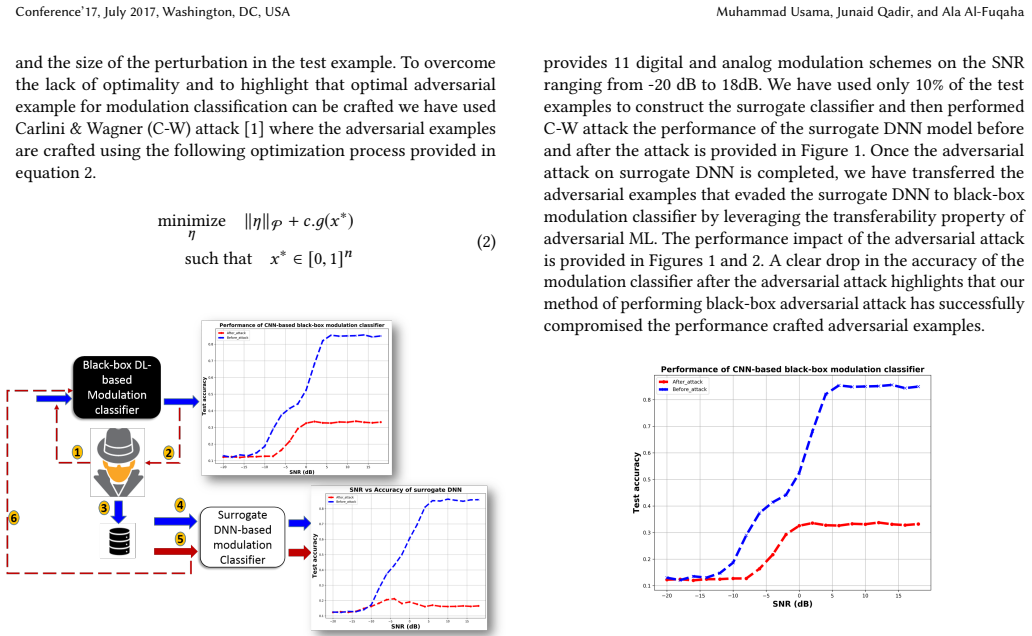
The mechanism is adversarial-example transferability together with the Carlini-Wagner optimization. The adversary first queries the black-box classifier with test inputs, records the labels, and trains a surrogate fully-connected DNN on about 10% of the test set. Adversarial perturbations are then computed against the surrogate by minimizing $\|\eta\|_p + c \cdot g(x^*)$ subject to the box constraint $x^* \in [0,1]^n$, where $g(x^*)$ encodes the goal of wrong classification. The resulting examples, already misclassified by the surrogate, are replayed against the CNN and LSTM targets, relying on the property that adversarial examples often transfer across models. The dataset is the GNU Radio RML2016.10a collection of 11 analog and digital modulation schemes over SNR from -20 to 18 dB.
What would settle it
Train a CNN and an LSTM modulation classifier on RML2016.10a; build a fresh surrogate, craft C-W adversarial examples against it, then replay them on the victims across the full SNR range. If the average accuracy drop is far below 60% or statistically insignificant for either architecture, the transferability assumption behind the black-box attack fails.
Extended reading notes
Core claim
The central claim is that adversarial examples transfer across deep-learning architectures in the radio-signal domain: perturbations crafted to fool a fully connected surrogate DNN also fool CNN and LSTM modulation classifiers treated as black boxes. The paper reports that after the transfer, both the CNN and LSTM classifiers suffer a 60% drop in classification performance, demonstrating that C-W attacks, previously studied mostly in computer vision, are effective against wireless signal classifiers. The authors present this as the first black-box Carlini-Wagner evaluation of such modulation classifiers.
Load-bearing premise
The whole attack depends on the assumption that an input designed to fool a locally trained stand-in model will also fool a different, unseen target model; if that transfer does not happen, the reported performance drop would not occur.
Editorial extensions
If this is right
- If the transferability result holds, an attacker needs only query access and a small surrogate to significantly degrade CNN- and LSTM-based modulation classifiers.
- Deployed cognitive radios that rely on deep-learning modulation recognition would face a realistic black-box attack threat, not just a white-box theoretical one.
- The 60% accuracy drop indicates that defenses such as adversarial training, input perturbation detection, or confidence-based rejection should be incorporated into RF deep-learning systems.
- Because the surrogate used only 10% of the test examples, the attack appears inexpensive to mount, strengthening the case that robustness evaluation should become standard for wireless ML.
Reading between the lines
- The attack may extend to other radio-signal classifiers, such as emitter identification or spectrum sensing, if transferability is a general property of RF deep-learning models; this is an extrapolation, not demonstrated in the paper.
- An over-the-air version would probably face additional distortions such as channel fading, noise, and receiver impairments, so the laboratory 60% drop is an upper bound unless the perturbations are physically robust.
- A testable extension is to vary the surrogate architecture, dataset split, and SNR to map precisely when transferability breaks down, which would reveal whether the vulnerability is universal or depends on model similarity.
- Defenders could exploit the query phase: since the adversary collects query-response pairs, monitoring for repeated query patterns may allow detection of this specific attack.
Signed reviews
Editorial analysis
A structured set of objections, weighed in public.
Referee Report
Summary. The paper proposes a black-box adversarial attack against deep learning based modulation classifiers. The authors use the RML2016.10a dataset, train a fully-connected surrogate DNN on 10% of the target model's test queries, craft adversarial examples against the surrogate using the Carlini-Wagner (C-W) attack, and then transfer those examples to CNN and LSTM based target classifiers, invoking the transferability property of adversarial examples. The paper claims a 60% performance drop on both target architectures and concludes that state-of-the-art deep learning modulation classifiers are not robust to adversarial attacks. The manuscript is presented as a short ACM-format paper with three figures and a brief experimental description.
Significance. If the central claim is substantiated, the paper would extend adversarial machine learning research to modulation classification in a black-box transfer setting, going beyond prior FGSM-based attacks with a stronger C-W attack. The step-by-step attack procedure is a reasonable template for future work, and the use of a standard public dataset (RML2016.10a) is a strength. However, the current evidence is far too thin: there are no reported baseline accuracies, no SNR-resolved accuracy curves, no error bars, no attack hyperparameters, and no measurement of the transfer rate between the surrogate and the target models. The significance of the paper is therefore conditional on substantially improved experimental reporting and validation.
major comments (5)
- [Section 3, step 6] The black-box attack relies entirely on the transferability of adversarial examples from the surrogate DNN to the CNN and LSTM target classifiers, yet the paper reports no measurement of the transfer rate. The manuscript states that adversarial examples compromising the surrogate 'are then transferred to black-box DL-based modulation classifier which according to the transferability property... will compromise the performance,' but no experiment verifies that a sufficient fraction of surrogate-fooling examples actually fool the targets. Without reporting the target clean accuracy and the target accuracy on the exact adversarial set that fools the surrogate, the claimed 60% drop cannot be attributed to the described black-box transfer mechanism.
- [Section 3, Figures 1 and 2] The results are presented through Figures 1 and 2 (and Figure 3 for LSTM), but the manuscript contains only figure captions and no actual plots. The reader cannot verify the claimed 60% performance drop, check SNR-dependent behavior, or see the pre-attack baseline accuracy. Additionally, Figure 1 is referenced both as a diagram of the attack procedure and as a performance plot, which is confusing. The authors must include the actual figures with clear axes, SNR ranges, and baseline curves.
- [Section 3, Eq. (2)] The C-W attack formulation in Eq. (2) depends on the cost constant c, the chosen norm p, and an iterative optimization procedure, but none of these are specified in the paper. Without reporting the value of c, the norm type (e.g., L2 or L∞), the number of optimization iterations, the learning rate, and whether the attack is targeted or untargeted, the attack is not reproducible and the reported results cannot be independently assessed.
- [Section 3, paragraph 3] The surrogate DNN is described only as 'a fully connected DNN model,' with no information about the number of layers, neurons per layer, activation functions, training epochs, optimizer, or the exact split of the 10% query subset. The training procedure and the surrogate's own accuracy before the attack are essential for understanding the surrogate's quality and for interpreting the transferability results.
- [Conclusions] The conclusion states 'We have achieved a 60% performance drop in both CNN and LSTM based modulation classification,' but the body of the paper does not define the baseline against which this drop is measured. Is it the target's clean accuracy averaged over all SNRs, at a single SNR, or something else? Without this definition and without error bars or multiple runs, the headline number is not statistically meaningful.
minor comments (4)
- [Abstract] The abstract contains a grammatical subject-verb agreement error: 'the robustness of these modulation classifiers have not been evaluated' should be 'has not been evaluated.'
- [Related work] The paper does not provide a quantitative comparison with the prior FGSM-based attacks of Sadeghi et al. and Kokalj-Filipovic et al., which would help the reader understand the additional value of the C-W attack in this domain.
- [Section 1, Eq. (1)] Equation (1) is written as x* = x + arg min over η, but the optimization should be over the perturbation η that minimizes its norm subject to f(x + η) = t; the current notation is ambiguous about the objective and constraints.
- [General] The paper uses the placeholder ACM format with 'Conference'17' and a dummy DOI, which is inappropriate for a journal submission; the authors should use the journal's formatting template.
Circularity Check
No significant circularity: the black-box attack is a direct empirical transferability experiment, not a derivation that reduces to its inputs.
full rationale
The paper reports a black-box adversarial attack in which a surrogate fully connected DNN is trained on 10% of the target classifiers' test queries, adversarial examples are crafted against the surrogate with the C-W optimization (Eq. 2), and those examples are then queried against CNN and LSTM modulation classifiers. The claimed 60% performance drop is a measured change in target accuracy before and after applying the transferred examples, as shown in Figures 2 and 3. This is an empirical outcome rather than a construction: the surrogate attack success is not defined in terms of target accuracy, and the target accuracy is not fitted from the surrogate. The transferability property is invoked in Section 3 step 6 as a motivating assumption, but the experiment directly tests it; if transfer failed, the reported drop would simply not occur, making the result negative, not making the argument circular. There are no self-citations used to justify the load-bearing premise, and the external references (C&W, Goodfellow, Sadeghi, O'Shea) provide algorithms and datasets rather than an unverified uniqueness or existence theorem that forces the conclusion. The only notable weakness is that the paper does not report the per-architecture transfer rate between surrogate and target, which is a completeness or robustness concern about the empirical claim, not a circularity in the derivation.
Assumptions & free parameters
free parameters (3)
- Carlini-Wagner cost constant c =
not reported
- Carlini-Wagner optimization iterations and learning rate =
not reported
- Surrogate DNN architecture (layers, neurons, activation) =
not reported
assumptions (3)
- domain assumption The RML2016.10a dataset is a valid and representative benchmark for modulation classification.
- domain assumption Adversarial examples transfer from a surrogate DNN to a different-architecture black-box model.
- standard math The Carlini-Wagner optimization in Equation 2 yields valid minimal-perturbation adversarial examples.
Cite this review
Pith. "Pith review of Black-box Adversarial ML Attack on Modulation Classification." pith.science (2026). https://pith.science/paper/T3IANZFM
@misc{pith2026190800635,
  author       = {Pith},
  title        = {Pith review of: Black-box Adversarial ML Attack on Modulation Classification},
  year         = {2026},
  howpublished = {\url{https://pith.science/paper/T3IANZFM}},
  note         = {Machine review of arXiv:1908.00635}
}
read the original abstract
Recently, many deep neural networks (DNN) based modulation classification schemes have been proposed in the literature. We have evaluated the robustness of two famous such modulation classifiers (based on the techniques of convolutional neural networks and long short term memory) against adversarial machine learning attacks in black-box settings. We have used Carlini \& Wagner (C-W) attack for performing the adversarial attack. To the best of our knowledge, the robustness of these modulation classifiers has not been evaluated through C-W attack before. Our results clearly indicate that state-of-art deep machine learning-based modulation classifiers are not robust against adversarial attacks.
Figures

Reference graph
Works this paper leans on
-
[1]
Carlini and Wagner. 2017. Towards evaluating the robustness of neural networks. In IEEE Symposium on Security and Privacy (SP) . IEEE, 39–57
work page 2017
-
[2]
Nick Feamster and Jennifer Rexford. 2017. Why (and how) networks should run themselves. arXiv preprint arXiv:1710.11583 (2017)
arXiv 2017
-
[3]
Ian J Goodfellow, Jonathon Shlens, and Christian Szegedy. 2014. Explaining and harnessing adversarial examples. arXiv preprint arXiv:1412.6572 (2014)
arXiv 2014
-
[4]
Silvija Kokalj-Filipovic and Rob Miller. 2019. Adversarial Examples in RF Deep Learning: Detection of the Attack and its Physical Robustness. arXiv preprint arXiv:1902.06044 (2019)
work page Pith review arXiv 2019
-
[5]
Albert Mestres, Alberto Rodriguez-Natal, Josep Carner, Pere Barlet-Ros, Eduard Alarcón, Marc Solé, Victor Muntés-Mulero, David Meyer, Sharon Barkai, Mike J Hibbett, et al. 2017. Knowledge-defined networking. ACM SIGCOMM Computer Communication Review 47, 3 (2017), 2–10
work page 2017
-
[6]
Timothy J O’shea and Nathan West. 2016. Radio machine learning dataset generation with gnu radio. In Proceedings of the GNU Radio Conference , Vol. 1
work page 2016
-
[7]
Meysam Sadeghi and Erik G Larsson. 2018. Adversarial attacks on deep-learning based radio signal classification. IEEE Wireless Communications Letters 8, 1 (2018), 213–216
work page 2018
Reviewed August 14, 2026 · model on record in the stance chip above.
Discussion (0). Continue with ORCID to comment.