REVIEW 3 major objections 3 minor 14 references
Robust Deep Sensing Through Transfer Learning in Cognitive Radio
T0 review · 3 major / 3 minor · reviewed 2026-08-14 · deepseek-v4-flash
Pith's one-line read A deep-learning spectrum sensor that is pretrained on one wireless scenario and fine-tuned on a few hundred labeled samples from a new scenario reliably detects primary-user signals across changed channels and modulations.
desk verdict A sound, incremental study whose useful negative result on unsupervised domain adaptation is more robust than its positive fine-tuning claim, which rests on an unvalidated labeled-target-data premise. read the letter →
The pith
A machine-rendered reading of the paper's core claim, the machinery that carries it, and where it could break.
The reading
What carries the argument
The load-bearing object is the CNN itself, a small two-convolutional-layer, two-dense-layer network whose input is a 2×N matrix of raw in-phase and quadrature samples, treated as a learnable filter bank that substitutes for hand-designed feature extraction. The transfer mechanism is fine-tuning: take weights pretrained on a large source-domain dataset and continue gradient descent on a small labeled target-domain dataset. For the no-label case the paper uses transfer component analysis, which minimizes the maximum mean discrepancy $\mathrm{tr}(KL)$ between source and target in a reproducing kernel Hilbert space, to show why that route fails to deliver robustness.
What would settle it
One experiment that would settle the claim: in a real or over-the-air testbed, collect a few hundred labeled target samples from a changed channel and modulation, fine-tune the QPSK-pretrained network, and measure detection probability at a false-alarm rate of 0.1; if fine-tuning does not exceed the energy detector at that label budget, or if it falls below training from scratch, the robustness claim fails. A simpler synthetic falsifier is a source-target pair where fine-tuning with 100 to 300 examples underperforms training from scratch, since no such pair appears among the paper's tested combinations.
Extended reading notes
Core claim
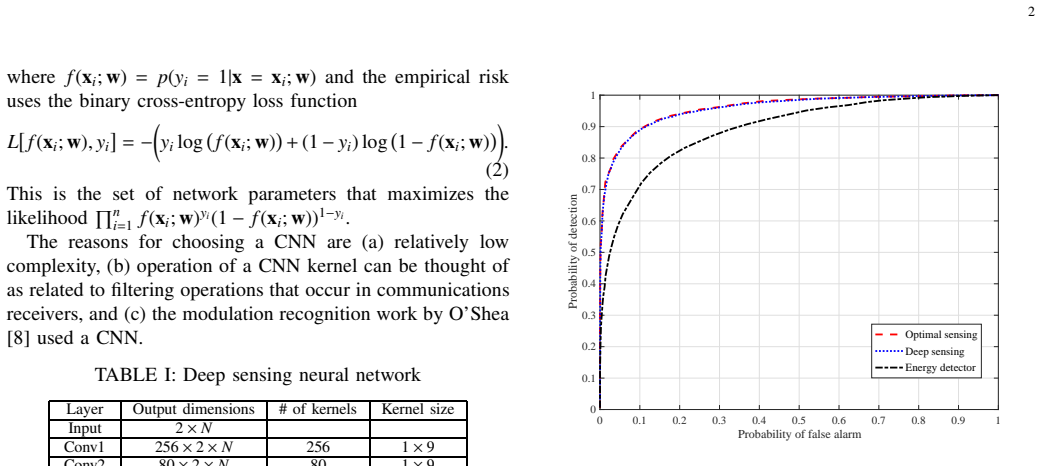
The central discovery is that robustness of deep spectrum sensing across changed wireless conditions is achievable by fine-tuning, not by unsupervised adaptation. On a same-domain Gaussian-in-AWGN task, a CNN with two convolutional layers trained on 2×$10^{4}$ raw I/Q examples performs close to the optimal log-likelihood-ratio detector and better than the energy detector. When the trained network is tested on a different domain (QPSK with Rayleigh fading, or vice versa), detection probability falls substantially; unsupervised domain adaptation based on maximum mean discrepancy does not reliably fix this. Fine-tuning the pretrained network with as few as a few hundred labeled target examples, however, yields detection probability above the energy detector and above a randomly initialized network trained on the same target data, across BPSK, QPSK, 16QAM, path-loss, and Rayleigh-fading source-target pairs considered in the paper.
Load-bearing premise
The entire positive robustness result depends on the secondary user being able to obtain a small set of correctly labeled sensing samples from the new environment, either through primary-user cooperation or another mechanism, and the paper does not demonstrate a protocol that actually supplies them.
Editorial extensions
If this is right
- A practical cognitive radio needs only a few hundred labeled sensing intervals in its actual environment to adapt a pre-trained deep sensor; after that it outperforms energy detection at a false-alarm rate of 0.1.
- The same pretrained network can be reused across multiple target domains, so the cost of collecting large same-domain training sets is paid once rather than for every scenario.
- Without a label-acquisition mechanism, robustness cannot be guaranteed: the paper's unsupervised domain-adaptation results are the explicit warning case.
- Fine-tuning dominates training from scratch in every source-target combination tested, including BPSK/QPSK and QPSK/16QAM with path loss and Rayleigh fading, so the benefit is not specific to one signal pair.
- The source-domain initialization is valuable even at zero target labels (detection probability above 0.55 versus below 0.1 for random initialization in the QPSK-to-Gaussian case), which means pretraining carries transferable structure.
Reading between the lines
- The crossover point of roughly 100 to 300 labeled examples suggests a concrete engineering target: a primary-user cooperation protocol that reserves only a few hundred sensing intervals per environment change would suffice, and this could be tested by measuring crossover as a function of SNR, window length $N$, and domain-shift magnitude.
- The paper leaves open whether noisy labels acquired through secondary-user listening (their alternative to primary-user cooperation) preserve the fine-tuning gain; a natural extension is to inject label noise into the fine-tuning set and measure how quickly the advantage over energy detection disappears.
- The architecture's convolutional kernels act like receiver filters, so one testable hypothesis implied by the results is that the first-layer filters remain largely unchanged after fine-tuning while only later layers adapt; if true, a shared radio feature extractor could be distributed as a standard pretrained block.
- The comparison baseline is energy detection; a stronger test would pit fine-tuned deep sensing against the optimal detector with estimated covariance parameters in the target domain, since the paper shows the optimal detector's advantage shrinks when its parameters are imperfect.
Signed reviews
Editorial analysis
A structured set of objections, weighed in public.
Referee Report
Summary. The paper proposes a deep-learning spectrum sensing method that feeds raw in-phase/quadrature samples into a CNN. The authors first show that a CNN trained on data from one communications scenario (e.g., narrowband Gaussian signals in AWGN) performs well in the same scenario, approaching an analytic log-likelihood-ratio detector and beating energy detection. They then demonstrate that the same network degrades when applied to a different scenario (e.g., QPSK with Rayleigh fading), and evaluate two transfer-learning remedies: unsupervised domain adaptation via transfer component analysis, and fine-tuning with a small number of labeled target-domain examples. The reported results show that unsupervised adaptation is unreliable, whereas fine-tuning outperforms both training from scratch and energy detection once roughly 100-300 labeled target examples are available; Table II extends this to BPSK, QPSK, and 16QAM with path loss and Rayleigh fading.
Significance. If the findings hold, the paper makes a useful contribution to deep learning based spectrum sensing by documenting that fine-tuning with modest amounts of labeled target data is an effective way to handle domain shift, and by honestly reporting the negative results of unsupervised domain adaptation. The comparison against an analytic optimal detector for the Gaussian/AWGN case and against energy detection in all cases provides meaningful baselines. The raw-I/Q end-to-end design is consistent with recent modulation-recognition work. The main limitation is that the positive practical claim depends on access to labeled target-domain samples, which the paper does not demonstrate; the experimental evidence is also based entirely on synthetic simulations with limited statistical reporting. These are fixable with additional analysis and uncertainty quantification.
major comments (3)
- [Section III-B (Fine-tuning with labeled data) and Fig. 2] The central positive result is conditional on the availability of a small number of labeled target-domain examples, and the paper's own experiments show that without such labels the unsupervised TCA transfer is unreliable and can remain below the energy detector. The two label-acquisition mechanisms sketched in Section III-B (PU cooperation during ON/OFF sensing intervals, and label estimation by listening across consecutive intervals) are described in one sentence each, with no throughput-loss analysis, no synchronization or mislabel model, and no experimental validation. All fine-tuning experiments in Fig. 3 and Table II use synthetic MATLAB-generated labels. The practical claim that the proposed framework is 'robust deep sensing ... in cognitive radio' therefore extends beyond what is demonstrated unless the label-acquisition condition is shown to be satisfiable in a real secondary-user deployment. The authors should either add an analysis or experiment supporting at least one label-acquisition mechanism, or explicitly revise the title/abstract/conclusion to state that the robustness result is conditional on the availability of labeled target samples.
- [Figs. 1-3 and Table II] The performance comparisons lack uncertainty quantification. Fig. 3 states that the network was trained 10 times and the results averaged, but no error bars, standard deviations, or confidence intervals are reported, and Table II reports area-under-curve values without variance or number of runs. Figs. 1 and 2 show single ROC curves with no indication of run-to-run variability. As a result, the claims that deep sensing 'outperforms energy detection' and that fine-tuning 'outperforms training from scratch' cannot be statistically assessed; the differences could be within stochastic optimization noise. Please add error bars or confidence bands for the averaged curves and include variance measures (or statistical significance tests) for the Table II comparisons.
- [Section III-A, Eq. (4), and Section II (training details)] Several experimental parameters needed for reproducibility are missing. The TCA implementation in Section III-A requires a choice of kernel, the latent dimension m, and the regularization parameter μ in Eq. (4), but none of these are reported. Similarly, the CNN training in Section II and the fine-tuning procedure in Section III-B do not specify learning rate, batch size, number of epochs, or how the fine-tuning learning rate/epoch count differs from training from scratch. Please add a reproducibility statement with these values or a reference to code.
minor comments (3)
- [Section II and Section III] The receive filter is described only as 'rectangular bandlimited' with no bandwidth or length specification, and the signal and channel models for QPSK/Rayleigh (pulse shape roll-off, path delays, Doppler, SNR distribution) are not fully specified.
- [Section III-B and Fig. 3] The threshold yielding p_fa = 0.1 is not described; it should be stated whether the threshold is chosen on a target validation set or on the training set, and how it is selected.
- [Author affiliations and figures] Several minor typographical and formatting issues appear: the author name 'Vasconcelos' is rendered with a stray space in the affiliation line, arrows such as 'QPSK → Gaussian' have inconsistent spacing, and the axis labels and legends in Figs. 1-3 should be checked for consistency.
Circularity Check
No significant circularity: the paper reports empirical comparisons against independent baselines, and its self-citations are motivational rather than load-bearing.
full rationale
The paper's central claims are empirical: a CNN trained on raw I/Q samples approximates the analytic log-likelihood-ratio detector in one scenario, mismatched training/test domains degrade performance, unsupervised domain adaptation is unreliable, and fine-tuning with a small amount of labeled target data improves detection probability relative to training from scratch and to the energy detector. None of these claims is derived from an input that already contains the conclusion. The ROC curves and probability-of-detection-versus-number-of-examples curves are computed on held-out test sets generated independently of training, and the baselines (energy detector and the optimal LLR test of Eq. (3)) are independently defined. The self-citation to [13] (B. Luo, Q. Peng, P. C. Cosman, and L. B. Milstein, 'Robustness of deep modulation recognition under AWGN and Rician fading') is used only to motivate the problem statement in Section III and is not invoked as proof of any result in this paper; the same holds for self-citation [3]. The practical concern that a secondary user must acquire labeled target data in its actual environment is an external-validity limitation explicitly acknowledged in Section III-B, not a circular step: the paper's conditional claim 'When there is a small amount of labeled target data, fine tuning is shown to be robust' is supported by experiments using simulated labeled target examples, and the paper does not disguise the label-acquisition requirement as a derived result. Since there is no equation that is equivalent to its own input, no fitted parameter renamed as a prediction, and no self-citation chain that forces the conclusion, the appropriate circularity score is 0.
Assumptions & free parameters
free parameters (3)
- CNN architecture hyperparameters =
Conv1 256 kernels, Conv2 80 kernels, Dense1 256, kernel 1x9, dropout 0.50
- Simulation domain conditions =
N=32, SNR -4 dB, Gaussian bandwidth 1/4 of filter bandwidth; QPSK RRC rolloff 0.5, 3-path Rayleigh fading, average SNR…
- Transfer component analysis hyperparameters =
not reported (kernel type, mu, number of components m)
assumptions (5)
- domain assumption Raw 2xN I/Q input preserves sufficient information for the detection task.
- domain assumption MATLAB-simulated Gaussian/AWGN and QPSK/Rayleigh signals are representative of real cognitive radio operating conditions.
- domain assumption Labeled target-domain data can be acquired in practice, for example through PU cooperation or interval listening.
- standard math The TCA/MMD formulation of [14] is a valid way to align source and target distributions.
- standard math The LLR detector of [12] is optimal for a narrowband Gaussian signal in AWGN.
Cite this review
Pith. "Pith review of Robust Deep Sensing Through Transfer Learning in Cognitive Radio." pith.science (2026). https://pith.science/paper/OFVLUYW6
@misc{pith2026190800658,
  author       = {Pith},
  title        = {Pith review of: Robust Deep Sensing Through Transfer Learning in Cognitive Radio},
  year         = {2026},
  howpublished = {\url{https://pith.science/paper/OFVLUYW6}},
  note         = {Machine review of arXiv:1908.00658}
}
read the original abstract
We propose a robust spectrum sensing framework based on deep learning. The received signals at the secondary user's receiver are filtered, sampled and then directly fed into a convolutional neural network. Although this deep sensing is effective when operating in the same scenario as the collected training data, the sensing performance is degraded when it is applied in a different scenario with different wireless signals and propagation. We incorporate transfer learning into the framework to improve the robustness. Results validate the effectiveness as well as the robustness of the proposed deep spectrum sensing framework.
Figures


Reference graph
Works this paper leans on
-
[7]
Deep Sensing: Cooperative Spectrum Sensing Based on Convolutional Neural Networks
W. Lee, M. Kim, D. Cho, and R. Schober, “Deep sensing: coop - erative spectrum sensing based on convolutional neural net works,” arXiv:1705.08164
-
[8]
Over-the-air deep learning based radio signal classification,
T. J. O’Shea, T. Roy, and T. C. Clancy, “Over-the-air deep learning based radio signal classification,” IEEE Journal on Selected Topics in Signal Processing, vol. 12, no. 1, Feb. 2018
work page 2018
-
[3]
Y . Li and Q. Peng, “Achieving secure spectrum sensing in p resence of malicious attacks utilizing unsupervised machine learn ing,” IEEE MILCOM, Baltimore, USA, Nov. 1-3, 2016
work page 2016
-
[13]
Robustn ess of deep modulation recognition under AWGN and Rician fading,
B Luo, Q. Peng, P . C. Cosman, and L. B. Milstein, “Robustn ess of deep modulation recognition under AWGN and Rician fading,” Asilomar Conference on Signals, Systems, and Computers , October, 2018
work page 2018
-
[14]
Domain ada ptation via transfer component analysis,
S. J. Pan, I. W. Tsang, J. T. Kwok, and Q. Y ang, “Domain ada ptation via transfer component analysis,” IEEE Trans. on Neural Networks , vol. 22, no. 2, pp. 199-210, Feb. 2011
work page 2011
-
[1]
A review on sp ectrum sensing for cognitive radio: challenges and solutions,
Y . Zeng, Y . Liang, A. T. Hoang, and R. Zhang, “A review on sp ectrum sensing for cognitive radio: challenges and solutions,” EURASIP Journal on Advances in Signal Processing , doi:10.1155 /2010/381465
work page 2010
-
[2]
Implementatio n issues in spectrum sensing for cognitive radios,
D. Cabric, S. M. Mishra, R. W. Brodersen, “Implementatio n issues in spectrum sensing for cognitive radios,” the 38th Asilomar Conference on Signals, Systems and Computers , Nov. 7-10, 2004
work page 2004
-
[4]
End to End Learning for Sel f-Driving Cars,
M. Bojarski, D. Testa, et al., “End to End Learning for Sel f-Driving Cars,” CoRR abs/1604.07316, 2016
arXiv 2016
Show all 14 references
-
[5]
Towards End-To-End Speech Reco gnition with Recurrent Neural Networks,
A. Graves and N. Jaitly, “Towards End-To-End Speech Reco gnition with Recurrent Neural Networks,” in Proceedings of the 31st International Conference on Machine Learning , 2014. 0 500 1000 1500 2000 2500 3000 Number of training examples 0 0.1 0.2 0.3 0.4 0.5 0.6 0.7 0.8 0.9Pro...
2014
-
[6]
Google’s Neural Machine Translation Syste m: Bridging the Gap between Human and Machine Translation,
Y . Wu et al., “Google’s Neural Machine Translation Syste m: Bridging the Gap between Human and Machine Translation,” CoRR abs/1609.08144, 2016
2016 arXiv
-
[9]
Generative adversari al learning for spectrum sensing,
K. Davaslioglu and Y . E. Sagduyu, “Generative adversari al learning for spectrum sensing,” IEEE International Conference on Communications , Kansas City, MO, USA, May 20-24, 2018
2018
-
[10]
Deep learning for la unching and mitigating wireless jamming attacks,
T. Erpek, Y . E. Sagduyu, and Y . Shi, “Deep learning for la unching and mitigating wireless jamming attacks,” IEEE Trans. on Cognitive Communications and Networking , vol. 5, no. 1, pp. 2-14, Mar. 2019
2019
-
[11]
Decaf: A deep convolutional activation featur e for generic visual recognition,
J. Donahue, Y . Jia, O. Vinyals, J. Ho ffman, N. Zhang, E. Tzeng, and T. Darrell, “Decaf: A deep convolutional activation featur e for generic visual recognition,” in Proceedings of the 31st International Conference on Machine Learning , 2014
2014
-
[12]
T. A. Schonho ffand A. A. Giordano, Detection and Estimation Theory and Its Applications , Prentice Hall, 2006
2006
Reviewed August 14, 2026 · model on record in the stance chip above.
Discussion (0). Continue with ORCID to comment.