REVIEW 4 major objections 5 minor 14 references
Efficiency Fairness Tradeoff in Battery Sharing
T0 review · 4 major / 5 minor · reviewed 2026-08-14 · deepseek-v4-flash
Pith's one-line read Fairness in a shared battery imposes an efficiency floor that battery capacity cannot remove.
desk verdict Theorem 3.1's fairness lower bound is correct and clean; the rest of the paper is promising but has real proof gaps in the exponential-rate and price-of-fairness constructions. read the letter →
The pith
A machine-rendered reading of the paper's core claim, the machinery that carries it, and where it could break.
The reading
What carries the argument
The load-bearing device is an accounting inequality for each user: writing $LLR_i$ as the long-run average of unmet demand and using the facts that accepted energy never exceeds surplus when generation is positive and that the fairness constraint forces the average accepted energy to be nonnegative, one obtains $LLR_i \ge -\Delta_i$. Summing this over the net-demanding users gives the battery-size-independent lower bound of Theorem 3.1. The complementary exponential-decay results are carried by a large-deviations analysis of a single user with positive drift, which identifies the battery with a finite-buffer Markov-modulated queue in a reversed system; the decay rate $\lambda_i$ is the negative logarithmic rate of the stationary probability of an empty buffer. The price-of-fairness and max-min-fairness results then use the equivalence of constrained Markov decision processes to linear programs over occupation measures.
What would settle it
Run a simulation of a shared battery with two users whose net generation is a two-state Markov chain, one with negative drift and one with positive drift so that the total drift is positive; compute the optimal fairness-constrained loss of load rate for growing battery size. If the curve does not remain bounded above zero, or if it decays to zero while the long-run average fairness constraints are satisfied, Theorem 3.1 is refuted.
Extended reading notes
Core claim
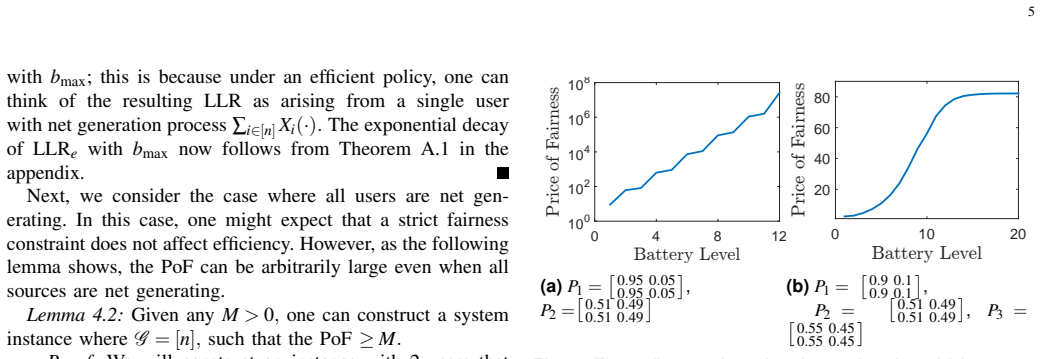
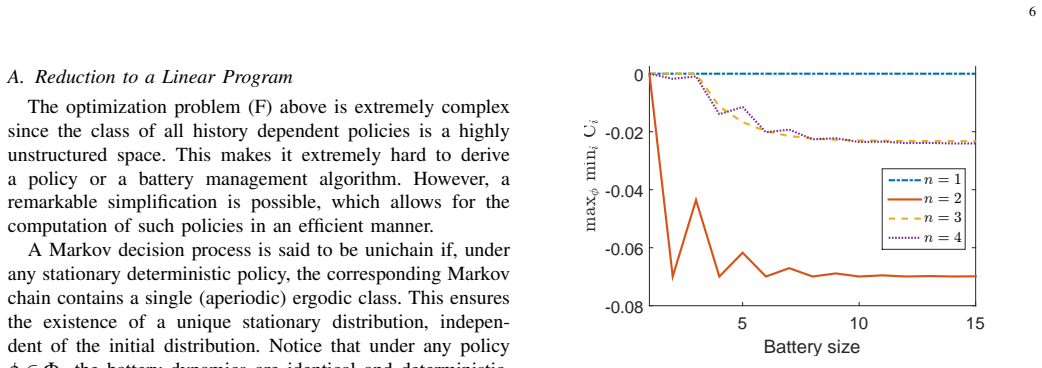
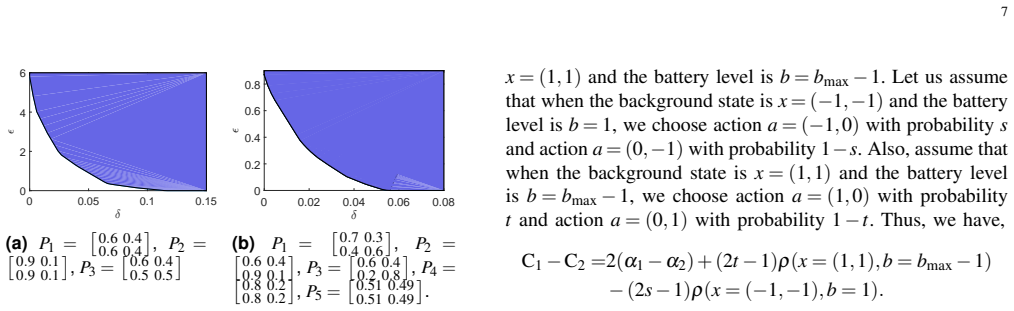
The central discovery is that fairness and efficiency in a shared battery are in fundamental conflict, and the conflict is not cured by adding battery capacity. Theorem 3.1 shows that if $D$ is the set of users with negative steady-state drift, every fair policy has $LLR_{\mathrm{sys}} \ge \sum_{i\in D}(-\Delta_i)$; in particular, whenever $D$ is nonempty the total loss of load rate is positive for every battery size, even when the whole system has positive average surplus. In the opposite regime, if all users have positive drift, the optimal fair loss of load rate decays exponentially with battery size, so fairness is asymptotically costless. The price of fairness, defined as the ratio of the optimal fair loss of load rate to the unconstrained optimal loss of load rate, therefore grows without bound with battery size if at least one user is net-demanding but the system is net-generative, and can be made arbitrarily large even when all users are net-generative. Finally, among exactly efficient policies, fairness is limited: the max-min value of users' net contributions is independent of battery size in a two-user model, and numerical frontiers show the fairness-efficiency tradeoff persists as battery size grows.
Load-bearing premise
The fairness constraint is only an average over time, so users may overdraw for long intervals as long as they eventually repay; all the lower bounds depend on this averaged fairness rule, and a stricter instantaneous rule could change or void them.
Editorial extensions
If this is right
- If any user is a net demander, no fair scheduling policy can drive the total loss of load rate below the sum of the net-demanding users' average deficits, so efficiency improvements from larger batteries hit a hard floor.
- When every user is a net generator, fairness does not prevent the optimal loss of load rate from decaying exponentially with battery size, so the fairness-efficiency gap disappears asymptotically in that regime.
- The price of fairness grows without bound as battery size grows in systems with a net-demanding user and positive system drift, and can be made arbitrarily large even when all users are net generators.
- Under any efficient policy the battery occupancy process and its stationary distribution are fixed; only the allocation of energy among users changes, so efficiency fixes the total flow and fairness only splits it among users.
- In the two-user symmetric example with $\alpha_1 > \alpha_2$, the max-min fairness value under efficient policies equals $\alpha_2 - \alpha_1$ for all even battery sizes, showing that larger batteries do not restore fairness.
Reading between the lines
- A stricter fairness rule that prevents overdrafts at every time step would shrink the feasible policy set; the paper's lower bounds, which rely on the long-run average form of the fairness constraint, would not automatically apply.
- The lower bound in Theorem 3.1 acts like a conservation law: fair operation forces the shared battery to carry each net-demanding user's average deficit, so the same bound should extend to settings with multiple batteries or battery ownership shares.
- The numerical saturation of fairness suggests that sharing contracts should price the residual unfairness rather than assume larger batteries will resolve it; a market for battery access could internalize this cost.
- One testable extension is to measure the fairness-efficiency frontier on real consumption data: if users' net generation is Markovian and the bounds hold, the frontier should saturate at a negative max-min value as battery capacity grows.
Signed reviews
Editorial analysis
A structured set of objections, weighed in public.
Referee Report
Summary. The paper studies the tradeoff between efficiency and fairness in the operation of a shared battery serving multiple users with Markov-modulated net generation. Efficiency is measured by the loss of load rate (LLR), and fairness is enforced by constraints (FCi) requiring each user's long-run average net contribution to the battery to be nonnegative. The main results are: (i) Theorem 3.1, a universal lower bound on the total LLR equal to the sum of negative drifts of net-demanding users, which holds for any battery size; (ii) Theorem 3.2, claiming that when all users are net generative the optimal LLR decays exponentially with battery size with a specified rate; (iii) a price-of-fairness (PoF) analysis showing that PoF can be unbounded even when all users are net generative (Lemma 4.2); and (iv) an LP-based formulation for optimizing fairness subject to hard efficiency constraints, with numerical experiments and a structural result (Proposition 5.2).
Significance. If the main claims hold, the paper makes a worthwhile contribution by quantifying a fundamental efficiency-fairness tradeoff in shared battery operation. The core lower bound (Theorem 3.1) is elegant and robust: it depends only on the long-run drift and the fairness constraint, and it implies that the presence of even one net-demanding user forces a positive efficiency loss independent of battery size. This is a clean, parameter-free result with clear practical implications. The paper also introduces a natural price-of-fairness metric and a tractable CMDP/LP formulation. However, several secondary results (the exact exponential rate in Theorem 3.2, the unbounded-PoF construction in Lemma 4.2) rest on proofs that are incomplete or only sketched, so the full set of claimed fundamental limits is not yet rigorously established.
major comments (4)
- [Section III-B, Theorem 3.2] The proof of Theorem 3.2 establishes only an upper bound on the optimal LLR by analyzing a particular chunking policy, showing that limsup_{bmax→∞} log(LLR^o)/bmax ≤ -c1 for some c1>0. The claim that the limit equals -c requires a matching lower bound showing that no feasible policy can achieve a faster decay. Without this, the existence of the limit and its exact value are not established; the result should be stated as an upper bound on the decay rate unless a lower bound is supplied.
- [Section IV, Lemma 4.2] The proof of Lemma 4.2 is explicitly a sketch and omits key justifications. The assertion that the sharing decay rate λe lies strictly between λ1 and λ2 is stated without proof or a supporting reference; the argument that 'the rate at which energy is accepted from user 2 is at most δ/2' is not derived from the displayed perturbed-system condition; and the notation π(s) in the condition ∑ sπ(s)I{X̃(s)<0} is ambiguous because the stationary distribution of the perturbed process should be used, not the original one. These gaps are load-bearing for the claim that PoF can be arbitrarily large even when all users are net generative.
- [Section IV, Lemma 4.2 (perturbation construction)] The perturbation X̃2(s) = X2(s) + a with a ≥ 0 is required to satisfy a condition involving a small threshold δ, where δ = LLR_{o,1}. Since the state space is assumed to have unit granularity, a must be an integer, but the required rate condition may force a to be non-integral when δ is small. The paper should either restrict to parameter regimes where an integer a works, or explicitly rescale the model to make the construction valid.
- [Appendix A] Theorem A.1 is stated for a single user's net generation process X_i(·), but Lemma 4.1 applies it to the aggregate process ∑_i X_i(t) under efficient policies. The proof in Appendix A actually only uses that the input is a functional of the Markov chain X(t), so the theorem should be stated for any functional of X with positive drift, or the application in Lemma 4.1 should be justified separately.
minor comments (5)
- [Theorem 3.1 proof] The last sentence says 'The statement of the lemma now follows' but the result is a theorem; please correct the cross-reference.
- [Section IV, Definition of PoF] The price of fairness is defined as a ratio; if LLR_e = 0 for some instance, the ratio is undefined. The paper should clarify that the definition applies to finite bmax where LLR_e > 0, which appears to be the intended setting.
- [Section V, LP formulation] In the display following equation (10), the notation P(x',b'|a,x,b) is used, but the transition probability does not depend on a through the background process X; the formula P(x'|x)I{b' = b + ∑_i a_i} is correct and could be stated more clearly.
- [General] There are several typographical issues, including 'Efficiency' in the title header, 'charactization' in the proof of Lemma 4.2, and inconsistent use of 'DTMC' vs. 'Markov chain'. These should be corrected.
- [Figure captions] Figures 1-3 have long captions with transition matrix parameters embedded; consider moving parameter descriptions to the text for readability.
Circularity Check
No significant circularity: the central bound is derived from the model primitives and the asymptotic results rest on external large-deviations theory.
full rationale
The paper's main lower bound (Theorem 3.1) is not an input renamed as a prediction. The proof starts from the definition of LLR_i (Eq. 4), uses the action constraint (3) to replace I{X_i>0}X_i by I{X_i>0}A_i, and uses the fairness constraint FC_i (Eq. 5) to lower-bound lim E[A_i] by 0. Each step is explicit and parameter-free; no fitted constant or prior result of the authors is invoked. The upper-bound and price-of-fairness claims (Theorem 3.2, Lemma 4.1, Lemma 4.2) invoke Theorem A.1, which is proved within the appendix. Theorem A.1 itself is derived from Lemma A.1 and Lemma A.2; the latter cites external standard asymptotics for finite-buffer Markov-modulated queues ([12, Section 6.5], [13]) and the reversed-system construction ([11]). These are independent, externally checkable results, not self-citations of the present authors. The only self-citation, [1], is the companion conference version and is listed in the references but is not used as a load-bearing proof step. There is no fitted-input-called-prediction pattern, no uniqueness theorem imported from the authors' prior work, and no ansatz smuggled in by citation. The paper does exhibit some secondary proof gaps -- Theorem 3.2 claims an exact exponential limit while only an upper bound on the limsup is established, and Lemma 4.2 is explicitly a sketch -- but these are correctness concerns, not circularity. Consequently there are no circular steps to report.
Assumptions & free parameters
assumptions (5)
- domain assumption Net generation processes form an irreducible, aperiodic finite-state DTMC with self-loops (Section II-B).
- domain assumption Fairness is defined as a long-run average net contribution nonnegative for each user (FCi, equation (5)).
- domain assumption Actions are constrained to not exceed demand or surplus and must respect battery capacity (equation (3)).
- standard math Unichain CMDPs admit stationary randomized optimal policies and an equivalent LP formulation (Altman [9]).
- standard math Finite-buffer Markov-modulated queues have logarithmic asymptotics for the overflow probability (Ganesh et al. [12], Toomey [13]).
Cite this review
Pith. "Pith review of Efficiency Fairness Tradeoff in Battery Sharing." pith.science (2026). https://pith.science/paper/Z5DMRDGH
@misc{pith2026190800699,
  author       = {Pith},
  title        = {Pith review of: Efficiency Fairness Tradeoff in Battery Sharing},
  year         = {2026},
  howpublished = {\url{https://pith.science/paper/Z5DMRDGH}},
  note         = {Machine review of arXiv:1908.00699}
}
read the original abstract
The increasing presence of decentralized renewable generation in the power grid has motivated consumers to install batteries to save excess energy for future use. The high price of energy storage calls for a shared storage system, but careful battery management is required so that the battery is operated in a manner that is fair to all and as efficiently as possible. In this paper, we study the tradeoffs between efficiency and fairness in operating a shared battery. We develop a framework based on constrained Markov decision processes to study both regimes, namely, optimizing efficiency under a hard fairness constraint and optimizing fairness under hard efficiency constraint. Our results show that there are fundamental limits to efficiency under fairness and vice-versa, and, in general, the two cannot be achieved simultaneously. We characterize these fundamental limits via absolute bounds on these quantities, and via the notion of price of fairness that we introduce in this paper.
Figures
Reference graph
Works this paper leans on
-
[1]
Efficiency fairness tradeoff in battery sharing,
K. N. Chadha, A. A. Kulkarni, and J. Nair, “Efficiency fairness tradeoff in battery sharing,” in Decision and Control (CDC), 2019 IEEE 58nd Annual Conference on . IEEE, 2019, p. pages
work page 2019
-
[2]
The sharing economy for the electricity storage,
D. Kalathil, C. Wu, K. Poolla, and P. Varaiya, “The sharing economy for the electricity storage,” IEEE Transactions on Smart Grid, vol. 10, no. 1, pp. 556–567, jan 2019. [Online]. Available: https://doi.org/10.1109/tsg.2017.2748519
-
[3]
Sharing storage in a smart grid: A coalitional game approach,
P. Chakraborty, E. Baeyens, K. Poolla, P. P. Khargonekar, and P. Varaiya, “Sharing storage in a smart grid: A coalitional game approach,” IEEE Transactions on Smart Grid , pp. 1–1, 2018. [Online]. Available: https://doi.org/10.1109/tsg.2018.2858206
arXiv 2018
-
[4]
C. Wu, J. Porter, and K. Poolla, “Community storage for firming,” in 2016 IEEE International Conference on Smart Grid Communications (SmartGridComm). IEEE, nov 2016. [Online]. Available: https: //doi.org/10.1109/smartgridcomm.2016.7778822
-
[5]
Managing wind-based electricity generation in the presence of storage and transmission capacity,
Y . H. Zhou, A. Scheller-Wolf, N. Secomandi, and S. Smith, “Managing wind-based electricity generation in the presence of storage and transmission capacity,” Production and Operations Management , nov
-
[6]
Vector-tensor supermultiplets in AdS and supergravity
J. H. Kim and W. B. Powell, “Optimal energy commitments with storage and intermittent supply,” Operations Research, vol. 59, no. 6, pp. 1347–1360, dec 2011. [Online]. Available: https://doi.org/10.1287/ opre.1110.0971
work page Pith review arXiv 2011
-
[7]
Operation and sizing of energy storage for wind power plants in a market system,
M. Korpaas, A. T. Holen, and R. Hildrum, “Operation and sizing of energy storage for wind power plants in a market system,” International Journal of Electrical Power & Energy Systems , vol. 25, no. 8, pp. 599–606, oct 2003. [Online]. Available: https://doi.org/10.1016/s0142-0615(03)00016-4
-
[8]
Optimal control of end-user energy storage,
P. M. van de Ven, N. Hegde, L. Massouli, and T. Salonidis, “Optimal control of end-user energy storage,” IEEE Transactions on Smart Grid , vol. 4, 03 2012
work page 2012
Show all 14 references
-
[9]
Altman, Constrained Markov Decision Processes , 1999
E. Altman, Constrained Markov Decision Processes , 1999
1999
-
[10]
M. L. Puterman, Markov decision processes: discrete stochastic dynamic programming. John Wiley & Sons, 2014
2014
-
[11]
Stochastic theory of a fluid model of producers and consumers coupled by a buffer,
D. Mitra, “Stochastic theory of a fluid model of producers and consumers coupled by a buffer,” Advances in Applied Probability , vol. 20, no. 3, pp. 646–676, 1988
1988
-
[12]
A. J. Ganesh, N. O’Connell, and D. J. Wischik, Big queues. Springer, 2004
2004
-
[13]
Bursty traffic and finite capacity queues,
F. Toomey, “Bursty traffic and finite capacity queues,” Annals of Oper- ations Research, vol. 79, pp. 45–62, 1998. Karan N. Chadha Karan is a dual degree student of Electrical Engineering at Indian Institute of Technol- ogy Bombay (IITB). His research interests include applied p...
2007
-
[2018]
Available: https://doi.org/10.1111/poms.12946
[Online]. Available: https://doi.org/10.1111/poms.12946
Reviewed August 14, 2026 · model on record in the stance chip above.
Discussion (0). Continue with ORCID to comment.