REVIEW 5 major objections 6 minor 1 cited by
Greedy AutoAugment
T0 review · 5 major / 6 minor · reviewed 2026-08-14 · deepseek-v4-flash
Pith's one-line read A greedy, linear-cost search over image augmentations finds better policies than AutoAugment at 1/360th the compute.
desk verdict A sensible greedy simplification of AutoAugment with plausible but overstated accuracy and compute claims; the 5-epoch child training proxy is the key untested assumption. read the letter →
The pith
A machine-rendered reading of the paper's core claim, the machinery that carries it, and where it could break.
The reading
What carries the argument
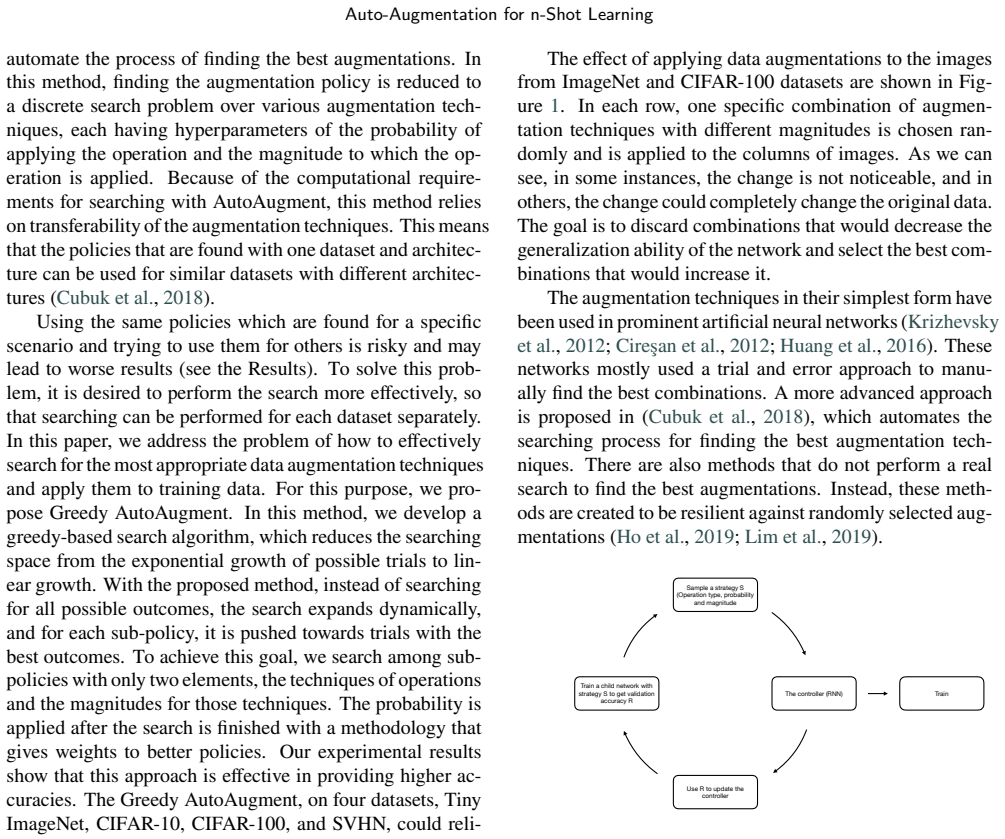
The engine is Algorithm 1, a greedy breadth-first search over (technique, magnitude) pairs with probability set to 1. At each layer, the best previous policy is extended by every operation and magnitude, and each candidate is scored by the validation accuracy of a child network trained for only 5 epochs. After $k$ layers, the $d$ best policies are selected, and their application probabilities are assigned post hoc using a Pareto distribution $v_i = (1/i)^\alpha$, giving higher weight to better-scoring policies and to the original data. This reduces the search space from $(t_n \times p_n \times m_n)^l$ to $k \times (t_n \times m_n)$.
What would settle it
Run the greedy search but train each child network for the full 200 epochs and compare the selected policies with those from 5-epoch scoring; if the rankings do not match on a held-out set, the reported gains come from the Pareto weighting rather than from the greedy search itself.
Extended reading notes
Core claim
The central claim is that a simple greedy search over augmentation operations and magnitudes, with probability ignored during search and applied afterward via a Pareto-weighted distribution, finds better augmentation policies than policies transferred from AutoAugment's separate search, at a fraction of the cost. Specifically, the search evaluates only 1000 child networks trained for 5 epochs each, versus AutoAugment's 15000 child networks trained for 120 epochs, a 360-fold reduction. Against transferred AutoAugment policies, Greedy AutoAugment improves accuracy on 9 of 11 networks on Tiny ImageNet, 9 of 11 on CIFAR-10, 9 of 11 on CIFAR-100, and 10 of 11 on SVHN, while manual augmentation also outperforms transferred AutoAugment on several datasets.
Load-bearing premise
The selection of policies rests on the assumption that the validation accuracy of a child network after only 5 epochs ranks augmentation policies in the same order as the full 200-epoch training.
Editorial extensions
If this is right
- Augmentation policy search becomes cheap enough to run per dataset, removing the need to transfer policies across datasets.
- The search cost grows linearly in the number of augmentation layers instead of exponentially, so deeper policies become accessible.
- Transferred AutoAugment policies are not universally beneficial: on Tiny ImageNet they hurt all tested networks, while per-dataset greedy search helps most.
- The Pareto weighting lets a single search pass output multiple candidate policies with a principled probability assignment.
Reading between the lines
- If five-epoch rankings are stable across training lengths, the same greedy scheme could be extended to longer policy chains or larger operation sets at modest cost.
- The Pareto weighting parameter $\alpha = 2$ is chosen without an ablation study; future work could test whether other values trade off exploration of weaker policies differently.
- Because the search relies on validation accuracy after 5 epochs, part of the reported gain could come from the Pareto weighting rather than the greedy selection; an ablation with random policy prefixes would isolate the search's contribution.
- The operation set and scoring procedure could carry over to other vision tasks such as object detection or segmentation, where augmentation policies are still hand-designed.
Signed reviews
Editorial analysis
A structured set of objections, weighed in public.
Referee Report
Summary. The paper proposes Greedy AutoAugment, a data-augmentation policy search algorithm that replaces the RNN controller of AutoAugment with a greedy breadth-first search over augmentation operations. During the search the application probability is fixed to one, and after the search a Pareto-weighted random selection scheme (Eq. 2) sets the probabilities for the d selected policies. The authors report experiments on Tiny ImageNet, CIFAR-10, CIFAR-100, and SVHN with eleven network architectures, claiming that Greedy AutoAugment improves classification accuracy while using 360 times fewer computational resources than AutoAugment. The central claims are the accuracy improvement and the compute-reduction factor of 360.
Significance. If the central claims are correct, the paper provides a useful and conceptually simple baseline for data-augmentation policy search: fixing probabilities during search and deferring them to a post-hoc weighting step is a sensible way to reduce the search cost, and the use of a greedy expansion is a reasonable alternative to reinforcement-learning controllers. The paper tests on a broad range of architectures and four datasets, and it builds on public implementations of the augmentation operations. However, the strength of the evidence is currently insufficient. The AutoAugment baseline is not re-searched under matched conditions, no uncertainty quantification or significance testing is reported, the five-epoch child-network scores that drive the greedy search are not validated against final 200-epoch accuracies, and the compute-reduction claim rests on unverified assumptions about child-network cost. The conceptual contribution is real, but the experimental validation needs substantial additional work before the headline claims can be accepted.
major comments (5)
- [Section 5.2, Algorithm 1] The greedy selection in Algorithm 1 is driven entirely by validation scores from child networks trained for only five epochs, as stated in Section 5.2, but the final evaluation is after 200 epochs. The manuscript provides no evidence that the ranking of candidate policies at five epochs predicts the ranking after full training, and no variance or seed-dependence analysis of the five-epoch scores is reported. Because lines 9 and 22 keep only the single best-scoring prefix at each depth, any noise in the five-epoch evaluation permanently discards all unselected branches; if these scores are dominated by optimization noise, the selected sub-policies are effectively arbitrary and the later Pareto weighting in Eq. (2), rather than the greedy search, would be the source of any accuracy gains. This is the load-bearing assumption behind the central accuracy claim and needs to be tested, for example by correlating five-epoch and 200-epoch rankings on a subset of candidates.
- [Section 5.1 and Section 5.2] The comparison against AutoAugment is not a controlled comparison of the two search algorithms. For CIFAR-10, CIFAR-100, and SVHN the authors apply the published AutoAugment policies, and for Tiny ImageNet they apply the ImageNet policy, so AutoAugment is never re-searched under the same conditions (same child networks, same epochs, same data splits). The claim in Section 5 that this is fair because AutoAugment policies are transferable is an assumption, and the Tiny ImageNet results in Table 2 actually show that the transferred ImageNet policy hurts accuracy, which undermines that assumption. The 360x compute reduction in Section 5.2 is computed as (15000*120)/(1000*5) under the explicit assumption that child networks are interchangeable, but no wall-clock or GPU-hour measurements are reported; moreover, if a separate Greedy AutoAugment search is run for each of the eleven architectures, the 1000-trial figure would need to be multiplied by eleven, changing the claimed factor.
- [Table 2, Section 5.1] The accuracy results are reported as averages over five trials without standard deviations, confidence intervals, or significance tests. The headline aggregate figures such as '78.34% higher accuracy' and '25.60% higher accuracy' are sums of percentage-point differences across eleven networks, which is not a well-defined performance metric because it treats a large gain on one network and a small loss on another as equivalent. The authors should report per-network uncertainty and test whether the differences between Greedy AutoAugment and the two baselines are statistically significant.
- [Section 4, Eq. (2)] The Pareto weighting scheme introduces free parameters alpha=2, d=25, and epsilon=5, and these values are stated without any sensitivity analysis. The final accuracy is the result of the entire pipeline, so the authors should show that the reported gains are stable with respect to reasonable variations of these parameters; otherwise the improvement over the manual baseline could be an artifact of a particular post-hoc selection rule rather than of the greedy search.
- [Section 3, Eq. (1), Table 3] The claimed reduction from exponential to linear search space is not clearly demonstrated. Eq. (1) is typeset as an unclear summation, and the GAutoAugment column of Table 3 lists 200, 4200, 8200, 12200 trials for l=1..4 without explaining the formula from which these numbers follow; the text in Section 5.2 says 'the number of possible trials is only 4000,' which does not match any single row. The 360x claim relies on this accounting, so the authors need to state precisely how the trial counts are derived and whether they include the cost of separate searches for each dataset and each architecture.
minor comments (6)
- [Abstract and Introduction] There are multiple typos, for example 'artifitial' in the abstract and 'the the arxiv version' in the footnote on page 1.
- [Table 2] The GAutoAugment columns are labeled 'Cifar10 Cifar10 SVHN' instead of 'Cifar10 Cifar100 SVHN'; the corresponding values appear to be CIFAR-100 results, so the header should be corrected.
- [Table 1] Table 1 contains several misspellings: 'Filliping' for both FlipLR and FlipUD, 'Redicing' for Posterize, and 'Sheering' for ShearX and ShearY.
- [Running head] The running head on pages 2-8 reads 'Auto-Augmentation for n-Shot Learning,' which does not match the paper's title, 'Greedy AutoAugment.'
- [Section 5.1] Phrases such as 'AutoAugment reduced the accuracy with 52.73%' and 'the proposed method provided 78.34% higher accuracy' should be phrased as sums of percentage-point differences or as per-network results, since the current wording implies a relative accuracy change that is not what is computed.
- [Algorithm 1 and Section 5] The relationship between the search split (Xtr, Xte) and the final training is under-specified: the text does not state whether the final training uses the full original training set or only the Xtr portion after the Xte split used for scoring.
Circularity Check
No significant circularity: the search is empirically evaluated on held-out test data, and the self-citation is non-load-bearing.
full rationale
The paper's derivation chain is an empirical search-and-evaluate procedure rather than a symbolic derivation, so the named circularity patterns do not apply. Algorithm 1 scores candidate augmentation policies by training child networks for only 5 epochs on a validation split of the training data (Section 5.2: 'The number of epochs used for our child networks was only5 epochs'), while the final accuracy results in Table 2 come from retraining on the training data and testing on the external test sets of Tiny ImageNet, CIFAR-10, CIFAR-100, and SVHN. The reported outcome is therefore not the same quantity used to guide the search. The 360x computational saving is arithmetic over declared trial and epoch counts, (15000 x 120) / (1000 x 5) = 360, not a fitted parameter renamed as a prediction. The only self-citation, Naghizadeh et al. (2020a), merely identifies the published version of this same paper and is not load-bearing. The concern that 5-epoch child-network rankings may not predict 200-epoch final rankings is a validity and noise risk, not circularity, and does not make the held-out accuracy results equivalent to the search inputs by construction.
Assumptions & free parameters
free parameters (5)
- k (number of greedy iterations) =
5
- alpha (Pareto distribution exponent) =
2
- d (number of selected policies) =
25
- epsilon (policies per probability set) =
5
- child network training epochs =
5
assumptions (3)
- ad hoc to paper Greedy prefix optimality: the augmentation policy that performs best after a given number of concatenated operations remains the best prefix when more operations are appended.
- domain assumption 5-epoch child-network validation accuracy is a reliable proxy for final policy quality.
- domain assumption AutoAugment policies are transferable to the smaller networks and shorter training used in this paper, making the comparison fair.
Cite this review
Pith. "Pith review of Greedy AutoAugment." pith.science (2026). https://pith.science/paper/BSXK3PHU
@misc{pith2026190800704,
  author       = {Pith},
  title        = {Pith review of: Greedy AutoAugment},
  year         = {2026},
  howpublished = {\url{https://pith.science/paper/BSXK3PHU}},
  note         = {Machine review of arXiv:1908.00704}
}
read the original abstract
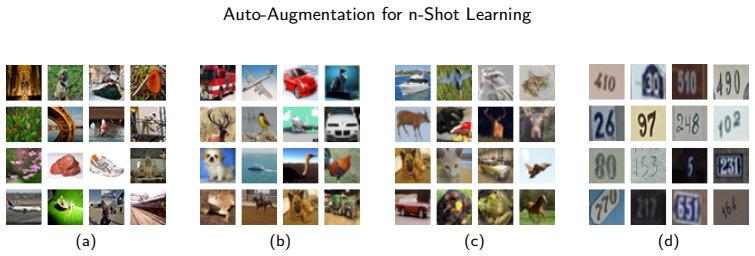
A major problem in data augmentation is to ensure that the generated new samples cover the search space. This is a challenging problem and requires exploration for data augmentation policies to ensure their effectiveness in covering the search space. In this paper, we propose Greedy AutoAugment as a highly efficient search algorithm to find the best augmentation policies. We use a greedy approach to reduce the exponential growth of the number of possible trials to linear growth. The Greedy Search also helps us to lead the search towards the sub-policies with better results, which eventually helps to increase the accuracy. The proposed method can be used as a reliable addition to the current artifitial neural networks. Our experiments on four datasets (Tiny ImageNet, CIFAR-10, CIFAR-100, and SVHN) show that Greedy AutoAugment provides better accuracy, while using 360 times fewer computational resources.
Figures

Forward citations
Cited by 1 Pith paper
-
AutoML: A Survey of the State-of-the-Art
A survey that organizes AutoML into a four-stage pipeline and reviews neural architecture search methods, their performance, and open problems.
Reference graph
Works this paper leans on
-
[1]
O. Ronneberger, P. Fischer, and T. Brox, ``U-net: Convolutional networks for biomedical image segmentation,'' in International Conference on Medical image computing and computer-assisted intervention. 1em plus 0.5em minus 0.4em Springer, 2015, pp. 234--241
work page 2015
-
[2]
C.-C. Kuo, C.-M. Chang, K.-T. Liu, W.-K. Lin, H.-Y. Chiang, C.-W. Chung, M.-R. Ho, P.-R. Sun, R.-L. Yang, and K.-T. Chen, ``Automation of the kidney function prediction and classification through ultrasound-based kidney imaging using deep learning,'' npj Digital Medicine, vol. 2, no. 1, p. 29, 2019
work page 2019
-
[3]
X. Zhu, D. Anguelov, and D. Ramanan, ``Capturing long-tail distributions of object subcategories,'' in Proceedings of the IEEE Conference on Computer Vision and Pattern Recognition, 2014, pp. 915--922
work page 2014
-
[4]
Z. Tang, Y. Zhang, Z. Li, and H. Lu, ``Face clustering in videos with proportion prior,'' in Twenty-Fourth International Joint Conference on Artificial Intelligence, 2015
work page 2015
-
[5]
Y.-X. Wang, D. Ramanan, and M. Hebert, ``Learning to model the tail,'' in Advances in Neural Information Processing Systems, 2017, pp. 7029--7039
work page 2017
-
[6]
A. Dosovitskiy, J. T. Springenberg, M. Riedmiller, and T. Brox, ``Discriminative unsupervised feature learning with convolutional neural networks,'' in Advances in Neural Information Processing Systems 27, Z. Ghahramani, M. Welling, C. Cortes, N. D. Lawrence, and K. Q. Weinberger, Eds. 1em plus 0.5em minus 0.4em Curran Associates, Inc., 2014, pp. 766--774
work page 2014
-
[7]
T. DeVries and G. W. Taylor, ``Dataset augmentation in feature space,'' arXiv preprint arXiv:1702.05538, 2017
arXiv 2017
- [8]
Show all 39 references
-
[9]
Ozair and Y
S. Ozair and Y. Bengio, ``Deep directed generative autoencoders,'' arXiv preprint arXiv:1410.0630, 2014
2014 arXiv
-
[10]
X. Peng, Z. Tang, F. Yang, R. S. Feris, and D. Metaxas, ``Jointly optimize data augmentation and network training: Adversarial data augmentation in human pose estimation,'' in Proceedings of the IEEE Conference on Computer Vision and Pattern Recognition, 2018, pp. 2226--2234
2018
-
[11]
F. Luan, S. Paris, E. Shechtman, and K. Bala, ``Deep photo style transfer,'' in Proceedings of the IEEE Conference on Computer Vision and Pattern Recognition, 2017, pp. 4990--4998
2017
-
[12]
LeCun, B
Y. LeCun, B. E. Boser, J. S. Denker, D. Henderson, R. E. Howard, W. E. Hubbard, and L. D. Jackel, ``Handwritten digit recognition with a back-propagation network,'' in Advances in neural information processing systems, 1990, pp. 396--404
1990
-
[13]
Krizhevsky, I
A. Krizhevsky, I. Sutskever, and G. E. Hinton, ``Imagenet classification with deep convolutional neural networks,'' in Advances in neural information processing systems, 2012, pp. 1097--1105
2012
-
[14]
Szegedy, W
C. Szegedy, W. Liu, Y. Jia, P. Sermanet, S. Reed, D. Anguelov, D. Erhan, V. Vanhoucke, and A. Rabinovich, ``Going deeper with convolutions,'' in Proceedings of the IEEE conference on computer vision and pattern recognition, 2015, pp. 1--9
2015
-
[15]
K. He, X. Zhang, S. Ren, and J. Sun, ``Deep residual learning for image recognition,'' in Proceedings of the IEEE conference on computer vision and pattern recognition, 2016, pp. 770--778
2016
-
[16]
Huang, Z
G. Huang, Z. Liu, L. Van Der Maaten, and K. Q. Weinberger, ``Densely connected convolutional networks,'' in Proceedings of the IEEE conference on computer vision and pattern recognition, 2017, pp. 4700--4708
2017
-
[17]
G. E. Hinton, A. Krizhevsky, and S. D. Wang, ``Transforming auto-encoders,'' in International Conference on Artificial Neural Networks. 1em plus 0.5em minus 0.4em Springer, 2011, pp. 44--51
2011
-
[18]
G. E. Hinton, S. Sabour, and N. Frosst, ``Matrix capsules with em routing,'' 2018
2018
-
[19]
Sabour, N
S. Sabour, N. Frosst, and G. E. Hinton, ``Dynamic routing between capsules,'' in Advances in neural information processing systems, 2017, pp. 3856--3866
2017
-
[20]
LeCun, ``The mnist database of handwritten digits,'' http://yann
Y. LeCun, ``The mnist database of handwritten digits,'' http://yann. lecun. com/exdb/mnist/, 1998
1998
-
[21]
J. Deng, W. Dong, R. Socher, L.-J. Li, K. Li, and L. Fei-Fei, `` ImageNet: A Large-Scale Hierarchical Image Database ,'' in CVPR09, 2009
2009
-
[22]
DeVries and G
T. DeVries and G. W. Taylor, ``Improved regularization of convolutional neural networks with cutout,'' arXiv preprint arXiv:1708.04552, 2017
2017 arXiv
-
[23]
Cire s an, U
D. Cire s an, U. Meier, and J. Schmidhuber, ``Multi-column deep neural networks for image classification,'' arXiv preprint arXiv:1202.2745, 2012
2012 arXiv
-
[24]
Huang, Y
G. Huang, Y. Sun, Z. Liu, D. Sedra, and K. Q. Weinberger, ``Deep networks with stochastic depth,'' in European conference on computer vision. 1em plus 0.5em minus 0.4em Springer, 2016, pp. 646--661
2016
-
[25]
E. D. Cubuk, B. Zoph, D. Mane, V. Vasudevan, and Q. V. Le, ``Autoaugment: Learning augmentation policies from data,'' arXiv preprint arXiv:1805.09501, 2018
2018 arXiv
-
[26]
Clark, Hugo, A
wiredfool, A. Clark, Hugo, A. Murray, A. Karpinsky, C. Gohlke, B. Crowell, D. Schmidt, A. Houghton, S. Johnson, S. Mani, J. Ware, D. Caro, S. Kossouho, E. W. Brown, A. Lee, M. Korobov, M. Górny, E. S. Santana, N. Pieuchot, O. Tonnhofer, M. Brown, B. Pierre, J. C. Abela, L. J. ...
2016 doi
-
[27]
Inoue, ``Data augmentation by pairing samples for images classification,'' arXiv preprint arXiv:1801.02929, 2018
H. Inoue, ``Data augmentation by pairing samples for images classification,'' arXiv preprint arXiv:1801.02929, 2018
2018 arXiv
-
[28]
Zhong, L
Z. Zhong, L. Zheng, G. Kang, S. Li, and Y. Yang, ``Random erasing data augmentation,'' arXiv preprint arXiv:1708.04896, 2017
2017 arXiv
-
[29]
B. Zoph, V. Vasudevan, J. Shlens, and Q. V. Le, ``Learning transferable architectures for scalable image recognition,'' in Proceedings of the IEEE conference on computer vision and pattern recognition, 2018, pp. 8697--8710
2018
-
[30]
B. C. Arnold, Pareto Distribution. 1em plus 0.5em minus 0.4em Wiley Online Library, 2015
2015
-
[31]
S. Xie, R. Girshick, P. Doll \'a r, Z. Tu, and K. He, ``Aggregated residual transformations for deep neural networks,'' in Proceedings of the IEEE conference on computer vision and pattern recognition, 2017, pp. 1492--1500
2017
-
[32]
A. G. Howard, M. Zhu, B. Chen, D. Kalenichenko, W. Wang, T. Weyand, M. Andreetto, and H. Adam, ``Mobilenets: Efficient convolutional neural networks for mobile vision applications,'' arXiv preprint arXiv:1704.04861, 2017
2017 arXiv
-
[33]
Zhang, X
X. Zhang, X. Zhou, M. Lin, and J. Sun, ``Shufflenet: An extremely efficient convolutional neural network for mobile devices,'' in Proceedings of the IEEE Conference on Computer Vision and Pattern Recognition, 2018, pp. 6848--6856
2018
-
[34]
``Deep model infrastructures used for training gautoaugment,'' https://github.com/kuangliu/pytorch-cifar, accessed: 2019-07-26
2019
-
[35]
Le and X
Y. Le and X. Yang, ``Tiny imagenet visual recognition challenge,'' 2015
2015
-
[36]
Krizhevsky, G
A. Krizhevsky, G. Hinton et al., ``Learning multiple layers of features from tiny images,'' Citeseer, Tech. Rep., 2009
2009
-
[37]
Netzer, T
Y. Netzer, T. Wang, A. Coates, A. Bissacco, B. Wu, and A. Y. Ng, ``Reading digits in natural images with unsupervised feature learning,'' 2011
2011
-
[38]
``Training deep models on cifar-10 and cifar-100 using autoaugment,'' https://github.com/tensorflow/models/tree/master/research/autoaugment, accessed: 2019-07-26
2019
-
[39]
" id="W5M0MpCehiHzreSzNTczkc9d
11em plus .33em minus .07em 4000 4000 100 4000 4000 500 `\.=1000 = #1 \@IEEEnotcompsoconly \@IEEEcompsoconly #1 * [1] 0pt [0pt][0pt] #1 * [1] 0pt [0pt][0pt] #1 * \| ** #1 \@IEEEauthorblockNstyle \@IEEEcompsocnotconfonly \@IEEEcompsocconfonly \@IEEEauthorblockAstyle \@IEEEcomps...
2017
Reviewed August 14, 2026 · model on record in the stance chip above.
Discussion (0). Continue with ORCID to comment.