REVIEW 3 major objections 4 minor 38 references
Distilling Knowledge From a Deep Pose Regressor Network
T0 review · 3 major / 4 minor · reviewed 2026-08-14 · deepseek-v4-flash
Pith's one-line read A student network with 92.95% fewer parameters can stay close to a deep pose-regressor teacher when the imitation loss is weighted by the teacher's own training loss as a confidence score.
desk verdict Teacher-loss-weighted distillation for pose regression is a genuinely new and plausible idea; the paper needs more runs and a robustness check on the confidence normalization before I'd trust the exact numbers. read the letter →
The pith
A machine-rendered reading of the paper's core claim, the machinery that carries it, and where it could break.
The reading
What carries the argument
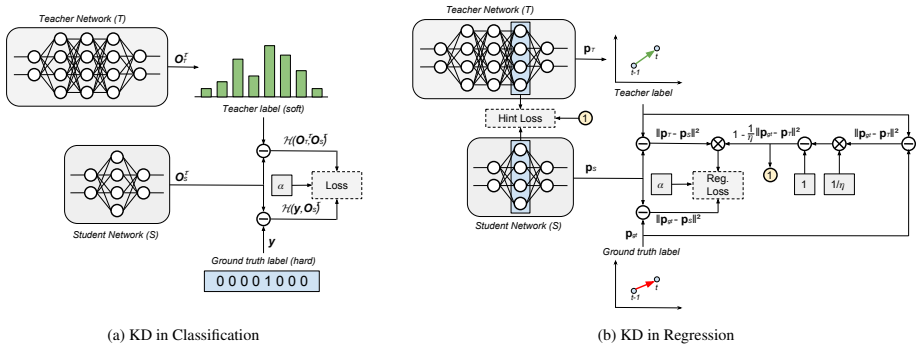
The load-bearing object is the normalized teacher loss $\Phi_i$, a scalar confidence score computed once from the teacher's errors across the whole training set. In Attentive Imitation Loss it multiplies the imitation term $\lVert p_S - p_T\rVert^2_i$ so that frames where the teacher errs are down-weighted; in Attentive Hint Training the same $\Phi_i$ multiplies the L2 distance between teacher and student intermediate representations. The two-stage training procedure first fits the student's intermediate representation with Attentive Hint Training, then trains the remaining layers with Attentive Imitation Loss; the paper reports that this separate schedule gives lower absolute pose error than training both objectives jointly. The normalization $\eta = \max(e_T) - \min(e_T)$ is computed separately for translation and rotation because their teacher-loss distributions differ.
What would settle it
Train the same 92.95%-reduced student on KITTI with the per-sample confidence weights $\Phi_i$ randomly permuted across frames while preserving their distribution; if the permuted student matches the attentive student's 29 m ATE, then the teacher-loss signal itself is not the cause of the improvement.
Extended reading notes
Core claim
The central discovery is that the teacher's loss on the training set, normalized to a confidence score by $\Phi_i = 1 - \lVert p_T - p_{gt}\rVert^2_i / \eta$ with $\eta = \max(e_T) - \min(e_T)$, is an effective per-sample trust weight for distilling a pose regressor. Using $\Phi_i$ to scale the imitation loss (Attentive Imitation Loss) tells the student to copy teacher predictions mostly where the teacher is close to ground truth, and using the same $\Phi_i$ to scale the hint loss (Attentive Hint Training) aligns the student's intermediate representation with the teacher's only on trusted frames. With this mechanism, the paper reports that a student retaining only 7.05% of the teacher's parameters keeps absolute trajectory error close to the teacher's (29.03 m vs 26.74 m) and runs 2.12 times faster. The attentive weighting is what separates the method from three baselines in the same setup: unweighted imitation gives 165.2 m ATE, teacher-as-upper-bound gives 46.2 m, and standard hint training gives 32.0 m, against the proposed method's 29.0 m.
Load-bearing premise
Everything rests on the assumption that the teacher's errors measured on the training set tell which teacher predictions are trustworthy, and that those trust weights remain valid on the test sequences the student will later see.
Editorial extensions
If this is right
- Regression networks can be distilled without dark knowledge: normalized teacher loss is sufficient to transfer pose-estimation ability to a student with 92.95% fewer parameters.
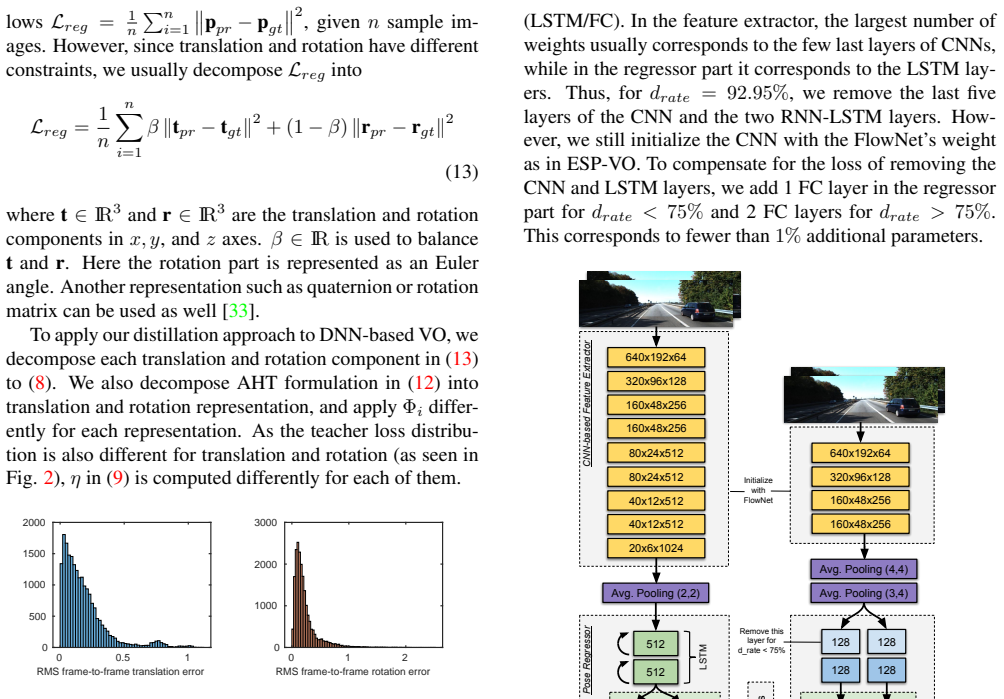
- A compressed visual odometry student can run at more than double the frame rate (41 ms vs 87 ms per frame) while staying close to the teacher's accuracy on KITTI, and at some compression ratios it beats the supervised teacher's absolute trajectory error.
- The attentive weighting is doing the work: under matched conditions, unweighted imitation gives 165.2 m ATE, teacher-as-upper-bound gives 46.2 m, and standard hint training gives 32.0 m, against 29.0 m for the proposed method.
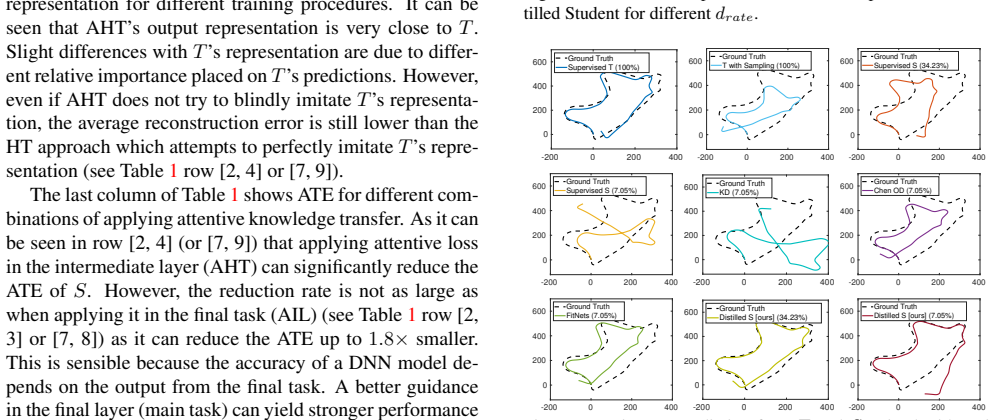
- Training the intermediate representation and the final output in two separate stages, both weighted by teacher loss, yields lower absolute pose error than combining both objectives in one joint loss, and the resulting model generalizes to a different dataset (Malaga) without retraining.
Reading between the lines
- The authors do not explore it, but the same teacher-loss confidence weighting could be applied to other regression distillation targets with heteroscedastic errors, such as monocular depth or optical flow, where a teacher's per-pixel error varies strongly with scene content.
- The min-max normalization is sensitive to outliers: a single catastrophic teacher loss on one training frame would flatten all confidence weights toward 1, silently reducing attentive learning to unweighted imitation, so rank-normalizing or clipping $\Phi_i$ is a testable robustness improvement.
- The results imply that an over-parameterized teacher may be most valuable as a source of reliable training signal rather than as a final predictor, since the distilled student matches or outperforms the supervised teacher on Malaga despite having far fewer parameters.
Signed reviews
Editorial analysis
A structured set of objections, weighed in public.
Referee Report
Summary. The manuscript addresses knowledge distillation for camera pose regression networks in visual odometry. Because regression outputs lack the 'dark knowledge' available in classification, the authors propose to weight the student's imitation loss by a per-sample confidence based on the teacher's own loss against ground truth. They introduce Attentive Imitation Loss (AIL) for the final pose objective and Attentive Hint Training (AHT) for an intermediate representation, both using the normalized teacher loss Phi_i. Training proceeds in two stages: AHT on the feature/regressor trunk, then AIL on the remaining layers. Experiments on KITTI and Malaga report student networks with up to 92.95% parameter reduction and 2.12x speedup, with ATE close to the teacher and better than standard KD, FitNets, and an upper-bound distillation baseline.
Significance. The central question is whether the teacher-loss-based confidence weighting is a working and necessary recipe for regression distillation. The paper gives a clear formulation and an informative ablation in Table 1: applying attentive weighting in the intermediate and final layers consistently improves ATE over the non-attentive counterparts. The cross-dataset test on Malaga and the comparison of trajectory-level accuracy against the three baselines are valuable and go beyond simple frame-wise RPE. If the normalization issue and robustness concerns are resolved, the method would be a useful contribution to model compression for pose regression. The paper does not provide code, and the quantitative evidence is based on single runs, so independent verification would be needed.
major comments (3)
- [Section 4, Eqs. (9)-(11)] The confidence weight Phi_i as written is not a normalized teacher loss. With eta = max(eT) - min(eT), the expression Phi_i = 1 - ||pT - pgt||^2_i / eta produces values outside [0,1]; in particular, if min(eT) > 0, the worst sample receives Phi < 0, turning imitation into anti-imitation on precisely the frames the method intends to down-weight. If the intended formula is Phi_i = 1 - (||pT - pgt||^2_i - min(eT)) / eta, this needs to be stated explicitly and the discrepancy from the printed equation resolved. Please also report the empirical range of Phi_i on the training and test sets, because a denominator dominated by a single outlier would collapse all weights to ~1 and reduce AIL/AHT to unweighted distillation.
- [Section 7.5, Table 3] The load-bearing comparison against FitNets and Chen's OD is not yet attributable to the attentive mechanism. Table 3 compares complete methods that differ in several respects: the two-stage schedule, the choice of hint/guided layers, the attentive weights Phi_i, and the alpha/beta hyperparameters. No sensitivity analysis is given to show that the 29.0m ATE advantage over FitNets (31.96m) is driven by Phi_i rather than by these auxiliary design choices. I recommend ablations that keep all other components identical and vary only the weighting (e.g., replace Phi_i by a constant, by the corrected max-min normalized weights, and by a percentile-based robust normalization), together with the distribution of Phi_i.
- [Section 7.3, Tables 1-3] All reported results are based on a single training run per configuration; no standard deviation, seed, or repeated-run statistics are provided. Because Table 3's improvement over FitNets is on the order of 3m in ATE, while Table 1 shows differences of 8-15m between procedures, the reader cannot judge whether the gains are stable. Please report multiple runs (at least 3 seeds) for the main configurations and use error bars or significance tests.
minor comments (4)
- [Section 5, Eq. (12)] Table 1 reports 'Rec. Error' of the student's intermediate representation with respect to the teacher's representation; for AHT this is literally the training objective being minimized, so the lower reconstruction error for AHT relative to HT is expected and should not be counted as independent evidence. The ATE column in Table 1 is the informative comparison.
- [Section 4, notation] The use of ||.||_i and ||.||_j with subscript indices is confusing because the same notation usually denotes a norm or a norm with exponent; the paper defines this convention but should consider a clearer notation such as superscripts or explicit loss variables e_i^{(T)}.
- [Section 7.1, Malaga test] The Malaga evaluation is qualitative because no ground-truth poses exist; the caption in Figure 9 should state this limitation directly in the figure and not rely only on the main text.
- [General] There are typographical errors such as 'Knowledege Distillation' in the text before Section 3 and inconsistent spacing in equations; the manuscript would benefit from a careful proofread.
Circularity Check
No significant circularity: the attentive weights are computed from the teacher's own errors, and the main evidence is external ATE/RPE on KITTI and Malaga, not a restatement of the training objective.
full rationale
The central derivation is self-contained. The confidence weight Phi_i (Eq. 9) is a deterministic function of the teacher's prediction error ||pT - pgt||^2 relative to the training-set range eta (Eqs. 10-11); it is computed before and independently of the student's predictions, so the AIL objective (Eq. 8) is not a tautology. AHT (Eq. 12) uses the same precomputed Phi to weight feature imitation, and the reported ATE/RPE values in Tables 2-3 are measured against ground-truth trajectories on held-out KITTI sequences and Malaga, providing external falsifiability. Self-citations (ESP-VO, DeepVO, etc.) appear only to justify the choice of teacher architecture and background, not to license the distillation mechanism or a uniqueness claim. The only concerns visible in the text—that the max-min normalization in Eq. 9 could be sensitive to outliers or that the printed formula omits subtracting min(eT)—are correctness and robustness risks, not circularity, because the claimed result is still logically independent of those implementation choices. The AHT reconstruction-error diagnostic in Table 1 is an internal measure closely aligned with the hint-training objective, but it is not used as a stand-alone prediction and does not affect the paper's load-bearing ATE comparison.
Assumptions & free parameters
free parameters (2)
- alpha (imitation balance) =
not reported
- beta (translation/rotation balance) =
not reported
assumptions (3)
- domain assumption Normalized teacher loss is a valid confidence score for knowledge transfer.
- ad hoc to paper Separate two-stage optimization is superior to joint optimization.
- domain assumption The teacher's training-set loss distribution generalizes to the test set.
Cite this review
Pith. "Pith review of Distilling Knowledge From a Deep Pose Regressor Network." pith.science (2026). https://pith.science/paper/K2HP6GNP
@misc{pith2026190800858,
  author       = {Pith},
  title        = {Pith review of: Distilling Knowledge From a Deep Pose Regressor Network},
  year         = {2026},
  howpublished = {\url{https://pith.science/paper/K2HP6GNP}},
  note         = {Machine review of arXiv:1908.00858}
}
read the original abstract
This paper presents a novel method to distill knowledge from a deep pose regressor network for efficient Visual Odometry (VO). Standard distillation relies on "dark knowledge" for successful knowledge transfer. As this knowledge is not available in pose regression and the teacher prediction is not always accurate, we propose to emphasize the knowledge transfer only when we trust the teacher. We achieve this by using teacher loss as a confidence score which places variable relative importance on the teacher prediction. We inject this confidence score to the main training task via Attentive Imitation Loss (AIL) and when learning the intermediate representation of the teacher through Attentive Hint Training (AHT) approach. To the best of our knowledge, this is the first work which successfully distill the knowledge from a deep pose regression network. Our evaluation on the KITTI and Malaga dataset shows that we can keep the student prediction close to the teacher with up to 92.95% parameter reduction and 2.12x faster in computation time.
Figures

Figures from the paper (5 more)



Reference graph
Works this paper leans on
-
[1]
Y . Almalioglu, M. R. U. Saputra, P. P. B. d. Gusmao, A. Markham, and N. Trigoni. Ganvo: Unsupervised deep monocular visual odometry and depth estimation with gen- erative adversarial networks. In IEEE International Confer- ence on Robotics and Automation (ICRA), 2019. 2
work page 2019
-
[2]
S. Bhattacharya and N. D. Lane. Sparsification and Sep- aration of Deep Learning Layers for Constrained Resource Inference on Wearables. In ACM Conference on Embedded Network Sensor Systems (SenSys), pages 176–189, 2016. 1, 2
work page 2016
-
[3]
J.-L. Blanco-Claraco, F.- ´A. Moreno-Due ˜nas, and J. Gonz´alez-Jim´enez. The m ´alaga urban dataset: High-rate stereo and lidar in a realistic urban scenario. The Interna- tional Journal of Robotics Research (IJRR), 33(2):207–214,
-
[4]
G. Chen, W. Choi, X. Yu, T. Han, and M. Chandraker. Learn- ing efficient object detection models with knowledge distilla- tion. In Advances in Neural Information Processing Systems (NIPS), pages 742–751, 2017. 1, 3, 8
work page 2017
- [5]
-
[6]
M. Courbariaux, Y . Bengio, and J.-P. David. BinaryConnect: Training Deep Neural Networks with binary weights during propagations. In Advances in Neural Information Processing Systems (NIPS), pages 1–9, 2015. 1, 2
work page 2015
-
[7]
A. Dosovitskiy, P. Fischery, E. Ilg, P. Hausser, C. Hazir- bas, V . Golkov, P. V . D. Smagt, D. Cremers, and T. Brox. FlowNet: Learning Optical Flow with Convolutional Net- works. In IEEE International Conference on Computer Vi- sion (ICCV), volume 11-18-Dece, pages 2758–2766, 2016. 5
work page 2016
- [8]
Show all 38 references
-
[9]
Y . Gong, L. Liu, M. Yang, and L. Bourdev. Compressing Deep Convolutional Networks using Vector Quantization. In arXiv:1412.6115, 2015. 1
2015 arXiv
-
[10]
Y . Guo, A. Yao, and Y . Chen. Dynamic Network Surgery for Efficient DNNs. In Advances in Neural Information Pro- cessing Systems (NIPS), 2016. 1, 2
2016
-
[11]
Gupta, A
S. Gupta, A. Agrawal, K. Gopalakrishnan, and P. Narayanan. Deep learning with limited numerical precision. In Inter- national Conference on Machine Learning (ICML) , pages 1737–1746, 2015. 2
2015
-
[12]
S. Han, H. Mao, and W. J. Dally. Deep Compression: Compressing Deep Neural Networks with Pruning, Trained Quantization and Huffman Coding. In International Confer- ence on Learning Representations (ICLR), 2016. 1
2016
-
[13]
S. Han, H. Mao, E. Gong, S. Tang, and J. Dally. DSD : Dense-Sparse-Dense Training for Deep Neural Networks. In International Conference on Learning Representations (ICLR), 2017. 2
2017
-
[14]
S. Han, J. Pool, J. Tran, and W. J. Dally. Learning both Weights and Connections for Efficient Neural Networks. In Advances in Neural Information Processing Systems (NIPS), pages 1–9, 2015. 2
2015
-
[15]
Hartley and A
R. Hartley and A. Zisserman. Multiple View Geometry in Computer Vision. Cambridge University Press, 2 edition,
-
[16]
Hinton, O
G. Hinton, O. Vinyals, and J. Dean. Distilling the Knowledge in a Neural Network. In NIPS Deep Learning and Represen- tation Learning Workshop (2015), pages 1–9, 2015. 1, 3, 4, 8
2015
-
[17]
Hubara, M
I. Hubara, M. Courbariaux, D. Soudry, R. El-Yaniv, and Y . Bengio. Binarized Neural Networks. InAdvances in Neu- ral Information Processing Systems (NIPS), 2016. 1, 2
2016
-
[18]
Jaderberg, A
M. Jaderberg, A. Vedaldi, and A. Zisserman. Speeding up convolutional neural networks with low rank expansions. In Proceedings of the British Machine Vision Conference (BMVC), 2014. 2
2014
-
[19]
S. H. Lee, D. H. Kim, and B. C. Song. Self-supervised knowledge distillation using singular value decomposition. In European Conference on Computer Vision (ECCV), pages 339–354. Springer, 2018. 1
2018
-
[20]
Lopez-Paz, L
D. Lopez-Paz, L. Bottou, B. Sch ¨olkopf, and V . Vapnik. Uni- fying distillation and privileged information. InInternational Conference on Learning Representations (ICLR), 2016. 1
2016
-
[21]
J.-H. Luo, J. Wu, and W. Lin. Thinet: A filter level prun- ing method for deep neural network compression. In Pro- ceedings of the IEEE International Conference on Computer Vision (ICCV), pages 5058–5066, 2017. 2
2017
-
[22]
Molchanov, A
D. Molchanov, A. Ashukha, and D. Vetrov. Variational Dropout Sparsifies Deep Neural Networks. In International Conference on Machine Learning (ICML), 2017. 2
2017
-
[23]
Polino, R
A. Polino, R. Pascanu, and D. Alistarh. Model compression via distillation and quantization. InInternational Conference on Learning Representations (ICLR), 2018. 1
2018
-
[24]
Rigamonti, A
R. Rigamonti, A. Sironi, V . Lepetit, and P. Fua. Learning separable filters. In Proceedings of the IEEE conference on Computer Vision and Pattern Recognition (CVPR), pages 2754–2761, 2013. 2
2013
-
[25]
Romero, N
A. Romero, N. Ballas, S. E. Kahou, A. Chassang, C. Gatta, and Y . Bengio. FitNets: Hints for Thin Deep Nets. In In- ternational Conference on Learning Representations (ICLR),
-
[26]
M. R. U. Saputra, P. P. B. d. Gusmao, S. Wang, A. Markham, and N. Trigoni. Learning monocular visual odometry through geometry-aware curriculum learning. In IEEE In- ternational Conference on Robotics and Automation (ICRA),
-
[27]
M. R. U. Saputra, A. Markham, and N. Trigoni. Visual SLAM and Structure from Motion in Dynamic Environments : A Survey. ACM Computing Surveys, 51(2), 2018. 2, 4
2018
-
[28]
Srivastava, G
N. Srivastava, G. Hinton, A. Krizhevsky, I. Sutskever, and R. Salakhutdinov. Dropout: A simple way to prevent neural networks from overfitting. The Journal of Machine Learning Research, 15(1):1929–1958, 2014. 6
1929
-
[29]
Sturm, N
J. Sturm, N. Engelhard, F. Endres, W. Burgard, and D. Cre- mers. A benchmark for the evaluation of rgb-d slam systems. In 2012 IEEE/RSJ International Conference on Intelligent Robots and Systems (IROS), pages 573–580. IEEE, 2012. 6
2012
-
[30]
C. Tai, T. Xiao, Y . Zhang, X. Wang, and W. E. Convolu- tional neural networks with low-rank regularization. In In- ternational Conference on Learning Representations (ICLR),
-
[31]
Vanhoucke, A
V . Vanhoucke, A. Senior, and M. Z. Mao. Improving the speed of neural networks on cpus. In Proc. Deep Learning and Unsupervised Feature Learning NIPS Workshop , vol- ume 1, page 4. Citeseer, 2011. 2
2011
-
[32]
H. Wang, H. Zhao, X. Li, and X. Tan. Progressive block- wise knowledge distillation for neural network acceleration. In International Joint Conference on Artificial Intelligence (IJCAI), pages 2769–2775, 2018. 1
2018
-
[33]
S. Wang, R. Clark, H. Wen, and N. Trigoni. DeepVO: To- wards End-to-End Visual Odometry with Deep Recurrent Convolutional Neural Networks. InIEEE International Con- ference on Robotics and Automation (ICRA), 2017. 2, 5, 8
2017
-
[34]
S. Wang, R. Clark, H. Wen, and N. Trigoni. End-to-end, sequence-to-sequence probabilistic visual odometry through deep neural networks. The International Journal of Robotics Research (IJRR), pages 1–30, 2018. 2, 5
2018
-
[35]
S. Yao, Y . Zhao, A. Zhang, L. Su, and T. Abdelzaher. DeepIoT: Compressing Deep Neural Network Structures for Sensing Systems with a Compressor-Critic Framework. In 15th ACM Conference on Embedded Networked Sensor Sys- tems (SenSys), number 17, 2017. 1, 2
2017
-
[36]
J. Yim, D. Joo, J. Bae, and J. Kim. A gift from knowl- edge distillation: Fast optimization, network minimization and transfer learning. In Proceedings of the IEEE Confer- ence on Computer Vision and Pattern Recognition (CVPR) , pages 4133–4141, 2017. 1
2017
-
[37]
H. Zhan, R. Garg, C. Saroj Weerasekera, K. Li, H. Agar- wal, and I. Reid. Unsupervised learning of monocular depth estimation and visual odometry with deep feature recon- struction. In Proceedings of the IEEE Conference on Com- puter Vision and Pattern Recognition (CVPR) , pag...
2018
-
[38]
H. Zhou, B. Ummenhofer, and T. Brox. Deeptam: Deep tracking and mapping. In Proceedings of the European Con- ference on Computer Vision (ECCV), pages 822–838, 2018. 2
2018
Reviewed August 14, 2026 · model on record in the stance chip above.
Discussion (0). Continue with ORCID to comment.