REVIEW 4 major objections 4 minor 2 cited by
Physical machine learning outperforms "human learning" in Quantum Chemistry
T0 review · 4 major / 4 minor · reviewed 2026-08-14 · deepseek-v4-flash
Pith's one-line read A generalization of the Hohenberg–Kohn theorem shows that a cheap approximate electron density uniquely determines exact molecular energies and densities, and a 3D convolutional network built on this principle reaches CCSD(T)-level…
desk verdict A real theoretical extension of HK plus promising DNN results, but the implemented descriptor drifts away from the theorem, and the empirical comparisons are not apples-to-apples. read the letter →
The pith
A machine-rendered reading of the paper's core claim, the machinery that carries it, and where it could break.
The reading
What carries the argument
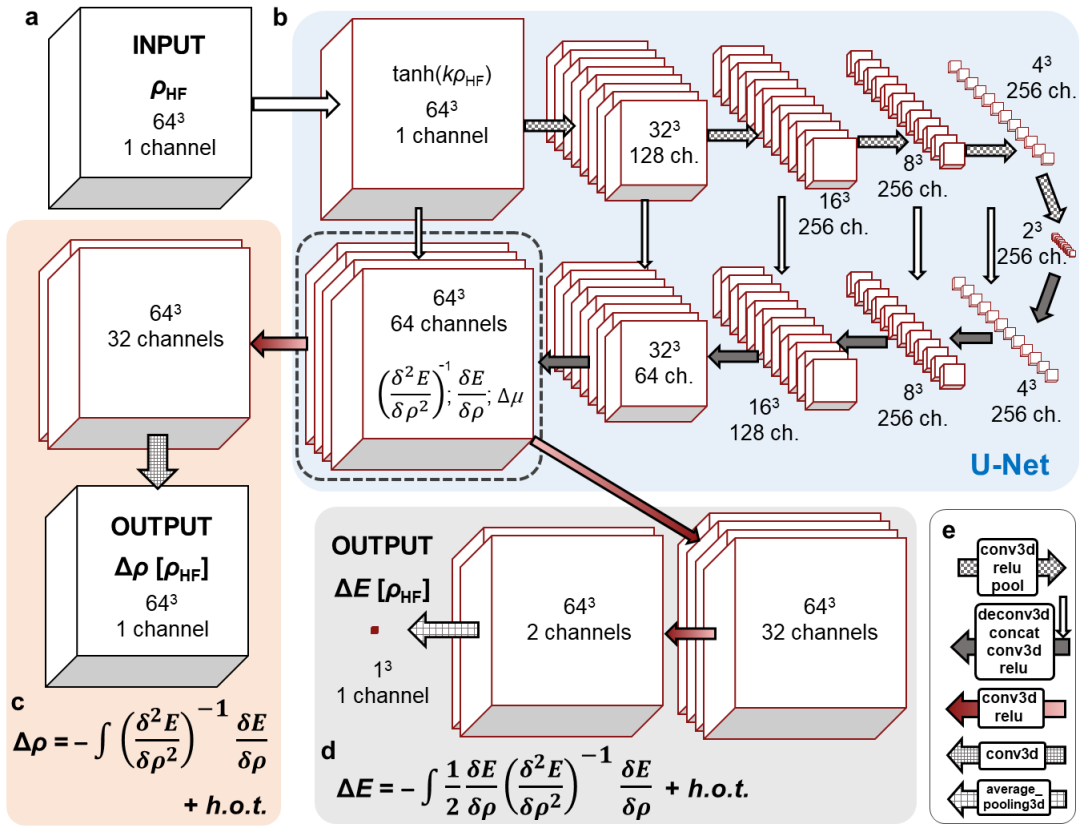
The load-bearing object is the generalized Hohenberg–Kohn map from an approximate density to the exact external potential, together with the resulting delta-correction equations $\rho = \rho_0 + \Delta\rho[\rho_0]$ and $E = E_0 + \Delta E[\rho_0]$. The computational implementation is a three-dimensional convolutional U-Net whose input is a single coarse-grained Hartree-Fock density on a $64 \times 64 \times 64$ grid; the network forks into a density-output path and an energy-output path, mirroring the shared functional-derivative precursors in the perturbative expansion of $\Delta\rho$ and $\Delta E$. The forked architecture lets the density prediction act as a physics-based regularizer for the energy prediction.
What would settle it
Find two distinct molecules whose Hartree-Fock densities, after coarse-graining to 64x64x64 cubes at 0.4 bohr spacing, are numerically identical while their CCSD(T) energies differ by more than about 1 kcal/mol; if such a pair exists, the learned map from coarse density to energy is not a well-defined function.
Extended reading notes
Core claim
The central claim is that the usual Hohenberg–Kohn argument survives when the input density is only an approximate solution of an approximate functional. Because any DFT method minimizes a functional of the form $F_{\mathrm{approx}}[n] + \int n V_{\mathrm{ext}}$, the stationarity condition lets one write $V_{\mathrm{ext}}(\mathbf{r}) = \mu - \delta F_{\mathrm{approx}}/\delta n|_{\rho_0}$, so an approximate ground-state density $\rho_0$ determines the external potential up to a constant, and therefore determines the exact Hamiltonian, all exact energies, and all exact densities, ground and excited. The paper writes this as $\rho = \rho_0 + \Delta\rho[\rho_0]$ and $E = E_0 + \Delta E[\rho_0]$, and argues that in this form the unknown corrections are exactly the kind of function-to-function and function-to-scalar maps that a deep network can approximate directly, without iterative minimization of the density functional.
Load-bearing premise
The proof assumes the approximate density is an exact minimizer of the approximate functional, and the implementation further assumes that coarse-graining to a 64x64x64 grid at 0.4 bohr spacing preserves enough information to distinguish every molecule from every other one.
Editorial extensions
If this is right
- An approximate DFT or HF electron density is a universal descriptor: no atomic-number channels, geometry lists, or hand-built symmetry functions are needed for the network to reach CCSD(T)-level energies.
- Corrections to density and energy can be computed in a single non-iterative pass, avoiding the expensive variational minimization that learning the full Hohenberg-Kohn functional would require.
- Two-stage training—first on cheap DFT data, then on scarce CCSD and CCSD(T) data—transfers to a held-out test set with 0.87 kcal/mol mean absolute error, below the 1 kcal/mol thermochemical accuracy threshold.
- Because the theory says excited-state densities and energies are also functionals of $\rho_0$, the same descriptor should support machine-learned excited-state predictions, not just ground-state energies.
- The computational cost of the network itself is nearly independent of molecule size, and the limiting step becomes generating the input density, so the practical advantage over DFT grows for larger molecules.
Reading between the lines
- If the uniqueness theorem is robust, the density descriptor should transfer to molecules containing elements outside the training set, such as sulfur or chlorine, without retraining, because the input is a physical density rather than an element-indexed feature; a direct test would be to train on carbon, hydrogen, nitrogen, oxygen, and fluorine only, then evaluate on a small set of sulfur- or chlo
- The forked architecture suggests that jointly learning density and energy corrections is what keeps the model physical; a controlled ablation that removes the density path and retrains on energies alone would isolate how much of the 0.87 kcal/mol accuracy comes from this regularization.
- Because the proof applies to any approximate method whose energy is a universal functional plus an external-potential term, the same delta-learning pipeline could in principle be built on MP2 or other correlated density inputs, not only HF or DFT densities, potentially pushing predictions even closer to exact densities.
- The fixed 64x64x64 grid limits the approach to molecules that fit in the cube; a scanning-window architecture that processes local density patches could extend the same density-to-property map to much larger systems, provided the local patches still determine the relevant physics.
Signed reviews
Editorial analysis
A structured set of objections, weighed in public.
Referee Report
Summary. The paper claims a generalization of the Hohenberg-Kohn theorems: an approximate ground-state electron density obtained from a specified DFT functional or from Hartree-Fock theory uniquely determines the external potential and hence the exact ground- and excited-state energies and densities. On this basis the authors propose a delta-ML scheme in which a 3D convolutional neural network takes the approximate density as its only input and predicts corrections to the energy and density, and they report a mean absolute error of 0.87 kcal/mol against CCSD(T) energies for a held-out subset of QM9 molecules, together with improved electron densities relative to standard DFT functionals. The supplementary material contains the formal proofs, a perturbative derivation of the corrections, extensive DFT functional/basis-set benchmarking, and details of the two-stage training on DFT and CCSD/CCSD(T) data.
Significance. If the theoretical claim holds, the paper offers a conceptually attractive bridge between DFT and machine learning: a physically motivated universal descriptor, a non-iterative delta-ML formulation, and a network architecture that jointly predicts densities and energies. The computational study is substantial: approximately 133,000 molecules with PBE0/pcS-3 densities, 4,762 molecules with RI-CCSD(T)/aug-cc-pVTZ energies, and 52 molecules with RI-CCSD/aug-cc-pVQZ densities, with careful benchmarking of many DFT functional/basis-set combinations. The simultaneous accuracy improvement in energies and densities on held-out molecules is a genuine empirical contribution. However, the paper's headline empirical claim is not yet a clean validation of the generalized HK descriptor, because the implemented descriptor differs from the theoretical minimizer density in several load-bearing ways, and because the comparisons to state-of-the-art DFT and ML methods are not made on identical test sets. The theoretical proofs are mostly plausible but have rigor gaps that should be addressed before the descriptor claim is presented as established.
major comments (4)
- [S3.1, S4.1, S4.2] The uniqueness theorem applies to a density ρ0 that is an unconstrained minimizer of the approximate functional in Eq. (S15), so that Eq. (S18) follows from the Euler equation. The actual network input is an HF/cc-pVDZ density computed in a finite basis, coarse-grained by summing 4×4×4 blocks to a 64×64×64 grid (S4.1, step 3), and then transformed elementwise by tanh(1.28ρHF) (S4.2). None of these operations is covered by the proof: the finite-basis HF density minimizes the HF energy only within the chosen basis subspace, and coarse-graining/tanh can map distinct molecular densities to the same processed tensor. The paper only checks that coarse-graining 'quantitatively preserves the spatial behavior' (S4.1), which is much weaker than injectivity, and no collision or near-collision audit is reported. Consequently, the MAE of 0.87 kcal/mol cannot be cited as direct empirical confirmation of the generalized Hohenberg-Kohn descriptor claim without closing this gap.
- [S2.3, S5.1, Table 1] The headline comparisons to 'human learning' are not made on identical test sets. The abstract's 'ML (down to ~1.5 kcal/mol)' refers to a model trained and tested on a different dataset (ANI-1ccx, Ref. 18), not on the 462-molecule CCSD(T)/aug-cc-pVTZ test set used for PML-QCCCSD(T) in Table 1. Similarly, the 'DFT down to ~3 kcal/mol' value is the best functional MAE over the 4,762-molecule set in Table S3, while the QM9 row in Table 1 reports B3LYP/6-31G(2df,p) errors on the 462-molecule subset. These dataset and reference-level differences mean the quantitative superiority claim should be supported by computing the same competing methods on the same held-out molecules, or by clearly reporting the comparison as cross-dataset rather than direct.
- [S4.1, Eqs. (S92)-(S95)] The final energy prediction uses a linear correction term c0 + Σ ca na whose coefficients are fitted to the training set and whose atom counts na are taken from the known molecular formula, not from the density by the network. The statement na = na[ρHF(r)] is a theoretical assertion about what the density determines in principle; it is not implemented, and the coarse-grained, tanh-saturated HF density is not demonstrated to determine atom types robustly. Thus the claim that 'a single input channel with an approximate density was sufficient' is only partially validated by the experiments: the energy model uses the true stoichiometry as additional information. An ablation without the linear correction, or a network that predicts atom counts from the density, would clarify how much of the reported accuracy is attributable to the density descriptor alone.
- [S3.2, Eqs. (S59)-(S64)] The alternative HF proof in Lemma 3 divides by spin-orbitals and derives that the ratios rj = ψj/ψ1 must be constant if the external potential is not uniquely determined. This step is not rigorous where ψ1 has nodal surfaces: the ratio is undefined at those points, and the Fock equations become homogeneous constraints on the ψj instead. The proof also uses strict inequalities in Lemma 1 (Eqs. (S36)-(S37)) without addressing possible HF degeneracies where equality could hold. These gaps are patchable, but they should be fixed or explicitly acknowledged before the theorem is presented as a complete proof that HF densities determine the external potential.
minor comments (4)
- [S3.3, Eq. (S78)] The identity Δρ[ρ0 + δρ] = Δρ[ρ0] − δρ is stated for arbitrary δρ, but the minimization that defines Δρ is constrained by ∫δρ = 0 in Eq. (S72); the statement should specify that δρ has zero integral, otherwise the number of electrons changes and the comparison is not meaningful.
- [S4.4, Fig. S5] No validation set is used for the electron-density output of the transfer-learned PML-QCCCSD(T) model; the statement that overfitting was not observed is based on the first-stage PML-QCDFT model (Fig. S5a) and is not directly evidence for the second-stage model. A validation split for densities, even small, would strengthen the claim.
- [S4.5] There are several typos in this section: 'number of elections N' should be 'number of electrons N', and 'for all expect the first four molecules' should be 'for all except the first four molecules'.
- [S5.1] The phrase 'an earlier version of this manuscript' followed by a reference to the authors' own arXiv preprint (Ref. 66) should be clarified as a self-citation to the previous version and marked as such, to avoid any impression that unpublished or overlapping material is being cited without identification.
Circularity Check
No circularity found: the generalized Hohenberg-Kohn proof is a self-contained first-principles derivation, and the ML validation uses held-out QM9/CCSD(T) targets rather than fitted inputs.
full rationale
The paper's central theoretical claim is derived in Section S3.1 from the Euler equation for an approximate density functional: Eq. (S17) gives V_ext(r) = μ - (δF_approx/δn)|ρ0, and Eq. (S20) shows that two systems with the same approximate ground-state density differ only by a constant in the external potential. This derivation does not use any ML model, fitted parameter, or training data, so it is not circular. The HF case is supported by a separate proof in Section S3.2 rather than by a self-citation. The ML stage is standard supervised regression: the network is trained on HF/cc-pVDZ densities with PBE0/pcS-3, RI-CCSD/aug-cc-pVQZ, and RI-CCSD(T)/aug-cc-pVTZ targets from the QM9 set, and performance is reported on held-out test molecules (Table 1, Section S4.4) against external ab initio references. The linear correction coefficients c0 and ca in Eq. (S92) are least-squares fits on the training set only; they are part of a conventional delta-learning baseline and do not enter the theoretical equations in Section S3. The self-citations (Refs. 25 and 66) concern an earlier model version and data augmentation, and are not load-bearing for the uniqueness theorem. A separate validity gap exists, namely that the implemented descriptor is a finite-basis HF density that is coarse-grained and tanh-transformed (Section S4.1-S4.2), so it is not literally the unconstrained minimizer used in the proof; however, this is a correctness risk, not a circular reduction of the claim to its inputs.
Assumptions & free parameters
free parameters (5)
- c0 (energy offset) =
0.002720 hartree (PML-QCDFT), 0.008006 hartree (PML-QCCCSD(T))
- c_H, c_C, c_N, c_O, c_F (per-atom coefficients) =
e.g., c_H=-0.020721, c_C=-0.076106, c_N=-0.108908, c_O=-0.087452, c_F=-0.058814 for PML-QCDFT
- dEreg (regularization prefactor) =
10
- wE (energy loss weight) =
10^4
- tanh scaling factor =
1.28
assumptions (5)
- standard math The universal density functional E[n] exists and is differentiable to required orders
- domain assumption Born-Oppenheimer approximation and non-relativistic electronic Hamiltonian
- domain assumption HF theory can be formulated as a variational density functional minimization
- domain assumption CCSD(T)/aug-cc-pVTZ and CCSD/aug-cc-pVQZ are accurate enough references
- ad hoc to paper The neural network represents the mappings Δρ and ΔE accurately from limited data
Cite this review
Pith. "Pith review of Physical machine learning outperforms "human learning" in Quantum Chemistry." pith.science (2026). https://pith.science/paper/XHMMA4GT
@misc{pith2026190800971,
  author       = {Pith},
  title        = {Pith review of: Physical machine learning outperforms "human learning" in Quantum Chemistry},
  year         = {2026},
  howpublished = {\url{https://pith.science/paper/XHMMA4GT}},
  note         = {Machine review of arXiv:1908.00971}
}
read the original abstract
Two types of approaches to modeling molecular systems have demonstrated high practical efficiency. Density functional theory (DFT), the most widely used quantum chemical method, is a physical approach predicting energies and electron densities of molecules. Recently, numerous papers on machine learning (ML) of molecular properties have also been published. ML models greatly outperform DFT in terms of computational costs, and may even reach comparable accuracy, but they are missing physicality - a direct link to Quantum Physics - which limits their applicability. Here, we propose an approach that combines the strong sides of DFT and ML, namely, physicality and low computational cost. By generalizing the famous Hohenberg-Kohn theorems, we derive general equations for exact electron densities and energies that can naturally guide applications of ML in Quantum Chemistry. Based on these equations, we build a deep neural network that can compute electron densities and energies of a wide range of organic molecules not only much faster, but also closer to exact physical values than current versions of DFT. In particular, we reached a mean absolute error in energies of molecules with up to eight non-hydrogen atoms as low as 0.9 kcal/mol relative to CCSD(T) values, noticeably lower than those of DFT (down to ~3 kcal/mol on the same set of molecules) and ML (down to ~1.5 kcal/mol) methods. A simultaneous improvement in the accuracy of predictions of electron densities and energies suggests that the proposed approach describes the physics of molecules better than DFT functionals developed by "human learning" earlier. Thus, physics-based ML offers exciting opportunities for modeling, with high-theory-level quantum chemical accuracy, of much larger molecular systems than currently possible.
Figures
Forward citations
Cited by 2 Pith papers
-
Ab-Initio Solution of the Many-Electron Schr\"odinger Equation with Deep Neural Networks
The Fermionic Neural Network is an antisymmetric neural-network wavefunction which, optimized variationally, recovers most correlation energy and outperforms CCSD(T) on several strongly correlated dissociation curves.
-
Regression-clustering for Improved Accuracy and Training Cost with Molecular-Orbital-Based Machine Learning
Clustering molecular-orbital training data into locally linear groups before regression cuts MOB-ML training time by up to 35,000-fold while retaining chemical accuracy.
Reference graph
Works this paper leans on
-
[1]
1 Hohenberg, P. & Kohn, W. Inhomogeneous Electron Gas. Phys. Rev. 136, B864 (1964). 2 Kohn, W. & Sham, L. J. Self -Consistent Equations Including Exchange and Correlation Effects. Phys. Rev. 140, A1133, doi:10.1103/PhysRev.140.A1133 (1965). 3 Parr, R. G. & Yang, W. Density-functional theory of atoms and molecules. (Oxford University Press; Clarendon Press...
arXiv 1964
-
[2015]
Density functional theory is straying from the path toward the exact functional
Lecture Notes in Computer Science Vol. 9351 (eds Navab N, Hornegger J, Wells W, & Frangi A) (Springer, Cham, 2015). 27 Farimani, A. B., Gomes, J. & Pande, V. S. Deep Learning the Physics of Transport Phenomena. arxiv, 1709.02432v02431 (2017). 28 Ramakrishnan, R., Dral, P. O., Rupp, M. & von Lilienfeld, O. A. Quantum chemistry structures and properties of ...
arXiv 2017
Reviewed August 14, 2026 · model on record in the stance chip above.
Discussion (0). Continue with ORCID to comment.