REVIEW 4 major objections 5 minor 155 references
A Survey on Compressive Sensing: Classical Results and Recent Advancements
T0 review · 4 major / 5 minor · reviewed 2026-08-14 · deepseek-v4-flash
Pith's one-line read The paper organizes the whole compressive sensing toolbox into two recovery strategies—$\ell_p$ relaxation and greedy pursuit—and tests both on recovering text meanings from word embeddings.
desk verdict A usable but uneven compressive sensing survey; the theory sections are broadly sound, while the numerical section is too underspecified to support its claims. read the letter →
The pith
A machine-rendered reading of the paper's core claim, the machinery that carries it, and where it could break.
The reading
What carries the argument
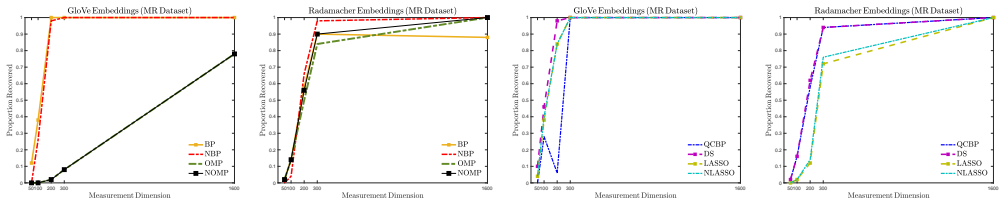
The central objects are the measurement matrix $A\in\mathbb{R}^{m\times N}$ and the sparsity level $s$, together with the matrix properties that certify recovery: the mutual coherence $\mu(A)$, the restricted isometry constants $\delta_s$, and the null space and range space properties. These properties are what let a convex relaxation or a greedy algorithm succeed despite the underlying problem being NP-hard. The algorithmic machinery is the pair of recovery families: $\ell_p$ minimization (basis pursuit, QCBP, LASSO, BPD, Dantzig selector, iterative reweighted $\ell_p$) and greedy pursuit (OMP, block OMP, CoSaMP, gOMP, NOMP, CMP). In the numerical comparison, a word-embedding matrix plays the role of $A$, a unigram count vector is the sparse $x$, and the text embedding is the measurement $y=Ax$.
What would settle it
Compute the mutual coherence (or estimate restricted-isometry constants) of the GloVe and Rademacher matrices actually used, with $m=50,100,200,300,1600$ and vocabularies of size 17,000 and 20,000, and measure the sparsity of the MR and SUBJ unigram vectors. If typical sparsity levels exceed the bounds of Theorem 3.1 or Theorem 4.1, or the coherence is too large, then the reported successful recoveries cannot be attributed to the compressive-sensing theory the survey presents.
Extended reading notes
Core claim
The survey's central claim is that the intractable $\ell_0$ sparse-recovery problem is best approached by two complementary strategies, and that the existing literature can be organized accordingly. The first replaces $\ell_0$ by an $\ell_p$ quasi-norm: $p=1$ is the convex workhorse that becomes a linear program (basis pursuit, LASSO, basis pursuit denoising, Dantzig selector), while $0<p<1$ offers less restrictive recovery conditions at the cost of nonconvexity and the need for a good initialization. The second attacks the problem directly with greedy support selection, led by orthogonal matching pursuit and its descendants—CoSaMP, generalized OMP, nonnegative OMP, constrained matching pursuit, and block variants. The survey states the sufficient conditions that make each route work, such as the null space property for $\ell_1$ uniqueness, $\delta_{2s}<0.4931$ for basis pursuit, $\delta_{s+1}\le 1/\sqrt{s+1}$ for OMP, and $\delta_{8s}<0.4782$ for CoSaMP, and it notes results showing $p>1$ problems almost always return full-support solutions. Its numerical demonstration treats word-embedding matrices as measurement matrices and unigram count vectors as the sparse signals, and reports successful recovery on the MR and SUBJ datasets.
Load-bearing premise
The load-bearing premise is that word-embedding matrices behave as valid compressive-sensing measurement matrices for unigram count vectors, meaning the unigram vectors are sparse enough and the matrices have low enough coherence or restricted-isometry constants; the survey states this model but does not measure either side of it.
Editorial extensions
If this is right
- A practitioner can pick a recovery method from known sufficient conditions: if the matrix has low coherence or small restricted isometry constants, $\ell_1$ minimization and OMP-family algorithms come with explicit guarantees.
- Nonconvex $\ell_p$ with $p<1$ can recover vectors that $\ell_1$ cannot, but only if the solver finds a global or near-global minimizer; the survey notes that a least-squares start is only an empirical heuristic.
- When sparsity is small, greedy algorithms are competitive and cheap; as sparsity grows, $\ell_p$ recovery becomes the better choice, according to the survey's text-embedding experiments.
- Exploiting extra structure—nonnegativity, block sparsity, discrete alphabets, or model-based priors—reduces the number of measurements needed and sharpens recovery guarantees.
- Deterministic measurement matrices can outperform random ones in specific applications, even though most theoretical guarantees are proven for random Gaussian or Bernoulli matrices.
Reading between the lines
- The text-embedding experiment would be more decisive if it measured the actual sparsity of unigram vectors and the coherence or RIP constants of the GloVe and Rademacher matrices; without that, the success shown could come from structure beyond the stated CS conditions.
- The result that $p>1$ yields full-support solutions suggests the meaningful boundary in this area is between $p=1$ and $p<1$, not between convex and nonconvex per se; future work may focus on initialization schemes that make nonconvex recovery reliable.
- If unigram vectors are truly sparse in the vocabulary basis, then recovering them from embeddings is a compressed-sensing problem, and the same lens could be applied to probing what information word embeddings preserve about individual words.
- A testable extension would compare these recovery methods on embeddings other than GloVe and Rademacher, such as word2vec or context-dependent embeddings, to see whether the reported recovery success is a general property of text embeddings or specific to the two matrices tested.
Signed reviews
Editorial analysis
A structured set of objections, weighed in public.
Referee Report
Summary. This survey reviews compressive sensing theory and algorithms, focusing on l_p recovery (including l1 and nonconvex 0<p<1) and greedy algorithms (OMP, CoSaMP, gOMP, CMP). It collects classical results such as recovery conditions based on mutual coherence, RIP, NSP, and RSP, and discusses variations including noisy measurements, nonnegative constraints, binary and quantized CS, and recent topics such as model-based CS and quantum annealing. The paper concludes with a numerical comparison of l1 recovery and greedy algorithms on unigram text representations from MR and SUBJ datasets using GloVe and Rademacher embedding matrices.
Significance. If the numerical section were properly substantiated, the paper would serve as a useful, compact roadmap of classical and recent compressive sensing, with a unified presentation of lp recovery and greedy algorithms. Strengths: the survey covers a broad set of results with precise theorem statements, brings together classical and recent literature (including the authors' own work on constrained matching pursuit and p>1 non-sparsity), and highlights practical issues such as determinism vs. randomness of measurement matrices. However, it introduces no new theorems or algorithms, and the empirical demonstration is central to the abstract's claim but is under-specified.
major comments (4)
- [Section 5] The central empirical claim is not verifiable: the figures are not present in the manuscript text (only captions appear), so the reader cannot see the success rates, and the text reports no sparsity level of the unigram vectors, no coherence or RIP estimates for the GloVe and Rademacher matrices, no algorithm implementations or parameter choices, and no standard deviations or error bars. Given that m ranges from 50 to 300 while a typical unigram vector for MR/SUBJ documents has tens to hundreds of nonzeros, the measurement model Ax_unigram = y_embedding may violate the sparsity assumptions required by the stated recovery guarantees; the claim that the results 'confirm the efficiency' is therefore unsupported as written.
- [Section 5] The model statement 'Ax_unigram^T = y_embedding^T' is dimensionally inconsistent with the earlier convention x in R^N and A in R^{m x N}: x_unigram^T is a row vector, and the use of transpose on both sides is unexplained. This makes the model ambiguous and needs correction.
- [Section 3, Theorem 3.7] The constant c_A is defined as max over G with |G|=m of ||A^{-1}_G (A^T)^{-1}A||_{\infty\to 1}; for a rectangular m x N matrix A with m<N, (A^T)^{-1} is not defined, so the statement as written cannot be a correct quotation of [154]. Either the notation is garbled or the theorem is misquoted; the authors should check the original source and state the theorem correctly.
- [Section 3, preceding Theorem 3.8] The claim that a sufficient condition 'delta_{3s}+27 delta_{4s}<26' follows from the displayed theorem is not self-evident; no derivation or explicit parameter substitution (p=1/2, k=?) is provided, and no citation is given for that specific condition. The authors should either derive it or cite the source.
minor comments (5)
- [Section 1, Notation] The phrase 'its adjacent by A*' should be 'its adjoint by A^*'.
- [Section 4] The algorithm name 'CoSaPM' is a typo for 'CoSaMP' in the paragraph introducing the compressive sampling matching pursuit.
- [Section 5] 'Radamacher' should be 'Rademacher'.
- [References] References [107] and [108] are identical; [121] and [122] are identical; [148] and [149] are identical; these duplicates should be removed.
- [Section 4, after Theorem 4.1] The sentence 'It is still an open question ... delta_{s+1} in (1/sqrt(s+1), 1/sqrt(s+1))' contains an empty interval; this is likely a typo and should be corrected.
Circularity Check
No significant circularity: the survey compiles external results and its numerical comparison is not used to derive the surveyed theory.
full rationale
This paper is a survey with no claimed derivation chain of its own: it compiles definitions (Section 2), external theorems (Sections 3 and 4, e.g., Theorems 3.1-3.10 and 4.1-4.4 credited to [52], [81], [61], [152], [153], [105], [113], [82], [145], [131], [89], and [114]), and a numerical comparison (Section 5). The central claim is the organizational/overview claim in the abstract, not a new construction whose output is fed back into its input. The self-citations ([11], [113], [114]) are literature references to prior work of the authors; none is used as a uniqueness theorem or ansatz that forces the survey's conclusions. In particular, the CMP description in Section 4 cites [114], but the survey's concluding assessment that l1 and greedy methods are effective rests on the external theorems and on the Section 5 experiment, not on [114] alone. The Section 5 experiment is not self-referential: it tests recovery of unigram vectors from embeddings using standard solvers and reports success by relative error below 1e-7; whether that experiment's measurement model is valid (sparsity levels, coherence of GloVe) is an empirical correctness concern, not circularity, because the claimed conclusion is not an input to the experiment. The paper's own admission that it 'avoid[s] a detailed explanation on the implemented algorithms' is a transparency limitation, not a circular step. Thus the appropriate finding is no significant circularity, score 0. Concerns about unverified measurement-model assumptions should be recorded as correctness risk, not as circularity.
Assumptions & free parameters
free parameters (1)
- success threshold for relative error =
1e-7
assumptions (3)
- domain assumption Unigram representations of documents are s-sparse in the vocabulary basis (Section 5)
- domain assumption Text embedding matrices from GloVe and Rademacher distributions act as measurement matrices satisfying coherence or RIP-like conditions (Section 5)
- standard math The quoted recovery guarantees from the cited literature are correct as transcribed (Theorems 3.1-3.10, 4.1-4.4)
Cite this review
Pith. "Pith review of A Survey on Compressive Sensing: Classical Results and Recent Advancements." pith.science (2026). https://pith.science/paper/ITEQC2RC
@misc{pith2026190801014,
  author       = {Pith},
  title        = {Pith review of: A Survey on Compressive Sensing: Classical Results and Recent Advancements},
  year         = {2026},
  howpublished = {\url{https://pith.science/paper/ITEQC2RC}},
  note         = {Machine review of arXiv:1908.01014}
}
read the original abstract
Recovering sparse signals from linear measurements has demonstrated outstanding utility in a vast variety of real-world applications. Compressive sensing is the topic that studies the associated raised questions for the possibility of a successful recovery. This topic is well-nourished and numerous results are available in the literature. However, their dispersity makes it challenging and time-consuming for readers and practitioners to quickly grasp its main ideas and classical algorithms, and further touch upon the recent advancements in this surging field. Besides, the sparsity notion has already demonstrated its effectiveness in many contemporary fields. Thus, these results are useful and inspiring for further investigation of related questions in these emerging fields from new perspectives. In this survey, we gather and overview vital classical tools and algorithms in compressive sensing and describe significant recent advancements. We conclude this survey by a numerical comparison of the performance of described approaches on an interesting application.
Figures

Reference graph
Works this paper leans on
-
[154]
Sparse Optimization Theory and Methods
Yun-Bin Zhao. Sparse Optimization Theory and Methods . CRC Press, 2018. 25
work page 2018
-
[1]
Cardinality Optimization Problems
Mohammad Javad Abdi. Cardinality Optimization Problems. University of Birmingham, 2013
2013
-
[2]
Nonconvex sparse recovery methods
Lasith Adhikari. Nonconvex sparse recovery methods. PhD thesis, Uinversity of California, Merced, 2017
2017
-
[3]
Deterministic construction of binary, bipolar, and ternary compressed sensing matrices
Arash Amini and Farokh Marvasti. Deterministic construction of binary, bipolar, and ternary compressed sensing matrices. IEEE Transactions on Information Theory , 57(4):2360–2370, 2011
2011
-
[4]
A compressed sensing view of unsupervised text embeddings, bag-of-n-grams, and lstms
Sanjeev Arora, Mikhail Khodak, Nikunj Saunshi, and Kiran Vodrahalli. A compressed sensing view of unsupervised text embeddings, bag-of-n-grams, and lstms. 2018
2018
-
[5]
Leveraging artificial intelligence to advance problem-solving with quantum annealers
Ramin Ayanzadeh et al. Leveraging artificial intelligence to advance problem-solving with quantum annealers. 2020
2020
-
[6]
Quantum-Assisted Greedy Algorithms
Ramin Ayanzadeh, Milton Halem, John Dorband, and Tim Finin. Quantum-assisted greedy algo- rithms. arXiv preprint arXiv:1912.02362 , 2019
work page Pith review arXiv 1912
-
[7]
Compressive geospatial analytics
Ramin Ayanzadeh, Milton Halem, and Tim Finin. Compressive geospatial analytics. AGUFM, 2019:IN53B–0733, 2019
2019
Show all 155 references
-
[8]
Sat-based compressive sensing
Ramin Ayanzadeh, Milton Halem, and Tim Finin. Sat-based compressive sensing. arXiv preprint arXiv:1903.03650, 2019
1903 arXiv
-
[9]
Reinforcement quantum annealing: A hybrid quantum learning automata
Ramin Ayanzadeh, Milton Halem, and Tim Finin. Reinforcement quantum annealing: A hybrid quantum learning automata. Scientific reports, 10(1):1–11, 2020. 16
2020
-
[10]
An ensemble approach for compressive sensing with quantum annealers
Ramin Ayanzadeh, Milton Halem, Tim Finin, et al. An ensemble approach for compressive sensing with quantum annealers. In IEEE International Geoscience and Remote Sensing Symposium, 2020
2020
-
[11]
Quantum annealing based binary compressive sensing with matrix uncertainty
Ramin Ayanzadeh, Seyedahmad Mousavi, Milton Halem, and Tim Finin. Quantum annealing based binary compressive sensing with matrix uncertainty. arXiv preprint arXiv:1901.00088 , 2019
1901 arXiv
-
[12]
Greedy sparsity-constrained optimization
Sohail Bahmani, Bhiksha Raj, and Petros T Boufounos. Greedy sparsity-constrained optimization. Journal of Machine Learning Research , 14(Mar):807–841, 2013
2013
-
[13]
High-efficiency observations: compressive sensing and recovery of seismic waveform data
Lanshu Bai, Huiyi Lu, and Yike Liu. High-efficiency observations: compressive sensing and recovery of seismic waveform data. Pure and Applied Geophysics , 177(1):469–485, 2020
2020
-
[14]
A simple proof of the restricted isometry property for random matrices
Richard Baraniuk, Mark Davenport, Ronald DeVore, and Michael Wakin. A simple proof of the restricted isometry property for random matrices. Constructive Approximation , 28(3):253–263, 2008
2008
-
[15]
Compressive sensing
Richard G Baraniuk. Compressive sensing. IEEE signal processing magazine , 24(4), 2007
2007
-
[16]
Model-based com- pressive sensing
Richard G Baraniuk, Volkan Cevher, Marco F Duarte, and Chinmay Hegde. Model-based com- pressive sensing. arXiv preprint arXiv:0808.3572 , 2008
2008 arXiv
-
[17]
Sparse signal recovery from nonlinear measurements
Amir Beck and Yonina C Eldar. Sparse signal recovery from nonlinear measurements. In2013 IEEE International Conference on Acoustics, Speech and Signal Processing, pages 5464–5468. IEEE, 2013
2013
-
[18]
Sparsity constrained nonlinear optimization: Optimality conditions and algorithms
Amir Beck and Yonina C Eldar. Sparsity constrained nonlinear optimization: Optimality conditions and algorithms. SIAM Journal on Optimization , 23(3):1480–1509, 2013
2013
-
[19]
On the minimization over sparse symmetric sets: Projections, optimality conditions, and algorithms
Amir Beck and Nadav Hallak. On the minimization over sparse symmetric sets: Projections, optimality conditions, and algorithms. Mathematics of Operations Research, 41(1):196–223, 2016
2016
-
[20]
Iterative hard thresholding for compressed sensing
Thomas Blumensath and Mike E Davies. Iterative hard thresholding for compressed sensing. Ap- plied and computational harmonic analysis , 27(3):265–274, 2009
2009
-
[21]
Compressed sensing and its applications
Holger Boche, Robert Calderbank, Gitta Kutyniok, and Jan Vyb´ ıral. Compressed sensing and its applications. Springer, 2015
2015
-
[22]
1-bit compressive sensing
Petros T Boufounos and Richard G Baraniuk. 1-bit compressive sensing. In 2008 42nd Annual Conference on Information Sciences and Systems , pages 16–21. IEEE, 2008
2008
-
[23]
On the uniqueness of nonnegative sparse solutions to underdetermined systems of equations
Alfred M Bruckstein, Michael Elad, and Michael Zibulevsky. On the uniqueness of nonnegative sparse solutions to underdetermined systems of equations. IEEE Transactions on Information Theory, 54(11):4813–4820, 2008
2008
-
[24]
Mathematical programs with cardi- nality constraints: reformulation by complementarity-type conditions and a regularization method
Oleg P Burdakov, Christian Kanzow, and Alexandra Schwartz. Mathematical programs with cardi- nality constraints: reformulation by complementarity-type conditions and a regularization method. SIAM Journal on Optimization , 26(1):397–425, 2016
2016
-
[25]
An adaptive inverse scale space method for compressed sensing
Martin Burger, Michael M¨ oller, Martin Benning, and Stanley Osher. An adaptive inverse scale space method for compressed sensing. Mathematics of Computation , 82(281):269–299, 2013
2013
-
[26]
Orthogonal matching pursuit for sparse signal recovery with noise
Tianwen Tony Cai and Lie Wang. Orthogonal matching pursuit for sparse signal recovery with noise. Institute of Electrical and Electronics Engineers, 2011. 17
2011
-
[27]
Shifting inequality and recovery of sparse signals
Tianwen Tony Cai, Lie Wang, and Guangwu Xu. Shifting inequality and recovery of sparse signals. IEEE Transactions on Signal Processing , 58(3):1300–1308, 2009
2009
-
[28]
On recovery of sparse signals via𝓁1 minimization
Tianwen Tony Cai, Guangwu Xu, and Jun Zhang. On recovery of sparse signals via𝓁1 minimization. IEEE Transactions on Information Theory , 55(7):3388–3397, 2009
2009
-
[29]
Sharp rip bound for sparse signal and low-rank matrix recovery
Tianwen Tony Cai and Anru Zhang. Sharp rip bound for sparse signal and low-rank matrix recovery. Applied and Computational Harmonic Analysis , 35(1):74–93, 2013
2013
-
[30]
Sparsity and incoherence in compressive sampling
Emmanuel Candes and Justin Romberg. Sparsity and incoherence in compressive sampling. Inverse problems, 23(3):969, 2007
2007
-
[31]
Compressive sampling
Emmanuel J Candes et al. Compressive sampling. In Proceedings of the international congress of mathematicians, volume 3, pages 1433–1452. Madrid, Spain, 2006
2006
-
[32]
A probabilistic and ripless theory of compressed sensing
Emmanuel J Candes and Yaniv Plan. A probabilistic and ripless theory of compressed sensing. IEEE transactions on information theory , 57(11):7235–7254, 2011
2011
-
[33]
Decoding by linear programming
Emmanuel J Candes and Terence Tao. Decoding by linear programming. arXiv preprint math/0502327, 2005
2005 arXiv
-
[34]
The dantzig selector: Statistical estimation when p is much larger than n
Emmanuel J Candes and Terence Tao. The dantzig selector: Statistical estimation when p is much larger than n. Ann. Statist., 35(6):2313–2351, 12 2007
2007
-
[35]
Enhancing sparsity by reweighted 𝓁1 minimization
Emmanuel J Candes, Michael B Wakin, and Stephen P Boyd. Enhancing sparsity by reweighted 𝓁1 minimization. Journal of Fourier Analysis and Applications , 14(5):877–905, Dec 2008
2008
-
[36]
Iterative hard thresholding for com- pressed sensing with partially known support
Rafael E Carrillo, Luisa F Polania, and Kenneth E Barner. Iterative hard thresholding for com- pressed sensing with partially known support. In2011 IEEE International Conference on Acoustics, Speech and Signal Processing (ICASSP), pages 4028–4031. IEEE, 2011
2011
-
[37]
A first-order primal-dual algorithm for convex problems with applications to imaging
Antonin Chambolle and Thomas Pock. A first-order primal-dual algorithm for convex problems with applications to imaging. Journal of mathematical imaging and vision , 40(1):120–145, 2011
2011
-
[38]
Exact reconstruction of sparse signals via nonconvex minimization
Rick Chartrand. Exact reconstruction of sparse signals via nonconvex minimization. IEEE Signal Processing Letters, 14(10):707–710, 2007
2007
-
[39]
Fast algorithms for nonconvex compressive sensing: Mri reconstruction from very few data
Rick Chartrand. Fast algorithms for nonconvex compressive sensing: Mri reconstruction from very few data. In 2009 IEEE International Symposium on Biomedical Imaging: From Nano to Macro , pages 262–265. IEEE, 2009
2009
-
[40]
Iteratively reweighted algorithms for compressive sensing
Rick Chartrand and Wotao Yin. Iteratively reweighted algorithms for compressive sensing. In 2008 IEEE International Conference on Acoustics, Speech and Signal Processing, pages 3869–3872. IEEE, 2008
2008
-
[41]
Atomic decomposition by basis pursuit
Scott Shaobing Chen, David L Donoho, and Michael A Saunders. Atomic decomposition by basis pursuit. SIAM review, 43(1):129–159, 2001
2001
-
[42]
Subspace pursuit for compressive sensing signal reconstruction
Wei Dai and Olgica Milenkovic. Subspace pursuit for compressive sensing signal reconstruction. IEEE transactions on Information Theory , 55(5):2230–2249, 2009
2009
-
[43]
A sharp rip condition for orthogonal matching pursuit
Wei Dan. A sharp rip condition for orthogonal matching pursuit. In Abstract and Applied Analysis, volume 2013. Hindawi, 2013. 18
2013
-
[44]
Testing the nullspace property using semidefinite programming
Alexandre d’Aspremont and Laurent El Ghaoui. Testing the nullspace property using semidefinite programming. Mathematical programming, 127(1):123–144, 2011
2011
-
[45]
An iterative thresholding algorithm for linear inverse problems with a sparsity constraint
Ingrid Daubechies, Michel Defrise, and Christine De Mol. An iterative thresholding algorithm for linear inverse problems with a sparsity constraint. Communications on Pure and Applied Math- ematics: A Journal Issued by the Courant Institute of Mathematical Sciences , 57(11):14...
2004
-
[46]
Sparsity adaptive matching pursuit algorithm for practical compressed sensing
Thong T Do, Lu Gan, Nam Nguyen, and Trac D Tran. Sparsity adaptive matching pursuit algorithm for practical compressed sensing. In 2008 42nd Asilomar Conference on Signals, Systems and Computers, pages 581–587. IEEE, 2008
2008
-
[47]
Counting the faces of randomly-projected hypercubes and orthants, with applications
David L Donoho and Jared Tanner. Counting the faces of randomly-projected hypercubes and orthants, with applications. Discrete & computational geometry , 43(3):522–541, 2010
2010
-
[48]
Precise undersampling theorems
David L Donoho and Jared Tanner. Precise undersampling theorems. Proceedings of the IEEE , 98(6):913–924, 2010
2010
-
[49]
Sparse solution of underde- termined systems of linear equations by stagewise orthogonal matching pursuit
David Leigh Donoho, Iddo Drori, Yaakov Tsaig, and Jean-Luc Starck. Sparse solution of underde- termined systems of linear equations by stagewise orthogonal matching pursuit. IEEE Transactions on Information Theory , 58(2):1094–1121, 2012
2012
-
[50]
Optimally sparse representation in general (nonorthogonal) dictionaries via 𝓁1 minimization
David Leigh Donoho and Michael Elad. Optimally sparse representation in general (nonorthogonal) dictionaries via 𝓁1 minimization. Proceedings of the National Academy of Sciences , 100(5):2197– 2202, 2003
2003
-
[51]
Sparse nonnegative solution of underdetermined linear equations by linear programming
David Leigh Donoho and Jared Tanner. Sparse nonnegative solution of underdetermined linear equations by linear programming. Proceedings of the National Academy of Sciences, 102(27):9446– 9451, 2005
2005
-
[52]
A generalized uncertainty principle and sparse representa- tion in pairs of bases
Michael Elad and Alfred M Bruckstein. A generalized uncertainty principle and sparse representa- tion in pairs of bases. IEEE Transactions on Information Theory , 48(9):2558–2567, Sep. 2002
2002
-
[53]
Block-sparse signals: Uncertainty rela- tions and efficient recovery
Yonina C Eldar, Patrick Kuppinger, and Helmut Bolcskei. Block-sparse signals: Uncertainty rela- tions and efficient recovery. IEEE Transactions on Signal Processing , 58(6):3042–3054, 2010
2010
-
[54]
Compressed sensing: theory and applications
Yonina C Eldar and Gitta Kutyniok. Compressed sensing: theory and applications . Cambridge University Press, 2012
2012
-
[55]
A rank minimization heuristic with applica- tion to minimum order system approximation
Maryam Fazel, Haitham Hindi, Stephen P Boyd, et al. A rank minimization heuristic with applica- tion to minimum order system approximation. In Proceedings of the American control conference, volume 6, pages 4734–4739. Citeseer, 2001
2001
-
[56]
An em algorithm for wavelet-based image restoration
M´ ario AT Figueiredo and Robert D Nowak. An em algorithm for wavelet-based image restoration. IEEE Transactions on Image Processing , 12(8):906–916, 2003
2003
-
[57]
Gradient projection for sparse reconstruction: Application to compressed sensing and other inverse problems
M´ ario AT Figueiredo, Robert D Nowak, and Stephen J Wright. Gradient projection for sparse reconstruction: Application to compressed sensing and other inverse problems. IEEE Journal of selected topics in signal processing , 1(4):586–597, 2007
2007
-
[58]
Numerical methods for sparse recovery
Massimo Fornasier. Numerical methods for sparse recovery. Theoretical foundations and numerical methods for sparse recovery, 14:93–200, 2010. 19
2010
-
[59]
Iterative thresholding algorithms
Massimo Fornasier and Holger Rauhut. Iterative thresholding algorithms. Applied and Computa- tional Harmonic Analysis , 25(2):187–208, 2008
2008
-
[60]
A note on guaranteed sparse recovery via l1-minimization
Simon Foucart. A note on guaranteed sparse recovery via l1-minimization. Applied and Computa- tional Harmonic Analysis , 29(1):97–103, 2010
2010
-
[61]
A Mathematical Introduction to Compressive Sensing
Simon Foucart and Holger Rauhut. A Mathematical Introduction to Compressive Sensing. Springer, 2013
2013
-
[62]
Block-sparse recovery via redundant block omp
Yuli Fu, Haifeng Li, Qiheng Zhang, and Jian Zou. Block-sparse recovery via redundant block omp. Signal Processing, 97:162–171, 2014
2014
-
[63]
Spread representations
Jean-Jacques Fuchs. Spread representations. In 2011 Conference Record of the Forty Fifth Asilomar Conference on Signals, Systems and Computers (ASILOMAR) , pages 814–817. IEEE, 2011
2011
-
[64]
An optimal recovery condition for sparse signals with partial support information via omp
Huanmin Ge and Wengu Chen. An optimal recovery condition for sparse signals with partial support information via omp. Circuits, Systems, and Signal Processing , pages 1–26, 2019
2019
-
[65]
Blind compressed sensing
Sivan Gleichman and Yonina C Eldar. Blind compressed sensing. IEEE Transactions on Informa- tion Theory, 57(10):6958–6975, 2011
2011
-
[66]
Deterministic compressed sensing matrices from sequences with optimal correlation
Zhi Gu, Zhengchun Zhou, Yang Yang, Avik Ranjan Adhikary, and Xiaolun Cai. Deterministic compressed sensing matrices from sequences with optimal correlation. IEEE Access, 7:16704–16710, 2019
2019
-
[67]
Exact recovery conditions for sparse representations with partial support information
C´ edric Herzet, Charles Soussen, J´ erˆ ome Idier, and R´ emi Gribonval. Exact recovery conditions for sparse representations with partial support information. IEEE Transactions on Information Theory, 59(11):7509–7524, 2013
2013
-
[68]
Sharp sufficient condition of block signal recovery via 𝓁2/𝓁1-minimisation
Jianwen Huang, Jianjun Wang, Wendong Wang, and Feng Zhang. Sharp sufficient condition of block signal recovery via 𝓁2/𝓁1-minimisation. IET Signal Processing, 2019
2019
-
[69]
Perfect recovery conditions for non-negative sparse modeling
Yuki Itoh, Marco F Duarte, and Mario Parente. Perfect recovery conditions for non-negative sparse modeling. IEEE Transactions on Signal Processing , 65(1):69–80, 2016
2016
-
[70]
Robust 1-bit com- pressive sensing via binary stable embeddings of sparse vectors
Laurent Jacques, Jason N Laska, Petros T Boufounos, and Richard G Baraniuk. Robust 1-bit com- pressive sensing via binary stable embeddings of sparse vectors. IEEE Transactions on Information Theory, 59(4):2082–2102, 2013
2013
-
[71]
Compressed sensing for finite-valued signals
Sandra Keiper, Gitta Kutyniok, Dae Gwan Lee, and G¨ otz E Pfander. Compressed sensing for finite-valued signals. Linear Algebra and its Applications , 532:570–613, 2017
2017
-
[72]
Sparse recovery of nonnegative signals with minimal expansion
Mohammad Amin Khajehnejad, Alexandros G Dimakis, Weiyu Xu, and Babak Hassibi. Sparse recovery of nonnegative signals with minimal expansion. IEEE Transactions on Signal Processing, 59(1):196–208, 2010
2010
-
[73]
Theory and applications of compressed sensing
Gitta Kutyniok. Theory and applications of compressed sensing. GAMM-Mitteilungen, 36(1):79– 101, 2013
2013
-
[74]
Multipath matching pursuit
Suhyuk Kwon, Jian Wang, and Byonghyo Shim. Multipath matching pursuit. IEEE Transactions on Information Theory , 60(5):2986–3001, 2014. 20
2014
-
[75]
Sparse recovery with integrality constraints
Jan-Hendrik Lange, Marc E Pfetsch, Bianca M Seib, and Andreas M Tillmann. Sparse recovery with integrality constraints. arXiv preprint arXiv:1608.08678 , 2016
2016 arXiv
-
[76]
Stable and efficient representation learning with nonnegativity constraints
Tsung-Han Lin and HT Kung. Stable and efficient representation learning with nonnegativity constraints. In International Conference on Machine Learning , pages 1323–1331, 2014
2014
-
[77]
Binary compressive sensing via smoothed 𝓁0 gradient descent
Tianlin Liu and Dae Gwan Lee. Binary compressive sensing via smoothed 𝓁0 gradient descent. arXiv preprint arXiv:1801.09937 , 2018
2018 arXiv
-
[78]
A review of sparse recovery algorithms
Elaine Crespo Marques, Nilson Maciel, Lirida Naviner, Hao Cai, and Jun Yang. A review of sparse recovery algorithms. IEEE Access, 7:1300–1322, 2018
2018
-
[79]
Distributed representa- tions of words and phrases and their compositionality
Tomas Mikolov, Ilya Sutskever, Kai Chen, Greg S Corrado, and Jeff Dean. Distributed representa- tions of words and phrases and their compositionality. InAdvances in neural information processing systems, pages 3111–3119, 2013
2013
-
[80]
A sharp restricted isometry constant bound of orthogonal matching pursuit
Qun Mo. A sharp restricted isometry constant bound of orthogonal matching pursuit. arXiv preprint arXiv:1501.01708, 2015
2015 arXiv
-
[81]
New bounds on the restricted isometry constant δ2k
Qun Mo and Song Li. New bounds on the restricted isometry constant δ2k. Applied and Compu- tational Harmonic Analysis , 31(3):460–468, 2011
2011
-
[82]
A remark on the restricted isometry property in orthogonal matching pursuit
Qun Mo and Yi Shen. A remark on the restricted isometry property in orthogonal matching pursuit. IEEE Transactions on Information Theory , 58(6):3654–3656, 2012
2012
-
[83]
Non-negative sparse decomposition based on constrained smoothed 0 norm
Mohammad Reza Mohammadi, Emad Fatemizadeh, and Mohammad H Mahoor. Non-negative sparse decomposition based on constrained smoothed 0 norm. Signal Processing, 100:42–50, 2014
2014
-
[84]
A fast approach for overcom- plete sparse decomposition based on smoothed 𝓁0 norm
Hosein Mohimani, Massoud Babaie-Zadeh, and Christian Jutten. A fast approach for overcom- plete sparse decomposition based on smoothed 𝓁0 norm. IEEE Transactions on Signal Processing , 57(1):289–301, 2008
2008
-
[85]
Solution uniqueness of convex piecewise affine functions based optimization with applications to constrained 𝓁1 minimization
Seyedahmad Mousavi and Jinglai Shen. Solution uniqueness of convex piecewise affine functions based optimization with applications to constrained 𝓁1 minimization. ESAIM: Control, Optimisa- tion and Calculus of Variations , 25:56, 2019
2019
-
[86]
Data streams: Algorithms and applications
Shanmugavelayutham Muthukrishnan et al. Data streams: Algorithms and applications. Founda- tions and Trends R© in Theoretical Computer Science, 1(2):117–236, 2005
2005
-
[87]
Discrete signal reconstruction by sum of absolute values
Masaaki Nagahara. Discrete signal reconstruction by sum of absolute values. IEEE Signal Process- ing Letters, 22(10):1575–1579, 2015
2015
-
[88]
Bcs: Compressive sensing for binary sparse signals
Ukash Nakarmi and Nazanin Rahnavard. Bcs: Compressive sensing for binary sparse signals. In MILCOM 2012-2012 IEEE Military Communications Conference , pages 1–5. IEEE, 2012
2012
-
[89]
Cosamp: Iterative signal recovery from incomplete and inaccu- rate samples
Deanna Needell and Joel A Tropp. Cosamp: Iterative signal recovery from incomplete and inaccu- rate samples. Applied and computational harmonic analysis , 26(3):301–321, 2009
2009
-
[90]
Signal recovery from incomplete and inaccurate measure- ments via regularized orthogonal matching pursuit
Deanna Needell and Roman Vershynin. Signal recovery from incomplete and inaccurate measure- ments via regularized orthogonal matching pursuit. arXiv preprint arXiv:0712.1360 , 2007
2007 arXiv
-
[91]
Deterministic sensing matrices in compressive sensing: a survey
Thu LN Nguyen and Yoan Shin. Deterministic sensing matrices in compressive sensing: a survey. The Scientific World Journal , 2013. 21
2013
-
[92]
Exponential enhancement of the efficiency of quantum annealing by non-stoquastic hamiltonians
Hidetoshi Nishimori and Kabuki Takada. Exponential enhancement of the efficiency of quantum annealing by non-stoquastic hamiltonians. Frontiers in ICT, 4:2, 2017
2017
-
[93]
A sentimental education: Sentiment analysis using subjectivity summa- rization based on minimum cuts
Bo Pang and Lillian Lee. A sentimental education: Sentiment analysis using subjectivity summa- rization based on minimum cuts. In Proceedings of the 42nd annual meeting on Association for Computational Linguistics, page 271. Association for Computational Linguistics, 2004
2004
-
[94]
Seeing stars: Exploiting class relationships for sentiment categoriza- tion with respect to rating scales
Bo Pang and Lillian Lee. Seeing stars: Exploiting class relationships for sentiment categoriza- tion with respect to rating scales. In Proceedings of the 43rd annual meeting on association for computational linguistics, pages 115–124. Association for Computational Linguistics, 2005
2005
-
[95]
Compressive feature learning
Hristo S Paskov, Robert West, John C Mitchell, and Trevor Hastie. Compressive feature learning. In Advances in Neural Information Processing Systems , pages 2931–2939, 2013
2013
-
[96]
Glove: Global vectors for word representation
Jeffrey Pennington, Richard Socher, and Christopher Manning. Glove: Global vectors for word representation. In Proceedings of the 2014 conference on empirical methods in natural language processing (EMNLP), pages 1532–1543, 2014
2014
-
[97]
Compressed-sensing-enabled video streaming for wireless multimedia sensor networks
Scott Pudlewski, Arvind Prasanna, and Tommaso Melodia. Compressed-sensing-enabled video streaming for wireless multimedia sensor networks. IEEE Transactions on Mobile Computing , (6):1060–1072, 2012
2012
-
[98]
Com- pressive sensing: From theory to applications, a survey
Saad Qaisar, Rana Muhammad Bilal, Wafa Iqbal, Muqaddas Naureen, and Sungyoung Lee. Com- pressive sensing: From theory to applications, a survey. Journal of Communications and networks , 15(5):443–456, 2013
2013
-
[99]
On recovery of block sparse signals via block generalized orthogonal matching pursuit
Rui Qi, Diwei Yang, Yujie Zhang, and Hongwei Li. On recovery of block sparse signals via block generalized orthogonal matching pursuit. Signal Processing, 153:34–46, 2018
2018
-
[100]
Sparse representation for wireless communications: A compressive sensing approach
Zhijin Qin, Jiancun Fan, Yuanwei Liu, Yue Gao, and Geoffrey Ye Li. Sparse representation for wireless communications: A compressive sensing approach. IEEE Signal Processing Magazine , 35(3):40–58, 2018
2018
-
[101]
Why 𝓁1 is a good approximation to 𝓁0: A geometric explanation
Carlos Ramirez, Vladik Kreinovich, and Miguel Argaez. Why 𝓁1 is a good approximation to 𝓁0: A geometric explanation. Journal of Uncertain Systems , 7(3):203–207, 2013
2013
-
[102]
A systematic review of compressive sensing: Concepts, implementations and applications
Meenu Rani, SB Dhok, and RB Deshmukh. A systematic review of compressive sensing: Concepts, implementations and applications. IEEE Access, 6:4875–4894, 2018
2018
-
[103]
Sparse modeling: theory, algorithms, and applications
Irina Rish and Genady Grabarnik. Sparse modeling: theory, algorithms, and applications . CRC press, 2014
2014
-
[104]
Com- pressive sensing with optical chaos
Damien Rontani, Daeyoung Choi, Chien-Yuan Chang, Alexandre Locquet, and DS Citrin. Com- pressive sensing with optical chaos. Scientific reports, 6:35206, 2016
2016
-
[105]
Stable sparse approximations via nonconvex optimization
Rayan Saab, Rick Chartrand, and Ozgur Yilmaz. Stable sparse approximations via nonconvex optimization. In 2008 IEEE International Conference on Acoustics, Speech and Signal Processing , pages 3885–3888. IEEE, 2008
2008
-
[106]
Quantization of compressive samples with stable and robust recovery
Rayan Saab, Rongrong Wang, and ¨Ozg¨ ur Yılmaz. Quantization of compressive samples with stable and robust recovery. Applied and Computational Harmonic Analysis , 44(1):123–143, 2018. 22
2018
-
[108]
On mehrotra-type predictor-corrector algorithms
Maziar Salahi, Jiming Peng, and Tam´ as Terlaky. On mehrotra-type predictor-corrector algorithms. SIAM Journal on Optimization , 18(4):1377–1397, 2007
2007
-
[109]
Compressive sensing
Aswin C Sankaranarayanan and Richard G Baraniuk. Compressive sensing. Computer Vision: A Reference Guide, pages 1–5, 2020
2020
-
[110]
Robust methods in inverse theory
John A Scales and Adam Gersztenkorn. Robust methods in inverse theory. Inverse problems , 4(4):1071, 1988
1988
-
[111]
Gespar: Efficient phase retrieval of sparse signals
Yoav Shechtman, Amir Beck, and Yonina C Eldar. Gespar: Efficient phase retrieval of sparse signals. IEEE transactions on signal processing , 62(4):928–938, 2014
2014
-
[112]
Sparsity based sub- wavelength imaging with partially incoherent light via quadratic compressed sensing.Optics express, 19(16):14807–14822, 2011
Yoav Shechtman, Yonina C Eldar, Alexander Szameit, and Mordechai Segev. Sparsity based sub- wavelength imaging with partially incoherent light via quadratic compressed sensing.Optics express, 19(16):14807–14822, 2011
2011
-
[113]
Least sparsity of p-norm based optimization problems with p> 1
Jinglai Shen and Seyedahmad Mousavi. Least sparsity of p-norm based optimization problems with p> 1. SIAM Journal on Optimization , 28(3):2721–2751, 2018
2018
-
[114]
Exact support and vector recovery of constrained sparse vectors via constrained matching pursuit
Jinglai Shen and Seyedahmad Mousavi. Exact support and vector recovery of constrained sparse vectors via constrained matching pursuit. arXiv preprint arXiv:1903.07236 , 2019
1903 arXiv
-
[115]
Sparse recovery with block multiple measurement vectors algorithm
Yanli Shi, Libo Wang, and Rong Luo. Sparse recovery with block multiple measurement vectors algorithm. IEEE Access, 7:9470–9475, 2019
2019
-
[116]
Signal representations with minimum -norm
Christoph Studer, Wotao Yin, and Richard G Baraniuk. Signal representations with minimum -norm. In 2012 50th Annual Allerton Conference on Communication, Control, and Computing (Allerton), pages 1270–1277. IEEE, 2012
2012
-
[117]
Grouped orthogonal matching pursuit for variable selection and prediction
Grzegorz Swirszcz, Naoki Abe, and Aurelie C Lozano. Grouped orthogonal matching pursuit for variable selection and prediction. In Advances in Neural Information Processing Systems , pages 1150–1158, 2009
2009
-
[118]
Sparsity-based single-shot subwavelength coherent diffractive imaging
Alexander Szameit, Yoav Shechtman, Eliyahu Osherovich Osherovich, Elad Bullkich, Pavel Sidorenko, Hod Dana, S Steiner, Ernst-Bernhard Kley Kley, Snir Gazit, Tzipi Cohen-Hyams, et al. Sparsity-based single-shot subwavelength coherent diffractive imaging. Nature materials, 11(5):...
2012
-
[119]
Regression shrinkage and selection via the lasso
Robert Tibshirani. Regression shrinkage and selection via the lasso. Journal of the Royal Statistical Society: Series B (Methodological) , 58(1):267–288, 1996
1996
-
[120]
Computing the spark: Mixed-integer programming for the (vector) matroid girth problem, 2018
Andreas M Tillmann. Computing the spark: Mixed-integer programming for the (vector) matroid girth problem, 2018
2018
-
[121]
The computational complexity of the restricted isometry property, the nullspace property, and related concepts in compressed sensing
Andreas M Tillmann and Marc E Pfetsch. The computational complexity of the restricted isometry property, the nullspace property, and related concepts in compressed sensing. IEEE Transactions on Information Theory , 60(2):1248–1259, 2013. 23
2013
-
[122]
The computational complexity of the restricted isometry property, the nullspace property, and related concepts in compressed sensing
Andreas M Tillmann and Marc E Pfetsch. The computational complexity of the restricted isometry property, the nullspace property, and related concepts in compressed sensing. IEEE Transactions on Information Theory , 60(2):1248–1259, 2013
2013
-
[123]
Greed is good: Algorithmic results for sparse approximation
Joel A Tropp. Greed is good: Algorithmic results for sparse approximation. IEEE Transactions on Information theory , 50(10):2231–2242, 2004
2004
-
[124]
Signal recovery from random measurements via orthogonal matching pursuit
Joel A Tropp and Anna C Gilbert. Signal recovery from random measurements via orthogonal matching pursuit. IEEE Transactions on information theory , 53(12):4655–4666, 2007
2007
-
[125]
Algorithms for simultaneous sparse approx- imation
Joel A Tropp, Anna C Gilbert, and Martin J Strauss. Algorithms for simultaneous sparse approx- imation. part i: Greedy pursuit. Signal processing, 86(3):572–588, 2006
2006
-
[126]
Sharp thresholds for high-dimensional and noisy sparsity recovery using 𝓁1 -constrained quadratic programming (lasso)
Martin J Wainwright. Sharp thresholds for high-dimensional and noisy sparsity recovery using 𝓁1 -constrained quadratic programming (lasso). IEEE transactions on information theory, 55(5):2183– 2202, 2009
2009
-
[127]
Support recovery with orthogonal matching pursuit in the presence of noise
Jian Wang. Support recovery with orthogonal matching pursuit in the presence of noise. IEEE Transactions on Signal Processing, 63(21):5868–5877, 2015
2015
-
[128]
Generalized orthogonal matching pursuit
Jian Wang, Seokbeop Kwon, and Byonghyo Shim. Generalized orthogonal matching pursuit. IEEE Transactions on signal processing, 60(12):6202–6216, 2012
2012
-
[129]
Binary compressive sensing via sum of l1-norm and l (infinity)-norm regularization
Sheng Wang and Nazanin Rahnavard. Binary compressive sensing via sum of l1-norm and l (infinity)-norm regularization. In MILCOM 2013-2013 IEEE Military Communications Confer- ence, pages 1616–1621. IEEE, 2013
2013
-
[130]
Lightamc: Lightweight automatic modulation clas- sification via deep learning and compressive sensing
Yu Wang, Jie Yang, Miao Liu, and Guan Gui. Lightamc: Lightweight automatic modulation clas- sification via deep learning and compressive sensing. IEEE Transactions on Vehicular Technology, 69(3):3491–3495, 2020
2020
-
[131]
An optimal condition for the block orthogonal matching pursuit algorithm
Jinming Wen, Huangke Chen, and Zhengchun Zhou. An optimal condition for the block orthogonal matching pursuit algorithm. IEEE Access, 6:38179–38185, 2018
2018
-
[132]
Stable recovery of sparse signals via lp-minimization
Jinming Wen, Dongfang Li, and Fumin Zhu. Stable recovery of sparse signals via lp-minimization. Applied and Computational Harmonic Analysis , 38(1):161–176, 2015
2015
-
[133]
A novel sufficient condition for generalized orthogonal matching pursuit
Jinming Wen, Zhengchun Zhou, Dongfang Li, and Xiaohu Tang. A novel sufficient condition for generalized orthogonal matching pursuit. IEEE Communications Letters, 21(4):805–808, 2016
2016
-
[134]
A sharp condition for exact support recovery with orthogonal matching pursuit
Jinming Wen, Zhengchun Zhou, Jian Wang, Xiaohu Tang, and Qun Mo. A sharp condition for exact support recovery with orthogonal matching pursuit. IEEE Transactions on Signal Processing, 65(6):1370–1382, 2016
2016
-
[135]
Improved bounds on restricted isometry constant for orthogonal matching pursuit
Jinming Wen, Xiaomei Zhu, and Dongfang Li. Improved bounds on restricted isometry constant for orthogonal matching pursuit. Electronics Letters, 49(23):1487–1489, 2013
2013
-
[136]
A fast algorithm for sparse reconstruc- tion based on shrinkage, subspace optimization, and continuation
Zaiwen Wen, Wotao Yin, Donald Goldfarb, and Yin Zhang. A fast algorithm for sparse reconstruc- tion based on shrinkage, subspace optimization, and continuation. SIAM Journal on Scientific Computing, 32(4):1832–1857, 2010
2010
-
[137]
Quantized compressive sensing with rip matrices: The benefit of dithering
Chunlei Xu and Laurent Jacques. Quantized compressive sensing with rip matrices: The benefit of dithering. arXiv preprint arXiv:1801.05870 , 2018. 24
2018 arXiv
-
[138]
Representative ofl1/2 regularization among lq(0 < q < 1) regularizations: an experimental study based on phase diagram
Zong-Ben XU, Hai-Liang GUO, Yao WANG, and Hai ZHANG. Representative ofl1/2 regularization among lq(0 < q < 1) regularizations: an experimental study based on phase diagram. Acta Automatica Sinica, 38(7):1225–1228, 2012
2012
-
[139]
l1/2 regularization: A thresholding rep- resentation theory and a fast solver
Zongben Xu, Xiangyu Chang, Fengmin Xu, and Hai Zhang. l1/2 regularization: A thresholding rep- resentation theory and a fast solver. IEEE Transactions on neural networks and learning systems , 23(7):1013–1027, 2012
2012
-
[140]
New coherence and rip analysis for weak orthogonal matching pursuit
Mingrui Yang and Frank de Hoog. New coherence and rip analysis for weak orthogonal matching pursuit. In 2014 IEEE Workshop on Statistical Signal Processing (SSP) , pages 376–379. IEEE, 2014
2014
-
[141]
compressed sensing
Leonid Yaroslavsky. Is “compressed sensing” compressive? can it beat the nyquist sampling ap- proach? arXiv preprint arXiv:1501.01811 , 2015
2015 arXiv
-
[142]
Bregman iterative algorithms for 𝓁1-minimization with applications to compressed sensing
Wotao Yin, Stanley Osher, Donald Goldfarb, and Jerome Darbon. Bregman iterative algorithms for 𝓁1-minimization with applications to compressed sensing. SIAM Journal on Imaging sciences , 1(1):143–168, 2008
2008
-
[143]
Necessary and sufficient conditions of solution uniqueness in 1-norm minimization
Hui Zhang, Wotao Yin, and Lizhi Cheng. Necessary and sufficient conditions of solution uniqueness in 1-norm minimization. Journal of Optimization Theory and Applications , 164(1):109–122, 2015
2015
-
[144]
A secure data collection scheme based on compressive sensing in wireless sensor networks
Ping Zhang, Shaokai Wang, Kehua Guo, and Jianxin Wang. A secure data collection scheme based on compressive sensing in wireless sensor networks. Ad Hoc Networks, 70:73–84, 2018
2018
-
[145]
Sparse recovery with orthogonal matching pursuit under rip
Tong Zhang. Sparse recovery with orthogonal matching pursuit under rip. IEEE Transactions on Information Theory, 57(9):6215–6221, 2011
2011
-
[146]
A unified primal-dual algorithm framework based on bregman iteration
Xiaoqun Zhang, Martin Burger, and Stanley Osher. A unified primal-dual algorithm framework based on bregman iteration. Journal of Scientific Computing , 46(1):20–46, 2011
2011
-
[147]
User’s guide for yall1: Your algorithms for l1 optimization
Yin Zhang. User’s guide for yall1: Your algorithms for l1 optimization. Technical report, 2011
2011
-
[148]
Theory of compressive sensing via 𝓁1-minimization: a non-rip analysis and extensions
Yin Zhang. Theory of compressive sensing via 𝓁1-minimization: a non-rip analysis and extensions. Journal of the Operations Research Society of China , 1(1):79–105, 2013
2013
-
[149]
Theory of compressive sensing via 1-minimization: a non-rip analysis and extensions
Yin Zhang. Theory of compressive sensing via 1-minimization: a non-rip analysis and extensions. Journal of the Operations Research Society of China , 1(1):79–105, 2013
2013
-
[150]
A survey of sparse representation: algorithms and applications
Zheng Zhang, Yong Xu, Jian Yang, Xuelong Li, and David Zhang. A survey of sparse representation: algorithms and applications. IEEE access, 3:490–530, 2015
2015
-
[151]
Electrocardiogram reconstruction based on compressed sensing
Zhimin Zhang, Xinwen Liu, Shoushui Wei, Hongping Gan, Feifei Liu, Yuwen Li, Chengyu Liu, and Feng Liu. Electrocardiogram reconstruction based on compressed sensing. IEEE Access, 2019
2019
-
[152]
Rsp-based analysis for sparsest and least 𝓁1-norm solutions to underdetermined linear systems
Yun-Bin Zhao. Rsp-based analysis for sparsest and least 𝓁1-norm solutions to underdetermined linear systems. IEEE Transactions on Signal Processing , 61(22):5777–5788, 2013
2013
-
[153]
Equivalence and strong equivalence between the sparsest and least 𝓁1-norm nonneg- ative solutions of linear systems and their applications
Yun-Bin Zhao. Equivalence and strong equivalence between the sparsest and least 𝓁1-norm nonneg- ative solutions of linear systems and their applications. Journal of the Operations Research Society of China, 2(2):171–193, 2014
2014
-
[155]
Does 𝓁p-minimization outperform 𝓁1-minimization? IEEE Transactions on Information Theory , 63(11):6896–6935, 2017
Le Zheng, Arian Maleki, Haolei Weng, Xiaodong Wang, and Teng Long. Does 𝓁p-minimization outperform 𝓁1-minimization? IEEE Transactions on Information Theory , 63(11):6896–6935, 2017
2017
-
[156]
Compressed sensing with quantized measurements
Argyrios Zymnis, Stephen Boyd, and Emmanuel Candes. Compressed sensing with quantized measurements. IEEE Signal Processing Letters, 17(2):149–152, 2009. 26
2009
Reviewed August 14, 2026 · model on record in the stance chip above.
Discussion (0). Continue with ORCID to comment.