REVIEW 2 major objections 5 minor 35 references
Efficient Truncated Statistics with Unknown Truncation
T0 review · 2 major / 5 minor · reviewed 2026-08-14 · deepseek-v4-flash
Pith's one-line read Efficient recovery of Gaussian parameters is possible even when the truncation set is unknown.
desk verdict Real advance in unknown truncation, but a proof gap in Lemma 3 and a heuristic lower bound mean the advertised guarantees need work before I'd trust them. read the letter →
The pith
A machine-rendered reading of the paper's core claim, the machinery that carries it, and where it could break.
The reading
What carries the argument
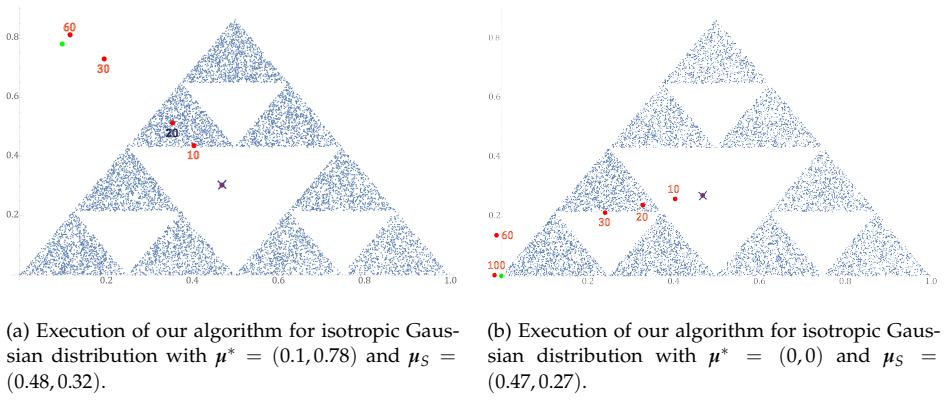
The load-bearing object is the weighted characteristic function $\psi(x)=1_S(x)\alpha_*^{-1}\mathcal{N}(\mu_*,\Sigma_*;x)/\mathcal{N}(0,I;x)$, which entangles the unknown set with the unknown Gaussian and whose Hermite coefficients are exactly the expectations $\mathbb{E}_{x\sim\mathcal{N}(\mu_*,\Sigma_*,S)}[H_V(x)]$ that samples reveal. The argument is carried by three identities: the tail of the Hermite expansion of $\psi$ is bounded by $\mathrm{poly}(1/\alpha)(\sqrt{\Gamma(S)}/k^{1/4}+1/k)$; the objective $M_f(u,B)=\mathbb{E}_{x\sim\mathcal{N}(\mu_*,\Sigma_*,S)}[e^{h(u,B;x)}\mathcal{N}(0,I;x)f(x)]$ is convex in $(u,B)$, with minimizer $(\Sigma_*^{-1}\mu_*,\Sigma_*^{-1})$ when $f=\psi$; and the set can be recovered by thresholding $\psi_k\mathcal{N}(0,I;x)/\mathcal{N}(\hat\mu,\hat\Sigma;x)$ at $1/2$. The algorithm's steps are therefore: estimate low-degree Hermite coefficients from truncated samples, run projected SGD on the convex objective, then threshold to recover the set.
What would settle it
Search in $\mathbb{R}^2$ for two Gaussians with $\|\mu_1-\mu_2\|_2>1$ and $\|\Sigma_1-\Sigma_2\|_F>1$, together with sets $S_1,S_2$ of mass at least $\alpha=0.1$, such that $d_{\mathrm{TV}}(\mathcal{N}(\mu_1,\Sigma_1,S_1),\mathcal{N}(\mu_2,\Sigma_2,S_2))$ is smaller than $(\alpha^3/8)\,d_{\mathrm{TV}}(\mathcal{N}(\mu_1,\Sigma_1),\mathcal{N}(\mu_2,\Sigma_2))$. An explicit pair, or a numerical optimizer that drives the ratio to zero while respecting the mass lower bound, would directly falsify Lemma 3 and with it the parameter-recovery chain.
Extended reading notes
Core claim
The central claim, on the paper's own terms, is that unknown truncation can be decoupled from the Gaussian parameters. The algorithm never learns the truncation set first; instead it estimates a weighted characteristic function $\psi(x)=1_S(x)\alpha_*^{-1}\,\mathcal{N}(\mu_*,\Sigma_*;x)/\mathcal{N}(0,I;x)$ from truncated samples, relying on the proof that this function has low-degree Hermite concentration when $S$ has bounded Gaussian surface area. Once a low-degree approximation $\psi_k$ is in hand, the paper defines a convex objective $M_{\psi_k}(u,B)$ whose unique minimizer is $(\Sigma_*^{-1}\mu_*,\Sigma_*^{-1})$, found by projected stochastic gradient descent. The same function, thresholded against the recovered Gaussian, also identifies the set $S$ up to small Gaussian measure. The abstract's strongest claim is Informal Theorem 2: with $N=d^k$ samples for $k=\mathrm{poly}(1/\alpha,1/\varepsilon)\,\Gamma(S)^2$, the output $\hat\mu,\hat\sigma^2I$ satisfies $d_{\mathrm{TV}}(\mathcal{N}(\mu,\sigma^2 I),\mathcal{N}(\hat\mu,\hat\sigma^2 I))\le\varepsilon$.
Load-bearing premise
The load-bearing premise is Lemma 3, which asserts that truncation cannot make two genuinely different Gaussians look alike: two Gaussians at total-variation distance $\varepsilon$ remain at least $C_\alpha \varepsilon$ apart after any truncation to sets of mass at least $\alpha$, with $C_\alpha=\Omega(\alpha^3)$. If that normalization lower bound fails, closeness of truncated distributions would not certify closeness of the underlying Gaussians, and both the VC-dimension recovery theorem and the abstract's parameter-recovery guarantee would collapse.
Editorial extensions
If this is right
- Any set family with VC-dimension $\mathrm{VC}(\mathcal C)$ admits recovery of the Gaussian mean and covariance to total-variation $\varepsilon$ from $\tilde O(\mathrm{VC}(\mathcal C)/\varepsilon + d^2/\varepsilon^2)$ samples.
- For spherical and diagonal Gaussians, families with Gaussian surface area $\Gamma(\mathcal C)$ can be handled in polynomial time with $d^{\mathrm{poly}(1/\alpha,1/\varepsilon)\Gamma(\mathcal C)^2}$ samples; this covers intersections of halfspaces, polynomial threshold functions, and all convex sets.
- The same samples suffice to recover the truncation set itself: the algorithm outputs a set whose symmetric difference with the true set has Gaussian mass below $\varepsilon$.
- Moment matching is sufficient for identification: matching moments up to degree $O(\Gamma(S)/\varepsilon^4)$ forces the truncated Gaussians, and hence the untruncated parameters, to be $\varepsilon$-close.
- The lower bound shows that some sets with small Gaussian surface area ($\Gamma(S)=O(d)$) still force $\Omega(2^{d/2})$ samples, so the polynomial dependence on $\Gamma$ cannot be replaced by a fixed polynomial in $d$ alone.
Reading between the lines
- Beyond the paper, the decoupling recipe—weighted indicator, Hermite concentration, convex objective—is not obviously tied to Gaussians; the same outline could be attempted for any exponential family with a quadratic log-density, with Gaussian surface area replaced by that family's isoperimetric profile.
- Beyond the paper, the sample bounds make concrete predictions for structured families: for intersections of $k$ halfspaces the bound is $d^{O(\log k)}$, so experiments on that family could reveal whether the true constant is closer to the bound than the convex-set case suggests.
- Beyond the paper, the moment-matching theorem implies truncated Gaussians are identifiable from finitely many moments; checking whether $O(\Gamma^2/\varepsilon^4)$ can be replaced by a smaller degree for axis-aligned rectangles or unions of boxes would separate the statistical from the computational content of the result.
Signed reviews
Editorial analysis
A structured set of objections, weighed in public.
Referee Report
Summary. The paper studies estimation of the mean and covariance of a Gaussian from samples that are observed only if they fall in an unknown truncation set S. It claims two main routes: a VC-dimension-based sample-complexity bound with an ERM/tournament algorithm (Informal Theorem 1, Theorem 1), and a computationally efficient algorithm for spherical and diagonal-covariance Gaussians whose sample complexity is controlled by the Gaussian surface area of the set family (Informal Theorems 2 and 3, Theorem 2). The technical engine is a Hermite-expansion approximation of the weighted indicator function ψ(x)=1_S(x) N*(x)/(α*N0(x)), followed by a convex stochastic-gradient optimization over the Gaussian parameters and a thresholding step to recover the set. The paper also proves a moment-matching identifiability result (Theorem 8) and a lower-bound construction (Theorem 7) intended to show that the surface-area dependence is tight. The proofs are detailed and mostly self-contained, with several technical lemmas deferred to the appendices.
Significance. If the proofs are sound, this is a significant contribution to high-dimensional truncated statistics: it is the first efficient algorithm for unknown truncation sets with guarantees governed by Gaussian surface area, it covers non-ERM families such as convex sets, and it includes a clean set-recovery corollary. The Hermite-concentration analysis of the weighted indicator and the convex SGD formulation are substantial and plausible. The paper is also honest about the distinction between VC-dimension and surface-area approaches. The main technical obstruction is Lemma 3, whose proof is not currently valid; since that lemma is load-bearing for the VC-dimension result and for the diagonal-covariance extension, the full scope of the claims is not yet established. The lower bound in Section 5 is also presented as a heuristic rather than a formal minimax argument. Both issues are fixable in a revision, so the paper merits major revision rather than rejection.
major comments (2)
- [Section 3, Lemma 3] The proof of Lemma 3 does not establish the claimed lower bound. The displayed chain lower-bounds E[|1-exp(p)|1_S] by E[|p|/2 1_{S\Q}] using |1-e^x|≥|x|/2 for |x|≤1, but the set S is defined by |1-exp(p)|≤T and the argument only shows N0(S\Q)≥α/4; it does not show that |p|≤1 on S\Q, and for p very negative the inequality fails since |1-e^p|≤1 while |p|/2 is unbounded. This step is load-bearing: Lemma 3 is used in Theorem 1 to transfer truncated-TV closeness to parameter-TV closeness and in the reduction from arbitrary diagonal covariance to the isotropic algorithm. I recommend replacing the pointwise inequality by the globally valid bound |1-e^p|≥min(1,|p|/2) and then controlling the mass of {p<−1} inside S\Q, or proving a uniform upper bound on T. In addition, the 'relaxed optimization' objective (1/α)∫|N(0,I;x)-(α/β)N(μ,Λ;x)|1_S(x)dx is not shown to be a lower bound on dTV(D1,D2): the true truncated densities have normalizing constants α1,α2 which need not equal α, and the free parameter β only adjusts the second density. The proof must justify this reduction before the lemma can be used.
- [Section 5, Theorem 7] The lower-bound proof is heuristic rather than a formal minimax argument. The claim that distinguishing N+(S+) from the reference density r requires a birthday collision is not supported by a reduction, and the event |Σ(pV−p)|<2^{-d/2} controls only one error term; it does not rule out algorithms that exploit the continuous sample coordinates inside each cube HV or that test other statistics of the sample. To establish the claimed Ω(2^{d/2}) lower bound for mean estimation, the proof should be recast as a two-point or Le Cam/Fano argument over pairs of hypotheses whose means are separated by Ω(1). As written, the tightness claim in the abstract and Section 6 is not established.
minor comments (5)
- [Section 3, Lemma 3 proof] The symbol S is used both for the family of sets and for the intersection set S1∩S2, which makes this proof unnecessarily confusing.
- [Section 4.1, Theorem 3] The equality ∑_{|V|≥k} should be ∑_{|V|>k} (or the definition of Skψ should be made consistent), since Skψ contains all Hermite terms of degree at most k.
- [Section 4.2, proof of Theorem 2] The sentence 'Hence we can we lose probability at most δ' contains a typo, and the probability accounting around the median-selection of the SGD runs is compressed; it should be spelled out in full.
- [Section 6, Lemma 14] The sentence 'Dχ2(N1‖N) Dχ2(N2‖N) are finite' is missing a conjunction and is hard to parse; it should be 'Dχ2(N1‖N) and Dχ2(N2‖N) are finite'.
- [Introduction, Informal Theorem 3] Informal Theorem 3 does not mention the affine-invariance assumption Γ(T(S))=O(Γ(S)) that is stated in Theorem 8; without that assumption the informal statement overclaims what is proved.
Circularity Check
No significant circularity: the paper's recovery guarantees are derived from explicit sample-complexity, Hermite-concentration, and anti-concentration arguments, and its self-citations are auxiliary parameter-free lemmas from prior work rather than circular premises.
full rationale
The central derivation is not circular. The unknown-truncation recovery results are obtained by first learning a weighted characteristic function through Hermite coefficient estimation, then optimizing an explicitly defined convex objective whose unique minimizer is identified by a direct calculation, and finally using standard concentration and anti-concentration tools. Lemma 3, which transfers total-variation closeness of truncated distributions to closeness of untruncated parameters, is a genuine lower-bound argument rather than a restatement of the conclusion. The paper's self-citations to [DGTZ18] are used for auxiliary facts such as empirical conditional mean/covariance estimation, projection onto the isotropic-position domain, and a truncated-Gaussian anti-concentration bound; these are parameter-free statements with stated assumptions that do not include the target unknown-truncation recovery claim, so they count as independent evidence under the review rules. No fitted parameter is later relabeled as a prediction, and no uniqueness theorem from the authors' prior work is invoked to forbid alternatives. A possible flaw in the proof of Lemma 3's inequality would be a correctness issue, not a circularity issue; the derivation chain does not assume its own conclusion.
Assumptions & free parameters
assumptions (5)
- domain assumption The truncation set S has mass at least alpha under the unknown Gaussian, and alpha is known to the algorithm (equation (3)).
- domain assumption The unknown Gaussian is in (O(log(1/alpha)), 1/16)-isotropic position after a whitening step (Definition 2).
- standard math Gaussian surface area is subadditive and bounds Gaussian noise sensitivity (Lemma 19, from [KOS08]).
- standard math Carbery-Wright anti-concentration for polynomials over Gaussian measure (Theorem 9) holds and is applied to degree-2 polynomials.
- domain assumption The class of sets is closed under affine transformations with Gaussian surface area growing at most as O(Gamma(S)) (Theorem 8 and Lemma 15).
Cite this review
Pith. "Pith review of Efficient Truncated Statistics with Unknown Truncation." pith.science (2026). https://pith.science/paper/L4M452LX
@misc{pith2026190801034,
  author       = {Pith},
  title        = {Pith review of: Efficient Truncated Statistics with Unknown Truncation},
  year         = {2026},
  howpublished = {\url{https://pith.science/paper/L4M452LX}},
  note         = {Machine review of arXiv:1908.01034}
}
abstract
We study the problem of estimating the parameters of a Gaussian distribution when samples are only shown if they fall in some (unknown) subset $S \subseteq \R^d$. This core problem in truncated statistics has long history going back to Galton, Lee, Pearson and Fisher. Recent work by Daskalakis et al. (FOCS'18), provides the first efficient algorithm that works for arbitrary sets in high dimension when the set is known, but leaves as an open problem the more challenging and relevant case of unknown truncation set. Our main result is a computationally and sample efficient algorithm for estimating the parameters of the Gaussian under arbitrary unknown truncation sets whose performance decays with a natural measure of complexity of the set, namely its Gaussian surface area. Notably, this algorithm works for large families of sets including intersections of halfspaces, polynomial threshold functions and general convex sets. We show that our algorithm closely captures the tradeoff between the complexity of the set and the number of samples needed to learn the parameters by exhibiting a set with small Gaussian surface area for which it is information theoretically impossible to learn the true Gaussian with few samples.
Figures
Reference graph
Works this paper leans on
-
[1]
Efficient learning of simplices
Joseph Anderson, Navin Goyal, and Luis Rademacher. Efficient learning of simplices. In Conference on Learning Theory , pages 1020--1045, 2013
work page 2013
-
[2]
The reverse isoperimetric problem for gaussian measure
Keith Ball. The reverse isoperimetric problem for gaussian measure. Discrete & Computational Geometry , 10(1):411--420, 1993
work page 1993
-
[3]
The art of progressive censoring
N Balakrishnan and Erhard Cramer. The art of progressive censoring . Springer, 2014
work page 2014
-
[4]
Truncated and censored samples: theory and applications
A Clifford Cohen. Truncated and censored samples: theory and applications . CRC press, 2016
work page 2016
-
[5]
Moses Charikar, Jacob Steinhardt, and Gregory Valiant. Learning from untrusted data. In Proceedings of the 49th Annual ACM SIGACT Symposium on Theory of Computing, STOC 2017, Montreal, QC, Canada, June 19-23, 2017 , pages 47--60, 2017
work page 2017
-
[6]
Distributional and l\^ q norm inequalities for polynomials over convex bodies in r\^ n
Anthony Carbery and James Wright. Distributional and l\^ q norm inequalities for polynomials over convex bodies in r\^ n . Mathematical research letters , 8(3):233--248, 2001
work page 2001
-
[7]
Learning from satisfying assignments
Anindya De, Ilias Diakonikolas, and Rocco A Servedio. Learning from satisfying assignments. In Proceedings of the twenty-sixth annual ACM-SIAM symposium on Discrete algorithms , pages 478--497. SIAM, 2014
2014
-
[8]
Pac learning from positive statistical queries
Fran c ois Denis. Pac learning from positive statistical queries. In International Conference on Algorithmic Learning Theory , pages 112--126. Springer, 1998
work page 1998
Show all 35 references
-
[9]
Efficient statistics, in high dimensions, from truncated samples
Constantinos Daskalakis, Themis Gouleakis, Christos Tzamos, and Manolis Zampetakis. Efficient statistics, in high dimensions, from truncated samples. In the 59th Annual IEEE Symposium on Foundations of Computer Science (FOCS) , 2018
2018
-
[10]
Faster and sample near-optimal algorithms for proper learning mixtures of gaussians
Constantinos Daskalakis and Gautam Kamath. Faster and sample near-optimal algorithms for proper learning mixtures of gaussians. In Proceedings of The 27th Conference on Learning Theory, COLT 2014, Barcelona, Spain, June 13-15, 2014 , pages 1183--1213, 2014
2014
-
[11]
Kane, Jerry Li, Ankur Moitra, and Alistair Stewart
Ilias Diakonikolas, Gautam Kamath, Daniel M. Kane, Jerry Li, Ankur Moitra, and Alistair Stewart. Robust estimators in high dimensions without the computational intractability. In IEEE 57th Annual Symposium on Foundations of Computer Science, FOCS 2016, 9-11 October 2016, Hyatt...
2016
-
[12]
Kane, Jerry Li, Ankur Moitra, and Alistair Stewart
Ilias Diakonikolas, Gautam Kamath, Daniel M. Kane, Jerry Li, Ankur Moitra, and Alistair Stewart. Being robust (in high dimensions) can be practical. In Proceedings of the 34th International Conference on Machine Learning, ICML 2017, Sydney, NSW, Australia, 6-11 August 2017 , p...
2017
-
[13]
Kane, Jerry Li, Ankur Moitra, and Alistair Stewart
Ilias Diakonikolas, Gautam Kamath, Daniel M. Kane, Jerry Li, Ankur Moitra, and Alistair Stewart. Robustly learning a gaussian: Getting optimal error, efficiently. In Proceedings of the Twenty-Ninth Annual ACM-SIAM Symposium on Discrete Algorithms, SODA 2018, New Orleans, LA, U...
2018
-
[14]
Combinatorial methods in density estimation
Luc Devroye and G \'a bor Lugosi. Combinatorial methods in density estimation . Springer Science & Business Media, 2012
2012
-
[15]
A polynomial number of random points does not determine the volume of a convex body
Ronen Eldan. A polynomial number of random points does not determine the volume of a convex body. Discrete & Computational Geometry , 46(1):29--47, 2011
2011
-
[16]
Properties and applications of Hh functions
RA Fisher. Properties and applications of Hh functions. Mathematical tables , 1:815--852, 1931
1931
-
[17]
Learning linear transformations
Alan Frieze, Mark Jerrum, and Ravi Kannan. Learning linear transformations. In Foundations of Computer Science, 1996. Proceedings., 37th Annual Symposium on , pages 359--368. IEEE, 1996
1996
-
[18]
An examination into the registered speeds of american trotting horses, with remarks on their value as hereditary data
Francis Galton. An examination into the registered speeds of american trotting horses, with remarks on their value as hereditary data. Proceedings of the Royal Society of London , 62(379-387):310--315, 1897
-
[19]
Learning convex bodies is hard
Navin Goyal and Luis Rademacher. Learning convex bodies is hard. arXiv preprint arXiv:0904.1227 , 2009
2009 arXiv
-
[20]
The gaussian surface area and noise sensitivity of degree-d polynomial threshold functions
Daniel M Kane. The gaussian surface area and noise sensitivity of degree-d polynomial threshold functions. computational complexity , 20(2):389--412, 2011
2011
-
[21]
Klivans, Yishay Mansour, and Rocco A
Adam Tauman Kalai, Adam R. Klivans, Yishay Mansour, and Rocco A. Servedio. Agnostically learning halfspaces. In 46th Annual IEEE Symposium on Foundations of Computer Science (FOCS 2005), 23-25 October 2005, Pittsburgh, PA, USA, Proceedings , pages 11--20, 2005
2005
-
[22]
Klivans, Ryan O'Donnell, and Rocco A
Adam R. Klivans, Ryan O'Donnell, and Rocco A. Servedio. Learning geometric concepts via gaussian surface area. In 49th Annual IEEE Symposium on Foundations of Computer Science, FOCS 2008, October 25-28, 2008, Philadelphia, PA, USA , pages 541--550, 2008
2008
-
[23]
Learning from positive and unlabeled examples
Fabien Letouzey, Fran c ois Denis, and R \'e mi Gilleron. Learning from positive and unlabeled examples. In International Conference on Algorithmic Learning Theory , pages 71--85. Springer, 2000
2000
-
[24]
Semigroup proofs of the isoperimetric inequality in euclidean and gauss space
Michel Ledoux. Semigroup proofs of the isoperimetric inequality in euclidean and gauss space. Bulletin des sciences math \'e matiques , 118(6):485--510, 1994
1994
-
[25]
tail" functions; when the
Alice Lee. Table of the gaussian" tail" functions; when the" tail" is larger than the body. Biometrika , 10(2/3):208--214, 1914
1914
-
[26]
Lai, Anup B
Kevin A. Lai, Anup B. Rao, and Santosh Vempala. Agnostic estimation of mean and covariance. In IEEE 57th Annual Symposium on Foundations of Computer Science, FOCS 2016, 9-11 October 2016, Hyatt Regency, New Brunswick, New Jersey, USA , pages 665--674, 2016
2016
-
[27]
On the Maximal Perimeter of a Convex Set in ^n with Respect to a Gaussian Measure , pages 169--187
Fedor Nazarov. On the Maximal Perimeter of a Convex Set in ^n with Respect to a Gaussian Measure , pages 169--187. Springer Berlin Heidelberg, Berlin, Heidelberg, 2003
2003
-
[28]
Analysis of Boolean Functions
Ryan O'Donnell. Analysis of Boolean Functions . Cambridge University Press, 2014
2014
-
[29]
On the systematic fitting of frequency curves
Karl Pearson. On the systematic fitting of frequency curves. Biometrika , 2:2--7, 1902
1902
-
[30]
Probabilistic methods in the geometry of banach spaces
Gilles Pisier. Probabilistic methods in the geometry of banach spaces. In Probability and analysis , pages 167--241. Springer, 1986
1986
-
[31]
On the generalised probable error in multiple normal correlation
Karl Pearson and Alice Lee. On the generalised probable error in multiple normal correlation. Biometrika , 6(1):59--68, 1908
1908
-
[32]
Truncated and censored samples from normal populations
Helmut Schneider. Truncated and censored samples from normal populations . Marcel Dekker, Inc., 1986
1986
-
[33]
Estimation of parameters of doubly truncated normal distribution from first four sample moments
SM Shah and MC Jaiswal. Estimation of parameters of doubly truncated normal distribution from first four sample moments. Annals of the Institute of Statistical Mathematics , 18(1):107--111, 1966
1966
-
[34]
Understanding machine learning: From theory to algorithms
Shai Shalev-Shwartz and Shai Ben-David. Understanding machine learning: From theory to algorithms . Cambridge university press, 2014
2014
-
[35]
Szeg \"o
G. Szeg \"o . Orthogonal Polynomials . Number . 23 in American Mathematical Society colloquium publications. American Mathematical Society, 1967
1967
Reviewed August 14, 2026 · model on record in the stance chip above.
Discussion (0). Continue with ORCID to comment.