REVIEW 3 major objections 4 minor 15 references
Modeling of Charged-Neutral Kaon Fluctuations as a Signature of DCC Production in A--A Collisions
T0 review · 3 major / 4 minor · reviewed 2026-08-14 · deepseek-v4-flash
Pith's one-line read The kaon fluctuation correlator ν_dyn(K±,K0s) rises sharply when as little as one percent of heavy-ion events contain DCC-like kaon fluctuations, making it a necessary first filter in DCC searches.
desk verdict Useful LHC-era kaon fluctuation baselines, but the DCC 'necessary condition' claim does not survive scrutiny without a charge-correlation control. read the letter →
The pith
A machine-rendered reading of the paper's core claim, the machinery that carries it, and where it could break.
The reading
What carries the argument
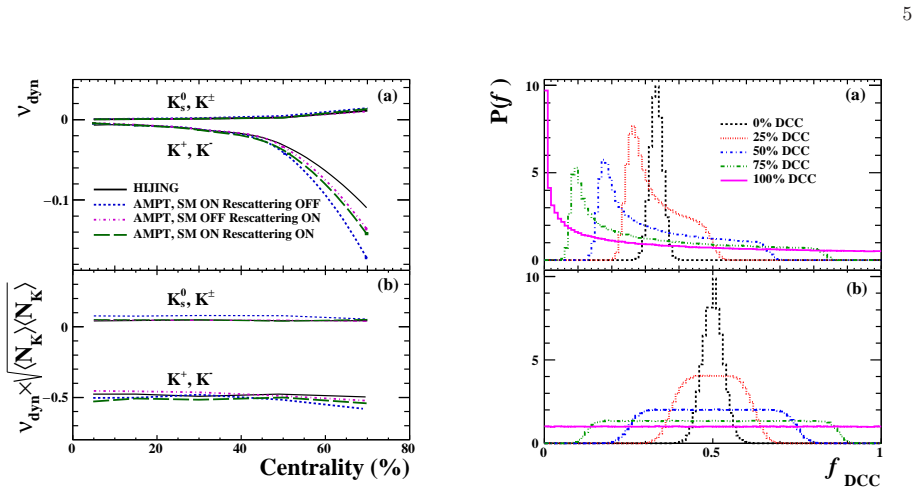
The central object is the ν_dyn correlator, defined as ν_dyn(α,β)=R_αα+R_ββ−2R_αβ with R_αβ=⟨n_α(n_α−δ_αβ)⟩/(⟨n_α⟩⟨n_β⟩)−1, which measures event-by-event fluctuations of the difference between charged and neutral kaon counts while remaining robust against detection inefficiencies because efficiency factors cancel in the ratios. On the DCC side, the machinery is the probability density P(f_K)=1 for the neutral kaon fraction, from the SU(3) linear sigma model, together with the pion density P(f_π)=1/(2√f_π); the DCC simulator generates kaon neutral fractions from the flat distribution and randomizes the charge of HIJING kaons, producing fluctuations whose centrality dependence is then compared with the no-DCC baselines.
What would settle it
A reader could falsify the claim by measuring ν_dyn(K±,K0s) in Pb–Pb collisions at √s_NN=2.76 TeV with the ALICE acceptance, 0.2<p_T<1.5 GeV/c and |η|<0.5: if the scaled quantity ν_dyn√⟨N_c⟩⟨N_0⟩ stays essentially centrality-invariant and tracks the HIJING/AMPT baselines in central collisions, rather than rising sharply as the model predicts for at least one percent DCC admixture, then the claimed sensitivity to small DCC admixtures is ruled out.
Extended reading notes
Core claim
The paper's central discovery is that the magnitude of ν_dyn(K±,K0s) responds strongly and characteristically to DCC-like fluctuations, even when those fluctuations are present in only about one percent of events. In the absence of DCCs, HIJING and AMPT predict a ν_dyn that is positive in all centrality classes and approximately follows 1/N dilution with increasing multiplicity. Once kaon charges are randomized in a fraction of HIJING events to mimic DCC decay, the centrality trend flattens and the multiplicity-scaled and charged-density-scaled correlators rise markedly in central Pb–Pb collisions, with deviations visible at a one percent DCC fraction. The authors state this as a necessary-condition result: large ν_dyn(K±,K0s) alone cannot identify DCC production, but without such a large value a DCC signal is unlikely, so the observable constitutes a first and necessary experimental condition for signaling possible DCC production.
Load-bearing premise
The load-bearing assumption is that real DCC domains, if formed, would produce kaon yield fluctuations equivalent to randomizing the charge of HIJING kaons, so the simulated one percent threshold is only as good as that equivalence.
Editorial extensions
If this is right
- A measurement of ν_dyn(K±,K0s) in Pb–Pb collisions at LHC energies that stays on the HIJING/AMPT baseline and preserves 1/N scaling with centrality would rule out DCC admixtures at or above the one percent level.
- A sharp rise of the scaled correlator in central collisions would provide a concrete trigger for more detailed DCC searches, even if it could not by itself prove DCC formation.
- The positivity of ν_dyn(K±,K0s) in all centralities, unlike the negative ν_dyn(K+,K−) imposed by charge conservation, offers a simple discriminator between kaon charge fluctuations and charged-neutral kaon isospin fluctuations.
- Experimental detector effects reduce and smear measured kaon yields, yet because ν_dyn corrects for efficiencies and acceptances, the reported sensitivity to small DCC admixtures is expected to survive at least approximately in a real ALICE analysis.
- The centrality dependence of scaled ν_dyn provides a way to separate genuine DCC-like fluctuations from trivial multiplicity fluctuations, since the latter follow 1/N dilution while DCC injection flattens that trend.
Reading between the lines
- Because the K0s is reconstructed through its π+π− decay with combinatorial background, a detector-level extension of this DCC injection model would quantify how the claimed one percent threshold moves under realistic ALICE conditions; this is an inference extending beyond the paper's generator-level study.
- Comparing ν_dyn(π0,π±) and ν_dyn(K±,K0s) in the same simulated events could sharpen the DCC filter, since the neutral-pion fraction follows a cusp-shaped distribution while the neutral-kaon fraction follows a flat one, so the two correlators should respond differently to DCC domain size; the paper does not make this comparison explicitly.
- The necessary-condition logic suggests a practical search strategy: scan the centrality dependence of multiplicity-scaled ν_dyn in existing LHC data, and use the observed flatness or rise to set upper limits on the DCC fraction f_DCC and the per-event DCC probability p_DCC; this is an editorial extension of the authors' stated criterion.
- If strangeness-rich DCC domains exist, their kaon yield fluctuations may be accompanied by enhanced Ω(Ω̄) production as previously suggested at SPS energies, so combining ν_dyn(K±,K0s) with strange-baryon yields could test whether an anomalous kaon fluctuation signal is tied to genuinely strange DCC physics; this connection is implicit in the paper's motivation rather than tested there.
Signed reviews
Editorial analysis
A structured set of objections, weighed in public.
Referee Report
Summary. The paper proposes ν_dyn(K±,Ks0) as an observable for charged-versus-neutral kaon fluctuations that could indicate Disoriented Chiral Condensate (DCC) production in Pb–Pb collisions at √sNN = 2.76 TeV. It defines the observable correctly via factorial correlators, computes baseline predictions with HIJING and AMPT under an ALICE-like acceptance, and then injects DCC-like fluctuations through three scenarios, including a HIJING+DCC mix in which kaon charges are randomized. The authors report that a 1% DCC admixture produces a visible change in the centrality dependence of ν_dyn and conclude that large values of ν_dyn(K±,Ks0) constitute a necessary condition for DCC production.
Significance. If the result holds, the paper provides a useful and falsifiable prediction: DCC admixtures should flatten the centrality dependence of ν_dyn(K±,Ks0), and the invariant-scaling plots in Fig. 5 offer a clear diagnostic. The baseline HIJING/AMPT part is straightforward and the analytical decomposition in Eq. (5) is valuable. The main weakness is that the DCC injection model is not tied to actual DCC dynamics and may violate conservation laws, so the magnitude of the claimed 1% sensitivity is not yet secured. The manuscript is transparent and reproducible, but the abstract's 'necessary condition' statement goes beyond what the simulations demonstrate.
major comments (3)
- [Sec. IV, Scenario 3 and Eq. (5)] The DCC-like events are generated by randomizing the charge of kaons produced by HIJING. This operation directly changes the charged-neutral asymmetry that ν_dyn measures, and it is not constrained to conserve total electric charge or strangeness. Since Eq. (5) shows that Rcc depends on ν_dyn(K+,K−), the randomization also alters the charged-kaon correlation term, so the observed increase in ν_dyn(K±,Ks0) may reflect the artificial relaxation of conservation-law correlations rather than a genuine DCC isospin fluctuation. The paper does not show ν_dyn(K+,K−) for the mixed HIJING+DCC samples, so this alternative explanation is not excluded. Please rerun the injection with a charge-conserving prescription and report ν_dyn(K+,K−) as a control for all mixed samples.
- [Figs. 1, 3–5] No statistical uncertainties are reported on any of the ν_dyn values. The central quantitative claim is that a 1% DCC admixture produces a significant deviation from the HIJING baseline; without error bars, confidence bands, or event counts per centrality class, the significance of the deviations in Fig. 5 cannot be assessed. Please provide statistical uncertainties and, where relevant, statements about the number of events used.
- [Sec. IV and abstract] The model is not validated against the DCC distribution it claims to implement. The text states that DCC kaon production follows P(fK)=1 in Eq. (2), but Scenario 3 implements DCC-like fluctuations by randomizing HIJING kaon charges, with no demonstration that this produces the claimed distribution or matches linear-sigma-model DCC decay kinematics. The introduction itself lists domain size, rescattering, and finite acceptance as relevant complications, but none of these is modeled. The conclusion that large ν_dyn(K±,Ks0) is a 'necessary condition' for DCC production therefore overreaches: the simulations establish only that one particular toy model produces large values, not that all (or even typical) DCC scenarios do. Please either validate the injection against DCC decay kinematics or soften the conclusion to 'within this model.'
minor comments (4)
- [Sec. II, Eq. (2)] The notation switches between f_K (defined in the text) and fk in the probability density P(fk)=1; please use a single symbol consistently.
- [Sec. III] The sentence 'The cumulant R+− is larger than either of R++ or R−− )' contains an unmatched parenthesis and should be clarified, for instance by stating whether 'larger' means larger in magnitude or algebraically larger.
- [Fig. 5 caption] The 'Default' curve in Fig. 5(a) is not defined in the caption; please state explicitly that it is the HIJING baseline without DCC injection.
- [Sec. III] The simulations are generator-level with no momentum smearing or particle losses. Since the paper targets ALICE, please comment on how finite detector efficiency and momentum resolution would affect the DCC scenarios, even if ν_dyn is designed to be robust to uniform efficiency.
Circularity Check
The claimed 1% DCC sensitivity is a built-in response of the charge-randomization model, not an emergent prediction.
-
self definitional
[Sec. IV (DCC Model Simulations), Scenario 3 and Fig. 5; Sec. II (definition of νdyn)]
"DCC-like fluctuations are introduced by randomizing the charge of kaons produced by HIJING. ... Injection of DCC-like fluctuations, however, drastically changes this behaviour ... Note that significant deviations from the HIJING baseline are found already when the fraction of DCC amounts to only one percent."
The observable νdyn(nc,n0) is defined in Sec. II, Eqs. (3-4), to measure relative yield fluctuations of charged versus neutral kaons; the text states that 'νdyn(nc,n0) is thus sensitive to fluctuations of the neutral fraction fK.' The DCC signal is implemented by randomly reassigning kaon charges, which directly enlarges exactly the charged-neutral yield imbalance that νdyn measures. In addition, the DCC component draws kaon fractions from P(fK)=1, Eq. (2), the broadest possible distribution of precisely the quantity being measured. The monotonic rise of νdyn with fDCC and the claimed 1% sensitivity are therefore inherited from the injection prescription rather than being emergent predictions of DCC physics.
full rationale
The paper's central claim is that νdyn(K±,K0s) is very sensitive to a small admixture of DCC-like fluctuations and that large values are a necessary first condition for DCC production. The mechanism producing this sensitivity is, however, defined into the model: the DCC events are generated by randomizing kaon charges and by drawing neutral fractions from P(fK)=1, and νdyn is expressly constructed to measure fluctuations of the charged-neutral kaon fraction. Thus the key positive result of Fig. 5 follows from the definition of the signal rather than from an independent dynamical derivation. The non-DCC baseline from HIJING and AMPT is genuinely independent and provides a useful reference, so this is not a case of wholesale circularity. The paper also openly labels the model 'simple phenomenological' and 'qualitative,' which mitigates the issue somewhat. Nevertheless, the load-bearing conclusion that large νdyn is a 'necessary condition' for DCC production goes beyond what the construction demonstrates: it shows only that one charge-randomizing toy model produces large νdyn, not that all physically plausible DCC scenarios must do so. The balance is a partial circularity centered on the simulated DCC signal being the same quantity the observable measures.
Assumptions & free parameters
free parameters (4)
- fDCC =
varied (0-100%)
- pDCC =
varied (0-0.5)
- fK =
user-selected
- Multiplicity scale factor =
3/2
assumptions (4)
- ad hoc to paper DCC decay produces kaon charge randomization as implemented in the toy model.
- domain assumption ν_dyn is robust against detection inefficiencies and K0_s weak-mixing losses.
- domain assumption Neutral kaon fraction in DCC decays follows P(fK)=1, and pion fraction P(fπ)=1/(2√fπ).
- domain assumption HIJING and AMPT provide a reasonable non-DCC baseline for kaon production in Pb-Pb at 2.76 TeV.
Cite this review
Pith. "Pith review of Modeling of Charged-Neutral Kaon Fluctuations as a Signature of DCC Production in A--A Collisions." pith.science (2026). https://pith.science/paper/REJZAEZH
@misc{pith2026190801130,
  author       = {Pith},
  title        = {Pith review of: Modeling of Charged-Neutral Kaon Fluctuations as a Signature of DCC Production in A--A Collisions},
  year         = {2026},
  howpublished = {\url{https://pith.science/paper/REJZAEZH}},
  note         = {Machine review of arXiv:1908.01130}
}
abstract
Anomalous event-by-event fluctuations of the relative yields of neutral (K$^0_s$) and charged kaon (K$^\pm$) have been predicted to yield a signature for the formation of Disoriented Chiral Condensate (DCC) in relativistic heavy-ion collisions. In this work, we model the production and decay of DCCs in the context of heavy-ion collisions at the Large Hadron Collider, and estimate the sensitivity of large acceptance detectors, such as the ALICE detector, towards the identification of such anomalous decays. Our study is based on the robust statistical observable, $\nu_{\rm dyn}$, known for its sensitivity to dynamical fluctuations. We first present simulations without DCCs, based on the HIJING and AMPT models, in order to establish an approximate reference for the magnitude of $\nu_{\rm dyn}({\rm K}^{\pm},{\rm K}^{0}_{s})$ and its centrality evolution in Pb--Pb collisions at the TeV energy scale. We next introduce simple phenomenological models of K$^0_s$ vs. K$^\pm$ event-by-event yield fluctuations, which we use to study the feasibility and sensitivity of detection of the production of DCCs in heavy-ion collisions. Although the precision of models such as HIJING and AMPT limit their use as absolute references and thus render anomalous fluctuations difficult to define precisely, our studies demonstrate that the magnitude of $\nu_{\rm dyn}({\rm K}^{\pm},{\rm K}^{0}_{s})$ is in fact very sensitive to the presence of small admixture of DCCs in normal non-DCC events. Consequently, while large values of $\nu_{\rm dyn}({\rm K}^{\pm},{\rm K}^{0}_{s})$ may not be sufficient to identify the existence of DCCs, nonetheless they constitute a first and necessary condition to signal their possible production in heavy-ion collisions.
Figures


Reference graph
Works this paper leans on
-
[14]
Zi-Wei Lin, Che Ming Ko, Bao-An Li, Bin Zhang, and Subrata Pal, Phys. Rev. C 72 , 064901, (2005)
work page 2005
-
[1]
2 < p T < 1. 5 GeV/ c and the pseudo-rapidity range |η| < 0. 5 to mimic the conditions of an ongo- ing ALICE analysis [14]. The number of charged, Nc, and neutral, N0, kaons were counted event- by-event and used to compute event-ensemble av- erages ⟨Nc⟩ and ⟨N0⟩, and second factorial mo- ments ⟨Nc(Nc − 1)⟩, ⟨N0(N0 − 1)⟩, and ⟨NcN0⟩. In turn, these were co...
-
[2]
K. L. Kowalski, J. D. Bjorken, and C. C. Taylor, SLAC-PUB-6109, (1993)
work page 1993
-
[3]
J. D. Bjorken, Acta. Phys.Polon. B 28 , 2773- 2791, (1997)
work page 1997
- [4]
-
[5]
M. M Aggarwal et al. (W A98 Collaboration), Phys. Lett. B 420 , 169 (1998)
work page 1998
-
[6]
T. C Brooks et al. (MiniMax Collaboration), Phys. Rev. D 61 , 032003 (2000)
work page 2000
-
[7]
L. Adamczyk et al. (STAR Collaboration), Phys. Rev. C 91 , 034905 ,(2015)
work page 2015
Show all 15 references
-
[8]
J. I. Kapusta and S. M. Wong, Phys. Rev. Lett 86, 4251 (2001)
2001
-
[9]
Sean Gavin, Joseph. I. Kapusta, Phys. Rev. C 65 , 054910, (2002)
2002
-
[10]
Pruneau, S
C. Pruneau, S. Gavin, and S. Voloshin, Phys.Rev. C 66 , 044904, (2002)
2002
-
[11]
Schaffner-Bielich and J
J. Schaffner-Bielich and J. Randrup, Phys. Rev. C 59 , 3329 (1999)
1999
-
[12]
B. K. Nandi, G. C. Mishra, B. Mohanty, D. P. Mahapatra and T. K. Nayak, Phys. Letts. B 449 , 109-113 (1999)
1999
-
[13]
X. N. Wang and M. Gyulassy, Phys. Rev. D 44 , 3501 (1991)
1991
-
[15]
10 (2019) no.1, 22
Ranjit Nayak (ALICE Collaboration), MDPI Proc. 10 (2019) no.1, 22
2019
Reviewed August 14, 2026 · model on record in the stance chip above.
Discussion (0). Continue with ORCID to comment.