REVIEW 8 minor 52 references
Understanding the Nature of Mean-Field Semiclassical Light-Matter Dynamics: An Investigation of Energy Transfer, Electron-Electron Correlations, External Driving and Long-Time Detailed Balance
T0 review · 0 major / 8 minor · reviewed 2026-08-14 · deepseek-v4-flash
Pith's one-line read More electron correlation can make a semiclassical light model worse.
desk verdict A careful minimal-model benchmark that convincingly shows full CI can overestimate driven double-excitation population in semiclassical light-matter dynamics. read the letter →
The pith
A machine-rendered reading of the paper's core claim, the machinery that carries it, and where it could break.
The reading
What carries the argument
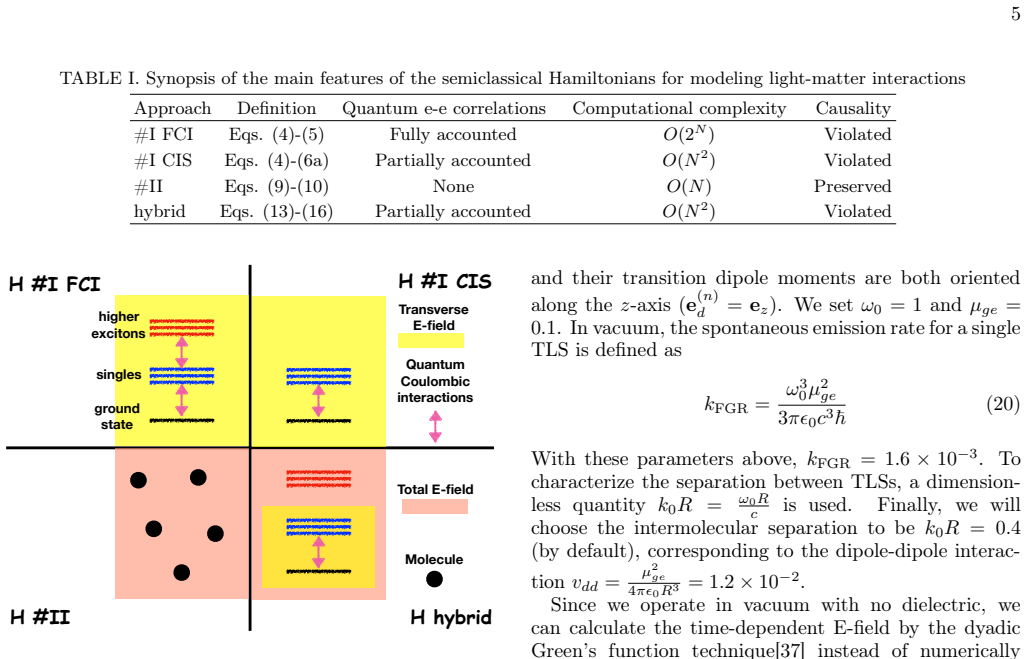
Hamiltonian #I for a pair of two-level systems is a $4\times4$ many-body Hamiltonian: a ground state $|0\rangle$, two singly excited states at energy $\hbar\omega_0$ coupled by the classical field, and a doubly excited state $|2\rangle$ at $2\hbar\omega_0$, with the instantaneous dipole-dipole operator $v_{\rm dd} = \mu_{ge}^2/(4\pi\epsilon_0 R^3)\,\hat\sigma_x^{(D)}\otimes\hat\sigma_x^{(A)}$ coupling $|0\rangle$ and $|2\rangle$. The paper propagates this Hamiltonian at three levels of electronic structure: full CI (all four states), CI singles (only the two singly excited states), and a hybrid scheme (singles treated quantum-mechanically, higher excitations mean-field), all within mean-field Ehrenfest dynamics and compared with the standard Born-Markov rotating-wave master equation. The load-bearing mechanism is the mismatch between the quantum two-body coupling and the classical field: in Ehrenfest dynamics the emission rate from an excited state is $k_{\rm Eh} = \rho_{gg} k_{\rm FGR}$, so decay of the double through $|2\rangle \to |b\rangle$ is suppressed until the bright state has population, while $v_{\rm dd}$ keeps feeding population into $|2\rangle$.
What would settle it
Compute the driven two-level-system dynamics with a numerically converged quantum treatment of the photon field (beyond the Born-Markov assumption) at $k_0R=0.4$ and $\Omega=0.3\,k_{\rm FGR}$; if the exact steady-state electronic energy and double population agree with the standard master equation rather than with #I-FCI, the paper's overestimation claim is confirmed, whereas agreement with #I-FCI would falsify it.
Extended reading notes
Core claim
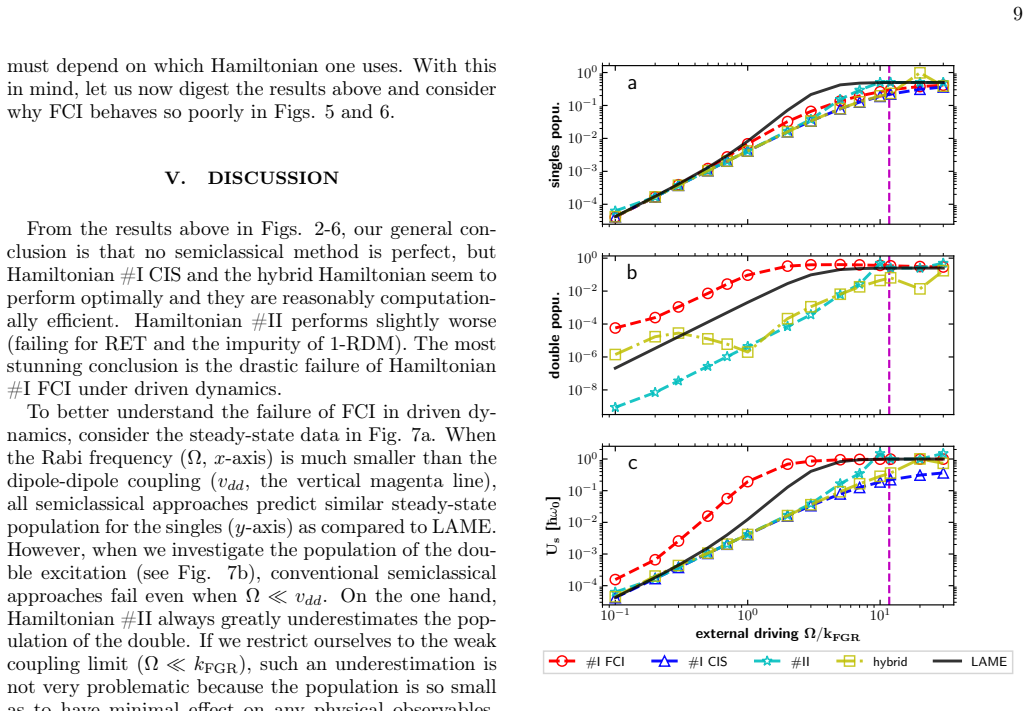
The central discovery is an anomaly: for two identical two-level systems in vacuum at separation $k_0R=0.4$, driven by a weak continuous-wave field with Rabi frequency $\Omega = 0.3\,k_{\rm FGR}$, time-dependent full configuration interaction for Hamiltonian #I predicts a steady-state electronic energy far above what the standard quantum master equation benchmark gives; the overestimation persists at stronger driving. The mechanism is that the quantum dipole-dipole coupling $v_{\rm dd}$ connects the ground state directly to the doubly excited state, while the classical field's dissipation, whose rate in Ehrenfest dynamics is proportional to the lower-state population, is nearly quenched when the system starts in the ground state. Population therefore accumulates in the double excitation and inflates the stored electronic energy. The authors state the general conclusion: for driven systems, the population dynamics for higher excitations (beyond singles) cannot be correctly described by Hamiltonian #I FCI even when the driving field is very weak.
Load-bearing premise
The whole anomaly is measured against the standard Born-Markov, rotating-wave quantum master equation used as the benchmark; if that benchmark is inaccurate at $k_0R=0.4$ for these driving strengths, the reported #I-FCI overshoot would be an artifact of the comparison rather than a real failure.
Editorial extensions
If this is right
- If the central claim is correct, driven semiclassical simulations cannot assume that upgrading from CIS to FCI improves accuracy; for Hamiltonian #I it can produce unphysical energy accumulation.
- The paper's practical recommendation is to use Hamiltonian #I CIS or the hybrid Hamiltonian as a trade-off between accuracy and cost, while accepting that no tested semiclassical method is quantitatively reliable.
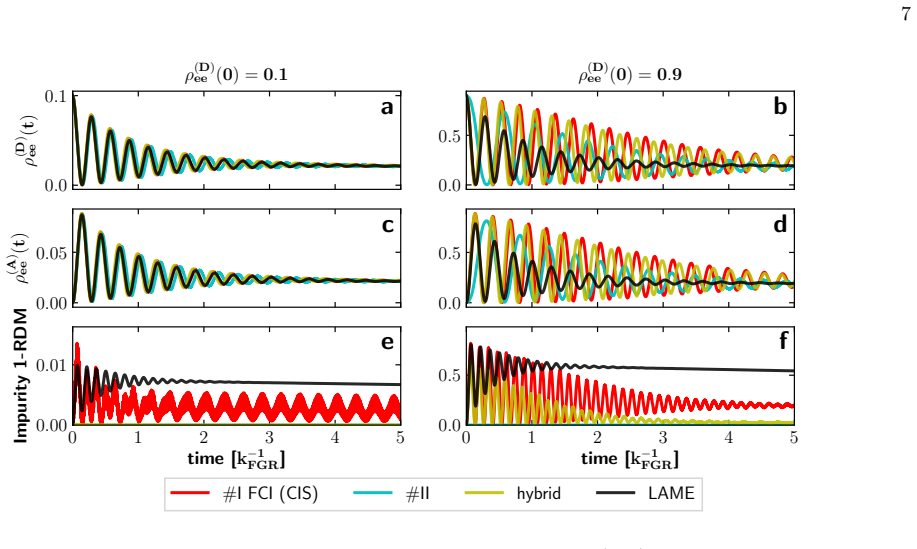
- When the Rabi frequency is much smaller than the dipole-dipole coupling, all approaches reproduce the master-equation population dynamics for single excitations, so the anomaly is specific to the treatment of higher excitations.
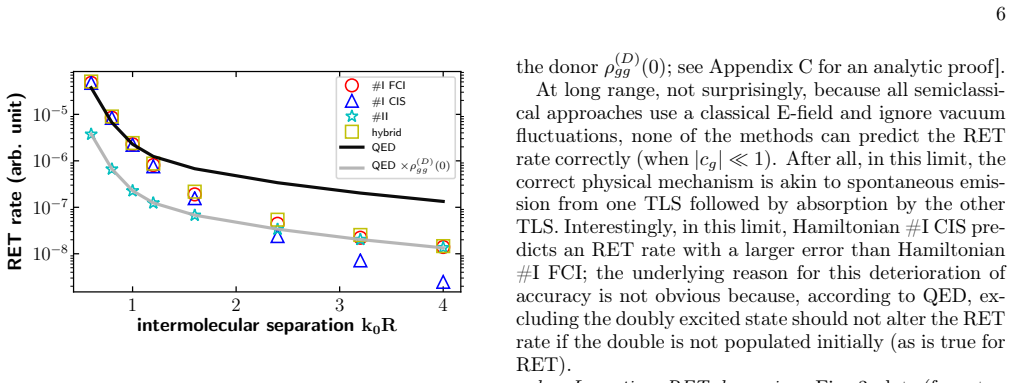
- For short-range resonance energy transfer, Hamiltonian #I FCI, #I CIS, and the hybrid Hamiltonian quantitatively match the perturbative QED rate, confirming that the static Coulomb term is the essential ingredient for RET at close separations.
- Long-range RET remains incorrect in all semiclassical approaches because vacuum fluctuations are missing, which limits any mean-field treatment in the retarded regime regardless of the Hamiltonian chosen.
Reading between the lines
- A natural extrapolation, not computed in the paper, is that the double-population accumulation will grow with the number of molecules, since the density of coupled higher-excitation states increases; testing $N>2$ two-level systems would show how quickly the #I-FCI anomaly worsens.
- The diagnosis suggests a testable remedy: adding a stochastic or Lindblad-type correction that restores spontaneous-emission decay even when the lower state is unpopulated should remove the energy accumulation, and the paper points toward such improvements.
- Because the paper's benchmark is itself an approximation, the safest reading is that #I-FCI disagrees with the standard master equation; a numerically exact QED calculation would decide whether the disagreement is a genuine failure or an artifact of comparing two approximate methods.
- The same quantum-classical mismatch may affect any semiclassical scheme that combines correlated electronic states with classical fields, suggesting that the intuition 'more correlation is better' should be replaced by the requirement that dissipation and decoherence be added consistently with the retained correlation.
Signed reviews
Editorial analysis
A structured set of objections, weighed in public.
Referee Report
Summary. This paper compares several semiclassical (Ehrenfest) approaches to light-matter dynamics on a minimal model of two identical two-level systems: Hamiltonian #I with full configuration interaction (FCI) or configuration interaction singles (CIS), Hamiltonian #II in the time-dependent Hartree (mean-field) approximation, and a hybrid Hamiltonian that keeps quantum two-body couplings for ground and singly excited states but treats higher excitations at the mean-field level. The authors benchmark resonance energy transfer (RET) rates and long-time dynamics against perturbative QED and the Lehmberg-Agarwal master equation (LAME), and driven dynamics against LAME. The principal claim is that, under weak or strong external driving, #I-FCI strongly overestimates the long-time electronic energy because it overestimates the double-excitation population: the classical field produces an Ehrenfest decay rate from the double to the bright state proportional to the bright-state population, which is initially zero, so the two-body Coulomb coupling accumulates population in the double. The hybrid Hamiltonian removes this anomaly and matches LAME for weak driving, while #II is stable but fails for short-range RET. The authors recommend #I-CIS or the hybrid as a practical compromise.
Significance. The central finding, if correct, is significant and somewhat counterintuitive: including full electron-electron correlation through FCI within a semiclassical framework can worsen long-time driven dynamics relative to a mean-field treatment. The paper supports this with consistent numerical results (Figs. 5-7) and a mechanistic explanation that is quantitatively consistent with the observed double-population growth. The analytic derivation in Appendix C showing that Hamiltonian #II's RET rate equals the QED rate multiplied by the donor's initial ground-state population is a clean, parameter-free result that confirms the numerical simulations. The hybrid Hamiltonian is a novel interpolation that eliminates the FCI anomaly and is likely to be of practical interest to the community. The manuscript is clearly written, and the model and parameters are described in sufficient detail for reproducibility.
minor comments (8)
- [Title] The phrase 'Long-Time Detailed Balance' in the title is not discussed in the text; either add a section on detailed balance or revise the title.
- [Section I] The word 'Hartree-Fork' should be 'Hartree-Fock'.
- [Abstract and Introduction] The notation '(#1 as #2)' is confusing; it should read '(#I as #II)'.
- [Section IV.B] The sentence 'as is shown in Fig. 6b(d)' should be 'as is shown in Figs. 6b and 6d'.
- [Section V] When reducing the pair to a three-level system, the paper should explicitly state that the dark state is exactly decoupled for identical, parallel dipoles under uniform driving; this justifies the neglect and is currently only implicit.
- [Section V] The statement that the mechanism 'should be very general, valid for ... many molecules' is an extrapolation beyond the simulations; consider softening it to 'may be general' or explicitly labeling it as a conjecture.
- [Section VI] The claim that 'no semiclassical algorithm performs quantitatively at all' seems overly strong given the good agreement for weakly excited RET dynamics (Fig. 3, left panel) and weak driving (Fig. 5a); clarify the intended scope.
- [Figure 4] The y-axis label 'Peak Freq. of E-field [ ω0]' is not explicit about the normalization; indicate whether this is the peak frequency in units of ω0 or the deviation from ω0.
Circularity Check
No significant circularity: the #I-FCI anomaly is a direct simulation result benchmarked against external QED and LAME references; no fitted parameter or self-citation chain produces the central claim.
full rationale
The central claim that Hamiltonian #I-FCI overestimates long-time electronic energy under weak external driving is a numerical observation from the stated Hamiltonian in Eq. (4), propagated without fitted parameters and compared against the independent Lehmberg-Agarwal master equation (LAME) of Appendix B and perturbative QED of Appendix C. The anomaly is not defined into the model: #I-FCI and LAME are different dynamical equations, and their disagreement in Figs. 5-7 is computed rather than assumed. The Sec. V mechanism uses kEh = rho_gg k_FGR (Eq. (23)), a standard Ehrenfest result supported by Crisp-Jaynes and Milonni as well as prior author work; this is an interpretive explanation of the observed overpopulation of the doubly excited state, not a fitted input used to generate the figures. The Appendix B identity connecting the RWA form of Hamiltonian #II to the mean-field LAME is a derived consistency check, and it concerns #II rather than the #I-FCI anomaly. The hybrid Hamiltonian's removal of the anomaly is by construction because higher excitations are mean-field in Eqs. (13)-(16), but the paper does not present this as an independent prediction; the key benchmark remains the external LAME comparison. Self-citations (Refs. 17, 18, 21) supply method-development context and causality discussion, but they do not carry the load-bearing comparison. No equation reduces by construction to its own input, no fitted parameter is renamed as a prediction, and no uniqueness theorem from the authors' prior work is invoked. Therefore the derivation chain is self-contained for the claims made.
Assumptions & free parameters
assumptions (5)
- domain assumption Classical EM field and mean-field (Ehrenfest) current density (Eq. 3).
- domain assumption Long-wavelength and point-dipole approximation for the molecular polarization (Eq. 19).
- domain assumption Electronic exchange between molecules is neglected (Sec. II A).
- domain assumption Slow-envelope approximation ρ_ge(t - R/c) ≈ ρ_ge(t) e^{-iω0 R/c} for the EM-free reduction (Eq. A24).
- domain assumption LAME benchmark validity (Born-Markov and RWA, Appendix B).
Cite this review
Pith. "Pith review of Understanding the Nature of Mean-Field Semiclassical Light-Matter Dynamics: An Investigation of Energy Transfer, Electron-Electron Correlations, External Driving and Long-Time Detailed Balance." pith.science (2026). https://pith.science/paper/P4VIOQXT
@misc{pith2026190801401,
  author       = {Pith},
  title        = {Pith review of: Understanding the Nature of Mean-Field Semiclassical Light-Matter Dynamics: An Investigation of Energy Transfer, Electron-Electron Correlations, External Driving and Long-Time Detailed Balance},
  year         = {2026},
  howpublished = {\url{https://pith.science/paper/P4VIOQXT}},
  note         = {Machine review of arXiv:1908.01401}
}
read the original abstract
Semiclassical electrodynamics is an appealing approach for studying light-matter interactions, especially for realistic molecular systems. However, there is no unique semiclassical scheme. On the one hand, intermolecular interactions can be described instantaneously by static two-body interactions connecting different molecules plus a classical transverse E-field; we will call this Hamiltonian #I. On the other hand, intermolecular interactions can also be described as effects that are mediated exclusively through a classical one-body E-field without any quantum effects at all (assuming we ignore electronic exchange); we will call this Hamiltonian #II. Moreover, one can also mix these two Hamiltonians into a third, hybrid Hamiltonian, which preserves quantum electron-electron correlations for lower excitations but describes higher excitations in a mean-field way. To investigate which semiclassical scheme is most reliable for practical use, here we study the real-time dynamics of a pair of identical two-level systems (TLSs) undergoing either resonance energy transfer (RET) or collectively driven dynamics. While all approaches perform reasonably well when there is no strong external excitation, we find that no single approach is perfect for all conditions. Each method has its own distinct problems: Hamiltonian #I performs best for RET but behaves in a complicated manner for driven dynamics. Hamiltonian #II is always stable, but obviously fails for RET at short distances. One key finding is that, under externally driving, a full configuration interaction description of Hamiltonian #I strongly overestimates the long-time electronic energy, highlighting the not obvious fact that, if one plans to merge quantum molecules with classical light, a full, exact treatment of electron-electron correlations can actually lead to worse results than a simple mean-field treatment.
Figures
Figures from the paper (3 more)


Reference graph
Works this paper leans on
-
[1]
Time-Dependent Full Configuration Interaction To fully account forˆV (nl) Coul, if one has the means, one can propagate the time-dependent Schrödinger equation in a complete basis using Hamiltonian #I. These ex- act, molecular quantum dynamics are known as time- dependent full configuration interaction (TD-FCI). Ob- viously, TD-FCI is possible only for simp...
-
[2]
Time-Dependent Configuration Interaction Singles For large systems with many molecules, in order to reduce the computational cost, the most common treat- ment is to truncate Hamiltonian #I at the level of single excitations, also called the time-dependent configuration interaction singles (TD-CIS) method. Here, the time- dependent electronic wave function i...
-
[3]
Time-dependent Hartree Method Given the one-body nature of Hamiltonian #II, the time-dependent Schrödinger equation can be evolved ex- actly with simple time-dependent Hartree (TDH) dy- namics, i.e., the electronic wavefunction can be written as a Hartree product: |ΨN(t)⟩ =|ψ1(t)⟩|ψ2(t)⟩···| ψN(t)⟩ (11) where|ψn(t)⟩ denotes an effective one-body wavefunc- ...
-
[4]
(6), and|ψhe(t)⟩ char- acterizes the wave function for higher excitations
Time-dependent Hybrid Method ForthehybridHamiltonian, themany-bodywavefunc- tion can be expanded as follows: |ΨN(t)⟩ =|ΨCIS(t)⟩⊗| ψhe(t)⟩ (17) Here,|ΨCIS(t)⟩ characterizes the wave function for the CIS states, which is defined in Eq. (6), and|ψhe(t)⟩ char- acterizes the wave function for higher excitations. On the one hand, we evolve|ΨCIS(t)⟩ by TD-CIS as ...
-
[5]
By contrast, the fact that Ehrenfest is too pure (with an impurity much smaller than LAME) is a statement that additional decoherence is needed. Apart from the RET dynamics of the two-level molecules, it is also worthwhile to study the frequency of the scattered E-field. Fig. 4 plots the frequency of the scattered E-field as a function ofρ(D) ee (0) for RET...
- [6]
-
[7]
N. Jia, N. Schine, A. Georgakopoulos, A. Ryou, L. W. Clark, A. Sommer, and J. Simon, Nat. Phys. 14, 550 (2018)
work page 2018
-
[8]
C. Schäfer, M. Ruggenthaler, H. Appel, and A. Rubio, Proc. Natl. Acad. Sci.116, 4883 (2019)
work page 2019
Show all 52 references
-
[9]
Thakkar, C
N. Thakkar, C. Cherqui, and D. J. Masiello, ACS Pho- tonics 2, 157 (2015)
2015
-
[10]
M. Du, L. A. Martínez-Martínez, R. F. Ribeiro, Z. Hu, V. M. Menon, and J. Yuen-Zhou, Chem. Sci. 9, 6659 (2018)
2018
-
[11]
J.Flick, M.Ruggenthaler, H.Appel, andA.Rubio,Proc. Natl. Acad. Sci.114, 3026 (2017)
2017
-
[12]
Gross and S
M. Gross and S. Haroche, Phys. Rep.93, 301 (1982)
1982
-
[13]
Puthumpally-Joseph, M
R. Puthumpally-Joseph, M. Sukharev, O. Atabek, and E. Charron, Phys. Rev. Lett.113, 163603 (2014)
2014
-
[14]
Puthumpally-Joseph, O
R. Puthumpally-Joseph, O. Atabek, M. Sukharev, and E. Charron, Phys. Rev. A 91, 043835 (2015), arXiv:1501.00457
2015 arXiv
-
[15]
Sukharev and A
M. Sukharev and A. Nitzan, Phys. Rev. A84, 043802 (2011)
2011
-
[16]
Neuhauser and K
D. Neuhauser and K. Lopata, J. Chem. Phys. 127, 154715 (2007)
2007
-
[17]
Lopata and D
K. Lopata and D. Neuhauser, J. Chem. Phys. 130, 104707 (2009)
2009
-
[18]
Lopata and D
K. Lopata and D. Neuhauser, J. Chem. Phys. 131, 014701 (2009). 17
2009
-
[19]
P.G.LisinetskayaandR.Mitrić,Phys.Rev.B 89,035433 (2014)
2014
-
[20]
M. D. Crisp and E. T. Jaynes, Phys. Rev. 179, 1253 (1969)
1969
-
[21]
Milonni, Phys
P. Milonni, Phys. Rep.25, 1 (1976)
1976
-
[22]
T. E. Li, A. Nitzan, M. Sukharev, T. Martinez, H.-T. Chen, and J. E. Subotnik, Phys. Rev. A 97, 032105 (2018)
2018
-
[23]
H.-T. Chen, T. E. Li, M. Sukharev, A. Nitzan, and J. E. Subotnik, J. Chem. Phys. 150, 044102 (2019), arXiv:1806.04662
2019 arXiv
-
[24]
N. M. Hoffmann, C. Schäfer, A. Rubio, A. Kelly, and H. Appel, Phys. Rev. A 99, 063819 (2019), arXiv:1901.01889
2019 arXiv
-
[25]
N. M. Hoffmann, H. Appel, A. Rubio, and N. T. Maitra, Eur. Phys. J. B91, 180 (2018)
2018
-
[26]
T. E. Li, H.-T. Chen, A. Nitzan, M. Sukharev, and J. E. Subotnik, J. Phys. Chem. Lett. , 5955 (2018)
2018
-
[27]
R. W. Ziolkowski, J. M. Arnold, and D. M. Gogny, Phys. Rev. A 52, 3082 (1995)
1995
-
[28]
C. S. DiLoreto and C. Rangan, Phys. Rev. A97, 013812 (2018), arXiv:1709.00517
2018 arXiv
-
[29]
Jestädt, M
R. Jestädt, M. Ruggenthaler, M. J. T. Oliveira, A. Rubio, and H. Appel, , 1 (2018), arXiv:1812.05049
2018 arXiv
-
[30]
Klamroth, Phys
T. Klamroth, Phys. Rev. B68, 245421 (2003)
2003
-
[31]
Krause, T
P. Krause, T. Klamroth, and P. Saalfrank, J. Chem. Phys. 123, 074105 (2005)
2005
-
[32]
Greenman, P
L. Greenman, P. J. Ho, S. Pabst, E. Kamarchik, D. A. Mazziotti, and R. Santra, Phys. Rev. A 82, 023406 (2010)
2010
-
[33]
J. C. Tremblay, T. Klamroth, and P. Saalfrank, J. Chem. Phys. 129, 084302 (2008)
2008
-
[34]
Rohringer, A
N. Rohringer, A. Gordon, and R. Santra, Phys. Rev. A 74, 043420 (2006)
2006
-
[35]
Scheel, L
S. Scheel, L. Knöll, D.-G. Welsch, and S. M. Barnett, Phys. Rev. A60, 1590 (1999)
1999
-
[36]
C. Lo, J. T. Wan, and K. Yu, Comput. Phys. Commun. 142, 453 (2001)
2001
-
[37]
C. L. Cortes and Z. Jacob, Opt. Express 26, 19371 (2018), arXiv:1807.06660
2018 arXiv
-
[38]
S.Mukamel, Principles of Nonlinear Optical Spectroscopy (Oxford University Press, New York, 1999)
1999
-
[39]
Förster, Ann
T. Förster, Ann. Phys.437, 55 (1948)
1948
-
[40]
Bruus and K
H. Bruus and K. Flensberg,Introduction to Many-body Quantum Theory in Condensed Matter Physics(Oxford University Press Inc., New York, 2004)
2004
-
[41]
Beck, Phys
M. Beck, Phys. Rep.324, 1 (2000)
2000
-
[42]
Novotny and B
L. Novotny and B. Hecht, Principles of Nano-Optics (Cambridge University Press, Cambridge, 2006)
2006
-
[43]
Taflove and S
A. Taflove and S. C. Hagness,Computational Electrody- namics, 3rd ed. (Artech House, Inc., Norwood, 2005)
2005
-
[44]
J. C. Butcher,Numerical Methods for Ordinary Differ- ential Equations(John Wiley & Sons„ New York, 2008)
2008
-
[45]
Salam, Molecular Quantum Electrodynamics: Long- Range Intermolecular Interactions(John Wiley & Sons, Inc., Hoboken, NJ, 2010)
A. Salam, Molecular Quantum Electrodynamics: Long- Range Intermolecular Interactions(John Wiley & Sons, Inc., Hoboken, NJ, 2010)
2010
-
[46]
Salam, Atoms6, 56 (2018)
A. Salam, Atoms6, 56 (2018)
2018
-
[47]
R. H. Lehmberg, Phys. Rev. A2, 883 (1970)
1970
-
[48]
G. S. Agarwal, inSpringer Tracts Mod. Phys.(Springer, Berlin, Heidelberg, 1974) pp. 1–128
1974
-
[49]
Andrews, Chem
D. Andrews, Chem. Phys.135, 195 (1989)
1989
-
[50]
Cohen-Tannoudji, J
C. Cohen-Tannoudji, J. Dupont-Roc, and G. Grynberg, Photons and Atoms: Introduction to Quantum Electro- dynamics (Wiley, New York, 1997)
1997
-
[51]
Breuer and F
H.-P. Breuer and F. Petruccione,The Theory of Open Quantum Systems (Oxford University Press, New York, 2007)
2007
-
[52]
Salam, J
A. Salam, J. Chem. Phys.136, 014509 (2012)
2012
Reviewed August 14, 2026 · model on record in the stance chip above.
Discussion (0). Continue with ORCID to comment.