REVIEW 3 major objections 5 minor 1 cited by
Automatic Playtesting for Game Parameter Tuning via Active Learning
T0 review · 3 major / 5 minor · reviewed 2026-08-14 · deepseek-v4-flash
Pith's one-line read Active learning reduces the number of human playtests needed to tune game parameters, for difficulty and control goals alike.
desk verdict Useful case study, but the evaluation metrics are surrogate accuracy (MSE/F1), not the design goals themselves, so the headline claim is one notch ahead of the evidence. read the letter →
The pith
A machine-rendered reading of the paper's core claim, the machinery that carries it, and where it could break.
The reading
What carries the argument
The load-bearing object is the acquisition function, a rule that scores every untried parameter setting by how informative or how promising a playtest there would be, and thereby turns playtesting into a sequential decision process. The paper evaluates four regression acquisition functions (variance, probability of improvement, expected improvement, upper confidence bound) and five classification acquisition functions (entropy, query-by-bagging vote and probability, expected error reduction, variance reduction). These functions carry the argument because the experiments vary only the acquisition function and show that balanced exploration-exploitation (UCB for regression, entropy/QBB for classification) consistently outperforms random selection.
What would settle it
Run a live playtesting loop on a new game with fresh human players each round, letting the acquisition function choose settings online, and compare objective value after N playtests against a random-sampling baseline; if active learning does not beat random sampling around 65-100 playtests for difficulty regression or around 100-200 playtests for control preference classification, the central claim would be falsified.
Extended reading notes
Core claim
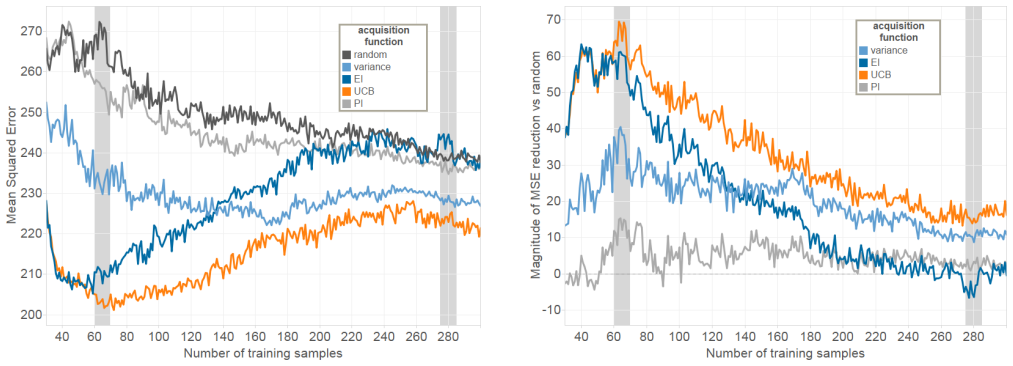
For difficulty-related tuning, treating the number of times a player is hit as a continuous output of three enemy parameters, and training a Gaussian process with the upper-confidence-bound acquisition function, lowered squared error to 203 at 65 playtests and 224 at 280 playtests, compared with 268 and 239 for random sampling. For control-related tuning, treating 'better or worse' control comparisons as a classification output, entropy, query-by-bagging, and expected error reduction improved F1 scores over random sampling for all three classifiers tested; with a Gaussian process classifier, entropy reached 0.763 F1 at 100 samples versus 0.720 random. The paper's conclusion is that active learning is a promising route to reducing the number of playtests needed for both difficulty and control design goals.
Load-bearing premise
The pool-based experiment assumes that a pre-collected set of playtests under random settings faithfully represents what would happen if the acquisition function's chosen settings were given to new players live, and if that correspondence fails, the measured playtest-count savings may not transfer to real tuning loops.
Editorial extensions
If this is right
- For difficulty tuning, using upper-confidence-bound selection over a Gaussian process reaches its best performance at about 70 playtests, a level that random sampling never reached on the same data.
- The largest gains over random sampling appear at small sample sizes, so active learning is most useful when the playtest budget is limited.
- Control settings can be tuned from pairwise 'better/worse' judgments using entropy, query-by-bagging, or expected error reduction, improving F1 over random sampling for Gaussian process, kernel SVM, and neuro-evolved classifiers.
- No single acquisition function is best across all tasks and budgets, so playtesting systems need to choose acquisition functions according to the design goal and the number of tests available.
- The approach can be embedded in iterative or online design loops to converge more rapidly on good fixed parameters for future use.
Reading between the lines
- Editorial inference: if the pool-based result transfers to live playtesting, the same acquisition functions could tune subjective qualities such as perceived difficulty, fun, or cognitive load whenever those can be scored as regression or classification labels.
- Editorial inference: the relative weakness of pure variance and variance-reduction acquisition functions suggests that in sparse high-dimensional playtest pools, maximising uncertainty is a poor guide; designers should favour functions that balance exploration with exploitation or tolerate noisy labels.
- Editorial inference: since classification gains were largest for the weakest baseline model, active learning may be most valuable precisely when the playtest model is poor and the budget is small, not when a strong model already exists.
Signed reviews
Editorial analysis
A structured set of objections, weighed in public.
Referee Report
Summary. The paper proposes casting game parameter tuning as an active learning (AL) problem, in which an acquisition function selects which parameter settings to playtest next so as to reduce the number of human playtests needed to reach a design goal. The authors define two classes of design objectives: a regression objective for tuning enemy parameters so that players are hit exactly six times per wave, and a classification objective for tuning control parameters according to player preference comparisons. They collect human playtest data from an online shoot-'em-up game and evaluate several regression and classification acquisition functions through 10-fold cross-validated, pool-based simulations, comparing against random sampling. The reported results show lower predictive MSE and higher predictive F1 for most acquisition functions compared with random sampling, and the authors conclude that AL is a promising approach for reducing the number of playtests required to achieve a design goal.
Significance. If the claims were fully supported, the paper would make a useful contribution to AI-assisted game design: it identifies a concrete, low-level playtesting task, uses genuine human playtest data, compares a broad set of acquisition functions, and addresses a domain—control tuning—that has received little attention in game AI. The cross-validated pool-based benchmarking against random sampling is a reasonable and standard way to assess label efficiency, and the paper is generally clearly written. However, the significance is currently contingent on closing a substantial gap between the stated design objectives and the metrics actually reported; the experiments demonstrate label-efficient surrogate modeling more directly than they demonstrate more efficient parameter tuning.
major comments (3)
- [§5.2, Tables 1–2, Figures 2–5] The experiments evaluate predictive model accuracy, not achievement of the stated design objectives. Section 4 defines the regression design goal as parameters that yield exactly six hits per wave, yet Table 1 and Figures 2–3 report GP MSE on held-out hit counts, which measures how well the model predicts player behavior rather than how close the selected parameter settings are to the design target. For classification, Section 5.2 explicitly redefines the goal as 'maximizing prediction quality (objective function: F1 score)' instead of the Section 4 goal of identifying control settings that players prefer. As a result, the paper demonstrates that AL can train surrogate models with fewer labels, but it does not demonstrate that AL reduces the number of playtests needed to achieve a design goal. I ask the authors to add an evaluation of the final recommended parameter settings under the original design objectives—for regression, report the distance from the chosen parameter setting to the six-hit target using held-out data; for classification, report whether the settings selected by the acquisition functions are actually preferred by players, not just whether pairwise preference labels are predicted accurately.
- [§6.1 and Table 1 footnote] The claim that 'AL methods led to significant improvements over the random baseline in all reported results tables' is not supported by any statistical analysis. The paper reports point estimates of MSE and F1 for selected sample sizes without confidence intervals, standard errors, or significance tests, and the figures show bands whose overlap suggests that some differences may be within noise. I request repeated cross-validation with confidence intervals, or paired statistical tests across folds, so that the reader can judge whether the reported improvements are reliable.
- [§5.2 and §6.3] The pool-based evaluation assumes that selecting parameter settings from a pre-collected pool of random playtests accurately represents a live playtesting loop in which the acquisition function's chosen settings are given to new human players. The paper does not report whether the pool adequately covers regions near the design optimum, nor whether the acquisition function can actually propose settings in those regions, nor whether player responses change when settings are chosen adaptively. I ask the authors to add coverage diagnostics—for example, the number of pool points near the target, the distribution of acquisition-selected settings versus the random pool—or a small live validation, so that the transfer of the reported reductions in playtest count to a real playtesting process can be assessed.
minor comments (5)
- [Title page] The affiliation line contains a typo: 'T echnology' should be 'Technology'.
- [§5.1] The paper states that 47 of 57 players provided only binary responses and that the analysis was limited to this subset, but it does not explain how the 'neither' and 'no difference' options were treated when present, nor why players who used those options were excluded. A brief clarification of the preprocessing of preference labels would improve reproducibility.
- [Tables 1–2 and Figures 2–5] The figure captions describe bands as 'values that were averaged to produce Table 1' and Table 2, but the bands in Figures 2 and 4 appear to be shaded regions whose meaning (e.g., standard error, range across folds) is not defined. Please state explicitly what the bands represent.
- [§6.2] The text says 'Entropy was only effective with few samples,' but Table 2 shows the same GP entropy F1 of 0.763 at both 100 and 200 samples, while the random baseline improves from 0.720 to 0.773 over that range. The narrative could be clarified to distinguish absolute performance from improvement over random sampling.
- [References] Reference [26] is listed as 'forthcoming, 2013'; if the paper has since appeared, the full citation should be updated. Also, the statement in Section 6.1 about 'significant improvements' should either be removed or accompanied by the statistical test details described in the major comments.
Circularity Check
No significant circularity: the active-learning comparisons are held-out evaluations against a random baseline, and the paper's central claim does not reduce to its inputs by construction.
full rationale
The paper's derivation chain is an empirical comparison: a pool of human playtest data is collected, models are trained on a small random seed, acquisition functions select additional inputs without seeing their outputs, and objective performance is then measured on held-out test data. There is no step in which a fitted parameter is renamed as a prediction or in which a design goal is defined in terms of the quantity being reported. The regression experiments minimize squared error to a target hit rate of 6 and report MSE on held-out data (Section 5.2, Table 1), so the reported values are genuine out-of-sample model errors, not artifacts of fitting. The classification experiments report F1 on held-out preference judgments (Section 5.2, Table 2), again a standard cross-validated evaluation. The paper's self-citations (e.g., [26], [28]) appear only in related-work positioning and are not load-bearing for the experimental results, which use publicly standard AL methods with references to Settles [19] and Bayesian experimental design [3, 5]. The offline pool-based design is an external-validity assumption about transfer to a live playtesting loop, not a circularity, because the acquisition function truly selects inputs from the pool without knowing their labels. One legitimate concern is that the classification 'design goal' of player preference is operationalized in Section 5.2 as maximizing F1, which is a surrogate model-accuracy objective rather than the stated design objective of finding preferred control settings; however, this is a measurement-validity or correctness issue, not an identity between input and output. F1 is computed from labels not used in selecting those labels and is not equivalent by construction to the design goal. Therefore the paper merits a circularity score of 0.
Assumptions & free parameters
assumptions (4)
- domain assumption The pool of pre-collected random playtests is representative of the parameter settings an online AL loop would offer.
- domain assumption A player being hit six times per wave is a valid proxy for a difficulty design goal.
- standard math Standard Gaussian process, KSVM, and neuro-evolution model assumptions hold for gameplay data.
- domain assumption Acquisition function behavior transfers from the pool-based setting to a sequential human playtesting process.
Cite this review
Pith. "Pith review of Automatic Playtesting for Game Parameter Tuning via Active Learning." pith.science (2026). https://pith.science/paper/2BBWLCUT
@misc{pith2026190801417,
  author       = {Pith},
  title        = {Pith review of: Automatic Playtesting for Game Parameter Tuning via Active Learning},
  year         = {2026},
  howpublished = {\url{https://pith.science/paper/2BBWLCUT}},
  note         = {Machine review of arXiv:1908.01417}
}
read the original abstract
Game designers use human playtesting to gather feedback about game design elements when iteratively improving a game. Playtesting, however, is expensive: human testers must be recruited, playtest results must be aggregated and interpreted, and changes to game designs must be extrapolated from these results. Can automated methods reduce this expense? We show how active learning techniques can formalize and automate a subset of playtesting goals. Specifically, we focus on the low-level parameter tuning required to balance a game once the mechanics have been chosen. Through a case study on a shoot-`em-up game we demonstrate the efficacy of active learning to reduce the amount of playtesting needed to choose the optimal set of game parameters for two classes of (formal) design objectives. This work opens the potential for additional methods to reduce the human burden of performing playtesting for a variety of relevant design concerns.
Figures

Forward citations
Cited by 1 Pith paper
-
NTRL: Encounter Generation via Reinforcement Learning for Dynamic Difficulty Adjustment in Dungeons and Dragons
A contextual-bandit RL agent, trained in a D&D combat simulator, generates encounters that lengthen fights, lower party HP, and keep win rates near 80%, though these outcomes are direct reward components rather than i...
Reference graph
Works this paper leans on
-
[1]
the single most important activity a designer engages in
INTRODUCTION Iterative game design practices emphasize the centrality of playtesting to improve and refine a game’s design. Human playtesters provide valuable feedback on audience reactions to a game. Playtesting is often claimed to be“the single most important activity a designer engages in” [7]. Test data in- forms designers of how real players may react...
-
[2]
Formulating efficient playtesting as an AL problem
-
[3]
Defining several common playtesting goals in terms of AL metrics
-
[4]
Demonstrating the efficacy of AL to reduce the number of playtests needed to optimize (1) difficulty-related and (2) control-related game parameters in a case study of a shoot-‘em-up game We believe machine–driven playtesting is a novel use of machine learning in games. Unlike prior work on dynamic difficulty and adaptive games we focus on the case of decid- in...
arXiv 1908
-
[5]
RELATED WORK Two research areas are closely related to machine playtest- ing: offline game design tools and online game adaptation. Offline game design tools help designers explore possible game designs by defining a high-level space of games through a design language. Online game adaptation changes game designs in real-time based on player actions or game sta...
-
[6]
RESULTS AND DISCUSSION Overall our results show AL is a promising approach for reducing the number of playtests needed to achieve a design goal. For enemy parameter tuning (a regression problem) we found acquisition functions that balance exploration and ex- ploitation (especially UCB) have the best performance. For control tuning (a classification problem...
-
[7]
CONCLUSIONS We have shown how playtesting for low-level design pa- rameter tuning can be automated using active learning. AL Figure 5: Classification performance improvement over random sampling with different combinations of classifiers and acquisition functions. Higher val- ues indicate better performance. Shows gains in F1 score with an increasing pool of...
-
[8]
PLAYTESTING AS ACTIVE LEARNING Our goal is to automate mundane playtesting tasks by effi- ciently choosing game design parameters for players to test. Active learning provides a generic set of techniques to per- form the playtesting process of choosing a set of design pa- rameters to test toward achieving a design goal. Playtesting typically involves trade-...
Show all 45 references
-
[9]
fric- tion
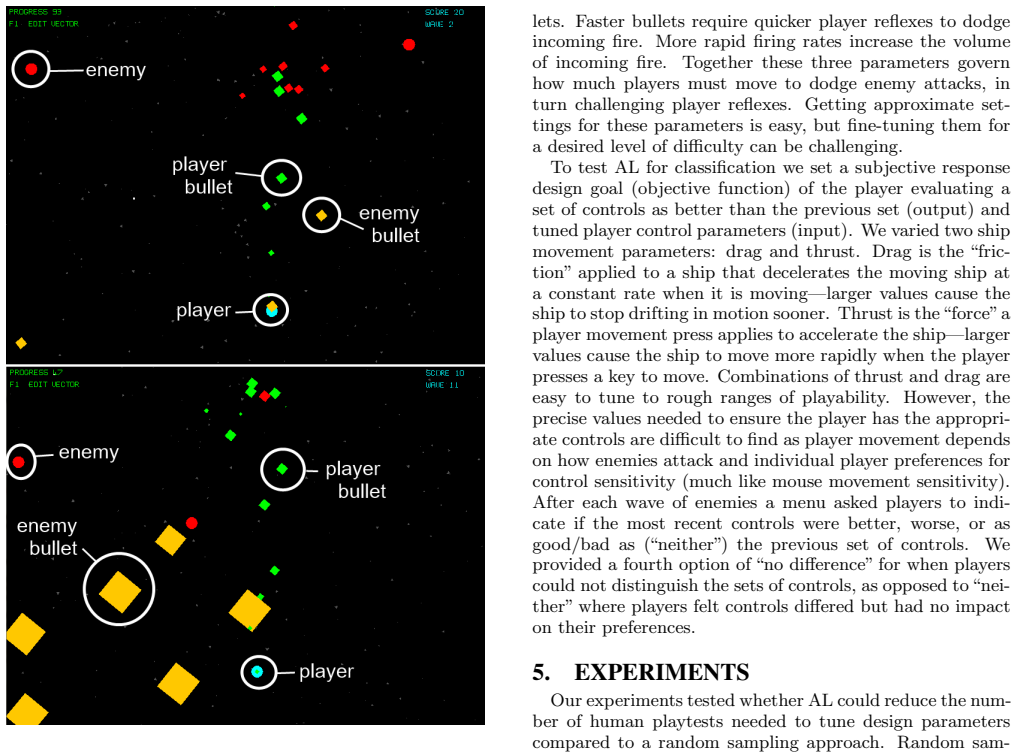
GAME DOMAIN We sought to assess how well AL could reduce the num- ber of playtests needed to achieve a design goal. To con- duct a case study of machine–driven playtesting we devel- oped a simple shoot-‘em-up game (Figure 1). Shoot-‘em-up games emphasize reflexes and pattern re...
-
[10]
neuro-evolution
EXPERIMENTS Our experiments tested whether AL could reduce the num- ber of human playtests needed to tune design parameters compared to a random sampling approach. Random sam- pling is the standard baseline used to evaluate the efficacy of AL models for improving an objective fu...
-
[11]
Train the regression or classification model on the train- ing data set
-
[12]
Evaluate the objective function for that model on the testing data set
-
[13]
1For computational reasons we use a gradient-based opti- mization method for network structure, size, and weights, rather than the more common neuro-evolutionary ap- proaches
Use the acquisition function to pick a new input sam- ple from the training pool (without yet knowing the sample output) to improve the objective function. 1For computational reasons we use a gradient-based opti- mization method for network structure, size, and weights, rather...
-
[14]
Move the selected sample (including the true output) from the training pool into the training data
-
[15]
Rafferty et al
use AL to recommend sets of useful player metrics to track. Rafferty et al. [16] optimize game designs offline to learn the most about player cognition. Machine–driven playtesting complements prior uses of AL for game design by focusing on efficiently improving designs for player b...
-
[16]
We used a maximum of 300 training samples in both regres- sion and classification
Return to the first step and repeat the process until the maximum number of training samples are used. We used a maximum of 300 training samples in both regres- sion and classification
-
[17]
A. I. Schein and L. H. Ungar. Active learning for logistic regression: an evaluation. Machine Learning, 68(3):235–265, 2007
2007
-
[18]
Abe and H
N. Abe and H. Mamitsuka. Query learning strategies using boosting and bagging. In International Conference on Machine Learning, 1998
1998
-
[19]
A. W. Bauer, S. Cooper, and Z. Popovic. Automated redesign of local playspace properties. In 8th International Conference on the Foundations of Digital Games, 2013
2013
-
[20]
player types
combine a rule-based reasoning approach with simula- tion to generate content for a physics-based game. Simu- lation approaches are valuable when design involves an in- tractably large space of possible parameters to test and can serve as input to optimization techniques. Mode...
-
[21]
E. Brochu. Interactive Bayesian optimization: learning user preferences for graphics and animation . PhD thesis, University of British Columbia, 2010
2010
-
[22]
Butler, A
E. Butler, A. M. Smith, Y.-E. Liu, and Z. Popovi ¨A˘G. A mixed-initiative tool for designing level progressions in games. In ACM Symposium on User Interface Software and Technology, 2013
2013
-
[23]
Chaloner and I
K. Chaloner and I. Verdinelli. Bayesian experimental design: A review. Statistical Science, 10 (3):273–304, 1995
1995
-
[24]
M. Cook, S. Colton, and J. Gow. Initial results from co-operative co-evolution for automated platformer design. In EvoGames 2012, 2012
2012
-
[25]
Fullerton, C
T. Fullerton, C. Swain, and S. Hoffman. Game design workshop: a playcentric approach to creating innovative games. Morgan Kaufmann, 2008
2008
-
[26]
Harrison and D
B. Harrison and D. L. Roberts. Analytics-driven dynamic game adaption for player retention in scrabble. In IEEE Conference on Computational Intelligence in Games , pages 1–8. IEEE, 2013
2013
-
[27]
Hastings, R
E. Hastings, R. K. Guha, and K. Stanley. Automatic content generation in the galactic arms race video game. IEEE Transactions on Computational Intelligence and AI in Games , 1:245–263, 2009
2009
-
[28]
Horswill and L
I. Horswill and L. Foged. Fast procedural level population with playability constraints. In Proceedings of the Eighth Conference on Artificial Intelligence and Interactive Digital Entertainment , 2012
2012
-
[29]
Hunicke and V
R. Hunicke and V. Chapman. AI for dynamic difficulty adjustment in games. In AAAI Workshop on Challenges in Game Artificial Intelligence , 2004
2004
-
[30]
A. Jaffe, A. Miller, E. Andersen, Y.-E. Liu, A. Karlin, and Z. Popovic. Evaluating competitive game balance with restricted play. In Proceedings of the Eighth Conference on Artificial Intelligence and Interactive Digital Entertainment, 2012
2012
-
[31]
Liapis, H
A. Liapis, H. P. Martınez, J. Togelius, and G. N. Yannakakis. Adaptive game level creation through rank-based interactive evolution. In IEEE Conference on Computational Intelligence in Games , volume 4, pages 71–78. Springer, 2013
2013
-
[32]
Magerko, B
B. Magerko, B. Stensrud, and L. Holt. Bringing the schoolhouse inside the box - a tool for engaging, individualized training. In 25th Army Science Conference, 2006
2006
-
[33]
Normoyle, J
A. Normoyle, J. Drake, M. Likhachev, and A. Safonova. Game-based data capture for player metrics. In 8th AAAI Conference on Artificial Intelligence and Interactive Digital Entertainment , 2012
2012
-
[34]
A. N. Rafferty, M. Zaharia, and T. L. Griffiths. Optimally designing games for cognitive science research. In 34th Annual Conference of the Cognitive Science Society, pages 280–287, 2012
2012
-
[35]
Seif El-Nasr
M. Seif El-Nasr. Interaction, narrative, and drama: Creating an adaptive interactive narrative using performance arts theories. Interaction Studies, 8(2):209–240, 2007
2007
-
[36]
B. Settles. Active learning, volume 6. Morgan & Claypool Publishers, 2012
2012
-
[37]
Shaker, N
M. Shaker, N. Shaker, and J. Togelius. Evolving playable content for cut the rope through a simulation-based approach. In 9th AAAI Conference on Artificial Intelligence and Interactive Digital Entertainment, 2013
2013
-
[38]
Shaker, G
N. Shaker, G. N. Yannakakis, and J. Togelius. Crowdsourcing the aesthetics of platform games. IEEE Transactions on Computational Intelligence and AI in Games, 5:276–290, 2013
2013
-
[39]
A. M. Smith, B. Eric, and Z. Popovic. Quantifying over play: Constraining undesirable solutions in puzzle design. In 8th International Conference on the Foundations of Digital Games , 2013
2013
-
[40]
Srinivas, A
N. Srinivas, A. Krause, S. Kakade, and M. Seeger. Gaussian process optimization in the bandit setting: No regret and experimental design. In International Conference on Machine Learning, 2010
2010
-
[41]
D. Thue, V. Bulitko, M. Spetch, and E. Wasylishen. Interactive storytelling: A player modelling approach. In 3rd AAAI Conference on Artificial Intelligence and Interactive Digital Entertainment , 2007
2007
-
[42]
Yannakakis and J
G. Yannakakis and J. Togelius. Experience-driven procedural content generation. IEEE Transactions on Affective Computing, 2(3):147–161, 2011
2011
-
[43]
Yu and M
H. Yu and M. O. Riedl. Personalized interactive narratives via sequential recommendation of plot points. IEEE Trans. Computational Intelligence and AI in Games , forthcoming, 2013
2013
-
[44]
Yu and T
H. Yu and T. Trawick. Personalized procedural content generation to minimize frustration and boredom based on ranking algorithm. In 7th AAAI Conference on Artificial Intelligence and Interactive Digital Entertainment, 2011
2011
-
[45]
Zook and M
A. Zook and M. O. Riedl. A temporal data-driven player model for dynamic difficulty adjustment. In 8th AAAI Conference on Artificial Intelligence and Interactive Digital Entertainment , 2012
2012
Reviewed August 14, 2026 · model on record in the stance chip above.
Discussion (0). Continue with ORCID to comment.