REVIEW 3 major objections 6 minor 51 references
TopoTag: A Robust and Scalable Topological Fiducial Marker System
T0 review · 3 major / 6 minor · reviewed 2026-08-14 · deepseek-v4-flash
Pith's one-line read TopoTag claims perfect detection on all 169,713 test images while using every bit for identity and all vertices for pose.
desk verdict TopoTag is a genuinely new topological fiducial system with strong detection results, but its headline pose-accuracy claim rests on an unverified robot-arm ground-truth chain that needs fixing before the paper is trustworthy. read the letter →
The pith
A machine-rendered reading of the paper's core claim, the machinery that carries it, and where it could break.
The reading
What carries the argument
The load-bearing object is the topological tree of connected binary regions, capped at depth 3, with a baseline node that contains exactly two white children and thereby disambiguates rotation. Detection finds candidates by tree shape; ID decoding reads one bit per normal node (0 = no white child, 1 = white child); pose estimation uses the centroids of all node regions as correspondences in a PnP solve refined with Levenberg-Marquardt. The baseline node is what allows full-bit encoding, and the tree search is what gives detection reliability.
What would settle it
Repeat the Seq #3 pose evaluation with an independent laser-tracked or motion-capture groundtruth; if the measured average position error gap between TopoTag and the best AprilTag family is not at least a few tenths of a millimeter, the claimed 28% error reduction is not supported. Also rerun the LabelMe false-positive test with TopoTag's published code: any single false positive would contradict the reported zero.
Extended reading notes
Core claim
The paper's central claim is that a marker's topology can do double duty: it makes detection reliable and, simultaneously, carries the identity code, eliminating the conventional trade-off between detection reliability and ID count. The evidence is the detection and pose results on 169,713 images, where TopoTag is the only system with 100% recall and 100% precision across all sequences, while the best square-marker family reaches 100% recall but not precision at every point; and the pose results on Seq #3, where TopoTag's average position error is 1.011 mm versus 1.402 mm for the best AprilTag family, its rotation jitter is about half the runner-up, and a two-sample Kolmogorov-Smirnov test gives p = 0.000 for the position-error advantage. The authors also claim that the design supports occlusion up to 10% of marker area, flexible internal and external shapes, and dictionary sizes up to millions of IDs, with dictionary generation taking seconds because an ID maps directly to its bit pattern.
Load-bearing premise
The pose-accuracy and jitter ranking assume the robot arm used as ground truth reports poses accurately enough to distinguish 1.011 mm from 1.402 mm; the paper does not report the arm's calibration or repeatability error.
Editorial extensions
If this is right
- ID dictionaries need no lexicode generation: a 25-bit TopoTag dictionary of 8,388,608 tags is generated in 4.1 seconds rather than hours or days.
- Tracking range scales with bit count: 3x3 tags reach about 1.20 m, 4x4 tags about 1.055 m, and 5x5 tags with millions of IDs still track to about 0.67 m.
- Pose estimation improves with the same number of printed bits because all node centroids, not just four corners, are fed to the PnP solver.
- Detection remains at 100% at 75-degree out-of-plane angles and under blur, where all compared square-border systems show recall or precision drops below 100%.
- A 10% occlusion of marker area is tolerated, and pairing many TopoTags on one object yields 360-degree tracking.
Reading between the lines
- Because the code lives in the tree, the same detector should work for any internal and external shape; the reported square, circle, and hexagon results suggest curved or decorative tags are a natural free extension.
- The price of full-bit encoding is range: as bits grow, each node shrinks, so the 5x5 tag's maximum distance is 0.67 m; a hierarchical or multi-scale node layout could in principle recover range while keeping millions of IDs.
- The 28% pose-error improvement is only as trustworthy as the robot arm's absolute pose accuracy; an independent motion-capture or laser-tracked groundtruth would be the direct check.
- Zero false positives on LabelMe is reported for one TopoTag configuration; whether it is a structural property of the topology or a property of that particular dictionary remains open.
Signed reviews
Editorial analysis
A structured set of objections, weighed in public.
Referee Report
Summary. The paper introduces TopoTag, a fiducial marker system that combines topological tree structure with geometric information. A distinctive baseline node (a black node with two white children) removes rotation ambiguity, allowing all remaining bits to be used for ID encoding, which yields dictionaries of 16,384 IDs for 4x4 tags and millions for 5x5 tags. Detection runs by adaptive threshold map estimation, binarization, topological filtering, error correction, ID decoding, and then PnP pose estimation using all tag vertices rather than only four corners. The authors collected a 169,713-image dataset using a robot arm to move a camera along the same trajectories for different tags, covering in-plane and out-of-plane rotation, blur, distance, and cluttered backgrounds, and they also report real indoor/outdoor tests with a rolling-shutter camera. They report 100% recall and precision on their dataset for TopoTag, improved pose accuracy (1.011 mm average position error vs. 1.402 mm for the best AprilTag family), lower pose jitter, and competitive speed, along with occlusion and shape-flexibility demonstrations.
Significance. If the claims hold, TopoTag is a practically valuable contribution: it offers a scalable dictionary without sacrificing detection robustness, and using all vertices for pose estimation is a sound idea that could improve monocular tag pose accuracy. The paper's strengths include a large, same-trajectory evaluation dataset, comparison against many baseline systems, code and dataset release, and additional real-scene rolling-shutter experiments. However, the headline pose-accuracy advantage rests on an incompletely documented ground-truth chain, and the parameter-setting and single-ID evaluation protocols leave room for overfitting concerns. These issues are fixable and do not invalidate the core design, but they must be addressed before the quantitative claims can be accepted.
major comments (3)
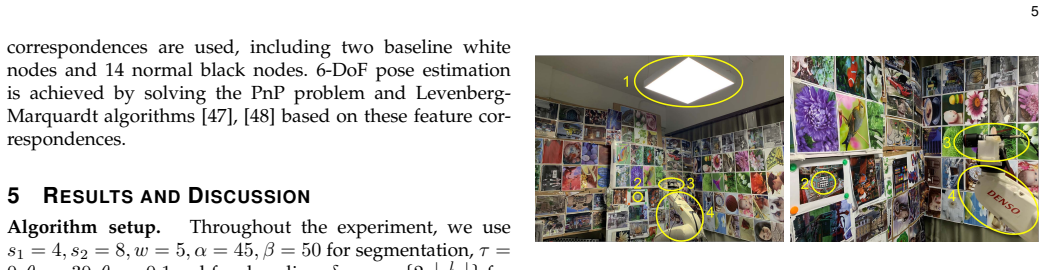
- [§5.4.1, Table 3] The pose-accuracy comparison is not reproducible because the ground-truth chain is incomplete. The text states only that "The robot's measurements serve as the groundtruth" and gives no accuracy or repeatability specification for the DENSO VS-6556, no hand-eye calibration between the camera and the robot flange, and no camera intrinsic calibration report. Since the camera is rigidly attached to the arm, the relative camera pose between two adjacent points is not simply the relative flange pose unless the hand-eye transform is identified; an uncalibrated hand-eye rotation couples a lever-arm translation into the reported motion, and even a small offset can produce errors exceeding the 0.391 mm average difference between TopoTag (1.011 mm) and AprilTag 36h11 (1.402 mm). Please report the arm's absolute and repeatability accuracy, the hand-eye calibration procedure and residual, the camera calibration, and an uncertainty analysis demonstrating that the measurement noise is well below the reported differences.
- [§5 (Algorithm setup), §5.1 (Dataset)] The algorithm parameters (s1=4, s2=8, w=5, alpha=45, beta=50, tau=0, theta1=30, theta2=0.1, delta) are fixed without a held-out validation protocol or sensitivity analysis, while baseline segmentation parameters are explicitly hand-tuned (ARToolKit threshold changed from 100 to 60; ArUco adaptive-threshold parameters changed). Because the same dataset is used to justify both the parameter choice and the final performance claims, the reported 100% recall/precision and pose results may reflect tuning to this specific collection. Please add a validation split or a parameter-sweep analysis showing that the conclusions are stable over reasonable parameter ranges.
- [§5.1, §5.3, Table 2] The detection-accuracy and scalability claims rest on a single randomly selected ID per tag family, including one 16-bit TopoTag (ID 278). TopoTag's node layout and white-child pattern vary with the encoded ID, so vertex geometry and decoding difficulty are ID-dependent; one sample does not establish that all 16,384 IDs of the 4x4 dictionary, let alone millions of 5x5 IDs, achieve the reported 100% recall/precision and vertex jitter. Please test a sample of IDs spanning the dictionary, especially the ID=0 and ID=max cases used to define the topological search bounds in Section 4.1, or provide a formal argument that detection and pose performance are invariant to the encoded ID.
minor comments (6)
- [§4.2] The text says "angel tolerance" and should say "angle tolerance."
- [§5.1] The sentence "For each tag, there are approximately 100,000 images collected" is inconsistent with the stated per-sequence counts (approximately 1,000 for Seq #1, 1,200 for Seq #2, and 7,800 for Seq #3, summing to about 10,000) and with the total of 169,713 images across the tag families; please correct the apparent typo.
- [§5.2] The 5x5 TopoTag is described as providing a "25-bit" dictionary, but its reported dictionary size is 8,388,608 = 2^23, which is 23 bits; please reconcile this inconsistency.
- [Figures 11 and 12] The captions contain the typo "rotatoin" and should read "rotation."
- [Table 6] The pass/fail symbols used in the occlusion test table are not defined in the caption; please add a legend.
- [§5.4.1] Reporting a Kolmogorov-Smirnov p-value of "0.000" is imprecise; please report p < 0.001, and ideally justify the use of a two-sample test for paired pose measurements.
Circularity Check
No significant circularity: TopoTag is an empirical systems paper whose claims are measured against external baselines and physical ground truth, not derived from its own definitions.
full rationale
This paper makes no formal derivation claim that could reduce to its inputs. The central results are measured detection recall/precision, pose error, and jitter on a self-collected dataset, with comparisons to external marker systems including AprilTag, ArUco, ARToolKit, and RuneTag. None of these metrics is defined in terms of TopoTag's own parameters or outputs in a way that forces the reported outcome. The hand-set segmentation and decoding parameters (s1, s2, w, alpha, beta, tau, theta1, theta2, delta) are algorithmic inputs, not fitted quantities renamed as predictions; the paper does not claim these are learned or optimized. The 'full bits for ID encoding' property follows directly from the marker design and is not presented as an empirical prediction requiring independent validation. The pose-accuracy comparison uses a robot arm as an external ground-truth source, and the paper does not invoke any self-citation or uniqueness theorem to justify its choice of pose-estimation method; the cited support for using more correspondences ([45], [46]) is external. The strongest concerns raised by a skeptical reading, namely unstated robot-arm accuracy and missing hand-eye calibration, are threats to the validity of the pose-error benchmark, not circularity, because they do not make the reported conclusion true by construction. Under the rule that circularity must be shown by quoting a specific reduction or a load-bearing self-citation chain, no qualifying step exists here.
Assumptions & free parameters
free parameters (10)
- s1 (first downsample scale) =
4
- s2 (second downsample scale) =
8
- w (local window size) =
5
- alpha (minimum pixel clamp) =
45
- beta (minimum brightness filter) =
50
- tau (child-count tolerance) =
0
- theta1 (error-node area ratio) =
30 percent
- theta2 (direction angle tolerance) =
0.1 rad
- delta (dilation size for vertices) =
max(2, floor(l/10))
- baseline tuning thresholds for ARToolKit and ArUco =
ARToolKit threshold 60; ArUco AdaptiveThresholdWindowSize 15 and range 2
assumptions (4)
- domain assumption The binarized image's connected-component tree correctly reflects the intended marker topology under all tested imaging conditions.
- domain assumption The DENSO robot arm's reported pose is an accurate enough ground truth for the millimeter-level pose error comparison.
- standard math The pinhole camera model and standard PnP assumptions (planar tag, known 3D model points) are valid.
- domain assumption A single randomly selected ID is representative of its tag family's performance.
invented entities (1)
-
Baseline node (a black node with two white children)
Cite this review
Pith. "Pith review of TopoTag: A Robust and Scalable Topological Fiducial Marker System." pith.science (2026). https://pith.science/paper/TZHNZPNU
@misc{pith2026190801450,
  author       = {Pith},
  title        = {Pith review of: TopoTag: A Robust and Scalable Topological Fiducial Marker System},
  year         = {2026},
  howpublished = {\url{https://pith.science/paper/TZHNZPNU}},
  note         = {Machine review of arXiv:1908.01450}
}
read the original abstract
Fiducial markers have been playing an important role in augmented reality (AR), robot navigation, and general applications where the relative pose between a camera and an object is required. Here we introduce TopoTag, a robust and scalable topological fiducial marker system, which supports reliable and accurate pose estimation from a single image. TopoTag uses topological and geometrical information in marker detection to achieve higher robustness. Topological information is extensively used for 2D marker detection, and further corresponding geometrical information for ID decoding. Robust 3D pose estimation is achieved by taking advantage of all TopoTag vertices. Without sacrificing bits for higher recall and precision like previous systems, TopoTag can use full bits for ID encoding. TopoTag supports tens of thousands unique IDs and easily extends to millions of unique tags resulting in massive scalability. We collected a large test dataset including in total 169,713 images for evaluation, involving in-plane and out-of-plane rotation, image blur, different distances and various backgrounds, etc. Experiments on the dataset and real indoor and outdoor scene tests with a rolling shutter camera both show that TopoTag significantly outperforms previous fiducial marker systems in terms of various metrics, including detection accuracy, vertex jitter, pose jitter and accuracy, etc. In addition, TopoTag supports occlusion as long as the main tag topological structure is maintained and allows for flexible shape design where users can customize internal and external marker shapes. Code for our marker design/generation, marker detection, and dataset are available at http://herohuyongtao.github.io/research/publications/topo-tag/.
Figures

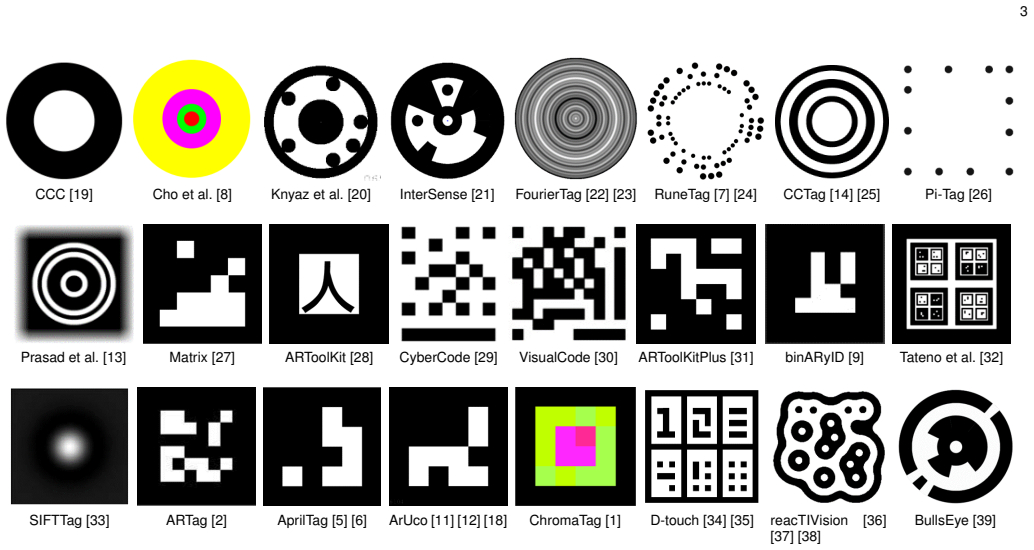

Figures from the paper (14 more)




Reference graph
Works this paper leans on
-
[1]
Chromatag: a colored marker and fast detection algorithm,
J. DeGol, T. Bretl, and D. Hoiem, “Chromatag: a colored marker and fast detection algorithm,” in Proceedings of the IEEE Interna- tional Conference on Computer Vision, 2017, pp. 1472–1481
work page 2017
-
[2]
Artag, a fiducial marker system using digital tech- niques,
M. Fiala, “Artag, a fiducial marker system using digital tech- niques,” in 2005 IEEE Computer Society Conference on Computer Vision and Pattern Recognition (CVPR’05), vol. 2. IEEE, 2005, pp. 590–596
work page 2005
-
[3]
Designing highly reliable fiducial markers,
——, “Designing highly reliable fiducial markers,” IEEE Transac- tions on Pattern analysis and machine intelligence , vol. 32, no. 7, pp. 1317–1324, 2010
work page 2010
-
[4]
CALTag: High Precision Fiducial Markers for Camera Calibration,
B. Atcheson, F. Heide, and W. Heidrich, “CALTag: High Precision Fiducial Markers for Camera Calibration,” Int. Workshop on Vision, Modeling and Visualization (VMV), 2010
work page 2010
-
[5]
Apriltag: A robust and flexible visual fiducial system,
E. Olson, “Apriltag: A robust and flexible visual fiducial system,” in 2011 IEEE International Conference on Robotics and Automation . IEEE, 2011, pp. 3400–3407
work page 2011
-
[6]
Apriltag 2: Efficient and robust fiducial detection,
J. Wang and E. Olson, “Apriltag 2: Efficient and robust fiducial detection,” in 2016 IEEE/RSJ International Conference on Intelligent Robots and Systems (IROS). IEEE, 2016, pp. 4193–4198
work page 2016
-
[7]
RUNE- Tag: A high accuracy fiducial marker with strong occlusion re- silience,
F. Bergamasco, A. Albarelli, E. Rodol `a, and A. Torsello, “RUNE- Tag: A high accuracy fiducial marker with strong occlusion re- silience,” Proceedings of the IEEE Computer Society Conference on Computer Vision and Pattern Recognition, pp. 113–120, 2011
work page 2011
-
[8]
Y. Cho, J. Lee, and U. Neumann, “A multi-ring color fiducial system and an intensity-invariant detection method for scalable fiducial-tracking augmented reality,” in IWAR, 1998
work page 1998
Show all 51 references
-
[9]
A lightweight id-based extension for marker tracking systems,
D. Flohr and J. Fischer, “A lightweight id-based extension for marker tracking systems,” in Eurographics Symposium on Virtual Environments (EGVE) Short Paper Proceedings, 2007, pp. 59–64
2007
-
[10]
On the design and evaluation of a precise scalable fiducial marker framework,
V . F. da Camara Neto, D. B. de Mesquita, R. F. Garcia, and M. F. M. Campos, “On the design and evaluation of a precise scalable fiducial marker framework,” in 2010 23rd SIBGRAPI Conference on Graphics, Patterns and Images. IEEE, 2010, pp. 216–223. 11 (a) Dark. (b) Bright outdo...
2010
-
[11]
Generation of fiducial marker dictionaries using mixed integer linear programming,
S. Garrido-Jurado, R. Munoz-Salinas, F. J. Madrid-Cuevas, and R. Medina-Carnicer, “Generation of fiducial marker dictionaries using mixed integer linear programming,” Pattern Recognition , vol. 51, pp. 481–491, 2016
2016
-
[12]
Automatic generation and detection of highly reliable fiducial markers under occlusion,
S. Garrido-Jurado, R. Mu ˜noz-Salinas, F. J. Madrid-Cuevas, and M. J. Mar ´ın-Jim´enez, “Automatic generation and detection of highly reliable fiducial markers under occlusion,” Pattern Recog- nition, vol. 47, no. 6, pp. 2280–2292, 2014
2014
-
[13]
A motion blur resilient fiducial for quadcopter imaging,
M. G. Prasad, S. Chandran, and M. S. Brown, “A motion blur resilient fiducial for quadcopter imaging,” in 2015 IEEE Winter Conference on Applications of Computer Vision. IEEE, 2015, pp. 254– 261
2015
-
[14]
Detec- tion and accurate localization of circular fiducials under highly challenging conditions,
L. Calvet, P . Gurdjos, C. Griwodz, and S. Gasparini, “Detec- tion and accurate localization of circular fiducials under highly challenging conditions,” in Proceedings of the IEEE Conference on Computer Vision and Pattern Recognition, 2016, pp. 562–570
2016
-
[15]
X-tag: A fiducial tag for flexible and accurate bundle adjustment,
T. Birdal, I. Dobryden, and S. Ilic, “X-tag: A fiducial tag for flexible and accurate bundle adjustment,” in 2016 Fourth International Conference on 3D Vision (3DV). IEEE, 2016, pp. 556–564
2016
-
[16]
A fiducial tag invariant to rotation, translation, and perspective transformations,
H. Cruz-Hern ´andez and L. G. de la Fraga, “A fiducial tag invariant to rotation, translation, and perspective transformations,” Pattern Recognition, vol. 81, pp. 213–223, 2018
2018
-
[17]
Real-time tracking of multiple ob- jects using fiducials for augmented reality,
J. Molineros and R. Sharma, “Real-time tracking of multiple ob- jects using fiducials for augmented reality,” Real-Time Imaging , vol. 7, no. 6, pp. 495–506, 2001
2001
-
[18]
Speeded up detection of squared fiducial markers,
F. J. Romero-Ramirez, R. Mu ˜noz-Salinas, and R. Medina-Carnicer, “Speeded up detection of squared fiducial markers,” Image and Vision Computing, vol. 76, pp. 38–47, 2018
2018
-
[19]
Robust image features: Concentric contrasting circles and their image extraction,
L. B. Gatrell, W. A. Hoff, and C. W. Sklair, “Robust image features: Concentric contrasting circles and their image extraction,” in Co- operative Intelligent Robotics in Space II , vol. 1612. International Society for Optics and Photonics, 1992, pp. 235–245
1992
-
[20]
The development of new coded targets for auto- mated point identification and non-contact 3d surface measure- ments,
V . A. Knyaz, “The development of new coded targets for auto- mated point identification and non-contact 3d surface measure- ments,” IAPRS, vol. 5, pp. 80–85, 1998
1998
-
[21]
Circular data matrix fiducial system and robust image processing for a wearable vision-inertial self- tracker,
L. Naimark and E. Foxlin, “Circular data matrix fiducial system and robust image processing for a wearable vision-inertial self- tracker,” in Proceedings of the 1st International Symposium on Mixed and Augmented Reality. IEEE Computer Society, 2002, p. 27
2002
-
[22]
Fourier tags: Smoothly degradable fiducial markers for use in human-robot interaction,
J. Sattar, E. Bourque, P . Giguere, and G. Dudek, “Fourier tags: Smoothly degradable fiducial markers for use in human-robot interaction,” in Fourth Canadian Conference on Computer and Robot Vision (CRV’07). IEEE, 2007, pp. 165–174
2007
-
[23]
Fourier tag: A smoothly degradable fidu- cial marker system with configurable payload capacity,
A. Xu and G. Dudek, “Fourier tag: A smoothly degradable fidu- cial marker system with configurable payload capacity,” in 2011 Canadian Conference on Computer and Robot Vision. IEEE, 2011, pp. 40–47
2011
-
[24]
An accurate and robust artificial marker based on cyclic codes,
F. Bergamasco, A. Albarelli, L. Cosmo, E. Rodola, and A. Torsello, “An accurate and robust artificial marker based on cyclic codes,” IEEE transactions on pattern analysis and machine intelligence, vol. 38, no. 12, pp. 2359–2373, 2016
2016
-
[25]
Camera tracking using concentric circle markers: Paradigms and algorithms,
L. Calvet, P . Gurdjos, and V . Charvillat, “Camera tracking using concentric circle markers: Paradigms and algorithms,” in2012 19th IEEE International Conference on Image Processing . IEEE, 2012, pp. 1361–1364
2012
-
[26]
Pi-tag: a fast image- space marker design based on projective invariants,
F. Bergamasco, A. Albarelli, and A. Torsello, “Pi-tag: a fast image- space marker design based on projective invariants,” Machine vision and applications, vol. 24, no. 6, pp. 1295–1310, 2013
2013
-
[27]
Matrix: A realtime object identification and registra- tion method for augmented reality,
J. Rekimoto, “Matrix: A realtime object identification and registra- tion method for augmented reality,” in Proceedings. 3rd Asia Pacific Computer Human Interaction (Cat. No. 98EX110) . IEEE, 1998, pp. 63–68. 12
1998
-
[28]
Marker tracking and hmd calibra- tion for a video-based augmented reality conferencing system,
H. Kato and M. Billinghurst, “Marker tracking and hmd calibra- tion for a video-based augmented reality conferencing system,” in Proceedings 2nd IEEE and ACM International Workshop on Augmented Reality (IWAR’99). IEEE, 1999, pp. 85–94
1999
-
[29]
Cybercode: designing augmented reality environments with visual tags,
J. Rekimoto and Y. Ayatsuka, “Cybercode: designing augmented reality environments with visual tags,” in Proceedings of DARE 2000 on Designing augmented reality environments . ACM, 2000, pp. 1–10
2000
-
[30]
Using camera-equipped mobile phones for interacting with real-world objects,
M. Rohs and B. Gfeller, “Using camera-equipped mobile phones for interacting with real-world objects,” Advances in pervasive com- puting, vol. 176, pp. 265–271, 2004
2004
-
[31]
Artoolkitplus for pose tracking on mobile devices,
D. WAGNER, “Artoolkitplus for pose tracking on mobile devices,” in Proceedings of 12th Computer Vision Winter Workshop (CVWW’07), February, 2007
2007
-
[32]
A nested marker for aug- mented reality,
K. Tateno, I. Kitahara, and Y. Ohta, “A nested marker for aug- mented reality,” in 2007 IEEE Virtual Reality Conference . IEEE, 2007, pp. 259–262
2007
-
[33]
Maximum detector response markers for sift and surf,
F. Schweiger, B. Zeisl, P . Georgel, G. Schroth, E. Steinbach, and N. Navab, “Maximum detector response markers for sift and surf,” in Vision, Modeling and Visualization Workshop (VMV), 2009
2009
-
[34]
A Region Adjacency Tree Approach to the Detection and Design of Fiducials,
E. Costanza and J. Robinson, “A Region Adjacency Tree Approach to the Detection and Design of Fiducials,” in Video Vision and Graphics, 2003, pp. 63–69
2003
-
[35]
D-touch: A consumer-grade tangible interface mod- ule and musical applications,
E. Costanza, “D-touch: A consumer-grade tangible interface mod- ule and musical applications,” in Proceedings of Conference on HumanComputer Interaction, 2003
2003
-
[36]
Improved topological fiducial tracking in the reactivision system,
R. Bencina, M. Kaltenbrunner, and S. Jorda, “Improved topological fiducial tracking in the reactivision system,” in 2005 IEEE Com- puter Society Conference on Computer Vision and Pattern Recognition (CVPR’05)-Workshops. IEEE, 2005, pp. 99–99
2005
-
[37]
The design and evolution of fiducials for the reactivision system,
R. Bencina and M. Kaltenbrunner, “The design and evolution of fiducials for the reactivision system,” in Proceedings of the Third International Conference on Generative Systems in the Electronic Arts , 2005
2005
-
[38]
reactivision: a computer-vision framework for table-based tangible interaction,
M. Kaltenbrunner and R. Bencina, “reactivision: a computer-vision framework for table-based tangible interaction,” in Proceedings of the 1st international conference on Tangible and embedded interaction . ACM, 2007, pp. 69–74
2007
-
[39]
Bullseye: high-precision fiducial tracking for table-based tangible interaction,
C. N. Klokmose, J. B. Kristensen, R. Bagge, and K. Halskov, “Bullseye: high-precision fiducial tracking for table-based tangible interaction,” in Proceedings of the Ninth ACM International Confer- ence on Interactive Tabletops and Surfaces. ACM, 2014, pp. 269–278
2014
-
[40]
What is the best fiducial?
C. B. Owen, F. Xiao, and P . Middlin, “What is the best fiducial?” in The First IEEE International Workshop Agumented Reality Toolkit, . IEEE, 2002, pp. 8–pp
2002
-
[41]
Reliable fiducial detection in nat- ural scenes,
D. Claus and A. W. Fitzgibbon, “Reliable fiducial detection in nat- ural scenes,” in European Conference on Computer Vision. Springer, 2004, pp. 469–480
2004
-
[42]
Reliable automatic calibration of a marker-based position tracking system,
——, “Reliable automatic calibration of a marker-based position tracking system,” in 2005 Seventh IEEE Workshops on Applications of Computer Vision (WACV/MOTION’05)-Volume 1, vol. 1. IEEE, 2005, pp. 300–305
2005
-
[43]
Keypoint recognition using randomized trees,
V . Lepetit and P . Fua, “Keypoint recognition using randomized trees,” IEEE transactions on pattern analysis and machine intelligence , vol. 28, no. 9, pp. 1465–1479, 2006
2006
-
[44]
Fast keypoint recognition using random ferns,
M. Ozuysal, M. Calonder, V . Lepetit, and P . Fua, “Fast keypoint recognition using random ferns,” IEEE transactions on pattern analysis and machine intelligence, vol. 32, no. 3, pp. 448–461, 2010
2010
-
[45]
Infinitesimal plane-based pose estima- tion,
T. Collins and A. Bartoli, “Infinitesimal plane-based pose estima- tion,” International Journal of Computer Vision , vol. 109, no. 3, pp. 252–286, Sep. 2014
2014
-
[46]
Error analysis in homography estimation by first order approximation tools: A general technique,
P . Chen and D. Suter, “Error analysis in homography estimation by first order approximation tools: A general technique,” Journal of Mathematical Imaging and Vision, vol. 33, no. 3, pp. 281–295, Mar. 2009
2009
-
[47]
An algorithm for least-squares estimation of nonlinear parameters,
D. W. Marquardt, “An algorithm for least-squares estimation of nonlinear parameters,” Journal of the society for Industrial and Applied Mathematics, vol. 11, no. 2, pp. 431–441, 1963
1963
-
[48]
Hartley and A
R. Hartley and A. Zisserman, Multiple view geometry in computer vision. Cambridge university press, 2003
2003
-
[49]
Labelme: a database and web-based tool for image annotation,
B. C. Russell, A. Torralba, K. P . Murphy, and W. T. Freeman, “Labelme: a database and web-based tool for image annotation,” International journal of computer vision, vol. 77, no. 1-3, pp. 157–173, 2008
2008
-
[50]
Comparing fiducial markers performance for a task of a humanoid robot self- calibration of manipulators: A pilot experimental study,
K. Shabalina, A. Sagitov, M. Svinin, and E. Magid, “Comparing fiducial markers performance for a task of a humanoid robot self- calibration of manipulators: A pilot experimental study,” in Inter- active Collaborative Robotics, A. Ronzhin, G. Rigoll, and R. Meshch- eryakov, Eds....
2018
-
[51]
Flexible layouts for fiducial tags,
M. Krogius, A. Haggenmiller, and E. Olson, “Flexible layouts for fiducial tags,” in Proceedings of the IEEE/RSJ International Conference on Intelligent Robots and Systems (IROS) , 2019. Guoxing Y u received his B.Eng degree in electronic information engineering from Wuhan Unive...
2019
Reviewed August 14, 2026 · model on record in the stance chip above.
Discussion (0). Continue with ORCID to comment.