REVIEW 3 major objections 5 minor 2 cited by
Hidden Chern number in one-dimensional non-Hermitian chiral-symmetric systems
T0 review · 3 major / 5 minor · reviewed 2026-08-14 · deepseek-v4-flash
Pith's one-line read The topology of one-dimensional non-Hermitian chiral-symmetric chains is a hidden two-dimensional Chern number.
desk verdict Clean, exact mapping from a known 1D non-Hermitian invariant to a 2D Hermitian Chern number, with a solid model study; the abstract overstates universality but the core is sound. read the letter →
The pith
A machine-rendered reading of the paper's core claim, the machinery that carries it, and where it could break.
The reading
What carries the argument
The central object is the effective two-dimensional Hermitian Hamiltonian $H^{\rm eff}(k,\eta) = H_k + \eta S = S(\eta - iH_k)$, built from the non-Hermitian Bloch Hamiltonian $H_k$, the chiral operator $S$, and the imaginary part of the energy $\eta$ treated as a synthetic momentum. A compactification rotation $R_\eta = \exp[\frac{i\pi}{4}(1+\tanh\eta)G]$ makes $H^{\rm eff}$ periodic in $\eta$ so that its Chern number is a well-defined integer computed by the Kubo formula. That integer is the hidden Chern number, and it predicts exactly how many localized end states with $\mathrm{Re}\,E=0$ appear in the open chain.
What would settle it
For the minimal model, compute the Chern number of $H^{\rm eff}(k,\eta)$ numerically from the Kubo formula at parameters where the real spectrum is gapped and count zero-real-energy end states in a long open chain; any parameter point where these disagree, or where a band touching occurs at finite $\eta$ inside a supposedly gapped phase, would refute the universality of the hidden Chern number.
Extended reading notes
Core claim
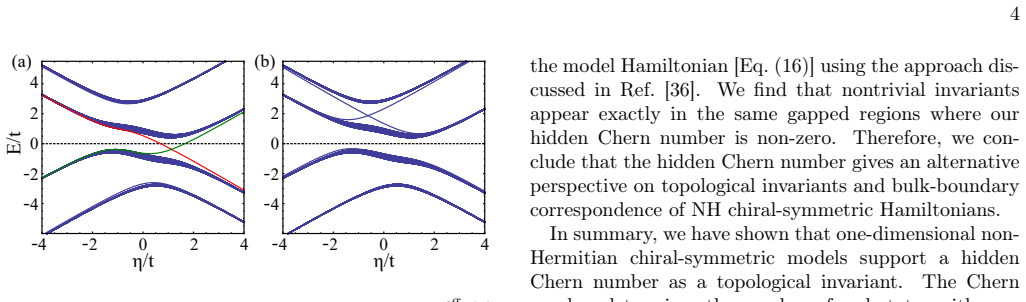
Every Hamiltonian $H_k$ obeying $S H_k S = -H_k^\dagger$ with traceless unitary $S$ can be written $H_k = i S \mathcal{H}_k$ with $\mathcal{H}_k$ Hermitian. Consequently the zero-real-energy eigenproblem $H_{\rm obc}|\psi\rangle = i\eta|\psi\rangle$ is equivalent to a zero-energy eigenproblem for the Hermitian operator $\mathcal{H}_{\rm obc} + \eta S_{\rm obc}$. In momentum space this defines a Hermitian Hamiltonian $H^{\rm eff}(k,\eta) = H_k + \eta S$ on a two-dimensional $(k,\eta)$ space, whose Chern number — the hidden Chern number — is quantized as long as the effective Hamiltonian stays gapped and is compactified in $\eta$. The paper shows that a nonzero hidden Chern number forces $C$ end states at zero real energy in the open non-Hermitian chain, and that because both open and periodic chains map to the same Hermitian problem, the skin effect does not spoil the correspondence. The minimal model, a four-site chain with alternating gain and loss, exhibits gapped phases with $C = -1$ and $C = 0$, and the gapped regions match where the previously known non-Hermitian invariant is nontrivial.
Load-bearing premise
The argument assumes the effective two-dimensional Hamiltonian $H^{\rm eff}(k,\eta)$ never has a band touching as the imaginary part of the energy is varied over its whole range; if a gap closes at some $\eta$, the Chern number is no longer a fixed integer and the predicted end-state count can change.
Editorial extensions
If this is right
- Gapped phases of one-dimensional non-Hermitian chiral-symmetric chains are classified by an integer hidden Chern number, and this invariant agrees with the previously known non-Hermitian classification where both are defined.
- A nonzero hidden Chern number implies the existence of $|C|$ topologically protected end states pinned to zero real part of the energy in an open chain.
- The bulk-boundary correspondence for these states remains valid even when the non-Hermitian skin effect would normally invalidate it, because open and periodic systems map to the same Hermitian problem.
- The minimal four-site gain-and-loss model provides a concrete platform with gapped regions of $C=-1$ and $C=0$ separated by gapless lines, and localized end states in the nontrivial regions.
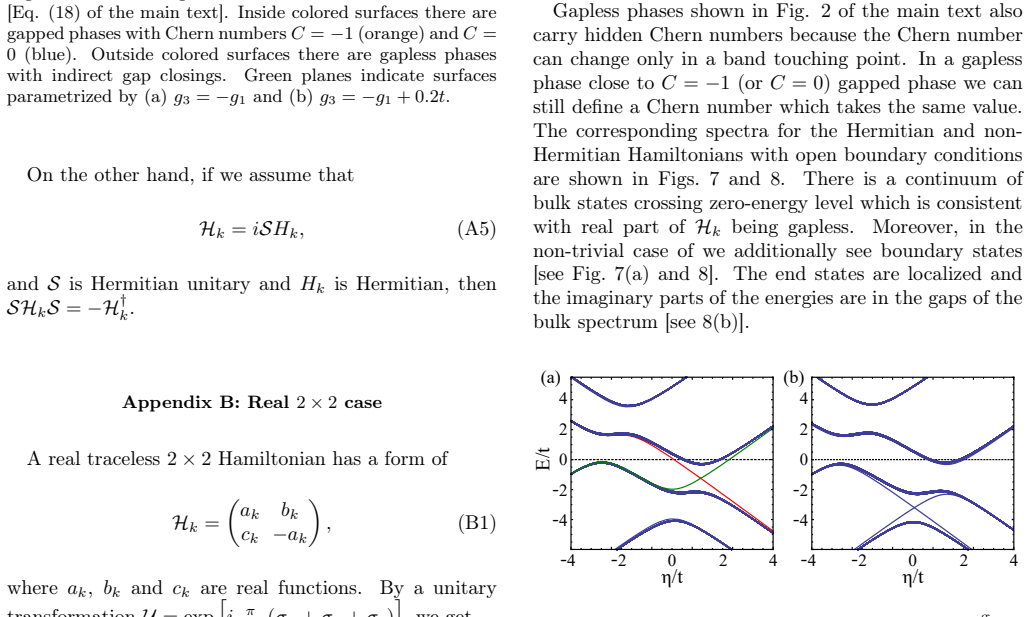
- Gapless phases can also carry a hidden Chern number, so the invariant and its associated end states extend beyond gapped phases.
Reading between the lines
- The same construction should generalize to higher dimensions, where additional synthetic coordinates could produce hidden Chern numbers in two-dimensional non-Hermitian systems.
- Imaginary energy $\eta$ could be treated as an experimentally addressable synthetic dimension, allowing direct probes of the hidden Chern number through response functions rather than edge states.
- A natural test is to realize the minimal four-site model in a photonic or electrical circuit lattice and check that zero-real-energy end states appear exactly where the hidden Chern number is nonzero.
- If the hidden Chern number accounts for the established non-Hermitian invariant in this symmetry class, similar constructions may extend to other pseudo-Hermitian classes, though the paper demonstrates the equivalence only here.
Signed reviews
Editorial analysis
A structured set of objections, weighed in public.
Referee Report
Summary. The paper studies one-dimensional non-Hermitian Hamiltonians H_k obeying the chiral-type symmetry S H_k S = -H_k^†, with S a traceless Hermitian unitary. The central construction maps eigenstates of H_k with zero real part of the energy to zero modes of a Hermitian effective Hamiltonian H_eff(k,eta)=H_k+eta S defined on the two-dimensional (k,eta) space, where eta is the imaginary part of the energy. The authors argue that the Chern number of the compactified H_eff is a topological invariant of the non-Hermitian system, that it controls the number of zero-real-energy end states in the open-boundary Hamiltonian H_obc, and that this bulk-boundary correspondence is immune to the non-Hermitian skin effect. They introduce a minimal four-band lattice model with gain and loss terms, compute its phase diagram, identify phases with hidden Chern numbers C=-1 and C=0, and verify numerically that the nontrivial phase hosts localized end states with zero real energy. The hidden Chern numbers are cross-checked against the topological invariant of Ref. [36].
Significance. If the general claims are correct, the paper offers a clean and potentially general dimensional-lifting perspective: the topology of a class of 1D non-Hermitian chiral-symmetric systems is encoded in a 2D Hermitian Chern insulator whose synthetic dimension is the imaginary part of the energy. The algebraic mapping leading to H_eff(k,eta) is exact and parameter-free, the compactification in eta is explicitly constructed, and the minimal model is analyzed with transparent numerics. The agreement with the known invariant of Ref. [36] and the explicit demonstration that the nontrivial phase supports localized zero-real-energy end states are genuine strengths. The main limitation is that the paper states the universal result for the whole symmetry class but supplies a complete rigorous argument only for the minimal model; the precise conditions under which the hidden Chern number is well defined for an arbitrary Hamiltonian in the class need to be stated and proved.
major comments (3)
- [Abstract and Sec. 2 (Eqs. (9)-(15))] The unqualified claim that 'the topology of a Hamiltonian belonging to this symmetry class is determined by a hidden Chern number' is not established for every Hamiltonian satisfying Eq. (1). For the Chern number computed by Eqs. (14)-(15) to be a well-defined integer, the occupied subspace of the compactified Hamiltonian H_eff_cp(k,eta) must be separated by a gap for all (k,eta). The paper provides the compactification (10)-(13), but it does not prove that an arbitrary H_k with gapped real spectrum yields such a gapped H_eff, nor does it prove that no zero-energy touching of H_eff can occur; the general argument is replaced by verification on the minimal model of Eq. (16). The authors should either prove the needed gap condition for all H_k in the class (for example, by showing that a zero mode of H_eff(k,eta) is equivalent to a purely imaginary eigenvalue of H_k, which follows from H_k=iSH_k, and then invoking smoothness of the negative-energy projector) or explicitly restrict the abstract and the main statements to the case where the gap condition holds.
- [Sec. 2, paragraph after Eq. (9)] The sentence 'if Hk has gapped real spectrum then Hobc also has gapped real spectrum' is imprecise and, as written, contradicted by the paper's own results: in a topologically nontrivial phase, H_obc possesses localized end states with zero real part of the energy, i.e., purely imaginary eigenvalues. The intended statement is presumably that the bulk (extended) spectrum of H_obc has a gap at Re E=0, or that zero-real-energy states, if present, are localized boundary states. Because this sentence is used to justify the robustness against the non-Hermitian skin effect, it should be reformulated precisely and the distinction between bulk and boundary states should be made explicit.
- [Appendix D] The claim that gapless phases 'can support hidden Chern numbers' is not well defined by the machinery in the main text. The Kubo formula (14)-(15) and the quantization argument require a gap at the Fermi level for every (k,eta); in a gapless phase, H_eff has zero-energy nodes, the Berry curvature in (15) is singular, and the Chern number is not an integer in the usual sense. The statement that 'we can still define a Chern number' needs a precise construction, for example a regularization or a definition on the punctured base, or the claim should be removed from the summary.
minor comments (5)
- [Eq. (15)] The notation H_eff^cmp appears in the sentence defining the eigenstates, while the Hamiltonian is denoted H_eff^cp in Eqs. (11)-(13). The notation should be unified.
- [Fig. 4 caption] The caption states that 'the boundary states localized at the opposite ends of the chain are shown in red and green', but in panel (b), which is the trivial C=0 case, there are no boundary states. The caption should specify that red/green lines appear only in panel (a).
- [Eq. (16) and discussion after it] The sentence 'Without loss of generality we can assume that g4=-g1-g2-g3' deserves justification: it is not immediately obvious that the condition is a gauge choice rather than a restriction, and the following trace properties of H_k and H_eff depend on it.
- [References [36] and [71]] In Ref. [71], two distinct papers are combined with a semicolon in a single reference entry; these should be separated into individual references to follow standard journal style.
- [Eq. (13)] The statement that the spectrum of H_eff_cp(k,eta) is the same as that of H_eff(k,eta) is correct because R_eta is unitary, but it would help the reader to spell out that the limit in Eq. (13) holds in the norm sense and that the compactified Hamiltonian is smooth in eta on the torus.
Circularity Check
No significant circularity: the hidden Chern number is constructed from H_k by an exact algebraic mapping, and its nontrivial phases are independently cross-checked against the Ref. [36] invariant.
full rationale
The central construction maps zero-real-energy eigenstates of the non-Hermitian Hamiltonian H_k to zero modes of the Hermitian effective Hamiltonian H_eff(k,eta) = H_k + eta S via the exact identity H_k = i S H_k with Hermitian H_k. This is an algebraic equivalence (Eqs. (3), (6)-(9)), not a fitted or self-referential definition. The Chern number of H_eff is computed from the Kubo formula, and its quantization is justified by the explicit compactification in Eqs. (10)-(13). No parameter is fitted to a subset of data and then renamed as a prediction: the phase diagram and end states are derived from the model Hamiltonian (16), and the comparison with the topological invariant of Ref. [36] is an external benchmark, not an input. There are no load-bearing self-citations: the paper does not rely on prior work by its own authors to justify its main premise. The only caveat is that the abstract's universal statement about 'a Hamiltonian belonging to this symmetry class' is broader than the explicit gapped-condition proof given for the minimal model, but that is an issue of scope or rigor, not circularity. The derivation is self-contained and does not reduce to its own inputs.
Assumptions & free parameters
free parameters (1)
- gain/loss amplitudes g1, g2, g3 (g4 = -g1-g2-g3) =
not fitted; scanned in phase diagrams, e.g., g1/t, g2/t, g3/t
assumptions (4)
- domain assumption S is a Hermitian unitary traceless operator, and H_k satisfies S H_k S = - H_k†.
- domain assumption H_eff(k,η)=H_k+ηS is fully gapped and compactifiable for all η, so its half-filled Chern number is a well-defined integer.
- standard math For a 2D Hermitian Chern insulator at half-filling, a nonzero Chern number implies chiral boundary modes crossing the gap.
- domain assumption The number of occupied bands is half the bands (n_F=2 for the 4-band model).
Cite this review
Pith. "Pith review of Hidden Chern number in one-dimensional non-Hermitian chiral-symmetric systems." pith.science (2026). https://pith.science/paper/K2HZR6AX
@misc{pith2026190801553,
  author       = {Pith},
  title        = {Pith review of: Hidden Chern number in one-dimensional non-Hermitian chiral-symmetric systems},
  year         = {2026},
  howpublished = {\url{https://pith.science/paper/K2HZR6AX}},
  note         = {Machine review of arXiv:1908.01553}
}
abstract
We consider a class of one-dimensional non-Hermitian models with a special type of a chiral symmetry which is related to pseudo-Hermiticity. We show that the topology of a Hamiltonian belonging to this symmetry class is determined by a hidden Chern number described by an effective 2D Hermitian Hamiltonian $H^{\rm eff} (k, \eta)$, where $\eta$ is the imaginary part of the energy. This Chern number manifests itself as topologically protected in-gap end states at zero real part of the energy. We show that the bulk-boundary correspondence coming from the hidden Chern number is robust and immune to non-Hermitian skin effect. We introduce a minimal model Hamiltonian supporting topologically nontrivial phases in this symmetry class, derive its topological phase diagram and calculate the end states originating from the hidden Chern number.
Figures


Figures from the paper (5 more)



Forward citations
Cited by 2 Pith papers
-
Nonreciprocal response theory of nonhermitian mechanical metamaterials: response phase transition from the skin effect of zero modes
For a nonreciprocal Kane-Lubensky chain, the zero-mode skin effect is predicted to coincide with a phase where the Petermann factor diverges exponentially with system size.
-
Perspective on topological states of non-Hermitian lattices
A perspective review that attributes defectiveness in non-Hermitian lattices to boundary conditions of a hypothetical Hermitian parent system.
Reference graph
Works this paper leans on
-
[36]
K. Kawabata, K. Shiozaki, M. Ueda, and M. Sato, Symmetry and Topology in Non-Hermitian Physics, arXiv:1812.09133
-
[1]
El-Ganainy, K
R. El-Ganainy, K. G. Makris, M. Khajavikhan, Z. H. Musslimani, S. Rotter, and D. N. Christodoulides, Non- Hermitian physics and PT symmetry, Nat. Phys.14, 11 (2018)
2018
-
[2]
V. V. Konotop, J. Yang, and D. A. Zezyulin, Nonlinear Waves in PT -Symmetric Systems, Rev. Mod. Phys.88, 035002 (2016)
work page 2016
-
[3]
C. M. Bender, Making sense of non-Hermitian Hamilto- nians, Rep. Prog. Phys.70, 947 (2007)
work page 2007
-
[4]
Hatano and D
N. Hatano and D. R. Nelson, Localization Transitions in Non-Hermitian Quantum Mechanics, Phys. Rev. Lett. 77, 570 (1996)
1996
-
[5]
K. B. Efetov, Directed Quantum Chaos, Phys. Rev. Lett. 79, 491 (1997)
work page 1997
-
[6]
D. Bernard and A. LeClair, A classification of 2D random Dirac fermions, J. Phys A: Math. Gen.35, 2555 (2002)
work page 2002
-
[7]
D. Bernard and A. LeClair, A classification of non- hermitian random matrices, in Statistical Field Theo- ries, edited by A. Cappelli and G. Mussardo (Springer Netherlands, Dordrecht) pp. 207-214 (2002)
work page 2002
Show all 75 references
-
[8]
Magnea, Random matrices beyond the Cartan classi- 5 fication, J
U. Magnea, Random matrices beyond the Cartan classi- 5 fication, J. Phys. A: Math. Theor. 41, 045203 (2008)
2008
-
[9]
M. Sato, K. Hasebe, K. Esaki, and M. Kohmoto, Time- Reversal Symmetry in Non-Hermitian Systems, Prog. Theor. Phys. 127, 937 (2012)
2012
-
[10]
J. Deng, U. Guenther, and Q. Wang, GeneralPT - Sym- metric Matrices, arXiv:1212.1861
-
[11]
S. Mi, D. I. Pikulin, M. Marciani, C. W. J. Beenakker, X-shaped and Y-shaped Andreev resonance profiles in a superconducting quantum dot, JETP119, 1018 (2014)
2014
-
[12]
Miri and A
M.-A. Miri and A. Alù, Exceptional Points in Optics and Photonics, Science 363, eaar7709 (2019)
2019
-
[13]
M. V. Berry, Physics of nonhermitian degeneracies, Czechoslov. J. Phys.54, 1039 (2004)
2004
-
[14]
W. D. Heiss, The Physics of Exceptional Points, J. Phys. A 45, 444016 (2012)
2012
-
[15]
D. J. Luitz and F. Piazza, Exceptional points and the topology of quantum many-body spectra, arXiv:1906.02224
1906 arXiv
-
[16]
Müller, S
M. Müller, S. Diehl, G. Pupillo, and P. Zoller, Engineered Open Systems and Quantum Simulations with Atoms and Ions, Adv. At. Mol. Opt. Phys.61, 1 (2012)
2012
-
[17]
Aspelmeyer, T.J
M. Aspelmeyer, T.J. Kippenberg, and F. Marquardt, CavityOptomechanics, Rev.Mod.Phys. 86, 1391(2014)
2014
-
[18]
Cao and J
H. Cao and J. Wiersig, Dielectric microcavities: Model systems for wave chaos and non-Hermitian physics, Rev. Mod. Phys. 87, 61 (2015)
2015
-
[19]
T. Gao, E. Estrecho, K. Y. Bliokh, T. C. H. Liew, M. D. Fraser, S. Brodbeck, M. Kamp, C. Schneider, S. Höfling, Y. Yamamoto, F. Nori, Y. S. Kivshar, A. G. Truscott, R. G. Dall and E. A. Ostrovskaya, Observation of non- Hermitian degeneracies in a chaotic exciton-polariton bil- ...
2015
-
[20]
J. M. Zeuner, M. C. Rechtsman, Y. Plotnik, Y. Lumer, S. Nolte, M. S. Rudner, M. Segev, and A. Szameit, Ob- servation of a Topological Transition in the Bulk of a Non-Hermitian System , Phys. Rev. Lett. 115, 040402 (2015)
2015
-
[21]
Selective enhancement of topologically induced in- terface states in a dielectric resonator chain
C. Poli, M. Bellec, U.Kuhl, F. Mortessagne, H. Schome- rus, "Selective enhancement of topologically induced in- terface states in a dielectric resonator chain", Nat. Com- mun. 6, 6710 (2015)
2015
-
[22]
H. Xu, D. Mason, L. Jiang, and J. G. E. Harris, Topo- logical energy transfer in an optomechanical system with exceptional points, Nature537, 80 (2016)
2016
-
[23]
Weimann, M
S. Weimann, M. Kremer, Y. Plotnik, Y. Lumer, S. Nolte, K. G. Makris, M. Segev, M. C. Rechtsman, and A. Sza- meit, Topologically Protected Bound States in Photonic Parity-Time-Symmetric Crystals , Nat. Mater. 16, 433 (2017)
2017
-
[24]
L. Xiao, X. Zhan, Z. H. Bian, K. K. Wang, X. Zhang, X. P. Wang, J. Li, K. Mochizuki, D. Kim, N. Kawakami, W. Yi, H. Obuse, B. C. Sanders, and P. Xue, Observation of Topological Edge States in Parity-Time-Symmetric Quantum Walks , Nat. Phys.13, 1117 (2017)
2017
-
[25]
Fitzpatrick, N
M. Fitzpatrick, N. M. Sundaresan, A. C. Y. Li, J. Koch and A. A. Houck, Observation of a dissipative phase tran- sition in a one-dimensional circuit QED lattice, Phys. Rev. X 7, 011016 (2017)
2017
-
[26]
H. Zhou, C. Peng, Y. Yoon, C. W. Hsu, K. A. Nel- son, L. Fu, J. D. Joannopoulos, M. Soljačić, and B. Zhen, Observation of Bulk Fermi Arc and Polarization Half Charge from Paired Exceptional Points , Science 359,1009 (2018)
2018
-
[27]
K. Wang, X. Qiu, L. Xiao, X. Zhan, Z. Bian, B. C.Sanders, W. Yi, and P. Xue, Observation of Emergent Momentum-Time Skyrmions in Parity-Time-Symmetric Non-Unitary Quench Dynamics , arXiv:1808.06446
-
[28]
Cerjan, S
A. Cerjan, S. Huang, K. P. Chen, Y. Chong, and M. C. Rechtsman, Experimental Realization of a Weyl Excep- tional Ring , arXiv:1808.09541
-
[29]
Partanen, J
M. Partanen, J. Goetz, K. Y. Tan, K. Kohvakka, V. Sevriuk, R. E. Lake, R. Kokkoniemi, J. Ikonen, D. Hazra, A. Mäkinen, E. Hyyppä, L. Grönberg, V. Vesterinen, M. Silveri, and M. Möttönen, Optimized heat transfer at ex- ceptional points in quantum circuits, arXiv:1812.02683
-
[30]
Silveri, S
M. Silveri, S. Masuda, V. Sevriuk, K. Y. Tan, M. Jenei, E. Hyyppä, F. Hassler, M. Partanen, J. Goetz, R. E. Lake, L. Grönberg, and M. Möttönen, Broadband Lamb shift in an engineered quantum system, Nat. Phys.15, 533 (2019)
2019
-
[31]
Sevriuk, K
V. Sevriuk, K. Y. Tan, E Hyyppä, M. Silveri, M. Par- tanen, M. Jenei, S. Masuda, J. Goetz, V. Vesterinen, L. Grönberg, M. Möttönen, Fast control of dissipation in a superconducting resonator, arXiv:1906.11519
1906 arXiv
-
[32]
Yoshida and Y
T. Yoshida and Y. Hatsugai, Exceptional rings pro- tected by emergent symmetry for mechanical systems, arXiv:1904.10764
1904 arXiv
-
[33]
Z. Gong, Y. Ashida, K. Kawabata, K. Takasan, S. Hi- gashikawa, and M. Ueda, Topological Phases of Non- Hermitian Systems, Phys. Rev. X8, 031079 (2018)
2018
-
[34]
Lieu, Topological symmetry classes for non-Hermitian models and connections to the bosonic Bogoliubov-de Gennes equation, Phys
S. Lieu, Topological symmetry classes for non-Hermitian models and connections to the bosonic Bogoliubov-de Gennes equation, Phys. Rev. B98, 115135 (2018)
2018
-
[35]
Zhou and J
H. Zhou and J. Y. Lee, Periodic table for topological bands with non-Hermitian symmetries, Phys. Rev. B99, 235112 (2019)
2019
-
[37]
Ghatak and T
A. Ghatak and T. Das, New topological invariants in non-Hermitian systems, J. Phys.: Condens. Matter 31, 263001 (2019)
2019
-
[38]
Bahari, A
B. Bahari, A. Ndao, F. Vallini, A. El Amili, Y. Fainman, and B. Kanté, Nonreciprocal Lasing in Topological Cav- ities of Arbitrary Geometries , Science358, 636 (2017)
2017
-
[39]
St-Jean, V
P. St-Jean, V. Goblot, E. Galopin, A. Lemaître,T. Ozawa, L. Le Gratiet, I. Sagnes, J. Bloch, and A. Amo, Lasing in Topological Edge States of a One-Dimensional Lattice , Nat. Photon.11, 651 (2017)
2017
-
[40]
Parto, S
M. Parto, S. Wittek, H. Hodaei, G. Harari, M. A. Bandres, J. Ren, M. C. Rechtsman, M. Segev, D. N.Christodoulides, and M. Khajavikhan, Edge-Mode Lasing in 1D Topological Active Arrays , Phys. Rev. Lett. 120, 113901 (2018)
2018
-
[41]
H. Zhao, P. Miao, M. H. Teimourpour, S. Malzard, R. El- Ganainy, H. Schomerus, and L. Feng, Topological Hybrid Silicon Microlasers , Nat. Commun.9, 981 (2018)
2018
-
[42]
Harari, M
G. Harari, M. A. Bandres, Y. Lumer, M. C. Rechtsman, Y. D. Chong, M. Khajavikhan, D. N. Christodoulides, and M. Segev, Topological Insulator Laser: Theory , Sci- ence 359, eaar4003 (2018)
2018
-
[43]
M. A. Bandres, S. Wittek, G. Harari, M. Parto, J. Ren, M. Segev, D. Christodoulides, and M. Khajavikhan, Topological Insulator Laser: Experiments , Science359, eaar4005 (2018)
2018
-
[44]
N.M.ShnerbandD.R.Nelson, WindingNumbers, Com- plex Currents, and Non-Hermitian Localization, Phys. Rev. Lett. 80,5172 (1998). 6
1998
-
[45]
M.S.RudnerandL.S.Levitov, TopologicalTransitionin a Non-Hermitian Quantum Walk, Phys. Rev. Lett.102, 065703 (2009)
2009
-
[46]
Esaki, M
K. Esaki, M. Sato, K. Hasebe, and M. Kohmoto, Edge states and topological phases in non-Hermitian systems, Phys. Rev. B84, 205128 (2011)
2011
-
[47]
Shi-Dong Liang and Guang-Yao Huang, Topological in- variance and global Berry phase in non-Hermitian sys- tems, Phys. Rev. A87, 012118 (2013)
2013
-
[48]
Topologically protected midgap states in complex photonic lattices
H. Schomerus, "Topologically protected midgap states in complex photonic lattices", Optics Letters 38, 1912 (2013)
2013
-
[49]
M. S. Rudner, M. Levin, and L. S. Levitov, Survival, de- cay, and topological protection in non-Hermitian quan- tum transport, arXiv:1605.07652
-
[50]
T. E. Lee, Anomalous Edge State in a Non-Hermitian Lattice , Phys. Rev. Lett.116, 133903 (2016)
2016
-
[51]
Leykam, K
D. Leykam, K. Y. Bliokh, C. Huang, Y. D. Chong, and F. Nori, Edge Modes, Degeneracies, and Topological Num- bers in Non-Hermitian Systems, Phys. Rev. Lett.118, 040401 (2017)
2017
-
[52]
Jin, Topological phases and edge states in a non- Hermitian trimerized optical lattice, Phys
L. Jin, Topological phases and edge states in a non- Hermitian trimerized optical lattice, Phys. Rev. A 96, 032103 (2017)
2017
-
[53]
Lieu, Topological phases in the non-Hermitian Su- Schrieffer-Heeger model, Phys
S. Lieu, Topological phases in the non-Hermitian Su- Schrieffer-Heeger model, Phys. Rev. B97, 045106 (2018)
2018
-
[54]
Duan, Weyl Ex- ceptional Rings in a Three-Dimensional Dissipative Cold Atomic Gas, Phys
Yong Xu, Sheng-Tao Wang, and L.-M. Duan, Weyl Ex- ceptional Rings in a Three-Dimensional Dissipative Cold Atomic Gas, Phys. Rev. Lett.118, 045701 (2017)
2017
-
[55]
H. Shen, B. Zhen, and L. Fu, Topological Band Theory for Non-Hermitian Hamiltonians, Phys. Rev. Lett.120, 146402 (2018)
2018
-
[56]
Takata and M
K. Takata and M. Notomi, Photonic Topological Insulat- ing Phase Induced Solely by Gain and Loss, Phys. Rev. Lett. 121, 213902 (2018)
2018
-
[57]
H. Wang, J. Ruan, and H. Zhang, Non-Hermitian nodal- line semimetals with an anomalous bulk-boundary corre- spondence, Phys. Rev. B99, 075130 (2019)
2019
-
[58]
Chun-Hui Liu, Hui Jiang, and Shu Chen, Topological classification of non-Hermitian systems with reflection symmetry, Phys. Rev. B99, 125103 (2019)
2019
-
[59]
Ye Xiong, Why does bulk boundary correspondence fail in some non-hermitian topological models, J. Phys. Com- mun. 2, 035043 (2018)
2018
-
[60]
Zirnstein, G
H.-G. Zirnstein, G. Refael, and B. Rosenow, Bulk- boundary correspondence for non-Hermitian Hamiltoni- ans via Green functions, arXiv:1901.11241
1901 arXiv
-
[61]
Herviou, J
L. Herviou, J. H. Bardarson, and N. Regnault, Defining a bulk-edge correspondence for non-Hermitian Hamilto- nians via singular-value decomposition, Phys. Rev. A99, 052118 (2019)
2019
-
[62]
F. K. Kunst, E. Edvardsson, J. C. Budich, and E. J. Bergholtz, Biorthogonal Bulk-Boundary Correspondence in Non-Hermitian Systems, Phys. Rev. Lett.121, 026808 (2018)
2018
-
[63]
Edvardsson, F
E. Edvardsson, F. K. Kunst, and E. J. Bergholtz, Non- Hermitian extensions of higher-order topological phases and their biorthogonal bulk-boundary correspondence, Phys. Rev. B99, 081302(R) (2019)
2019
-
[64]
V. M. Martinez Alvarez, J. E. Barrios Vargas, and L. E. F. Foa Torres, Non-Hermitian robust edge states in one dimension: Anomalous localization and eigenspace condensation at exceptional points, Phys. Rev. B 97, 121401(R) (2018); S. Yao and Z. Wang, Edge States and Topologica...
2018
-
[65]
Kawabata, K
K. Kawabata, K. Shiozaki, and M. Ueda, Anomalous helical edge states in a non-Hermitian Chern insulator, Phys. Rev. B98, 165148 (2018)
2018
-
[66]
W. B. Rui, M. M. Hirschmann, and A. P. Schny- der, PT -symmetric non-Hermitian Dirac semimetals, arXiv:1907.10417
1907 arXiv
-
[67]
D. S. Borgnia, A. J. Kruchkov, R.-J. Slager, Non- Hermitian Boundary Modes, arXiv:1902.07217
1902 arXiv
-
[68]
Thomale, Anatomy of skin modes and topology in non-Hermitian systems, Phys
Ching Hua Lee and R. Thomale, Anatomy of skin modes and topology in non-Hermitian systems, Phys. Rev. B 99, 201103(R) (2019)
2019
-
[69]
Helbig, T
T. Helbig, T. Hofmann, S. Imhof, M. Abdelghany, T. Kiessling, L. W. Molenkamp, Ching Hua Lee, A. Sza- meit, M. Greiter, and R. Thomale, Observation of bulk boundary correspondence breakdown in topolectrical cir- cuits, arXiv:1907.11562
1907 arXiv
-
[70]
Hofmann, T
T. Hofmann, T. Helbig, F. Schindler, N. Salgo, M. Brzez- ińska, M. Greiter, T. Kiessling, D. Wolf, A. Vollhardt, A. KabaÅ¡i, Ching Hua Lee, A. Bilušić, R. Thomale, and T. Neupert, Reciprocal skin effect and its realization in a topolectrical circuit, arXiv:1908.02759
1908 arXiv
-
[71]
K. L. Zhang, H. C. Wu, L. Jin, and Z. Song, Topological phase transition independent of system non-Hermiticity, Phys. Rev. B100, 045141 (2019); L. Li, C. H. Lee, and J. Gong, Geometric characterization of non-Hermitian topological systems through the singularity ring in pseu- ...
2019
-
[72]
D. J. Thouless, M. Kohmoto, M. P. Nightingale, and M. den Nijs, Quantized Hall Conductance in a Two- Dimensional Periodic Potential, Phys. Rev. Lett.49, 405 (1982)
1982
-
[73]
Nagaosa, J
N. Nagaosa, J. Sinova, S. Onoda, A. H. MacDonald, and N. P. Ong, Anomalous Hall effect, Rev. Mod. Phys.82, 1539 (2010)
2010
-
[74]
Qi-Bo Zeng, Yan-Bin Yang, and Yong Xu, Topological Phases in Non-Hermitian Aubry-André-Harper Models, arXiv:1901.08060
1901 arXiv
-
[75]
J. Y. Lee, J. Ahn, H. Zhou, A. Vishwanath, Topological Correspondence between Hermitian and Non-Hermitian Systems: Anomalous Dynamics, arXiv:1906.08782. Appendix A: Proof of equivalence (3) Assume that there exist a Hermitian unitary operator S such that SHkS =−H† k. (A1) Then...
1906 arXiv
Reviewed August 14, 2026 · model on record in the stance chip above.
Discussion (0). Continue with ORCID to comment.