REVIEW 4 minor 31 references
Nonreciprocal response theory of nonhermitian mechanical metamaterials: response phase transition from the skin effect of zero modes
T0 review · 0 major / 4 minor · reviewed 2026-08-14 · deepseek-v4-flash
Pith's one-line read This paper predicts a response phase transition in nonreciprocal mechanical metamaterials: inside the zero-mode skin-effect window the low-frequency response diverges with system size.
desk verdict A clean, testable prediction that the zero-mode skin effect in nonreciprocal metamaterials comes with an exponentially divergent Petermann factor; minor fixes needed but deserves peer review. read the letter →
The pith
A machine-rendered reading of the paper's core claim, the machinery that carries it, and where it could break.
The reading
What carries the argument
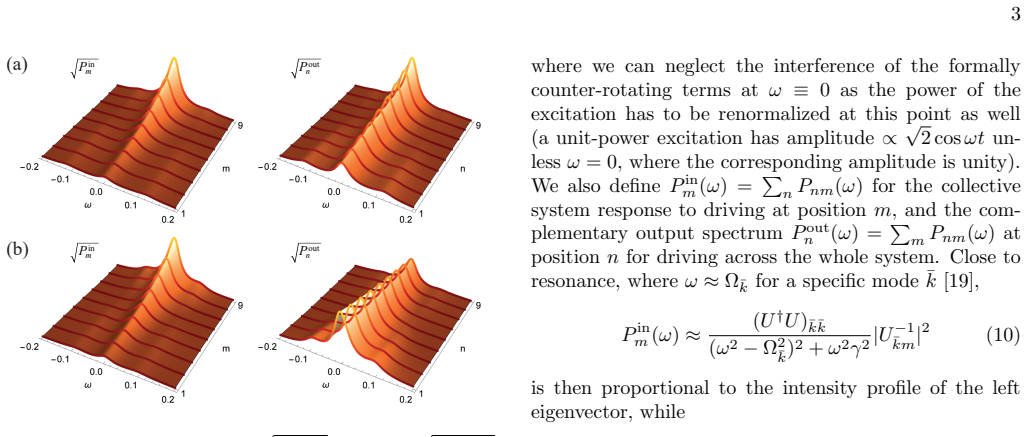
The central object is the Petermann factor $K_{\bar k}=(U^\dagger U)_{\bar k\bar k}(U^{-1}U^{-\dagger})_{\bar k\bar k}$, a condition number that quantifies how nonorthogonal the right and left eigenvectors of mode $\bar k$ are; for the zero mode it reduces to Eq. (15), a ratio of geometric sums. The argument runs through the biorthogonal spectral decomposition of the Green's function $\hat G=(\omega^2\mathbb{1}-M)^{-1}$: the left eigenvectors determine how strongly a drive at each site couples to the mode, the right eigenvectors determine where the mode's response appears, and $K_{\bar k}$ is the product of their squared norms that weights the total response near resonance. The same machinery yields the separate input and output power spectra $P^{\rm in}_m$ and $P^{\rm out}_n$, which map out the left and right eigenvectors individually.
What would settle it
Take the $N$-oscillator chain with $a=1$, $b=0.73$, $\varepsilon=0.3$ (inside the window $0.156<\varepsilon<6.41$) and drive it at zero frequency with a narrow frequency width $\eta$; if the total power $P^{\rm tot}(0)$, or the $K_0$ extracted from the line shape via Eq. (14), does not grow roughly exponentially as $N$ is increased (say $N=5,9,13,17$), the predicted response phase transition is falsified.
Extended reading notes
Core claim
For the chain whose dynamical matrix factors as $M=QR$, the right zero mode is $u_{0,n}\propto [a(1-\varepsilon)/(b(1+\varepsilon))]^n$ and the left zero mode is $v_{0,n}\propto (a/b)^n$; the right mode switches edge at $\varepsilon_1=(a-b)/(a+b)$ and $\varepsilon_2=(a+b)/(a-b)$, while the left mode stays put. The paper shows that the total power spectrum near zero frequency is $P^{\rm tot}(\omega)\approx K_0/(\omega^4+\omega^2\gamma^2)$, with $K_0$ given by Eq. (15), a ratio of geometric sums in the two localization lengths. In the thermodynamic limit $K_0$ stays finite outside the skin-effect phase and grows exponentially in $N$ for $\varepsilon_1<\varepsilon<\varepsilon_2$. The paper's central discovery is that this response phase transition is a generic consequence of the zero-mode skin effect: it occurs over the entire phase, is independent of spectral singularities, and reveals the biorthogonal structure in a directly measurable response.
Load-bearing premise
The load-bearing assumption is that a real experimental drive can be modeled by the harmonic equation (5) with velocity-dependent damping $\gamma$ plus a finite frequency width $\eta$ for the zero mode; if the physical excitation has no such width, the formally diverging Petermann factor may not translate into a diverging observable response.
Editorial extensions
If this is right
- For any $\varepsilon$ in $\varepsilon_1<\varepsilon<\varepsilon_2$, the zero-mode Petermann factor $K_0$ grows exponentially with system size, so the low-frequency response of a sufficiently large nonreciprocal chain diverges.
- The enhanced sensitivity is a phase property: it holds across the whole skin-effect window, with no need to tune to an exceptional point, and the resonance spectrum remains real.
- A position-resolved power-spectrum measurement separates the two biorthogonal partners: the input spectrum follows the left eigenvector, the output spectrum follows the right eigenvector.
- The onset and end of the sensitive phase coincide with the relocalization of the right zero mode at $\varepsilon_1$ and $\varepsilon_2$, so response measurements pin down the zero-mode skin-effect boundaries.
- Because the response formulas hold for arbitrary linear dynamical matrices, the same transition should appear in other nonreciprocal nonhermitian media, including skin effects of nonzero modes and topoelectric circuits.
Reading between the lines
- If the divergence is observable, the skin-effect window becomes a ready-made sensing phase: operate anywhere inside it, drive at the edge selected by the left eigenvector, and read the amplified response at the edge selected by the right eigenvector, with no exceptional-point fine-tuning.
- The same $K_0$ that weights the driven response should also weight spontaneous fluctuations, so the phase transition might be detectable passively through excess noise rather than by external driving.
- A finite-$N$ experiment should show $K_0$ rising steeply as $\varepsilon$ crosses $\varepsilon_1$ and falling after $\varepsilon_2$, with the maximum inside the phase but away from the bulk exceptional point; any other pattern would indicate an extra ingredient beyond the biorthogonal response theory.
- Since $K_0$ depends only on the two localization lengths, any nonreciprocal chain whose zero-mode profile is geometric in $a/b$ and $a(1-\varepsilon)/b(1+\varepsilon)$ should exhibit the same phase transition, regardless of the microscopic feedback mechanism.
Signed reviews
Editorial analysis
A structured set of objections, weighed in public.
Referee Report
Summary. The paper develops a response theory for non-Hermitian nonreciprocal mechanical metamaterials described by a general dynamical matrix M. The central object is the regularized Green's function and the total power spectrum, which near a resonance is weighted by the biorthogonal Petermann factor K_k = (U^†U)_kk (U^{-1}U^{-†})_kk, where U contains the right eigenvectors and U^{-1} the left eigenvectors. Applied to the robotic metamaterial of Ghatak et al., the zero-mode profiles u0,n ∝ (a(1−ε)/b(1+ε))^n and v0,n ∝ (a/b)^n are used to derive Eq. (15) for K0, and Eq. (16) shows that K0 diverges exponentially with system size in the zero-mode skin-effect phase ε1 < ε < ε2, while remaining finite outside it. The paper thus predicts an extended phase of extreme low-frequency sensitivity that is tied to the non-Hermitian skin effect and not to exceptional points.
Significance. The result is significant because it identifies an experimentally accessible signature of biorthogonality in non-Hermitian metamaterials: the left eigenvectors and the Petermann factor, which are not directly visible in the right-eigenvector spatial profiles measured in the experiment, become manifest in the response to external driving. The core derivation is algebraic and parameter-free once the experimental couplings (a, b, ε) are fixed; Eq. (15) follows directly from biorthogonal normalization and the explicit mode profiles, and the divergence in the skin-effect phase is a falsifiable system-size-scaling prediction. The paper also correctly emphasizes that the sensitive phase is not tied to spectral exceptional points, which broadens the potential relevance to sensing applications. The main caveat is operational: because the zero mode has no velocity-dependent damping at exactly zero frequency, the statement of divergence should be phrased in terms of the system-size scaling of K0 at a fixed small nonzero drive frequency; with that interpretation, the central claim is sound.
minor comments (4)
- [Eq. (3)] Equation (3): the right zero-mode profile should read u0,n = c_R [a(1−ε)/b(1+ε)]^n; the printed denominator b(1−ε) is inconsistent with Eq. (15) and with the stated phase boundaries ε1 = (a−b)/(a+b), ε2 = (a+b)/(a−b). Please correct this typo.
- [Sec. 3 (around Eqs. (5)–(13))] Paragraph following Eq. (5) and the discussion of Eq. (12): please add an explicit operational statement for the zero-mode response. At ω = 0 the stationary response is not defined because the velocity-dependent damping does not affect the zero mode; Eq. (13) shows that at fixed ω ≠ 0 the zero-mode contribution is P_tot ≈ K0/[ω²(ω²+γ²)], so the predicted phase transition is the system-size scaling of K0 at fixed small ω (or, equivalently, of the η-regularized response at ω = 0 with η fixed). A sentence stating this would remove the ambiguity about whether the divergence is an artifact of the η-regularization.
- [Figs. 1(c) and 3] Figures 1(c) and 3: consider using a logarithmic color or vertical scale for K0, since the exponential growth across the skin-effect phase spans many orders of magnitude and the linear scale obscures the comparison with Eq. (16).
- [Introduction] In the introduction, 'compassing' should be 'encompassing'.
Circularity Check
No significant circularity: the central response-phase prediction is a parameter-free derivation from the model's biorthogonal eigenmodes.
full rationale
The central claim—that the zero-mode skin effect is accompanied by a phase where the Petermann factor K0 diverges exponentially with system size—is derived directly from the spectral decomposition (6)-(7), the explicit zero-mode eigenvectors (3), and the definition of the enhancement factor (14). Equation (15) is an explicit evaluation of K0 for the model, and Eq. (16) is the large-N asymptotics of that same expression; neither introduces a fitted parameter nor presupposes the target result. The thresholds ε1 and ε2 follow from the localization switch of the right eigenvector, not from K0, so the association between the skin-effect phase and the sensitive-response phase is a genuine derived correspondence rather than a restatement of definitions. Self-citations to Petermann-factor literature (Refs. [13], [21], [23]) are used only as background terminology and analogy; the factor is independently computed here. The acknowledged modeling caveat about the difference between velocity-dependent damping and the frequency-width regularization (12) around ω = 0 is a physical-regime limitation, not a circular reduction: the predicted divergence is stated in terms of K0, which is well-defined from the eigenvector basis independently of the regularization. Thus no load-bearing step reduces to its inputs by construction, and there is no fitted input dressed up as a prediction.
Assumptions & free parameters
assumptions (4)
- standard math The spectral decomposition M = U Ω^2 U^{-1} holds for the non-Hermitian dynamical matrix M.
- domain assumption The robotic metamaterial is described by the linear equation d²x/dt² + γ dx/dt + M x + y cos(ωt) = 0 with M = Q R for the given Q and R.
- domain assumption The zero-mode contribution to the response is regularized by a finite width η of the driving frequency (Eq. (12)).
- standard math Near resonance, the response is dominated by a single mode, giving the Petermann factor (14).
Cite this review
Pith. "Pith review of Nonreciprocal response theory of nonhermitian mechanical metamaterials: response phase transition from the skin effect of zero modes." pith.science (2026). https://pith.science/paper/OX2XSWLL
@misc{pith2026190806312,
  author       = {Pith},
  title        = {Pith review of: Nonreciprocal response theory of nonhermitian mechanical metamaterials: response phase transition from the skin effect of zero modes},
  year         = {2026},
  howpublished = {\url{https://pith.science/paper/OX2XSWLL}},
  note         = {Machine review of arXiv:1908.06312}
}
read the original abstract
Nonreciprocal nonhermitian systems provide an unconventional localization mechanism of topological zero modes via the nonhermitian skin effect. While fundamental theoretical characterizations of this effect involve the biorthogonal system of right and left eigenmodes, the recent demonstration of this effect for a zero mode in a robotic metamaterial (Ghatak et al., arXiv:1907.11619) is based on the direct experimental observation of the conventional right eigenvectors. Here I show that such nonreciprocal mechanical metamaterials reveal their underlying biorthogonality in the directly observable response of the system to external excitation. Applied to the ground-breaking experiment, this nonreciprocal response theory predicts that the zero-mode skin effect goes along an extended phase where the system is highly sensitive to physical perturbations, leading to a diverging response in the limit of a large system.
Figures


Reference graph
Works this paper leans on
-
[1]
Non-reciprocal robotic metamaterials
M. Brandenbourger, X. Locsin, E. Lerner, and C. Coulais, Non-reciprocal robotic metamaterials, arXiv e-prints arXiv:1903.03807 (2019)
work page Pith review arXiv 2019
-
[2]
A. Ghatak, M. Brandenbourger, J. van Wezel, and C. Coulais, Observation of non-hermitian topol- ogy and its bulk-edge correspondence, arXiv e-prints arXiv:1907.11619 (2019)
work page Pith review arXiv 2019
-
[3]
Hatano and D
N. Hatano and D. R. Nelson, Localization transitions in non-hermitian quantum mechanics, Phys. Rev. Lett. 77, 570 (1996)
1996
-
[4]
Xiong, Why does bulk boundary correspondence fail in some non-hermitian topological models, J
Y. Xiong, Why does bulk boundary correspondence fail in some non-hermitian topological models, J. Phys. Com- mun. 2, 035043 (2018)
work page 2018
-
[5]
Yao and Z
S. Yao and Z. Wang, Edge states and topological in- variants of non-hermitian systems, Phys. Rev. Lett. 121, 086803 (2018)
2018
-
[6]
F. K. Kunst, E. Edvardsson, J. C. Budich, and E. J. Bergholtz, Biorthogonal bulk-boundary correspondence in non-hermitian systems, Phys. Rev. Lett. 121, 026808 (2018)
2018
-
[7]
Lieu, Topological phases in the non-hermitian su- schrieffer-heeger model, Phys
S. Lieu, Topological phases in the non-hermitian su- schrieffer-heeger model, Phys. Rev. B 97, 045106 (2018)
work page 2018
-
[8]
A. McDonald, T. Pereg-Barnea, and A. A. Clerk, Phase- dependent chiral transport and effective non-hermitian dynamics in a bosonic Kitaev-Majorana chain, Phys. Rev. X 8, 041031 (2018)
work page 2018
Show all 31 references
-
[9]
V. M. Martinez Alvarez, J. E. Barrios Vargas, and L. E. F. Foa Torres, Non-hermitian robust edge states in one dimension: Anomalous localization and eigenspace condensation at exceptional points, Phys. Rev. B 97, 121401(R) (2018)
2018
-
[10]
C. H. Lee and R. Thomale, Anatomy of skin modes and topology in non-hermitian systems, Phys. Rev. B 99, 201103(R) (2019)
2019
-
[11]
Brzezicki and T
W. Brzezicki and T. Hyart, Hidden Chern number in one-dimensional non-Hermitian chiral-symmetric sys- tems, arXiv e-prints arXiv:1908.01553 (2019)
2019 arXiv
-
[12]
A. E. Siegman, Excess spontaneous emission in non- hermitian optical systems. I. Laser amplifiers, Phys. Rev. A 39, 1253 (1989)
1989
-
[13]
Patra, H
M. Patra, H. Schomerus, and C. W. J. Beenakker, Quantum-limited linewidth of a chaotic laser cavity, Phys. Rev. A 61, 023810 (2000)
2000
-
[14]
M. V. Berry, Mode degeneracies and the petermann excess-noise factor for unstable lasers, J. Mod. Opt. 50, 63 (2003)
2003
-
[15]
A. Pick, B. Zhen, O. D. Miller, C. W. Hsu, F. Hernandez, A. W. Rodriguez, M. Soljaˇ ci´ c, and S. G. Johnson, General theory of spontaneous emission near exceptional points, Opt. Express 25, 12325 (2017)
2017
-
[16]
C. L. Kane and T. C. Lubensky, Topological boundary modes in isostatic lattices, Nature Phys. 10, 39 (2014)
2014
-
[17]
B. G. Chen, N. Upadhyaya, and V. Vitelli, Nonlinear con- duction via solitons in a topological mechanical insulator, PNAS 111, 13004 (2014)
2014
-
[18]
S. D. Huber, Topological mechanics, Nature Phys. 12, 621 EP (2016)
2016
-
[19]
In the following expressions we assume for transparency real bare resonance frequencies, as these give rise to the most visible response features and naturally encompass the zero mode. From here the generalization to complex frequencies is straightforward, and only results in ...
-
[20]
J. T. Chalker and B. Mehlig, Eigenvector statistics in non-hermitian random matrix ensembles, Phys. Rev. Lett. 81, 3367 (1998)
1998
-
[21]
Schomerus, K
H. Schomerus, K. Frahm, M. Patra, and C. Beenakker, Quantum limit of the laser line width in chaotic cavi- ties and statistics of residues of scattering matrix poles, Physica A 278, 469 (2000)
2000
-
[22]
Y. V. Fyodorov and B. Mehlig, Statistics of resonances and nonorthogonal eigenfunctions in a model for single- channel chaotic scattering, Phys. Rev. E 66, 045202(R) (2002)
2002
-
[23]
Yoo, H.-S
G. Yoo, H.-S. Sim, and H. Schomerus, Quantum noise and mode nonorthogonality in non-hermitian PT- symmetric optical resonators, Phys. Rev. A 84, 063833 (2011)
2011
-
[24]
Wiersig, Enhancing the sensitivity of frequency and energy splitting detection by using exceptional points: Application to microcavity sensors for single-particle de- tection, Phys
J. Wiersig, Enhancing the sensitivity of frequency and energy splitting detection by using exceptional points: Application to microcavity sensors for single-particle de- tection, Phys. Rev. Lett. 112, 203901 (2014)
2014
-
[25]
With periodic boundary conditions, the bulk spectrum also displays exceptional points at ε1 and ε2, but these are not affecting the system with open boundary condi- tions [6]
-
[26]
El-Ganainy, K
R. El-Ganainy, K. G. Makris, M. Khajavikhan, Z. H. Musslimani, S. Rotter, and D. N. Christodoulides, Non- hermitian physics and PT symmetry, Nature Phys. 14, 11 (2018)
2018
-
[27]
Chen, S ¸
W. Chen, S ¸. Kaya ¨Ozdemir, G. Zhao, J. Wiersig, and L. Yang, Exceptional points enhance sensing in an optical microcavity, Nature 548, 192 (2017)
2017
-
[28]
Helbig, T
T. Helbig, T. Hofmann, S. Imhof, M. Abdelghany, T. Kiessling, L. W. Molenkamp, C. H. Lee, A. Szameit, M. Greiter, and R. Thomale, Observation of bulk bound- ary correspondence breakdown in topolectrical circuits, arXiv e-prints arXiv:1907.11562 (2019)
2019 arXiv
-
[29]
Hofmann, T
T. Hofmann, T. Helbig, F. Schindler, N. Salgo, M. Brzezi´ nska, M. Greiter, T. Kiessling, D. Wolf, A. Voll- hardt, A. Kabaˇ si, C. H. Lee, A. Biluˇ si´ c, R. Thomale, and T. Neupert, Reciprocal skin effect and its realization in a topolectrical circuit, arXiv e-prints arXiv:190...
2019 arXiv
-
[30]
Schomerus, Quantum noise and self-sustained radi- ation of PT-symmetric systems, Phys
H. Schomerus, Quantum noise and self-sustained radi- ation of PT-symmetric systems, Phys. Rev. Lett. 104, 233601 (2010)
2010
-
[31]
Scheel and A
S. Scheel and A. Szameit, PT-symmetric photonic quan- tum systems with gain and loss do not exist, EPL 122, 34001 (2018)
2018
Reviewed August 14, 2026 · model on record in the stance chip above.
Discussion (0). Continue with ORCID to comment.