REVIEW 3 major objections 5 minor 54 references
Hunting for T-violation and Majoranality of Neutrinos in Muon Decays
T0 review · 3 major / 5 minor · reviewed 2026-08-14 · deepseek-v4-flash
Pith's one-line read One measured spin component of muon-decay positrons could reveal both T-violation and Majorana neutrinos, with a projected tenfold sensitivity gain over the previous experiment.
desk verdict Solid experimental proposal with a real physics case, but the central factor-of-ten sensitivity claim rests on an unvalidated conversion from simulated longitudinal to transverse analyzing power. read the letter →
The pith
A machine-rendered reading of the paper's core claim, the machinery that carries it, and where it could break.
The reading
What carries the argument
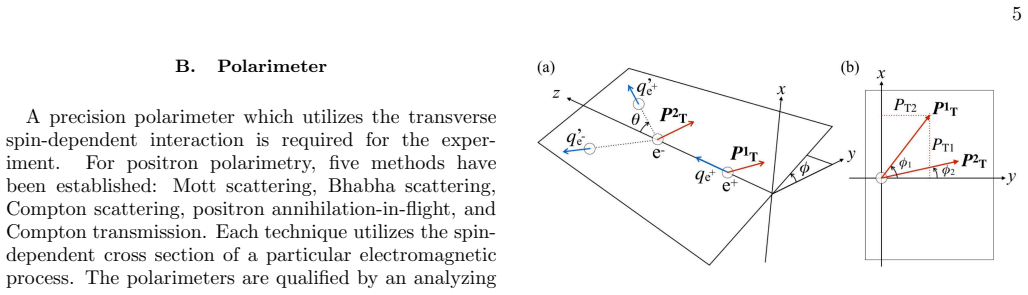
The load-bearing object is the T-odd coefficient $T(e)$ in the muon decay rate, with the explicit form $T(e) \simeq -\epsilon_M\lambda h_I(m_\mu - m_e^2/m_\mu)$, where $\epsilon_M$ flags Majorana versus Dirac neutrinos and $h_I$ is the imaginary part of products of left- and right-handed neutrino mixing matrices—a generalized Jarlskog invariant in the lepton sector. On the experimental side, the carrier is the azimuthal modulation $\cos(2\varphi-\varphi_1-\varphi_2)$ of the annihilation-in-flight asymmetry of decay positrons on a magnetized foil; the out-of-plane component $P_{T2}$ isolates the T-odd term. The projected sensitivity is obtained from a Monte Carlo simulation of the polarimeter in which the simulated longitudinal asymmetry is converted to a transverse asymmetry using the analytic ratio $B_T(\theta^*)\cos(2\varphi-\varphi_1-\varphi_2)/B_L(\theta^*)$ for annihilation-in-flight.
What would settle it
Run a Monte Carlo simulation of annihilation-in-flight with explicitly transversely polarized positrons, including photon conversion, multiple scattering, and energy thresholds, and compare the resulting azimuthal asymmetry with the value obtained by the paper's longitudinal-to-transverse conversion; a discrepancy larger than the projected one-year statistical errors would refute the sensitivity estimate.
Extended reading notes
Core claim
The central claim is that the T-odd term $\zeta_\mu \cdot (\mathbf{q}_e \times \boldsymbol{\zeta}_e)\,T(e)/E$ in the muon decay width is a clean, effectively background-free probe of new physics. Under the assumed (V−A) ⊕ (V+A) interaction, $T(e) \simeq -\epsilon_M\, \lambda\, h_I (m_\mu - m_e^2/m_\mu)$, where $\epsilon_M=1$ for Majorana and $\epsilon_M=0$ for Dirac neutrinos, and $h_I = \sum_{j,k}\operatorname{Im} C'_{jk}$ with $C'_{jk}=U^*_{ej}V_{ek}V^*_{\mu j}U_{\mu k}$ is a generalized Jarlskog invariant built from left- and right-handed neutrino mixing matrices. Because the two interfering diagrams (L,L,R,R) and (R,R,L,L) describe the same process only when neutrinos are their own antiparticles, the term vanishes for Dirac neutrinos; no analogous contamination appears from Standard Model radiative corrections. Experimentally, the $P_{T2}$ component of the decay positron's transverse polarization is read off from the azimuthal modulation $\cos(2\varphi-\varphi_1-\varphi_2)$ of the annihilation-in-flight asymmetry on a magnetized foil. The paper therefore concludes that a statistically significant non-zero $P_{T2}$ would simultaneously establish T-violation and Majoranality in this framework, and that the proposed J-PARC polarimeter could reach $P_{T2}$ sensitivity about ten times better than the previous experiment.
Load-bearing premise
The sensitivity projection assumes that the polarimeter's response to transverse positron polarization can be obtained by multiplying its simulated longitudinal asymmetry by an analytic angular ratio, rather than by simulating the spin-dependent annihilation process directly; if real detector effects distort the angular pattern differently for the two polarization directions, the factor-of-ten projection would not hold.
Editorial extensions
If this is right
- A statistically significant non-zero $P_{T2}$ would simultaneously establish time-reversal violation and Majorana neutrinos, and would point to right-handed currents at high energy.
- One year of data with the proposed polarimeter should reach sensitivity near $8\times10^{-4}$ for $P_{T2}$, a factor of ten better than the precursor experiment's $8\times10^{-3}$.
- Four days of data would already match the precursor's statistical precision if the two transverse components are comparable in size.
- The Standard Model background from radiative corrections is roughly $10^{-13}$ of the decay width, so a signal at the projected sensitivity would be essentially background-free.
- The same apparatus can measure Bhabha scattering and annihilation-in-flight simultaneously under the pulsed beam, which helps control systematics and also measures longitudinal polarization.
Reading between the lines
- Beyond the paper: a null result at the $10^{-3}$ level would not rule out the mechanism; it would push the required right-handed gauge-boson mass or mixing parameters higher, so the experiment is best read as a parameter-space probe rather than a yes/no test.
- Beyond the paper: the same $P_{T2}$ technique could be extended to other polarized leptonic decays if high-intensity polarized sources become available, where the mass-dependent ratios and V+A couplings would differ.
- Beyond the paper: because the sensitivity estimate relies on an analytic longitudinal-to-transverse conversion, an independent calibration using a beam of positrons with known transverse polarization would materially strengthen the projected reach.
- Beyond the paper: a positive signal would complement neutrinoless double beta decay, since $0\nu\beta\beta$ constrains Majorana masses through nuclear matrix elements while this muon-decay observable probes the same Majoranality through a purely leptonic T-odd interference.
Signed reviews
Editorial analysis
A structured set of objections, weighed in public.
Referee Report
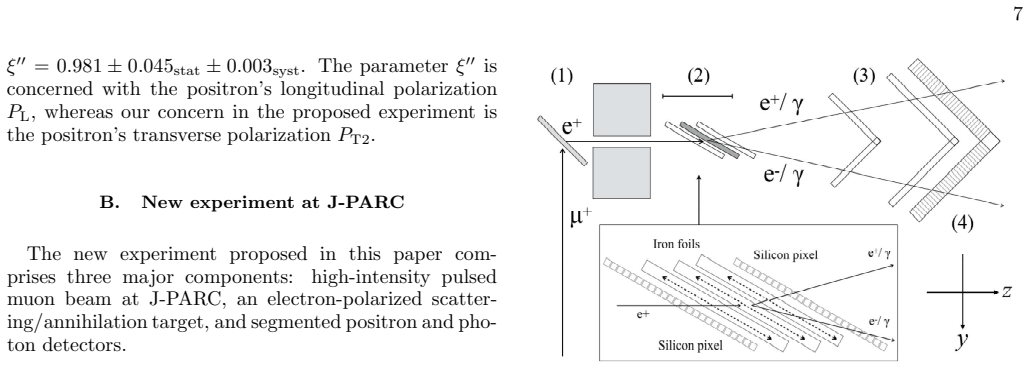
Summary. This manuscript proposes a new experiment to search for time-reversal violation in muon decay by measuring the transverse positron polarization component PT2, using the high-intensity pulsed muon beam at J-PARC MLF and a segmented annihilation-in-flight/Bhabha polarimeter. The theoretical part adapts the V+A ⊕ V−A effective Lagrangian of Doi et al., states that the T-odd term in Eq. (14) is nonvanishing only for Majorana neutrinos within that framework, and estimates the Standard-Model background as O(10^-13). The experimental part describes the polarimeter, reports GEANT4 simulations of longitudinal asymmetries, converts these to transverse asymmetries using the analytic ratios of Eqs. (29) and (33), optimizes target thickness and energy thresholds, and projects a factor-of-ten sensitivity improvement over the PSI precursor after one year of measurement.
Significance. If the projected sensitivity and the model interpretation are correct, the proposal offers a comparatively clean observable connecting muon decay to V+A interactions and neutrino Majoranality, using an existing high-intensity facility. The manuscript is concrete: it gives beam intensity, target geometry, energy thresholds, a figure of merit, and a quantitative comparison with a real precursor experiment. The FOM formalism and the use of pulsed-beam timing to suppress accidental backgrounds are sensible. However, the numerical projection is only as strong as the procedure used to obtain the transverse analyzing power, and that procedure is currently an analytic rescaling of a longitudinal simulation rather than a direct simulation of the observable being measured; the event-selection description is also incomplete.
major comments (3)
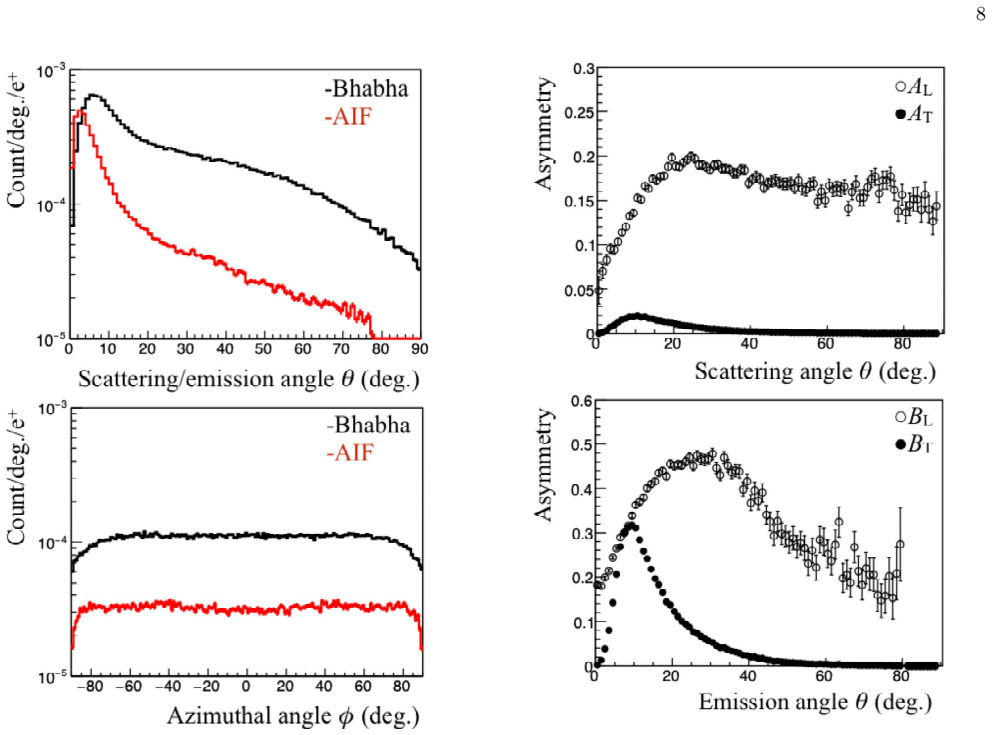
- [Section V.C.2, Eqs. (29) and (33)] The central sensitivity projection is obtained by taking the GEANT4 longitudinal asymmetry and multiplying it by the analytic ratio AT/BT over AL/BL, but GEANT4 contains no spin-dependent annihilation and the longitudinal asymmetry carries no azimuthal information. This conversion assumes that photon conversion, multiple scattering in the 3 mm iron foil, energy thresholds (E1 > 2 MeV, E2 > 2 MeV, E1+E2 > 15 MeV), and calorimeter segmentation suppress the cos(2φ−φ1−φ2) transverse term and the φ-independent longitudinal term in exactly the same way. Because the ratio is angle- and energy-dependent and the simulated acceptance is θlab = 13±8 degrees, whereas the maximum of the conversion factor occurs at much smaller lab angles, the inferred transverse analyzing power could be biased. Figures 9 through 11 and the factor-of-ten improvement claim all rely on this converted asymmetry, so the central numerical claim is not established without a direct spin-dependent simulation or a calibration test with an independently known transverse polarization.
- [Section II and Summary] The statement that a nonzero PT2 indicates Majoranality is valid only within the V+A ⊕ V−A model. The manuscript itself acknowledges in Section II that general S, P, V, A, T effective couplings can produce a T-odd term even for Dirac neutrinos. Since the proposed polarimeter measures only PT2 and cannot determine the Lorentz structure of the underlying interaction, the abstract and summary overreach when they present a measurement of PT2 as providing definitive information on Majoranality. The claims should be explicitly phrased as model-dependent: a nonzero PT2 would be evidence for T violation, and within the V+A framework it would point to Majorana neutrinos.
- [Section V.C.3] The text promises that details of event selection will be described in the next subsection, but V.C.3 provides only optimized thresholds and an acceptance window. The absolute event rate entering Eq. (37), and therefore the required measurement time in Fig. 11, depends on how photon-pair events are separated from accidental coincidences, beam-related backgrounds, and overlapping pulses at the assumed 1e8 muons/s rate. In addition, the sensitivity curves in Fig. 11 appear to be statistical only, while the PSI precursor's total uncertainty in Eqs. (35) and (36) includes a systematic error of 3.4e-3. Without an estimate of the dominant systematics of the proposed apparatus, the claimed factor-of-ten improvement relative to the precursor is not fully supported.
minor comments (5)
- [Section IV.C] State explicitly that Eqs. (27)–(29) are leading-order, high-energy-limit formulas for free electrons, and specify the θ* range over which they are applied in the simulation.
- [Figure 8 caption] The caption should state clearly that the filled 'transverse asymmetry' points are obtained from the longitudinal simulation via the analytic conversion factor of Eq. (33), rather than by a direct spin-dependent simulation.
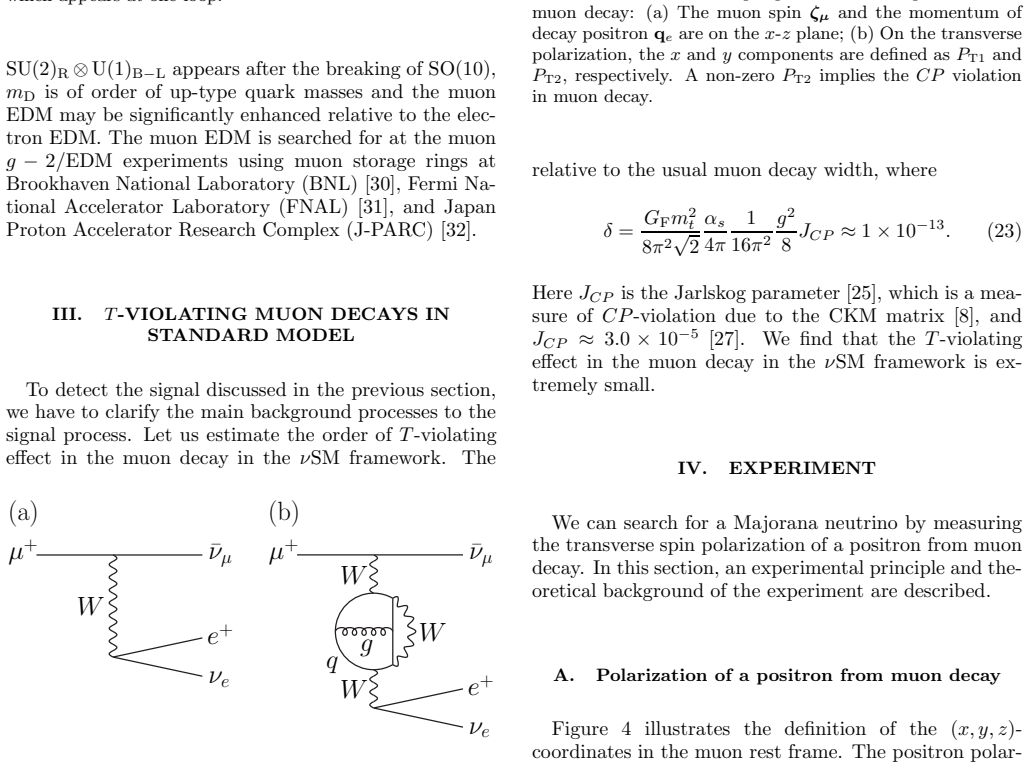
- [Section III, Eq. (23)] The estimate of the Standard-Model background should define all symbols, in particular g and the renormalization scale for αs, and should state that the result is an order-of-magnitude estimate; as written the numerical prefactor is difficult to reproduce.
- [Section V.C.3, Eq. (40)] The expression for σ diverges as φ1 approaches 90 degrees; specify the range of φ1 for which the formula is used and clarify the treatment of the φ1 = 90 degree case.
- [Figure 11] Indicate whether the abscissa is live time or wall-clock time, and state how the 25 Hz double-pulse structure and the equal division between positive and negative target-polarization configurations enter the rate calculation.
Circularity Check
No significant circularity: the T(e) formula and AIF asymmetry ratio are external inputs, and the GEANT4-based sensitivity projection fits no parameter to the claimed result.
full rationale
The paper's central theoretical input, the T-odd term T(e) of Eq. (14), is taken directly from Doi et al. [1] and used as a starting point rather than derived from the experimental projection; borrowing an external formula is reliance, not circularity. The experimental sensitivity claim is based on a GEANT4 simulation with no free parameters fitted to the target quantity PT2. In Section V.C.2, the transverse asymmetry is obtained by multiplying the simulated longitudinal asymmetry by the analytic ratio of Eqs. (29) and (33), which comes from external leading-order QED cross sections. This is a modeling approximation whose validity can be questioned, but it is not a circular reduction: the predicted sensitivity does not feed back into the input asymmetry, and no fitted parameter is renamed as a prediction. The only self-citation, Ref. [19] by the first author, is a general SO(10) GUT reference and is not load-bearing for the factor-of-ten sensitivity estimate. Therefore no step in the paper's derivation chain reduces by construction to its own inputs.
Assumptions & free parameters
free parameters (3)
- Target polarization P_e =
0.072 (assumed)
- Muon beam intensity =
1e8 muons/s (assumed)
- Optimized target thickness and energy thresholds =
3 mm foil, E1 > 2 MeV, E2 > 2 MeV, E1+E2 > 15 MeV
assumptions (4)
- domain assumption The effective Hamiltonian Eq. (3) with left- and right-handed currents and mixing parameters lambda and kappa is the appropriate BSM framework.
- domain assumption The T-odd term T(e) in Eq. (14), taken from Doi et al. [1], is the full T-violating contribution and vanishes for Dirac neutrinos.
- domain assumption The nuSM background to the T-odd correlation is approximately delta = 1e-13 as given in Eq. (23).
- domain assumption GEANT4 simulation with the described geometry accurately reproduces the detector response and longitudinal asymmetry, and the analytic conversion factors of Eqs. (29) and (33) yield the transverse asymmetry.
Cite this review
Pith. "Pith review of Hunting for T-violation and Majoranality of Neutrinos in Muon Decays." pith.science (2026). https://pith.science/paper/X4S6XCEP
@misc{pith2026190801630,
  author       = {Pith},
  title        = {Pith review of: Hunting for T-violation and Majoranality of Neutrinos in Muon Decays},
  year         = {2026},
  howpublished = {\url{https://pith.science/paper/X4S6XCEP}},
  note         = {Machine review of arXiv:1908.01630}
}
read the original abstract
We propose a new experiment to search for a time-reversal (T) symmetry breaking process in muon decay and the Majoranality of the neutrinos. In the presence of V+A interactions, the Majoranality appears as a T-violating term in the muon decay width as shown by Doi et al, while in the Standard Model such a T-violating term is negligibly small. The presences of V+A interactions and the corresponding heavy right-handed Majorana neutrinos give us an important clue to solve two major issues in particle physics, the deficit of baryon asymmetry in the universe and the Majoranality of neutrinos. In the experiment, the polarization of positrons from muon decays is measured using a polarimeter consisting of a magnetized foil and a segmented calorimeter. According to our result of numerical calculation, a factor of ten improvement in sensitivity to the T-violating process is expected by a year of measurement at J-PARC Materials and Life Science Experimental Facility, compared to the most recent precursor experiment.
Figures


Figures from the paper (6 more)


Reference graph
Works this paper leans on
-
[1]
Pulsed muon beam In contrast to the continuous beam at PSI, the pulsed muon beam at J-PARC has a periodic timing structure by nature. For a case of an experiment with pulsed beam, no muon trigger counter is required because arrival of the muon beam is synchronized to the accelerator repetition. The repetition cycle is 25 Hz and the beam has double pulse s...
-
[2]
Decay positron polarimeter The polarimeter is designed for both the Bhabha and AIF measurements. Figure 6 depicts a schematic of the polarimeter. A thin plate of beryllium is placed for a muon-stopping target. Magnetized iron foils are em- ployed as a spin-analyzing target. Between the muon- stopping target and the spin-analyzing target, a lead col- limat...
-
[3]
Angular distributions The number of signal events per incident muon to the stopping target is calculated. For the case of Bhabha scattering, the signal events are selected by a pair of charged particle tracks, which is detected by the silicon 8 FIG. 7. Simulated angular distributions of Bhabha scatter- ing and AIF: (top) scattering/emission angle ( θ); (b...
-
[4]
Figure 8 shows typi- cal simulated asymmetries as functions of the scatter- ing/emission angle θ
Angular asymmetries Spin-analyzing power of the polarimeter is numerically evaluated for polarized positrons. Figure 8 shows typi- cal simulated asymmetries as functions of the scatter- ing/emission angle θ. The polarization of positrons from FIG. 8. Simulated asymmetries with Bhabha scattering and AIF: (top) the result of Bhabha polarimeter case; (bottom...
-
[5]
Sensitivity to the T -violating effect In order to maximize the sensitivity for the transverse polarization, essential parameters in the experiment and analysis are optimized considering the FOM F = (N+ −N−)2 N+ +N− , (37) where N+ and N− are the numbers of observed events with “positive” and “negative” configurations in the tar- get polarization, respectiv...
-
[6]
M. Doi, T. Kotani, H. Nishiura, K. Okuda, and E. Taka- sugi, Progress of Theoretical Physics 67, 281 (1982)
work page 1982
-
[7]
T. D. Lee and C. N. Yang, Phys. Rev. 87, 410 (1952)
1952
-
[8]
C. S. Wu, E. Ambler, R. W. Hayward, D. D. Hoppes, and R. P. Hudson, Phys. Rev. 105, 1413 (1957)
work page 1957
Show all 54 references
-
[9]
J. D. Jackson, S. B. Treiman, and H. W. Wyld, Phys. Rev. 106, 517 (1957)
1957
-
[10]
J. H. Christenson, J. W. Cronin, V. L. Fitch, and R. Turlay, Phys. Rev. Lett. 13, 138 (1964)
1964
-
[11]
Abe et al
K. Abe et al. (Belle Collaboration), Phys. Rev. Lett. 87, 091802 (2001)
2001
-
[12]
Aubert et al
K. Aubert et al. (BABAR Collaboration), Phys. Rev. Lett. 87, 091801 (2001)
2001
-
[13]
Kobayashi and T
M. Kobayashi and T. Maskawa, Progress of Theoretical Physics 49, 652 (1973)
1973
-
[14]
Cabibbo, Phys
N. Cabibbo, Phys. Rev. Lett. 10, 531 (1963)
1963
-
[15]
Z. Maki, M. Nakagawa, and S. Sakata, Progress of Theoretical Physics 28, 870 (1962)
1962
-
[16]
Pontecorvo, Sov
B. Pontecorvo, Sov. Phys. JETP 7, 172 (1958)
1958
-
[17]
Minkowski, Physics Letters B 67, 421 (1977)
P. Minkowski, Physics Letters B 67, 421 (1977)
1977
-
[18]
Yanagida, Conf
T. Yanagida, Conf. Proc. C7902131, 95 (1979)
1979
-
[19]
Gell-Mann, P
M. Gell-Mann, P. Ramond, and R. Slansky, Conf. Proc. C790927, 315 (1979)
1979
-
[20]
S. L. Glashow, Cargese Summer Institute: Quarks and Leptons Cargese, France, July 9-29, 1979 , NATO Sci. Ser. B 61, 687 (1980)
1980
-
[21]
R. N. Mohapatra and G. Senjanovi´ c, Phys. Rev. Lett. 44, 912 (1980)
1980
-
[22]
Fukugita and T
M. Fukugita and T. Yanagida, Physics Letters B 174, 45 (1986)
1986
-
[23]
Kuzmin, V
V. Kuzmin, V. Rubakov, and M. Shaposhnikov, Physics Letters B 155, 36 (1985)
1985
-
[24]
Fukuyama, Int
T. Fukuyama, Int. J. Mod. Phys. A 28, 1330008 (2013)
2013
-
[25]
The symmetry breaking to naive SU(5) ⊗ U(1)X leads to too fast proton decay
-
[26]
J. C. Pati and A. Salam, Phys. Rev. D 10, 275 (1974)
1974
-
[27]
Beall, M
G. Beall, M. Bander, and A. Soni, Phys. Rev. Lett. 48, 848 (1982)
1982
-
[28]
V. B. Berestetskii, E. M. Lifshitz, and L. P. Pitaevskii , Relativistic Quantum Theory (Pergamon Press, 1971)
1971
-
[29]
M. Doi, T. Kotani, H. Nishiura, K. Okuda, and E. Taka- sugi, Science Reports, Colleage of General Education, Os- aka University 30, 119 (1981)
1981
-
[30]
Jarlskog, Phys
C. Jarlskog, Phys. Rev. Lett. 55, 1039 (1985)
1985
-
[31]
Mandal, M
S. Mandal, M. Mitra, and N. Sinha, Phys. Rev. D 96, 035023 (2017)
2017
-
[32]
Patrignani and P
C. Patrignani and P. D. Group, Chinese Physics C 40, 100001 (2016)
2016
-
[33]
Michel, Proc
L. Michel, Proc. Phys. Soc. A 63, 514 (1950)
1950
-
[34]
Bernreuther and M
W. Bernreuther and M. Suzuki, Rev. Mod. Phys. 63, 313 (1991)
1991
-
[35]
G. W. Bennett et al. (Muon g-2 Collaboration), Phys. Rev. D 73, 072003 (2006)
2006
- [36]
-
[37]
Abe et al
M. Abe et al. , PTEP 2019, 053C02 (2019)
2019
-
[38]
[49], it can be shown that no CP violation occurs if we neglect the gluon in Fig
By using the same technique used in Ref. [49], it can be shown that no CP violation occurs if we neglect the gluon in Fig. 3 (b)
-
[39]
Swartz, SLAC Publication 4656 (1988)
M. Swartz, SLAC Publication 4656 (1988)
1988
-
[40]
Agostinelli et al., Nucl
S. Agostinelli et al., Nucl. Instrum. Meth. A 506, 250 (2003)
2003
-
[41]
Allison et al
J. Allison et al. , IEEE Trans. Nucl. Sci. 53, 270 (2006)
2006
-
[42]
Allison et al., Nucl
J. Allison et al., Nucl. Instrum. Meth. A 835, 186 (2016)
2016
-
[43]
L. A. Page, Phys. Rev. 106, 394 (1957)
1957
-
[44]
W. H. McMaster, Rev. Mod. Phys. 33, 8 (1961)
1961
-
[45]
Fetscher, The European Physical Journal C 52, 1 (2007)
W. Fetscher, The European Physical Journal C 52, 1 (2007)
2007
-
[46]
Danneberg et al., Phys
N. Danneberg et al., Phys. Rev. Lett. 94, 021802 (2005)
2005
-
[47]
Prieels et al
R. Prieels et al. , Phys. Rev. D 90, 112003 (2014)
2014
-
[48]
Kawamura et al
N. Kawamura et al. , PTEP 2018, 113G01 (2018)
2018
-
[49]
Corriveau et al
F. Corriveau et al. , Phys. Rev. D 24, 2004 (1981)
1981
-
[50]
Carne et al
A. Carne et al. , Hyperfine Interact , 17 (1984)
1984
-
[51]
S. M. Bilenky, Physics of Particles and Nuclei 41, 690 (2010)
2010
-
[52]
M. Doi, T. Kotani, and E. Takasugi, Progress of Theoretical Physics Supplement 83, 1 (1985)
1985
-
[53]
Gando et al
A. Gando et al. (KamLAND-Zen Collaboration), Phys. Rev. Lett. 117, 082503 (2016)
2016
-
[54]
E. P. Shabalin, Sov. J. Nucl. Phys. 28, 75 (1978), [Yad. Fiz.28,151(1978)]
1978
Reviewed August 14, 2026 · model on record in the stance chip above.
Discussion (0). Continue with ORCID to comment.