REVIEW 3 major objections 5 minor 1 cited by
Attribute-Guided Coupled GAN for Cross-Resolution Face Recognition
T0 review · 3 major / 5 minor · reviewed 2026-08-14 · deepseek-v4-flash
Pith's one-line read The paper proposes an attribute-guided coupled GAN that learns a shared embedding for low- and high-resolution face images, using facial attribute prediction to sharpen the subspace and improve cross-resolution recognition.
desk verdict A plausible engineering combination of known losses that likely helps modestly for cross-resolution face recognition, but the SCFace/UCCS attribute guidance is built on unvalidated MOON pseudo-labels and Table 1 has arithmetic errors, so the state-of-the-art claim is weaker than it first looks. read the letter →
The pith
A machine-rendered reading of the paper's core claim, the machinery that carries it, and where it could break.
The reading
What carries the argument
The load-bearing mechanism is a coupled GAN: two U-Net generators, one for the low-resolution domain and one for the high-resolution domain, tied together by a contrastive loss over a shared latent embedding. Each generator is trained with a patch-based discriminator, an L2 reconstruction loss, and the low-resolution branch also carries a deep perceptual loss. Attribute predictors attached to the bottleneck of each generator add supervised cross-entropy losses for individual facial attributes, and a fine-tuned face attribute predictor network supplies an attribute perceptual loss that compares attributes of synthesized and real images. The total objective is the weighted sum of the contrastive loss, attribute prediction loss, GAN loss, perceptual loss, attribute perceptual loss, and reconstruction loss; the attribute prediction term is what the paper identifies as the contributor that makes the embedding more discriminative.
What would settle it
Train the same coupled GAN with only the attribute prediction loss removed, and separately replace the synthetic attribute labels on SCFace and UCCS with human-verified labels; if recognition accuracy does not improve with human labels, or if randomly shuffled attribute labels reproduce the same gain, then attribute guidance is not the source of the reported improvement.
Extended reading notes
Core claim
The central claim is that facial attributes, used as auxiliary supervision inside a coupled GAN, make the common embedding subspace more discriminative for cross-resolution face recognition. The framework has two sub-networks, one for low-resolution images and one for high-resolution images, coupled by a contrastive loss that attracts same-identity pairs and repels different-identity pairs in the shared subspace. Each sub-network also predicts a set of facial attributes from its bottleneck features, and the joint attribute prediction loss, together with attribute-consistency losses between real and synthesized images, shapes the embedding so that faces with similar attributes land close together across resolutions. The paper reports that this design outperforms the SKD and D-Align embedding baselines on SCFace, lowers top-1 and top-5 errors relative to VLRR and SKD on UCCS, and improves attribute prediction for low-resolution CelebA images. Its ablation study shows the attribute prediction loss provides an additional gain beyond the GAN and perceptual losses.
Load-bearing premise
The method's main bet is that the facial-attribute labels used to guide the embedding are accurate enough to help; on SCFace and UCCS those labels are produced automatically by a pretrained network rather than annotated by humans, so if they are noisy the attribute-guided contribution is not actually being tested on those benchmarks.
Editorial extensions
If this is right
- Low-resolution probe faces can be matched directly against high-resolution gallery faces in the learned subspace, avoiding the computational cost of hallucinating high-resolution images before recognition.
- The same features used for matching can also predict facial attributes from low-resolution images, which can narrow down the gallery during identification.
- Adding attribute prediction as a multi-task loss is a workable way to improve cross-resolution matching even when attribute labels are machine-generated rather than human-annotated.
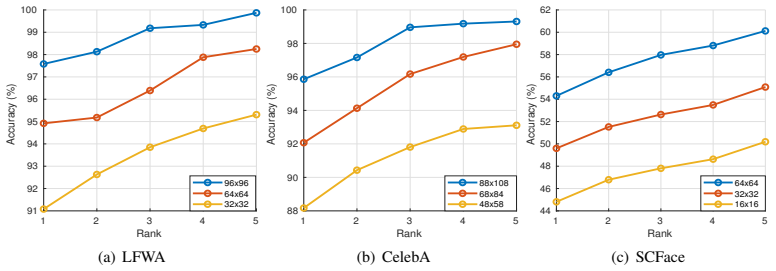
- The reported rank-1 gains on SCFace across three camera distances suggest the approach transfers to surveillance settings with varying standoff distances.
Reading between the lines
- If the attribute guidance is genuinely responsible for the gain, the same design should transfer to other cross-domain face-matching problems, such as matching visible to near-infrared images, where attribute consistency across domains can regularize the embedding.
- A direct test of the paper's mechanism would be to replace the synthetic attribute labels on SCFace and UCCS with human-verified labels and measure whether recognition accuracy changes; if it does not, the attribute loss may be acting mainly as extra regularization.
- The reported improvement in low-resolution attribute prediction suggests the shared embedding preserves soft-biometric information that a standalone low-resolution attribute predictor loses, which could be exploited for attribute-based retrieval from surveillance imagery.
Signed reviews
Editorial analysis
A structured set of objections, weighed in public.
Referee Report
Summary. The authors propose an attribute-guided coupled GAN for cross-resolution face recognition. Two sub-networks, one for low-resolution and one for high-resolution inputs, project images into a common embedding space learned with a contrastive loss; the overall objective also includes attribute prediction, GAN, perceptual, and L2 reconstruction losses. The paper reports rank-1 recognition improvements over several baselines on LFWA, CelebA, SCFace, and UCCS, and an ablation on LFWA showing that the attribute prediction loss contributes to verification performance.
Significance. If the reported results are reproducible, the method offers a practical embedding-based solution to matching low-resolution surveillance probes against high-resolution galleries, and the multi-task attribute prediction appears to yield a modest but consistent gain on LFWA. The paper provides a useful ablation study and comparisons on four datasets. However, the central attribute-guidance mechanism is directly validated only on LFWA; on SCFace and UCCS the attribute labels are machine-generated without validation, and Table 1 contains an arithmetic error for the D-Align baseline. These issues need to be addressed before the contributions can be fully assessed.
major comments (3)
- [Table 1] The average rank-1 accuracy reported for D-Align is 24.30, but the average of the three distance-specific values (34.37, 39.38, 49.37) is 41.04. This error substantially overstates the margin of the proposed method over D-Align. Please correct the table and re-check any text that cites this margin.
- [Section 5.1 and Eqs. (8)-(10)] The attribute labels for SCFace and UCCS are generated by MOON, but the paper provides no accuracy or sensitivity analysis for these pseudo-labels. Since Eqs. (8)-(10) make the attribute prediction loss directly dependent on these labels, and since the only ablation that isolates the contribution of La is on LFWA (Section 5.6), the current evidence does not establish whether the attribute guidance is responsible for the gains on SCFace and UCCS. The margins over SKD on SCFace are small (0.80-1.60 pp), so noisy labels could easily account for or erode them. Please provide a validation of MOON on these datasets, an ablation including and excluding La on SCFace and UCCS, or a discussion of the expected impact of label noise.
- [Section 4.2 and Eq. (7)] The contrastive loss is written as a sum over all N^2 pairs, but the text in Section 5.2 states that genuine and impostor pairs are balanced. Please clarify how the pairs are sampled and how the balance is achieved, since the number of genuine pairs is O(N) while impostor pairs are O(N^2). This clarification is needed to understand the actual training objective and the role of the contrastive margin m.
minor comments (5)
- [Section 5.5] The text says the attribute prediction results are 'for both datasets', but Table 2 only reports CelebA. Please specify the dataset(s) for each reported column.
- [Figure 3] The legend labels the first baseline as 'VLLR', but the text and reference [48] call it 'VLRR'. Please correct the legend.
- [Eq. (21) and Section 5.2] The text in Section 5.2 states that λ3 and λ4 are 0.5 while all other λ's are 1; consider explicitly listing all hyperparameter values in one place for reproducibility.
- [Abstract and Section 1] The text states that the method 'maximizes pair-wise correlation', but the contrastive loss in Eqs. (5)-(6) minimizes distances. Please align the terminology with the actual objective.
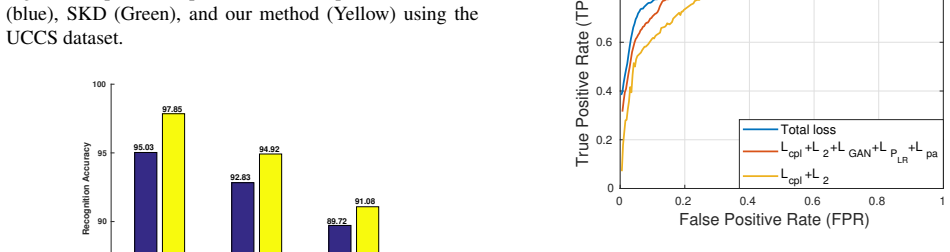
- [Figure 5] The ROC curves would be more informative if accompanied by numerical AUC or equal-error-rate values; consider adding them.
Circularity Check
No significant circularity: recognition accuracy is measured on held-out identities, and the attribute-guided losses are auxiliary terms trained with external labels rather than outputs of the recognition model.
full rationale
The paper's derivation chain is an empirical training scheme, not a formal derivation. The recognition claim is evaluated by Eq. (22): a probe LR embedding z1(xp_LR) is matched to gallery HR embeddings z2(xj_HR) by minimum Euclidean distance, and the reported accuracies are measured on test identities not used in training. The attribute prediction losses La (Eqs. 8-10) and attribute perceptual loss Lpa (Eqs. 15-17) are auxiliary terms in the total objective (Eq. 21); their labels are either human annotations (LFWA, CelebA) or MOON-generated pseudo-labels (SCFace, UCCS), i.e., external inputs rather than outputs of the proposed model. The ablation in Fig. 5 compares loss combinations on LFWA and shows incremental ROC improvement, which is an empirical sensitivity check, not a tautology. Self-citations such as [40], [41], and [44] appear in related-work context and are not used to justify the central recognition result. No equation reduces the reported recognition accuracy to a fitted parameter or to the attribute labels by construction. The MOON-label concern on SCFace/UCCS is a correctness risk about whether the attribute-guidance contribution is actually tested there, but it is not circularity under the stated criteria.
Assumptions & free parameters
free parameters (2)
- Loss weights λ1, λ2, λ3, λ4, λ5 =
λ1=λ2=λ5=1; λ3=λ4=0.5
- Contrastive margin m
assumptions (3)
- domain assumption A balanced set of genuine and impostor LR/HR pairs (Section 5.2) is sufficient to learn a contrastive embedding that separates identities at test time.
- domain assumption MOON-generated attribute labels for SCFace and UCCS are accurate enough to serve as ground truth for the attribute-guided loss.
- domain assumption The VGG-Face attribute predictor fine-tuned on LFWA attributes provides a meaningful perceptual attribute loss when applied to other datasets.
Cite this review
Pith. "Pith review of Attribute-Guided Coupled GAN for Cross-Resolution Face Recognition." pith.science (2026). https://pith.science/paper/XMQM2DMX
@misc{pith2026190801790,
  author       = {Pith},
  title        = {Pith review of: Attribute-Guided Coupled GAN for Cross-Resolution Face Recognition},
  year         = {2026},
  howpublished = {\url{https://pith.science/paper/XMQM2DMX}},
  note         = {Machine review of arXiv:1908.01790}
}
read the original abstract
In this paper, we propose a novel attribute-guided cross-resolution (low-resolution to high-resolution) face recognition framework that leverages a coupled generative adversarial network (GAN) structure with adversarial training to find the hidden relationship between the low-resolution and high-resolution images in a latent common embedding subspace. The coupled GAN framework consists of two sub-networks, one dedicated to the low-resolution domain and the other dedicated to the high-resolution domain. Each sub-network aims to find a projection that maximizes the pair-wise correlation between the two feature domains in a common embedding subspace. In addition to projecting the images into a common subspace, the coupled network also predicts facial attributes to improve the cross-resolution face recognition. Specifically, our proposed coupled framework exploits facial attributes to further maximize the pair-wise correlation by implicitly matching facial attributes of the low and high-resolution images during the training, which leads to a more discriminative embedding subspace resulting in performance enhancement for cross-resolution face recognition. The efficacy of our approach compared with the state-of-the-art is demonstrated using the LFWA, Celeb-A, SCFace and UCCS datasets.
Figures


Figures from the paper (1 more)
Forward citations
Cited by 1 Pith paper
-
Deep Sparse Band Selection for Hyperspectral Face Recognition
A VGG-19 network with group Lasso on its first convolutional layer selects 3 to 4 spectral bands per dataset and reaches about 99.9% accuracy on the CMU, HK PolyU, and UWA hyperspectral face datasets.
Reference graph
Works this paper leans on
- [1]
-
[2]
A. Dantcheva, P. Elia, and A. Ross. What else does your bio- metric data reveal? a survey on soft biometrics. IEEE Trans- actions on Information Forensics and Security , 11(3):441– 467, March 2016
work page 2016
-
[3]
C. Dong, C. C. Loy, K. He, X. Tang, D. Fleet, T. Pajdla, B. Schiele, and T. Tuytelaars. Learning a deep convolutional network for image super-resolution. In Proc. European Con- ference on Computer Vision (ECCV), pages 184–199, 2014
work page 2014
-
[4]
S. N. Ferdous, M. Mostofa, and N. M. Nasrabadi. Super resolution-assisted deep aerial vehicle detection. In Artificial Intelligence and Machine Learning for Multi-Domain Oper- ations Applications, 2019
2019
-
[5]
S. Ge, S. Zhao, C. Li, and J. Li. Low-resolution face recog- nition in the wild via selective knowledge distillation. IEEE Transactions on Image Processing, 28:2051–2062, 2018
work page 2018
-
[6]
I. Goodfellow, J. Pouget-Abadie, M. Mirza, B. Xu, D. Warde-Farley, S. Ozair, A. Courville, and Y . Bengio. Gen- erative adversarial nets. In Proc. Neural Information Pro- cessing Systems, pages 2672–2680. 2014
work page 2014
- [7]
-
[8]
M. Haghighat and M. Abdel-Mottaleb. Low resolution face recognition in surveillance systems using discriminant cor- relation analysis. In Proc. IEEE International Conference on Automatic Face & Gesture Recognition, pages 912–917, 2017
work page 2017
Show all 53 references
-
[9]
Herrmann, D
C. Herrmann, D. Willersinn, and J. Beyerer. Low-resolution convolutional neural networks for video face recognition. In Proc. IEEE International Conference on Advanced Video and Signal Based Surveillance (AVSS) , pages 221–227, 2016
2016
-
[10]
Isola, J.-Y
P. Isola, J.-Y . Zhu, T. Zhou, and A. A. Efros. Image-to-image translation with conditional adversarial networks. In Proc. IEEE Conference on Computer Vision and Pattern Recogni- tion (CVPR), pages 5967–5976, 2017
2017
-
[11]
Jian and K.-M
M. Jian and K.-M. Lam. Simultaneous hallucination and recognition of low-resolution faces based on singular value decomposition. IEEE Transactions on Circuits and Systems for Video Technology, 25(11):1761–1772, 2015
2015
-
[12]
Jiang, R
J. Jiang, R. Hu, Z. Wang, and Z. Cai. Cdmma: Cou- pled discriminant multi-manifold analysis for matching low- resolution face images. Signal Processing , 124:162–172, 2016
2016
-
[13]
Johnson, A
J. Johnson, A. Alahi, and L. Fei-Fei. Perceptual losses for real-time style transfer and super-resolution. In Proc. Euro- pean Conference on Computer Vision (ECCV), 2016
2016
-
[14]
Kazemi, S
H. Kazemi, S. M. Iranmanesh, and N. Nasrabadi. Style and content disentanglement in generative adversarial networks. In Proc. IEEE Winter Conference on Applications of Com- puter Vision (WACV), pages 848–856, 2019
2019
-
[15]
Kazemi, S
H. Kazemi, S. Soleymani, F. Taherkhani, S. Iranmanesh, and N. Nasrabadi. Unsupervised image-to-image transla- tion using domain-specific variational information bound. In Advances in Neural Information Processing Systems , pages 10348–10358, 2018
2018
-
[16]
Kazemi, F
H. Kazemi, F. Taherkhani, and N. M. Nasrabadi. Unsuper- vised facial geometry learning for sketch to photo synthesis. In International Conference of the Biometrics Special Inter- est Group (BIOSIG). IEEE, 2018
2018
-
[17]
D. P. Kingma and J. Ba. Adam: A method for stochastic optimization. CoRR, abs/1412.6980, 2015
2015 arXiv
-
[18]
Kolouri and G
S. Kolouri and G. K. Rohde. Transport-based single frame super resolution of very low resolution face images. InProc. IEEE Conference on Computer Vision and Pattern Recogni- tion (CVPR), pages 4876–4884, 2015
2015
-
[19]
Ledig, L
C. Ledig, L. Theis, F. Huszar, J. Caballero, A. P. Aitken, A. Tejani, J. Totz, Z. Wang, and W. Shi. Photo-realistic single image super-resolution using a generative adversarial network. CoRR, abs/1609.04802, 2016
2016 arXiv
-
[20]
P. Li, L. Prieto, D. Mery, and P. J. Flynn. On low-resolution face recognition in the wild: Comparisons and new tech- niques. IEEE Transactions on Information Forensics and Security, page 11, 2019
2019
-
[21]
Z. Liu, P. Luo, X. Wang, and X. Tang. Deep learning face attributes in the wild. In Proceedings of International Con- ference on Computer Vision (ICCV), 2015
2015
-
[22]
Mirza and S
M. Mirza and S. Osindero. Conditional generative adversar- ial nets. arXiv preprint arXiv:1411.1784, 2014
2014 arXiv
-
[23]
S. P. Mudunuri and S. Biswas. Low resolution face recog- nition across variations in pose and illumination. IEEE Transactions on Pattern Analysis and Machine Intelligence, 38(5):1034–1040, 2016
2016
-
[24]
S. P. Mudunuri, S. Venkataramanan, and S. Biswas. Dic- tionary alignment with re-ranking for low-resolution nir-vis face recognition. IEEE Transactions on Information Foren- sics and Security, 14(4):886–896, April 2019
2019
-
[25]
U. M. Osahor and N. M. Nasrabadi. Deep adversarial at- tack on target detection systems. In Artificial Intelligence and Machine Learning for Multi-Domain Operations Appli- cations, 2019
2019
-
[26]
U. M. Osahor and N. M. Nasrabadi. Design of adversar- ial targets: fooling deep atr systems. In Automatic Target Recognition XXIX, 2019
2019
-
[27]
O. M. Parkhi, A. Vedaldi, A. Zisserman, et al. Deep face recognition. In Proc. British Machine Vision Conference (BMVC), volume 1, page 6, 2015
2015
-
[28]
S. Reed, Z. Akata, X. Yan, L. Logeswaran, B. Schiele, and H. Lee. Generative adversarial text to image synthesis. InIn- ternational Conference on Machine Learning (ICML), 2016
2016
-
[29]
Ren, D.-Q
C.-X. Ren, D.-Q. Dai, and H. Yan. Coupled kernel embed- ding for low-resolution face image recognition. IEEE Trans- actions on Image Processing, 21(8):3770–3783, 2012
2012
-
[30]
Ronneberger, P
O. Ronneberger, P. Fischer, and T. Brox. U-net: Convolu- tional networks for biomedical image segmentation. InProc. International Conference on Medical Image Computing and Computer-Assisted Intervention , pages 234–241. Springer, 2015
2015
-
[31]
E. M. Rudd, M. G ¨unther, and T. E. Boult. Moon: A mixed objective optimization network for the recognition of facial attributes. In Proc. European Conference on Cmputer Vision (ECCV), 2016
2016
-
[32]
Sapkota and T
A. Sapkota and T. E. Boult. Large scale unconstrained open set face database. In 2013 IEEE Sixth International Con- ference on Biometrics: Theory, Applications and Systems (BTAS), Sep. 2013
2013
-
[33]
Shekhar, V
S. Shekhar, V . M. Patel, and R. Chellappa. Synthesis- based robust low resolution face recognition. arXiv preprint arXiv:1707.02733, 2017
2017 arXiv
-
[34]
Simonyan and A
K. Simonyan and A. Zisserman. Very deep convolutional networks for large-scale image recognition. arXiv preprint arXiv:1409.1556, 2014
2014 arXiv
-
[35]
Singh, S
M. Singh, S. Nagpal, M. Vatsa, R. Singh, A. Majumdar, and IIIT-Delhi. Identity aware synthesis for cross resolution face recognition. In Proc. IEEE/CVF Conference on Computer Vision and Pattern Recognition Workshops (CVPRW), pages 479–488, 2018
2018
-
[36]
Soleymani, A
S. Soleymani, A. Dabouei, J. Dawson, and N. M. Nasrabadi. Adversarial examples to fool iris recognition systems.CoRR, abs/1906.09300, 2019
1906 arXiv
-
[37]
Soleymani, A
S. Soleymani, A. Dabouei, S. M. Iranmanesh, H. Kazemi, J. Dawson, and N. M. Nasrabadi. Prosodic-enhanced siamese convolutional neural networks for cross-device text- independent speaker verification. In Proc. IEEE Interna- tional Conference on Biometrics Theory, Applications an...
2018
-
[38]
Taherkhani and M
F. Taherkhani and M. Jamzad. Restoring highly corrupted images by impulse noise using radial basis functions inter- polation. IET Image Processing, 12(1):20–30, 2017
2017
-
[39]
Taherkhani, H
F. Taherkhani, H. Kazemi, and N. M. Nasrabadi. Matrix completion for graph-based deep semi-supervised learning. In Thirty-Third AAAI Conference on Artificial Intelligence , 2019
2019
-
[40]
Taherkhani, N
F. Taherkhani, N. M. Nasrabadi, and J. Dawson. A deep face identification network enhanced by facial attributes pre- diction. In Proc. IEEE Conference on Computer Vision and Pattern Recognition Workshops, pages 553–560, 2018
2018
-
[41]
Taherkhani, V
F. Taherkhani, V . Talreja, H. Kazemi, and N. Nasrabadi. Fa- cial attribute guided deep cross-modal hashing for face im- age retrieval. In International Conference of the Biometrics Special Interest Group (BIOSIG). IEEE, 2018
2018
-
[42]
Talreja, T
V . Talreja, T. Ferrett, M. C. Valenti, and A. Ross. Biometrics- as-a-service: A framework to promote innovative biometric recognition in the cloud. In IEEE International Conference on Consumer Electronics (ICCE), 2018
2018
-
[43]
Talreja, S
V . Talreja, S. Soleymani, M. C. Valenti, and N. M. Nasrabadi. Learning to authenticate with deep multibiometric hashing and neural network decoding. CoRR, abs/1902.04149, 2019
1902 arXiv
-
[44]
Talreja, F
V . Talreja, F. Taherkhani, M. C. Valenti, and N. M. Nasrabadi. Using deep cross modal hashing and error cor- recting codes for improving the efficiency of attribute guided facial image retrieval. In Proc. IEEE Global Conference on Signal and Information Processing (GlobalSIP),...
2018
-
[45]
Talreja, M
V . Talreja, M. C. Valenti, and N. M. Nasrabadi. Multibio- metric secure system based on deep learning. In Proc. IEEE Global Conference on Signal and Information Processing , pages 298–302, Nov. 2017
2017
-
[46]
Uiboupin, P
T. Uiboupin, P. Rasti, G. Anbarjafari, and H. Demirel. Fa- cial image super resolution using sparse representation for improving face recognition in surveillance monitoring. In Proc. IEEE Signal Processing and Communication Applica- tion Conference (SIU), pages 437–440, 2016
2016
-
[47]
X. Wang, H. Hu, and J. Gu. Pose robust low-resolution face recognition via coupled kernel-based enhanced discrim- inant analysis. IEEE/CAA Journal of Automatica Sinica , 3(2):203–212, 2016
2016
-
[48]
Z. Wang, S. Chang, Y . Yang, D. Liu, and T. S. Huang. Study- ing very low resolution recognition using deep networks. In Proc. IEEE Conference on Computer Vision and Pattern Recognition, pages 4792–4800, 2016
2016
-
[49]
L. Wolf, T. Hassner, and Y . Taigman. Effective uncon- strained face recognition by combining multiple descriptors and learned background statistics. IEEE Transactions on Pattern Analysis and Machine Intelligence , 33(10):1978– 1990, Oct 2011
1978
-
[50]
Xing and K
X. Xing and K. Wang. Couple manifold discriminant anal- ysis with bipartite graph embedding for low-resolution face recognition. Signal Processing, 125:329–335, 2016
2016
-
[51]
Yang, C.-P
M.-C. Yang, C.-P. Wei, Y .-R. Yeh, and Y .-C. F. Wang. Recog- nition at a long distance: Very low resolution face recogni- tion and hallucination. In Proc. International Conference on Biometrics (ICB), pages 237–242, 2015
2015
-
[52]
Zhang, X
P. Zhang, X. Ben, W. Jiang, R. Yan, and Y . Zhang. Cou- pled marginal discriminant mappings for low-resolution face recognition. Optik, 126(23):4352–4357, 2015
2015
-
[53]
Zhong, J
Y . Zhong, J. Sullivan, and H. Li. Face attribute prediction using off-the-shelf cnn features. In Proc. International Con- ference on Biometrics (ICB), 2016
2016
Reviewed August 14, 2026 · model on record in the stance chip above.
Discussion (0). Continue with ORCID to comment.