REVIEW 4 major objections 5 minor 42 references
Dialogue Act Classification in Group Chats with DAG-LSTMs
T0 review · 4 major / 5 minor · reviewed 2026-08-14 · deepseek-v4-flash
Pith's one-line read The paper demonstrates that encoding same-participant turn-taking links into an LSTM's graph structure—with an elementwise-max cell update to prevent state growth—improves dialogue-act classification in group chats, reaching 87.69%…
desk verdict A sensible architectural tweak with a plausible but under-supported empirical claim—worth engaging, but the superiority over baselines needs reruns and error bars before being taken as established. read the letter →
The pith
A machine-rendered reading of the paper's core claim, the machinery that carries it, and where it could break.
The reading
What carries the argument
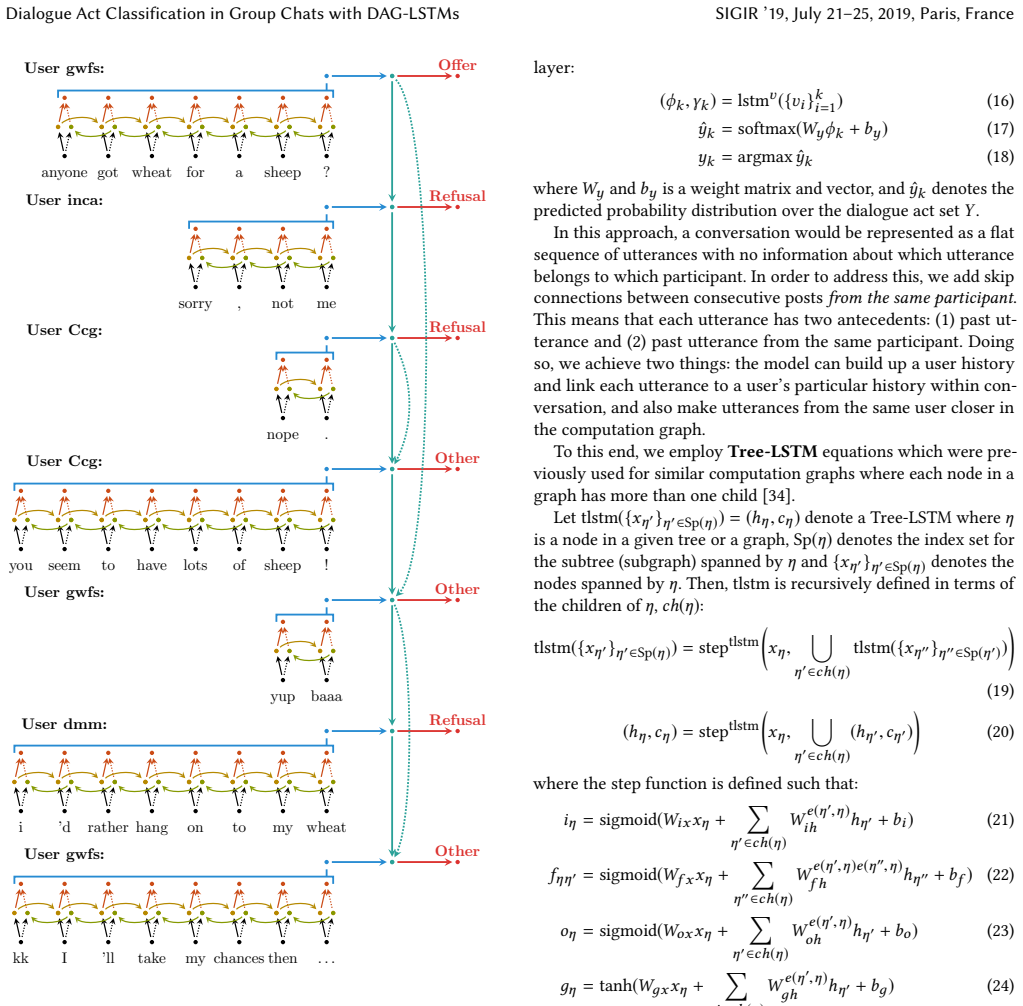
The central object is the DAG-LSTM, a Tree-LSTM-style recurrent unit whose computation graph is a directed acyclic graph: every utterance node receives children from the previous utterance and from the same participant's most recent utterance, and edge-type-specific weights distinguish the two kinds of link. The load-bearing modification is the elementwise maximum over children in the cell-state update, which keeps representational growth linear in conversation length while letting the model choose the most relevant antecedent path coordinate by coordinate. This carries the argument because it makes many-parent recurrence feasible on long chats and it is what injects participant identity into the context representation.
What would settle it
Run the same five models on many random splits of the STAC corpus and record the spread of accuracy and per-category F1; if the DAG-LSTM is not consistently ahead of the flat LSTM baseline across splits, the central claim fails.
Extended reading notes
Core claim
The central claim is that the turn-taking structure of a chat should be part of the recurrent computation graph, not compressed into a flat utterance sequence. The DAG-LSTM treats each utterance as a node whose hidden state is computed from two parents: the previous utterance in the conversation and the previous utterance from the same participant, with separate edge-type-specific weight matrices for the two kinds of link. The standard Tree-LSTM sum over child cell states is replaced by an elementwise max, $c_\eta = i_\eta \odot g_\eta + \max_{\eta'\in\mathrm{ch}(\eta)} f_{\eta\eta'}\odot c_{\eta'}$, so each dimension of the cell state follows a single child path and the total state grows at worst linearly instead of exponentially. In the authors' experiments this structure outperforms CNN and LSTM baselines, with the largest gains on offers, where same-speaker history prevents misclassifying them as counteroffers.
Load-bearing premise
The load-bearing premise is that the reported gains of about 0.9 points in accuracy and 1.2 points in average per-category F1 come from the architecture itself, rather than from chance in the single random split of games into train, development, and test sets, because the paper reports no repeated runs or significance test.
Editorial extensions
If this is right
- Same-participant history is a usable context signal in multi-party chat: providing it as an explicit edge type improves dialogue-act classification over treating context as a flat sequence.
- The elementwise-max cell update keeps DAG recurrence feasible on conversations of realistic length, so the architecture scales beyond short snippets.
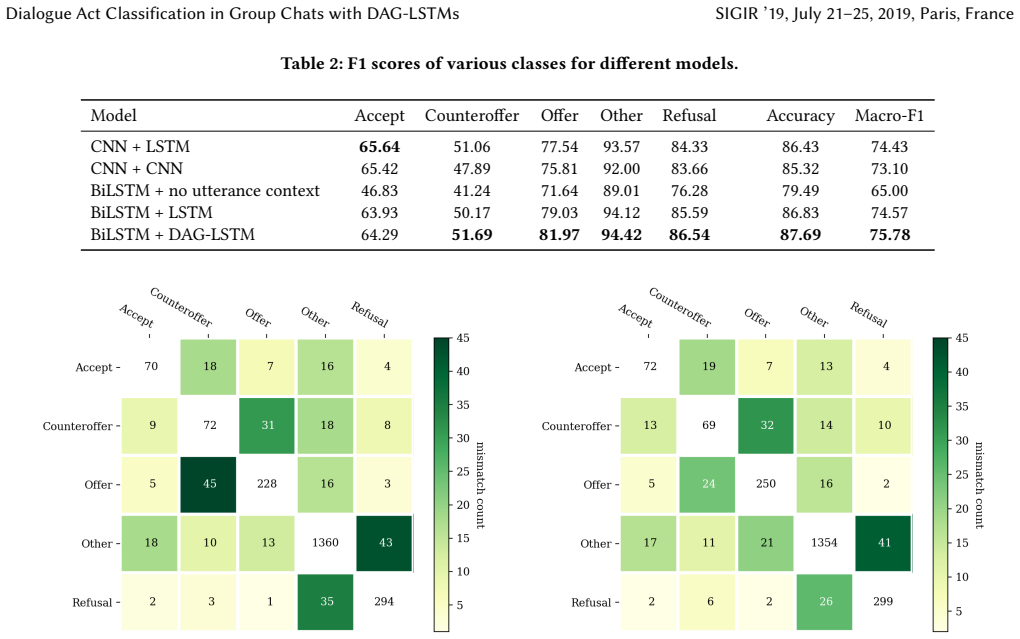
- On the STAC data, the clearest benefit is reduced confusion between offers and counteroffers, suggesting that speaker-identity context helps with pragmatically similar acts.
- The same edge-type mechanism can be repurposed for other context relations, such as prior utterances from the same team or same conversational thread, and for tasks beyond dialogue acts.
- The architecture is not specific to conversation: any input whose structure is a DAG can use the same recurrence.
Reading between the lines
- Editorial inference: because the reported improvement is about one point on a single split, the practical benefit in deployed systems may be smaller than the headline; a k-fold or repeated-seed evaluation would tell whether the effect is stable.
- Editorial inference: the elementwise-max update effectively routes each cell dimension through a single prior utterance, so the model may be selecting a most relevant antecedent; that makes the same-speaker link's contribution more inspectable than a flat LSTM's.
- Editorial inference: on longer or noisier group chats where a speaker's relevant prior post is many turns back, the same-speaker skip connection should help more than it did on STAC's roughly eleven thousand utterances; that is a testable claim on a larger corpus.
Signed reviews
Editorial analysis
A structured set of objections, weighed in public.
Referee Report
Summary. The paper introduces DAG-LSTM, an LSTM variant for dialogue act classification in multi-party group chats. Each utterance is encoded with a BiLSTM, and a conversation-level DAG-LSTM incorporates two incoming relations: the immediately preceding utterance and the preceding utterance by the same participant. To avoid the exponential growth of additive terms that occurs when Tree-LSTM equations are applied to DAGs, the cell update uses an elementwise maximum over child cell states. On the STAC corpus, the proposed BiLSTM+DAG-LSTM reports 87.69% accuracy and 75.78% macro-F1, about 0.86 and 1.21 points above the best baseline (BiLSTM+LSTM). The authors also analyze confusion matrices and error examples for Offer/Counteroffer and Refusal/Other.
Significance. If the performance claim holds, the paper makes a modest but useful contribution: it shows that encoding speaker-specific turn-taking structure through same-participant skip connections helps DA classification, and the max-over-children update is a simple, generic remedy for DAG state explosion. The paper is clearly written, the model formulation is detailed, hyperparameter search is reported, and the confusion-matrix analysis gives some qualitative support for the mechanism. However, the current experimental evidence is not yet sufficient to support the headline claim: the reported margins are small and come from a single split with no variance or significance testing, and the stated experimental confirmation of state explosion is absent from the paper.
major comments (4)
- [Section 5, Table 2; Section 4 (Setting)] The headline result that BiLSTM+DAG-LSTM outperforms all baselines (87.69% vs. 86.83% accuracy; 75.78 vs. 74.57 macro-F1) rests on a single random train/dev/test split and a single run per model. The margins are under one accuracy point, hyperparameters are selected using validation macro-F1, and early stopping is also based on validation macro-F1, so the reported gains could plausibly arise from split or seed variation. The paper should report results over multiple splits or seeds with error bars or standard deviations and a significance test, or explicitly weaken the superiority claim.
- [Section 3.2, paragraph following Eq. (25)] The sentence 'This causes very quick state explosions in the length of a conversation, which we experimentally confirm' is not supported by any experiment reported in the paper. No measurement of cell-state growth, memory use, or training behavior for the full Tree-LSTM/DAG-sum update is given. Either remove the claim or add the supporting experiment; this is the stated motivation for the max-over-children modification in Eq. (27).
- [Section 3.2, Eq. (22)] Equation (22) defines the forget gate f_{ηη′} with a summation over all children η″ and a weight-matrix superscript containing both e(η′,η) and e(η″,η). This differs from the standard Tree-LSTM forget gate, which conditions only on the child whose memory is being gated, and it is not explained in the text. As written, the model is under-specified and difficult to implement correctly; if this is a typo it should be corrected, and if it is intentional the design should be described and justified.
- [Section 3.2, Related architectures; Section 5] The paper does not compare against the two existing DAG-LSTM variants cited ([9, 39]) or against an ablation that replaces Eq. (27) with the original sum update of Eq. (25). Without such a comparison, the specific contribution of the max-over-child-cell-states mechanism and of the edge-type parameterization is not isolated; the reported improvement could be due to the added same-participant context alone. A simple ablation (e.g., a sum-over-children variant if it is feasible, or the DAG-LSTM variant of [9]) would substantially strengthen the architectural claim.
minor comments (5)
- [Section 5 and Section 6] The phrase 'much better accuracy and macro-F1 scores' overstates the reported 0.86-point accuracy and 1.21-point macro-F1 margins; consider wording such as 'modestly better' or report confidence intervals.
- [Figure 2] The confusion matrices are difficult to read at the printed size; please enlarge them or tabulate the counts, and clarify which observed differences remain meaningful given the single-split evaluation.
- [Section 3.2, Eq. (15)] The notation 'maxt eυt' mixes an index variable with a pooling operation; define the max operator consistently, e.g., as an elementwise maximum over the time index t.
- [Table 1] The table lists 'Preference (discarded)' as one of the dialog acts; a footnote explaining that this class was removed before training (because it has only 8 utterances) would make the table self-contained.
- [General reproducibility] The paper does not release code or exact hyperparameter configurations for the reported runs; given the ambiguity in Eq. (22), providing code or a configuration file would greatly aid reproducibility.
Circularity Check
No significant circularity: DAG-LSTM is evaluated on held-out STAC data and its reported gains are measured, not derived from its inputs.
full rationale
The paper's central claim is the 87.69% accuracy and 75.78% macro-F1 of BiLSTM+DAG-LSTM on a held-out test split (Table 2). This is an empirical benchmark result: models are trained with stochastic optimization, hyperparameters are selected by random search on the validation macro-F1, and test performance is reported for all five architectures under the same protocol. The DAG-LSTM cell update (Eq. 27) is an architectural choice, not fitted to the evaluation labels, and the skipped-turn connections are defined from chat participant structure before training. No equation constructs the prediction from the label, and no parameter is defined in terms of the target metric. The paper does not rely on a same-author uniqueness theorem: its citations to prior DAG-LSTM work [9,39] are comparative negatives, not load-bearing inputs, and the Tree-LSTM citations [34] supply standard update equations rather than a forced conclusion. The reader's stated concern about a single random split, missing reruns, and no significance test is a statistical robustness issue, not circularity. Consequently the circularity score is 0.
Assumptions & free parameters
free parameters (1)
- Validation-tuned hyperparameters =
Not reported; only sampling distributions given
assumptions (5)
- standard math LSTM and Tree-LSTM equations from Tai et al. (2015) are correct and applicable as background.
- domain assumption STAC corpus dialogue act annotations are consistent enough to train and evaluate classifiers.
- ad hoc to paper Elementwise-max over child cell states controls state explosion while retaining enough context for classification.
- domain assumption The previous utterance and the previous utterance from the same participant are sufficient contextual parents for DA classification.
- domain assumption Stanford PTBTokenizer and GloVe embeddings are adequate preprocessing for informal game chat text.
Cite this review
Pith. "Pith review of Dialogue Act Classification in Group Chats with DAG-LSTMs." pith.science (2026). https://pith.science/paper/M7JQIJ6X
@misc{pith2026190801821,
  author       = {Pith},
  title        = {Pith review of: Dialogue Act Classification in Group Chats with DAG-LSTMs},
  year         = {2026},
  howpublished = {\url{https://pith.science/paper/M7JQIJ6X}},
  note         = {Machine review of arXiv:1908.01821}
}
read the original abstract
Dialogue act (DA) classification has been studied for the past two decades and has several key applications such as workflow automation and conversation analytics. Researchers have used, to address this problem, various traditional machine learning models, and more recently deep neural network models such as hierarchical convolutional neural networks (CNNs) and long short-term memory (LSTM) networks. In this paper, we introduce a new model architecture, directed-acyclic-graph LSTM (DAG-LSTM) for DA classification. A DAG-LSTM exploits the turn-taking structure naturally present in a multi-party conversation, and encodes this relation in its model structure. Using the STAC corpus, we show that the proposed method performs roughly 0.8% better in accuracy and 1.2% better in macro-F1 score when compared to existing methods. The proposed method is generic and not limited to conversation applications.
Figures
Reference graph
Works this paper leans on
-
[9]
Xinchi Chen, Zhan Shi, Xipeng Qiu, and Xuanjing Huang. 2017. DAG-based Long Short-Term Memory for Neural Word Segmentation. arXiv preprint arXiv:1707.00248 (2017)
arXiv 2017
-
[1]
Jeremy Ang, Yang Liu, and Elizabeth Shriberg. 2005. Automatic dialog act seg- mentation and classification in multiparty meetings. In Proceedings.(ICASSP’05). IEEE International Conference on Acoustics, Speech, and Signal Processing, 2005. , Vol. 1. IEEE, I–1061
work page 2005
- [2]
-
[3]
John Langshaw Austin. 1975. How to do things with words . Oxford university press
work page 1975
-
[4]
Lina M Rojas Barahona, Milica Gasic, Nikola Mrkšić, Pei-Hao Su, Stefan Ultes, Tsung-Hsien Wen, and Steve Young. 2016. Exploiting sentence and context representations in deep neural models for spoken language understanding. arXiv preprint arXiv:1610.04120 (2016)
arXiv 2016
-
[5]
Harry Bunt, Jan Alexandersson, Jae-Woong Choe, Alex Chengyu Fang, Koiti Hasida, Volha Petukhova, Andrei Popescu-Belis, and David R Traum. 2012. ISO 24617-2: A semantically-based standard for dialogue annotation.. In LREC. 430– 437
work page 2012
-
[6]
Anais Cadilhac, Nicholas Asher, Farah Benamara, and Alex Lascarides. 2013. Grounding strategic conversation: Using negotiation dialogues to predict trades in a win-lose game. In Proceedings of the 2013 Conference on Empirical Methods in Natural Language Processing. 357–368
work page 2013
-
[7]
Qian Chen, Xiaodan Zhu, Zhenhua Ling, Si Wei, and Hui Jiang. 2016. Enhancing and combining sequential and tree lstm for natural language inference. arXiv preprint arXiv:1609.06038 (2016)
arXiv 2016
Show all 42 references
-
[8]
Xinyun Chen, Chang Liu, and Dawn Song. 2018. Tree-to-tree neural networks for program translation. In Advances in Neural Information Processing Systems . 2547–2557
2018
-
[10]
Alfred Dielmann and Steve Renals. 2008. Recognition of dialogue acts in multi- party meetings using a switching DBN. IEEE transactions on audio, speech, and language processing 16, 7 (2008), 1303–1314
2008
-
[11]
Raul Fernandez and Rosalind W Picard. 2002. Dialog act classification from prosodic features using support vector machines. In Speech Prosody 2002, Inter- national Conference. Dialogue Act Classification in Group Chats with DAG-LSTMs SIGIR ’19, July 21–25, 2019, Paris, France
2002
-
[12]
Eric N Forsythand and Craig H Martell. 2007. Lexical and discourse analysis of online chat dialog. In International Conference on Semantic Computing (ICSC 2007). IEEE, 19–26
2007
-
[13]
Alex Graves and Jürgen Schmidhuber. 2005. Framewise phoneme classification with bidirectional LSTM and other neural network architectures.Neural Networks 18, 5-6 (2005), 602–610
2005
-
[14]
Sepp Hochreiter and Jürgen Schmidhuber. 1997. Long short-term memory.Neural computation 9, 8 (1997), 1735–1780
1997
-
[15]
Daniel Jurafsky, Rebecca Bates, Noah Coccaro, Rachel Martin, Marie Meteer, Klaus Ries, Elizabeth Shriberg, Andreas Stolcke, Paul Taylor, and Carol Van Ess- Dykema. 1997. Automatic detection of discourse structure for speech recognition and understanding. In 1997 IEEE Workshop ...
1997
-
[16]
Nal Kalchbrenner and Phil Blunsom. 2013. Recurrent Convolutional Neural Networks for Discourse Compositionality. In Proceedings of the Workshop on Continuous Vector Space Models and their Compositionality . 119–126
2013
-
[17]
Su Nam Kim, Lawrence Cavedon, and Timothy Baldwin. 2010. Classifying dialogue acts in one-on-one live chats. In Proceedings of the 2010 Conference on Empirical Methods in Natural Language Processing. Association for Computational Linguistics, 862–871
2010
-
[18]
Su Nam Kim, Lawrence Cavedon, and Timothy Baldwin. 2012. Classifying dialogue acts in multi-party live chats. In Proceedings of the 26th Pacific Asia Conference on Language, Information, and Computation . 463–472
2012
-
[19]
Diederik P Kingma and Jimmy Ba. 2014. Adam: A method for stochastic opti- mization. arXiv preprint arXiv:1412.6980 (2014)
2014 arXiv
-
[20]
Yanran Li, Hui Su, Xiaoyu Shen, Wenjie Li, Ziqiang Cao, and Shuzi Niu. 2017. DailyDialog: A Manually Labelled Multi-turn Dialogue Dataset. In Proceedings of the Eighth International Joint Conference on Natural Language Processing (Volume 1: Long Papers). 986–995
2017
-
[21]
Yang Liu, Kun Han, Zhao Tan, and Yun Lei. 2017. Using context information for dialog act classification in DNN framework. In Proceedings of the 2017 Conference on Empirical Methods in Natural Language Processing . 2170–2178
2017
-
[22]
Jean Maillard, Stephen Clark, and Dani Yogatama. 2017. Jointly learning sen- tence embeddings and syntax with unsupervised tree-lstms. arXiv preprint arXiv:1705.09189 (2017)
2017 arXiv
-
[23]
Christopher Manning, Mihai Surdeanu, John Bauer, Jenny Finkel, Steven Bethard, and David McClosky. 2014. The Stanford CoreNLP natural language processing toolkit. In Proceedings of 52nd annual meeting of the association for computational linguistics: system demonstrations. 55–60
2014
-
[24]
Michael McTear, Zoraida Callejas, and David Griol. 2016. The conversational interface: Talking to smart devices . Springer
2016
-
[25]
Jeffrey Pennington, Richard Socher, and Christopher Manning. 2014. Glove: Global vectors for word representation. In Proceedings of the 2014 conference on empirical methods in natural language processing (EMNLP) . 1532–1543
2014
-
[26]
Eugénio Ribeiro, Ricardo Ribeiro, and David Martins de Matos. 2015. The in- fluence of context on dialogue act recognition. arXiv preprint arXiv:1506.00839 (2015)
2015 arXiv
-
[27]
Eugénio Ribeiro, Ricardo Ribeiro, and David Martins de Matos. 2018. Deep Dialog Act Recognition using Multiple Token, Segment, and Context Information Representations. arXiv preprint arXiv:1807.08587 (2018)
2018 arXiv
-
[28]
1969.Speech acts: An essay in the philosophy of language
John R Searle and John Rogers Searle. 1969.Speech acts: An essay in the philosophy of language. Vol. 626. Cambridge university press
1969
-
[29]
Iulian Vlad Serban, Ryan Lowe, Peter Henderson, Laurent Charlin, and Joelle Pineau. 2018. A survey of available corpora for building data-driven dialogue systems: The journal version. Dialogue & Discourse 9, 1 (2018), 1–49
2018
-
[30]
Elizabeth Shriberg, Raj Dhillon, Sonali Bhagat, Jeremy Ang, and Hannah Carvey
-
[31]
Vivek Kumar Rangarajan Sridhar, Srinivas Bangalore, and Shrikanth Narayanan
-
[32]
Andreas Stolcke, Klaus Ries, Noah Coccaro, Elizabeth Shriberg, Rebecca Bates, Daniel Jurafsky, Paul Taylor, Rachel Martin, Carol Van Ess-Dykema, and Marie Meteer. 2000. Dialogue act modeling for automatic tagging and recognition of conversational speech. Computational linguist...
2000
-
[33]
Dinoj Surendran and Gina-Anne Levow. 2006. Dialog act tagging with support vector machines and hidden Markov models. In Ninth International Conference on Spoken Language Processing
2006
-
[34]
Kai Sheng Tai, Richard Socher, and Christopher D Manning. 2015. Improved Semantic Representations From Tree-Structured Long Short-Term Memory Net- works. In Proceedings of the 53rd Annual Meeting of the Association for Computa- tional Linguistics and the 7th International Join...
2015
-
[35]
Tsung-Hsien Wen, Milica Gasic, Nikola Mrkšić, Pei-Hao Su, David Vandyke, and Steve Young. 2015. Semantically Conditioned LSTM-based Natural Language Generation for Spoken Dialogue Systems. In Proceedings of the 2015 Conference on Empirical Methods in Natural Language Processin...
2015
-
[36]
Tianhao Wu, Faisal M Khan, Todd A Fisher, Lori A Shuler, and William M Pot- tenger. [n. d.]. Posting act tagging using transformation-based learning. In Foundations of data mining and knowledge discovery . Springer, 319–331
-
[37]
Steve Young, Milica Gašić, Blaise Thomson, and Jason D Williams. 2013. Pomdp- based statistical spoken dialog systems: A review. Proc. IEEE 101, 5 (2013), 1160–1179
2013
-
[38]
Tiancheng Zhao and Maxine Eskenazi. 2016. Towards End-to-End Learning for Dialog State Tracking and Management using Deep Reinforcement Learning. In 17th Annual Meeting of the Special Interest Group on Discourse and Dialogue . 1
2016
-
[39]
Xiaodan Zhu, Parinaz Sobhani, and Hongyu Guo. 2016. Dag-structured long short-term memory for semantic compositionality. In Proceedings of the 2016 Conference of the North American Chapter of the Association for Computational Linguistics: Human Language Technologies. 917–926
2016
-
[40]
Xiaodan Zhu, Parinaz Sobihani, and Hongyu Guo. 2015. Long short-term memory over recursive structures. In International Conference on Machine Learning . 1604– 1612
2015
-
[2004]
In Proceedings of the 5th SIGdial Workshop on Discourse and Dialogue at HLT-NAACL 2004
The ICSI meeting recorder dialog act (MRDA) corpus. In Proceedings of the 5th SIGdial Workshop on Discourse and Dialogue at HLT-NAACL 2004
2004
-
[2009]
Computer Speech & Language 23, 4 (2009), 407–422
Combining lexical, syntactic and prosodic cues for improved online dialog act tagging. Computer Speech & Language 23, 4 (2009), 407–422
2009
Reviewed August 14, 2026 · model on record in the stance chip above.
Discussion (0). Continue with ORCID to comment.