REVIEW 3 major objections 5 minor 45 references
Nonequilibrium path-ensemble averages for symmetric protocols
T0 review · 3 major / 5 minor · reviewed 2026-08-14 · deepseek-v4-flash
Pith's one-line read Time-reversed twin trajectories give a faster, lower-error estimator for symmetric nonequilibrium protocols.
desk verdict A clean, honestly-scoped specialization of the MA estimator for symmetric pulling protocols; small math, solid empirical validation, and a couple of rigor gaps that are fixable. read the letter →
The pith
A machine-rendered reading of the paper's core claim, the machinery that carries it, and where it could break.
The reading
What carries the argument
The load-bearing object is the conjugate-twin reweighting identity for symmetric protocols, $\rho_F[\Gamma]/\rho_F[\tilde\Gamma]=e^{\beta W}$, derived from the general forward/reverse path-density relation with $\Delta F=0$. It is inserted into a doubled path average, Eq. (3), whose Jacobian is taken to be unity because the integrator is symplectic and the initial and final states coincide. This produces a ratio estimator in which the twin contribution is weighted by $e^{-\beta W[\Gamma]}$; the denominator $\sum (1+e^{-\beta W})$ renormalizes automatically. The same identity underlies all of the paper's applications: free energies come from setting $F[\Gamma]=e^{-\beta W[\Gamma(t)]}$ and potentials of mean force come from setting $F[\Gamma]=\delta[z-z[\Gamma(t)]] e^{-\beta W[\Gamma(t)]}$.
What would settle it
Run symmetric-protocol simulations and compare the Eq. (7) estimate against a very long unidirectional estimate or an exact reference; a bias that grows with work variance in the stochastic systems would indicate the Jacobian-unity assumption is violated. More directly, estimate the ratio of forward-path to twin-path probabilities from sampled twins and check whether it equals $e^{\beta W}$ across the work range.
Extended reading notes
Core claim
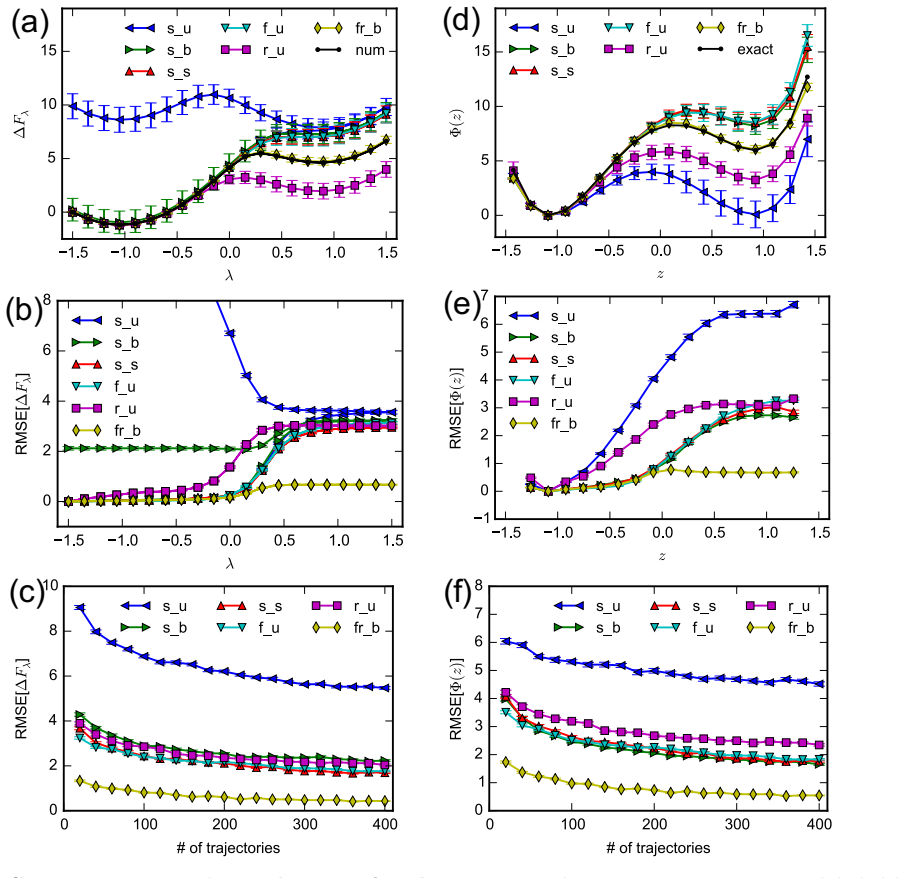
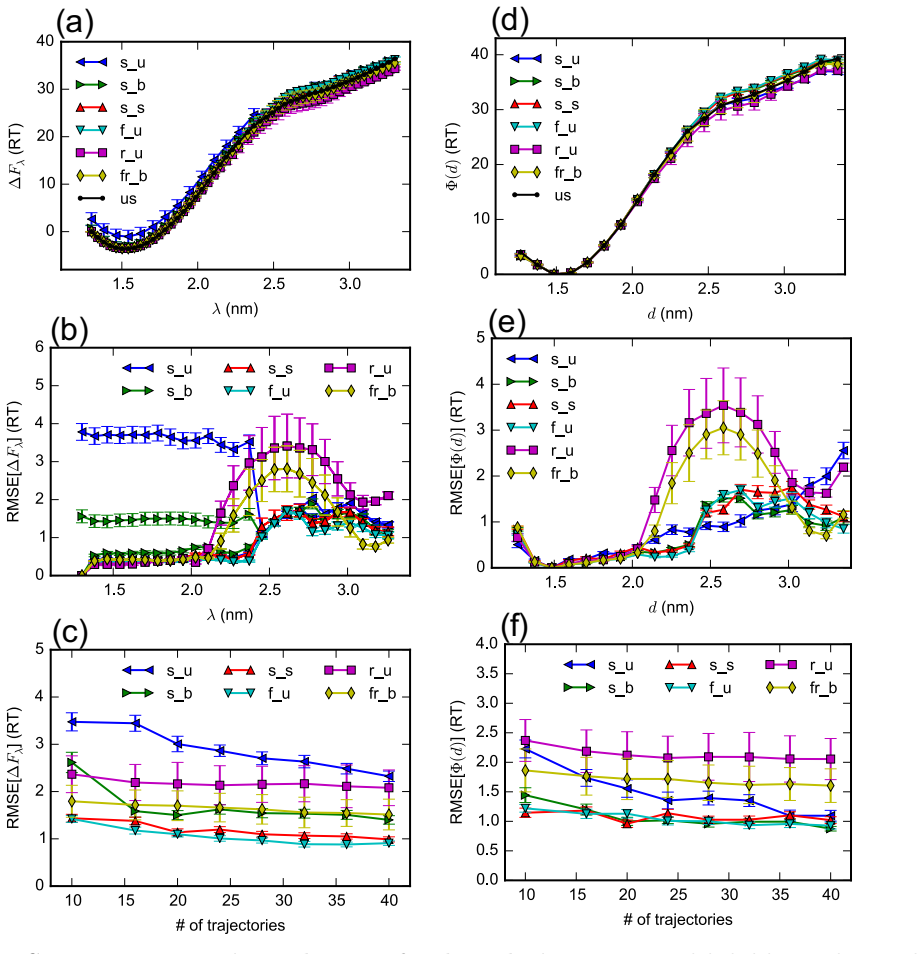
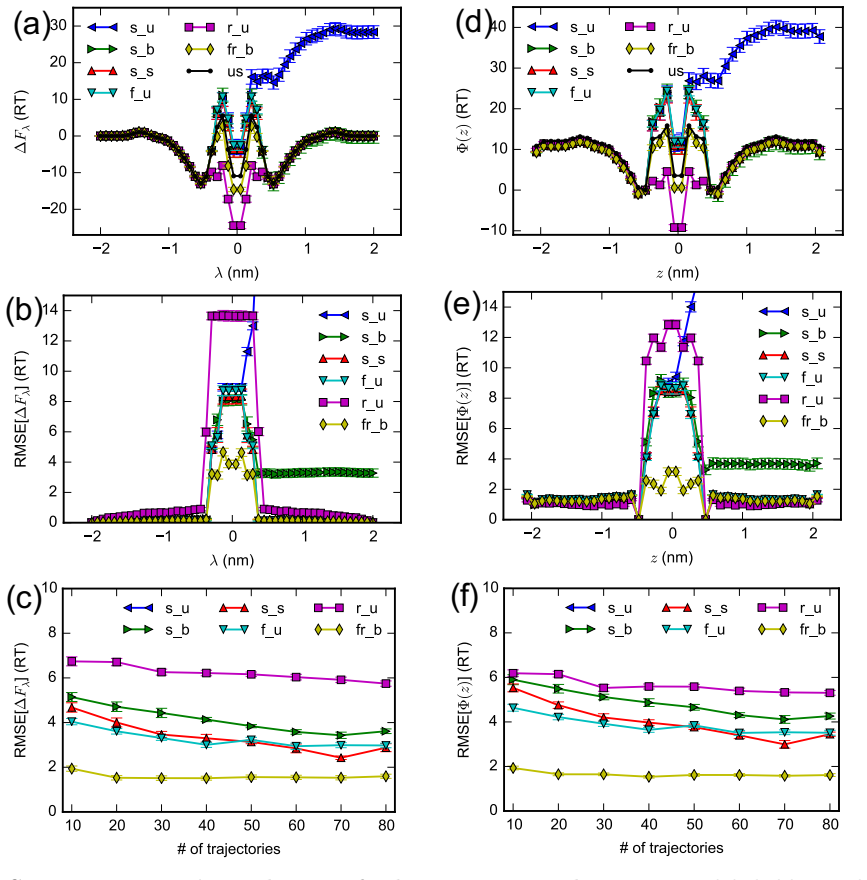
On the paper's own terms, the central result is the estimator of Eq. (7): for $N$ sampled trajectories $\Gamma_n$ with work $W[\Gamma_n]$ and conjugate twins $\tilde\Gamma_n$, an arbitrary path-ensemble average is estimated by $$\hat F = \frac{\sum_{n=1}^N (F[\Gamma_n] + F[\tilde\Gamma_n] $e^{{-\beta W[\Gamma_n]}}$)}{\sum_{n=1}^N (1 + $e^{{-\beta W[\Gamma_n]}}$)}.$$ The step that makes this valid is Eq. (5), the symmetric-protocol specialization of the forward–reverse path-density relation: $\rho_F[\Gamma] / \rho_F[\tilde\Gamma] = e^{\beta W}$, which follows because forward and reverse processes coincide and $\Delta F=0$. Substituting this into a doubled form of the path average replaces the unidirectional average with a ratio in which every trajectory and its twin contribute, and the twin's contribution is automatically suppressed when the work is large. The paper claims this estimator is asymptotically unbiased for symmetric protocols and demonstrates on 1D potentials, deca-alanine, a host–guest complex, and gramicidin A that it gives lower RMSE than unidirectional and bidirectional estimates computed from the same symmetric-protocol data. It also reports the scope condition: when data from a forward/reverse pair of asymmetric protocols are available, the bidirectional estimator usually performs better, so the symmetric estimator is recommended where bidirectional estimation is infeasible or expected to fail.
Load-bearing premise
The estimator is unbiased only if the transformation from a trajectory to its time-reversed twin preserves the path measure—that is, the Jacobian is unity—which the derivation ties to a symplectic integrator with identical initial and final states, while the validation simulations use stochastic dynamics where this measure preservation is asserted rather than verified.
Editorial extensions
If this is right
- For any symmetric pulling protocol, the new estimator is the best rigorous choice among the estimators compared: it lowers RMSE for both free energies and potentials of mean force relative to unidirectional and bidirectional analysis of the same trajectories.
- Symmetric data analyzed with Eq. (7) are as accurate as a unidirectional protocol of half the length with twice as many trajectories, so the return leg of a single-molecule pulling or steered simulation contributes real statistical value.
- When a forward/reverse pair of asymmetric protocols with equilibration at both ends is available, the bidirectional estimator usually still wins; the symmetric estimator is for cases where that setup is not feasible or one direction is far from equilibrium.
- Because $\Delta F=0$ for symmetric protocols, the estimator does not need a free energy estimate to compute dissipated work, simplifying the reweighting compared with the bidirectional estimator.
- In slow pulling of gramicidin A, the symmetric estimator reconstructs the PMF barrier shape more accurately than bidirectional-plus-histogram analysis, although faster pulling favors the bidirectional approach.
Reading between the lines
- Inference: the same ratio construction should transfer to any dynamics for which the twin map is measure-preserving; a natural test is to check whether the Jacobian is unity for a stochastic integrator with the paper's time-reversal convention, which the paper leaves open.
- Inference: one could turn the denominator of Eq. (7) into a convergence diagnostic, since it estimates $\langle 1+e^{-\beta W}\rangle$ and thereby monitors whether the sampled trajectories cover the rare, low-work events that dominate the average.
- Inference: for membrane-permeation studies, where equilibrating a penetrant in the bilayer interior is difficult, a symmetric pull across the membrane plus Eq. (7) is a directly testable application that the paper suggests but does not implement.
Signed reviews
Editorial analysis
A structured set of objections, weighed in public.
Referee Report
Summary. The paper derives a new statistical estimator for nonequilibrium path-ensemble averages in systems driven by symmetric protocols, i.e., protocols satisfying λ(t)=λ(τ−t). The estimator reweights each sampled trajectory by adding its time-reversed conjugate twin weighted by exp(−βW), and it is derived from the Crooks fluctuation theorem. The authors compare this estimator with unidirectional and bidirectional (Minh–Adib) estimators on five model systems: a symmetric 1D potential, an asymmetric 1D potential, deca-alanine, a CB7–hexafluorobenzene host–guest complex, and a gramicidin A ion channel. They report that the symmetric estimator is the best among estimators applied to symmetric-protocol data, but that the bidirectional estimator applied to asymmetric forward/reverse pairs usually outperforms it for the same total simulation time. The paper concludes that the symmetric estimator is recommended when bidirectional estimation is infeasible or expected to perform poorly.
Significance. If the estimator is unbiased under the applied dynamics, it has clear practical value for free-energy calculations and single-molecule pulling experiments where symmetric protocols can be implemented without additional equilibration. The paper's strengths include a clean derivation from the Crooks relation with no fitted parameters, a broad set of validation systems ranging from 1D potentials to a membrane ion channel, and independent reference free energies from numerical integration or umbrella sampling/WHAM. However, the central theoretical claim is conditional on a unit-Jacobian assumption that is not justified for the stochastic integrators used in the validation, and the printed bidirectional baseline formula is not normalized. These issues are addressable and do not invalidate the underlying idea if the derivation is properly extended and the presentation corrected.
major comments (3)
- [Section II.A and Section III.B/III.D] The estimator is derived under the assumption that forward and reverse processes are identical, i.e., λ(t)=λ(τ−t). However, the text describes the symmetric process for the symmetric 1D potential as a single pull from λ=−1.5 to λ=1.5 in 750 steps, and the gramicidin A simulations as forward pulls from z=−1.3 nm to z=1.3 nm with separate reverse simulations. Neither of these described protocols satisfies λ(t)=λ(τ−t). If the actual protocols were round-trip (e.g., pull and return), the text should state this explicitly; if they were one-way protocols on a spatially symmetric system, then Eq. 5 (ρF[Γ]=ρR[Γ]) is not valid for the same trajectory Γ, and a separate derivation incorporating the spatial symmetry is required before Eq. 7 can be applied to these systems. This is a load-bearing issue for the empirical validation of the central claim.
- [Section II.A, Eq. 3] The substitution in Eq. 3 assumes that the Jacobian of the transformation Γ→Γ̃ is unity, which the text ties to a symplectic integrator and identical initial and final states. The validation simulations in Section III, however, use Brownian dynamics (in-house script for 1D systems) and Langevin dynamics (NAMD for deca-alanine, host–guest, and gramicidin A), neither of which is symplectic in the sense of deterministic Hamiltonian flow. For these stochastic path measures, the time-reversal map need not preserve the discretized path measure, and the Crooks relation (Eq. 4) may not hold exactly for the discrete integrator. If the Jacobian deviates from unity, Eq. 6 would acquire a Jacobian factor and Eq. 7 would be biased. The authors should either prove the unit-Jacobian property for the specific stochastic integrators, numerically test the unbiasedness of Eq. 7 against the available reference free energies in a way that separates bias from variance, or restrict the claim of rigorous unbiasedness to symplectic dynamics.
- [Section II.A, Eq. 9] The printed bidirectional (Minh–Adib) estimator in Eq. 9 is not normalized: the sums in the numerator are not divided by the total weight in a denominator. As written, Eq. 9 does not estimate ⟨F⟩ even asymptotically, and using it as a baseline in Section IV would disadvantage the MA estimator. Please provide the correct normalized expression (which should include a denominator analogous to the one in Eq. 7) and confirm that the simulations in Section IV used the normalized version.
minor comments (5)
- [Section II.A] The sentence "For one of the integrals in each of sums" contains a grammatical error; it should be "in each of the sums."
- [Figure 1 caption] The caption labels panel (b) as "symmetric 1D system," but the text describes it as the asymmetric 1D potential; this should be corrected.
- [Section III.B] The phrase "at at 300 K" contains a duplicated word; it should be "at 300 K."
- [Section IV] The RMSE comparisons are reported without statistical error bars on the RMSE itself. Since block averaging is used, the authors could report the standard error of the RMSE across blocks or another measure of uncertainty, so that the reader can judge whether differences between estimators are significant.
- [Abstract and Section V] The claim that "the symmetric estimator has similar performance to a unidirectional protocol of half the length and twice the number of trajectories" is stated in the abstract but not explicitly quantified in the results; please indicate which figures or tables support this conclusion.
Circularity Check
No significant circularity: the estimator is derived from Crooks' fluctuation theorem and validated against independent references.
full rationale
The derivation chain (Eqs. 1-7) is not circular. Equation 7 is obtained by doubling the path integral, substituting the time-reversed variable, and invoking Crooks' fluctuation theorem (Eq. 4) specialized to symmetric protocols (ΔF=0 and ρF=ρR). These are external or exact identities; no parameter is fitted to the target free energies or PMFs, and no prediction is a renamed input. Reference values come from numerical integration or umbrella sampling with WHAM/MBAR, independent of the nonequilibrium estimator. Self-citations (the MA estimator in Eq. 9 and prior gA/CB7 simulation setups) provide context, baselines, and system details but do not justify the central result. The paper states the symplectic-integrator/unit-Jacobian condition for Eq. 3 and then validates with Brownian and Langevin integrators; if the path measure is not preserved under time reversal for those integrators, the estimator may be biased. That is a validity gap raised by the manuscript itself, but it is not a circularity of the derivation.
Assumptions & free parameters
assumptions (5)
- domain assumption Crooks fluctuation theorem, Eq. 4, relating forward and reverse path probabilities.
- domain assumption Symmetric protocol condition λ(t) = λ(τ - t), making forward and reverse path ensembles identical and ΔF = 0.
- domain assumption The trajectory-to-twin transformation Γ → Γ̃ has unit Jacobian.
- domain assumption Initial states are sampled from the canonical equilibrium distribution.
- domain assumption Umbrella sampling with WHAM provides unbiased reference free energies and PMFs.
Cite this review
Pith. "Pith review of Nonequilibrium path-ensemble averages for symmetric protocols." pith.science (2026). https://pith.science/paper/4KOMZ54P
@misc{pith2026190801845,
  author       = {Pith},
  title        = {Pith review of: Nonequilibrium path-ensemble averages for symmetric protocols},
  year         = {2026},
  howpublished = {\url{https://pith.science/paper/4KOMZ54P}},
  note         = {Machine review of arXiv:1908.01845}
}
read the original abstract
According to the nonequilibrium work relations, path-ensembles generated by irreversible processes in which a system is driven out of equilibrium according to a predetermined protocol may be used to compute equilibrium free energy differences and expectation values. Estimation has previously been improved by considering data collected from the reverse process, which starts in equilibrium in the final thermodynamic state of the forward process and is driven according to the time-reversed protocol. Here, we develop a theoretically rigorous statistical estimator for nonequilibrium path-ensemble averages specialized for symmetric protocols, in which forward and reverse processes are identical. The estimator is tested with a number of model systems: a symmetric 1D potential, an asymmetric 1D potential, the unfolding of deca-alanine, separating a host-guest system, and translocating a potassium ion through a gramicidin A ion channel. When reconstructing free energies using data from symmetric protocols, the new estimator outperforms existing rigorous unidirectional and bidirectional estimators, converging more quickly and resulting in smaller error. However, in most cases, using the bidirectional estimator with data from a forward and reverse pair of asymmetric protocols outperforms the corresponding symmetric protocol and estimator with the same amount of simulation time. Hence, the new estimator is only recommended when the bidirectional estimator is not feasible or is expected to perform poorly. The symmetric estimator has similar performance to a unidirectional protocol of half the length and twice the number of trajectories.
Figures


Figures from the paper (9 more)



Reference graph
Works this paper leans on
-
[1]
Jarzynski ,\ @noop journal journal Phys
author author C. Jarzynski ,\ @noop journal journal Phys. Rev. E \ volume 56 ,\ pages 5018 ( year 1997 a ) NoStop
work page 1997
-
[2]
Jarzynski ,\ @noop journal journal Phys
author author C. Jarzynski ,\ @noop journal journal Phys. Rev. Lett. \ volume 78 ,\ pages 2690 ( year 1997 b ) NoStop
work page 1997
-
[3]
author author G. E. \ Crooks ,\ @noop journal journal Phys. Rev. E \ volume 61 ,\ pages 2361 ( year 2000 ) NoStop
work page 2000
-
[4]
author author G. Hummer \ and\ author A. Szabo ,\ @noop journal journal Proc. Natl. Acad. Sci. USA \ volume 98 ,\ pages 3658 ( year 2001 ) NoStop
work page 2001
-
[5]
author author G. Hummer \ and\ author A. Szabo ,\ @noop journal journal Acc. Chem. Res. \ volume 38 ,\ pages 504 ( year 2005 ) NoStop
work page 2005
-
[6]
author author D. D. L. \ Minh ,\ @noop journal journal Phys. Rev. E \ volume 74 ,\ pages 61120 ( year 2006 ) NoStop
work page 2006
-
[7]
author author D. D. L. \ Minh ,\ @noop journal journal J. Phys. Chem. B \ volume 111 ,\ pages 4137 ( year 2007 ) NoStop
work page 2007
-
[8]
author author D. D. L. \ Minh \ and\ author J. A. \ McCammon ,\ @noop journal journal J. Phys. Chem. B \ volume 112 ,\ pages 5892 ( year 2008 ) NoStop
work page 2008
Show all 45 references
-
[9]
author author D. D. L. \ Minh \ and\ author A. B. \ Adib ,\ @noop journal journal Phys. Rev. Lett. \ volume 100 ,\ pages 180602 ( year 2008 ) NoStop
2008
-
[10]
author author D. D. L. \ Minh \ and\ author J. D. \ Chodera ,\ @noop journal journal J. Chem. Phys. \ volume 131 ,\ pages 134110 ( year 2009 ) NoStop
2009
-
[11]
Hummer \ and\ author A
author author G. Hummer \ and\ author A. Szabo ,\ @noop journal journal Proc. Natl. Acad. Sci. USA \ volume 107 ,\ pages 21441 ( year 2010 ) NoStop
2010
-
[12]
Park , author F
author author S. Park , author F. Khalili-Araghi , author E. Tajkhorshid , \ and\ author K. Schulten ,\ @noop journal journal J. Chem. Phys. \ volume 119 ,\ pages 3559 ( year 2003 ) NoStop
2003
-
[13]
author author D. D. L. \ Minh \ and\ author J. D. \ Chodera ,\ @noop journal journal J. Chem. Phys. \ volume 134 ,\ pages 024111 ( year 2011 ) NoStop
2011
-
[14]
Hummer ,\ @noop journal journal J
author author G. Hummer ,\ @noop journal journal J. Chem. Phys. \ volume 114 ,\ pages 7330 ( year 2001 ) NoStop
2001
-
[15]
author author F. M. \ Ytreberg \ and\ author D. M. \ Zuckerman ,\ @noop journal journal J. Comput. Chem. \ volume 25 ,\ pages 1749 ( year 2004 ) NoStop
2004
-
[16]
Dellago \ and\ author G
author author C. Dellago \ and\ author G. Hummer ,\ @noop journal journal entropy \ volume 16 ,\ pages 41 ( year 2014 ) NoStop
2014
-
[17]
author author R. B. \ Sandberg , author M. Banchelli , author C. Guardiani , author S. Menichetti , author G. Caminati , \ and\ author P. Procacci ,\ @noop journal journal J. Chem. Theory Comput. \ volume 11 ,\ pages 423 ( year 2015 ) NoStop
2015
-
[18]
Giovannelli , author P
author author E. Giovannelli , author P. Procacci , author G. Cardini , author M. Pagliai , author V. Volkov , \ and\ author R. Chelli ,\ @noop journal journal J. Chem. Theory Comput. \ volume 13 ,\ pages 5874 ( year 2017 ) NoStop
2017
-
[19]
Gore , author F
author author J. Gore , author F. Ritort , \ and\ author C. Bustamante ,\ @noop journal journal Proc. Natl. Acad. Sci. USA \ volume 100 ,\ pages 12564 ( year 2003 ) NoStop
2003
-
[20]
Jarzynski ,\ @noop journal journal Phys
author author C. Jarzynski ,\ @noop journal journal Phys. Rev. E \ volume 73 ,\ pages 46105 ( year 2006 ) NoStop
2006
-
[21]
Kosztin , author B
author author I. Kosztin , author B. Barz , \ and\ author L. Janosi ,\ @noop journal journal J. Chem. Phys. \ volume 124 ,\ pages 064106 ( year 2006 ) NoStop
2006
-
[22]
Chelli \ and\ author P
author author R. Chelli \ and\ author P. Procacci ,\ @noop journal journal Phys. Chem. Chem. Phys. \ volume 11 ,\ pages 1152 ( year 2009 ) NoStop
2009
-
[23]
author author E. W. \ Frey , author J. Li , author S. S. \ Wijeratne , \ and\ author C. H. \ Kiang ,\ @noop journal journal J. Phys. Chem. B \ volume 119 ,\ pages 5132 ( year 2015 ) NoStop
2015
-
[24]
author author V. A. \ Ngo , author I. Kim , author T. W. \ Allen , \ and\ author S. Y. \ Noskov ,\ @noop journal journal J. Chem. Theory Comput. \ volume 12 ,\ pages 1000 ( year 2016 ) NoStop
2016
-
[25]
author author C. P. \ Calderon , author L. Janosi , \ and\ author I. Kosztin ,\ @noop journal journal J. Chem. Phys. \ volume 130 ,\ pages 144908 ( year 2009 ) NoStop
2009
-
[26]
Giorgino \ and\ author G
author author T. Giorgino \ and\ author G. De Fabritiis ,\ @noop journal journal J. Chem. Theory Comput. \ volume 7 ,\ pages 1943 ( year 2011 ) NoStop
1943
-
[27]
Sinha , author B
author author V. Sinha , author B. Ganguly , \ and\ author T. Bandyopadhyay ,\ @noop journal journal PLoS ONE \ volume 7 ,\ pages e40188 ( year 2012 ) NoStop
2012
-
[28]
Soto-Delgado , author R
author author J. Soto-Delgado , author R. A. \ Tapia , \ and\ author J. Torras ,\ @noop journal journal J. Chem. Theory Comput. \ volume 12 ,\ pages 4735 ( year 2016 ) NoStop
2016
-
[29]
author author G. E. \ Crooks ,\ @noop journal journal J. Stat. Phys. \ volume 90 ,\ pages 1481 ( year 1998 ) NoStop
1998
-
[30]
author author A. D. \ Mackerell Jr. , author M. Feig , \ and\ author C. L. \ Brooks III ,\ @noop journal journal J. Comput. Chem. \ volume 25 ,\ pages 1400 ( year 2004 ) NoStop
2004
-
[31]
author author A. D. \ MacKerell , author D. Bashford , author M. Bellott , author R. L. \ Dunbrack , author J. D. \ Evanseck , author M. J. \ Field , author S. Fischer , author J. Gao , author H. Guo , author S. Ha , author D. Joseph-McCarthy , author L. Kuchnir , author K. Ku...
1998
-
[32]
author author A. D. \ MacKerell , author M. Feig , \ and\ author C. L. \ Brooks ,\ @noop journal journal J Am. Chem. Soc. \ volume 126 ,\ pages 698 ( year 2004 ) NoStop
2004
-
[33]
author author J. C. \ Phillips , author R. Braun , author W. Wang , author J. Gumbart , author E. Tajkhorshid , author E. Villa , author C. Chipot , author R. D. \ Skeel , author L. Kalé , \ and\ author K. Schulten ,\ @noop journal journal J. Comput. Chem. \ volume 26 ,\ pages...
2005
-
[34]
Park , author F
author author S. Park , author F. Khalili , \ and\ author J. Strumpfer ,\ http://www.ks.uiuc.edu/Training/Tutorials/ title Stretching deca-alanine, http://www.ks.uiuc.edu/training/tutorials/ , \ ( year 2012 ) NoStop
2012
-
[35]
Velez-Vega \ and\ author M
author author C. Velez-Vega \ and\ author M. K. \ Gilson ,\ @noop journal journal J. Comput. Chem. \ volume 34 ,\ pages 2360 ( year 2013 ) NoStop
2013
-
[36]
author author T. H. \ Nguyen \ and\ author D. D. L. \ Minh ,\ @noop journal journal J. Chem. Theory Comput. \ volume 12 ,\ pages 2154 ( year 2016 ) NoStop
2016
-
[37]
author author M. K. \ Gilson , author H. S. R. \ Gilson , \ and\ author M. J. \ Potter ,\ @noop journal journal J. Chem. Inf. Comput. Sci. \ volume 43 ,\ pages 1982 ( year 2003 ) NoStop
1982
-
[38]
Hornak , author R
author author V. Hornak , author R. Abel , author A. Okur , author B. Strockbine , author A. Roitberg , \ and\ author C. Simmerling ,\ @noop journal journal Proteins: Struct., Funct., Bioinf. \ volume 65 ,\ pages 712 ( year 2006 ) NoStop
2006
-
[39]
Wang , author R
author author J. Wang , author R. M. \ Wolf , author J. W. \ Caldwell , author P. A. \ Kollman , \ and\ author D. A. \ Case ,\ @noop journal journal J. Comput. Chem. \ volume 25 ,\ pages 1157 ( year 2004 ) NoStop
2004
-
[40]
author author M. J. \ Vainio \ and\ author M. S. \ Johnson ,\ @noop journal journal J. Chem. Inf. Model. \ volume 47 ,\ pages 2462 ( year 2007 ) NoStop
2007
-
[41]
Wang , author W
author author J. Wang , author W. Wang , author P. A. \ Kollman , \ and\ author D. A. \ Case ,\ @noop journal journal J. Mol. Graph. Model. \ volume 25 ,\ pages 247 ( year 2006 ) NoStop
2006
-
[42]
author author D. E. \ Smith \ and\ author L. X. \ Dang ,\ @noop journal journal J. Chem. Phys. \ volume 100 ,\ pages 3757 ( year 1994 ) NoStop
1994
-
[43]
author author M. R. \ Shirts \ and\ author J. D. \ Chodera ,\ @noop journal journal J. Chem. Phys. \ volume 129 ,\ pages 124105 ( year 2008 ) NoStop
2008
-
[44]
author author A. M. \ Ferrenberg \ and\ author R. H. \ Swendsen ,\ @noop journal journal Phys. Rev. Lett. \ volume 63 ,\ pages 1195 ( year 1989 ) NoStop
1989
-
[45]
Kumar , author J
author author S. Kumar , author J. M. \ Rosenberg , author D. Bouzida , author R. H. \ Swendsen , \ and\ author P. A. \ Kollman ,\ @noop journal journal J. Comput. Chem. \ volume 13 ,\ pages 1011 ( year 1992 ) NoStop
1992
Reviewed August 14, 2026 · model on record in the stance chip above.
Discussion (0). Continue with ORCID to comment.