REVIEW 3 major objections 5 minor 29 references
Representing Robot Task Plans as Robust Logical-Dynamical Systems
T0 review · 3 major / 5 minor · reviewed 2026-08-14 · deepseek-v4-flash
Pith's one-line read Task plans compiled into logical-dynamical chains converge to their goal with probability one when each step succeeds with nonzero bounded probability.
desk verdict A useful reactive-execution framework with a genuinely new condition-propagation algorithm, but the headline convergence theorem has a fixingable proof gap and the empirical section is thin. read the letter →
The pith
A machine-rendered reading of the paper's core claim, the machinery that carries it, and where it could break.
The reading
What carries the argument
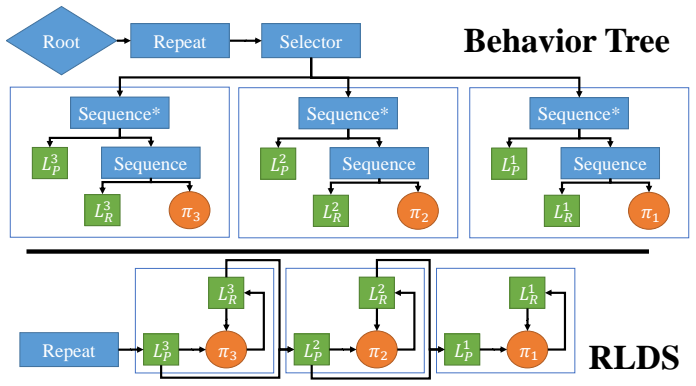
The central object is the Robust Logical-Dynamical Chain (RLDC), a sequence of operators $o_i = (L^P_i, L^R_i, L^E_i, \pi_i)$ whose local chaining condition is $L^E_i \Rightarrow L^P_{i+1} \Rightarrow L^R_{i+1}$. Execution always favors the most downstream enterable operator, which implements both progress toward the goal and automatic fallback to earlier recovery operators when conditions fail. The theoretical analysis models each operator as either producing a controlled transition (its effect becomes satisfied) or an uncontrolled transition (the run becomes infeasible and the system resets to some enterable state), with the probability of controlled transitions bounded below by $p$. This abstraction is what lets the paper reduce convergence to a probabilistic argument over repeated traversals of the chain.
What would settle it
Run a chain in simulation with $N=3$ operators where a failed operator pushes the continuous state further from the next precondition, so retry success probabilities decrease with each failure. If the mean number of transitions to reach the goal exceeds $N/p^N$ for the measured $p$, the independence assumption in the Theorem 1 proof is violated.
Extended reading notes
Core claim
The paper's discovery is that reactive robustness can be engineered by construction: a sequence of operators that obeys the chaining condition $L^E_i \Rightarrow L^P_{i+1} \Rightarrow L^R_{i+1}$ turns any sequential plan into a self-recovering controller. At every control tick the system picks the most downstream operator whose entry condition holds, and if the current run becomes infeasible it jumps to the most downstream enterable operator, which usually means backing up and retrying. The main theoretical result, Theorem 1, states that if each operator induces a controlled transition with probability $p_i \geq p > 0$, the chain reaches the goal condition $L_G$ with probability 1, and the expected transition count is bounded by $N/p^N$. The proof treats each uncontrolled transition as a fresh attempt at traversing the whole chain, so the convergence rate is exponential in the number of uncontrolled transitions.
Load-bearing premise
The load-bearing premise is that each operator's success probability $p_i$ stays bounded below by $p$ and that successive attempts are independent enough that the proof's multiplication $p^N$ is valid; if failures are correlated, the bound could fail.
Editorial extensions
If this is right
- A sequential plan written as a list of operators can be compiled into an RLDS, so reactive recovery does not require manually programming fallback connections.
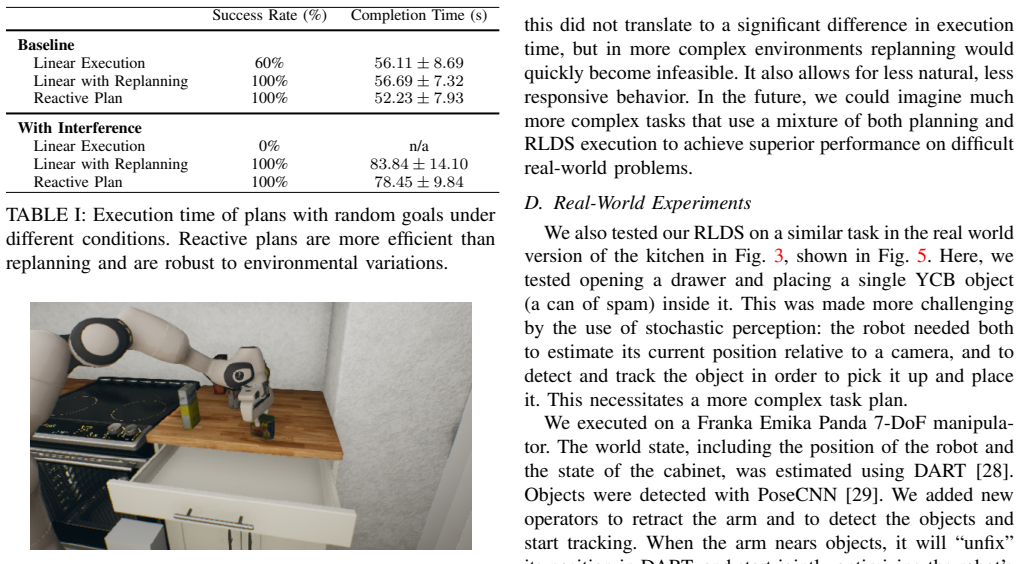
- In the kitchen manipulation case study, reactive execution matched replanning on success rate while completing tasks faster, and it coped with a human closing the drawer or shoving the robot without replanning.
- Because RLDS execution re-evaluates logical conditions at every tick, the system can skip ahead when a later step's preconditions become true, for example when an object accidentally lands in the drawer.
- The convergence theorem gives a bound on expected time to goal, $N/p^N$, that can be used a priori to decide whether a chain of operators is reliable enough for a task.
- Any Behavior Tree can be expressed as an RLDS and vice versa, so the framework inherits the expressiveness of Behavior Trees while adding a formal convergence statement.
Reading between the lines
- The proof multiplies per-step success probabilities, which presumes failures are independent across attempts; a natural extension would state Theorem 1 under conditional independence or a Markov assumption on the failure process, and the bound would likely still hold with a modified $p$.
- If the probabilities $p_i$ are not fixed but depend on the continuous state, the geometric-trial argument no longer applies directly; estimating $p_i$ online from observed transitions could yield an adaptive version that reorders operators by reliability.
- The same chain formalism could be applied outside robotics to any reactive discrete-event system whose actions have bounded success probabilities, such as automated assembly or dialogue managers, though the paper does not explore those domains.
- A practical test of the bound: instrument a deployed RLDS to record the number of uncontrolled transitions before success; if the empirical distribution deviates strongly from the geometric form used in the proof, the independence assumption is being violated in that environment.
Signed reviews
Editorial analysis
A structured set of objections, weighed in public.
Referee Report
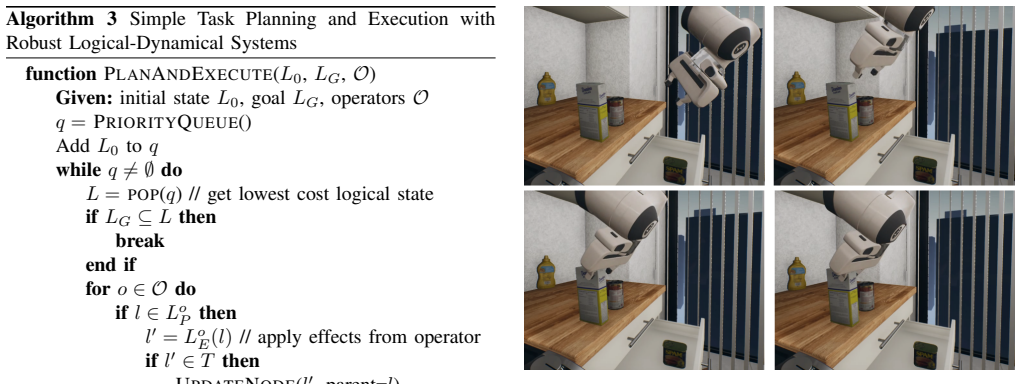
Summary. The paper introduces Robust Logical-Dynamical Systems (RLDS), a reactive task-execution representation in which a plan is represented as a chain of operators, each with an entry condition, run condition, effect, and an associated low-level policy. The authors contribute an algorithm for composing RLDS from sequential plans, a method for computing implicit logical conditions (Algorithm 2), a simple STRIPS-style planner integrated with RLDS execution (Algorithm 3), and a theoretical convergence result (Theorem 1) that claims almost-sure convergence to the goal with expected number of transitions bounded by N/p^N. The framework is evaluated in a simulated kitchen manipulation task with YCB objects, comparing linear execution, replanning, and reactive RLDS execution under nominal and adversarial conditions, and in a real-world demonstration with a Franka Panda arm.
Significance. If Theorem 1 can be stated and proved rigorously, the RLDS framework would provide a formal probabilistic convergence guarantee for reactive task execution with recovery, a property that is difficult to establish for behavior trees and related reactive frameworks. The paper also demonstrates a working integration with low-level Riemannian motion policies, automatic plan composition, and experiments with adversarial interference, which are valuable practical contributions. However, the central proof currently rests on unstated probabilistic assumptions about independence and reset behavior, and the execution algorithm does not fully match the model used in the proof. The theoretical contribution is therefore contingent on a repair of the theorem's statement and proof.
major comments (3)
- [Section IV-B, Theorem 1 proof] The definition of p_i is ambiguous, and the proof multiplies per-operator probabilities to obtain p^N. If p_i is a marginal probability of a controlled transition, the product requires an independence assumption across successive operator executions, which is neither stated nor justified. If p_i is instead intended as a lower bound on the probability of a controlled transition conditional on entering operator i, then the product can be justified by the chain rule, but the paper never states this conditional interpretation, nor does it define p_i uniformly over the continuous states from which operator i can be entered. In addition, the geometric model p_k = (1 - p^N)^k p^N assumes that each uncontrolled transition resets the system to the initial state and that successive runs are independent and identically distributed; these renewal assumptions are not stated. As written, Theorem 1 is not a theorem about the system described by Algorithm 1.
- [Section IV-C, Algorithm 1] The execution loop can fail to select any operator. When the current operator o_j becomes non-runnable, the first branch is blocked for i = j by the guard o_i != o_{t-1}, and if no other operator is enterable, the for loop completes without assigning o_t. The subsequent call to Step pi_i(x_t) then uses the leftover loop variable i, which is not a well-defined current operator. The completeness condition union_i L_i^P = S does not prevent this situation, because the currently guarded operator is excluded from re-entry. The algorithm needs an explicit default transition or a re-entry rule, and this rule must be consistent with the reset model used in the proof of Theorem 1.
- [Section IV-B, expectation bound] In the expectation derivation, the proof writes E[T] <= sum_{k=0}^infinity (k+1)N P_k, where P_k was previously defined as the cumulative probability of reaching the goal with at most k uncontrolled transitions. As written, this is not a valid expectation; the sum over cumulative probabilities diverges. The intended computation works with the exact-trial probabilities p_k = (1 - p^N)^k p^N, and the surrounding algebra shows that the stated result can be recovered. This notational error should be corrected, and the derivation should be rewritten using exact probabilities.
minor comments (5)
- [Section IV-A, Eq. (1)] The notation uses the implication arrow between conditions that are also treated as sets of states; the paper should state explicitly that L_i^E => L_{i+1}^P means inclusion of the corresponding sets, i.e., L_i^E subset of L_{i+1}^P.
- [Section V-B, Algorithm 2] The set-builder notation L_i^I = {rho in L_{i+1}^P union L_{i+1}^I forall rho not in L_i^E} is nonstandard; it should be written as {rho in L_{i+1}^P union L_{i+1}^I : rho not in L_i^E}.
- [Section VI-B and Table I] The experimental section does not state how many trials were run per condition, and no statistical significance tests are reported. The differences in completion time between replanning and reactive execution are within one standard deviation, so the claim that reactive execution is 'more efficient' should be tempered or supported by a larger trial count.
- [Section IV-B, Theorem 1 statement] The phrase 'converging exponentially in the number of uncontrolled transitions k' is imprecise; the proof establishes that the cumulative success probability after at most k uncontrolled transitions is 1 - (1 - p^N)^{k+1}, which is an exponential approach to 1 in k. The theorem statement should state this explicitly.
- [Section VI-D, real-world experiments] The real-world experiments are described qualitatively; reporting the number of trials, the number of failures, and the types of interference encountered would make the demonstration more reproducible and easier to assess.
Circularity Check
No significant circularity: Theorem 1 is a conditional geometric-trial bound from an external policy-success parameter, not a fitted or self-referential prediction.
full rationale
Walking the claimed derivation chain: the only quantitative premise of Theorem 1 is the per-operator success probability p, defined in Section IV-B as 'oi induces a controlled transition with probability pi if with that probability it generates a feasible sequence terminating in LiE satisfied.' This p is an external property of the low-level policies, and the paper explicitly treats it as an assumption ('We also assume that our low-level control policies have their own convergence guarantees'). The proof then derives the tail probability P_k = 1 - (1-p^N)^{k+1} and E[T] <= N/p^N via a geometric-trials calculation; neither p nor the conclusion is fitted to data, and no empirical quantity is relabeled as a prediction. The theorem is not made true by definition: the conclusion 'achieve LG with probability 1' requires the argument that repeated bounded-probability forward progress with resets almost surely occurs, which is exactly what the calculation supplies. The self-citations in the paper (CoSTAR, RMPflow, DART, PoseCNN) appear in related-work and implementation contexts, not as evidence for Theorem 1, and there is no imported uniqueness theorem. Two proof-gaps do exist and should be weighed: the p^N multiplication in Section IV-B is not justified without either an independence or conditional-chain-rule statement, and the phrase 'wherein the uncontrolled transition is all the way back to the start' does not match Alg. 1's re-entry behavior exactly. These are correctness or omitted-proof issues, not circular reductions; they do not equate any output to an input by construction, so the paper's central derivation is self-contained rather than circular.
Assumptions & free parameters
assumptions (3)
- domain assumption Low-level policies have known success probabilities and their own convergence guarantees.
- domain assumption The logical state space is Markov; predicates are sufficient statistics of history.
- ad hoc to paper Successive transitions are independent, so per-step probabilities can be multiplied.
Cite this review
Pith. "Pith review of Representing Robot Task Plans as Robust Logical-Dynamical Systems." pith.science (2026). https://pith.science/paper/LWOVAHGE
@misc{pith2026190801896,
  author       = {Pith},
  title        = {Pith review of: Representing Robot Task Plans as Robust Logical-Dynamical Systems},
  year         = {2026},
  howpublished = {\url{https://pith.science/paper/LWOVAHGE}},
  note         = {Machine review of arXiv:1908.01896}
}
read the original abstract
It is difficult to create robust, reusable, and reactive behaviors for robots that can be easily extended and combined. Frameworks such as Behavior Trees are flexible but difficult to characterize, especially when designing reactions and recovery behaviors to consistently converge to a desired goal condition. We propose a framework which we call Robust Logical-Dynamical Systems (RLDS), which combines the advantages of task representations like behavior trees with theoretical guarantees on performance. RLDS can also be constructed automatically from simple sequential task plans and will still achieve robust, reactive behavior in dynamic real-world environments. In this work, we describe both our proposed framework and a case study on a simple household manipulation task, with examples for how specific pieces can be implemented to achieve robust behavior. Finally, we show how in the context of these manipulation tasks, a combination of an RLDS with planning can achieve better results under adversarial conditions.
Figures

Figures from the paper (2 more)

Reference graph
Works this paper leans on
-
[1]
The smach high-level executive [ros news],
J. Bohren and S. Cousins, “The smach high-level executive [ros news],” IEEE Robotics & Automation Magazine , vol. 17, no. 4, pp. 18–20, 2010
work page 2010
-
[2]
Costar: Instructing collaborative robots with behavior trees and vision,
C. Paxton, A. Hundt, F. Jonathan, K. Guerin, and G. D. Hager, “Costar: Instructing collaborative robots with behavior trees and vision,” in Robotics and Automation (ICRA), 2017 IEEE International Conference on. IEEE, 2017, pp. 564–571. 2https://youtu.be/l_8pzcRGztk Fig. 5: In the real world experiments, a human pushed on the robot, shoved its end effector...
work page 2017
-
[3]
Eval- uating methods for end-user creation of robot task plans,
C. Paxton, F. Jonathan, A. Hundt, B. Mutlu, and G. D. Hager, “Eval- uating methods for end-user creation of robot task plans,” Intelligent Robots and Systems (IROS), 2018 IEEE International Conference on , 2018
work page 2018
-
[4]
Behavior trees in robotics and AI: An introduction,
M. Colledanchise and P. ¨Ogren, “Behavior trees in robotics and AI: An introduction,” 2018
work page 2018
-
[5]
Rmpflow: A computational graph for automatic motion policy generation,
C.-A. Cheng, M. Mukadam, J. Issac, S. Birchfield, D. Fox, B. Boots, and N. Ratliff, “Rmpflow: A computational graph for automatic motion policy generation,” arXiv preprint arXiv:1811.07049 , 2018
arXiv 2018
-
[6]
Model-based, hierarchical control of a mobile manipulation plat- form,
C. McGann, E. Berger, J. Bohren, S. Chitta, B. Gerkey, S. Glaser, B. Marthi, W. Meeussen, T. Pratkanis, E. Marder-Eppstein et al. , “Model-based, hierarchical control of a mobile manipulation plat- form,” in ICAPS Workshop on Planning and Plan Execution for Real- World Systems, Thessaloniki, Greece , 2009
work page 2009
-
[7]
Sequential com- position of dynamically dexterous robot behaviors,
R. R. Burridge, A. A. Rizzi, and D. E. Koditschek, “Sequential com- position of dynamically dexterous robot behaviors,” The International Journal of Robotics Research , vol. 18, no. 6, pp. 534–555, 1999
1999
-
[8]
Behavior based robotics using hybrid automata,
M. Egerstedt, “Behavior based robotics using hybrid automata,” in International Workshop on Hybrid Systems: Computation and Control. Springer, 2000, pp. 103–116
work page 2000
Show all 29 references
-
[9]
Lessons from the amazon picking challenge: Four aspects of building robotic systems
C. Eppner, S. H ¨ofer, R. Jonschkowski, R. Mart´ın-Mart´ın, A. Sieverling, V . Wall, and O. Brock, “Lessons from the amazon picking challenge: Four aspects of building robotic systems.” in Robotics: Science and Systems, 2016
2016
-
[10]
Behavior trees as a representation for medical procedures,
B. Hannaford, R. Bly, I. Humphreys, and M. Whipple, “Behavior trees as a representation for medical procedures,” arXiv preprint arXiv:1808.08954, 2018
2018 arXiv
-
[11]
On three-layer architec- tures,
E. Gat, R. P. Bonnasso, R. Murphy et al. , “On three-layer architec- tures,” Artificial intelligence and mobile robots, vol. 195, p. 210, 1998
1998
-
[12]
Idea: Planning at the core of autonomous reactive agents,
N. Muscettola, G. A. Dorais, C. Fry, R. Levinson, and C. Plaunt, “Idea: Planning at the core of autonomous reactive agents,” 2002
2002
-
[13]
Constraint-based attribute and interval planning,
J. Frank and A. J ´onsson, “Constraint-based attribute and interval planning,” Constraints, vol. 8, no. 4, pp. 339–364, 2003
2003
-
[14]
Activity planning for the mars exploration rovers
J. L. Bresina, A. K. J ´onsson, P. H. Morris, and K. Rajan, “Activity planning for the mars exploration rovers.” in ICAPS, 2005, pp. 40–49
2005
-
[15]
A deliberative architecture for auv control,
C. McGann, F. Py, K. Rajan, H. Thomas, R. Henthorn, and R. McEwen, “A deliberative architecture for auv control,” in 2008 IEEE International Conference on Robotics and Automation . IEEE, 2008, pp. 1049–1054
2008
-
[16]
How behavior trees generalize the teleo-reactive paradigm and and-or-trees,
M. Colledanchise and P. ¨Ogren, “How behavior trees generalize the teleo-reactive paradigm and and-or-trees,” in 2016 IEEE/RSJ Interna- tional Conference on Intelligent Robots and Systems (IROS) . IEEE, 2016, pp. 424–429
2016
-
[17]
Pddl—the planning domain definition language,
M. Ghallab, A. Howe, C. Knoblock, D. McDermott, A. Ram, M. Veloso, D. Weld, and D. Wilkins, “Pddl—the planning domain definition language,” AIPS-98 planning committee, vol. 3, p. 14, 1998
1998
-
[18]
Motion planning with temporal-logic specifications: Progress and challenges,
E. Plaku and S. Karaman, “Motion planning with temporal-logic specifications: Progress and challenges,” AI communications, vol. 29, no. 1, pp. 151–162, 2016
2016
-
[19]
Extended behavior trees for quick definition of flexible robotic tasks,
F. Rovida, B. Grossmann, and V . Kr ¨uger, “Extended behavior trees for quick definition of flexible robotic tasks,” in 2017 IEEE/RSJ International Conference on Intelligent Robots and Systems (IROS) . IEEE, 2017, pp. 6793–6800
2017
-
[20]
An overview of hierarchical task network planning,
I. Georgievski and M. Aiello, “An overview of hierarchical task network planning,” arXiv preprint arXiv:1403.7426 , 2014
2014 arXiv
-
[21]
Logic-geometric programming: An optimization-based approach to combined task and motion planning,
M. Toussaint, “Logic-geometric programming: An optimization-based approach to combined task and motion planning,” in Twenty-Fourth International Joint Conference on Artificial Intelligence , 2015
2015
-
[22]
Neural task programming: Learning to generalize across hierarchical tasks,
D. Xu, S. Nair, Y . Zhu, J. Gao, A. Garg, L. Fei-Fei, and S. Savarese, “Neural task programming: Learning to generalize across hierarchical tasks,” in 2018 IEEE International Conference on Robotics and Automation (ICRA). IEEE, 2018, pp. 1–8
2018
-
[23]
Combining neural networks and tree search for task and motion planning in chal- lenging environments,
C. Paxton, V . Raman, G. D. Hager, and M. Kobilarov, “Combining neural networks and tree search for task and motion planning in chal- lenging environments,” in2017 IEEE/RSJ International Conference on Intelligent Robots and Systems (IROS) . IEEE, 2017, pp. 6059–6066
2017
-
[24]
Neural task graphs: Generalizing to unseen tasks from a single video demonstration,
D.-A. Huang, S. Nair, D. Xu, Y . Zhu, A. Garg, L. Fei-Fei, S. Savarese, and J. C. Niebles, “Neural task graphs: Generalizing to unseen tasks from a single video demonstration,” arXiv preprint arXiv:1807.03480, 2018
2018 arXiv
-
[25]
STRIPS: A new approach to the appli- cation of theorem proving to problem solving,
R. E. Fikes and N. J. Nilsson, “STRIPS: A new approach to the appli- cation of theorem proving to problem solving,” Artificial intelligence, vol. 2, no. 3-4, pp. 189–208, 1971
1971
-
[26]
The fast downward planning system,
M. Helmert, “The fast downward planning system,” Journal of Artifi- cial Intelligence Research , vol. 26, pp. 191–246, 2006
2006
-
[27]
Yale-CMU-Berkeley dataset for robotic manipulation research,
B. Calli, A. Singh, J. Bruce, A. Walsman, K. Konolige, S. Srini- vasa, P. Abbeel, and A. M. Dollar, “Yale-CMU-Berkeley dataset for robotic manipulation research,” The International Journal of Robotics Research, vol. 36, no. 3, pp. 261–268, 2017
2017
-
[28]
DART: Dense Articulated Real-Time Tracking,
T. Schmidt, R. A. Newcombe, and D. Fox, “DART: Dense Articulated Real-Time Tracking,” in Robotics: Science and Systems , vol. 2, no. 1, 2014
2014
-
[29]
PoseCNN: A convolutional neural network for 6d object pose estimation in cluttered scenes,
Y . Xiang, T. Schmidt, V . Narayanan, and D. Fox, “PoseCNN: A convolutional neural network for 6d object pose estimation in cluttered scenes,” arXiv preprint arXiv:1711.00199 , 2017
2017 arXiv
Reviewed August 14, 2026 · model on record in the stance chip above.
Discussion (0). Continue with ORCID to comment.