REVIEW 2 major objections 5 minor 36 references
Counting statistics of dark-state transport through a carbon nanotube quantum dot
T0 review · 2 major / 5 minor · reviewed 2026-08-14 · deepseek-v4-flash
Pith's one-line read Dark-state-limited transport through a carbon nanotube quantum dot should show enormous current-noise fluctuations: the Fano factor diverges to +∞ and the skewness to −∞ as the tunneling phase difference $\Delta\varphi$ vanishes, and…
desk verdict Solid, useful dark-state FCS paper with a messy appendix; the experimental predictions are worth taking seriously, but the printed F3 derivation needs correction before I trust the numbers. read the letter →
The pith
A machine-rendered reading of the paper's core claim, the machinery that carries it, and where it could break.
The reading
What carries the argument
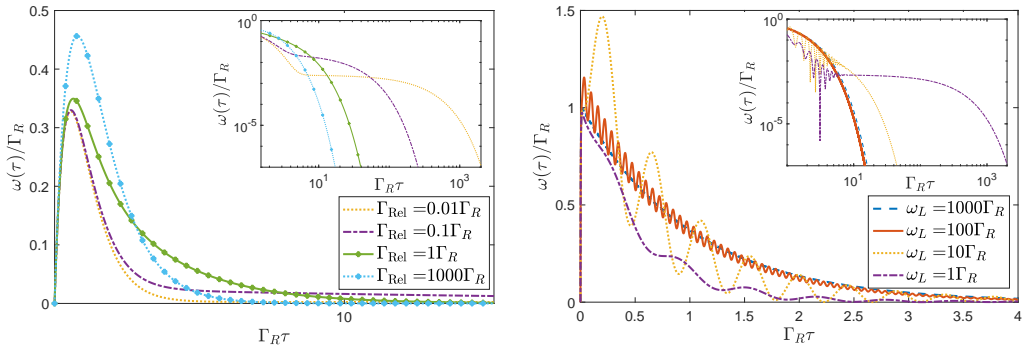
The engine of the calculation is the five-element Liouvillian $W(\chi)$ of the CNT-QD model: the density matrix contains the empty state $|0\rangle$, the two orbital-momentum states $|\pm l\rangle$, and their coherences, with source tunneling at rate $4\Gamma_L$ into the coupled/dark superposition and drain tunneling at rate $\Gamma_R$ from the coupled state only. The phase difference $\Delta\varphi=\varphi_L-\varphi_R$ sets the probability that source electrons enter the dark state. Unblocking comes from relaxation $\Gamma_{\mathrm{Rel}}$ and Lamb-shift precession $\omega_L$. Cumulants are computed from the $\chi$-resolved master equation, and the waiting-time distribution is $\omega(\tau)=\langle\langle J e^{W_0\tau} J\rangle\rangle/\langle\langle J\rangle\rangle$. The explanatory heart is a reduced three-state rate model $(|0\rangle,|\mathrm{CS}\rangle,|\mathrm{DS}\rangle)$ that gives exact formulas for the current and the first two Fano factors, together with a Bernoulli-bistability caricature $P(n,t)=(1-p)\delta_{n,0}+p\delta_{n,n_0}$ that directly produces $F_k\sim t^{k-1}$, positive $F_2$, and a skewness that changes sign with $p$.
What would settle it
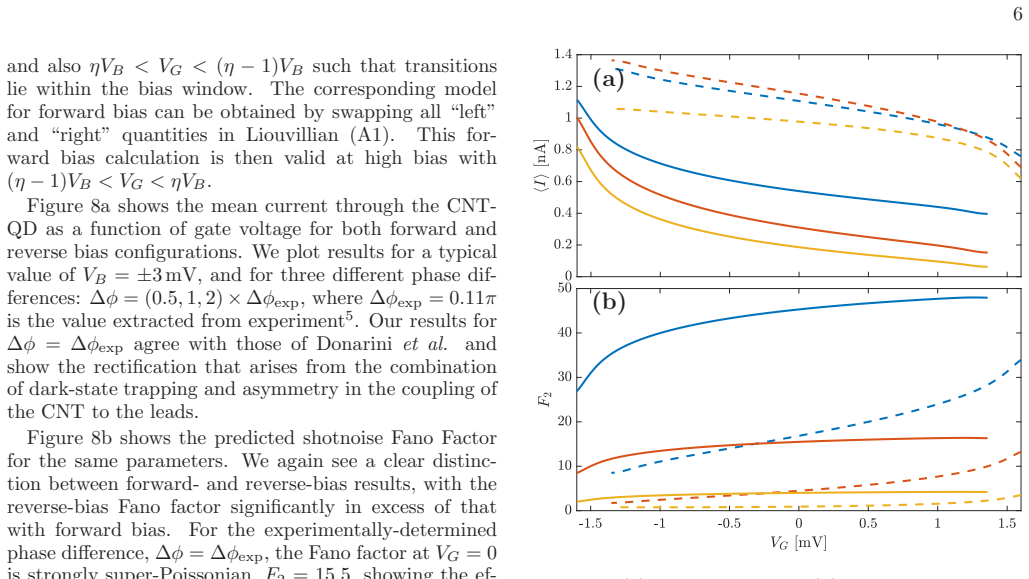
Measure the second and third current cumulants and the waiting-time distribution of a carbon nanotube dot in reverse bias near $V_G=0$ using the experimental parameters quoted in the paper. The model predicts $F_2\approx16$ and $F_3\approx275$ plus a waiting-time tail out to roughly $10^3\Gamma_R^{-1}$; observing Poisson-like noise close to $F_2=1$, a small positive $F_3$, or a single fast exponential waiting-time decay under these conditions would rule out the dark-state mechanism as the source of the current suppression.
Extended reading notes
Core claim
The central claim is that dark-state-limited transport through the CNT-QD is a bistable switching process, and that the switching statistics are what one actually measures. For $\Delta\varphi\neq0$, electrons tunnel into both the coupled state $|\mathrm{CS}\rangle$ and the dark state $|\mathrm{DS}\rangle$; with vanishing relaxation $\Gamma_{\mathrm{Rel}}\to0$ or precession $\omega_L\to0$, the dark state traps electrons for very long times, so the system alternates between blocked and conducting periods. The transferred-charge distribution is then close to a Bernoulli mixture, which yields $F_k\sim t^{k-1}$: $F_2\to+\infty$ and $F_3\to-\infty$, with the skewness sign fixed by whether the conducting branch is more or less probable than the blocking branch. With the parameters of the CNT-QD experiment, reverse bias at $V_G=0$ gives $F_2\approx15.5$ and $F_3\approx275$, while forward bias gives much weaker statistics and negative skewness over much of the gate-voltage range. The waiting-time distribution is a short-time peak followed by an extremely long tail, and oscillations are imprinted in the tail when Lamb-shift precession dominates the unblocking.
Load-bearing premise
The whole calculation assumes the weak-coupling Markovian master equation in the $N=0,1$ Coulomb-blockade sector, with spin entering only as a degeneracy factor of four; if the real carbon nanotube device involves cotunneling, multielectron states, or non-Markovian lead coupling, the predicted giant Fano factors and long tails would not appear.
Editorial extensions
If this is right
- Near $\Delta\varphi=0$ with weak relaxation or precession, the current noise Fano factor diverges to $+\infty$ and the skewness to $-\infty$, so even a small phase mismatch between source and drain tunneling should be visible as enormous current fluctuations.
- Using the CNT-QD experiment's own parameters, reverse-bias transport at $V_G=0$ should show $F_2\approx16$ and $F_3\approx275$, while forward bias should show much smaller, partly negative skewness; the bias asymmetry is itself a signature of dark-state trapping.
- Because $F_2$ is far more sensitive to $\Delta\varphi$ than the mean current, adding shot-noise measurements should let experimenters determine $\Delta\varphi$ much more accurately than current measurements alone.
- Waiting-time distributions should have a short-time peak and a tail reaching roughly $\tau\approx10^3\Gamma_R^{-1}$; an oscillating tail would indicate that Lamb-shift precession, not relaxation, unblocks the dark state.
- At $\Delta\varphi=\pi/4$ with $\Gamma_{\mathrm{Rel}}=0$ and $\omega_L\to0$, the statistics collapse to $F_2=3$, corresponding to bunches of three electrons per burst, matching earlier channel-blockade models.
Reading between the lines
- Beyond the paper itself, the same Bernoulli-bistability logic should apply to any transport setup with a decoupled dark subspace and slow repopulation, so the divergent Fano factors and the negative-skewness window should appear in triple-dot or other coherent nanostructures, not only carbon nanotubes.
- Also extending the paper's logic, the long tail of the waiting-time distribution directly encodes the dark-state lifetime, so fitting the tail could extract $\Gamma_{\mathrm{Rel}}$ without measuring third cumulants.
- A third extension not pursued in the paper: since spin enters only as a degeneracy factor, a magnetic field that splits the $\pm l$ states should destroy the dark-state coherence; the predicted collapse of $F_2$ toward $1$ under an applied field would cleanly test whether the giant noise comes from the dark state.
Signed reviews
Editorial analysis
A structured set of objections, weighed in public.
Referee Report
Summary. The manuscript studies the full counting statistics and waiting-time distributions of a carbon-notube quantum-dot model with a coherent dark state, previously introduced by Donarini et al. It computes the first three current cumulants from a five-element Markovian Liouvillian, reports giant super-Poissonian Fano factors (F2 diverging to +∞ and F3 to −∞ as Δφ→0 with vanishing relaxation), introduces a three-state effective model that reproduces F2 in the relaxation-dominated regime, and predicts experimental signatures using parameters from Ref. 5: F2≈16 and F3≈275 at VG=0 under reverse bias. It also calculates waiting-time distributions with long tails and, when Lamb-shift precession is the unblocking mechanism, oscillations. The central claims are that these statistics are signatures of dark-state-induced bistability and extreme electron bunching, and that noise measurements could determine the critical phase difference Δφ more robustly than current measurements alone.
Significance. If the calculations are correct, the paper provides concrete, falsifiable experimental signatures of dark-state transport: strongly super-Poissonian noise and skewness, extreme sensitivity to the phase difference Δφ, and long-tailed waiting-time distributions. The effective three-state model and the Bernoulli-bistability argument give a simple physical explanation of the bunching and of the divergence signs, and the F2→3 limit connects naturally to the channel-blockade results of Belzig and to the triple-dot literature. A further strength is that the predictions are made with experimental parameters from Ref. 5 without fitting to the transport data. The main obstruction is that the printed full-counting-statistics formulas on which the third-cumulant results rest contain an apparent sign error and a garbled third-order line; the specific F3 values and the F3 sign change are therefore not verifiable from the manuscript as submitted.
major comments (2)
- [Appendix B, Eq. (B3)] With R defined as the pseudo-inverse of W, the second-cumulant formula as printed, ⟨⟨J+2JRJ⟩⟩, has the wrong sign; stationary perturbation theory gives ⟨I²⟩_c = ⟨⟨J⟩⟩−2⟨⟨JRJ⟩⟩. The inconsistency is visible in the exactly solvable two-state limit Δφ=0, Γ_Rel=0: the paper's own generating function (C2) gives F2=(1+a²)/2, whereas the printed sign gives F2=(3−a²)/2 (F2=3/2 for a=0), so the sign error is not innocuous. The third-cumulant line in (B3) is also garbled as printed: 'J+3JRJ+3JRJ+6JR[JR−RJP]J' contains a repeated '3JRJ' and no 'JRJRJ' term, so no correct third-order expression can be recovered from the text. Since the F3 curves in Figs. 5 and 10 and the headline values F3≈275 and F3→−∞ are computed from this expansion, those results are not verifiable without a corrected derivation or machine-checkable code.
- [Section V, Figs. 5 and 10] The effective three-state model of Section V provides closed-form expressions only for the mean current and F2 (Eqs. (3)-(4)); the manuscript states that the skewness expression is 'cumbersome' and does not give it. Consequently the specific F3 predictions—the sign change as a function of Δφ, the divergence F3→−∞, and the experimental value F3≈275 at VG=0—are supported neither by an analytic formula nor by released code or data. The Bernoulli bistability argument at the end of Section V explains the sign and the qualitative divergence, but it does not fix the numerical magnitude or the gate-voltage dependence in Fig. 10. Please supply a corrected third-cumulant expression, a reproducibility script, or both.
minor comments (5)
- [Fig. 10 caption] The caption reads 'With reverse bias, large positive values of F3 are observed whereas at reverse bias, the skewness is negative across large portions on the gate-voltage range'; the second 'at reverse bias' should presumably be 'at forward bias', since the text in Section VII states that the forward-bias skewness is negative.
- [Section VIII] The phrase 'the the Aharonov-Bohm interferometer models' contains a duplicated 'the', and 'similar to that reported Urban and König (see also Li et al.)' is missing 'by' before the author names.
- [Section VI] The waiting-time distribution is denoted ω(τ) in the text but w(τ) in the figures and in equation (B4); please unify the notation.
- [Appendix A and B] The counting-field factors e^{iχ} are introduced in the Liouvillian (A1) without an explicit statement that the jump operator J consists of all terms carrying this factor; a one-sentence clarification would help the reader connect (A1) to the cumulant expressions (B3).
- [Reference 21] The author name in Ref. 21 appears garbled as 'Bu/suppress lka'; this is likely a LaTeX rendering error that should be corrected (the author is B. Bułka).
Circularity Check
Minor non-load-bearing self-citations; central FCS/WTD results are self-contained model outputs, not circular.
full rationale
The paper's central chain is: adopt the Donarini et al. model (Section II, Eq. A1) as an input, compute the first three current cumulants and waiting-time distributions from the chi-resolved Liouvillian via the standard FCS expansion of Appendix B, and then evaluate at the experimental parameters of Ref. 5 (Delta_phi_exp = 0.11 pi, Gamma_L = 4 micro-eV, Gamma_R = 10 micro-eV, Gamma_rel = 0.1 micro-eV, U = 20 meV, J = 10 micro-eV, k_B T = 50 micro-eV, eta = 0.55). The reported Fano factors (F2 about 15.5-16, F3 about 275) and long WTD tails are model outputs, not quantities fitted to the target predictions; the experimental parameters are inputs, not fitting targets. The effective models in Section V are post-hoc explanations (the bistable Bernoulli picture and the three-state rate model) and are checked against the full numerics and against the external F2 = 3 result of Belzig, so they do not smuggle the conclusion in. The self-citations (Refs. 4, 19, 20, 24, 36) are contextual or motivational; no load-bearing step relies on an unverified claim from the authors' own prior work, and no uniqueness theorem is imported. I therefore find no circular reduction. One non-circularity concern: Eq. (B3) appears to have a sign error in the C2 term and a garbled C3 expression; this affects verifiability of the printed F3 values but is a correctness issue, not a circularity.
Assumptions & free parameters
free parameters (3)
- Δφ (phase difference between left and right tunnel bases) =
0.11π (experimental estimate from Ref. 5)
- ΓRel (relaxation rate from dark state to coupled state) =
0.1 μeV (experimental estimate from Ref. 5)
- ωL (Lamb-shift precession frequency)
assumptions (5)
- domain assumption Weak-coupling Born-Markov quantum master equation (2) with Liouvillian (A1) describes the CNT-QD transport.
- domain assumption The transport sector is restricted to N=0,1 excess electrons; spin enters only via degeneracy factors of 4.
- standard math The cumulant formulas (B3) and waiting-time formula (B4) for Markovian single-reset processes are valid.
- standard math The stationary state of W is unique and the pseudo-inverse R exists for the cumulant expansion.
- domain assumption The Lamb shifts obey the voltage dependence of Eqs. (5)-(6) with digamma functions.
Cite this review
Pith. "Pith review of Counting statistics of dark-state transport through a carbon nanotube quantum dot." pith.science (2026). https://pith.science/paper/GHZ4CIIX
@misc{pith2026190802026,
  author       = {Pith},
  title        = {Pith review of: Counting statistics of dark-state transport through a carbon nanotube quantum dot},
  year         = {2026},
  howpublished = {\url{https://pith.science/paper/GHZ4CIIX}},
  note         = {Machine review of arXiv:1908.02026}
}
read the original abstract
In a recent experiment [A. Donarini et al., Nat Comms 10, 381 (2019)], electronic transport through a carbon nanotube quantum dot was observed to be suppressed by the formation of a quantum-coherent ``dark state''. In this paper we consider theoretically the counting statistics and waiting-time distribution of this dark-state-limited transport. We show that the statistics are characterised by giant super-Poissonian Fano factors and long-tailed waiting-time distributions, both of which are signatures of the bistability and extreme electron bunching caused by the dark state.
Figures


Figures from the paper (5 more)



Reference graph
Works this paper leans on
-
[1]
author author G. Alzetta , author A. Gozzini , author L. Moi , \ and\ author G. Orriols ,\ @noop journal journal Nuovo Cimento B \ volume 36 ,\ pages 5 ( year 1976 ) NoStop
work page 1976
-
[2]
author author E. Arimondo \ and\ author G. Orriols ,\ @noop journal journal Lett.\ al Nuovo Cim. \ volume 17 ,\ pages 333 ( year 1976 ) NoStop
work page 1976
-
[3]
author author R. M. \ Whitley \ and\ author C. R. \ Stroud ,\ @noop journal journal Phys.\ Rev. A. \ volume 14 ,\ pages 1498 ( year 1976 ) NoStop
work page 1976
-
[4]
author author B. Michaelis , author C. Emary , \ and\ author C. Beenakker ,\ @noop journal journal Europhys.\ Lett. \ volume 73 ,\ pages 677 ( year 2006 ) NoStop
work page 2006
-
[5]
author author A. Donarini , author M. Niklas , author M. Schafberger , author N. Paradiso , author C. Strunk , \ and\ author M. Grifoni ,\ @noop journal journal Nat.\ Comms \ volume 10 ,\ pages 381 ( year 2019 ) NoStop
work page 2019
-
[6]
author author L. S. \ Levitov \ and\ author G. B. \ Lesovik ,\ @noop journal journal JETP.\ Lett. \ volume 55 ,\ pages 555 ( year 1992 ) NoStop
work page 1992
-
[7]
author author L. S. \ Levitov , author H. Lee , \ and\ author G. B. \ Lesovik ,\ @noop journal journal J. Math. Phys. \ volume 37 ,\ pages 4845 ( year 1996 ) NoStop
work page 1996
-
[8]
author author D. A. \ Bagrets \ and\ author Y. V. \ Nazarov ,\ @noop journal journal Phys.\ Rev. B \ volume 67 ,\ pages 085316 ( year 2003 ) NoStop
work page 2003
Show all 36 references
-
[9]
Gustavsson , author R
author author S. Gustavsson , author R. Leturcq , author R. S. \ B. Simovic , author T. Ihn , author P. Studerus , author K. Ensslin , author D. C. \ Driscoll , \ and\ author A. C. \ Gossard ,\ @noop journal journal Phys.\ Rev. Lett. \ volume 96 ,\ pages 076605 ( year 2006 ) NoStop
2006
-
[10]
Gustavsson , author R
author author S. Gustavsson , author R. Leturcq , \ and\ author K. T.Ihin ,\ @noop journal journal Phys.\ Rev. B \ volume 75 ,\ pages 075314 ( year 2007 ) NoStop
2007
-
[11]
Fujisawa , author T
author author T. Fujisawa , author T. Hayashi , \ and\ author Y. R. Tomita ,\ @noop journal journal Science \ volume 312 (5780) ,\ pages 1634 ( year 2006 ) NoStop
2006
-
[12]
Kurzmann , author P
author author A. Kurzmann , author P. Stegmann , author J. Kerski , author R. Schott , author A. Ludwig , author A. D. \ Wieck , author J. K\"onig , author A. Lorke , \ and\ author M. Geller ,\ 10.1103/PhysRevLett.122.247403 journal journal Phys. Rev. Lett. \ volume 122 ,\ pag...
-
[13]
Brandes ,\ @noop journal journal Ann
author author T. Brandes ,\ @noop journal journal Ann. Phys. (Berlin) \ volume 17 ,\ pages 477 ( year 2008 ) NoStop
2008
-
[14]
author author L. S. \ Levitov \ and\ author M. Reznikov ,\ @noop journal journal Phys.\ Rev. B \ volume 70 ,\ pages 115305 ( year 2004 ) NoStop
2004
-
[15]
Loss \ and\ author E
author author D. Loss \ and\ author E. V. \ Sukhorukov ,\ @noop journal journal Phys.\ Rev. Lett. \ volume 84 ,\ pages 1035 ( year 2000 ) NoStop
2000
-
[16]
Kiesslich , author E
author author G. Kiesslich , author E. Schoell , author T. Brandes , author F. Hohls , \ and\ author R. J. \ Haug ,\ @noop journal journal Phys.\ Rev. Lett. \ volume 99 ,\ pages 206602 ( year 2007 ) NoStop
2007
-
[17]
Emary , author C
author author C. Emary , author C. P \"o ltl , author A. Carmele , author J. Kabuss , author A. Knorr , \ and\ author T. Brandes ,\ @noop journal journal Phys.\ Rev. B \ volume 85 ,\ pages 165417 ( year 2012 ) NoStop
2012
-
[18]
author author C. W. \ Groth , author B. Michaelis , \ and\ author C. W. J. \ Beenakker ,\ @noop journal journal Phys.\ Rev. B. \ volume 74 ,\ pages 125315 ( year 2006 ) NoStop
2006
-
[19]
Emary ,\ @noop journal journal Phys.\ Rev
author author C. Emary ,\ @noop journal journal Phys.\ Rev. B. \ volume 76 ,\ pages 245319 ( year 2007 ) NoStop
2007
-
[20]
P \"o ltl , author C
author author C. P \"o ltl , author C. Emary , \ and\ author T. Brandes ,\ @noop journal journal Phys.\ Rev. B. \ volume 80 ,\ pages 115313 ( year 2009 ) NoStop
2009
-
[21]
Weymann , author B
author author I. Weymann , author B. R. \ Bu ka , \ and\ author J. Barna s \' s ,\ @noop journal journal Phys. Rev. B \ volume 83 ,\ pages 195302 ( year 2011 ) NoStop
2011
-
[22]
Domínguez , author G
author author F. Domínguez , author G. Platero , \ and\ author S. Kohler ,\ https://doi.org/10.1016/j.chemphys.2010.06.017 journal journal Chem. Phys. \ volume 375 ,\ pages 284 ( year 2010 ) NoStop
2010 doi
-
[23]
Dom\'inguez , author S
author author F. Dom\'inguez , author S. Kohler , \ and\ author G. Platero ,\ @noop journal journal Phys.\ Rev. B \ volume 83 ,\ pages 235319 ( year 2011 ) NoStop
2011
-
[24]
P \"o ltl , author C
author author C. P \"o ltl , author C. Emary , \ and\ author T. Brandes ,\ @noop journal journal Phys.\ Rev. B. \ volume 87 ,\ pages 045416 ( year 2013 ) NoStop
2013
-
[25]
\ Zhao , author J
author author H.-K. \ Zhao , author J. Wang , \ and\ author Q. Wang ,\ @noop journal journal Phys. Lett. A \ volume 378 ,\ pages 1553–1560 ( year 2014 ) NoStop
2014
-
[26]
Urban \ and\ author J
author author D. Urban \ and\ author J. K \"o nig ,\ @noop journal journal Phys.\ Rev. B. \ volume 79 ,\ pages 165319 ( year 2009 ) NoStop
2009
-
[27]
Li , author H
author author F. Li , author H. J. \ Jiao , author J. Y. \ Luo , author X.-Q. \ Li , \ and\ author S. A. \ Gurvitz ,\ @noop journal journal Physica E \ volume 41 ,\ pages 1707 ( year 2009 ) NoStop
2009
-
[28]
author author D. V. \ Averin \ and\ author K. K. \ Likharev ,\ @noop journal journal J Low Temp Phys \ volume 62 ,\ pages 345 ( year 1986 ) NoStop
1986
-
[29]
Cottet , author W
author author A. Cottet , author W. Belzig , \ and\ author C. Bruder ,\ 10.1103/PhysRevB.70.115315 journal journal Phys. Rev. B \ volume 70 ,\ pages 115315 ( year 2004 ) NoStop
2004 doi
-
[30]
Belzig ,\ @noop journal journal Phys.\ Rev
author author W. Belzig ,\ @noop journal journal Phys.\ Rev. B. \ volume 71 ,\ pages 161301 ( year 2005 ) NoStop
2005
-
[31]
Schaller , author G
author author G. Schaller , author G. Kieblich , \ and\ author T. Brandes ,\ @noop journal journal Phys.\ Rev. B. \ volume 81 ,\ pages 205305 ( year 2010 ) NoStop
2010
-
[32]
Kie lich , author E
author author G. Kie lich , author E. Sch\"oll , author T. Brandes , author F. Hohls , \ and\ author R. J. \ Haug ,\ 10.1103/PhysRevLett.99.206602 journal journal Phys. Rev. Lett. \ volume 99 ,\ pages 206602 ( year 2007 ) NoStop
2007 doi
-
[33]
Flindt , author T
author author C. Flindt , author T. Novotn\'y , \ and\ author A.-P. \ Jauho ,\ @noop journal journal Phys. Rev. B \ volume 70 ,\ pages 205334 ( year 2004 ) NoStop
2004
-
[34]
\ Jauho , author C
author author A.-P. \ Jauho , author C. Flindt , author T. Novotn\'y , \ and\ author A. Donarini ,\ @noop journal journal Physics of Fluids \ volume 17 ,\ pages 100613 ( year 2005 ) NoStop
2005
-
[35]
Flindt , author T
author author C. Flindt , author T. Novotn\'y , author A. Braggio , author M. Sassetti , \ and\ author A.-P. \ Jauho ,\ @noop journal journal Phys. Rev. Lett. \ volume 100 ,\ pages 150601 ( year 2008 ) NoStop
2008
-
[36]
Marcos , author C
author author D. Marcos , author C. Emary , author T. Brandes , \ and\ author R. Aguado ,\ @noop journal journal New J.\ Phys. \ volume 12 ,\ pages 123009 ( year 2010 ) NoStop
2010
Reviewed August 14, 2026 · model on record in the stance chip above.
Discussion (0). Continue with ORCID to comment.