REVIEW 3 major objections 5 minor 71 references
Analytical description of quantum emission in optical analogues to gravity
T0 review · 3 major / 5 minor · reviewed 2026-08-14 · deepseek-v4-flash
Pith's one-line read All spontaneous emission at a moving refractive-index front in a dispersive dielectric follows from a single analytically computed scattering matrix, which yields concrete spectra and correlation maps for a fused-silica analogue of black…
desk verdict Honest, useful extension of the step-RIF programme to two-photon correlations and lab-frame observables; the sharp-step idealization and the thesis dependency are the real caveats. read the letter →
The pith
A machine-rendered reading of the paper's core claim, the machinery that carries it, and where it could break.
The reading
What carries the argument
The machinery is the Hopfield model—a Lagrangian in which light (a scalar potential) is coupled to three polarisation oscillator fields with Sellmeier dispersion—combined with matching conditions at a step-like refractive index front. The matching conditions, derived in Appendix B, require continuity of the potential, the polarisation fields, and their derivatives across the step, with a discontinuity in the polarisation-derivative set by the elastic constants. The scattering matrix S is obtained as the transformation between global in and out mode bases, S = (σ_out_L)^{-1} σ_in_L, and is shown to be quasi-unitary with respect to the Klein-Gordon norm, which preserves the canonical commutation relations. All observables—flux (3), covariance (7), correlation coefficient (9), and g(2) (11)—are expressed directly in terms of S, so the entire emission phenomenology rests on this matrix.
What would settle it
Measure the photon-number correlation coefficient at the predicted black-hole pair (397 nm, 210 nm) using a 400 nm pump pulse in fused silica: if C is far below 0.97, or if the spectral peak at 210 nm lacks the sharp 'shark fin' cut-off at the horizon boundary, the step-like Hopfield model does not capture the emission.
Extended reading notes
Core claim
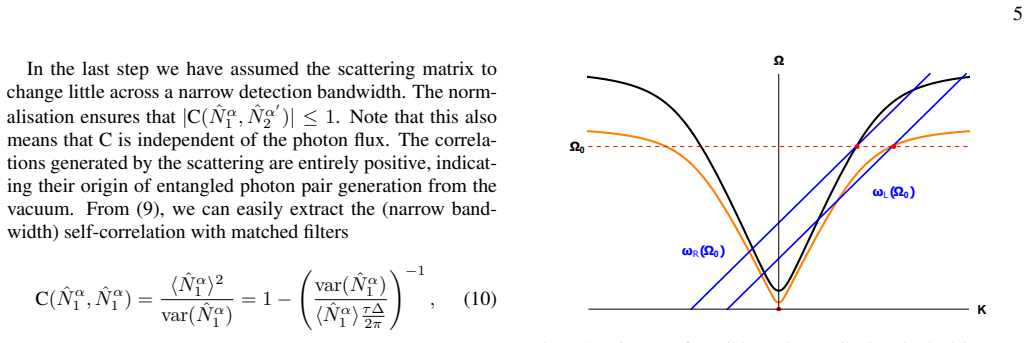
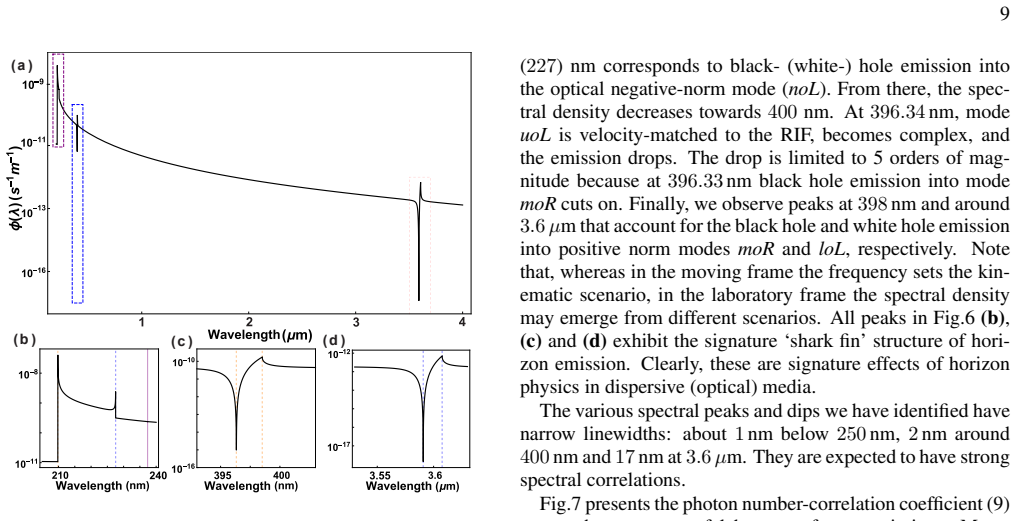
The central discovery is that the quantum emission at a moving refractive index front is completely characterised by an analytically constructed scattering matrix. The authors supplement the Hopfield-model field theory in curved spacetime, treat the index change as a sharp step, and match the electromagnetic potential, the three polarisation fields, and their derivatives at the boundary. Solving the resulting linear system yields the scattering matrix in all kinematic scenarios—horizonless, white-hole, black-hole, and mixed—including the complex, evanescent modes. From this matrix the authors derive the output photon flux in Eq. (3) and the normally ordered photon-number covariance in Eq. (7), which is independent of the photon flux, and hence the full correlation coefficient (9) and g(2) functions. Applied to fused silica, the formalism predicts narrow 'shark-fin' spectral peaks over the horizon intervals and near-unity pair correlations—0.97 at the black-hole pair (397 nm, 210 nm) and 0.92 at the white-hole pair (3.6 µm, 227 nm)—with the overall structure stable against changes in step height and pulse velocity.
Load-bearing premise
The predictions rest on modelling the moving refractive-index perturbation as a sharp, lossless step in a three-resonance Hopfield dielectric, ignoring phonon interactions, four-wave mixing, and other nonlinearities; a real Kerr pulse has a smooth index profile, and the paper acknowledges that the step 'is physically hard to implement'.
Editorial extensions
If this is right
- A fused-silica experiment with a 400 nm pump (RIF velocity u = 2c/3) should observe the black-hole partner at 210 nm and the signal at 398 nm, with a photon-number correlation coefficient of 0.97 at (397 nm, 210 nm).
- The white-hole pair at 3.6 µm and 227 nm, with C = 0.92, provides a spectrally well-separated target that avoids pump contamination.
- The 'shark fin' spectral line shape, cut off abruptly at the horizon interval boundary, is a robust signature of horizon emission, persisting over five orders of magnitude of index-step height.
- The method extends to finite-length pulse profiles, allowing theoretical predictions for the two-horizon configurations that real Kerr pulses implement.
Reading between the lines
- Because the correlation coefficient in Eq. (9) is independent of the photon flux, the correlation map may remain measurable even where the flux is too low for direct detection; this makes the near-unity contours, rather than peak heights, the most decisive experimental signature.
- The same S-matrix formalism could be transferred to other linear bosonic platforms with step-like inhomogeneities—polariton condensates, cold atoms, or superconducting circuits—where analogous horizon pairs would display the same shark-fin spectral cut-offs if dispersion is tuned to match the Hopfield-Sellmeier structure.
- A smooth-front calculation is the natural next test: if a realistic Kerr pulse only broadens the shark-fin peaks rather than shifting their centres, the analytic step model would still serve as the quantitative backbone for designing analogue-gravity experiments.
Signed reviews
Editorial analysis
A structured set of objections, weighed in public.
Referee Report
Summary. The paper presents an analytical scattering-matrix framework for spontaneous emission at a moving refractive-index step in a dispersive dielectric described by the Hopfield model. It constructs global modes for all kinematic scenarios, including evanescent waves, derives the S-matrix from the field matching conditions at the step, and uses it to compute photon flux spectra and photon-number correlations in both the comoving and laboratory frames. Numerical results for fused silica predict 'shark-fin' spectral peaks at white-hole and black-hole horizon frequencies and near-unity correlations at specific wavelength pairs, with correlation structures reported to be robust to changes in step height and RIF velocity.
Significance. If correct, the paper provides a complete and explicit analytical route from a microscopic Hopfield model to the two-photon observables of an optical analogue of gravity, including a step-by-step derivation of the covariance and variance formulas and a quasi-unitarity check of the S-matrix. The expressions relating flux and correlations directly to S-matrix elements are general and could be reused for other stationary mode-conversion problems. The main limitation is that the quantitative predictions are computed for an idealized sharp step, which the authors themselves note is hard to realize experimentally; the paper therefore demonstrates a calculational method and identifies qualitative types of emission, rather than delivering directly testable experimental spectra.
major comments (3)
- [Section V, Figs. 4-7, Table I] The quantitative predictions, including the shark-fin spectral shape and the peak correlations of 0.97 and 0.92 at (397 nm, 210 nm) and (3.6 micrometres, 227 nm), are computed for a single infinitely sharp step with matching at x=0 (Appendix B). The robustness study in Section V C and Table I varies only the step height and the RIF velocity, never the profile shape or the pulse length. The Introduction explicitly states that the step 'is physically hard to implement' and that outputs 'will be further modified by gradual horizons, two-horizon interactions and other nonlinear effects'. Since a Kerr-generated RIF has a smooth finite-width profile, the step result is not automatically the limit of the smooth result, and the paper does not demonstrate that the computed spectra and correlations describe a real experiment. The abstract and Section V B should be tempered to state that these are predictions for the idealized step, or the paper should add a concrete discussion (even a qualitative adiabaticity estimate) of how smooth profiles are expected to modify the signatures.
- [Section IV and Appendix C] The central claim that 'We calculate the scattering matrix at all frequencies (from all kinematic scenarios)' is only explicitly demonstrated for mode scenario c (8 propagating modes on either side). Appendix C works out the sigma matrices and the S-matrix for that case and refers to the first author's PhD thesis ([36]) for 'further calculations'. Scenarios with evanescent (complex) modes are described verbally in Appendix A 2, but no explicit construction, matching solution, or quasi-unitarity verification for such a scenario appears in the manuscript. To substantiate the all-frequency claim and make the paper self-contained, the authors should include at least one explicit example with evanescent modes (e.g., scenario d) in an appendix, or provide the general algorithm in sufficient detail to reproduce those cases.
- [Appendices A 2 and D] The treatment of unphysical (evanescent) modes assigns them a norm of unity in the metric g (Appendix D) and includes them in the S-matrix construction. The physical observables (3) and (9) sum only over beta not in {alpha}, which excludes the unphysical modes if they are placed in {alpha}, so physical predictions are expected to be independent of this arbitrary normalization, but this independence is not shown. The authors should demonstrate that the physical block of the S-matrix is unaffected by the arbitrary norm assignment, or justify why the quasi-unitarity relation with such an assignment is a meaningful numerical check.
minor comments (5)
- [Equation (9)] The prefactor 'Delta^2/Delta1 Delta2' in the last line of Eq. (9) is printed in the text as 'Delta2/Delta1 Delta2', which is ambiguous and would reduce to 1/Delta1 if taken literally; this should be corrected to clarify that the numerator contains Delta^2.
- [Section V B] Near the discussion of Fig. 7, the text reads 'starting at 237 mn' and should read '237 nm'.
- [Section III and Appendix E] The distinction between the scattering matrix S and the norm-adjusted matrix S introduced in Appendix E is not defined in the main text at Eq. (6); a short note clarifying that rows of negative-norm modes are complex-conjugated would improve readability.
- [Abstract and Introduction] The abstract states 'We supplement the field theory in curved spacetime for this model', but the Lagrangian (A1) is written in a moving frame and the analogue metric is not explicitly used; a brief clarification of how the analogue spacetime enters the calculation would help readers.
- [Figure 5] The caption of Fig. 5 uses labels uL, lL, nlL, and nuL for non-optical modes without defining them; these labels should be defined or referenced to Fig. 8.
Circularity Check
No significant circularity: the S-matrix is derived from matching conditions and observables follow from it; self-citations are contextual rather than load-bearing.
full rationale
Walking the derivation chain: the field theory in Appendix A is the standard Hopfield model with Sellmeier parameters taken from external references, not from the paper's own outputs. The moving refractive index perturbation is treated as a step by explicit assumption, with the paper itself conceding that the step is 'physically hard to implement' and that outputs would be modified by gradual horizons and two-horizon interactions; this is a limitation on external validity, not circularity. The scattering matrix is constructed in Section IV from local-mode bases and field matching conditions (Eqs. (16)-(23)), with the matching conditions derived in Appendix B, an explicit example in Appendix C, and quasi-unitarity verified in Appendix D. Observables in Section III are derived from the S-matrix: the photon flux Eq. (3) follows from the second moment (E2), and the correlation coefficient Eq. (9) follows from the fourth-order moment (E5). No parameter is fitted to the computed spectra or correlation maps; the Sellmeier coefficients are external inputs and the step height and velocity are scanned as parameters. The prior self-citations ([36], [38], [39]) supply kinematic classification, earlier flux results, and supplementary mode-configuration calculations, but the central S-matrix and correlation derivation is carried out in the present paper, and the cited results are not used to define the quantities being predicted. Thus no step reduces by construction to its inputs, and the observed robustness of the 'types' is a computed consequence of the S-matrix rather than a restatement of the definitions. The main weakness, namely the reliance on a sharp step profile, is a correctness risk about external validity, not a circularity.
Assumptions & free parameters
free parameters (3)
- Sellmeier coefficients kappa_i, Omega_i (fused silica) =
kappa=(0.07142,0.03246,0.05540); Omega=(190.341 THz,16.2047 PHz,27.537 PHz)
- Refractive index step height delta_n =
10^-6 to 10^-1; main plots use 2x10^-6
- RIF velocity u =
u/c = 2/3, 2.04/3, 2.05/3
assumptions (6)
- domain assumption The Hopfield Lagrangian in Eq. (A1) with three Lorentz oscillators describes the dielectric response of fused silica at the frequencies of interest.
- domain assumption The medium is transparent: absorption is neglected because frequencies are far from material resonances.
- domain assumption Fields are treated as one-dimensional scalar fields, with only the x-component of the vector potential and three polarization fields.
- domain assumption The RIF is a sharp step, and phonon interactions, four-wave mixing and other optical nonlinearities are neglected.
- standard math Canonical quantization via the equal-time commutation relations in Eqs. (A15)-(A16) applies to the Hopfield fields.
- ad hoc to paper The unphysical complex (evanescent) modes can be assigned a norm and included in the S-matrix construction.
Cite this review
Pith. "Pith review of Analytical description of quantum emission in optical analogues to gravity." pith.science (2026). https://pith.science/paper/FZVDGJOK
@misc{pith2026190802060,
  author       = {Pith},
  title        = {Pith review of: Analytical description of quantum emission in optical analogues to gravity},
  year         = {2026},
  howpublished = {\url{https://pith.science/paper/FZVDGJOK}},
  note         = {Machine review of arXiv:1908.02060}
}
read the original abstract
We consider a moving refractive index perturbation in an optical medium as an optical analogue to waves under the influence of gravity. We describe the dielectric medium by the Lagrangian of the Hopfield model. We supplement the field theory in curved spacetime for this model to solve the scattering problem for all modes and frequencies analytically. Because of dispersion, the kinematic scenario of the field modes may contain optical event horizons for some frequencies. We calculate the spectra of spontaneous emission in the frame co-moving with the perturbation and in the laboratory frame. We also calculate the spectrally-resolved photon number correlations in either frame. The emitted multimode field comes in different types depending on the presence of horizons. We show that these types are robust against changes in the system parameters and thus are genuine features of optical and non-optical analogues. These methods and findings pave the way to new observations of analogue gravity in dispersive systems.
Figures


Figures from the paper (6 more)




Reference graph
Works this paper leans on
-
[36]
M. J. Jacquet, Negative Frequency at the Horizon: Theoretical Study and Experimental Realisation of Analogue Gravity Phys- ics in Dispersive Optical Media, Springer Theses (Springer In- ternational Publishing, Vienna, 2018), ISBN 978-3-319-91070- 3
work page 2018
-
[1]
W. G. Unruh, Physical Review Letters 46, 1351 (1981)
1981
- [2]
-
[3]
S. W. Hawking, Communications In Mathematical Physics 43, 199 (1975)
work page 1975
- [4]
-
[5]
J. R. Muoz de Nova, K. Golubkov, V . I. Kolobov, and J. Stein- hauer, Nature 569, 688 (2019)
work page 2019
-
[6]
G. Rousseaux, C. Mathis, P. Maissa, T. G. Philbin and U. Leon- hardt, New Journal of Physics 10, 053015 (2008)
work page 2008
-
[7]
S. Weinfurtner, E. W. Tedford, M. C. J. Penrice, W. G. Un- ruh and G. A. Lawrence, Physical Review Letters 106, 021302 (2011)
work page 2011
Show all 71 references
-
[8]
Euv ´e, F
L.-P. Euv ´e, F. Michel, R. Parentani, T. G. Philbin and G. Rousseaux, Physical Review Letters 117, 121301 (2016)
2016
-
[9]
Torres, S
T. Torres, S. Patrick, A. Coutant, M. Richartz, E. W. Tedford and S. Weinfurtner, Nature Physics13, 833 (2017)
2017
-
[10]
Euv ´e and G
L.-P. Euv ´e and G. Rousseaux, Physical Review D 96, 064042 (2017)
2017
-
[11]
Euv ´e, S
L.-P. Euv ´e, S. Robertson, N. James, A. Fabbri and G. Rousseaux, Physical Review Letters 124, 141101 (2020)
2020
-
[12]
H. S. Nguyen, D. Gerace, I. Carusotto, D. Sanvitto, E. Galopin, A. Lemaˆıtre, I. Sagnes, J. Bloch and A. Amo, Physical Review Letters 114, 036402 (2015)
2015
-
[13]
Michel, O
C. Michel, O. Boughdad, M. Albert, P.-E. Larr ´e and M. Bellec, Nature Communications 9, 2108 (2018)
2018
-
[14]
Fontaine, T
Q. Fontaine, T. Bienaim ´e, S. Pigeon, E. Giacobino, A. Bramati and Q. Glorieux, Physical Review Letters 121 (2018)
2018
-
[15]
M. J. Jacquet, T. Boulier, F. Claude, A. Ma ˆıtre, E. Cancellieri, C. Adrados, A. Amo, S. Pigeon, Q. Glorieux, A. Bramati and E. Giacobino, arXiv:2002.00043 [cond-mat, physics:quant-ph] (2020)
2020 arXiv
-
[16]
Busch and R
X. Busch and R. Parentani, Physical Review D 89, 105024 (2014)
2014
-
[17]
Busch, I
X. Busch, I. Carusotto and R. Parentani, Physical Review A 89, 043819 (2014)
2014
-
[18]
Finazzi and I
S. Finazzi and I. Carusotto, Physical Review A 90, 033607 (2014)
2014
-
[19]
Boiron, A
D. Boiron, A. Fabbri, P.-E. Larr ´e, N. Pavloff, C. I. Westbrook and P. Zi´n, Physical Review Letters 115, 025301 (2015)
2015
-
[20]
Michel, J.-F
F. Michel, J.-F. Coupechoux and R. Parentani, Physical Review D 94 (2016)
2016
-
[22]
Sch ¨utzhold and W
R. Sch ¨utzhold and W. G. Unruh, Physical Review Letters 107, 149401 (2011)
2011
-
[23]
Finke, P
A. Finke, P. Jain and S. Weinfurtner, New Journal of Physics 18, 113017 (2016)
2016
-
[24]
Fabbri and N
A. Fabbri and N. Pavloff, SciPost Physics 4 (2018)
2018
-
[25]
Coutant and S
A. Coutant and S. Weinfurtner, Physical Review D 97, 025005 (2018)
2018
-
[26]
Coutant and S
A. Coutant and S. Weinfurtner, Physical Review D 97, 025006 (2018)
2018
-
[27]
Isoard and N
M. Isoard and N. Pavloff, Physical Review Letters 124, 060401 (2020)
2020
-
[28]
Visser, Classical and Quantum Gravity 15, 1767 (1998)
M. Visser, Classical and Quantum Gravity 15, 1767 (1998)
1998
-
[29]
Leonhardt, Nature 415, 406 (2002)
U. Leonhardt, Nature 415, 406 (2002)
2002
-
[30]
Sch ¨utzhold and W
R. Sch ¨utzhold and W. G. Unruh, Physical Review Letters 95, 031301 (2005)
2005
-
[31]
A. V . Gorbach and D. V . Skyrabin, Nature Photonics 1, 653 (2007)
2007
-
[32]
T. G. Philbin, C. Kuklewicz, S. Robertson, S. Hill, F. K¨onig and U. Leonhardt, Science 319, 1367 (2008)
2008
-
[33]
S. Hill, C. E. Kuklewicz, U. Leonhardt and F. K ¨onig, Optics Express 17, 13588 (2009)
2009
-
[34]
Faccio, S
D. Faccio, S. Cacciatori, V . Gorini, G. Sala, A. Averchi, A. Lotti, M. Kolesik and J. V . Moloney, Europhysics Letters 89, 34004 (2010)
2010
-
[35]
Choudhary and F
A. Choudhary and F. K ¨onig, Optics Express 20, 5538 (2012)
2012
-
[37]
Drori, Y
J. Drori, Y . Rosenberg, D. Bermudez, Y . Silbergerg and U. Leonhardt, Physical Review Letters 122 (2019)
2019
-
[38]
M. J. Jacquet and F. K ¨onig, Physical Review A 92, 023851 (2015)
2015
-
[39]
M. J. Jacquet and F. K ¨onig, arXiv:2001.05807 [cond-mat, physics:gr-qc, physics:quant-ph] (2020)
2020 arXiv
-
[40]
Belgiorno, S
F. Belgiorno, S. Cacciatori and F. Dalla Piazza, Physical Review D 91, 124063 (2015). 12
2015
-
[41]
M. F. Linder, R. Sch¨utzhold and W. G. Unruh, Physical Review D 93, 104010 (2016)
2016
-
[42]
Finazzi and I
S. Finazzi and I. Carusotto, Physical Review A 87, 023803 (2013)
2013
-
[43]
Loudon, The quantum theory of light , 117 (Oxford Univer- sity Press, Oxford, 2000)
R. Loudon, The quantum theory of light , 117 (Oxford Univer- sity Press, Oxford, 2000)
2000
-
[44]
G. P. Agrawal, Nonlinear fiber optics (Academic Press, Boston, 2012)
2012
-
[45]
between uoL and moR
Note that also extremely weak positive-positive norm correla- tions exist which are not visible in the figure, e.g. between uoL and moR
-
[46]
McLenaghan and F
J. McLenaghan and F. K ¨onig, New Journal of Physics 16, 063017 (2014)
2014
-
[47]
Sch ¨utzhold, G
R. Sch ¨utzhold, G. Plunien and G. Soff, Physical Review Letters 88, 061101 (2002)
2002
-
[48]
J. J. Hopfield, Physical Review 112, 1555 (1958)
1958
-
[49]
Weinfurtner, P
S. Weinfurtner, P. Jain, M. Visser and C. W. Gardiner, Classical and Quantum Gravity 26, 065012 (2009)
2009
-
[50]
Eckel, A
S. Eckel, A. Kumar, T. Jacobson, I. B. Spielman and G. K. Campbell, Physical Review X 8 (2018)
2018
-
[51]
Campo and R
D. Campo and R. Parentani, Physical Review D 72, 045015 (2005)
2005
-
[52]
Campo and R
D. Campo and R. Parentani, International Journal of Theoretical Physics 44, 1705 (2005)
2005
-
[53]
Campo and R
D. Campo and R. Parentani, Physical Review D 74, 025001 (2006)
2006
-
[54]
J. L. Gaona-Reyes and D. Bermudez, Annals of Physics 380, 41 (2017)
2017
-
[55]
Bermudez and U
D. Bermudez and U. Leonhardt, Classical and Quantum Gravity 36, 024001 (2019)
2019
-
[56]
Patrick, A
S. Patrick, A. Coutant, M. Richartz and S. Weinfurtner, Physical Review Letters 121, 061101 (2018)
2018
-
[57]
Macher and R
J. Macher and R. Parentani, Physical Review D 79, 124008 (2009)
2009
-
[58]
Cohen-Tannoudji, J
C. Cohen-Tannoudji, J. Dupont-Roc and G. Grynberg, Photons and atoms: introduction to quantum electrodynamics , Physics textbook (Wiley, Weinheim, 2004), ISBN 978-0-471-18433-1
2004
-
[59]
Sellmeier, Annalen der Physik 223, 386 (1872)
W. Sellmeier, Annalen der Physik 223, 386 (1872)
-
[60]
Rubino, J
E. Rubino, J. McLenaghan, S. C. Kehr, F. Belgiorno, D. Twonsend, S. Rohr, C. E. Kuklewicz, U. Leonhardt, F. K ¨onig and D. Faccio, Physical Review Letters 108, 253901 (2012)
2012
-
[61]
Schubert and B
M. Schubert and B. Wilhelmi, Nonlinear optics and quantum electronics, Wiley series in pure and applied optics (Wiley, New York, 1986), ISBN 978-0-471-08807-3
1986
-
[62]
Huttner, J
B. Huttner, J. J. Baumberg and S. M. Barnett, Europhysics Let- ters 16, 177 (1991)
1991
-
[63]
Huttner and S
B. Huttner and S. M. Barnett, Europhysics Letters 18, 487 (1992)
1992
-
[64]
Matloob, R
R. Matloob, R. Loudon, S. M. Barnett and J. Jeffers, Physical Review A 52, 4823 (1995)
1995
-
[65]
S. M. Barnett, B. Huttner and R. Loudon, Physical Review Let- ters 68, 3698 (1992)
1992
-
[66]
S. M. Barnett, R. Matloob and R. Loudon, Journal of Modern Optics 42, 1165 (1995)
1995
-
[67]
D. J. Santos and R. Loudon, Physical Review A 52, 1538 (1995)
1995
-
[68]
Finazzi and I
S. Finazzi and I. Carosutto, Physical Review A 89, 053807 (2014)
2014
-
[69]
N. N. Bogoliubov, V . V . Tolmachov and D. V . Sirkov, Fortsch- ritte der Physik 6, 605 (1958). Appendix A: Field Theory
1958
-
[70]
We consider one-dimensional scalar electromagnetic fields and operate at frequencies sufficiently far from the me- dium resonances to neglect absorption
Light in an inhomogeneous dispersive dielectric Following [42, 47, 57] and [38], we describe the interac- tions of light with an inhomogeneous and transparent dielec- tric by a microscopic model based on the Hopfield model [48]. We consider one-dimensional scalar electromagneti...
-
[71]
We proceed to construct modes of the inhomogen- eous system, the global modes (GMs)
Global modes of the system In section II, we have discussed all possible mode scen- arios [36]. We proceed to construct modes of the inhomogen- eous system, the global modes (GMs). These are solutions to the equation of motion that are valid in both regions. Global modes corre...
-
[72]
Conversely, each out GM describes a single harmonic wave resulting from the scattering of various incoming waves
Quantum field theory of scattering at the RIF Each in GM describes the scattering of a harmonic wave to various outgoing harmonic waves. Conversely, each out GM describes a single harmonic wave resulting from the scattering of various incoming waves. The scattering can be descr...
Reviewed August 14, 2026 · model on record in the stance chip above.
Discussion (0). Continue with ORCID to comment.