REVIEW 3 major objections 5 minor 9 references
Efficient construction of many-body Fock states having the lowest energies
T0 review · 3 major / 5 minor · reviewed 2026-08-14 · deepseek-v4-flash
Pith's one-line read An O(D_E) algorithm generates exactly all N-particle Fock states with non-interacting energy below a cutoff, and this energy-ordered basis converges far faster than single-particle cutoff truncation.
desk verdict Useful algorithm with real potential, but the central claims are unproven and the one numerical example contains an arithmetic error that undermines the headline efficiency comparison. read the letter →
The pith
A machine-rendered reading of the paper's core claim, the machinery that carries it, and where it could break.
The reading
What carries the argument
The central object is the first-quantization representation of a Fock state as a sorted list of occupied single-particle indices $(i_1,\dots,i_N)$, with $i_1 \le \dots \le i_N$ for bosons and strict inequalities for fermions, together with a lexicographic backtracking rule. Starting from the lowest state, the algorithm checks whether the current state's non-interacting energy $\sum_k E(i_k)$ lies within the cutoff $E$; when it does not, it increments the rightmost index that can be increased and resets all later indices to the smallest allowed values. This reset is what makes the enumeration complete and ordered: it guarantees no valid state is skipped and that output states are produced in lexicographic order, which is also what gives the claimed $O(D_E)$ running time and instant index lookup.
What would settle it
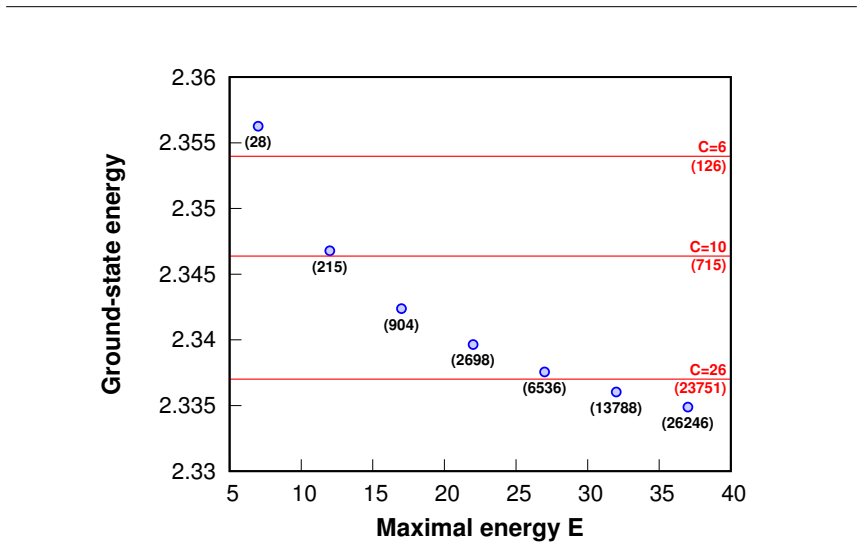
For two bosons in the anharmonic trap of Eq. (5) with a large contact interaction $g$, compare the ground-state energy obtained with the energy-ordered basis and with the single-particle cutoff basis at equal Hilbert-space dimension $D$; if the energy-ordered basis is not more accurate, or is less accurate, the paper's central practical claim fails. Separately, enumerate all occupation vectors with $\sum_k n_k \varepsilon_k \le E$ by brute force for a small hand-computable spectrum and compare with the algorithm's output; any missing state falsifies the claimed completeness.
Extended reading notes
Core claim
For a fixed number $N$ of indistinguishable particles and a sorted single-particle spectrum $\varepsilon_0 \le \varepsilon_1 \le \dots$, the algorithm accepts one number, the maximal energy $E$, and outputs, in lexicographic order, exactly the set of all Fock states with non-interacting energy $\sum_k n_k \varepsilon_k \le E$. The novelty is the enumeration itself: a state is represented as a sorted list of occupied orbital indices, and a short backtracking loop moves from one allowed state to the next by incrementing the rightmost index that can be raised and resetting all following indices to their minimal legal values (equal for bosons, consecutive for fermions). Because the loop walks through the allowed region instead of filtering a large precomputed set, the paper claims the running time is $O(D_E)$. The authors further claim this basis gives immediate index-to-occupation mapping, and they show numerically that exact diagonalization in this basis is substantially more accurate, at equal basis size, than the standard single-particle cutoff construction.
Load-bearing premise
The load-bearing assumption is that ordering Fock states by non-interacting energy is the right truncation for the interacting problem; for strong interactions, the relevant correlations may live in Fock states with higher non-interacting energy, so the claimed accuracy advantage could shrink or reverse.
Editorial extensions
If this is right
- For any single-particle spectrum with known ascending energies, the energy-ordered Fock basis can be built directly, without first generating a larger cutoff Hilbert space and filtering it.
- In the weak-coupling regime tested in the paper, equal-size bases converge faster than cutoff bases, because nearly degenerate low-energy many-body states are included systematically rather than accidentally.
- The same enumeration pattern works for fermions and, by recursive energy budgeting, for multicomponent mixtures with different particle numbers or spectra.
- Lexicographic output order gives a direct map between basis index and occupation vector, simplifying the construction of Hamiltonian matrix elements.
- Only the orbital energies, the particle number, and the desired maximal energy $E$ are needed, so the method transfers to any system with a non-interacting Hamiltonian that is a sum of independent single-particle Hamiltonians.
Reading between the lines
- The paper's accuracy example is weakly interacting; a natural extension is to test the same basis at strong coupling, where bound states built from many high-energy orbitals may make the non-interacting energy ordering a poor guide.
- By starting the enumeration from a shifted configuration rather than the ground state, the same machinery could generate a finite energy window and give a route to excited-state exact diagonalization without building the full low-energy space.
- Because the algorithm's only physical input is the set of single-particle energies, it could be applied to quantum-chemistry active-space construction or lattice-model low-energy sectors, not only to trapped ultracold atoms.
Signed reviews
Editorial analysis
A structured set of objections, weighed in public.
Referee Report
Summary. The manuscript presents an algorithm for generating all N-particle Fock states whose non-interacting energy is no larger than a user-specified maximal energy E, for both bosonic and fermionic statistics, and claims that the states are produced in lexicographic order in O(D_E) time, where D_E is the number of generated states. The algorithm is described through two schematic flowcharts that implement a weighted-combination backtracking enumeration. The authors illustrate the output for N=4 bosons in two single-particle spectra and then demonstrate the method on a system of two interacting ultra-cold bosons in an anharmonic trap, comparing the convergence of the ground-state energy obtained by diagonalization in the energy-ordered basis against the standard single-particle cutoff method.
Significance. If the completeness and complexity claims are correct, the algorithm is a useful and simple tool for exact-diagonalization calculations, potentially reducing the Hilbert-space dimension needed for a given accuracy relative to the standard cutoff approach. The manuscript's strengths are its transparent algorithmic idea, the explicit flowcharts, and the worked examples in Tables 1 and Fig. 3. The claimed benefits are, however, not backed by proofs or by a fully consistent numerical comparison, so the significance is conditional on the repairs described below.
major comments (3)
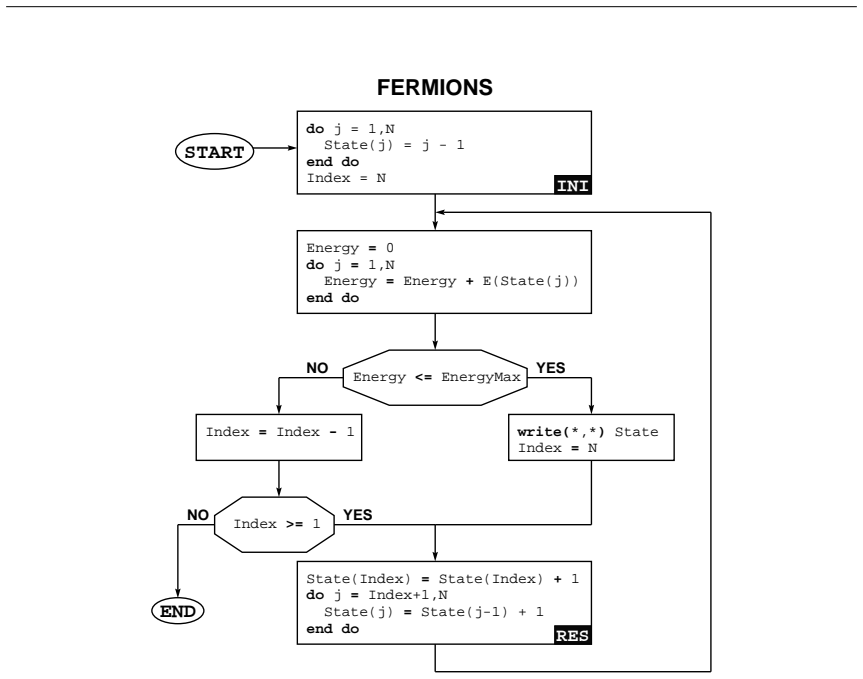
- [Section 2, Figs. 1 and 2] The paper asserts in Section 1 that the algorithm returns 'a complete set of all D_E Fock states' with energy no larger than E, but Section 2 provides only schematic flowcharts and no formal specification, loop invariant, or termination proof. The flowcharts are not sufficient to rule out missing or duplicated states, especially for the fermionic version and for arbitrary single-particle spectra. I recommend adding a rigorous pseudocode listing and an inductive proof that every N-particle Fock state satisfying the energy bound is generated exactly once, using the monotonicity of the single-particle energies and the lexicographic ordering of the first-quantization representation.
- [Section 1 and Section 2] The claim 'Fock states are generated sequentially one-by-one in O(D_E) time' is not derived. The flowchart computes the non-interacting energy as a sum over N terms for every candidate, which costs O(N) per generated state, and the number of rejected candidates that exceed the energy bound is not analyzed. The authors should either state the complexity as O(N D_E) for fixed N or provide an amortized argument bounding the total number of energy tests in terms of D_E.
- [Section 3, Fig. 3] The reported Hilbert-space dimensions for the standard cutoff method are inconsistent with the stated N=2 boson system. For N=2 bosons, the formula in Section 1 gives D_C=(C+N)!/(C!N!), so C=6, 10, and 26 yield D_C=28, 66, and 378, respectively, while the figure and text report values such as 23,751 for C=26. This error invalidates the quantitative comparison and the specific statement that D_E=6,536 outperforms D_C=23,751; the example should be recomputed with the correct cutoff dimensions.
minor comments (5)
- [Abstract and Section 1] There are several typographical errors, including 'build' for 'built' in the abstract, 'dependents' for 'depends' in Section 1, and 'fitting' for 'fitting' in the abstract; these should be corrected.
- [Section 2] The flowcharts are difficult to parse as the sole specification of the algorithm; a compact pseudocode listing in the text would greatly improve reproducibility and clarity.
- [Section 2, multicomponent generalization] The proposed generalization to multicomponent systems is described only in words; a pseudocode sketch or a more detailed explanation would help readers implement it correctly.
- [Section 3] The physical example uses a single parameter set (alpha=0.5, g=0.1) and does not report the exact ground-state energy or a convergence criterion; a brief discussion of how the results depend on the interaction strength would better support the generality of the method.
- [Table 1 caption] The notation |n0 n1 ...> is not explicitly decoded in the caption; a one-sentence reminder that these are the occupation numbers of the single-particle orbitals would help readers.
Circularity Check
No circularity: the algorithm's acceptance test defines the target set, while completeness and the numerical demonstration are independent of the inputs.
full rationale
The paper's central claim is an algorithmic one: given sorted single-particle energies and a maximal energy E, the flowcharts of Section 2 are asserted to output exactly the Fock states with non-interacting energy no larger than E. The energy test 'Energy <= EnergyMax' in the flowcharts is indeed the definition of the accepted set, but the nontrivial content of the claim is that the lexicographic enumeration is complete and duplicate-free; that content is not assumed by the test but is the algorithm's advertised behavior. The Section 3 demonstration computes ground-state energies by exact diagonalization in these bases and compares with standard single-particle cutoff truncation for the Hamiltonian (5) with fixed parameters alpha = 0.5 and g = 0.1. No parameter is fitted to a subset of the presented data and then renamed as a prediction; the variational upper bounds are computed directly from the stated Hamiltonian. The only self-citation is reference [8], which is used to motivate the choice of low non-interacting-energy states, and the paper also supplies its own energetic-hierarchy argument and an independent numerical comparison, so that citation is not load-bearing. The O(D_E) complexity statement is asserted rather than proven, and the flowchart specification is informal, but these are rigor or correctness concerns, not circularity. No step in the derivation reduces to its own input by construction or through a self-citation chain.
Assumptions & free parameters
assumptions (4)
- domain assumption The single-particle spectrum is sorted, discrete, and unbounded above, so only finitely many Fock states have noninteracting energy below any finite E.
- standard math Every Fock state is represented by exactly one sorted N-tuple, and the reset rules in Figs. 1 and 2 enumerate these tuples exactly once.
- domain assumption Truncating to Fock states with the lowest noninteracting energies yields systematic convergence of the interacting ground-state energy.
- standard math For nondecreasing energies, the lexicographically smallest completion of a fixed prefix gives the minimum possible sum over all completions.
Cite this review
Pith. "Pith review of Efficient construction of many-body Fock states having the lowest energies." pith.science (2026). https://pith.science/paper/LNGVKEWY
@misc{pith2026190802084,
  author       = {Pith},
  title        = {Pith review of: Efficient construction of many-body Fock states having the lowest energies},
  year         = {2026},
  howpublished = {\url{https://pith.science/paper/LNGVKEWY}},
  note         = {Machine review of arXiv:1908.02084}
}
read the original abstract
To perform efficient many-body calculations in the framework of the exact diagonalization of the Hamiltonian one needs an appropriately tailored Fock basis built from the single-particle orbitals. The simplest way to compose the basis is to choose a finite set of single-particle wave functions and find all possible distributions of a given number of particles in these states. It is known, however, that this construction leads to very inaccurate results since it does not take into account different many-body states having the same energy on equal footing. Here we present a fast and surprisingly simple algorithm for generating the many-body Fock basis build from many-body Fock states having the lowest non-interacting energies. The algorithm is insensitive to details of the distribution of single-particle energies and it can be used for an arbitrary number of particles obeying bosonic or fermionic statistics. Moreover, it can be easily generalized to a larger number of components. Taking as a simple example the system of two ultra-cold bosons in an anharmonic trap, we show that exact calculations in the basis generated with the algorithm are substantially more accurate than calculations performed within the standard approach.
Figures

Reference graph
Works this paper leans on
-
[8]
Numerically exact approach to few-body problems far from a perturbative regime
M. Płodzie´n, D. Wiater, A.Chrostowski, T. Sowi´nski, arXiv:1803.08387 (2018). URL: https://arxiv.org/abs/1803.08387
work page Pith review arXiv 2018
-
[1]
H. Q. Lin, Phys. Rev. B 42, 6561 (1990). DOI: https://doi.org/10.1103/PhysRevB.42.6561
-
[2]
H. Q. Lin, J. E. Gubernatis, Comput. Phys. 7, 400 (1993). DOI: https://doi.org/10.1063/1.4823192
-
[3]
A. Weisse, F. Fehske, Exact diagonalization techniques. In: Fehske H., Schneider R., Weie A. Computational Many-Particle Physics. Lecture Notes in Physics, vol 739 (Berlin: Springer, 2008). DOI: https://doi.org/10.1007/978-3-540-74686-7_18
-
[4]
J. M. Zhang, R. X. Dong, Eur. J. Phys. 31, 591 (2010). DOI: https://doi.org/10.1088/0143-0807/31/3/016
-
[5]
P Ko ´scik, Phys. Lett. A 382, 2561 (2018). DOI: https://doi.org/10.1016/j.physleta.2018.06.025
-
[6]
T. Haugset, H. Haugerud, Phys. Rev. A 57, 3809 (1998). DOI: https://doi.org/10.1103/PhysRevA.57.3809
-
[7]
F. Deuretzbacher, K. Bongs, K. Sengstock, D. Pfannkuche, Phys. Rev. A 75, 013614 (2007). DOI: https://doi.org/10.1103/PhysRevA.75.013614
Show all 9 references
-
[9]
S ´andor, D
J. S ´andor, D. S. Mitrinovi ´c, B. Crstici, Handbook of Number Theory. Partitions. (Springer Netherlands, Dordrecht, 2006), pp. 491-521. DOI: https://doi.org/10.1007/1-4020-3658-2 8
2006 doi
Reviewed August 14, 2026 · model on record in the stance chip above.
Discussion (0). Continue with ORCID to comment.