REVIEW 3 major objections 4 minor 28 references
Infinitesimal asphericity changes the universality of the jamming transition
T0 review · 3 major / 4 minor · reviewed 2026-08-14 · deepseek-v4-flash
Pith's one-line read Even a tiny asphericity changes the universality class of the jamming transition.
desk verdict A solid extension of the authors' PNAS 2018 result with a clearer variational derivation and good breathing-particle numerics, but the universality claim is overstated: the key sign condition fails for dimers and Platonic solids. read the letter →
The pith
A machine-rendered reading of the paper's core claim, the machinery that carries it, and where it could break.
The reading
What carries the argument
The argument is carried by a variational estimate of the smallest vibrational eigenvalue combined with the assumption of marginal stability. The interaction potential is expanded in a small shape parameter $\Delta$ around a reference sphere; the leading asphericity introduces a term $Q_N \sim p\Delta$ that stabilizes the rotational zero modes, with stiffness $k_R \sim p\Delta$. Applying the variational argument of spherical jamming to these zero modes gives $\lambda_{\min} \sim p(c_1 \Delta \delta z^2 + c_2 \Delta^2)$, where the first term is the stabilizing pre-stress and the second (negative, $c_2<0$) is the destabilizing buckling contribution. Requiring $\lambda_{\min} \sim 0$ (marginal stability) balances the two terms and yields $\delta z \sim \Delta^{1/2}$. This single relation then controls the contact number, the shear modulus via $G \sim p\delta z/\Delta$, and the truncation scales of the gap and force distributions through finite-size scaling with $\delta z$ in place of $1/N$.
What would settle it
Numerically simulate slightly aspherical ellipsoids at fixed small $\Delta$ and measure the shear modulus as a function of pressure down to $p$ much smaller than $\Delta$: the predicted linear regime $G \sim p$ must appear, with crossover to $G \sim p^{1/2}$ near $p \sim \Delta$. If the square-root law persists all the way to $p=0$ at fixed $\Delta>0$, the central scaling claim is wrong. Equivalently, the excess contact number at jamming should scale as $(A-1)^{1/4}$; a different exponent would falsify Eq. (21).
Extended reading notes
Core claim
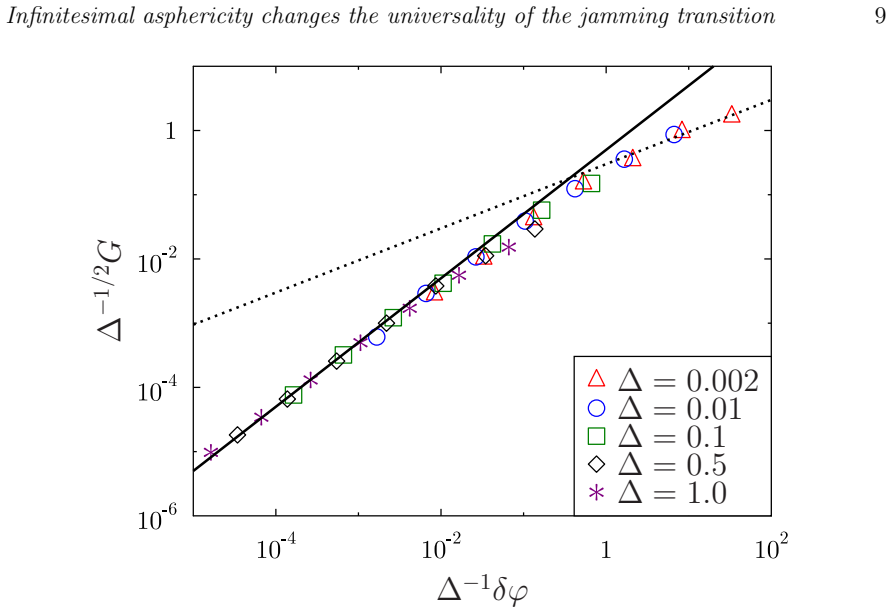
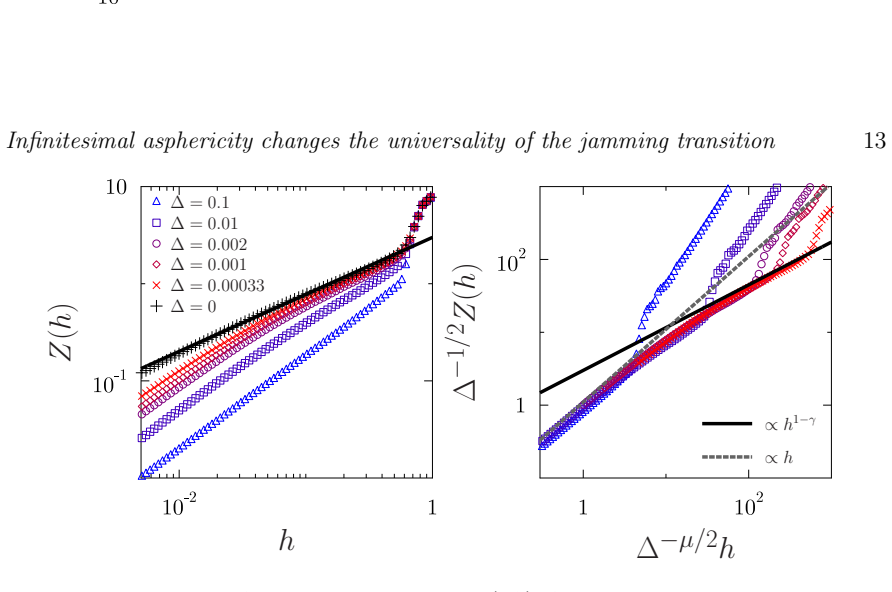
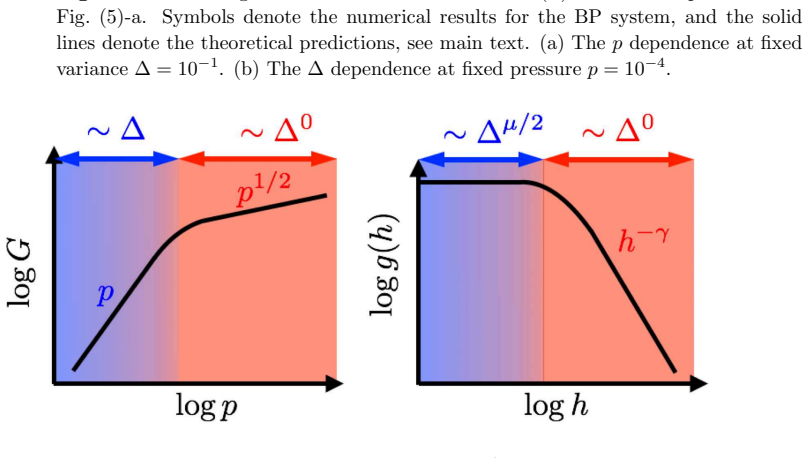
The paper's central claim is that the jamming transition of non-spherical particles belongs to a universality class distinct from that of spherical particles, and that the distinction survives in the limit of infinitesimal asphericity. Concretely, for any fixed $\Delta > 0$, sufficiently near the transition ($p \ll \Delta$) the shear modulus behaves as $G \sim p/\Delta^{1/2}$, linear in pressure, whereas for spheres $G \sim p^{1/2}$; the crossover between the two regimes occurs at $p \sim \Delta$. The excess contact number at the jamming point scales as $\delta z \sim \Delta^{1/2} \sim (A-1)^{1/4}$, and above jamming $z-z_J \sim p/\Delta^{1/2}$. The gap distribution $g(h)$ and force distribution $P(f)$, which for spheres diverge as power laws at the transition, remain finite and analytic for $\Delta > 0$, with the singularities truncated at $h \sim \Delta^{\mu/2}$ and $f \sim \Delta^{\nu}$. The density of states splits into three bands with characteristic frequencies $\omega_0 \sim \Delta^{1/2} p^{1/2}$, $\omega_1 \sim \Delta$, and $\omega_2 \sim \Delta^{1/2}$. The same exponents are found for breathing particles, and the paper presents numerical data supporting the predictions.
Load-bearing premise
The argument assumes that the first-order effect of asphericity stabilizes the rotational zero modes; for shapes where that stabilization is absent or negative—the paper names dimers and Platonic solids—the predicted exponents do not follow.
Editorial extensions
If this is right
- For any nonzero asphericity, the shear modulus of a jammed packing is linear in pressure in the asymptotic unjamming limit, changing the low-frequency mechanics from the spherical square-root form.
- The gap and force distributions are regular functions at the jamming point for aspherical particles, so the power-law singularities characteristic of isostatic jamming disappear for any $\Delta>0$.
- The density of states contains three distinct bands with characteristic frequencies $\omega_0 \sim \Delta^{1/2}p^{1/2}$, $\omega_1 \sim \Delta$, and $\omega_2 \sim \Delta^{1/2}$, rather than the single soft mode scale of spheres.
- Breathing particles reproduce the same critical exponents, giving a rotationally symmetric model in which the predictions can be tested efficiently.
- The contact number at jamming increases with asphericity as $z_J = 2d + O(\Delta^{1/2})$, and above jamming $z-z_J$ grows linearly in $p/\Delta^{1/2}$.
Reading between the lines
- If the claim holds, any experimental granular material composed of slightly elongated grains should show a linear pressure dependence of the shear modulus in the deeply unjammed regime; this could be checked with photoelastic disks or 3D ellipsoidal particles.
- The sign of the first-order stabilizing coefficient becomes a shape classifier: shapes with positive sign should follow the new universality class, while shapes where it is zero or negative (dimers, Platonic solids) remain isostatic—so the universality class may be selected by the geometry of the rotational modes.
- The same marginal-stability balance might extend to other internal degrees of freedom, such as particle deformability or internal orientational fields, whenever the first-order stabilizing term is positive.
- Because the gap distribution is regularized, force-network criticality and associated avalanches near jamming may be suppressed at scales below $\Delta$, a testable prediction for mesoscopic simulations.
Signed reviews
Editorial analysis
A structured set of objections, weighed in public.
Referee Report
Summary. The paper studies the jamming transition of non-spherical particles and argues that even infinitesimal asphericity changes the universality class relative to spherical particles. Using a variational argument combined with marginal stability, the authors derive scaling laws for the excess contact number δz ∼ Δ^{1/2}, the shear modulus G ∼ p/Δ^{1/2} for p ≪ Δ, the truncation of gap and force distributions, and the characteristic frequencies of the density of states. They support these predictions with numerical simulations of the breathing-particle model and by comparisons with literature data for ellipsoids and other shapes. The paper is presented as a longer, more direct version of the authors' earlier PNAS work, with additional numerical data.
Significance. The central claim, if established, is significant: it would imply that the jamming universality class is discontinuous at the spherical limit, and it unifies non-spherical particles with breathing particles into a single class with hypostatic jamming. The paper's strengths are that the exponents are derived rather than fitted to the new data, that the numerical collapses in Figs. 2, 4, 5, and 6 are convincing, and that the predictions are checked against external data in Refs. [7, 15, 16]. However, the derivation of the key scaling δz ∼ Δ^{1/2} relies on a sign assumption about the pre-stress coefficients that the authors themselves state fails for dimers and Platonic solids; the scope of the universality claim therefore needs to be narrowed or supported by additional argument.
major comments (3)
- [Sec. 6, Eq. (20)] The step from Eq. (20) to Eq. (21) requires c1 > 0 and c2 < 0. The paper explicitly states in Sec. 6 that the assumption c1 > 0 is violated for non-spherical particles made of spherical particles such as dimers, and that Platonic solids are isostatic at jamming. Since the abstract and the opening of Sec. 6 present the universality change for non-spherical particles without this restriction, the strongest form of the claim is not supported by the derivation. Please restrict the claim to shapes satisfying the sign assumption, or provide a criterion for determining the sign of c1 and ideally a numerical check of the balance in Eq. (20).
- [Fig. 1] The text says Fig. 1 compares Eq. (21) with numerical results for 'various shapes of non-spherical particles' from Ref. [15]. It is not stated which shapes are actually included. If dimers or Platonic solids are among them, this would be in tension with the Sec. 6 caveat and needs discussion; if they are excluded, the figure caption should say so explicitly.
- [Eqs. (6)-(7)] The expression for g_i(ui) in Eq. (7) appears to contain both f(r_ij, ui) and f(-r_ij, ui), whereas the first-order gap correction in Eq. (3) involves f(r_ij, ui) + f(-r_ij, uj). Summing Eq. (7) over i does not reproduce the first-order expansion of the potential derived from Eq. (3) unless a factor of 1/2 or a reindexing is intended. Please correct or clarify this step, since QN and its stiffness kR are the basis of Eq. (19).
minor comments (4)
- [Abstract] In the abstract, 'a sphericity' should be 'asphericity'.
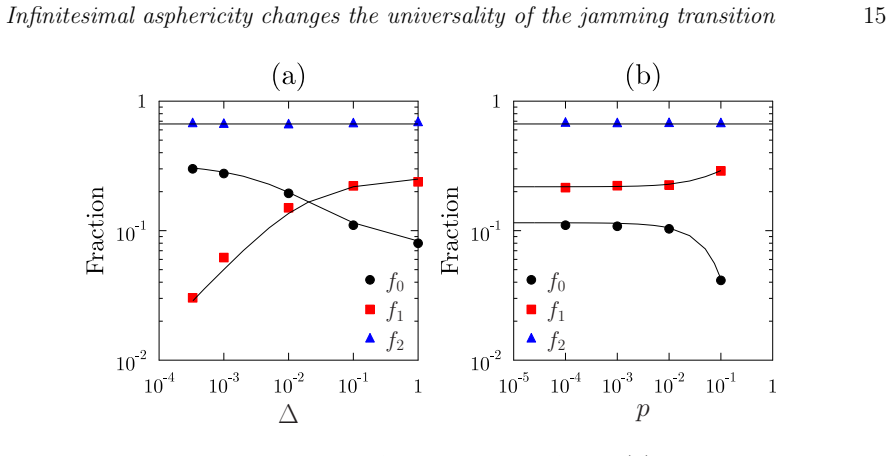
- [Sec. 5, Eq. (52)] Please clarify the p- and Δ-dependence of the characteristic frequencies: Fig. 5(b) is at fixed p, giving ω0 ∼ Δ^{1/2}, while Fig. 5(c) is at fixed Δ, giving ω0 ∼ p^{1/2}; the text currently mixes these two dependencies without distinguishing the fixed variable.
- [Fig. 4 caption] The caption says the data are for 'non-spherical particles', but the text explains that the simulations are of the breathing-particle model; this should be reflected in the caption for clarity.
- [Sec. 2.4, Eq. (18)] The statement that N_c^Q - N0 = N δz/2 > 0 'indeed suffices to stabilize the zero modes' is not immediate, because extra constraints stabilize the modes only if they are independent; a brief justification of the independence assumption would help.
Circularity Check
No significant circularity: the claimed scaling exponents are derived from a variational marginal-stability argument and checked against external and new simulations, not obtained by fitting or by definition.
full rationale
The derivation chain is self-contained in the relevant sense. Eq. (21), δz ∼ Δ^{1/2}, follows from balancing the first- and second-order asphericity terms in the marginal-stability condition Eq. (20), λ_min ∼ p[c1Δδz² + c2Δ²]; c1 > 0 and c2 < 0 are explicit assumptions with stated (and partly self-cited) justifications, not fit parameters, and the paper openly notes shapes where the sign assumption fails (dimers, Platonic solids). The subsequent predictions for the shear modulus (Eq. 27), gap distribution (Eqs. 48–49), and density-of-states frequencies (Sec. 5) are derived from this scaling and then compared with data from external references (Refs. 7, 15) and with new BP simulations in collapse plots (Figs. 1, 2, 4, 5, 6). No 'prediction' is equivalent by construction to an input; no fitted parameter is relabeled as a prediction. The reliance on the authors' prior works [5, 9, 10, 11] is real, but the central claim has independent content: the direct variational derivation and the external benchmarks would stand or fall on their own. The acknowledged c1 > 0 limitation is a correctness/scope concern, not circularity.
Assumptions & free parameters
assumptions (7)
- domain assumption Marginal stability persists above jamming, λ_min ~ 0 or at most ~ p.
- ad hoc to paper The first-order pre-stress term stabilizes (c1 > 0) and the second-order term destabilizes (c2 < 0).
- domain assumption Each particle pair contributes at most one contact.
- domain assumption The variational estimate λ_min ~ k δz² for near-isostatic systems holds (Ref [12]).
- domain assumption The gap and radius can be expanded to first order in the asphericity parameter Δ, Eqs. (2)-(3).
- domain assumption The scaling functions Z(x) and G(x) are regular and interpolate to the spherical limit.
- domain assumption Shear deformation excites only the soft zero modes.
Cite this review
Pith. "Pith review of Infinitesimal asphericity changes the universality of the jamming transition." pith.science (2026). https://pith.science/paper/FKYYSTWH
@misc{pith2026190802091,
  author       = {Pith},
  title        = {Pith review of: Infinitesimal asphericity changes the universality of the jamming transition},
  year         = {2026},
  howpublished = {\url{https://pith.science/paper/FKYYSTWH}},
  note         = {Machine review of arXiv:1908.02091}
}
read the original abstract
The jamming transition of non-spherical particles is fundamentally different from the spherical case. Non-spherical particles are hypostatic at their jamming points, while isostaticity is ensured in the case of the jamming of spherical particles. This structural difference implies that the presence of asphericity affects the critical exponents related to the contact number and the vibrational density of states. Moreover, while the force and gap distributions of isostatic jamming present power-law behaviors, even an infinitesimal asphericity is enough to smooth out these singularities. In a recent work [PNAS 115(46), 11736], we have used a combination of marginal stability arguments and the replica method to explain these observations. We argued that systems with internal degrees of freedom, like the rotations in ellipsoids, or the variation of the radii in the case of the \textit{breathing} particles fall in the same universality class. In this paper, we review comprehensively the results about the jamming with internal degrees of freedom in addition to the translational degrees of freedom. We use a variational argument to derive the critical exponents of the contact number, shear modulus, and the characteristic frequencies of the density of states. Moreover, we present additional numerical data supporting the theoretical results, which were not shown in the previous work.
Figures


Figures from the paper (4 more)

Reference graph
Works this paper leans on
-
[15]
VanderWerf K, Jin W, Shattuck M D and O’Hern C S 2018 Phys. Rev. E 97(1) 012909 URL https://link.aps.org/doi/10.1103/PhysRevE.97.012909
-
[1]
Van Hecke M 2009 Journal of Physics: Condensed Matter 22 033101
work page 2009
-
[2]
Torquato S and Stillinger F H 2010 Rev. Mod. Phys. 82(3) 2633–2672 URL https://link.aps.org/doi/10.1103/RevModPhys.82.2633
-
[3]
Donev A, Cisse I, Sachs D, Variano E A, Stillinger F H, Connelly R, Tor quato S and Chaikin P M 2004 Science 303 990–993
work page 2004
-
[4]
Bernal J and Mason J 1960 Nature 188 910 Infinitesimal asphericity changes the universality of the j amming transition 17
work page 1960
-
[5]
Brito C, Ikeda H, Urbani P, Wyart M and Zamponi F 2018 Proceedings of the National Academy of Sciences 115 11736–11741
work page 2018
-
[6]
Donev A, Torquato S and Stillinger F H 2005 Phys. Rev. E 71(1) 011105 URL https://link.aps.org/doi/10.1103/PhysRevE.71.011105
-
[7]
Mailman M, Schreck C F, O’Hern C S and Chakraborty B 2009 Phys. Rev. Lett. 102(25) 255501 URL https://link.aps.org/doi/10.1103/PhysRevLett.102.255501
Show all 28 references
-
[8]
Schreck C F, Mailman M, Chakraborty B and O’Hern C S 2012 Phys. Rev. E 85(6) 061305 URL https://link.aps.org/doi/10.1103/PhysRevE.85.061305
2012 doi
-
[9]
Ikeda H, Urbani P and Zamponi F 2019 Journal of Physics A: Mathematical and Theoretical 52 344001
2019
-
[10]
Brito C, Lerner E and Wyart M 2018 Phys. Rev. X 8(3) 031050 URL https://link.aps.org/doi/10.1103/PhysRevX.8.031050
2018 doi
-
[11]
Wyart M, Silbert L E, Nagel S R and Witten T A 2005 Phys. Rev. E 72(5) 051306 URL https://link.aps.org/doi/10.1103/PhysRevE.72.051306
2005 doi
-
[12]
Yan L, DeGiuli E and Wyart M 2016 EPL (Europhysics Letters) 114 26003
2016
-
[13]
Alexander S 1998 Physics reports 296 65–236
1998
-
[14]
O’Hern C S, Silbert L E, Liu A J and Nagel S R 2003 Phys. Rev. E 68(1) 011306 URL https://link.aps.org/doi/10.1103/PhysRevE.68.011306
2003 doi
-
[16]
Schreck C F, Xu N and O’Hern C S 2010 Soft Matter 6 2960–2969
2010
-
[17]
Wyart M 2005 arXiv preprint cond-mat/0512155
2005 arXiv
-
[18]
Charbonneau P, Corwin E I, Parisi G and Zamponi F 2012 Phys. Rev. Lett. 109(20) 205501 URL https://link.aps.org/doi/10.1103/PhysRevLett.109.205501
2012 doi
-
[19]
Charbonneau P, Kurchan J, Parisi G, Urbani P and Zamponi F 2 014 Nat. Commun. 5 3725
-
[20]
Charbonneau P, Corwin E I, Parisi G and Zamponi F 2015 Phys. Rev. Lett. 114(12) 125504 URL https://link.aps.org/doi/10.1103/PhysRevLett.114.125504
2015 doi
-
[21]
Kallus Y 2016 Phys. Rev. E 93(1) 012902 URL https://link.aps.org/doi/10.1103/PhysRevE.93.012902
2016 doi
-
[22]
Goodrich C P, Liu A J and Nagel S R 2012 Phys. Rev. Lett. 109(9) 095704 URL https://link.aps.org/doi/10.1103/PhysRevLett.109.095704
2012 doi
-
[23]
Goodrich C P, Liu A J and Sethna J P 2016 Proceedings of the National Academy of Sciences 113 9745–9750
2016
-
[24]
2(3) 019 URL https://scipost.org/10.21468/SciPostPhys.2.3.019
Franz S, Parisi G, Sevelev M, Urbani P and Zamponi F 2017 SciPost Phys. 2(3) 019 URL https://scipost.org/10.21468/SciPostPhys.2.3.019
2017 doi
-
[25]
Kittel C, McEuen P and McEuen P 1996 Introduction to solid state physics vol 8 (Wiley New York)
1996
-
[26]
Lerner E, D¨ uring G and Wyart M 2012 Proceedings of the National Academy of Sciences 109 4798–4803
2012
-
[27]
Papanikolaou S, O’Hern C S and Shattuck M D 2013 Phys. Rev. Lett. 110(19) 198002 URL https://link.aps.org/doi/10.1103/PhysRevLett.110.198002
2013 doi
-
[28]
Smith K C, Fisher T S and Alam M 2011 Phys. Rev. E 84(3) 030301 URL https://link.aps.org/doi/10.1103/PhysRevE.84.030301
2011 doi
Reviewed August 14, 2026 · model on record in the stance chip above.
Discussion (0). Continue with ORCID to comment.