REVIEW 2 major objections 6 minor 1 cited by
Uranus and Neptune are key to understand planets with hydrogen atmospheres
T0 review · 2 major / 6 minor · reviewed 2026-08-14 · deepseek-v4-flash
Pith's one-line read The methane clouds of Uranus and Neptune unlock all giant planets
desk verdict A clearly written mission white paper with a useful quantitative table, but its central analogy between methane and water condensation is undercut by the inhibition parameter it introduces. read the letter →
The pith
A machine-rendered reading of the paper's core claim, the machinery that carries it, and where it could break.
The reading
What carries the argument
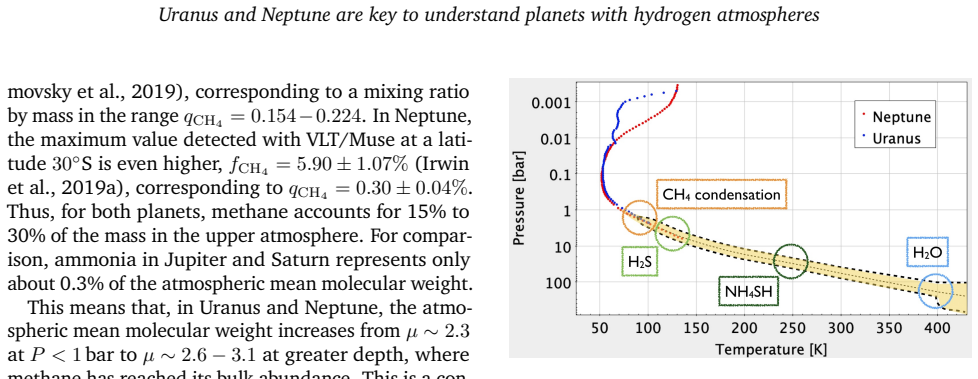
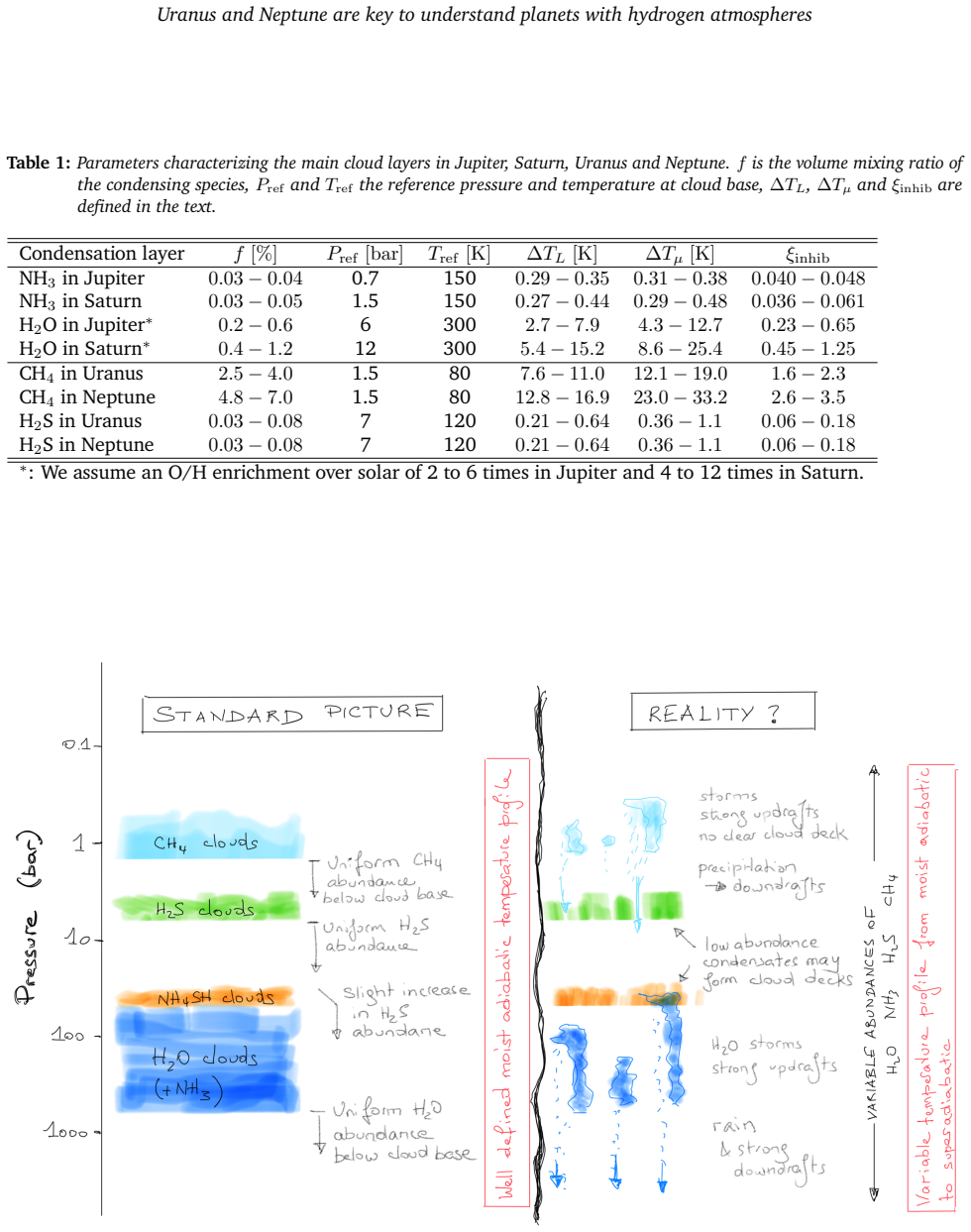
The central object is the methane condensation layer of Uranus and Neptune, treated as an accessible stand-in for the water condensation layer of Jupiter and Saturn. The argument is carried by three parameters: the latent-heat temperature change ΔT_L ≡ q_v L_v / c_p, the mean-molecular-weight compensation ΔT_μ ≡ [−ln(1−ϖ q_v)]T, and the moist-convection inhibition factor ξ_inhib ≡ ϖ M_v L_v / (R T) q_v, where moisture-driven convection is suppressed when ξ_inhib > 1. For methane in Uranus and Neptune these parameters are large (ΔT_L of order 8–17 K, ΔT_μ of order 12–33 K, ξ_inhib of order 1.6–3.5), whereas ammonia layers in Jupiter and Saturn have values of only a fraction of a kelvin and ξ_inhib well below 1. The layer therefore sits in the regime where condensation is expected to dominate dynamics, and observing it should decide between the uniform cloud-deck picture and the intermittent-storm picture of hydrogen-rich atmospheres.
What would settle it
An entry probe descending at a quiescent location that measures a nearly moist-adiabatic temperature profile with no super-adiabatic layer, a methane abundance that simply follows saturation, and no sign of dry subsiding regions would contradict the prediction of inhibited convection and intermittent storm organization. Alternatively, a high-resolution map of the 1–5 bar region showing a uniform, well-defined methane cloud deck with little horizontal temperature variation would falsify the claim that abundant heavier-than-air condensates dominate the dynamics.
Extended reading notes
Core claim
The paper's central claim is that the methane condensation region of Uranus and Neptune, observable near 1.5 bar where the atmosphere is still relatively transparent, is a direct experimental analogue for the hidden water condensation region of Jupiter and Saturn. Because methane is abundant and condenses at low optical depth, temperature and composition can be mapped as functions of position and depth. Comparing these maps with the parameters ΔT_L, ΔT_μ, and ξ_inhib should show whether condensation organizes into well-defined cloud decks or into intermittent storms with strong updrafts and dry subsiding regions. If the analogy holds, the result is a template for the dynamics, thermal structure, and interior boundary conditions of all planets with hydrogen atmospheres, including Jupiter, Saturn, super-Earths, and forming embryos. The paper also argues that a probe is required because radio occultations measure refractivity, which depends on both temperature and mean molecular weight, so a direct in-situ profile is the only way to break that degeneracy.
Load-bearing premise
The argument depends on the methane condensation layer of Uranus and Neptune being a valid stand-in for the water condensation layer of Jupiter and Saturn, so that what is learned about the shallow, visible methane layer can be transferred to the deep, hidden water layer despite differences in abundance, temperature, and cloud-base depth.
Editorial extensions
If this is right
- An orbiter with a microwave spectrometer and imaging spectrograph, plus one or more probes, would directly map the temperature and methane fields in the 1–5 bar region and test whether the methane layer produces well-defined cloud decks or intermittent storms.
- A direct in-situ temperature profile would break the refractivity degeneracy that currently leaves the temperature-pressure profiles of Uranus and Neptune uncertain, anchoring all remote observations of these planets.
- Noble gas and isotopic measurements from a probe would test specific formation scenarios, such as photoevaporation or clathrate formation, by comparing enrichments with the Galileo results at Jupiter.
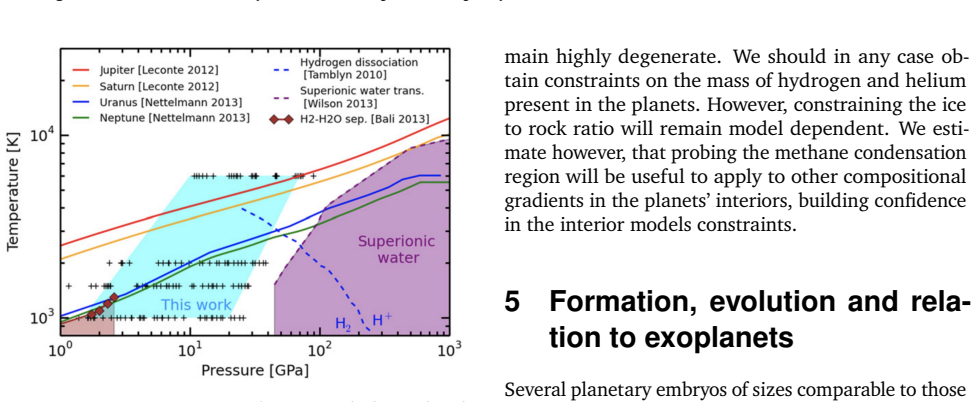
- High-precision gravity and magnetic field mapping from a polar orbiter would constrain the depth of zonal flows and the interior structure, yielding new limits on hydrogen and helium content and on the ice-to-rock ratio.
- If the analogy holds, the same condensation-convection framework would apply to exoplanets with hydrogen atmospheres, whose unresolved spectra must be interpreted with the physics learned at Uranus and Neptune.
Reading between the lines
- A natural extension of the paper's analogy would be to compare Neptune's storm statistics with Jupiter's water-storm statistics (from Juno and Earth-based monitoring) after normalizing by the three parameters, testing whether the same dimensionless relations hold across the two condensation layers.
- The same three-parameter characterization could be applied to other condensable species (H2S, NH4SH, silicates) and to exoplanet atmospheres with different metallicities, turning the paper's Table 1 into a predictive taxonomy of which species drive storms on any hydrogen-rich planet.
- If the methane layer on Uranus is confirmed to be strongly convection-inhibited and super-adiabatic, that would provide a natural explanation for Uranus's very low intrinsic heat flux and would imply that similar inhibition can slow the cooling of young hydrogen-rich exoplanets, affecting their inferred ages and radii.
Signed reviews
Editorial analysis
A structured set of objections, weighed in public.
Referee Report
Summary. This white paper, prepared for ESA's Voyage 2050 process, advocates an orbiter-plus-probe mission to Uranus and/or Neptune. Its central scientific argument is that the methane condensation region near 1.5 bar in these planets is uniquely observable (low optical depth, high methane abundance) and that mapping temperature and methane abundance there will reveal how convection organizes in hydrogen atmospheres with no surface and with condensates heavier than the surrounding air. The paper reviews lessons from Galileo, Juno, and Cassini, defines three parameters (ΔT_L, ΔT_μ, ξ_inhib) to characterize condensation-layer dynamics, and argues that the CH4 layer resembles the hidden H2O layers of Jupiter and Saturn. It further argues for interior constraints from gravity, magnetic field, and possible seismology measurements, and for formation constraints from noble-gas and isotope measurements, connecting all of these to exoplanet science.
Significance. If the central argument holds, the paper makes a strong, well-grounded case that a Uranus/Neptune mission would resolve long-standing degeneracies (temperature versus mean molecular weight in occultation profiles; interior ice-to-rock ratios) and provide a template for hydrogen-atmosphere dynamics with return value for Jupiter, Saturn, and exoplanets. The paper's strengths include its careful use of Juno, Cassini, and Galileo results; explicit acknowledgment of the refractivity degeneracy (Section 3) and of interior-model degeneracies (Section 4.5); quantitative framing via Eqs. (1)-(3) with the one significant assumption (O/H enrichment for the Jovian/Saturnian water layers) stated in Table 1; and falsifiable mission objectives, most notably discriminating between the cloud-structure scenarios of Fig. 3. The main fragility is the CH4-to-H2O transferability analogy, which is where the major comments below concentrate.
major comments (2)
- [Sec. 3, Table 1] The paper's central transferability argument is internally inconsistent. Eq. (3) defines ξ_inhib and the text states 'Moist convection is inhibited whenever ξ_inhib > 1'; the paragraph before Table 1 adds that in both Uranus and Neptune methane 'exceeds the critical value over which moist convection is inhibited' and that this inhibition extends to double-diffusive convection. Yet the paragraph after Table 1 groups CH4 in Uranus/Neptune with H2O in Jupiter/Saturn as both being 'characterized by large values ΔT_L and ΔT_μ... favorable to the development of large storms.' Table 1 itself gives ξ_inhib = 1.6–3.5 for CH4 in Uranus/Neptune versus 0.23–0.65 (H2O in Jupiter) and 0.45–1.25 (H2O in Saturn), i.e., the two layers lie on opposite sides of the inhibition threshold. The statement that 'The similarities between H2O in Jupiter and Saturn and CH4 in Uranus and Neptune seen in Table 1 implies that much is to be gained' is therefore not supported by the table as a whole: according to the paper's own criterion, the CH4 layer is predicted to be in the inhibited/double-diffusive regime, not in the active moist-convection regime that powers Jovian water storms. Please reconcile this, either by providing a mechanism for large storms despite ξ_inhib > 1 (for example finite-amplitude triggering or episodic release of a stored super-adiabatic gradient), or by reframing the transferability claim so that the CH4 layer is presented as a probe of the inhibited/double-diffusive regime, which would still be relevant to hydrogen atmospheres but in a manner distinct from what is currently claimed.
- [Sec. 3, Fig. 3] Figure 3 frames the mission's central question as a choice between a standard moist-adiabatic cloud-deck picture and a storm-dominated picture, and the text says probing the methane layer 'would give us the ability to decide between the different possibilities of Fig. 3.' However, the third possibility explicitly raised in the text — a highly super-adiabatic temperature gradient resulting from inhibition of both moist and double-diffusive convection (Guillot 1995; Leconte et al. 2017; Friedson and Gonzales 2017) — is not included as a distinct scenario in Fig. 3. Since the paper's own criterion (ξ_inhib > 1 for CH4) makes an inhibited, super-adiabatic structure the expected regime, omitting it from the decision tree leaves the mission's central discriminating objective incompletely specified. Fig. 3, or the accompanying text, should add this as a third possible atmospheric structure and state the observable signatures (for example a super-adiabatic lapse rate, layered convection, reduced cloud condensation) that would distinguish it from the two current panels.
minor comments (6)
- [Sec. 3, p. 3] The mass mixing ratios for methane are quoted inconsistently: 'qCH4 = 0.154−0.224' for Uranus (a dimensionless fraction) but 'qCH4 = 0.30± 0.04%' for Neptune (a percentage). Please use a single convention (0.30 ± 0.04 or 30 ± 4%).
- [Sec. 2] The citation 'Guillot et al., submitted' for the mushball mechanism should be replaced with a published reference or a preprint identifier, since this mechanism is important for interpreting the Juno ammonia results.
- [Sec. 4.2] The sentence 'It may be not as well known that the rotation period of the deep interior in giant planets is not well known' is awkwardly phrased; please reword.
- [Sec. 3, Eq. (2)] The notation ΔTμ ≡ [−ln(1−ϖqv)]T is unconventional; writing ΔTμ = −T ln(1−ϖqv) would be clearer.
- [Sec. 1] The sentence about low-orbit satellite constellations threatening the night sky is unrelated to the scientific argument and should be removed or shortened.
- [Table 1] Adding a horizontal rule or shading at the ξ_inhib = 1 threshold would make the inhibition boundary immediately visible and would support the surrounding discussion.
Circularity Check
No circular derivation: the white paper's analogy and mission rationale are not manufactured from fitted inputs or self-citation; the ξ_inhib tension is a scientific-merit issue, not circularity.
full rationale
This is a mission-advocacy white paper rather than a quantitative derivation, so the standard circularity patterns do not apply. The central claim—that mapping temperature and methane abundance in the 1–5 bar region of Uranus and Neptune will illuminate convection in hydrogen atmospheres—is an analogy argued from Table 1, whose entries come from observed abundances, thermodynamic constants, and previously published formulas (Eqs. 1–3). The paper does not fit any parameter to a subset of data and then present a closely related quantity as a prediction. Author self-citations (Guillot 1995 for ξ_inhib; Guillot et al., submitted for the mushball mechanism; Guillot 2005 and Helled & Guillot 2018 for interior-model caveats) are real prior work with stated assumptions and are not invoked as an unverified uniqueness theorem that forces the conclusion. The paper itself flags an internal tension: it states that methane abundance 'exceeds the critical value over which moist convection is inhibited,' so the CH4 layer may not be a direct proxy for Jovian water-driven moist convection. That is a challenge to the scientific merits of the analogy, not evidence that the reasoning is circular. The only self-referential elements are minor and non-load-bearing.
Assumptions & free parameters
free parameters (1)
- Assumed O/H enrichment over solar for Jupiter and Saturn water layers =
2 to 6 times solar for Jupiter; 4 to 12 times solar for Saturn
assumptions (4)
- domain assumption Condensates heavier than the surrounding atmosphere create a stabilizing mean molecular weight gradient and can inhibit moist convection when xi_inhib is greater than 1.
- domain assumption The methane condensation layer in Uranus and Neptune is dynamically analogous to the water condensation layer in Jupiter and Saturn.
- domain assumption New remote and in situ measurements can resolve the degeneracy in the Voyager radio occultation profiles of Uranus and Neptune.
- standard math Interior models that assume one-dimensional, usually adiabatic, structures are limited by unknown atmospheric boundary conditions.
Cite this review
Pith. "Pith review of Uranus and Neptune are key to understand planets with hydrogen atmospheres." pith.science (2026). https://pith.science/paper/LVAKTKQG
@misc{pith2026190802092,
  author       = {Pith},
  title        = {Pith review of: Uranus and Neptune are key to understand planets with hydrogen atmospheres},
  year         = {2026},
  howpublished = {\url{https://pith.science/paper/LVAKTKQG}},
  note         = {Machine review of arXiv:1908.02092}
}
read the original abstract
Uranus and Neptune are the last unexplored planets of the Solar System. I show that they hold crucial keys to understand the atmospheric dynamics and structure of planets with hydrogen atmospheres. Their atmospheres are active and storms are believed to be fueled by methane condensation which is both extremely abundant and occurs at low optical depth. This means that mapping temperature and methane abundance as a function of position and depth will inform us on how convection organizes in an atmosphere with no surface and condensates that are heavier than the surrounding air, a general feature of gas giants. Using this information will be essential to constrain the interior structure of Uranus and Neptune themselves, but also of Jupiter, Saturn and numerous exoplanets with hydrogen atmospheres. Owing to the spatial and temporal variability of these atmospheres, an orbiter is required. A probe would provide a reference profile to lift ambiguities inherent to remote observations. It would also measure abundances of noble gases which can be used to reconstruct the history of planet formation in the Solar System. Finally, mapping the planets' gravity and magnetic fields will be essential to constrain their global composition, structure and evolution.
Figures

Figures from the paper (4 more)


Forward citations
Cited by 1 Pith paper
-
The atmospheric vertical structure of Uranus and Neptune from thermochemical models: the impact of model assumptions
Varying assumed metallicity, C/O, S/N, and 1-bar temperature in thermochemical equilibrium models changes predicted mixing ratios and cloud decks of Uranus and Neptune by more than an order of magnitude, and thermal p...
Reference graph
Works this paper leans on
-
[151]
Thealbedo,effec- tive temperature, and energy balance of Neptune, as determined from Voyager data
eprint:1207.2309 (astro-ph.EP). Pearl,J.C.andB.J.Conrath(1991).“Thealbedo,effec- tive temperature, and energy balance of Neptune, as determined from Voyager data”. In: J. Geophys. Res. 96, p. 18. Podolak, M., W. B. Hubbard, and D. J. Stevenson (1991). “Model of Uranus’ interior and magnetic field”.In:Uranus.Ed.byJ.T.Bergstralh,E.D.Miner, and M. S. Matthews,...
arXiv 1991
-
[530]
The Interiors of Giant Planets: Models and Outstanding Questions
eprint:astro-ph/0502068. Guillot, T. and D. Gautier (2014). “Giant Planets”. In: arXiv e-prints. eprint:1405.3752 (astro-ph.EP). Guillot, T. and R. Hueso (2006). “The composition of Jupiter: sign of a (relatively) late formation in a chemically evolved protosolar disc”. In: MNRAS 367, pp. L47–L51. eprint:astro-ph/0601043. Guillot, T. et al. (2018). “A sup...
work page Pith review arXiv 2014
-
[624]
Saturn's deep atmospheric flows revealed by the Cassini Grand Finale gravity measurements
eprint:1902.04268 (astro-ph.EP). Gaulme, P. et al. (2011). “Detection of Jovian seismic waves:anewprobeofitsinteriorstructure”.In:A&A 531, A104, A104. eprint:1106.3714 (astro-ph.EP). Gierasch, P. J. and B. J. Conrath (1987). “Vertical tem- perature gradients on Uranus - Implications for lay- eredconvection”.In:J.Geophys.Res.92,pp.15019– 15029. Gierasch, P...
work page Pith review arXiv 2011
Reviewed August 14, 2026 · model on record in the stance chip above.
Discussion (0). Continue with ORCID to comment.