REVIEW 3 major objections 6 minor 29 references
AttentionBoost: Learning What to Attend by Boosting Fully Convolutional Networks
T0 review · 3 major / 6 minor · reviewed 2026-08-14 · deepseek-v4-flash
Pith's one-line read AttentionBoost claims that per-pixel adaptive boosting across four stages improves gland segmentation without predefined attention.
desk verdict Genuinely novel per-pixel boosting loss for dense prediction, but the key ablation is confounded with output averaging and postprocessing, so the main claim isn't yet proven. read the letter →
The pith
A machine-rendered reading of the paper's core claim, the machinery that carries it, and where it could break.
The reading
What carries the argument
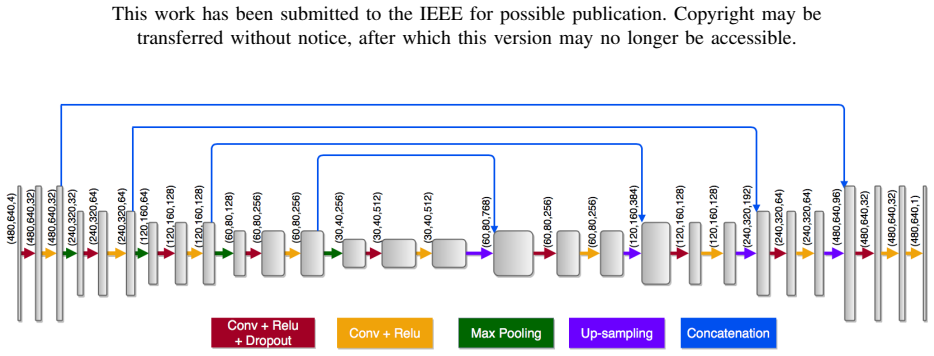
The central mechanism is the iterative loss-contribution update of Eqns. (2)-(3). At each stage, the network's per-pixel confidence $|\hat{y}_n(p)-0.5|$ is combined with whether the prediction is correct to form a multiplier $\beta_n(p)$ between 0.5 and 1.5; multiplying the current contribution $C_n(p)$ by this multiplier shifts attention away from pixels the current stage already handles well and toward pixels it gets wrong. The multi-stage architecture makes this usable by feeding the previous stage's probability map into the next stage as an extra input, so later stages can build on earlier corrections. The paper also normalizes contributions over correctly and incorrectly predicted pixels within each image separately, and averages all stage maps at test time.
What would settle it
Run the MultiStageWithoutAdaptiveBoosting baseline exactly as described, but average the probability maps of all four stages before postprocessing instead of taking only the final stage's map. If its F-score and Dice match or exceed AttentionBoost's, the adaptive boosting update is not what drives the reported improvement.
Extended reading notes
Core claim
AttentionBoost is a four-stage model in which each stage is a fully convolutional network that takes the original image plus the previous stage's probability map and outputs a new probability map. The contribution is a per-pixel loss adjustment: at stage $n$, the loss weight $C_n(p)$ for pixel $p$ is multiplied by $\beta_n(p)$, where $\beta_n(p)=1-|\hat{y}_n(p)-0.5|$ if the stage predicted correctly and $\beta_n(p)=1+|\hat{y}_n(p)-0.5|$ if it predicted incorrectly. A confidently correct pixel is therefore down-weighted for the next stage, while a confidently wrong pixel is up-weighted; initial weights reflect class frequencies, and correct and incorrect pixels are normalized separately so later stages do not abandon easy pixels entirely. The final map averages all four stage probability maps and then applies seed-controlled region growing with a confidence threshold. On 100 test images of colon glands, the paper reports higher object-level F-score and Dice and lower Hausdorff distance than the boundary-attention methods and the no-boosting multi-stage baseline, with fewer undersegmented glands and fewer false gland objects.
Load-bearing premise
The paper's central comparison assumes that its gains come from changing the loss weights pixel by pixel across stages, even though AttentionBoost also combines all four stages' outputs while the no-boosting comparison uses only the final stage; if output combining alone produces the same gain, the boosting explanation does not stand.
Editorial extensions
If this is right
- AttentionBoost does not require a predefined notion of what to attend to, so a single model can address several kinds of hard pixels, including boundaries, artifacts, and small glands.
- Because each stage receives a different per-pixel reweighting, the stage probability maps tend to be complementary, which makes the averaged output more stable than any single stage map.
- On the reported test set, AttentionBoost achieves an object-level F-score of 94.03, Dice of 93.56, and Hausdorff distance of 34.12, each better than the three comparison methods.
- The model reduces undersegmented ground truth objects and false segmented objects at the same time, whereas each boundary-attention baseline improves one mistake type at the expense of the other.
Reading between the lines
- My reading: the reported comparison does not isolate the boosting mechanism, because AttentionBoost averages all four stage maps while the no-boosting baseline uses only its final stage; averaging the baseline's stage maps would separate the reweighting effect from the aggregation effect.
- The per-pixel reweighting is not specific to glands, so a natural extension is to apply it to other dense prediction tasks where hard pixels are not known in advance and to check whether the learned attention correlates with measured error hotspots.
- The update rule can be viewed as a confidence-annealed reweighting; one testable extension is whether the optimal number of stages grows as the difficulty distribution of the dataset becomes more spread out.
Signed reviews
Editorial analysis
A structured set of objections, weighed in public.
Referee Report
Summary. The paper proposes AttentionBoost, a multi-stage fully convolutional network for dense prediction that adjusts per-pixel loss weights across stages using an adaptive-boosting-inspired update rule. At each stage, the loss contribution of each pixel is multiplied by a confidence-dependent factor that increases weight for pixels the previous stage classified incorrectly and decreases weight for pixels classified correctly. All four stage probability maps are averaged, and the averaged map is postprocessed by a seed-controlled region-growing procedure to produce gland segmentations. Experiments on a private colon histopathology dataset of 200 images compare AttentionBoost with two single-stage boundary-attention baselines and a multi-stage baseline without adaptive boosting, reporting higher object-level F-score, Dice index, and lower Hausdorff distance. The paper attributes the improvement to the adaptive loss-adjustment mechanism.
Significance. The core idea---applying a per-pixel boosting-style weight update to the loss of successive fully convolutional stages---is a plausible and potentially general contribution to dense prediction, and it is distinct from prior work that uses fixed boundary-weight maps or class-frequency-based costs. The paper is also careful in several respects: external parameters are selected on training and validation images, all baselines use the same base FCN architecture, and the evaluation uses object-level metrics from the GlaS challenge. The mistake-type analysis in Table III is informative. However, the central causal claim that adaptive boosting, rather than output aggregation or postprocessing, drives the improvement is not supported by the current experimental protocol, because the key comparison differs along more than one dimension. The absence of multiple-run statistics makes the reported margins difficult to assess. The idea is worth pursuing, but the evidence presented does not yet isolate the proposed mechanism.
major comments (3)
- [Section IV-E3 and Section III-D] The main comparison between AttentionBoost and MultiStageWithoutAdaptiveBoosting is confounded. AttentionBoost aggregates the probability maps of all four stages by averaging (Section III-D), while MultiStageWithoutAdaptiveBoosting uses only the segmentation map produced by its last stage (Section IV-E3). Additionally, AttentionBoost uses the region-growing postprocessing with parameters α=0.15, A_thr=250, f_size=15, whereas MultiStageWithoutAdaptiveBoosting uses the erosion/dilation postprocessing shared with BoundaryAttentionWithLossAdjustment. Thus Table II cannot distinguish the effect of adaptive boosting from the effect of ensembling all stage maps or from the effect of the different postprocessor. This is especially important because Section V and Fig. 5 argue that the stage maps are complementary; averaging complementary maps is a known ensemble effect that does not require any change in the loss function. To support the paper's central claim, the authors should add controlled experiments: for example, MultiStageWithoutAdaptiveBoosting with average aggregation and the same region-growing postprocessing, and AttentionBoost with only its last-stage output and the baseline postprocessing. Reporting per-stage results for both methods under the same aggregation rule would also help.
- [Table II and Section V] All quantitative results in Table II, Table III, and Fig. 6 appear to come from a single training run, with no error bars, repeated-seed statistics, or significance tests. The reported margins in Table II are substantial, but without an estimate of run-to-run variability it is not possible to know whether the differences are reproducible or whether they could be explained by initialization or optimization noise. The authors should train the proposed method and the comparison methods with multiple random seeds and report mean and standard deviation, or at least perform a statistical test. This is particularly relevant because the comparison in Table II is the only quantitative evidence for the headline claim.
- [Section V] The statement that AttentionBoost 'misses slightly more ground truth objects' is not well supported by Table III, where the number of missing ground truth objects for AttentionBoost is 42 versus 20, 30, and 31 for the three comparison methods. The authors should either qualify this claim more carefully or discuss why the increase in false negatives is an acceptable trade-off. This does not by itself invalidate the method, but it affects the interpretation of the overall improvement.
minor comments (6)
- [Equations (6) and (7)] In the definitions of the object-level Dice and Hausdorff distances, the denominator of the weight term is written as a sum over sets (e.g., ∑_{s_m∈S} s_m); it should be a sum of areas, i.e., ∑_{s_m∈S} |s_m|, to be dimensionally correct.
- [Section III-A] The paper states that initial loss contributions C_0(p) are selected with respect to class pixel frequencies, but the exact formula or procedure is not given. Since this is a design choice that may affect the behavior of the first stage, a brief description would improve reproducibility.
- [Section III-A] The normalization after Eq. (2) is described only in words. Because the normalization separately forces the total contribution of correctly predicted and incorrectly predicted pixels to 1 per image, it changes the scale of the loss in a way that is not reflected in Eq. (1). The authors should state the normalization mathematically and justify the choice, since it weakens the direct connection to standard AdaBoost.
- [Section IV-A] The evaluation is performed on a private dataset, and no comparison is made on the public GlaS Challenge benchmark, which is cited in the paper. Adding results on a public benchmark, or at least a discussion of why this is not feasible, would make the claims easier to verify and compare with the broader literature.
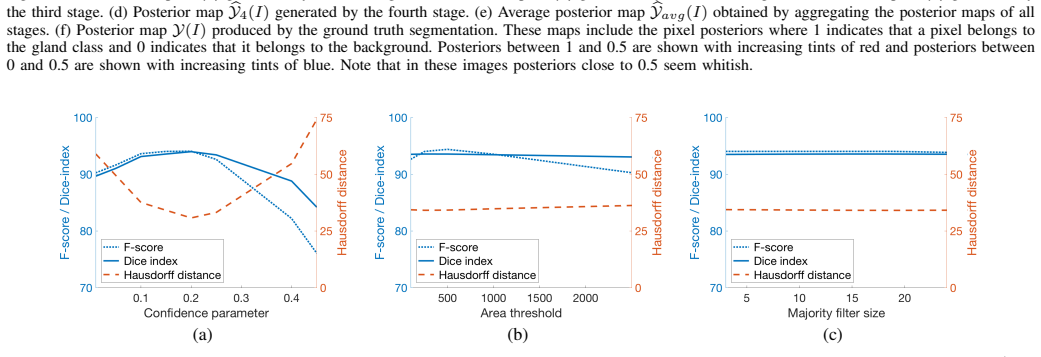
- [Section V] Fig. 6 reports test-set sensitivity to α, A_thr, and f_size, but it is not stated whether these plots are based on the same single run as Table II. If so, the sensitivity curves may be noisy; this should be clarified.
- [General] The paper contains occasional grammatical and stylistic issues (e.g., 'the multi-stage network is fit on the memory of the GPU'), and some sentences are long. A careful proofread would improve readability.
Circularity Check
No circularity: AttentionBoost's per-pixel reweighting is a trained mechanism, and no prediction is defined by its fit.
full rationale
Walking the paper's derivation chain, no step reduces by construction to its own inputs. The per-pixel loss contributions C_n(p) in Eqns. 2-3 are computed from the previous stage's predictions and the ground truth, and they modulate the loss in Eqn. 1; they are training mechanisms, not predicted outputs. The final gland segmentation is obtained by averaging all stage probability maps and applying a region-growing postprocessor, whose three parameters are selected by grid search on training and validation images (Sec. IV-D), and the test set is explicitly excluded from that selection. The comparison to MultiStageWithoutAdaptiveBoosting does differ in output aggregation and postprocessing as well as in the loss-update rule, which is a legitimate experimental-confound concern, but it is not circularity: Table II reports empirical results, not quantities forced by a fitted parameter or by a self-citation chain. The paper cites no prior work by the same authors as a load-bearing justification, invokes no uniqueness theorem, and does not rename a known result as its own derivation. The central claim is therefore self-contained in the sense relevant to circularity analysis; any weakness lies in experimental isolation, not in definitional or fitted-input circularity.
Assumptions & free parameters
free parameters (3)
- alpha (confidence parameter) =
0.15
- Athr (area threshold) =
250
- fsize (majority filter size) =
15
assumptions (4)
- standard math Backpropagation can train the multi-stage network end-to-end with the stage-wise loss functions Ln.
- domain assumption The private dataset of 200 colon biopsy images is representative of the gland segmentation problem, and the ground truth annotations are correct.
- domain assumption Pixels that the previous stage classifies incorrectly with high confidence are exactly the pixels whose increased loss weight will improve overall segmentation.
- domain assumption The three postprocessing parameters (alpha, Athr, fsize) selected by grid search on training and validation generalize to the test set.
Cite this review
Pith. "Pith review of AttentionBoost: Learning What to Attend by Boosting Fully Convolutional Networks." pith.science (2026). https://pith.science/paper/AY7OJXJM
@misc{pith2026190802095,
  author       = {Pith},
  title        = {Pith review of: AttentionBoost: Learning What to Attend by Boosting Fully Convolutional Networks},
  year         = {2026},
  howpublished = {\url{https://pith.science/paper/AY7OJXJM}},
  note         = {Machine review of arXiv:1908.02095}
}
read the original abstract
Dense prediction models are widely used for image segmentation. One important challenge is to sufficiently train these models to yield good generalizations for hard-to-learn pixels. A typical group of such hard-to-learn pixels are boundaries between instances. Many studies have proposed to give specific attention to learning the boundary pixels. They include designing multi-task networks with an additional task of boundary prediction and increasing the weights of boundary pixels' predictions in the loss function. Such strategies require defining what to attend beforehand and incorporating this defined attention to the learning model. However, there may exist other groups of hard-to-learn pixels and manually defining and incorporating the appropriate attention for each group may not be feasible. In order to provide a more attainable and scalable solution, this paper proposes AttentionBoost, which is a new multi-attention learning model based on adaptive boosting. AttentionBoost designs a multi-stage network and introduces a new loss adjustment mechanism for a dense prediction model to adaptively learn what to attend at each stage directly on image data without necessitating any prior definition about what to attend. This mechanism modulates the attention of each stage to correct the mistakes of previous stages, by adjusting the loss weight of each pixel prediction separately with respect to how accurate the previous stages are on this pixel. This mechanism enables AttentionBoost to learn different attentions for different pixels at the same stage, according to difficulty of learning these pixels, as well as multiple attentions for the same pixel at different stages, according to confidence of these stages on their predictions for this pixel. Using gland segmentation as a showcase application, our experiments demonstrate that AttentionBoost improves the results of its counterparts.
Figures


Figures from the paper (3 more)


Reference graph
Works this paper leans on
-
[1]
Visualizing and understanding convolu- tional networks,
M. D. Zeiler and R. Fergus, “Visualizing and understanding convolu- tional networks,” in Proc. European Conf. Computer Vision , 2014, pp. 818–833
work page 2014
-
[2]
ImageNet classification with deep convolutional neural networks,
A. Krizhevsky, I. Sutskever, and G. E. Hinton, “ImageNet classification with deep convolutional neural networks,” in Proc. Adv. Neural Inf. Process. Syst., 2012, pp. 1097–1105
work page 2012
-
[3]
Very deep convolutional networks for large-scale image recognition,
K. Simonyan and A. Zisserman, “Very deep convolutional networks for large-scale image recognition,” arXiv preprint arXiv:1409.1556 , 2014
arXiv 2014
-
[4]
Going deeper with convolutions,
C. Szegedy et al., “Going deeper with convolutions,” in Proc. IEEE Conf. Comp. Vis. Pattern Recognit. , Jun. 2015, pp. 1–9
work page 2015
-
[5]
Rich feature hierarchies for accurate object detection and semantic segmentation,
R. Girshick, J. Donahue, T. Darrell, and J. Malik, “Rich feature hierarchies for accurate object detection and semantic segmentation,” in Proc. IEEE Conf. Comp. Vis. Pattern Recognit. , Jun. 2014, pp. 580– 587
work page 2014
-
[6]
Fully convolutional networks for semantic segmentation,
J. Long, E. Shelhamer, and T. Darrell, “Fully convolutional networks for semantic segmentation,” in Proc. IEEE Conf. Comp. Vis. Pattern Recognit., Jun. 2015, pp. 3431–3440
work page 2015
-
[7]
A survey on deep learning in medical image analysis,
G. Litjens et al.,, “A survey on deep learning in medical image analysis,” Med. Image Anal. , vol. 42, pp. 60–88, 2017
work page 2017
-
[8]
U-net: Convolutional networks for biomedical image segmentation,
O. Ronneberger, P. Fischer, and T. Brox, “U-net: Convolutional networks for biomedical image segmentation,” in Proc. Int. Conf. Med. Image Comput. Comput. Assist. Intervent. , 2015, pp. 234–241
work page 2015
Show all 29 references
-
[9]
DCAN: Deep contour-aware networks for object instance segmentation from histology images,
H. Chen, X. Qi, L. Yu, Q. Dou, J. Qin, and P.-A. Heng, “DCAN: Deep contour-aware networks for object instance segmentation from histology images,” Med. Image Anal. , vol. 36, pp. 135–146, 2017
2017
-
[10]
Gland instance segmentation by deep multichannel side supervision,
Y . Xu et al., “Gland instance segmentation by deep multichannel side supervision,” in Proc. Int. Conf. Med. Image Comput. Comput. Assist. Intervent., 2016, pp. 496–504
2016
-
[11]
Gland instance segmentation using deep multichannel neural networks,
Y . Xu et al., “Gland instance segmentation using deep multichannel neural networks,” in IEEE Trans. Biomed. Eng. , vol. 64, no. 12, pp. 2901–2912, 2017
2017
-
[12]
A decision-theoretic generalization of on-line learning and an application to boosting,
Y . Freund and R. E. Schapire, “A decision-theoretic generalization of on-line learning and an application to boosting,” J. Comput. Syst. Sci. , vol. 55, no. 1, pp. 119–139, 1997
1997
-
[13]
Auto-context and its application to high-level vision tasks and 3D brain image segmentation,
Z. Tu and X. Bai, “Auto-context and its application to high-level vision tasks and 3D brain image segmentation,” IEEE Trans. Pattern Anal. Mach. Intell. , vol. 32, no. 10, pp. 1744–1757, 2010
2010
-
[14]
Iterative instance segmentation,
K. Li, B. Hariharan, and J. Malik, “Iterative instance segmentation,” in Proc. IEEE Conf. Comp. Vis. Pattern Recognit. , Jun. 2016, pp. 3659– 3667
2016
-
[15]
Boundary-aware fully convolutional network for brain tumor segmentation,
H. Shen, R. Wang, J. Zhang, and S. J. McKenna, “Boundary-aware fully convolutional network for brain tumor segmentation,” in Proc. Int. Conf. Med. Image Comput. Comput. Assist. Intervent. , 2017, pp. 433–441
2017
-
[16]
Detect, replace, refine: Deep structured prediction for pixel wise labeling,
S. Gidaris and N. Komodakis, “Detect, replace, refine: Deep structured prediction for pixel wise labeling,” in Proc. IEEE Conf. Comp. Vis. Pattern Recognit., Jun. 2017, pp. 5248–5257
2017
-
[17]
Image segmentation by iterative inference from conditional score estimation,
A. Romero, M. Drozdzal, A. Erraqabi, S. Jegou, and Y . Bengio, “Image segmentation by iterative inference from conditional score estimation,” arXiv preprint arXiv:1705.07450 , 2017
2017 arXiv
-
[18]
Predicting depth, surface normals and semantic labels with a common multi-scale convolutional architecture,
D. Eigen and R. Fergus, “Predicting depth, surface normals and semantic labels with a common multi-scale convolutional architecture,” in Proc. IEEE Int. Conf. Comp. Vis. , 2015, pp. 2650–2658
2015
-
[19]
SegNet: A deep convolutional encoder-decoder architecture for image segmentation,
V . Badrinarayanan, A. Kendall, and R. Cipolla, “SegNet: A deep convolutional encoder-decoder architecture for image segmentation,” IEEE Trans. Pattern Anal. Mach. Intell. , vol. 39, no. 12, pp. 2481–2495, 2017
2017
-
[20]
Generalised dice overlap as a deep learning loss function for highly unbalanced segmentations,
C. H. Sudre, W. Li, T. Vercauteren, S. Ourselin, and M. J. Cardoso, “Generalised dice overlap as a deep learning loss function for highly unbalanced segmentations,” Deep Learning in Medical Image Analysis and Multimodal Learning for Clinical Decision Support , Springer, 2017, ...
2017
-
[21]
Focal loss for dense object detection,
T.-Y . Lin, P. Goyal, R. Girshick, K. He, and P. Dollar, “Focal loss for dense object detection,” in Proc. IEEE Int. Conf. Comp. Vis. , 2017, pp. 2980–2988
2017
-
[22]
Boosting neural networks,
H. Schwenk and Y . Bengio, “Boosting neural networks,” Neural Com- put., vol. 12, no. 8, pp. 1869–1887, 2000
2000
-
[23]
Incremental learning of convolutional neural networks,
D. Medera and S. Babinec, “Incremental learning of convolutional neural networks,” in Proc. Int. Joint Conf. Comput. Intell. , 2009, pp. 547–550
2009
-
[24]
Convolutional neural network based sentiment analysis using adaboost combination,
Y . Gao, W. Rong, Y . Shen, and Z. Xiong, “Convolutional neural network based sentiment analysis using adaboost combination,” inProc. Int. Joint Conf. Neural Networks , 2016, pp. 1333–1338
2016
-
[25]
Robust object rep- resentation by boosting-like deep learning architecture,
L. Wang, B. Zhang, J. Han, L. Shen, and C.-S. Qian, “Robust object rep- resentation by boosting-like deep learning architecture,” Signal Process. Image Comm. , vol. 47, pp. 490–499, 2016
2016
-
[26]
Incremental boosting convolutional neural network for facial action unit recognition,
S. Han, Z. Meng, A.-S. Khan, and Y . Tong, “Incremental boosting convolutional neural network for facial action unit recognition,” in Proc. Adv. Neural Inf. Process. Syst. , 2016, pp. 109–117
2016
-
[27]
Dropout: a simple way to prevent neural networks from overfit- ting,
N. Srivastava, G. Hinton, A. Krizhevsky, I. Sutskever, and R. Salakhut- dinov, “Dropout: a simple way to prevent neural networks from overfit- ting,” J. Mach. Learn. Res. , vol. 15, no. 1, pp.1929–1958, 2014
1929
-
[28]
Adadelta: an adaptive learning rate method,
M. D. Zeiler, “Adadelta: an adaptive learning rate method,” arXiv preprint arXiv:1212.5701, 2012
2012 arXiv
-
[29]
Gland segmentation in colon histology im- ages: The GlaS Challenge Contest,
K. Sirinukunwattana et al.,, “Gland segmentation in colon histology im- ages: The GlaS Challenge Contest,” arXiv preprint arXiv:1603.00275v2, 2016. 10
2016 arXiv
Reviewed August 14, 2026 · model on record in the stance chip above.
Discussion (0). Continue with ORCID to comment.