REVIEW 3 major objections 4 minor 45 references
Finite-size effects on the cluster expansions for quantum gases in restricted geometries
T0 review · 3 major / 4 minor · reviewed 2026-08-14 · deepseek-v4-flash
Pith's one-line read This paper derives exact finite-size density matrices and cluster expansions for ideal Bose and Fermi gases in box geometries, and extends the cluster expansion to a quasi-1D interacting gas by using mean-field energy levels.
desk verdict The ideal-gas half is a correct but textbook-level re-derivation; the interacting quasi-1D cluster expansion is a mean-field ansatz presented as exact, and the advertised theorem and harmonic-trap results never appear. read the letter →
The pith
A machine-rendered reading of the paper's core claim, the machinery that carries it, and where it could break.
The reading
What carries the argument
The load-bearing object is the Jacobi $\theta$ function $\vartheta_3(u,q)$, which sums the box's sine-square eigenstates into a closed form. A difference of two $\theta$ functions, one in $x'-x$ and one in $x'+x$, represents the free propagator plus its reflected image, so the density matrix satisfies the Bloch equation with Dirichlet boundary conditions. In the cluster expansion, the key identity is that the multiple integral in Eq. (19) collapses to a one-level sum, $\int \rho(1,2)\cdots\rho(\nu,1)\,d^3r_1\cdots d^3r_\nu = \sum_j e^{-\nu\beta E_j}$, by repeated use of eigenstate orthonormality. For the interacting quasi-1D case, the same collapse is asserted with the mean-field spectrum $\bar E_j$ from Eq. (27), built from Jacobi elliptic functions solving the nonlinear Schrödinger equation, replacing the ideal levels.
What would settle it
Compute the two-particle cluster integral $h_2$ for a small repulsively interacting Bose gas in a 1D box by exact two-body diagonalization of the Hamiltonian in Eq. (25), and compare the result with $\sum_j e^{-2\beta\bar E_j}$ using the eigenvalues of Eq. (27); a discrepancy at any temperature would refute the interacting cluster expansion.
Extended reading notes
Core claim
The central claim is that box confinement can be handled exactly in the single-particle density matrix and in the quantum cluster expansion. For a particle in a 1D box, $\rho(x,x';\beta)=\frac{1}{2L}[\vartheta_3(\frac{\pi(x'-x)}{2L},e^{-\beta\pi^2\hbar^2/2mL^2})-\vartheta_3(\frac{\pi(x'+x)}{2L},e^{-\beta\pi^2\hbar^2/2mL^2})]$; the second $\theta$ term is the image contribution that makes the density matrix vanish at the walls. The one-particle density matrix of an ideal Bose or Fermi gas follows by expanding in fugacity, and the paper derives from the orthonormality of the sine eigenstates that the $\nu$-particle cluster integral of Eq. (19) reduces to $h_\nu=\sum_{j_1,j_2,j_3}e^{-\nu\beta \pi^2\hbar^2(j_1^2/L_1^2+j_2^2/L_2^2+j_3^2/L_3^2)/2m}$, the single-particle partition function at inverse temperature $\nu\beta$. The same reduction is then asserted, with a sign convention, for an interacting quasi-1D gas, with the mean-field eigenvalues $\bar E_j$ of Eq. (27) replacing the ideal levels.
Load-bearing premise
The argument rests on assuming that for the interacting quasi-1D gas the $\nu$-particle cluster integral is just $\sum_j e^{-\nu\beta \bar E_j}$, with $\bar E_j$ the mean-field eigenvalues of Eq. (27); the cluster-integral definition for interacting particles does not by itself imply this.
Editorial extensions
If this is right
- The one-particle density matrix of an ideal Bose or Fermi gas in a box can be written down at any temperature as a fugacity series of theta functions, so spatial correlations in box traps have closed-form expressions.
- For a gas free in two directions and bounded in one, the pressure on the wall is given by Eq. (24): it is lower than the free-gas pressure and exponentially suppressed when the thermal wavelength exceeds the box length, so the confined gas behaves quasi-two-dimensionally at low temperature.
- Finite-size corrections to the grand free energy and particle number follow from the same cluster expansion and reduce exactly to the familiar free-gas results as all box lengths go to infinity.
- If the interacting quasi-1D cluster form holds, the equation of state and density correlations for a short-range-interacting Bose or Fermi gas in a narrow box are obtained simply by evaluating the ideal-gas formulas at the mean-field eigenvalues $\bar E_j$.
Reading between the lines
- The theta-function image method is not restricted to Dirichlet boxes: the same construction should yield closed-form density matrices for Neumann or periodic boundary conditions, and for other separable containers, by choosing the appropriate eigenfunction reflection pair.
- The claimed interacting cluster formula $h_\nu=\sum_j e^{-\nu\beta\bar E_j}$ is an ansatz rather than a derivation; a direct test would be to compute $h_2$ for a small repulsive Bose gas in a 1D box by exact two-body diagonalization and compare with $\sum_j e^{-2\beta\bar E_j}$.
- A natural next step, consistent with the paper's aims, would be to use these formulas to map the dimensional crossover from 3D to quasi-1D thermodynamics as two box lengths shrink below the thermal wavelength, and to compare the predicted pressure with box-trap measurements.
Signed reviews
Editorial analysis
A structured set of objections, weighed in public.
Referee Report
Summary. This manuscript derives the statistical-mechanical density matrix for a single particle in one- and three-dimensional hard-wall boxes in terms of Jacobi theta functions (Eq. (8)), extends it to one-particle density matrices of ideal Bose and Fermi gases (Eqs. (11)-(15)), and uses cluster integrals to obtain the grand free energy and equation of state in a slab geometry (Eqs. (22) and (24)). It then claims exact cluster expansions for interacting quasi-one-dimensional Bose and Fermi gases by replacing the single-particle energies with Gross-Pitaevskii mean-field eigenvalues (Eqs. (29) and (30)). The abstract additionally promises results for harmonic traps and a theorem with proof, neither of which appears in the body of the paper.
Significance. The ideal-gas part of the paper is sound and useful: the theta-function representation (8) is correct, the cluster expansion (22) and the slab equation of state (24) reduce to the standard free-gas results in the appropriate limits, and the derivation is parameter-free and self-contained. These are clean results with pedagogical value. The advertised novelty, however, is the exact treatment of interacting gases and a generic theorem about quantum cluster integrals, and that part is not supported. Because the interacting cluster expansion is asserted rather than derived from the many-body problem, the central claim of exactness for interacting quantum gases fails in the present form.
major comments (3)
- [Section V, Eq. (30)] The cluster integral h_nu = sum_j exp(-nu beta Ebar_j) does not follow from the cluster-integral definition (19). For the interacting Hamiltonian (25), cluster coefficients are fixed by traces of the nu-body problem and contain interaction contributions; they cannot be obtained by inserting the mean-field Gross-Pitaevskii eigenvalues Ebar_j of Eq. (27) into the ideal-gas formula. Moreover, Eq. (19) uses the noninteracting single-particle density matrix of Eq. (9), so it is not an interacting cluster integral at all. The functions psi_j of Eq. (26) are nonlinear mean-field solutions, not a complete orthonormal basis of the many-body Hilbert space, so the grand-canonical trace is not a sum over them. Consequently Eq. (29) is also a mean-field ansatz rather than an exact one-particle density matrix. These gaps invalidate the interacting cluster expansion and the corresponding claims in Sections V and VI.
- [Abstract and Section VI] The abstract claims 'a theorem (with a proof) about the generic form of the quantum cluster integral' and results for 'harmonically trapped geometries', but neither appears in the manuscript. There is no theorem statement, proof, or harmonic-trap calculation anywhere in the body. These claims must be removed or the corresponding content supplied; as submitted, the paper advertises results it does not contain.
- [Section IV, Eq. (21)] The sign factor is inconsistent with the definition (19). Eq. (19) defines h_nu without a sign, while Eq. (21) inserts a factor (±1)^{nu-1} into h_nu. If Eq. (21) is literally used in Eq. (18), the factor (±1)^{nu-1} cancels and the Fermi gas loses its alternating sign in the grand free energy. The final formula (22) correctly omits the sign inside h_nu, but the two statements need to be reconciled.
minor comments (4)
- [Eq. (9)] The text says x3 = y; this should be x3 = z.
- [Eq. (13) and Fig. 2] The sentence 'We plot the 1-particle density matrix-element in Eqn. (8)' should refer to Eq. (13), which is the formula actually plotted.
- [Eqs. (10) and (11)] Eq. (10) uses the symbol ± while Eq. (11) uses ∓; the sign convention for Bose and Fermi statistics should be stated once and then used consistently.
- [Eq. (20)] The text says a Fourier series expansion of the theta functions was used to obtain Eq. (20), but the result follows by orthonormality of the sine eigenstates; this phrasing should be clarified.
Circularity Check
No significant circularity: the ideal-gas cluster expansion is derived from the density-matrix convolution definition, and the problematic interacting result is an unsupported substitution rather than a circular reduction.
full rationale
The paper's ideal-gas results are self-contained and not circular. The single-particle density matrix for the box, Eq. (8), follows from summing the exact eigenstates of the box Hamiltonian, and the 1-particle density matrix in Eq. (11) is the standard grand-canonical sum over single-particle states. The cluster expansion in Section IV starts from the standard cluster-integral definition Eq. (19); Eq. (20) for h_1 follows by direct integration, and Eq. (21) follows from orthonormality of the box eigenstates. No parameter is fitted to a subset of data and then renamed a prediction, and no central result is assumed into its own derivation. The self-citations (refs. [25], [26], [29], [30]) provide background or input solutions but are not used to force the central ideal-gas equations. The main weakness of the paper is not circularity but an unsupported derivation step: Eq. (30) asserts h_nu = sum_j exp(-nu beta Ebar_j) for the interacting quasi-1D gas simply 'by looking at Eqn. (21)', with Ebar_j taken from the nonlinear Gross-Pitaevskii equation. This is a mean-field ansatz substituted into an ideal-gas formula, not a derived many-body cluster integral; however, this is a gap or error in the derivation, not a reduction of the claimed result to its own inputs. Likewise, the abstract's promised theorem and harmonic-trap results do not appear in the body, which is an incompleteness relative to the claims, not a circularity. No step of the paper reduces by construction to a fitted parameter, a self-citation chain, or a definition that presupposes the conclusion, so the circularity score is 0.
Assumptions & free parameters
assumptions (3)
- standard math Standard Kahn-Uhlenbeck / Lee-Yang quantum cluster expansion: Omega = -k_B T sum_nu (+-)^{nu-1} h_nu z^nu / nu (Eq. 18).
- domain assumption Dirichlet boundary conditions for the box and the free-particle heat kernel of Eq. (5) as the L->infinity reference.
- ad hoc to paper For the quasi-1D interacting gas, the mean-field GP energies Ebar_j (Eq. 27) are taken as given from Carr-Clark-Reinhardt [28] and then used to write the cluster integral as h_nu = sum_j e^{-nu beta Ebar_j} (Eq. 30).
Cite this review
Pith. "Pith review of Finite-size effects on the cluster expansions for quantum gases in restricted geometries." pith.science (2026). https://pith.science/paper/ROP424LY
@misc{pith2026190802106,
  author       = {Pith},
  title        = {Pith review of: Finite-size effects on the cluster expansions for quantum gases in restricted geometries},
  year         = {2026},
  howpublished = {\url{https://pith.science/paper/ROP424LY}},
  note         = {Machine review of arXiv:1908.02106}
}
read the original abstract
We have analytically obtained 1-particle density matrices for ideal Bose and Fermi gases in both the 3-D box geometries and the harmonically trapped geometries for the entire range of temperature. We have obtained quantum cluster expansions of the grand free energies in closed forms for the same systems in the restricted geometries. We have proposed a theorem (with a proof) about the generic form of the quantum cluster integral. We also have considered short ranged interactions in our analyses for the quasi 1-D cases of Bose and Fermi gases in the box geometries. Our theoretical results are exact, and are directly useful for understanding finite-size effects on quantum cluster expansion of Bose and Fermi gases in the restricted geometries. Our results would be relevant in the context of experimental study of spatial correlations in ultra-cold systems of dilute Bose and Fermi gases of alkali atoms (i) in 3-D magneto-optical box traps with quasi-uniform potential around the center [1], and (ii) in 3-D harmonic traps [2, 3].
Figures

Reference graph
Works this paper leans on
-
[1]
can be recast as [ 4] ˆρ = ∞∑ j=1 e−βEj |ψj⟩⟨ψj | (2) A. Density matrix for a single particle in a 1-D box If the pointsx andx′ be any two arbitrary points inside a 1-D box of length L which confines a point-particle such that 0 < x < L, then the density matrix element of the system can be defined in position representation as ρ(x,x ′;β) = ⟨x|ˆρ|x′⟩ = ⟨x|e−...
-
[2]
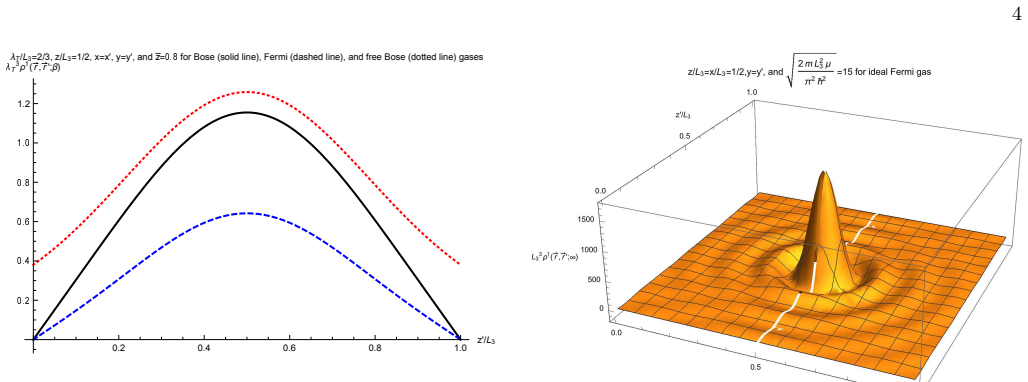
The dotted line would come arbitrary close to the solid line at z =L3/2 for ¯z → 0. Alternating series expansion in Eqn.( 13) further re- duces the spatial correlations in the Fermi gas in com- parison to that in the Bose gas as clear in the FIG. 2. Eqn.(13), for the Fermi gas, can be recast as ρ1(⃗ r,⃗ r′;β) = ∞∑ j3=1 [ ∫ ei(⃗ r′ ⊥−⃗ r⊥)·⃗ p⊥/ℏ eβ([p2 ⊥/...
-
[3]
This can be considered as an inhomogeneous boundary condition for the solution to the diffusion Eqn
we get ρ(x,x ′; 0) = δ(x −x′). This can be considered as an inhomogeneous boundary condition for the solution to the diffusion Eqn. ( 4). The solution for L → ∞, i.e. for the case of free particle, ρf (x,x ′;β) = √ m 2πℏ2β e− m(x′ −x)2 2ℏ 2β (5) is well known in the literature [ 4]. The solution to the Eqn.( 4) for finite L, however, is not known in the lit...
-
[4]
R. P. Feynman, Statistical Mechanics: A Set of Lectures , p. 39-96 (ch. 2-3), Westview Press, Boulder, USA (1972)
work page 1972
-
[5]
G. C. Wick, Phys. Rev. 96, 1124 (1954)
work page 1954
-
[6]
Fox, Quantum Optics: An Introduction , p
M. Fox, Quantum Optics: An Introduction , p. 171 (ch. 9), Oxford Univ. Press, Oxford, New York, USA (2006)
work page 2006
-
[7]
we get an exact result in compact form as ρ(x,x ′;β) = 1 2L [ ϑ3 ( π[x′ −x] 2L , e−β π2ℏ 2 2mL2 ) −ϑ3 ( π[x′ +x] 2L , e−β π2ℏ 2 2mL2 )] (8) where ϑ3 represents a Jacobi (elliptic) theta function in the usual notation[31]. The second term in the right hand 3 side of Eqn.( 8) breaks the translational symmetry in the density matrix-element, as because, the d...
-
[8]
for the 3-D as product of the density matrix elements for the individual axes: ρ(⃗ r,⃗ r′;β) = Π 3 i=1 1 2Li [ ϑ3 ( π[x′ i −xi] 2Li , e −β π2ℏ 2 2mL2 i ) −ϑ3 ( π[x′ i +xi] 2Li , e −β π2 ℏ 2 2mL2 i )] (9) where x1 =x, x2 =y, x3 =y, and so as for the primed coordinates. Eqn.(9) is our result for statistical mechanical density matrix element ( ρ(⃗ r,⃗ r′;β) ...
Show all 45 references
-
[9]
for the density matrix-element for a particle in 1-D box, has been used to get the final expression of h1 which by definition is the partition function for a sin- gle particle in the 3-D box. It can be shown from the orthonormality of the single-particle energy eigenstates that,...
-
[10]
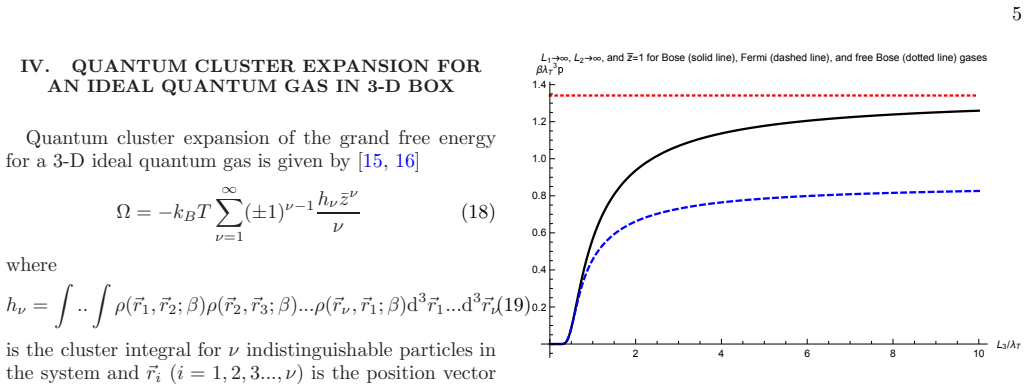
for ideal Bose and Fermi gases for fixed fugacity, and com- pare with the the case of the free Bose gas in FIG. 4. The solid line approaches the result λ3 Tp/kBT =g5/2(¯z), whereg5/2 is the Bose integral [ 16], for the 3-D free Bose gas as L3/λT tends to ∞. The dashed line appr...
-
[11]
for the finiteness of the system only along the z axis [ 25] apart from studying typical finite-size ef- fect on the many-body system. V. QUANTUM CLUSTER EXP ANSION FOR A NON-IDEAL QUANTUM GAS IN A CLOSED RECTANGULAR CYLINDER Let the Bose gas spin 0 particles be interacting with...
-
[12]
D. M. Gangardt and G. V. Shlyapnikov, New J. Phys. 8, 167 (2006)
2006
-
[13]
The dotted line represents the same for 3-D fr ee Bose gas, and follows Eqn.( 15) for the upper sign
for upper and lower signs respectively. The dotted line represents the same for 3-D fr ee Bose gas, and follows Eqn.( 15) for the upper sign. in Eqn.(8) for 3-D ideal Bose gas, and compare it with the one (in Eqn.( 15)) with the free-boundary in FIG. 2. It is clear from the FI...
-
[14]
von Neumann, G¨ ottinger Nachrichten 1927, 245 (1927)
J. von Neumann, G¨ ottinger Nachrichten 1927, 245 (1927)
1927
-
[15]
P. A. M. Dirac, Proc. Cambridge Phil. Soc. 25, 62 (1929) ; 27, 240 (1931)
1929
-
[16]
R. C. Tolman, The Principles of Statistical Mechanics , p. 327-361 (ch. 9), Clarendon Press, Oxford, Great Britain (1938)
1938
-
[17]
Dalfovo, S
F. Dalfovo, S. Giorgini, L. P. Pitaevskii, andS. Stringari, Rev. Mod. Phys. 71, 463 (1999)
1999
-
[18]
Bloch, J
I. Bloch, J. Dalibard, and W. Zwerger, Rev. Mod. Phys. 80, 885 (2008)
2008
-
[19]
Penrose and L
O. Penrose and L. Onsager, Phys. Rev. 104, 576 (1956)
1956
-
[20]
L. P. Pitaevskii and S. Stringari, Bose-Einstein Conden- sation, p. 7 (ch. 2), Oxford Univ. Press, Oxford, New York, USA (2003)
2003
-
[21]
L. F. Barragan-Gila and R. Walser, Am. J. Phys. 86, 22 (2018)
2018
-
[22]
Let us now remove the boundaries along the x and y axes so that L1 → ∞ , L2 → ∞ , and the quantum gas remains bounded only along the z axis
and ( 23). Let us now remove the boundaries along the x and y axes so that L1 → ∞ , L2 → ∞ , and the quantum gas remains bounded only along the z axis. In this situation the summations in Eqns. ( 22) and ( 23) over j1 and j2 can be replaced by integrations from 0 to ∞ without ...
-
[23]
Onofri, Am
E. Onofri, Am. J. Phys. 46, 379 (1978)
1978
-
[24]
Let us now define the generalized pressure given by the quantum gas on a wall of the system as p = −Ω L1L2L3 which would be the true pressure in the thermodynamic limit
for +ve and -ve signs respectively. Let us now define the generalized pressure given by the quantum gas on a wall of the system as p = −Ω L1L2L3 which would be the true pressure in the thermodynamic limit. Thermodynamic behaviour of the ideal quantum gas can now be extracted fr...
-
[25]
M. T. Batchelor, X. W. Guan, N. Oelkers, and C. Lee, J. Phys. A: Math. Gen. 38, 7787 (2005)
2005
-
[26]
- ( 30) would be re- placed by ¯N/ 2 for the interacting Fermi system. In ad- dition the Bose-Einstein statistics (¯ nj = 1 eβ[ ¯Ej −µ]−1 ) in Eqn.(29) is to be replaced by the Fermi-Dirac statistics (¯nj = 1 eβ[ ¯Ej −µ]+1 ) and a phase factor ( −1)ν−1 would be multiplied in t...
-
[27]
J.-S. Caux, P. Calabrese, and N. A. Slavnov, J. Stat. Mech. 2007, P01008 (2007)
2007
-
[28]
Kira and S
M. Kira and S. W. Koch, Phys. Rev. A 78, 022102 (2008)
2008
-
[29]
Kahn and G
B. Kahn and G. E. Uhlenbeck, Physica 5, 399 (1938) ; T. D. Lee and C. N. Yang, Phys. Rev. 117, 22 (1960)
1938
-
[30]
R. K. Pathria, Statistical Mechanics , 2nd edn., p. 254, ch. 9, Butterworth-Heinemann, Oxford, New York, USA
-
[31]
Giorgini, L
S. Giorgini, L. P. Pitaevskii, and S. Stringari, Rev. Mod. Phys. 80, 1215 (2008)
2008
-
[32]
M. H. Anderson, J. R. Ensher, M. R. Matthews, C. E. Wieman, E. A. Cornell, Science 269, 198 (1995)
1995
-
[33]
C. C. Bradley, C. A. Sackett, J. J. Tollett, and R. G. Hulet, Phys. Rev. Lett. 75, 1687 (1995)
1995
-
[34]
K. B. Davis, M. -O. Mewes, M. R. Andrews, N. J. van Druten, D. S. Durfee, D. M. Kurn, and W. Ketterle, Phys. Rev. Lett. 75, 3969 (1995)
1995
-
[35]
A. L. Gaunt, T. F. Schmidutz, I. Gotlibovych, R. P. Smith, and Z. Hadzibabic, Phys. Rev. Lett. 110, 200406 (2013); Also see - T. P. Meyrath, F. Schreck, J. L. Hanssen, C.-S. Chuu, and M. G. Raizen, Phys. Rev. A 71, 041604(R) (2005)
2013
-
[36]
L. D. Landau and E. M. Lifshitz, Statistical Physics : part-1, 3rd edn., p. 356 (sec. 117), Butterworth- Heinemann, Oxford, New York, USA
-
[37]
Biswas, J
S. Biswas, J. Phys. A: Math. Theor. 40, 9969 (2007) ; Eur. Phys. J. D 42, 109 (2007)
2007
-
[38]
Bhattacharya, S
A. Bhattacharya, S. Das, and S. Biswas, J. Phys. B: At. Mol. Opt. Phys. 51, 075301 (2018)
2018
-
[39]
Biswas, Eur
S. Biswas, Eur. Phys. J. D 55, 653 (2009)
2009
-
[40]
L. D. Carr, C. W. Clark, and W. P. Reinhardt, Phys. Rev. A 62, 063610 (2000)
2000
-
[41]
Biswas, J
S. Biswas, J. K. Bhattacharjee, D. Majumder, K. Saha, and N. Chakravarty, J. Phys. B: At. Mol. Opt. Phys. 43, 085305 (2010)
2010
-
[42]
Biswas, D
S. Biswas, D. Jana, and R. K. Manna, Eur. Phys. J. D 66, 217 (2012)
2012
-
[43]
The Jacobi (elliptic) theta function, ϑ 3(u, q ), is defined as ϑ 3(u, q ) = 1 + 2 ∑ ∞ j=1 qj2 cos(2ju) for u ∈ C and |q|< 1
-
[44]
Maximization of the density matrix-element is possible at x′ = x = L/ 2 as there is a reflection symmetry about this point
-
[45]
This is the limiting case of Fermi-Huang potential under Born approximation for low energy scattering [ 26]
Reviewed August 14, 2026 · model on record in the stance chip above.
Discussion (0). Continue with ORCID to comment.