REVIEW 4 major objections 4 minor 54 references
Semi-Supervised Adversarial Monocular Depth Estimation
T0 review · 4 major / 4 minor · reviewed 2026-08-14 · deepseek-v4-flash
Pith's one-line read The paper claims that monocular depth estimation can be made semi-supervised: with a few hundred labeled pairs, adversarial feedback from two discriminators lets unlabeled RGB images drive depth accuracy to state-of-the-art levels.
desk verdict Useful two-discriminator recipe for semi-supervised depth, but the central gain is small and not yet backed by variance estimates or consistent baselines. read the letter →
The pith
A machine-rendered reading of the paper's core claim, the machinery that carries it, and where it could break.
The reading
What carries the argument
The load-bearing object is a three-player adversarial game among one generator and two discriminators. The pair discriminator is a PatchGAN, a convolutional classifier that scores overlapping $70\times70$ patches of the concatenated image and predicted depth; the depth discriminator is structurally similar but receives only depth maps. Their feedback reaches the generator through the weighted loss above, and the paper interprets the arrangement as a Bayesian decomposition $p(d|I)\propto p(I|d)p(d)$, with the depth discriminator providing the prior $p(d)$ and the pair discriminator providing the joint $p(d,I)$.
What would settle it
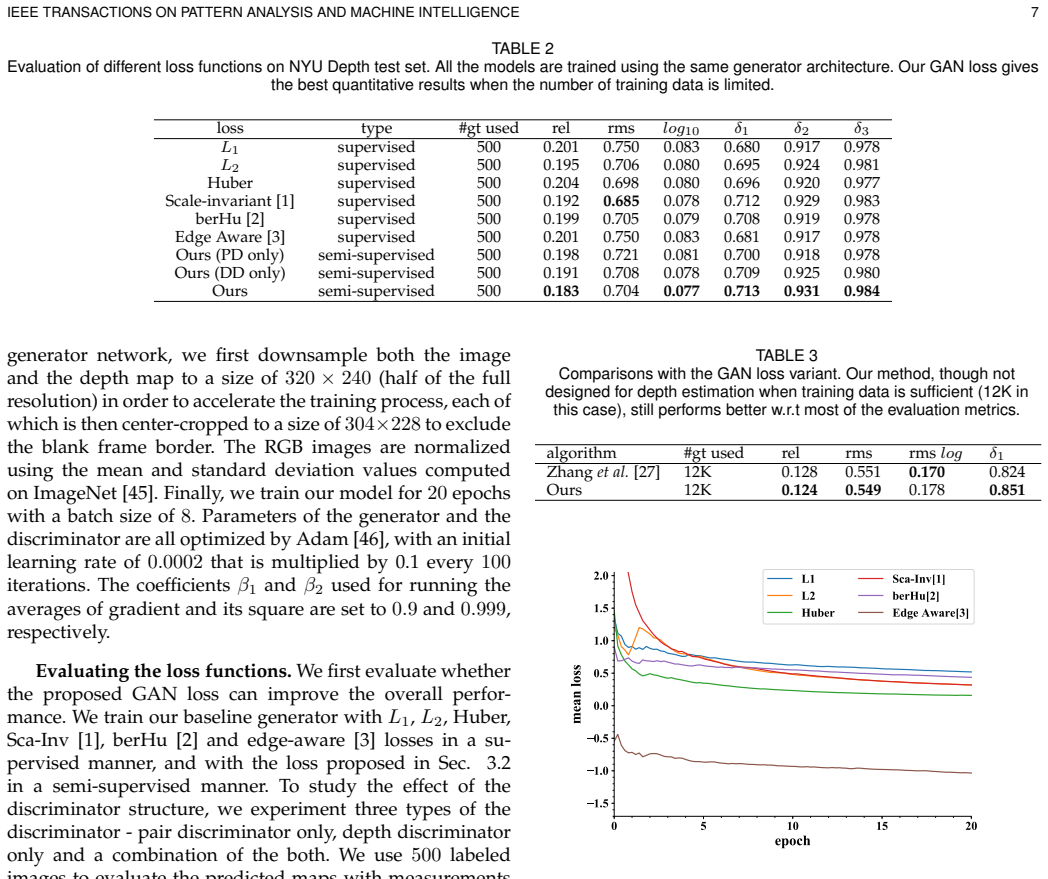
On NYU v2 with 500 labeled pairs, train the full model but freeze the depth discriminator at initialization so it supplies no learned feedback; if accuracy stays at the combined-model level (rel 0.183) instead of falling toward the pair-discriminator-only level (rel 0.198), the depth discriminator is not carrying the claimed benefit.
Extended reading notes
Core claim
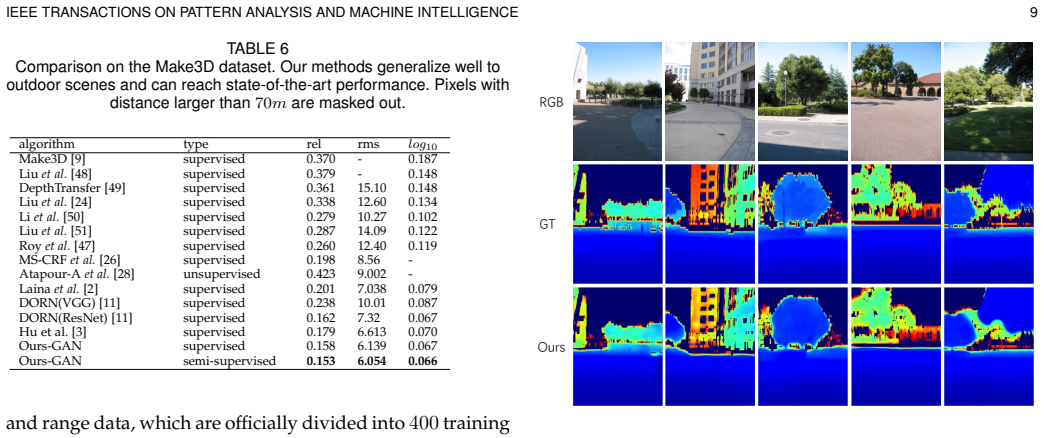
The central claim of the paper is that realism is a usable training signal for monocular depth regression when labeled image-depth pairs are scarce. The generator loss is $L_G = \lambda \mathbb{E}_{i'\sim p_{data}(i')}[\log(1-P_D(i',G(i')))] + (1-\lambda) \mathbb{E}_{i'\sim p_{data}(i')}[\log(1-D_D(G(i')))]$, with $\lambda = 0.7$, and supervised iterations add an $\ell^1$ regression term. The pair discriminator $P_D$ judges whether an image and its predicted depth form a real image-depth pair, while the depth discriminator $D_D$ judges whether a predicted depth map alone resembles real depth. With only hundreds of labeled pairs, the two discriminators let the generator exploit unlabeled RGB images; the paper reports rel 0.183 on NYU v2 with 500 labeled pairs versus 0.195 for supervised L2, and rel 0.153/0.158 on Make3D.
Load-bearing premise
The depth discriminator can learn a useful distribution of real depth maps from only the labeled depth maps available, and its feedback improves rather than distorts the regressed depth scale and structure.
Editorial extensions
If this is right
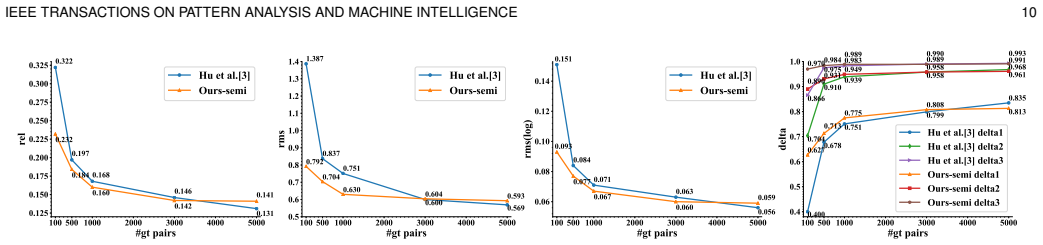
- With limited labeled pairs, adding unlabeled RGB images improves depth accuracy, and the benefit grows up to roughly ten unlabeled images per labeled pair before saturating.
- When labeled pairs are abundant (beyond about 3.5K on NYU v2), the semi-supervised gain disappears, so the method targets the scarce-label regime rather than replacing large-scale supervision.
- The same loss improves three different generator architectures, so the dual-discriminator feedback transfers across backbone designs.
- The framework supports domain adaptation: a model trained on KITTI pairs plus Make3D RGB images cuts the KITTI-trained Make3D relative error from 0.555 to 0.447.
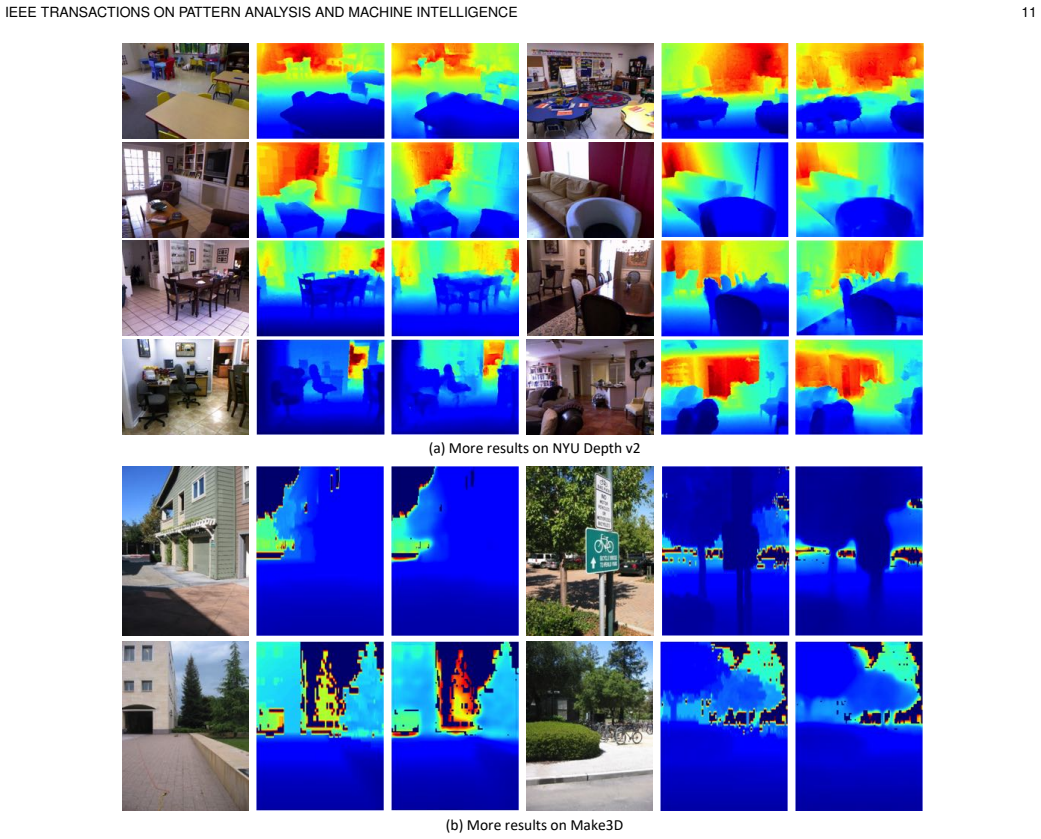
- Adversarial feedback yields qualitatively sharper object boundaries in predicted depth maps than L1, L2, or Huber losses under limited labels.
Reading between the lines
- The depth discriminator is trained only on the labeled depth maps, so its contribution plausibly depends on how representative those maps are; ablating its capacity at fixed labeled count would test this, and the paper does not report such a study.
- The same pair-plus-depth discriminator split could apply to other dense regression tasks with scarce labels, such as surface-normal estimation or image restoration, wherever a 'real output' distribution is well defined.
- Since the unlabeled images contribute only realism feedback, combining this loss with geometric self-supervision, such as left-right or photometric consistency, might extract additional signal from the same unlabeled pool.
- The saturation pattern suggests a practical rule: collect about ten unlabeled images per labeled pair before spending more on annotation, a rule other datasets could test directly.
Signed reviews
Editorial analysis
A structured set of objections, weighed in public.
Referee Report
Summary. The paper proposes a semi-supervised adversarial framework for monocular depth estimation that uses a small number of labeled image-depth pairs together with many unlabeled RGB images. A generator (backbone can be U-Net, FCRN, or the Hu et al. network) regresses a depth map; two discriminators then evaluate the output: a pair discriminator (PatchGAN) on the image-depth pair and a depth discriminator on the depth channel alone. The generator loss combines the feedback from both discriminators, plus an L1 regression term on labeled pairs. Experiments on NYU Depth, Make3D, and KITTI, including a KITTI-to-Make3D domain adaptation setting, report improvements over supervised baselines and state-of-the-art results on Make3D with limited labels.
Significance. If the reported results hold, the contribution is practically useful: a relatively simple way to exploit unlabeled RGB images in depth regression when labeled depth is scarce, with an architecture that can wrap several existing depth networks. The paper includes useful ablations over loss functions, backbones, labeled-data counts, and the number of additional unlabeled images, and it explicitly discusses the regime where semi-supervised learning stops helping. However, the absence of error bars or repeated-seed statistics, the small size of several key gains, and some internal inconsistencies in the core equations prevent the central claim from being fully established as written.
major comments (4)
- [Sec. 4.3-4.5, Tables 2, 4, 6, 7] The paper reports no error bars, no results over multiple random seeds, and no significance tests anywhere in the experimental section. The key semi-supervised improvements are small in absolute terms (Make3D rel 0.158 to 0.153 in Table 6; KITTI rel 0.107 to 0.093 in Table 7), and GAN training is known to be sensitive to initialization. Moreover, Table 4 shows the opposite direction for one configuration (Unet at 1000 labels: supervised rel 0.365 vs semi-supervised 0.369). Without a variance estimate, the reader cannot tell whether the reported gains reflect the method or run-to-run noise. This is load-bearing for the central claim that unlabeled images improve depth accuracy; please provide mean and standard deviation over at least three runs for the main comparisons, and ideally paired differences.
- [Sec. 3.2 Eqs. (5); Sec. 3.3 Eqs. (8)-(9)] The formal definition of the proposed loss is internally inconsistent. In Eq. (5), the terms intended for the depth discriminator are written with PD: the third term is E[log PD(d)] and the fourth is E[log(1 - PD(G(i')))], whereas Eq. (3) defines the depth discriminator objective with DD. In Sec. 3.3, Eq. (9) labels the DD loss but uses PD in both expectations, and Eq. (8) mixes the labeled index i with the unlabeled index i'. Since the method is defined by these equations, the manuscript does not currently specify the algorithm unambiguously. Please correct all three equations and make the index conventions consistent throughout.
- [Sec. 3.2-3.3, Sec. 4.3-4.4] The hyperparameter selection protocol is not described for the NYU and Make3D experiments. The text in Sec. 3.2 reports that lambda = 0.7 was found to give 'a reasonable result', and Sec. 3.3 mentions a larger beta at initial training, but no validation split or tuning procedure is given for these datasets. Only the KITTI section (Sec. 4.5) mentions a 160-sample validation set. If lambda, beta, or early stopping were chosen by inspecting test-set numbers, the reported results are optimistically biased. Please specify the validation protocol for each dataset, or fix the hyperparameters and the beta schedule a priori.
- [Sec. 3.1.2, Eq. (3), Table 2] The depth discriminator is trained on only 400-500 real depth maps (NYU, Make3D), but no experiment checks whether it learns a useful, non-degenerate distribution. The DD-only ablation in Table 2 reaches rel 0.191, close to the L2 baseline, and there is no analysis of the discriminator's separability on held-out depth statistics or of its capacity. Because the depth discriminator supplies the prior p(d) in the claimed Bayesian interpretation, the authors should add an experiment varying the discriminator capacity or measuring its generalization, to show that the semi-supervised gain is not an artifact of memorizing the few labeled depth maps.
minor comments (4)
- [Sec. 1, Sec. 3.2] The phrase 'Different traditional GANs' loss' should read 'Different from traditional GANs' loss' for clarity.
- [Sec. 4.3, Tables 2 and 4] Table 2 and Table 4 report different supervised numbers for the same 500-label backbone (Edge Aware [3] rel 0.201 vs Hu et al. [3] rel 0.197); please clarify which loss (edge-aware vs L1) was used for each row, since the current text in Sec. 4.3 could be read as inconsistent.
- [Sec. 4.5] The Cityscape images are described as 'drawn' from the dataset; please state explicitly that they are used without depth labels, and describe how they are sampled.
- [General] The paper would benefit from releasing code and trained models; at present no reproducibility artifacts are provided, which makes it harder to verify the small semi-supervised gains.
Circularity Check
No significant circularity found: the adversarial loss is not defined in terms of the reported depth metrics, and no load-bearing self-citation appears.
full rationale
The paper's derivation chain is self-contained against external benchmarks: the generator loss in Eq. (6) combines two discriminator feedback terms, and the discriminators in Eqs. (1) and (3) are trained on real labeled depth maps and image-depth pairs, while the generator is evaluated on held-out test splits (NYU 654-image test set, Make3D 134-pair test set, and the KITTI Eigen split). The reported rel/RMSE/log10 numbers are computed directly on these held-out ground truths and are not equal by construction to any fitted parameter or discriminator output. The hyperparameters lambda and beta are tuned on a validation set (KITTI 160-sample subset), which is a standard fitting procedure rather than a disguised prediction. No self-citations are present in the reference list, and no uniqueness theorem or prior-work result is invoked to forbid alternative explanations. The paper's limitation section and ablation study (PD-only, DD-only in Table 2) provide independent checks of the contribution of each component, and the claim that unlabeled RGB images help is an empirical comparison (e.g., Table 6: Ours-GAN 0.158 vs Ours-GAN semi 0.153) whose magnitude could be debated on statistical grounds, but that is a correctness risk, not circularity. The Bayesian interpretation of the two discriminators as p(d) and p(d,I) is a post-hoc conceptual framing, not an input to the optimization that forces the outcome. Accordingly, no step reduces to its inputs by definition, and the circularity score is 0.
Assumptions & free parameters
free parameters (2)
- lambda (adversarial trade-off between pair and depth discriminators) =
0.7
- beta (regression loss weight in supervised phase) =
not reported quantitatively
assumptions (3)
- ad hoc to paper The depth discriminator can learn a meaningful depth distribution from only n labeled depth maps (e.g., 400-500 maps).
- domain assumption Adversarial realism feedback from discriminators improves regression accuracy, not just perceptual quality or sharpness.
- domain assumption Standard train/test splits and evaluation protocols of Eigen et al. and of the Make3D literature are used consistently.
Cite this review
Pith. "Pith review of Semi-Supervised Adversarial Monocular Depth Estimation." pith.science (2026). https://pith.science/paper/CNW7XUDU
@misc{pith2026190802126,
  author       = {Pith},
  title        = {Pith review of: Semi-Supervised Adversarial Monocular Depth Estimation},
  year         = {2026},
  howpublished = {\url{https://pith.science/paper/CNW7XUDU}},
  note         = {Machine review of arXiv:1908.02126}
}
read the original abstract
In this paper, we address the problem of monocular depth estimation when only a limited number of training image-depth pairs are available. To achieve a high regression accuracy, the state-of-the-art estimation methods rely on CNNs trained with a large number of image-depth pairs, which are prohibitively costly or even infeasible to acquire. Aiming to break the curse of such expensive data collections, we propose a semi-supervised adversarial learning framework that only utilizes a small number of image-depth pairs in conjunction with a large number of easily-available monocular images to achieve high performance. In particular, we use one generator to regress the depth and two discriminators to evaluate the predicted depth , i.e., one inspects the image-depth pair while the other inspects the depth channel alone. These two discriminators provide their feedbacks to the generator as the loss to generate more realistic and accurate depth predictions. Experiments show that the proposed approach can (1) improve most state-of-the-art models on the NYUD v2 dataset by effectively leveraging additional unlabeled data sources; (2) reach state-of-the-art accuracy when the training set is small, e.g., on the Make3D dataset; (3) adapt well to an unseen new dataset (Make3D in our case) after training on an annotated dataset (KITTI in our case).
Figures


Figures from the paper (9 more)





Reference graph
Works this paper leans on
-
[1]
Depth map prediction from a single image using a multi-scale deep network,
D. Eigen, C. Puhrsch, and R. Fergus, “Depth map prediction from a single image using a multi-scale deep network,” in Advances in neural information processing systems, 2014, pp. 2366–2374
work page 2014
-
[2]
Deeper depth prediction with fully convolutional residual net- works,
I. Laina, C. Rupprecht, V . Belagiannis, F. Tombari, and N. Navab, “Deeper depth prediction with fully convolutional residual net- works,” in 3D Vision (3DV), 2016 Fourth International Conference on. IEEE, 2016, pp. 239–248
work page 2016
-
[3]
J. Hu, M. Ozay, Y. Zhang, and T. Okatani, “Revisiting single image depth estimation: toward higher resolution maps with accurate object boundaries,” in 2019 IEEE Winter Conference on Applications of Computer Vision (WACV). IEEE, 2019, pp. 1043–1051
work page 2019
-
[4]
E. Prados and O. Faugeras, “Shape from shading,” in Handbook of mathematical models in computer vision. Springer, 2006, pp. 375–388
work page 2006
-
[5]
J. Aloimonos, “Shape from texture,” Biological cybernetics, vol. 58, no. 5, pp. 345–360, 1988
work page 1988
-
[6]
Hartley and A
R. Hartley and A. Zisserman, Multiple view geometry in computer vision. Cambridge university press, 2003
2003
-
[7]
A comparison and evaluation of multi-view stereo reconstruction algorithms,
S. M. Seitz, B. Curless, J. Diebel, D. Scharstein, and R. Szeliski, “A comparison and evaluation of multi-view stereo reconstruction algorithms,” in Computer vision and pattern recognition, 2006 IEEE Computer Society Conference on, vol. 1. IEEE, 2006, pp. 519–528
work page 2006
-
[8]
Learning depth from single monocular images,
A. Saxena, S. H. Chung, and A. Y. Ng, “Learning depth from single monocular images,” in Advances in neural information processing systems, 2006, pp. 1161–1168
work page 2006
Show all 54 references
-
[9]
Make3d: Learning 3d scene structure from a single still image,
A. Saxena, M. Sun, and A. Y. Ng, “Make3d: Learning 3d scene structure from a single still image,” IEEE transactions on pattern analysis and machine intelligence, vol. 31, no. 5, pp. 824–840, 2009
2009
-
[10]
Depth extraction from video using non-parametric sampling,
K. Karsch, C. Liu, and S. B. Kang, “Depth extraction from video using non-parametric sampling,” in European Conference on Com- puter Vision. Springer, 2012, pp. 775–788. IEEE TRANSACTIONS ON PATTERN ANAL YSIS AND MACHINE INTELLIGENCE 12
2012
-
[11]
Deep ordinal regression network for monocular depth estimation,
H. Fu, M. Gong, C. Wang, K. Batmanghelich, and D. Tao, “Deep ordinal regression network for monocular depth estimation,” in Proceedings of the IEEE Conference on Computer Vision and Pattern Recognition, 2018, pp. 2002–2011
2018
-
[12]
Unsupervised learning of depth and ego-motion from video,
T. Zhou, M. Brown, N. Snavely, and D. G. Lowe, “Unsupervised learning of depth and ego-motion from video,” in CVPR, vol. 2, no. 6, 2017, p. 7
2017
-
[13]
Unsupervised monocular depth estimation with left-right consistency,
C. Godard, O. Mac Aodha, and G. J. Brostow, “Unsupervised monocular depth estimation with left-right consistency,” inCVPR, vol. 2, no. 6, 2017, p. 7
2017
-
[14]
U-net: Convolutional networks for biomedical image segmentation,
O. Ronneberger, P . Fischer, and T. Brox, “U-net: Convolutional networks for biomedical image segmentation,” in International Conference on Medical image computing and computer-assisted inter- vention. Springer, 2015, pp. 234–241
2015
-
[15]
Shape-from- shading: a survey,
R. Zhang, P .-S. Tsai, J. E. Cryer, and M. Shah, “Shape-from- shading: a survey,”IEEE transactions on pattern analysis and machine intelligence, vol. 21, no. 8, pp. 690–706, 1999
1999
-
[16]
Hmm-based surface reconstruction from single images,
T. Nagai, T. Naruse, M. Ikehara, and A. Kurematsu, “Hmm-based surface reconstruction from single images,” in Image Processing
-
[17]
Example based 3d reconstruction from single 2d images,
T. Hassner and R. Basri, “Example based 3d reconstruction from single 2d images,” in Computer Vision and Pattern Recognition Workshop, 2006. CVPRW’06. Conference on . IEEE, 2006, pp. 15– 15
2006
-
[18]
Bayesian reconstruction of 3d shapes and scenes from a single image,
F. Han and S.-C. Zhu, “Bayesian reconstruction of 3d shapes and scenes from a single image,” in Higher-Level Knowledge in 3D Mod- eling and Motion Analysis, 2003. HLK 2003. First IEEE International Workshop on. IEEE, 2003, pp. 12–20
2003
-
[19]
Image and depth from a conventional camera with a coded aperture,
A. Levin, R. Fergus, F. Durand, and W. T. Freeman, “Image and depth from a conventional camera with a coded aperture,” ACM transactions on graphics (TOG), vol. 26, no. 3, p. 70, 2007
2007
-
[20]
Parallel tracking and mapping for small ar workspaces,
G. Klein and D. Murray, “Parallel tracking and mapping for small ar workspaces,” in Mixed and Augmented Reality, 2007. ISMAR
2007
-
[21]
Pulling things out of perspec- tive,
L. Ladicky, J. Shi, and M. Pollefeys, “Pulling things out of perspec- tive,” in Proceedings of the IEEE Conference on Computer Vision and Pattern Recognition, 2014, pp. 89–96
2014
-
[22]
Predicting depth, surface normals and semantic labels with a common multi-scale convolutional architec- ture,
D. Eigen and R. Fergus, “Predicting depth, surface normals and semantic labels with a common multi-scale convolutional architec- ture,” in Proceedings of the IEEE International Conference on Computer Vision, 2015, pp. 2650–2658
2015
-
[23]
Squeeze-and-excitation networks,
J. Hu, L. Shen, and G. Sun, “Squeeze-and-excitation networks,” in Proceedings of the IEEE conference on computer vision and pattern recognition, 2018, pp. 7132–7141
2018
-
[24]
Discrete-continuous depth estimation from a single image,
M. Liu, M. Salzmann, and X. He, “Discrete-continuous depth estimation from a single image,” in Computer Vision and Pattern Recognition (CVPR), 2014 IEEE Conference on. IEEE, 2014, pp. 716– 723
2014
-
[25]
Towards unified depth and semantic prediction from a single image,
P . Wang, X. Shen, Z. Lin, S. Cohen, B. Price, and A. L. Yuille, “Towards unified depth and semantic prediction from a single image,” in Proceedings of the IEEE Conference on Computer Vision and Pattern Recognition, 2015, pp. 2800–2809
2015
-
[26]
Multi-scale continuous crfs as sequential deep networks for monocular depth estimation,
D. Xu, E. Ricci, W. Ouyang, X. Wang, and N. Sebe, “Multi-scale continuous crfs as sequential deep networks for monocular depth estimation,” in Proceedings of CVPR, 2017
2017
-
[27]
Depth map prediction from a single image with generative adversarial nets,
S. Zhang, N. Li, C. Qiu, Z. Yu, H. Zheng, and B. Zheng, “Depth map prediction from a single image with generative adversarial nets,” Multimedia Tools and Applications, pp. 1–18, 2018
2018
-
[28]
Real-time monocular depth estimation using synthetic data with domain adaptation via image style transfer,
A. Atapour-Abarghouei and T. P . Breckon, “Real-time monocular depth estimation using synthetic data with domain adaptation via image style transfer,” in Proceedings of the IEEE Conference on Computer Vision and Pattern Recognition, 2018, pp. 2800–2810
2018
-
[29]
Unsupervised cnn for single view depth estimation: Geometry to the rescue,
R. Garg, V . K. BG, G. Carneiro, and I. Reid, “Unsupervised cnn for single view depth estimation: Geometry to the rescue,” inEuropean Conference on Computer Vision. Springer, 2016, pp. 740–756
2016
-
[30]
Monocular depth prediction using generative adversarial networks,
A. CS Kumar, S. M. Bhandarkar, and M. Prasad, “Monocular depth prediction using generative adversarial networks,” in Proceedings of the IEEE Conference on Computer Vision and Pattern Recognition Workshops, 2018, pp. 300–308
2018
-
[31]
Deep3d: Fully automatic 2d- to-3d video conversion with deep convolutional neural networks,
J. Xie, R. Girshick, and A. Farhadi, “Deep3d: Fully automatic 2d- to-3d video conversion with deep convolutional neural networks,” in European Conference on Computer Vision. Springer, 2016, pp. 842– 857
2016
-
[32]
Dense monocular depth estimation in complex dynamic scenes,
R. Ranftl, V . Vineet, Q. Chen, and V . Koltun, “Dense monocular depth estimation in complex dynamic scenes,” in Proceedings of the IEEE conference on computer vision and pattern recognition , 2016, pp. 4058–4066
2016
-
[33]
Semi-supervised deep learning for monocular depth map prediction,
Y. Kuznietsov, J. St ¨uckler, and B. Leibe, “Semi-supervised deep learning for monocular depth map prediction,” in Proc. of the IEEE Conference on Computer Vision and Pattern Recognition , 2017, pp. 6647–6655
2017
-
[34]
Vision meets robotics: The kitti dataset,
A. Geiger, P . Lenz, C. Stiller, and R. Urtasun, “Vision meets robotics: The kitti dataset,” International Journal of Robotics Research (IJRR), 2013
2013
-
[35]
Dual discriminator generative adversarial nets,
T. Nguyen, T. Le, H. Vu, and D. Phung, “Dual discriminator generative adversarial nets,” in Advances in Neural Information Processing Systems, 2017, pp. 2667–2677
2017
-
[36]
Deep residual learning for image recognition,
K. He, X. Zhang, S. Ren, and J. Sun, “Deep residual learning for image recognition,” in Proceedings of the IEEE conference on computer vision and pattern recognition, 2016, pp. 770–778
2016
-
[37]
Fully convolutional net- works for semantic segmentation,
J. Long, E. Shelhamer, and T. Darrell, “Fully convolutional net- works for semantic segmentation,” in Proceedings of the IEEE conference on computer vision and pattern recognition, 2015, pp. 3431– 3440
2015
-
[38]
Holistically-nested edge detection,
S. Xie and Z. Tu, “Holistically-nested edge detection,” in Proceed- ings of the IEEE international conference on computer vision , 2015, pp. 1395–1403
2015
-
[39]
Image-to-image translation with conditional adversarial networks,
P . Isola, J.-Y. Zhu, T. Zhou, and A. A. Efros, “Image-to-image translation with conditional adversarial networks,” arXiv preprint, 2017
2017
-
[40]
Seman- tic segmentation using adversarial networks,
P . Luc, C. Couprie, S. Chintala, and J. Verbeek, “Seman- tic segmentation using adversarial networks,” arXiv preprint arXiv:1611.08408, 2016
2016 arXiv
-
[41]
Generative adversarial nets,
I. Goodfellow, J. Pouget-Abadie, M. Mirza, B. Xu, D. Warde-Farley, S. Ozair, A. Courville, and Y. Bengio, “Generative adversarial nets,” in Advances in neural information processing systems, 2014, pp. 2672–2680
2014
-
[42]
Conditional generative adversarial nets,
M. Mirza and S. Osindero, “Conditional generative adversarial nets,” arXiv preprint arXiv:1411.1784, 2014
2014 arXiv
-
[43]
Deep multi-scale video prediction beyond mean square error,
M. Mathieu, C. Couprie, and Y. LeCun, “Deep multi-scale video prediction beyond mean square error,” arXiv preprint arXiv:1511.05440, 2015
2015 arXiv
-
[44]
Indoor seg- mentation and support inference from rgbd images,
N. Silberman, D. Hoiem, P . Kohli, and R. Fergus, “Indoor seg- mentation and support inference from rgbd images,” in European Conference on Computer Vision. Springer, 2012, pp. 746–760
2012
-
[45]
Imagenet large scale visual recognition challenge,
O. Russakovsky, J. Deng, H. Su, J. Krause, S. Satheesh, S. Ma, Z. Huang, A. Karpathy, A. Khosla, M. Bernstein et al., “Imagenet large scale visual recognition challenge,” International journal of computer vision, vol. 115, no. 3, pp. 211–252, 2015
2015
-
[46]
Adam: A method for stochastic optimiza- tion,
D. P . Kingma and J. Ba, “Adam: A method for stochastic optimiza- tion,” arXiv preprint arXiv:1412.6980, 2014
2014 arXiv
-
[47]
Monocular depth estimation using neural regression forest,
A. Roy and S. Todorovic, “Monocular depth estimation using neural regression forest,” in Proceedings of the IEEE Conference on Computer Vision and Pattern Recognition, 2016, pp. 5506–5514
2016
-
[48]
Single image depth estimation from predicted semantic labels,
B. Liu, S. Gould, and D. Koller, “Single image depth estimation from predicted semantic labels,” in 2010 IEEE Computer Society Conference on Computer Vision and Pattern Recognition. IEEE, 2010, pp. 1253–1260
2010
-
[49]
Depth transfer: Depth extrac- tion from video using non-parametric sampling,
K. Karsch, C. Liu, and S. B. Kang, “Depth transfer: Depth extrac- tion from video using non-parametric sampling,”IEEE transactions on pattern analysis and machine intelligence, vol. 36, no. 11, pp. 2144– 2158, 2014
2014
-
[50]
Depth and surface normal estimation from monocular images using regression on deep features and hierarchical crfs,
B. Li, C. Shen, Y. Dai, A. Van Den Hengel, and M. He, “Depth and surface normal estimation from monocular images using regression on deep features and hierarchical crfs,” in Proceedings of the IEEE Conference on Computer Vision and Pattern Recognition , 2015, pp. 1119–1127
2015
-
[51]
Learning depth from single monocular images using deep convolutional neural fields,
F. Liu, C. Shen, G. Lin, and I. Reid, “Learning depth from single monocular images using deep convolutional neural fields,” IEEE transactions on pattern analysis and machine intelligence , vol. 38, no. 10, pp. 2024–2039, 2016
2024
-
[52]
The cityscapes dataset for semantic urban scene understanding,
M. Cordts, M. Omran, S. Ramos, T. Rehfeld, M. Enzweiler, R. Be- nenson, U. Franke, S. Roth, and B. Schiele, “The cityscapes dataset for semantic urban scene understanding,” in Proc. of the IEEE Conference on Computer Vision and Pattern Recognition (CVPR), 2016
2016
-
[2002]
2002 International Conference on , vol
Proceedings. 2002 International Conference on , vol. 2. IEEE, 2002, pp. II–II
2002
-
[2007]
IEEE, 2007, pp
6th IEEE and ACM International Symposium on . IEEE, 2007, pp. 225–234
2007
Reviewed August 14, 2026 · model on record in the stance chip above.
Discussion (0). Continue with ORCID to comment.