REVIEW 3 major objections 5 minor 38 references
Accelerating models with a hybrid scale factor in extended gravity
T0 review · 3 major / 5 minor · reviewed 2026-08-14 · deepseek-v4-flash
Pith's one-line read In f(R,T) gravity, a hybrid scale factor yields a late-time universe that behaves almost like a cosmological constant and shows no sign of slowing down.
desk verdict Competent but incremental f(R,T) Bianchi model whose 'no slowing down' claim is an artifact of the hybrid scale factor ansatz, not a dynamical prediction. read the letter →
The pith
A machine-rendered reading of the paper's core claim, the machinery that carries it, and where it could break.
The reading
What carries the argument
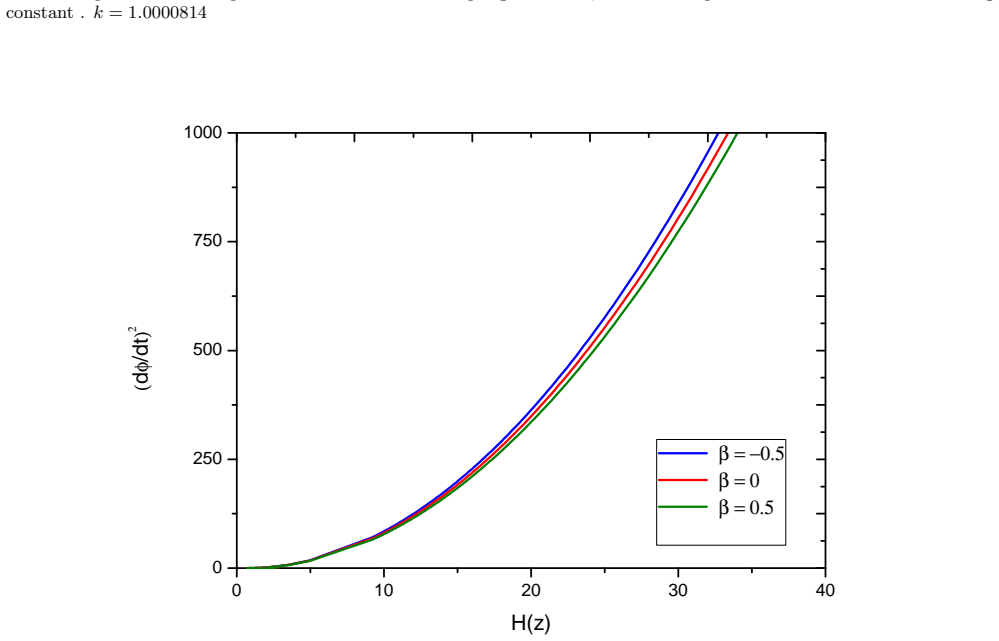
The central machinery is the hybrid scale factor $R(t)=e^{at}t^b$, which interpolates between power-law and exponential expansion and, through $H=a+b/t$, makes every dynamical quantity an explicit function of time. The second piece is the anisotropy ansatz $H_1=kH_2$, a fixed proportionality between directional Hubble rates that closes the otherwise underdetermined field equations; with $k=1.0000814$ it sets the present shear amplitude to $\sigma/H=4.7\times10^{-5}$. The chosen f(R,T) functional $R+2\Lambda_0+2\beta T$ converts the field equations into expressions involving only $H$ and $\dot H$, so the hybrid scale factor determines the deceleration parameter, equation of state, energy conditions, reconstructed scalar field, and diagnostics.
What would settle it
Measure the present-day cosmic shear amplitude $\sigma/H$ with the sensitivity of the tighter CMB-polarization limit: a value below about $10^{-10}$ would exclude $k=1.0000814$ and with it the model as constructed. Independently, reconstruct $q'(z)$ from type Ia supernova and baryon acoustic oscillation data: a clear sign change in $q'(z)$ at recent redshifts would directly contradict the paper's claim of no slowing down.
Extended reading notes
Core claim
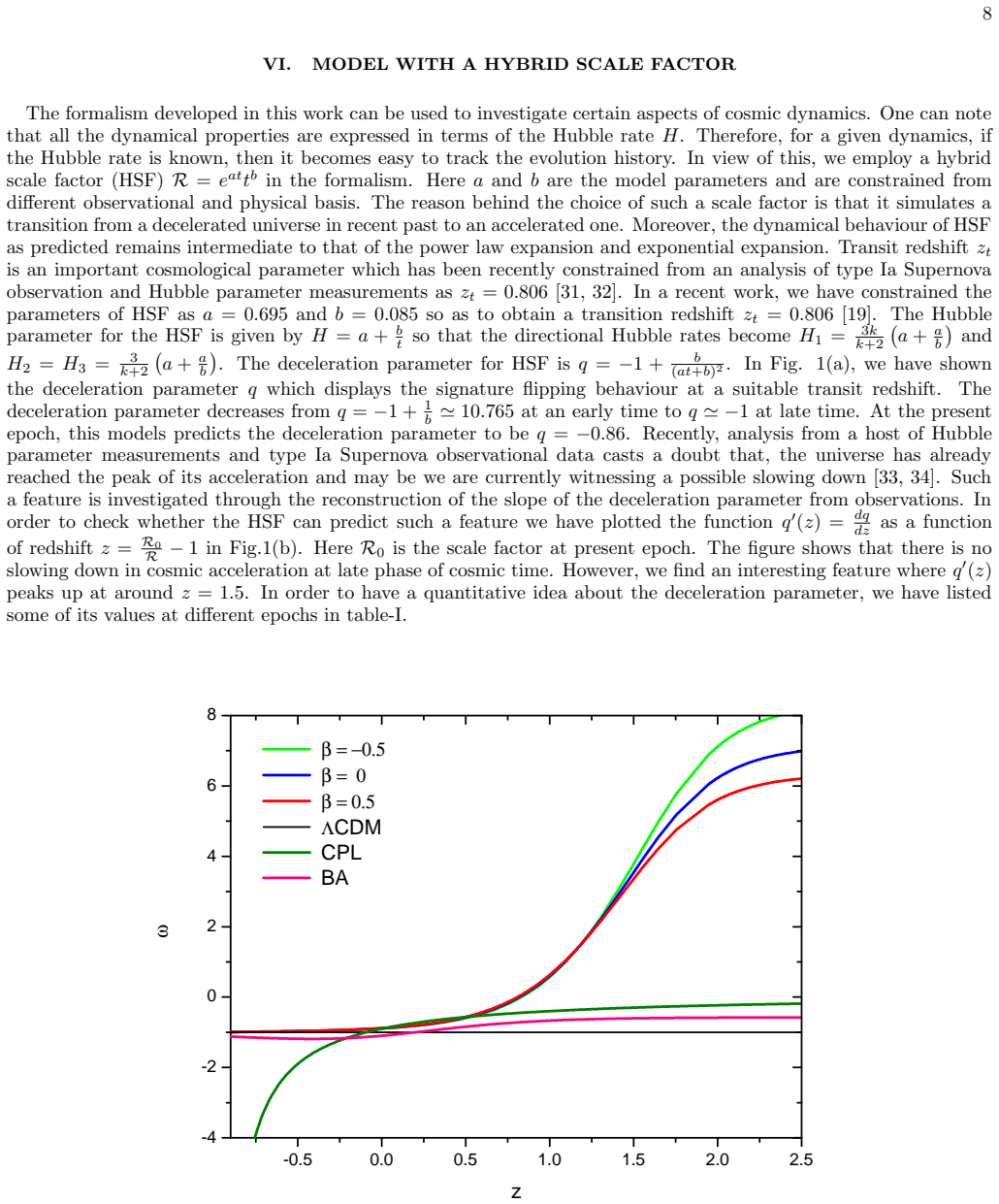
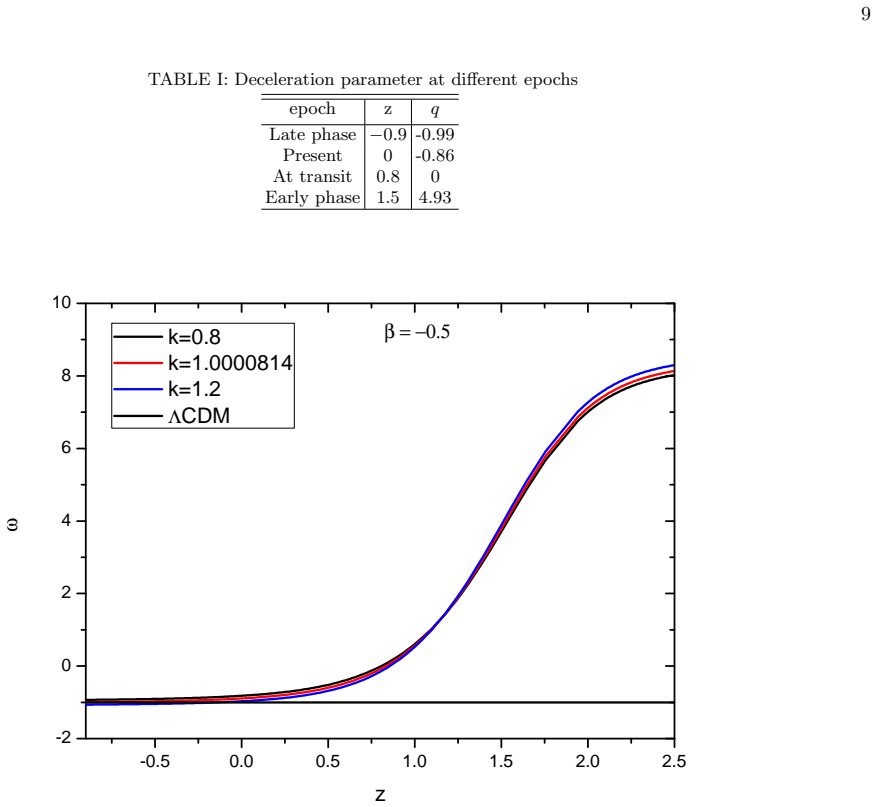
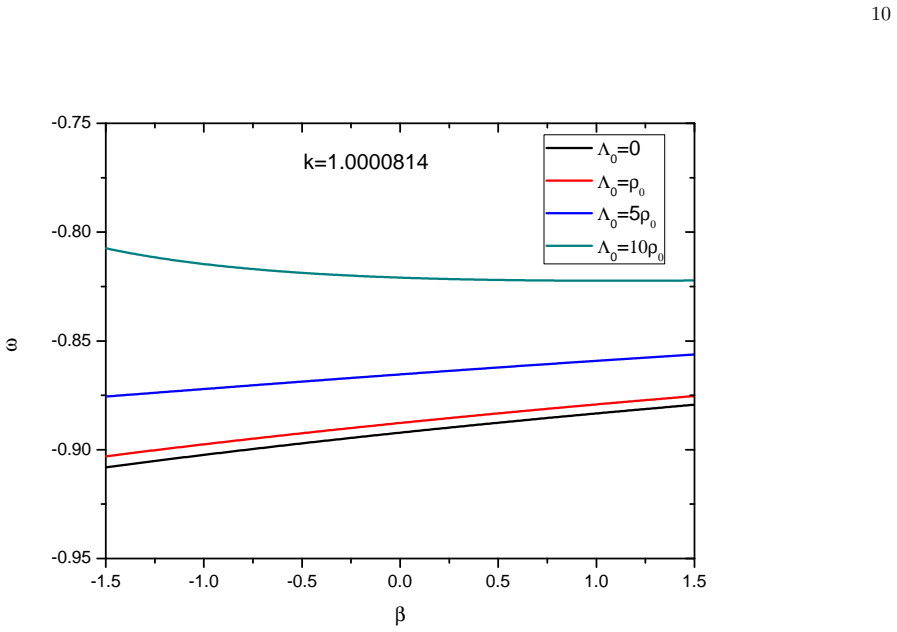
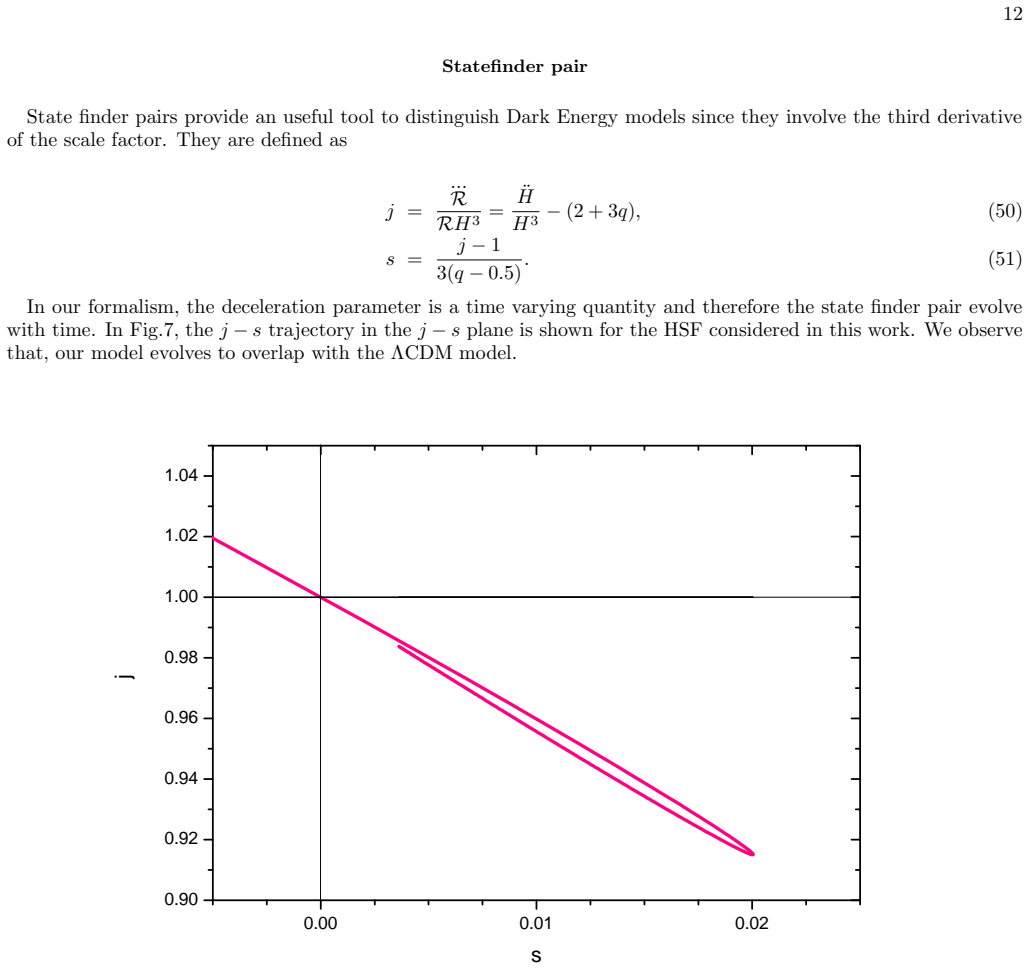
The paper's central claim is that, with the functional choice $f(R,T)=R+2\Lambda_0+2\beta T$ in a Bianchi type $VI_h$ space-time with $h=-1$, the hybrid scale factor $R=e^{at}t^b$ with $a=0.695$ and $b=0.085$ yields a viable cosmic transit model. The Hubble rate $H=a+b/t$ gives the deceleration parameter $q=-1+b/(at+b)^2$, which flips from deceleration to acceleration at $z_t=0.806$ and takes the value $q\simeq -0.86$ at the present epoch, with the equation-of-state parameter $\omega\simeq -0.89$. At late times the model's trajectories converge to $\omega=-1$ independently of the matter-curvature coupling $\beta$, the Om diagnostic is nearly constant in $0\le z\le 0.7$, and the statefinder trajectory approaches the $\Lambda$CDM point. The reconstructed scalar field is quintessence-like, and $q'(z)$ shows no downturn in the recent past or near future, which the paper summarises as a model that 'almost looks like a cosmological constant for a substantial cosmic time zone and does not show any slowing down feature in near future.'
Load-bearing premise
The load-bearing premise is the assumed fixed ratio $H_1=kH_2$ between directional expansion rates, chosen to match one anisotropy bound while a stricter bound quoted in the paper would rule it out; if that ratio is relaxed or the stricter bound is enforced, the constructed model's predictions do not follow.
Editorial extensions
If this is right
- If the model is right, a single hybrid expansion law with two fitted parameters reproduces the observed transition redshift $z_t=0.806$ and present deceleration $q\approx -0.86$, so no dynamical dark-energy fluid is needed to explain the cosmic transit.
- The nearly flat Om diagnostic for $0\le z\le 0.7$ makes the model observationally degenerate with a pure cosmological constant in the recent past; distinguishing them requires data beyond that redshift range or beyond the Om diagnostic.
- Because $\omega$ approaches $-1$ at late times independently of the coupling $\beta$, low-redshift equation-of-state measurements constrain the combination of $\Lambda_0$ and $\beta$ only weakly, while the early-time trajectories are $\beta$-dependent and could pin the coupling at higher redshift.
- The absence of a downturn in $q'(z)$ implies cosmic acceleration has not peaked in the recent past or near future, directly contradicting the suggestion from some data compilations that the universe is already slowing down.
- The model's expansion asymmetry $\Delta H/H=0.814\times10^{-4}$ is presented as consistent with current large-scale-structure bounds, so the mild anisotropy is a testable signature rather than a nuisance parameter.
Reading between the lines
- A testable extension would be to fit $a$ and $b$ directly to supernova and Hubble-parameter data instead of fixing them to reproduce $z_t=0.806$; this would show whether the hybrid scale factor's parameter values are a genuine property of the data or an artifact of the chosen prior.
- The no-slowing-down conclusion is tied to the specific monotone form $q=-1+b/(at+b)^2$; a more flexible scale factor with a non-monotone deceleration parameter could restore a peak in acceleration, so this claim should be read as a property of the hybrid scale factor family rather than of f(R,T) gravity in general.
- The paper quotes a tighter cosmic-shear bound that disfavours any finite departure from isotropy and then adopts $k=1.0000814$ anyway; enforcing the tighter bound would push $k$ essentially to $1$, and whether the $\Lambda$CDM-like late-time behaviour survives in that exactly isotropic limit is an open question.
Signed reviews
Editorial analysis
A structured set of objections, weighed in public.
Referee Report
Summary. The paper constructs a Bianchi type VI_h cosmological model in f(R,T) gravity with f(R,T)=R+2Λ0+2βT and a cosmic string fluid. The authors impose a proportionality relation H1=kH2 between directional Hubble rates, choose the hybrid scale factor R=e^{at}t^b with parameters a=0.695 and b=0.085 taken from their previous fit to the transition redshift z_t=0.806, and then derive the equation-of-state parameter, energy conditions, reconstructed scalar fields, statefinder pair, and Om(z) diagnostic. The paper's central claims are that the model approaches ΛCDM at late times and that it 'does not show any slowing down feature in near future.'
Significance. The formal part of the paper is competently executed: the authors provide explicit general expressions for pressure, energy density, string tension, energy conditions, and scalar-field reconstruction in terms of the Hubble rate, and they compare the EoS behavior with CPL and BA parametrizations. If the central claims were supported, the paper would offer a convenient anisotropic extension of f(R,T) cosmology. However, the two headline results are not dynamically established: the 'no slowing down' conclusion is an identity of the chosen scale-factor ansatz, and the adopted anisotropy parameter k=1.0000814 violates the tighter Planck-based bound that the paper itself cites. The paper is therefore best regarded as an internally consistent model-building exercise whose observational viability claims require substantial reframing or additional testing.
major comments (3)
- [Section VI, Eqs. (15)-(17) and Fig. 1] The 'no slowing down' statement is an analytic identity of the hybrid scale factor, not a dynamical prediction of the f(R,T) field equations. For R=e^{at}t^b, one has H=a+b/t and, from Eq. (17), q=-1+b/(at+b)^2. With a=0.695>0 and b=0.085>0, dq/dt is negative for all t, so q'(z)>0 for all z; Fig. 1(b) therefore restates the choice of the scale factor and is independent of k, β, Λ0, and the Bianchi VI_h geometry. The abstract and Section VIII claim that the model 'does not show any slowing down feature in near future' is thus unsupported as a result of the modified-gravity dynamics. To retain this claim, the authors should either confront q'(z) directly with the reconstructions cited in refs. [33,34] or demonstrate robustness across a family of scale factors consistent with z_t and q0.
- [Section III, Eq. (20) and paragraph following it] The chosen value k=1.0000814 gives (σ/H)_0=4.7×10^{-5}, which is six orders of magnitude above the tighter Planck-based limit (σ/H)_0<4.7×10^{-11} from Saadeh et al. cited in the same section. The observation that such analyses can be prior-dependent does not justify adopting a value excluded by the quoted bound. Since the anisotropic nature of the model is a key feature and the conclusion explicitly advertises the model as observationally viable, this inconsistency is load-bearing and should be resolved by either using a k consistent with the tighter bound or explicitly presenting the model as a toy anisotropic example not subject to that bound.
- [Sections IV, VI, VII] The parameters a=0.695 and b=0.085 are fitted only to reproduce z_t=0.806 in the authors' prior work [19]. All derived quantities considered in the diagnostics—the EoS parameter, Om(z), and the statefinder pair—are functions of the same H(z) generated by this ansatz. Consequently, the late-time approach to ω=-1 and the 'almost ΛCDM' behavior for 0≤z≤0.7 are inherited from the fitted scale factor rather than independently verified by the f(R,T) dynamics or by direct comparison with observational reconstructions. The paper should explicitly state this limitation or add a test of the diagnostics against data.
minor comments (5)
- [Section VI] The directional Hubble rates after the HSF choice appear as H1 = 3k/(k+2) (a + a/b) and H2 = H3 = 3/(k+2) (a + a/b); this is presumably a typo for (a + b/t), since H = a + b/t and a + a/b does not have the correct time dependence.
- [Abstract and title page] The line 'P ACS number: 04.50kd' should read 'PACS number: 04.50.Kd'.
- [Section IV, near Eq. (41)] The sentence 'a detailed analysis on these energy condition may be possible one the cosmic dynamics is fixed up' contains a typo: 'one' should be 'once'.
- [Fig. 1 caption] The caption 'The model does not favour a slowing down at late phase' should be qualified: for the chosen HSF, q'(z)>0 holds by construction, so the caption should say 'for the chosen hybrid scale factor' rather than attributing the behavior to the model.
- [References] Reference [28] lists 'Phy. Rev. Lett. 100, 191302 (2018)' with arXiv:0711.3459; the journal volume, year, and arXiv identifier appear inconsistent, and the entry should be checked.
Circularity Check
The central 'no slowing down' claim is an identity of the hybrid scale factor R=e^{at}t^b, not a result of the f(R,T) dynamics; the paper's diagnostics reduce to the same fitted ansatz.
-
self definitional
[Section VI (Model with a hybrid scale factor), Eq. (17) q formula and Fig. 1(b); abstract/conclusion claims.]
"The deceleration parameter for HSF is q =−1 + b/(at+b)^2. ... The figure shows that there is no slowing down in cosmic acceleration at late phase of cosmic time."
With H=a+b/t from R=e^{at}t^b, q'(t)=-2ab/(at+b)^3<0 for a,b>0, and since dt/dz<0, q'(z)>0 for all z. The 'no slowing down' conclusion is therefore a mathematical identity of the chosen HSF, independent of beta, Lambda_0, k, and of the f(R,T) field equations (10)-(14). The paper even frames it as checking 'whether the HSF can predict such a feature', but the HSF was defined with b=0.085>0, so q'(z)>0 is fixed before any cosmology is done. This is not an independent result of the extended gravity model.
full rationale
The f(R,T) field-equation algebra (Sections II–IV) is self-contained: given f=R+2Lambda_0+2beta T and H1=kH2, the quantities p, rho, xi are derived from the field equations without circularity. The central circularity enters when the model is closed with the hybrid scale factor. The abstract's headline that the universe 'does not show any slowing down feature in near future' is not a property of f(R,T) gravity; it is contained in q=-1+b/(at+b)^2 for b>0. Since a and b were themselves fixed (in the authors' prior work [19]) to reproduce z_t=0.806, the subsequent outputs q0=-0.86, omega->-1, flat Om(z), and Lambda-CDM-like statefinder behavior are consequences of the same fitted ansatz rather than independent tests of extended gravity. The paper does compare omega with CPL and BA parametrizations, but that comparison only reflects the chosen H(z). No observational reconstruction of q'(z) is used, so the headline 'prediction' is an identity. Score 8: the central result is forced by construction, while the supporting f(R,T) derivation itself is not circular.
Assumptions & free parameters
free parameters (5)
- a (HSF parameter) =
0.695
- b (HSF parameter) =
0.085
- k (anisotropy parameter) =
1.0000814
- β (coupling constant) =
varied (-0.5, 0, 0.5)
- Λ0 (cosmological constant) =
varied (0, ρ0, 5ρ0, 10ρ0)
assumptions (5)
- domain assumption The functional form f(R,T)=R+2Λ0+2βT is assumed.
- domain assumption The matter content is a cloud of cosmic strings with Lm=-p.
- ad hoc to paper The spacetime is Bianchi type VI_h with h=-1.
- ad hoc to paper The directional Hubble rates satisfy H1=kH2.
- ad hoc to paper The scale factor is the hybrid form R=e^{at}t^b.
Cite this review
Pith. "Pith review of Accelerating models with a hybrid scale factor in extended gravity." pith.science (2026). https://pith.science/paper/SK5DGK2A
@misc{pith2026190802152,
  author       = {Pith},
  title        = {Pith review of: Accelerating models with a hybrid scale factor in extended gravity},
  year         = {2026},
  howpublished = {\url{https://pith.science/paper/SK5DGK2A}},
  note         = {Machine review of arXiv:1908.02152}
}
read the original abstract
Dynamical aspects of cosmological model in an extended gravity theory have been investigated in the present work. We have adopted a simplified approach to obtain cosmic features, which in fact requires more involved calculations. A cosmological model is constructed using a hybrid scale factor that simulates a cosmic transit behaviour. The deceleration parameter and energy conditions have been obtained for the constructed model. Scalar fields have been reconstructed from the present model in the extended gravity. Different diagnostic methods have been applied to analyse the viability of the constructed model. The present model almost looks like a cosmological constant for a substantial cosmic time zone and does not show any slowing down feature in near future.
Figures

Figures from the paper (5 more)


Reference graph
Works this paper leans on
-
[19]
Tripathy, Sankarasn Tarai, Mod
B.Mishra, S.K. Tripathy, Sankarasn Tarai, Mod. Phys. Lett. A , 33, 1850052 (2018)
work page 2018
- [1]
- [2]
- [3]
-
[4]
T. Clifton, P.G. Ferreira, A. Padilla, C. Skordis, Phys. Rep., 513, 1 (2012)
work page 2012
-
[5]
E. Berti et al., Classical Quant. Grav. , 32, 243001 (2015)
work page 2015
-
[6]
S. Capozziello, S. Carloni, A. Troisi, Recent Res. Dev. Astron. Astrophys. , 1, 625 (2003)
work page 2003
- [7]
Show all 38 references
-
[8]
Caroll, V
S.M. Caroll, V. Duvvuri, M. Trodden, M.S. Turner, Phys. Rev. D , 70, 043528 (2004)
2004
-
[9]
Sotiriou, V
T.P. Sotiriou, V. Faraoni, Rev. Mod. Phys. , 82, 451 (2010)
2010
-
[10]
Harko, F
T. Harko, F. S. N. Lobo, S. Nojiri, S. D. Odintsov, Phys. Rev. D , 84, 024020 (2011)
2011
-
[11]
Zubair, Gen
M.Sharif, M. Zubair, Gen. Relat. Grav. , 46, 1723 (2014)
2014
-
[12]
Shabani, M
H. Shabani, M. Farhoudi, Phys. Rev. D , 90, 044031 (2014)
2014
-
[13]
Mishra, Sankarsan Tarai, S.K.Tripathy: Adv
B. Mishra, Sankarsan Tarai, S.K.Tripathy: Adv. High. Energy Phys. ,8543560, 1,(2016)
2016
-
[14]
Yousaf, K
Z. Yousaf, K. Bamba, M. Z. H. Bhatti, Phys. Rev. D , 93, 124048 (2016)
2016
-
[15]
Velten, T.R.P
H. Velten, T.R.P. Carames, Phys. Rev. D , 95, 123536 (2017)
2017
-
[16]
Abbas, R
G. Abbas, R. Ahmed, Eur. Phys. J. C , 77, 441 (2017)
2017
-
[17]
Baffou et al., Eur
E.H. Baffou et al., Eur. Phys. J. C , 77, 708 (2017)
2017
-
[18]
G. A. Carvalho et al., Eur. Phys. J. C , 77, 871 (2017)
2017
-
[20]
B.Mishra, Sankarasn Tarai, S.K. J. Pacif, Int. J. of Geom. Methods in Mod. Phys. , 15, 1850036 (2018)
2018
-
[21]
Tripathy, Indian J
B.Mishra, Sankarasn Tarai, S.K. Tripathy, Indian J. Phys , 92, 1199 (2018)
2018
-
[22]
S. K. Tripathy et al., Advances in High Energy Physics , 2015, 705262 (2015)
2015
-
[23]
P. K. Mishra et al., Advances in High Energy Physics , 2016, 1986387 (2016)
2016
-
[24]
E. F. Bunn, P.G.Ferreira,J. Silk, Phys. Rev. Lett. 77, 2883(1996)
1996
-
[25]
Saadeh, S
D. Saadeh, S. M. Fineey, A. Pontzen, H. V. Peiris, J. D. McEwen, Phys. Rev. Lett. 117,131302(2016)
2016
-
[26]
H K Deng, H Wei, Eur. Phys. J. C , 78, 755(2018). arXiv:1806.02773
2018 arXiv
-
[27]
Saadeh, S
D. Saadeh, S. M. Fineey, A. Pontzen, H. V. Peiris, J. D. McEwen Mon. Not. R. Astron. Soc. 462,1802(2016)
2016
-
[28]
R. R. Caldwell, A. Stebbins, Phy. Rev. Lett. , 100, 191302 (2018) arXiv:0711.3459
2018 arXiv
-
[29]
Kalus, D
B. Kalus, D. J. Schwarz, M. Seikel, A. Wiegand, Astron. Astrophys. 553, A56 (2013)
2013
-
[30]
Campanelli, P
L. Campanelli, P. Cea, G. L. Fogli and L. Tedesco, Int. J. Mod. Phys. D 20, 1153 (2011)
2011
-
[31]
J. F. Jesus, R. F. L. Holanda and S. H. Pereira, J. Cosmol. Astropart. Phys. 05, 073 (2018)
2018
-
[32]
Farooq, F
O. Farooq, F. R. Madiyar, S. Crandall and B. Ratra, Astrophys. J. 835, 26 (2017)
2017
-
[33]
Shefieloo, V
A. Shefieloo, V. Sahni and A. A. Starobinsky, Phys. Rev. D 80, 101301 (2009)
2009
-
[34]
M. J. Jhang, J. Q. Xia, Nucl. Phys. B 229, 438 (2018)
2018
-
[35]
Chevallier and D
M. Chevallier and D. Polarski: Int. J. Mod. Phys D , 10, 213 (2001)
2001
-
[36]
E. V. Linder: Phys. Rev. Lett. , 90, 091301 (2003)
2003
-
[37]
E. M. Barboza, Jr. and J. S. Alcaniz: J. Cosmol. Astropart. Phys. , 1202, 42 (2012)
2012
-
[38]
Sahni, A
V. Sahni, A. Shefieloo, A. A. Starobinsky, Phys. Rev. D 78, 103502 (2008)
2008
Reviewed August 14, 2026 · model on record in the stance chip above.
Discussion (0). Continue with ORCID to comment.