REVIEW 3 major objections 5 minor 41 references
Deep Self-Learning From Noisy Labels
T0 review · 3 major / 5 minor · reviewed 2026-08-14 · deepseek-v4-flash
Pith's one-line read The paper proposes a self-learning framework that trains accurate image classifiers on real-world noisy datasets without any extra clean supervision, using multiple density-selected class prototypes to correct labels iteratively.
desk verdict Solid self-training approach for noisy labels with real empirical payoff; the 'no noise-distribution assumption' claim overreaches, but the method itself deserves a serious look. read the letter →
The pith
A machine-rendered reading of the paper's core claim, the machinery that carries it, and where it could break.
The reading
What carries the argument
The central object is the multi-prototype label-correction mechanism. For each class c, m images sharing that noisy label are randomly sampled, their deep features G(x) are compared by cosine similarity (Eq. 5), and a density ρ_i counts how many neighbors each image has above a threshold S_c; a second measure η_i picks high-density samples that are not too close to each other, yielding p prototypes per class (Eqs. 6-7). The corrected label of an image is the class maximizing the average cosine similarity between its feature and the prototypes of that class (Eqs. 8-9). The training objective combines original label y and corrected label ŷ as L_total = (1−α)L(F(θ,x), y) + αL(F(θ,x), ŷ) (Eq. 4). This machinery carries the argument because the paper's performance gain rests on the corrected labels being accurate enough to guide training.
What would settle it
On a noisy dataset with systematic confusions between two visually similar classes, compute the paper's density ρ for each training image and measure how well a threshold on ρ separates correct from incorrect labels; if the separation is near chance, the prototype selector will pick mislabeled images and the corrected-label accuracy will not exceed the original label accuracy.
Extended reading notes
Core claim
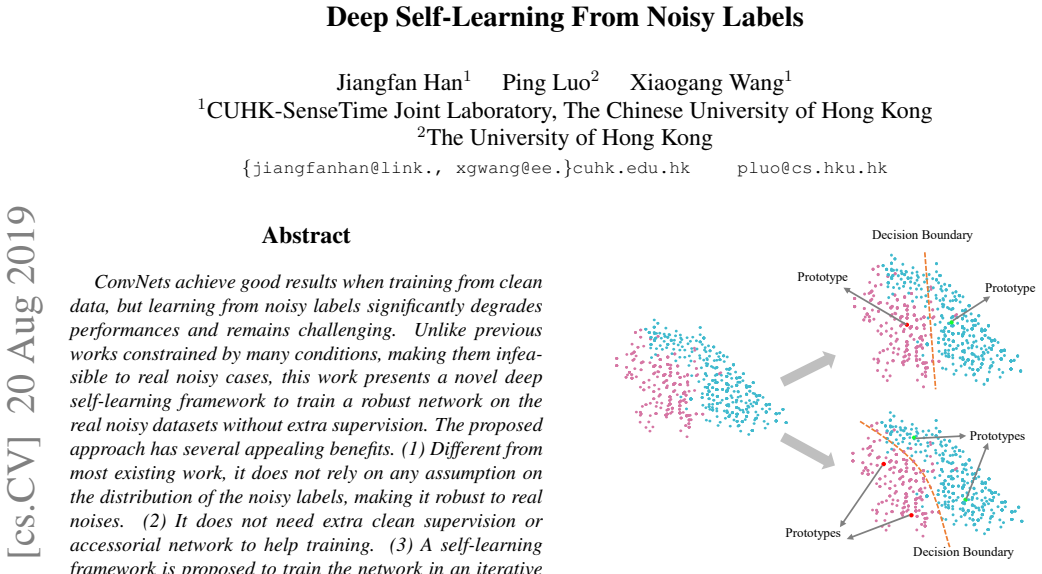
The central claim is that a single prototype per class is insufficient to represent a noisy category, because samples in the same category form several clusters in deep feature space. SMP therefore selects for each class a small set of prototypes—images whose deep features have high local density and are spread apart—and corrects each training sample to the class whose prototypes are on average most similar to it. The network is then trained on a convex combination of the original noisy label and this corrected label, with weight α, and the two phases iterate until convergence. On Clothing1M and Food101-N the paper reports higher accuracy than previous methods, including ones that use additional clean labels, and ablation studies show the benefit of multiple prototypes and of mixing original with corrected labels.
Load-bearing premise
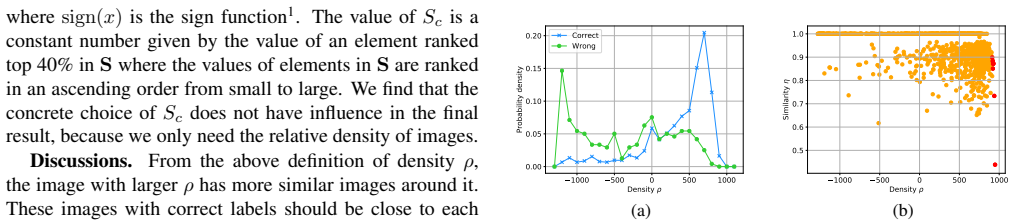
The method assumes that images with correct labels are dense in the network's feature space while mislabeled images are isolated, so that picking high-density, spread-out prototypes recovers clean class representatives even from a network trained only on noisy labels.
Editorial extensions
If this is right
- A classifier can be trained on a noisy web-scale dataset without a manually cleaned subset, removing a major bottleneck in practice.
- Using several prototypes per class instead of one provides a measurable accuracy boost, suggesting prototype-based label correction should use multi-modal representations.
- Combining the corrected labels with the original noisy labels (α ≈ 0.5) works better than either alone, indicating the original labels still carry information about hard samples.
- The framework's benefit extends to settings where a small clean set is available, where it also improves over prior methods.
Reading between the lines
- The density-isolation premise implies the method should fail when label noise is systematic and clustered—for instance, when two visually similar classes are heavily confused, the mislabeled samples may form their own dense clusters that compete with the true prototypes.
- The same multi-prototype selection could be applied to other self-training setups, such as semi-supervised learning or domain adaptation, wherever features are dense for confident samples.
- Because the accuracy is insensitive to the number of sampled images m and to the clustering method, the core ingredient is likely the multi-prototype voting rule, not the specific density estimate.
- The paper's Figure 3 density plots suggest a testable diagnostic: before training, one could compute the density separation between correct and wrong labels in feature space and use it to predict whether SMP will help.
Signed reviews
Editorial analysis
A structured set of objections, weighed in public.
Referee Report
Summary. This paper proposes SMP (Self-Learning with Multi-Prototypes), an iterative framework for training convolutional networks on datasets with noisy labels. The method alternates between two phases: a training phase that minimizes a weighted cross-entropy loss combining the original noisy label and a corrected pseudo-label (Eq. 4), and a label-correction phase that selects multiple class prototypes per category using density and similarity measures computed from deep features of a sampled subset of each class (Eqs. 5-9). The authors claim the framework requires no assumption on the noise distribution and no extra clean supervision, and report state-of-the-art accuracy on Clothing1M and Food101-N, with ablations over the number of prototypes p, the weight factor alpha, the number of sampled images m, and the prototype-selection method.
Significance. If the claims hold, the work is practically significant because it offers a simple, single-network self-training recipe for learning from large-scale noisy web data without manual cleaning. The paper's strengths include experiments on two realistic noisy benchmarks, an extensive ablation suite, and the explicit verification that corrected labels improve from 61.74% to 77.36% on Clothing1M (Table 2). The central idea of using multiple prototypes per class rather than a single one is clearly motivated by Figure 1 and supported by the ablations in Figure 4b. However, the abstract's 'no assumption on the noise distribution' and 'without extra supervision' claims are stronger than what the method and experiments actually support, and the main hyperparameters are selected on the test set, which weakens the reported margins.
major comments (3)
- [Abstract and Section 3.3]
- [Section 4.1, Table 1]
- [Section 4.2, Figure 4b-c]
minor comments (5)
- [Section 3.3, Eq. (7)]
- [Section 3.3]
- [Table 2 and Section 4]
- [Abstract and Section 5]
- [Algorithm 1]
Circularity Check
No derivation-chain circularity: the self-training loop is an algorithm, not a theorem; benchmark accuracy is independently grounded.
full rationale
The proposed SMP framework is an iterative self-training algorithm (Algorithm 1): corrected labels y_hat are produced by Eq. 9 from cosine similarity to prototypes selected via density (Eqs. 5-7), and the network is trained on a convex combination of original and corrected labels (Eq. 4). This is self-referential in the sense that the same network generates the pseudo-labels it is trained with, but it is not a case where a claimed derivation reduces to its inputs by construction. The paper's central quantitative claims are accuracies on held-out test sets of Clothing1M and Food101-N (Tables 1 and 5), and the corrected-label accuracies in Table 2 are evaluated against human clean labels; these are external benchmarks, not outputs of Eq. 4. There are no load-bearing self-citations: [38] is cited as the public Clothing1M dataset and [15] as a baseline. The abstract's 'no assumption on the distribution of noisy labels' is in tension with Section 3.3's density-cluster premise ('images with correct labels should be close to each other, while the images with noisy labels are usually isolated'), and the selection of p and alpha appears to use test accuracy (Figures 4b-4c); both are correctness and empirical-validity concerns rather than circularity steps under the definitional, fitted-input, or self-citation patterns. Because the derivation chain is not equivalently forced by its inputs and the headline results are externally falsifiable, the circularity score is 0.
Assumptions & free parameters
free parameters (6)
- alpha (weight factor) =
0.5
- p (number of prototypes per class) =
8
- Sc (density threshold) =
top 40% of similarity values
- eta threshold for prototype selection =
0.95
- m (sampled images per class) =
1280
- start epoch =
not specified
assumptions (5)
- domain assumption Correctly labeled images form dense clusters in deep feature space while noisy images are isolated.
- domain assumption The network trained on original noisy labels for the first phase yields features with sufficient cluster structure.
- domain assumption Original noisy labels retain useful information and should be kept with alpha=0.5.
- domain assumption Average cosine similarity over multiple prototypes is a reliable corrected-label score.
- standard math Density peak clustering results from prior work can be adopted with cosine similarity.
Cite this review
Pith. "Pith review of Deep Self-Learning From Noisy Labels." pith.science (2026). https://pith.science/paper/BDGGYWFI
@misc{pith2026190802160,
  author       = {Pith},
  title        = {Pith review of: Deep Self-Learning From Noisy Labels},
  year         = {2026},
  howpublished = {\url{https://pith.science/paper/BDGGYWFI}},
  note         = {Machine review of arXiv:1908.02160}
}
read the original abstract
ConvNets achieve good results when training from clean data, but learning from noisy labels significantly degrades performances and remains challenging. Unlike previous works constrained by many conditions, making them infeasible to real noisy cases, this work presents a novel deep self-learning framework to train a robust network on the real noisy datasets without extra supervision. The proposed approach has several appealing benefits. (1) Different from most existing work, it does not rely on any assumption on the distribution of the noisy labels, making it robust to real noises. (2) It does not need extra clean supervision or accessorial network to help training. (3) A self-learning framework is proposed to train the network in an iterative end-to-end manner, which is effective and efficient. Extensive experiments in challenging benchmarks such as Clothing1M and Food101-N show that our approach outperforms its counterparts in all empirical settings.
Figures

Figures from the paper (2 more)


Reference graph
Works this paper leans on
-
[1]
k-means++: The ad- vantages of careful seeding
David Arthur and Sergei Vassilvitskii. k-means++: The ad- vantages of careful seeding. In Proceedings of the eigh- teenth annual ACM-SIAM symposium on Discrete algo- rithms, pages 1027–1035. Society for Industrial and Applied Mathematics, 2007
work page 2007
-
[2]
Imagenet: A large-scale hierarchical image database
Jia Deng, Wei Dong, Richard Socher, Li-Jia Li, Kai Li, and Li Fei-Fei. Imagenet: A large-scale hierarchical image database. 2009
2009
-
[3]
A semi-supervised two-stage approach to learning from noisy labels
Yifan Ding, Liqiang Wang, Deliang Fan, and Boqing Gong. A semi-supervised two-stage approach to learning from noisy labels. In 2018 IEEE Winter Conference on Applica- tions of Computer Vision (WACV), pages 1215–1224. IEEE, 2018
work page 2018
-
[4]
Making risk minimization tolerant to label noise
Aritra Ghosh, Naresh Manwani, and PS Sastry. Making risk minimization tolerant to label noise. Neurocomputing, 160:93–107, 2015
work page 2015
-
[5]
Fast r-cnn
Ross Girshick. Fast r-cnn. In Proceedings of the IEEE inter- national conference on computer vision , pages 1440–1448, 2015
2015
-
[6]
Training deep neural-networks using a noise adaptation layer
Jacob Goldberger and Ehud Ben-Reuven. Training deep neural-networks using a noise adaptation layer. 2016
work page 2016
-
[7]
Cur- riculumnet: Weakly supervised learning from large-scale web images
Sheng Guo, Weilin Huang, Haozhi Zhang, Chenfan Zhuang, Dengke Dong, Matthew R Scott, and Dinglong Huang. Cur- riculumnet: Weakly supervised learning from large-scale web images. In Proceedings of the European Conference on Computer Vision (ECCV), pages 135–150, 2018
work page 2018
-
[8]
Deep residual learning for image recognition
Kaiming He, Xiangyu Zhang, Shaoqing Ren, and Jian Sun. Deep residual learning for image recognition. In Proceed- ings of the IEEE conference on computer vision and pattern recognition, pages 770–778, 2016
2016
Show all 41 references
-
[9]
Using trusted data to train deep networks on labels corrupted by severe noise
Dan Hendrycks, Mantas Mazeika, Duncan Wilson, and Kevin Gimpel. Using trusted data to train deep networks on labels corrupted by severe noise. In Advances in Neural Information Processing Systems, pages 10477–10486, 2018
2018
-
[10]
Qual- ity management on amazon mechanical turk
Panagiotis G Ipeirotis, Foster Provost, and Jing Wang. Qual- ity management on amazon mechanical turk. In Proceed- ings of the ACM SIGKDD workshop on human computation, pages 64–67. ACM, 2010
2010
-
[11]
Mentornet: Learning data-driven curriculum for very deep neural networks on corrupted labels
Lu Jiang, Zhengyuan Zhou, Thomas Leung, Li-Jia Li, and Li Fei-Fei. Mentornet: Learning data-driven curriculum for very deep neural networks on corrupted labels. In Interna- tional Conference on Machine Learning , pages 2309–2318, 2018
2018
-
[12]
Learning multiple layers of features from tiny images
Alex Krizhevsky and Geoffrey Hinton. Learning multiple layers of features from tiny images. Technical report, Cite- seer, 2009
2009
-
[13]
Imagenet classification with deep convolutional neural net- works
Alex Krizhevsky, Ilya Sutskever, and Geoffrey E Hinton. Imagenet classification with deep convolutional neural net- works. In Advances in neural information processing sys- tems, pages 1097–1105, 2012
2012
-
[14]
Pseudo-label: The simple and efficient semi-supervised learning method for deep neural networks
Dong-Hyun Lee. Pseudo-label: The simple and efficient semi-supervised learning method for deep neural networks. In Workshop on Challenges in Representation Learning, ICML, volume 3, page 2, 2013
2013
-
[15]
Cleannet: Transfer learning for scalable image classi- fier training with label noise
Kuang-Huei Lee, Xiaodong He, Lei Zhang, and Linjun Yang. Cleannet: Transfer learning for scalable image classi- fier training with label noise. In Proceedings of the IEEE Conference on Computer Vision and Pattern Recognition , pages 5447–5456, 2018
2018
-
[16]
Learning to learn from noisy labeled data
Junnan Li, Yongkang Wong, Qi Zhao, and Mohan S Kankan- halli. Learning to learn from noisy labeled data. In Proceed- ings of the IEEE Conference on Computer Vision and Pattern Recognition, pages 5051–5059, 2019
2019
-
[17]
Learning from noisy labels with distillation
Yuncheng Li, Jianchao Yang, Yale Song, Liangliang Cao, Jiebo Luo, and Li-Jia Li. Learning from noisy labels with distillation. In Proceedings of the IEEE International Con- ference on Computer Vision, pages 1910–1918, 2017
1910
-
[18]
Feature pyramid networks for object detection
Tsung-Yi Lin, Piotr Doll ´ar, Ross Girshick, Kaiming He, Bharath Hariharan, and Serge Belongie. Feature pyramid networks for object detection. In Proceedings of the IEEE Conference on Computer Vision and Pattern Recognition , pages 2117–2125, 2017
2017
-
[19]
Microsoft coco: Common objects in context
Tsung-Yi Lin, Michael Maire, Serge Belongie, James Hays, Pietro Perona, Deva Ramanan, Piotr Doll´ar, and C Lawrence Zitnick. Microsoft coco: Common objects in context. In European conference on computer vision , pages 740–755. Springer, 2014
2014
-
[20]
Show, tell and discriminate: Image captioning by self-retrieval with partially labeled data
Xihui Liu, Hongsheng Li, Jing Shao, Dapeng Chen, and Xi- aogang Wang. Show, tell and discriminate: Image captioning by self-retrieval with partially labeled data. In Proceedings of the European Conference on Computer Vision (ECCV) , pages 338–354, 2018
2018
-
[21]
Improving referring expression grounding with cross-modal attention-guided erasing
Xihui Liu, Zihao Wang, Jing Shao, Xiaogang Wang, and Hongsheng Li. Improving referring expression grounding with cross-modal attention-guided erasing. In Proceedings of the IEEE Conference on Computer Vision and Pattern Recognition, pages 1950–1959, 2019
1950
-
[22]
Fully convolutional networks for semantic segmentation
Jonathan Long, Evan Shelhamer, and Trevor Darrell. Fully convolutional networks for semantic segmentation. In Pro- ceedings of the IEEE conference on computer vision and pat- tern recognition, pages 3431–3440, 2015
2015
-
[23]
A study of the effect of different types of noise on the preci- sion of supervised learning techniques.Artificial intelligence review, 33(4):275–306, 2010
David F Nettleton, Albert Orriols-Puig, and Albert Fornells. A study of the effect of different types of noise on the preci- sion of supervised learning techniques.Artificial intelligence review, 33(4):275–306, 2010
2010
-
[24]
Learning deconvolution network for semantic segmentation
Hyeonwoo Noh, Seunghoon Hong, and Bohyung Han. Learning deconvolution network for semantic segmentation. In Proceedings of the IEEE international conference on com- puter vision, pages 1520–1528, 2015
2015
-
[25]
Making deep neural networks robust to label noise: A loss correction approach
Giorgio Patrini, Alessandro Rozza, Aditya Krishna Menon, Richard Nock, and Lizhen Qu. Making deep neural networks robust to label noise: A loss correction approach. In Pro- ceedings of the IEEE Conference on Computer Vision and Pattern Recognition, pages 1944–1952, 2017
1944
-
[26]
Class noise and supervised learn- ing in medical domains: The effect of feature extraction
Mykola Pechenizkiy, Alexey Tsymbal, Seppo Puuronen, and Oleksandr Pechenizkiy. Class noise and supervised learn- ing in medical domains: The effect of feature extraction. In 19th IEEE Symposium on Computer-Based Medical Systems (CBMS’06), pages 708–713. IEEE, 2006
2006
-
[27]
Yolo9000: better, faster, stronger
Joseph Redmon and Ali Farhadi. Yolo9000: better, faster, stronger. InProceedings of the IEEE conference on computer vision and pattern recognition, pages 7263–7271, 2017
2017
-
[28]
Train- ing deep neural networks on noisy labels with bootstrapping
Scott Reed, Honglak Lee, Dragomir Anguelov, Christian Szegedy, Dumitru Erhan, and Andrew Rabinovich. Train- ing deep neural networks on noisy labels with bootstrapping. arXiv preprint arXiv:1412.6596, 2014
2014 arXiv
-
[29]
Learning to reweight examples for robust deep learning
Mengye Ren, Wenyuan Zeng, Bin Yang, and Raquel Urta- sun. Learning to reweight examples for robust deep learning. arXiv preprint arXiv:1803.09050, 2018
2018 arXiv
-
[30]
Faster r-cnn: Towards real-time object detection with region proposal networks
Shaoqing Ren, Kaiming He, Ross Girshick, and Jian Sun. Faster r-cnn: Towards real-time object detection with region proposal networks. In Advances in neural information pro- cessing systems, pages 91–99, 2015
2015
-
[31]
Clustering by fast search and find of density peaks
Alex Rodriguez and Alessandro Laio. Clustering by fast search and find of density peaks. Science, 344(6191):1492– 1496, 2014
2014
-
[32]
Training convolutional networks with noisy labels
Sainbayar Sukhbaatar, Joan Bruna, Manohar Paluri, Lubomir Bourdev, and Rob Fergus. Training convolutional networks with noisy labels. arXiv preprint arXiv:1406.2080, 2014
2014 arXiv
-
[33]
Going deeper with convolutions
Christian Szegedy, Wei Liu, Yangqing Jia, Pierre Sermanet, Scott Reed, Dragomir Anguelov, Dumitru Erhan, Vincent Vanhoucke, and Andrew Rabinovich. Going deeper with convolutions. In Proceedings of the IEEE conference on computer vision and pattern recognition, pages 1–9, 2015
2015
-
[34]
Deepface: Closing the gap to human-level perfor- mance in face verification
Yaniv Taigman, Ming Yang, Marc’Aurelio Ranzato, and Lior Wolf. Deepface: Closing the gap to human-level perfor- mance in face verification. In Proceedings of the IEEE con- ference on computer vision and pattern recognition , pages 1701–1708, 2014
2014
-
[35]
Joint optimization framework for learning with noisy labels
Daiki Tanaka, Daiki Ikami, Toshihiko Yamasaki, and Kiy- oharu Aizawa. Joint optimization framework for learning with noisy labels. In Proceedings of the IEEE Conference on Computer Vision and Pattern Recognition , pages 5552– 5560, 2018
2018
-
[36]
Toward robustness against label noise in train- ing deep discriminative neural networks
Arash Vahdat. Toward robustness against label noise in train- ing deep discriminative neural networks. In Advances in Neural Information Processing Systems , pages 5596–5605, 2017
2017
-
[37]
Learning from noisy large- scale datasets with minimal supervision
Andreas Veit, Neil Alldrin, Gal Chechik, Ivan Krasin, Abhi- nav Gupta, and Serge Belongie. Learning from noisy large- scale datasets with minimal supervision. In Proceedings of the IEEE Conference on Computer Vision and Pattern Recognition, pages 839–847, 2017
2017
-
[38]
Learning from massive noisy labeled data for im- age classification
Tong Xiao, Tian Xia, Yi Yang, Chang Huang, and Xiaogang Wang. Learning from massive noisy labeled data for im- age classification. In Proceedings of the IEEE Conference on Computer Vision and Pattern Recognition , pages 2691– 2699, 2015
2015
-
[39]
Generalized cross entropy loss for training deep neural networks with noisy labels
Zhilu Zhang and Mert Sabuncu. Generalized cross entropy loss for training deep neural networks with noisy labels. In Advances in Neural Information Processing Systems , pages 8792–8802, 2018
2018
-
[40]
Pyramid scene parsing network
Hengshuang Zhao, Jianping Shi, Xiaojuan Qi, Xiaogang Wang, and Jiaya Jia. Pyramid scene parsing network. In Proceedings of the IEEE conference on computer vision and pattern recognition, pages 2881–2890, 2017
2017
-
[41]
Talking face generation by adversarially disentan- gled audio-visual representation
Hang Zhou, Yu Liu, Ziwei Liu, Ping Luo, and Xiaogang Wang. Talking face generation by adversarially disentan- gled audio-visual representation. In Proceedings of the AAAI Conference on Artificial Intelligence, volume 33, pages 9299–9306, 2019
2019
Reviewed August 14, 2026 · model on record in the stance chip above.
Discussion (0). Continue with ORCID to comment.